
Articles | Volume 44, issue 2
https://doi.org/10.5194/angeo-44-903-2026
© Author(s) 2026. This work is distributed under
the Creative Commons Attribution 4.0 License.
the Creative Commons Attribution 4.0 License.
https://doi.org/10.5194/angeo-44-903-2026
© Author(s) 2026. This work is distributed under
the Creative Commons Attribution 4.0 License.
the Creative Commons Attribution 4.0 License.
Regular paper
| 
04 Sep 2026
Regular paper |
| 04 Sep 2026
| 04 Sep 2026
Estimating the source altitude of auroral precipitation from dispersed Alfvén waves in the dayside ionosphere

Department of Physics and Technology, UiT The Arctic University of Norway, Tromsø, Norway
Andres Spicher
Department of Physics and Technology, UiT The Arctic University of Norway, Tromsø, Norway
Björn Gustavsson
Department of Physics and Technology, UiT The Arctic University of Norway, Tromsø, Norway
Juha Vierinen
Department of Physics and Technology, UiT The Arctic University of Norway, Tromsø, Norway
James Clemmons
Department of Physics and Astronomy, University of New Hampshire, Durham, NH, USA
Robert Pfaff
NASA Goddard Space Flight Center, Greenbelt, MD, USA
Douglas Rowland
NASA Goddard Space Flight Center, Greenbelt, MD, USA
Related authors

Etienne Gavazzi, Andres Spicher, Björn Gustavsson, James Clemmons, Robert Pfaff, and Douglas Rowland
Ann. Geophys., 44, 1–15, https://doi.org/10.5194/angeo-44-1-2026, https://doi.org/10.5194/angeo-44-1-2026, 2026
Short summary
Short summary
Auroral precipitation refers to energetic particles that come down into the upper part of our atmosphere, the ionosphere. There, they collide with atoms and molecules and transfer some of their energy, causing aurora. The most rapid time-variation of this energy deposition and its consequences on the ionosphere are not fully understood. We show here that one can use a new model to study auroral precipitation on sub-second timescales and advance our understanding about small-scale dynamic aurora.
Margaretha Myrvang and Björn Gustavsson
Ann. Geophys., 44, 921–935, https://doi.org/10.5194/angeo-44-921-2026, https://doi.org/10.5194/angeo-44-921-2026, 2026
Short summary
Short summary
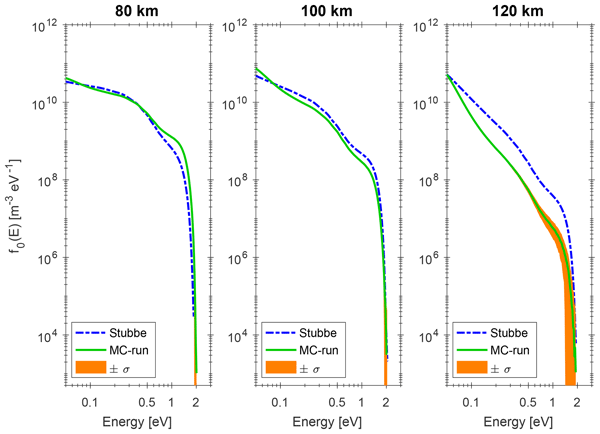
This paper investigate how radio wave heating affect the electron distribution in the D region. Radio wave heating can lead to absorption of radio wave energy by electrons, thereby increasing the temperature. Electrons are cooled by inelastic collisions with the neutrals atmosphere, affecting the electron distribution since electrons lose energy by exciting different states in neutrals. Thus, electrons are redistributed to lower energies, which changes the shape of the electron distribution.
Lena Mielke, Katie Herlingshaw, Noora Partamies, Maxime Grandin, Emma Bruus, Rowan Dayton-Oxland, Donna Lach, Marjan Spijkers, Vincent Ledvina, Eero Karvinen, Andres Spicher, Benjamin Eberhardt, and Olivier Staiger
EGUsphere, https://doi.org/10.5194/egusphere-2026-3756, https://doi.org/10.5194/egusphere-2026-3756, 2026
Short summary
Short summary
This study presents 26 citizen science observations of fragmented aurora-like emissions, here called fragments, from around the world. Using auroral images and satellite and solar wind data, we found that these short-lived fragments appear across a wide range of magnetic latitudes and local times. They can occur not only poleward of the auroral oval, but also within and equatorward of it. These findings broaden where fragments are known to occur and highlight the value of citizen science.
Ingeborg Frøystein, Andres Spicher, and Kjellmar Oksavik
Ann. Geophys., 44, 577–593, https://doi.org/10.5194/angeo-44-577-2026, https://doi.org/10.5194/angeo-44-577-2026, 2026
Short summary
Short summary
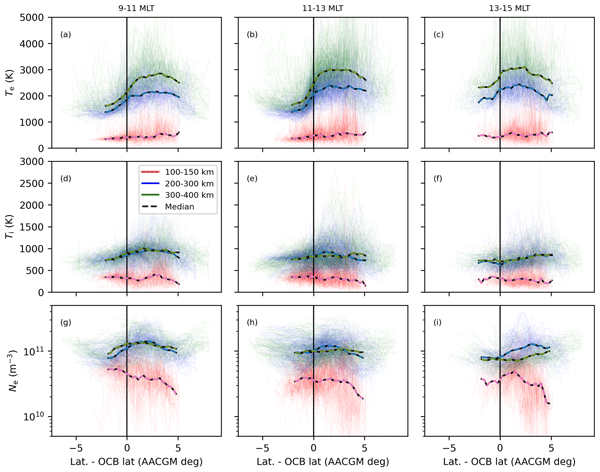
The dayside auroral region is a highly dynamic region of the ionosphere that is influenced by the coupling between the solar wind, magnetosphere, and ionosphere. In this paper, we illustrate this dynamic nature and present a quantitative analysis of both altitudinal and latitudinal variation within the region. In addition, ionospheric parameters on closed field lines, along the open-closed field line boundary and in the polar cap are statistically compared.
Devin Huyghebaert, Juha Vierinen, Björn Gustavsson, Ralph Latteck, Toralf Renkwitz, Marius Zecha, Claudia C. Stephan, J. Federico Conte, Daniel Kastinen, Johan Kero, and Jorge L. Chau
Atmos. Meas. Tech., 19, 4277–4292, https://doi.org/10.5194/amt-19-4277-2026, https://doi.org/10.5194/amt-19-4277-2026, 2026
Short summary
Short summary
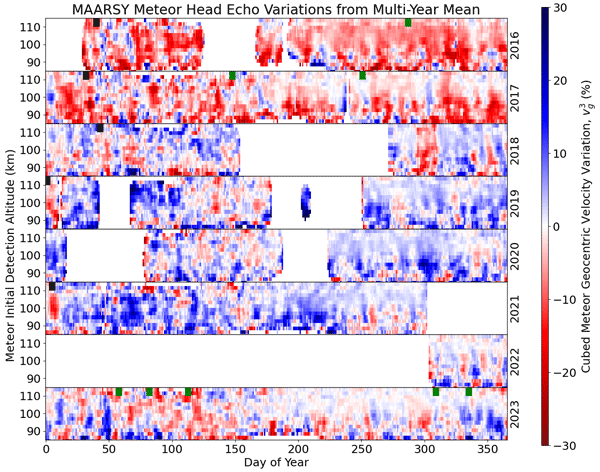
The phenomena of meteors occurs at altitudes of 60–120 km and can be used to measure the neutral atmosphere. We use a large high power radar system in Norway (Middle Atmosphere Alomar Radar System (MAARSY)) to measure the meteors and determine changes to the atmospheric density between the years of 2016–2023 at altitudes of 85–115 km. The same time period between years are compared, minimizing changes to the measurements due to factors other than the atmosphere.
Juha Vierinen, Dabrowka Knach, Jorge Luis Chau, Gerd Baumgarten, Devin Huyghebaert, Matthias Clahsen, Nico Pfeffer, Toralf Renkwitz, Robin Wing, Kenneth Obenberger, Björn Gustavsson, and Daniel Kastinen
EGUsphere, https://doi.org/10.5194/egusphere-2026-2857, https://doi.org/10.5194/egusphere-2026-2857, 2026
Short summary
Short summary
We observed the re-entry of a Falcon 9 rocket upper stage over Europe using a network of cameras and radars normally used to study meteors. The measurements showed how hot ionized gas formed around the debris during hypervelocity entry, producing strong radio echoes high in the atmosphere. As the number of satellites and rocket launches increases, these observations can help improve monitoring of space waste re-entering the atmosphere and its possible environmental effects.
Theresa Rexer, Björn Gustavsson, Juha Vierinen, Andres Spicher, Devin Ray Huyghebaert, Andreas Kvammen, Robert Gillies, and Asti Bhatt
Geosci. Instrum. Method. Data Syst., 15, 127–139, https://doi.org/10.5194/gi-15-127-2026, https://doi.org/10.5194/gi-15-127-2026, 2026
Short summary
Short summary
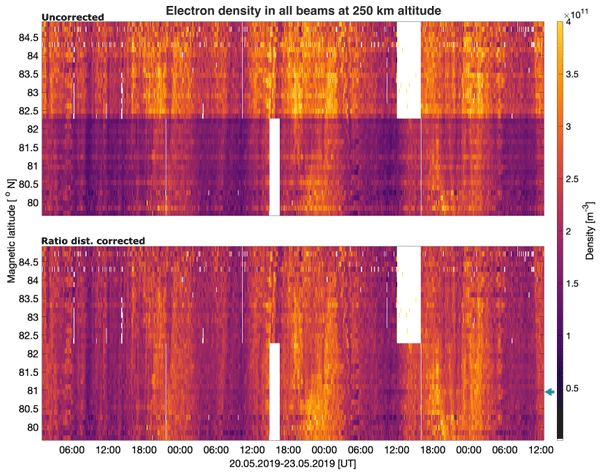
We present a second-level calibration method for electron density measurements from multi-beam incoherent scatter radars. It is based on the well-known Flat field correction method used in imaging and photography. The method improves data quality and useability as it accounts for unaccounted and unpredictable variations in the radar system. This is valuable for studies where inter-beam calibration is important such as studies of polar cap patches, plasma irregularities and turbulence.
Margaretha Myrvang and Björn Johan Gustavsson
EGUsphere, https://doi.org/10.5194/egusphere-2026-1118, https://doi.org/10.5194/egusphere-2026-1118, 2026
This preprint is open for discussion and under review for Annales Geophysicae (ANGEO).
Short summary
Short summary
This is the second of two papers. The first paper demonstrate that the electron distribution becomes non-Maxwellian during radio wave heating. Electron cooling rates are macroscopic properties of the electron gas, where electrons transfer some of their kinetic energy through collisions with neutrals and ions, and can be determined by integrating over the electron distribution. Any changes in the electron distribution affect the cooling rates.
Oliver Stalder, Björn Gustavsson, and Ilkka Virtanen
Ann. Geophys., 44, 123–135, https://doi.org/10.5194/angeo-44-123-2026, https://doi.org/10.5194/angeo-44-123-2026, 2026
Short summary
Short summary
The rapid changes in ion composition during auroral are dynamically modeled by integrating the coupled continuity equations for 15 ionospheric species. The effect of the ionospheric variation on the inversion of incoherent scatter radar (ISR) electron density profiles to differential energy spectra of precipitating electrons is studied. A systematic overestimation at high electron energies can be removed using a dynamic model. Comparisons are made with static and steady-state ionospheric models.
Kian Sartipzadeh, Andreas Kvammen, Björn Gustavsson, Njål Gulbrandsen, Magnar G. Johnsen, Devin Huyghebaert, and Juha Vierinen
Ann. Geophys., 44, 85–107, https://doi.org/10.5194/angeo-44-85-2026, https://doi.org/10.5194/angeo-44-85-2026, 2026
Short summary
Short summary
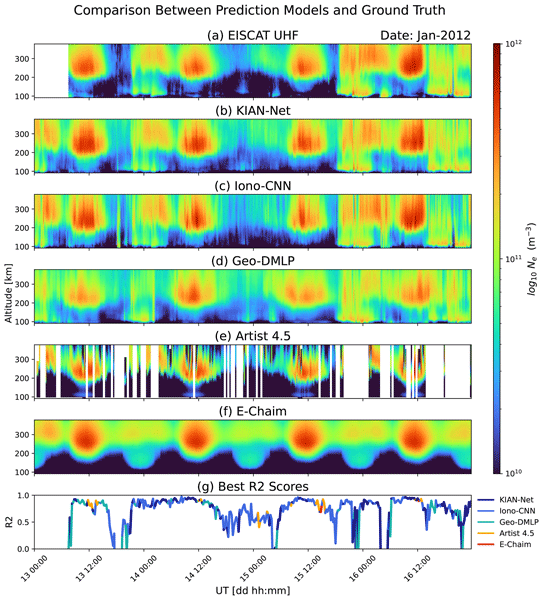
Knowledge of the charged environment in the upper atmosphere is essential for understanding space weather effects on satellites and radio communication. This environment is difficult to estimate at high latitudes, where aurora cause strong variability. We developed an artificial intelligence model to estimate this environment continuously. Our results show that the model provides reliable estimates even during auroral activity, improving monitoring of the polar upper atmosphere.
Etienne Gavazzi, Andres Spicher, Björn Gustavsson, James Clemmons, Robert Pfaff, and Douglas Rowland
Ann. Geophys., 44, 1–15, https://doi.org/10.5194/angeo-44-1-2026, https://doi.org/10.5194/angeo-44-1-2026, 2026
Short summary
Short summary
Auroral precipitation refers to energetic particles that come down into the upper part of our atmosphere, the ionosphere. There, they collide with atoms and molecules and transfer some of their energy, causing aurora. The most rapid time-variation of this energy deposition and its consequences on the ionosphere are not fully understood. We show here that one can use a new model to study auroral precipitation on sub-second timescales and advance our understanding about small-scale dynamic aurora.
Spencer Mark Hatch, Ilkka Virtanen, Karl Magnus Laundal, Habtamu Wubie Tesfaw, Juha Vierinen, Devin Ray Huyghebaert, Andres Spicher, and Jens Christian Hessen
Ann. Geophys., 43, 633–649, https://doi.org/10.5194/angeo-43-633-2025, https://doi.org/10.5194/angeo-43-633-2025, 2025
Short summary
Short summary
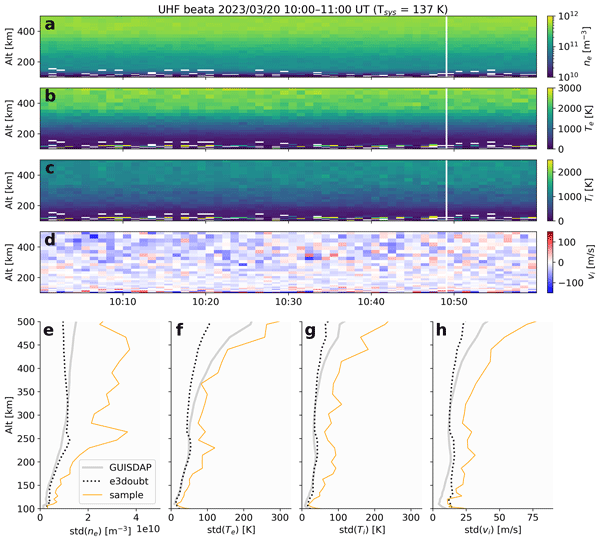
This study addresses the design of next-generation incoherent scatter radar experiments used to study the ionosphere, particularly with systems that have multiple sites. We have developed a method to estimate uncertainties of measurements of plasma density, temperature, and ion drift. Our method is open-source, and helps to optimize radar configurations and assess the effectiveness of an experiment. This method ultimately serves to enhance our understanding of Earth's space environment.
Devin Huyghebaert, Björn Gustavsson, Juha Vierinen, Andreas Kvammen, Matthew Zettergren, John Swoboda, Ilkka Virtanen, Spencer M. Hatch, and Karl M. Laundal
Ann. Geophys., 43, 99–113, https://doi.org/10.5194/angeo-43-99-2025, https://doi.org/10.5194/angeo-43-99-2025, 2025
Short summary
Short summary
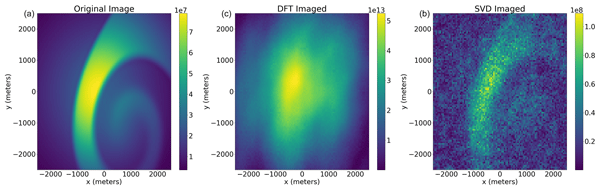
The EISCAT_3D radar is a new ionospheric radar under construction in the Fennoscandia region. The radar will make measurements of plasma characteristics at altitudes above approximately 60 km. The capability of the system to make these measurements at spatial scales of less than 100 m using multiple digitised signals from each of the radar antenna panels is highlighted. There are many ionospheric small-scale processes that will be further resolved using the techniques discussed here.
Yoshimasa Tanaka, Yasunobu Ogawa, Akira Kadokura, Takehiko Aso, Björn Gustavsson, Urban Brändström, Tima Sergienko, Genta Ueno, and Satoko Saita
Ann. Geophys., 42, 179–190, https://doi.org/10.5194/angeo-42-179-2024, https://doi.org/10.5194/angeo-42-179-2024, 2024
Short summary
Short summary
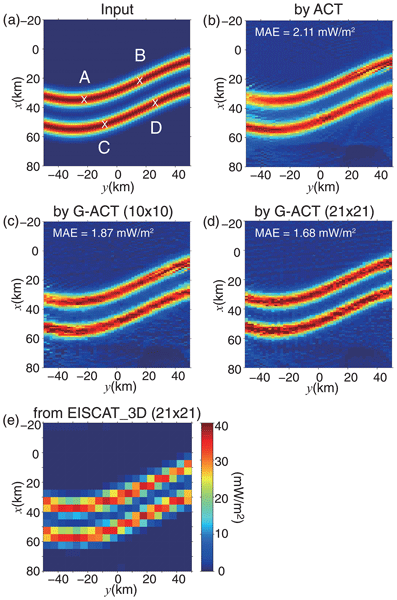
We present via simulation how useful monochromatic images taken by a multi-point imager network are for auroral research in the EISCAT_3D project. We apply the generalized-aurora computed tomography (G-ACT) to modeled multiple auroral images and ionospheric electron density data. It is demonstrated that G-ACT provides better reconstruction results than the normal ACT and can interpolate ionospheric electron density at a much higher spatial resolution than observed by the EISCAT_3D radar.
Thomas B. Leyser, Tima Sergienko, Urban Brändström, Björn Gustavsson, and Michael T. Rietveld
Ann. Geophys., 41, 589–600, https://doi.org/10.5194/angeo-41-589-2023, https://doi.org/10.5194/angeo-41-589-2023, 2023
Short summary
Short summary
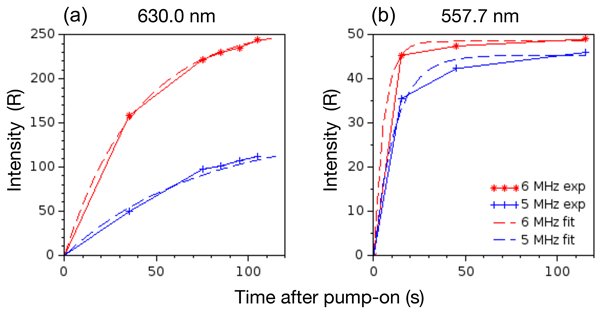
Powerful radio waves transmitted into the ionosphere from the ground were used to study electron energization in the pumped ionospheric plasma turbulence, by detecting optical emissions from atomic oxygen. Our results obtained with the EISCAT (European Incoherent Scatter Scientific Association) facilities in northern Norway and optical detection with the ALIS (Auroral Large Imaging System) in northern Sweden suggest that long-wavelength upper hybrid waves are important in accelerating electrons.

Johann Stamm, Juha Vierinen, Björn Gustavsson, and Andres Spicher
Ann. Geophys., 41, 55–67, https://doi.org/10.5194/angeo-41-55-2023, https://doi.org/10.5194/angeo-41-55-2023, 2023
Short summary
Short summary
The study of some ionospheric events benefit from the knowledge of how the physics varies over a volume and over time. Examples are studies of aurora or energy deposition. With EISCAT3D, measurements of ion velocity vectors in a volume will be possible for the first time. We present a technique that uses a set of such measurements to estimate electric field and neutral wind. The technique relies on adding restrictions to the estimates. We successfully consider restrictions based on physics.
Daniel K. Whiter, Noora Partamies, Björn Gustavsson, and Kirsti Kauristie
Ann. Geophys., 41, 1–12, https://doi.org/10.5194/angeo-41-1-2023, https://doi.org/10.5194/angeo-41-1-2023, 2023
Short summary
Short summary
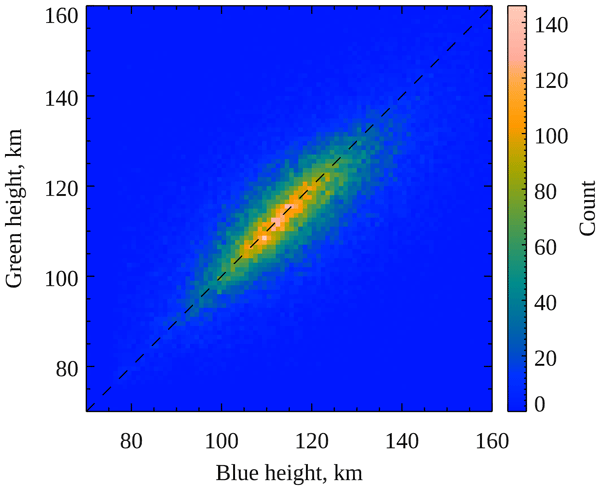
We measured the height of green and blue aurorae using thousands of camera images recorded over a 7-year period. Both colours are typically brightest at about 114 km altitude. When they peak at higher altitudes the blue aurora is usually higher than the green aurora. This information will help other studies which need an estimate of the auroral height. We used a computer model to explain our observations and to investigate how the green aurora is produced.
Knut Ola Dølven, Juha Vierinen, Roberto Grilli, Jack Triest, and Bénédicte Ferré
Geosci. Instrum. Method. Data Syst., 11, 293–306, https://doi.org/10.5194/gi-11-293-2022, https://doi.org/10.5194/gi-11-293-2022, 2022
Short summary
Short summary
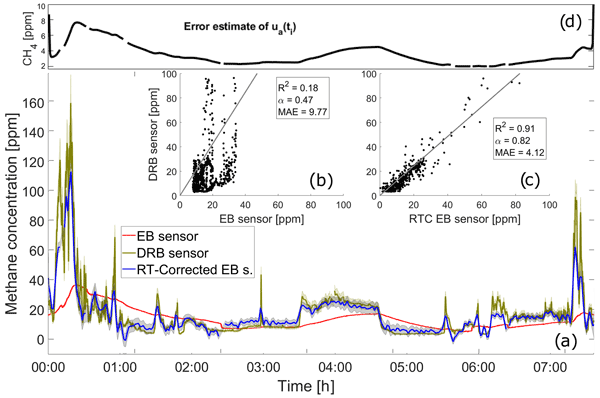
Sensors capable of measuring rapid fluctuations are important to improve our understanding of environmental processes. Many sensors are unable to do this, due to their reliance on the transfer of the measured property, for instance a gas, across a semi-permeable barrier. We have developed a mathematical tool which enables the retrieval of fast-response signals from sensors with this type of sensor design.
Carsten Baumann, Antti Kero, Shikha Raizada, Markus Rapp, Michael P. Sulzer, Pekka T. Verronen, and Juha Vierinen
Ann. Geophys., 40, 519–530, https://doi.org/10.5194/angeo-40-519-2022, https://doi.org/10.5194/angeo-40-519-2022, 2022
Short summary
Short summary
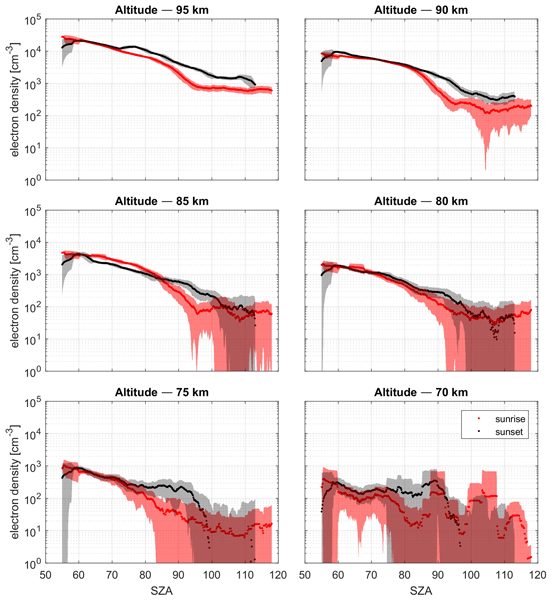
The Arecibo radar was used to probe free electrons of the ionized atmosphere between 70 and 100 km altitude. This is also the altitude region were meteors evaporate and form secondary particulate matter, the so-called meteor smoke particles (MSPs). Free electrons attach to these MSPs when the sun is below the horizon and cause a drop in the number of free electrons, which are the subject of these measurements. We also identified a different number of free electrons during sunset and sunrise.
Mizuki Fukizawa, Takeshi Sakanoi, Yoshimasa Tanaka, Yasunobu Ogawa, Keisuke Hosokawa, Björn Gustavsson, Kirsti Kauristie, Alexander Kozlovsky, Tero Raita, Urban Brändström, and Tima Sergienko
Ann. Geophys., 40, 475–484, https://doi.org/10.5194/angeo-40-475-2022, https://doi.org/10.5194/angeo-40-475-2022, 2022
Short summary
Short summary
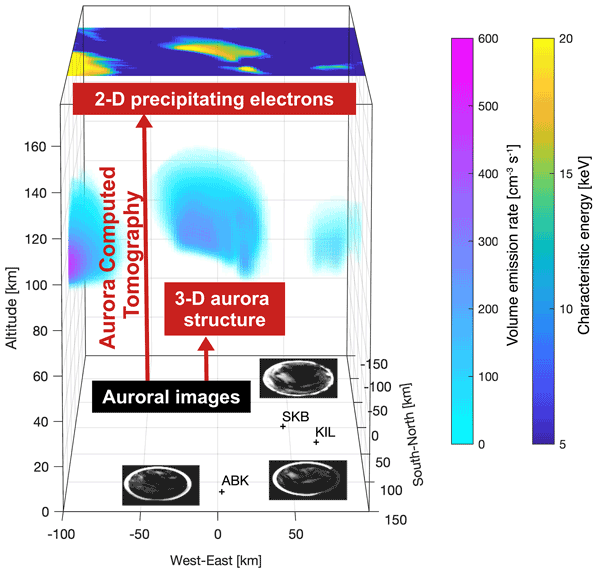
The pulsating auroral generation mechanism has been investigated by observing precipitating electrons using rockets or satellites. However, it is difficult for such observations to distinguish temporal changes from spatial ones. In this study, we reconstructed the horizontal 2-D distribution of precipitating electrons using only auroral images. The 3-D aurora structure was also reconstructed. We found that there were both spatial and temporal changes in the precipitating electron energy.

Derek McKay, Juha Vierinen, Antti Kero, and Noora Partamies
Geosci. Instrum. Method. Data Syst., 11, 25–35, https://doi.org/10.5194/gi-11-25-2022, https://doi.org/10.5194/gi-11-25-2022, 2022
Short summary
Short summary
When radio waves from our galaxy enter the Earth's atmosphere, they are absorbed by electrons in the upper atmosphere. It was thought that by measuring the amount of absorption, it would allow the height of these electrons in the atmosphere to be determined. If so, this would have significance for future instrument design. However, this paper demonstrates that it is not possible to do this, but it does explain how multiple-frequency measurements can nevertheless be useful.
Ryan Volz, Jorge L. Chau, Philip J. Erickson, Juha P. Vierinen, J. Miguel Urco, and Matthias Clahsen
Atmos. Meas. Tech., 14, 7199–7219, https://doi.org/10.5194/amt-14-7199-2021, https://doi.org/10.5194/amt-14-7199-2021, 2021
Short summary
Short summary
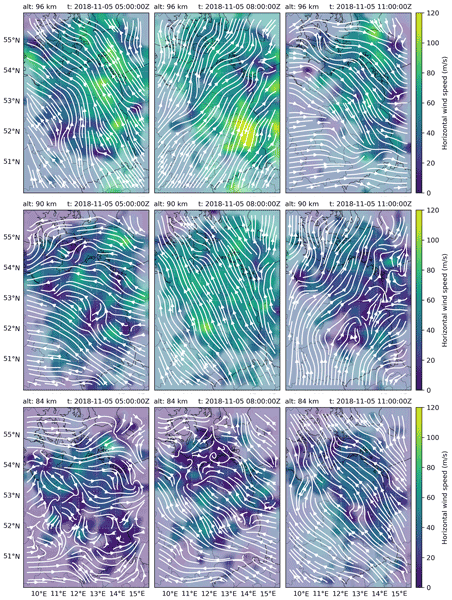
We introduce a new way of estimating winds in the upper atmosphere (about 80 to 100 km in altitude) from the observed Doppler shift of meteor trails using a statistical method called Gaussian process regression. Wind estimates and, critically, the uncertainty of those estimates can be evaluated smoothly (i.e., not gridded) in space and time. The effective resolution is set by provided parameters, which are limited in practice by the number density of the observed meteors.
Johann Stamm, Juha Vierinen, and Björn Gustavsson
Ann. Geophys., 39, 961–974, https://doi.org/10.5194/angeo-39-961-2021, https://doi.org/10.5194/angeo-39-961-2021, 2021
Short summary
Short summary
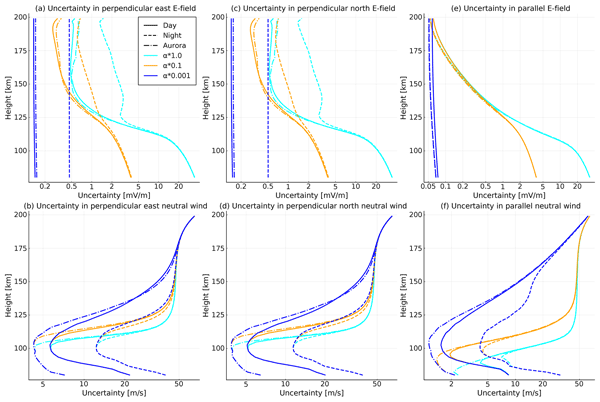
Measurements of the electric field and neutral wind in the ionosphere are important for understanding energy flows or electric currents. With incoherent scatter radars (ISRs), we can measure the velocity of the ions, which depends on both the electrical field and the neutral wind. In this paper, we investigate methods to use ISR data to find reasonable values for both parameters. We find that electric field can be well measured down to 125 km height and neutral wind below this height.
Cited articles
Akaike, H.: A new look at the statistical model identification, IEEE T. Automat. Contr., 19, 716–723, https://doi.org/10.1109/TAC.1974.1100705, 1974. a
Aster, R. C., Borchers, B., and Thurber, C. H.: Parameter estimation and inverse problems, Elsevier, Amsterdam Oxford Cambridge, third edn., ISBN 978-0-12-804651-7, 2019. a
Bilitza, D., Pezzopane, M., Truhlik, V., Altadill, D., Reinisch, B. W., and Pignalberi, A.: The International Reference Ionosphere Model: A Review and Description of an Ionospheric Benchmark, Rev. Geophys., 60, e2022RG000792, https://doi.org/10.1029/2022RG000792, 2022. a
Cameron, T. and Knudsen, D.: Inverse electron energy dispersion from moving auroral forms, J. Geophys. Res.-Space, 121, https://doi.org/10.1002/2016JA023045, 2016. a
Carlson, C. W., Curtis, D. W., Paschmann, G., and Michel, W.: An instrument for rapidly measuring plasma distribution functions with high resolution, Adv. Space Res., 2, 67–70, https://doi.org/10.1016/0273-1177(82)90151-X, 1982. a
Cavanaugh, J. E. and Neath, A. A.: The Akaike information criterion: Background, derivation, properties, application, interpretation, and refinements, WIREs Computational Statistics, 11, e1460, https://doi.org/10.1002/wics.1460, 2019. a
Chagas, R. A. J. and Pantazides, A.: JuliaSpace/SatelliteToolboxGeomagneticField.jl: v1.2.0, Zenodo, https://doi.org/10.5281/zenodo.17273749, 2025. a
Chaston, C. C., Carlson, C. W., Peria, W. J., Ergun, R. E., and McFadden, J. P.: FAST Observations of Inertial Alfven Waves in the Dayside Aurora, Geophys. Res. Lett., 26, 647–650, https://doi.org/10.1029/1998GL900246, 1999. a
Chaston, C. C., Carlson, C. W., Ergun, R. E., and McFadden, J. P.: Alfvén Waves, Density Cavities and Electron Acceleration Observed from the FAST Spacecraft, Phys. Scripta, 2000, 64, https://doi.org/10.1238/Physica.Topical.084a00064, 2000. a, b
Chaston, C. C., Bonnell, J. W., Carlson, C. W., Berthomier, M., Peticolas, L. M., Roth, I., McFadden, J. P., Ergun, R. E., and Strangeway, R. J.: Electron acceleration in the ionospheric Alfven resonator, J. Geophys. Res.-Space, 107, SMP 41-1–SMP 41-16, https://doi.org/10.1029/2002JA009272, 2002a. a, b, c, d, e, f, g
Chaston, C. C., Bonnell, J. W., Peticolas, L. M., Carlson, C. W., McFadden, J. P., and Ergun, R. E.: Driven Alfven waves and electron acceleration: A FAST case study, Geophys. Res. Lett., 29, 30-1–30-4, https://doi.org/10.1029/2001GL013842, 2002b. a
Chaston, C. C., Genot, V., Bonnell, J. W., Carlson, C. W., McFadden, J. P., Ergun, R. E., Strangeway, R. J., Lund, E. J., and Hwang, K. J.: Ionospheric erosion by Alfvén waves, J. Geophys. Res.-Space, 111, https://doi.org/10.1029/2005JA011367, , 2006. a, b
Chaston, C. C., Carlson, C. W., McFadden, J. P., Ergun, R. E., and Strangeway, R. J.: How important are dispersive Alfvén waves for auroral particle acceleration?, Geophys. Res. Lett., 34, L07101, https://doi.org/10.1029/2006GL029144, 2007a. a
Chaston, C. C., Hull, A. J., Bonnell, J. W., Carlson, C. W., Ergun, R. E., Strangeway, R. J., and McFadden, J. P.: Large parallel electric fields, currents, and density cavities in dispersive Alfvén waves above the aurora, J. Geophys. Res.-Space, 112, https://doi.org/10.1029/2006JA012007, 2007b. a
Chen, L.-J., Kletzing, C. A., Hu, S., and Bounds, S. R.: Auroral electron dispersion below inverted-V energies: Resonant deceleration and acceleration by Alfvén waves, J. Geophys. Res.-Space, 110, https://doi.org/10.1029/2005JA011168, 2005. a, b
Clemmons, J. H., Boehm, M. H., Paschmann, G. E., and Haerendel, G.: Signatures of energy-time dispersed electron fluxes measured by Freja, Geophys. Res. Lett., 21, 1899–1902, https://doi.org/10.1029/94GL00885, 1994. a, b, c
Danisch, S. and Krumbiegel, J.: Makie.jl: Flexible high-performance data visualization for Julia, Journal of Open Source Software, 6, 3349, https://doi.org/10.21105/joss.03349, 2021. a
Feltman, C., Howes, G. G., Bounds, S. R., Miles, D. M., Kletzing, C. A., Greene, K., Broadfoot, R., Bonnell, J., and Roglans, R.: Inferential Evidence for Suprathermal Electron Burst Intensification Due To Inverted-V Precipitation via Inertial Alfvén Waves, J. Geophys. Res.-Space, 130, e2025JA033869, https://doi.org/10.1029/2025JA033869, 2025. a, b, c, d, e, f, g, h
Gavazzi, E.: Replication material for “Estimating the source altitude of auroral precipitation from dispersed Alfvén waves in the dayside ionosphere”, Zenodo [data set] and [code], https://doi.org/10.5281/zenodo.21981682, 2026. a
Gavazzi, E., Spicher, A., Gustavsson, B., Clemmons, J., Pfaff, R., and Rowland, D.: Time-dependent modeling of Alfvénic precipitation observed in the ionosphere, Ann. Geophys., 44, 1–15, https://doi.org/10.5194/angeo-44-1-2026, 2026. a, b
Goertz, C. K. and Boswell, R. W.: Magnetosphere-ionosphere coupling, J. Geophys. Res.-Space, 84, 7239–7246, https://doi.org/10.1029/JA084iA12p07239, 1979. a
Génot, V., Louarn, P., and Mottez, F.: Alfvén wave interaction with inhomogeneous plasmas: acceleration and energy cascade towards small-scales, Ann. Geophys., 22, 2081–2096, https://doi.org/10.5194/angeo-22-2081-2004, 2004. a
Hasegawa, A.: Particle acceleration by MHD surface wave and formation of aurora, J. Geophys. Res., 81, 5083–5090, https://doi.org/10.1029/JA081i028p05083, 1976. a
Hirahara, M., Ebihara, Y., Kitamura, N., Sakanoi, T., Asamura, K., Takada, T., and Saito, H.: Reimei Satellite Observations of Alfvénic Interaction Modulating Inverted-V Electrons and Filamentary Auroral Forms at the Poleward Edge of a Discrete Arc, J. Geophys. Res.-Space, 129, e2024JA032650, https://doi.org/10.1029/2024JA032650, 2024. a, b, c, d
Hui, C. H. and Seyler, C. E.: Electron acceleration by Alfvén waves in the magnetosphere, J. Geophys. Res.-Space, 97, 3953–3963, https://doi.org/10.1029/91JA03101, 1992. a
International Association of Geomagnetism and Aeronomy: IGRF-14, Zenodo, https://doi.org/10.5281/zenodo.14218973, 2024. a, b, c
Kataoka, R., Chaston, C. C., Knudsen, D., Lynch, K. A., Lysak, R. L., Song, Y., Rankin, R., Murase, K., Sakanoi, T., Semeter, J., Watanabe, T.-H., and Whiter, D.: Small-Scale Dynamic Aurora, Space Sci. Rev., 217, 17, https://doi.org/10.1007/s11214-021-00796-w, 2021. a
Kletzing, C. A.: Electron acceleration by kinetic Alfvén waves, J. Geophys. Res.-Space, 99, 11095–11103, https://doi.org/10.1029/94JA00345, 1994. a, b, c, d
Kletzing, C. A. and Torbert, R. B.: Electron time dispersion, J. Geophys. Res.-Space, 99, 2159–2172, https://doi.org/10.1029/93JA01745, 1994. a
Kletzing, C. A., Mozer, F. S., and Torbert, R. B.: Electron temperature and density at high latitude, J. Geophys. Res.-Space, 103, 14837–14845, https://doi.org/10.1029/98JA00962, 1998. a, b
Lynch, K. A., Pietrowski, D., Torbert, R. B., Ivchenko, N., Marklund, G., and Primdahl, F.: Multiple-point electron measurements in a nightside auroral arc: Auroral turbulence II particle observations, Geophys. Res. Lett., 26, 3361–3364, https://doi.org/10.1029/1999GL900599, 1999. a, b, c, d
Lynch, K. A., Hampton, D., Mella, M., Zhang, B., Dahlgren, H., Disbrow, M., Kintner, P. M., Lessard, M., Lundberg, E., and Stenbaek-Nielsen, H. C.: Structure and dynamics of the nightside poleward boundary: Sounding rocket and ground-based observations of auroral electron precipitation in a rayed curtain, J. Geophys. Res.-Space, 117, https://doi.org/10.1029/2012JA017691, 2012. a, b, c, d, e
Lysak, R. L.: Kinetic Alfvén waves and auroral particle acceleration: a review, Reviews of Modern Plasma Physics, 7, 6, https://doi.org/10.1007/s41614-022-00111-2, 2023. a
McFadden, J. P., Carlson, C. W., Boehm, M. H., and Hallinan, T. J.: Field-aligned electron flux oscillations that produce flickering aurora, J. Geophys. Res.-Space, 92, 11133–11148, https://doi.org/10.1029/JA092iA10p11133, 1987. a, b, c
Mella, M. R., Lynch, K. A., Hampton, D. L., Dahlgren, H., Kintner, P. M., Lessard, M., Lummerzheim, D., Lundberg, E. T., Nicolls, M. J., and Stenbaek-Nielsen, H. C.: Sounding rocket study of two sequential auroral poleward boundary intensifications, J. Geophys. Res.-Space, 116, https://doi.org/10.1029/2011JA016428, 2011. a, b
Michell, R. G., Samara, M., Grubbs II, G., Ogasawara, K., Miller, G., Trevino, J. A., Webster, J., and Stange, J.: APES: Acute Precipitating Electron Spectrometer – A high time resolution monodirectional magnetic deflection electron spectrometer, J. Geophys. Res.-Space, 121, 5959–5965, https://doi.org/10.1002/2016JA022637, 2016. a, b
Motoba, T. and Hirahara, M.: High-resolution auroral acceleration signatures within a highly dynamic onset arc, Geophys. Res. Lett., 43, 1793–1801, https://doi.org/10.1002/2015GL067580, 2016. a, b, c
Mottez, F. and Génot, V.: Electron acceleration by an Alfvénic pulse propagating in an auroral plasma cavity: ALFVÉN PULSE IN CAVITY, J. Geophys. Res.-Space, 116, https://doi.org/10.1029/2010JA016367, 2011. a
Saito, Y., Yokota, S., Asamura, K., and Krieger, A.: High-speed MCP anodes for high time resolution low-energy charged particle spectrometers, J. Geophys. Res.-Space, 122, 1816–1830, https://doi.org/10.1002/2016JA023157 2017. a
Schroeder, J. W. R., Howes, G. G., Kletzing, C. A., Skiff, F., Carter, T. A., Vincena, S., and Dorfman, S.: Laboratory measurements of the physics of auroral electron acceleration by Alfvén waves, Nat. Commun., 12, 3103, https://doi.org/10.1038/s41467-021-23377-5, 2021. a
Stasiewicz, K., Bellan, P., Chaston, C., Kletzing, C., Lysak, R., Maggs, J., Pokhotelov, O., Seyler, C., Shukla, P., Stenflo, L., Streltsov, A., and Wahlund, J.-E.: Small Scale Alfvénic Structure in the Aurora, Space Sci. Rev., 92, 423–533, https://doi.org/10.1023/A:1005207202143, 2000. a, b, c
Streltsov, A. V. and Lotko, W.: Coupling between density structures, electromagnetic waves and ionospheric feedback in the auroral zone, J. Geophys. Res.-Space, 113, https://doi.org/10.1029/2007JA012594, 2008. a
Sugiura, N.: Further analysis of the data by Akaike's information criterion and the finite corrections: Further analysis of the data by akaike' s, Communications in Statistics – Theory and Methods, 7, 13–26, https://doi.org/10.1080/03610927808827599, 1978. a
Takahashi, T., Spicher, A., Di Mare, F., Rowland, D. E., Pfaff, R. F., Collier, M. R., Clausen, L. B. N., and Moen, J. I.: Suppression of Ionospheric Irregularity Due to Auroral Particle Impact, J. Geophys. Res.-Space, 127, e2020JA028725, https://doi.org/10.1029/2020JA028725, 2022. a
Tanaka, H., Saito, Y., Asamura, K., Ishii, S., and Mukai, T.: High time resolution measurement of multiple electron precipitations with energy-time dispersion in high-latitude part of the cusp region, J. Geophys. Res.-Space, 110, https://doi.org/10.1029/2004JA010664, 2005a. a, b, c, d, e, f, g, h, i, j, k, l, m, n, o, p, q
Tanaka, H., Saito, Y., Asamura, K., and Mukai, T.: Numerical modeling of electron energy‐time dispersions in the high‐latitude part of the cusp region, J. Geophys. Res.-Space, 110, 2004JA010665, https://doi.org/10.1029/2004JA010665, 2005b. a
Thompson, B. J. and Lysak, R. L.: Electron acceleration by inertial Alfvén waves, J. Geophys. Res.-Space, 101, 5359–5369, https://doi.org/10.1029/95JA03622, 1996. a, b
Watt, C. E. J. and Rankin, R.: Electron acceleration due to inertial Alfvén waves in a non-Maxwellian plasma, J. Geophys. Res.-Space, 112, https://doi.org/10.1029/2006JA011907, 2007. a
Watt, C. E. J. and Rankin, R.: Do magnetospheric shear Alfvén waves generate sufficient electron energy flux to power the aurora?, J. Geophys. Res.-Space, 115, https://doi.org/10.1029/2009JA015185, 2010. a
Watt, C. E. J., Rankin, R., Rae, I. J., and Wright, D. M.: Self-consistent electron acceleration due to inertial Alfvén wave pulses, J. Geophys. Res.-Space, 110, https://doi.org/10.1029/2004JA010877, 2005. a, b, c
Watt, C. E. J., Rankin, R., Rae, I. J., and Wright, D. M.: Inertial Alfvén waves and acceleration of electrons in nonuniform magnetic fields, Geophys. Res. Lett., 33, https://doi.org/10.1029/2005GL024779, 2006. a, b, c
Wu, J., Knudsen, D. J., Shen, Y., and Gillies, D. M.: e-POP Observations of Suprathermal Electron Bursts in the Ionospheric Alfvén Resonator, J. Geophys. Res.–Space, 126, e2020JA028005, https://doi.org/10.1029/2020JA028005, 2021. a, b
Wygant, J. R., Keiling, A., Cattell, C. A., Johnson, M., Lysak, R. L., Temerin, M., Mozer, F. S., Kletzing, C. A., Scudder, J. D., Peterson, W., Russell, C. T., Parks, G., Brittnacher, M., Germany, G., and Spann, J.: Polar spacecraft based comparisons of intense electric fields and Poynting flux near and within the plasma sheet‐tail lobe boundary to UVI images: An energy source for the aurora, J. Geophys. Res.-Space, 105, 18675–18692, https://doi.org/10.1029/1999JA900500, 2000. a, b
Short summary
Auroras are caused by energetic electrons entering the upper atmosphere. For the smallest and most dynamic auroras, scientists think electrons are accelerated by waves (called Alfvén waves) thousands of kilometers above Earth. In this paper, we analyse data from a rocket that flew through auroras, applying existing and new techniques to estimate where the acceleration took place. Our results match theory, and we show how they can be used to study conditions in the near-Earth space environment.
Auroras are caused by energetic electrons entering the upper atmosphere. For the smallest and...


