
Articles | Volume 44, issue 1
https://doi.org/10.5194/angeo-44-85-2026
© Author(s) 2026. This work is distributed under
the Creative Commons Attribution 4.0 License.
the Creative Commons Attribution 4.0 License.
https://doi.org/10.5194/angeo-44-85-2026
© Author(s) 2026. This work is distributed under
the Creative Commons Attribution 4.0 License.
the Creative Commons Attribution 4.0 License.
Regular paper
| 
03 Feb 2026
Regular paper |
| 03 Feb 2026
| 03 Feb 2026
Plasma density estimation from ionograms and geophysical parameters with deep learning
Kian Sartipzadeh
Department of Physics and Technology, UiT The Arctic University of Norway, Tromsø, Norway
Simplera AS, Tromsø, Norway

Tromsø Geophysical Observatory, UiT The Arctic University of Norway, Tromsø, Norway
Björn Gustavsson
Department of Physics and Technology, UiT The Arctic University of Norway, Tromsø, Norway
Njål Gulbrandsen
Tromsø Geophysical Observatory, UiT The Arctic University of Norway, Tromsø, Norway
Magnar G. Johnsen
Tromsø Geophysical Observatory, UiT The Arctic University of Norway, Tromsø, Norway
Devin Huyghebaert
Leibniz Institute of Atmospheric Physics, Kühlungsborn, Germany
Juha Vierinen
Department of Physics and Technology, UiT The Arctic University of Norway, Tromsø, Norway
Related authors
No articles found.
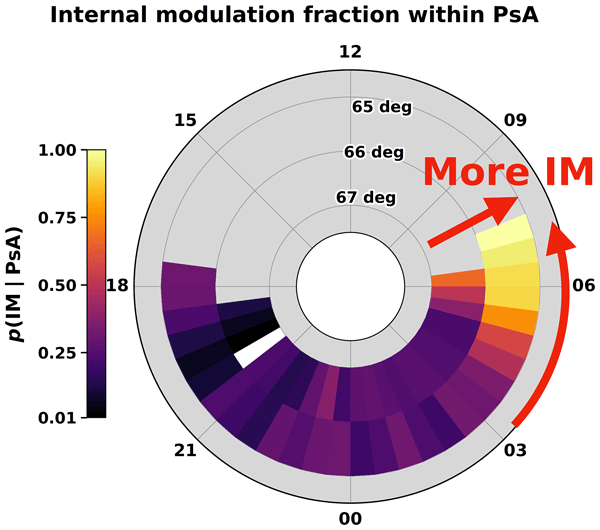
Sota Nanjo, Tomoe Taki, Keisuke Hosokawa, Urban Brändström, Yoshizumi Miyoshi, and Magnar G. Johnsen
Ann. Geophys., 44, 1023–1042, https://doi.org/10.5194/angeo-44-1023-2026, https://doi.org/10.5194/angeo-44-1023-2026, 2026
Short summary
Short summary
Pulsating aurora often contains rapid brightness changes, but their overall behavior has not been well measured. We analyzed high-speed camera images from northern Sweden and Norway with machine learning to identify when these rapid changes occur. We found that they become more common toward the morning and at the lower-latitude sector. This suggests that small-scale auroral fluctuation can help reveal how particles from near-Earth space enter the upper atmosphere.
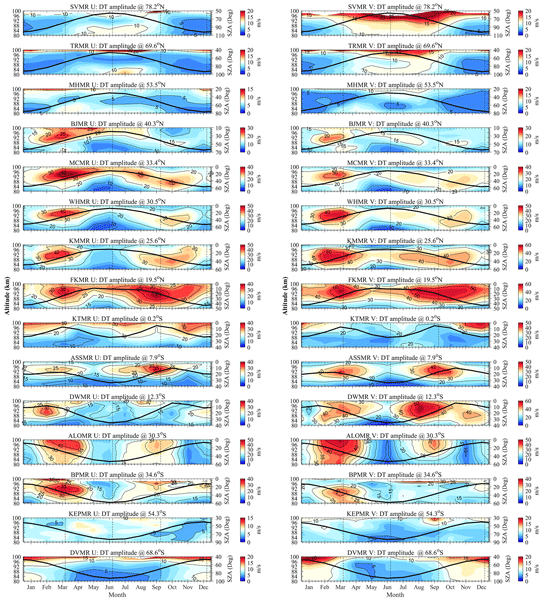
Wen Yi, Jianyuan Wang, Xianghui Xue, Chengyun Yang, Iain M. Reid, Robert A. Vincent, Andrew MacKinnon, Damian J. Murphy, Njål Gulbrandsen, Masaki Tsutsumi, Baiqi Ning, Guozhu Li, Nicholas J. Mitchell, Tracy Moffat-Griffin, Toshitaka Tsuda, Haiying Li, Paulo P. Batista, Jianfei Wu, Tingdi Chen, and Xiankang Dou
Atmos. Chem. Phys., 26, 13441–13462, https://doi.org/10.5194/acp-26-13441-2026, https://doi.org/10.5194/acp-26-13441-2026, 2026
Short summary
Short summary
This study provides observational evidence that the solar zenith angle (SZA) influences the vertical structure of diurnal tides in the mesosphere and lower thermosphere (MLT) region. Diurnal tides are strongest at low and mid-latitudes (10–50° N/S) and weaker near the Equator and at polar latitudes. The results further suggest that background zonal winds influence tidal propagation and structure through filtering and momentum drag.
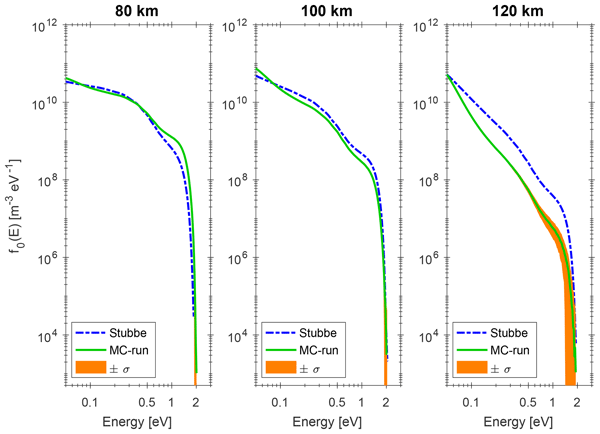
Margaretha Myrvang and Björn Gustavsson
Ann. Geophys., 44, 921–935, https://doi.org/10.5194/angeo-44-921-2026, https://doi.org/10.5194/angeo-44-921-2026, 2026
Short summary
Short summary
This paper investigate how radio wave heating affect the electron distribution in the D region. Radio wave heating can lead to absorption of radio wave energy by electrons, thereby increasing the temperature. Electrons are cooled by inelastic collisions with the neutrals atmosphere, affecting the electron distribution since electrons lose energy by exciting different states in neutrals. Thus, electrons are redistributed to lower energies, which changes the shape of the electron distribution.
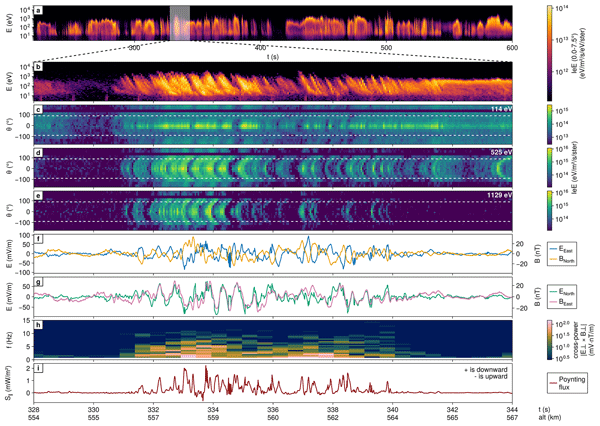
Etienne Gavazzi, Andres Spicher, Björn Gustavsson, Juha Vierinen, James Clemmons, Robert Pfaff, and Douglas Rowland
Ann. Geophys., 44, 903–920, https://doi.org/10.5194/angeo-44-903-2026, https://doi.org/10.5194/angeo-44-903-2026, 2026
Short summary
Short summary
Auroras are caused by energetic electrons entering the upper atmosphere. For the smallest and most dynamic auroras, scientists think electrons are accelerated by waves (called Alfvén waves) thousands of kilometers above Earth. In this paper, we analyse data from a rocket that flew through auroras, applying existing and new techniques to estimate where the acceleration took place. Our results match theory, and we show how they can be used to study conditions in the near-Earth space environment.
Marie Vigger Eldor, Magnar Gullikstad Johnsen, Nils Olsen, and Anna Naemi Willer
Ann. Geophys., 44, 811–823, https://doi.org/10.5194/angeo-44-811-2026, https://doi.org/10.5194/angeo-44-811-2026, 2026
Short summary
Short summary
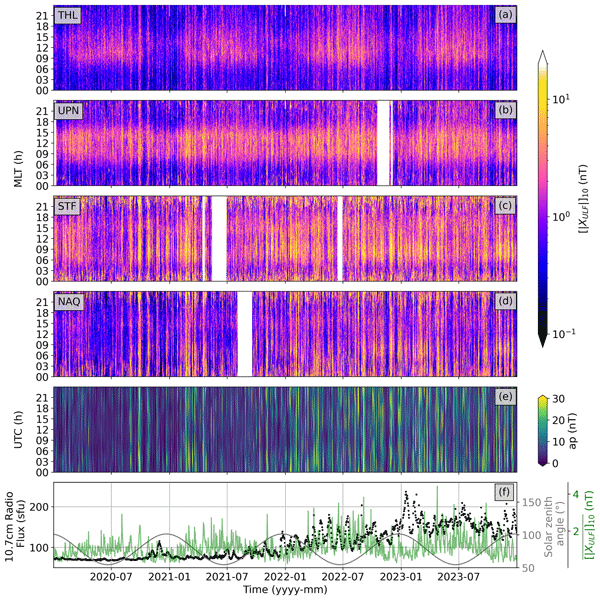
Rapid geomagnetic variations in the ultra-low frequency band are observed using ground-based magnetometers. We apply four years of data from West Greenland in a statistical analysis of the distribution of such variations. We identify a rapid geomagnetic variation population associated with the magnetospheric cusp that is separate from the auroral oval during summer. Earlier studies, which were mainly performed in winter, failed to unambiguously identify these variations.
Arnaud Zaslavsky, Ingrid B. Mann, Russel A. Howard, Zoltan Sternovsky, Simon Anghel, Andreas Kvammen, David M. Malaspina, Nicole Meyer-Vernet, Filippo Pantellini, Arthur Pérrone, Kristina Rackovic-Babic, Veerle J. Sterken, Jamey R. Szalay, Stuart D. Bale, Volker Bothmer, Craig E. DeForest, L. Claire Gasque, Ryo Ishimaru, Hiroshi Kimura, Milan Maksimovic, Michiko Morooka, Teresa Nieves-Chinchilla, Libor Nouzák, David Píša, Petr Pokorný, Nour E. Raouafi, Mitchell M. Shen, Austin Matheus Smith, and Guillermo Stenborg
EGUsphere, https://doi.org/10.5194/egusphere-2026-4440, https://doi.org/10.5194/egusphere-2026-4440, 2026
Short summary
Short summary
Small grains of dust, released by comets and asteroids, fill the space between the Sun and the planets. To learn how they behave near the Sun, we combined data from four spacecraft that either sense single grains hitting them or picture the sunlight scattered by the grains. Together, these observations build a consistent picture of where the dust sits and how it moves in the inner solar system, which helps us understand dust around other stars and grains coming from beyond our solar system.
Gaël Cessateur, Jean Lilensten, Hervé Lamy, Léo Bosse, Magnar G. Johnsen, Antonio Guerrero, David Bolsée, Mathieu Barthelemy, Thijs A. Stockmans, and Frans Snik
EGUsphere, https://doi.org/10.5194/egusphere-2026-3324, https://doi.org/10.5194/egusphere-2026-3324, 2026
This preprint is open for discussion and under review for Annales Geophysicae (ANGEO).
Short summary
Short summary
Auroras are more than beautiful lights: the way their light is polarized may reveal how charged particles enter the upper atmosphere. Such measurements have so far been limited to instruments that observe only a very small part of the sky. In this study, we show that a new polarization camera can map this signal across an aurora. We find that the polarization angle often changes coherently across the scene, while the polarization strength decreases in the brightest parts.
Devin Huyghebaert, Juha Vierinen, Björn Gustavsson, Ralph Latteck, Toralf Renkwitz, Marius Zecha, Claudia C. Stephan, J. Federico Conte, Daniel Kastinen, Johan Kero, and Jorge L. Chau
Atmos. Meas. Tech., 19, 4277–4292, https://doi.org/10.5194/amt-19-4277-2026, https://doi.org/10.5194/amt-19-4277-2026, 2026
Short summary
Short summary
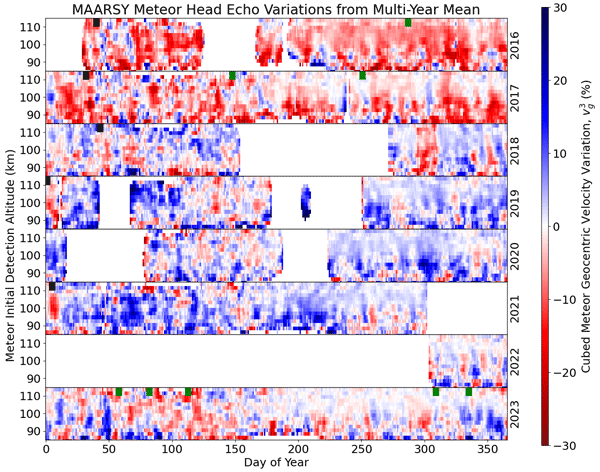
The phenomena of meteors occurs at altitudes of 60–120 km and can be used to measure the neutral atmosphere. We use a large high power radar system in Norway (Middle Atmosphere Alomar Radar System (MAARSY)) to measure the meteors and determine changes to the atmospheric density between the years of 2016–2023 at altitudes of 85–115 km. The same time period between years are compared, minimizing changes to the measurements due to factors other than the atmosphere.
Gunter Stober, Hanli Liu, Zishun Qiao, Kaoru Sato, Loretta Pearl Poku, Witali Krochin, Alan Liu, Alexander Kozlovsky, Diego Janches, Jie Zeng, Wen Yi, Masaki Tsutsumi, Njål Gulbrandsen, Satonori Nozawa, Mark Lester, Johan Kero, and Nicholas Mitchell
EGUsphere, https://doi.org/10.5194/egusphere-2026-3156, https://doi.org/10.5194/egusphere-2026-3156, 2026
This preprint is open for discussion and under review for Atmospheric Measurement Techniques (AMT).
Short summary
Short summary
Vertical winds are a crucial atmospheric parameter in the mesosphere/lower thermosphere and are connected to adiabatic heating and cooling of the atmosphere. Mesospheric temperatures are affected by the vertical transport driven by a pole-to-pole circulation with upwelling in the summer hemisphere and downwelling in the winter hemisphere. We present results based on a new retrieval technique for the seasonal climatological vertical winds and an intercomparison to current state-of-the-art models.
Juha Vierinen, Dabrowka Knach, Jorge Luis Chau, Gerd Baumgarten, Devin Huyghebaert, Matthias Clahsen, Nico Pfeffer, Toralf Renkwitz, Robin Wing, Kenneth Obenberger, Björn Gustavsson, and Daniel Kastinen
EGUsphere, https://doi.org/10.5194/egusphere-2026-2857, https://doi.org/10.5194/egusphere-2026-2857, 2026
Short summary
Short summary
We observed the re-entry of a Falcon 9 rocket upper stage over Europe using a network of cameras and radars normally used to study meteors. The measurements showed how hot ionized gas formed around the debris during hypervelocity entry, producing strong radio echoes high in the atmosphere. As the number of satellites and rocket launches increases, these observations can help improve monitoring of space waste re-entering the atmosphere and its possible environmental effects.
Magnus F. Ivarsen, Kaili Song, Luca Spogli, Jean-Pierre St-Maurice, Devin Ray Huyghebaert, Brian Pitzel, Saif Marei, Yangyang Shen, Satoshi Kasahara, Kunihiro Keika, Yoshizumi Miyoshi, Tomo Hori, Atsuki Shinbori, Kazuhiro Yamamoto, David Russel Themens, P. Thayyil Jayachandran, Yoichi Kazama, Shiang-Yu Wang, Ayako Matsuoka, Iku Shinohara, Takefumi Mitani, Takeshi Takashima, Shoichiro Yokota, Yoshiya Kasahara, and Glenn Hussey
EGUsphere, https://doi.org/10.5194/egusphere-2026-2344, https://doi.org/10.5194/egusphere-2026-2344, 2026
Short summary
Short summary
During geomagnetic storms, the sun drives auroral plasma turbulence that disrupts GPS signals. This turbulence spans sizes from hundreds of kilometers to meters, but most instruments see only a narrow slice. We combined radar and GPS receiver data to build a continuous turbulence spectrum across four orders of magnitude in scale, validated by satellite conjunctions. The spectrum suggests the ionosphere directly mirrors magnetospheric energy input, providing a baseline for space weather models.
Theresa Rexer, Björn Gustavsson, Juha Vierinen, Andres Spicher, Devin Ray Huyghebaert, Andreas Kvammen, Robert Gillies, and Asti Bhatt
Geosci. Instrum. Method. Data Syst., 15, 127–139, https://doi.org/10.5194/gi-15-127-2026, https://doi.org/10.5194/gi-15-127-2026, 2026
Short summary
Short summary
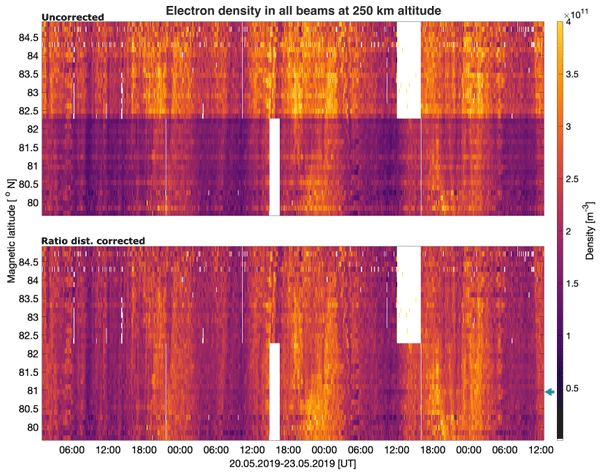
We present a second-level calibration method for electron density measurements from multi-beam incoherent scatter radars. It is based on the well-known Flat field correction method used in imaging and photography. The method improves data quality and useability as it accounts for unaccounted and unpredictable variations in the radar system. This is valuable for studies where inter-beam calibration is important such as studies of polar cap patches, plasma irregularities and turbulence.
Loretta Pearl Poku, Gunter Stober, Witali Krochin, Alan Liu, Alexander Kozlovsky, Diego Janches, Jie Zeng, Wen Yi, Masaki Tsutsumi, Njål Gulbrandsen, Satonori Nozawa, Mark Lester, Johan Kero, and Nicholas Mitchell
EGUsphere, https://doi.org/10.5194/egusphere-2025-6377, https://doi.org/10.5194/egusphere-2025-6377, 2026
Short summary
Short summary
This study presents 3D spatially resolved wind fields in the MLT using advanced retrieval techniques. Specifically, a novel SVVP method in spherical coordinates to enhance the physical consistency of wind retrievals compared to the conventional VVP method in plane geometry and the 3DVAR+DIV method. The SVVP provides a robust framework for future MLT dynamics studies, and the 3DVAR+DIV retrieval is beneficial for high-resolution case studies due to its ability to capture small-scale variability.
Margaretha Myrvang and Björn Johan Gustavsson
EGUsphere, https://doi.org/10.5194/egusphere-2026-1118, https://doi.org/10.5194/egusphere-2026-1118, 2026
Short summary
Short summary
This is the second of two papers. The first paper demonstrate that the electron distribution becomes non-Maxwellian during radio wave heating. Electron cooling rates are macroscopic properties of the electron gas, where electrons transfer some of their kinetic energy through collisions with neutrals and ions, and can be determined by integrating over the electron distribution. Any changes in the electron distribution affect the cooling rates.
Liisa Juusola, Ari Viljanen, Ilja Honkonen, Magnar Gullikstad Johnsen, Andrew Dimmock, Vanina Lanabere, and Alice Wallner
EGUsphere, https://doi.org/10.5194/egusphere-2026-1110, https://doi.org/10.5194/egusphere-2026-1110, 2026
Short summary
Short summary
During severe space storms, the induced geoelectric field has the potential to cause substantial problems in power grids. We examine the geomagnetically induced currents (GIC) the geoelectric field would have driven in a simple model power grid located in Northern Europe during the May 2024 superstorm. Our results help us understand how the complicated interaction between the driving from space and the response of the conducting ground produces the most intense GIC peaks.
Oliver Stalder, Björn Gustavsson, and Ilkka Virtanen
Ann. Geophys., 44, 123–135, https://doi.org/10.5194/angeo-44-123-2026, https://doi.org/10.5194/angeo-44-123-2026, 2026
Short summary
Short summary
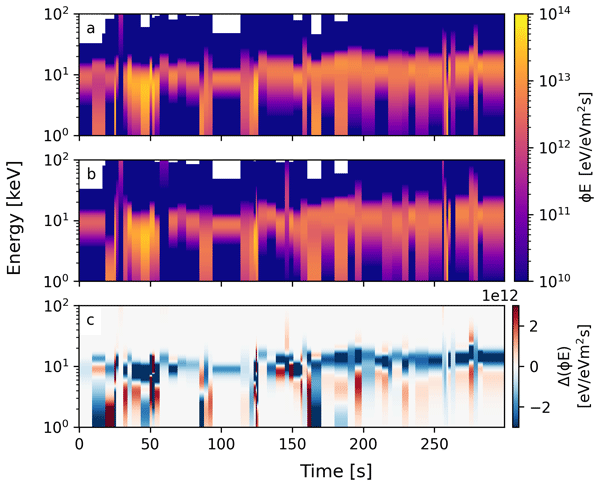
The rapid changes in ion composition during auroral are dynamically modeled by integrating the coupled continuity equations for 15 ionospheric species. The effect of the ionospheric variation on the inversion of incoherent scatter radar (ISR) electron density profiles to differential energy spectra of precipitating electrons is studied. A systematic overestimation at high electron energies can be removed using a dynamic model. Comparisons are made with static and steady-state ionospheric models.

Sota Nanjo, Katie Herlingshaw, Tima Sergienko, Gaël Cessateur, Noora Partamies, Magnar G. Johnsen, Keisuke Hosokawa, Hervé Lamy, Yasunobu Ogawa, Antti Kero, Shin-ichiro Oyama, and Masatoshi Yamauchi
Ann. Geophys., 44, 63–84, https://doi.org/10.5194/angeo-44-63-2026, https://doi.org/10.5194/angeo-44-63-2026, 2026
Short summary
Short summary
During the New Year’s Day storm of 2025, we observed rare auroral features: thin, short-lived green stripes and a “picket fence” near the poleward edge of the auroral oval. Using ground cameras and satellites, we found that the stripes sometimes appeared at widely separated longitudes at the same time and often tracked the motion of nearby red auroras. Some stripes were aligned with the magnetic field, while others were not, implying that multiple local processes contribute to their generation.
Gaël Cessateur, Keisuke Hosokawa, Hervé Lamy, Sota Nanjo, Mathieu Barthelemy, Magnar G. Johnsen, and Romain Maggiolo
EGUsphere, https://doi.org/10.5194/egusphere-2026-385, https://doi.org/10.5194/egusphere-2026-385, 2026
Short summary
Short summary
The Auroral Spectrograph in Skibotn has been measuring auroral light spectra since October 2023. We estimate the energy of electrons producing diffuse auroras from red oxygen and blue nitrogen emissions. Our statistical analysis shows that electron energy increases toward the morning sector, confirming previous studies: electron scattering by chorus waves can populate the loss cone and lead to precipitation, while changes in resonance conditions toward dawn favor harder electrons
Stephen Omondi, Spencer Mark Hatch, Andreas Kvammen, Magnar Gullikstad Johnsen, Mathew J. Owens, Kristian Solheim Thinn, and Rodrigo López
EGUsphere, https://doi.org/10.5194/egusphere-2025-6298, https://doi.org/10.5194/egusphere-2025-6298, 2026
Short summary
Short summary
Researchers tested whether combining real-time solar wind data with forecasts can improve predictions of local geomagnetic activity in Norway. Using a machine learning model, they found that accurate solar wind speed and magnetic field direction are key for reliable forecasts over 3 hours ahead, while CME arrival time only helps if magnetic field data is precise.

Etienne Gavazzi, Andres Spicher, Björn Gustavsson, James Clemmons, Robert Pfaff, and Douglas Rowland
Ann. Geophys., 44, 1–15, https://doi.org/10.5194/angeo-44-1-2026, https://doi.org/10.5194/angeo-44-1-2026, 2026
Short summary
Short summary
Auroral precipitation refers to energetic particles that come down into the upper part of our atmosphere, the ionosphere. There, they collide with atoms and molecules and transfer some of their energy, causing aurora. The most rapid time-variation of this energy deposition and its consequences on the ionosphere are not fully understood. We show here that one can use a new model to study auroral precipitation on sub-second timescales and advance our understanding about small-scale dynamic aurora.
J. Federico Conte, Jorge L. Chau, Toralf Renkwitz, Ralph Latteck, Masaki Tsutsumi, Christoph Jacobi, Njål Gulbrandsen, and Satonori Nozawa
Ann. Geophys., 43, 603–619, https://doi.org/10.5194/angeo-43-603-2025, https://doi.org/10.5194/angeo-43-603-2025, 2025
Short summary
Short summary
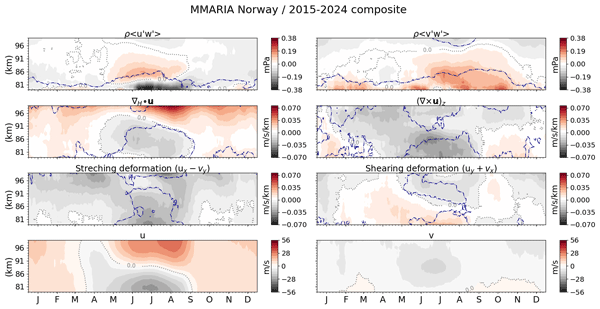
Analysis of 10 years of continuous measurements provided MMARIA/SIMONe Norway and MMARIA/SIMONe Germany reveals that the divergent and vortical motions in the mesosphere and lower thermosphere exchange the dominant role depending on the height and the time of the year. At summer mesopause altitudes over middle latitudes, the horizontal divergence and the relative vorticity contribute approximately the same, indicating an energetic balance between mesoscale divergent and vortical motions.
Spencer Mark Hatch, Ilkka Virtanen, Karl Magnus Laundal, Habtamu Wubie Tesfaw, Juha Vierinen, Devin Ray Huyghebaert, Andres Spicher, and Jens Christian Hessen
Ann. Geophys., 43, 633–649, https://doi.org/10.5194/angeo-43-633-2025, https://doi.org/10.5194/angeo-43-633-2025, 2025
Short summary
Short summary
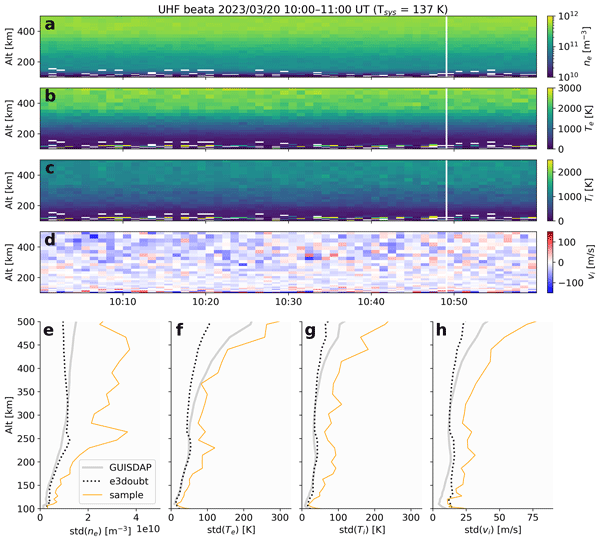
This study addresses the design of next-generation incoherent scatter radar experiments used to study the ionosphere, particularly with systems that have multiple sites. We have developed a method to estimate uncertainties of measurements of plasma density, temperature, and ion drift. Our method is open-source, and helps to optimize radar configurations and assess the effectiveness of an experiment. This method ultimately serves to enhance our understanding of Earth's space environment.
Guochun Shi, Hanli Liu, Masaki Tsutsumi, Njål Gulbrandsen, Alexander Kozlovsky, Dimitry Pokhotelov, Mark Lester, Christoph Jacobi, Kun Wu, and Gunter Stober
Atmos. Chem. Phys., 25, 9403–9430, https://doi.org/10.5194/acp-25-9403-2025, https://doi.org/10.5194/acp-25-9403-2025, 2025
Short summary
Short summary
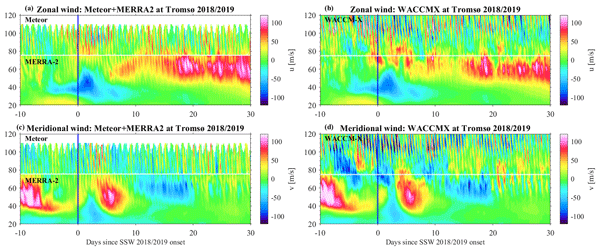
Concerns about climate change are growing due to its widespread impacts, including rising temperatures, extreme weather events, and disruptions to ecosystems. To address these challenges, urgent global action is needed to monitor the distribution of trace gases and understand their effects on the atmosphere.
Arthur Gauthier, Claudia Borries, Alexander Kozlovsky, Diego Janches, Peter Brown, Denis Vida, Christoph Jacobi, Damian Murphy, Masaki Tsutsumi, Njål Gulbrandsen, Satonori Nozawa, Mark Lester, Johan Kero, Nicholas Mitchell, Tracy Moffat-Griffin, and Gunter Stober
Ann. Geophys., 43, 427–440, https://doi.org/10.5194/angeo-43-427-2025, https://doi.org/10.5194/angeo-43-427-2025, 2025
Short summary
Short summary
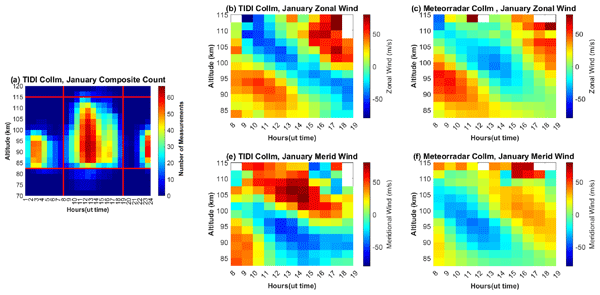
This study focuses on a TIMED Doppler Interferometer (TIDI)–meteor radar (MR) comparison of zonal and meridional winds and their dependence on local time and latitude. The correlation calculation between TIDI wind measurements and MR winds shows good agreement. A TIDI–MR seasonal comparison and analysis of the altitude–latitude dependence for winds are performed. TIDI reproduces the mean circulation well when compared with MRs and may be a useful lower boundary for general circulation models.
Florian Günzkofer, Gunter Stober, Johan Kero, David R. Themens, Anders Tjulin, Njål Gulbrandsen, Masaki Tsutsumi, and Claudia Borries
Ann. Geophys., 43, 331–348, https://doi.org/10.5194/angeo-43-331-2025, https://doi.org/10.5194/angeo-43-331-2025, 2025
Short summary
Short summary
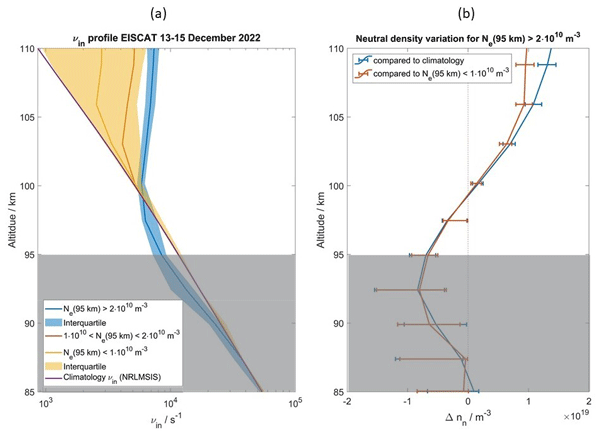
The Earth’s magnetic field is not closed at high latitudes. Electrically charged particles can penetrate the Earth’s atmosphere, deposit their energy, and heat the local atmosphere–ionosphere. This presumably causes an upwelling of the neutral atmosphere, which affects the atmosphere–ionosphere coupling. We apply a new analysis technique to infer the atmospheric density from incoherent scatter radar measurements. We identify signs of particle precipitation impact on the neutral atmosphere.
Sota Nanjo, Masatoshi Yamauchi, Magnar Gullikstad Johnsen, Yoshihiro Yokoyama, Urban Brändström, Yasunobu Ogawa, Anna Naemi Willer, and Keisuke Hosokawa
Ann. Geophys., 43, 303–317, https://doi.org/10.5194/angeo-43-303-2025, https://doi.org/10.5194/angeo-43-303-2025, 2025
Short summary
Short summary
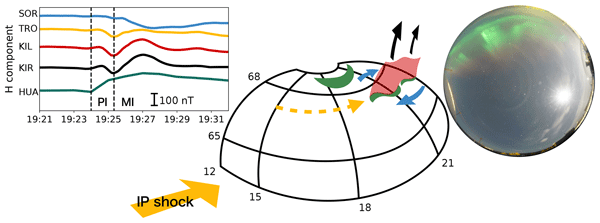
Our research explores the shock aurora, which is typically observed on the dayside due to the rapid compression of the Earth's magnetic field. We observed this rare aurora on the nightside, a region where such events are difficult to detect. Using ground-based cameras, we identified new features, including leaping and vortex-like patterns. These findings offer a fresh insight into the interactions between the solar wind and the magnetosphere, enhancing our understanding of space weather and its effects.
Ingeborg Frøystein and Magnar Gullikstad Johnsen
Ann. Geophys., 43, 241–269, https://doi.org/10.5194/angeo-43-241-2025, https://doi.org/10.5194/angeo-43-241-2025, 2025
Short summary
Short summary
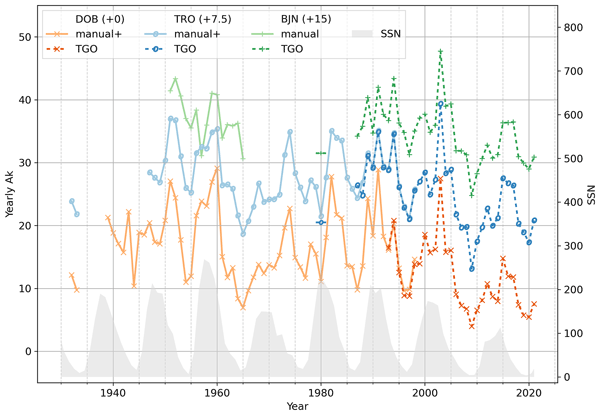
The complete time series of the geomagnetic disturbance index (K) from Norwegian magnetic observatories have been digitized. We compare and discuss the tree methods used to derive the index, finding that each method has strengths and weaknesses. In total, we present all K indices derived from Norwegian observatories since the 1930s until today, the used derivation methods and the long historic time series as a whole, enabling critical use for future scientific work.
Devin Huyghebaert, Björn Gustavsson, Juha Vierinen, Andreas Kvammen, Matthew Zettergren, John Swoboda, Ilkka Virtanen, Spencer M. Hatch, and Karl M. Laundal
Ann. Geophys., 43, 99–113, https://doi.org/10.5194/angeo-43-99-2025, https://doi.org/10.5194/angeo-43-99-2025, 2025
Short summary
Short summary
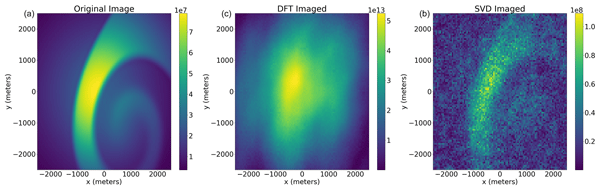
The EISCAT_3D radar is a new ionospheric radar under construction in the Fennoscandia region. The radar will make measurements of plasma characteristics at altitudes above approximately 60 km. The capability of the system to make these measurements at spatial scales of less than 100 m using multiple digitised signals from each of the radar antenna panels is highlighted. There are many ionospheric small-scale processes that will be further resolved using the techniques discussed here.
Dorota Jozwicki, Puneet Sharma, Devin Huyghebaert, and Ingrid Mann
Ann. Geophys., 42, 431–453, https://doi.org/10.5194/angeo-42-431-2024, https://doi.org/10.5194/angeo-42-431-2024, 2024
Short summary
Short summary
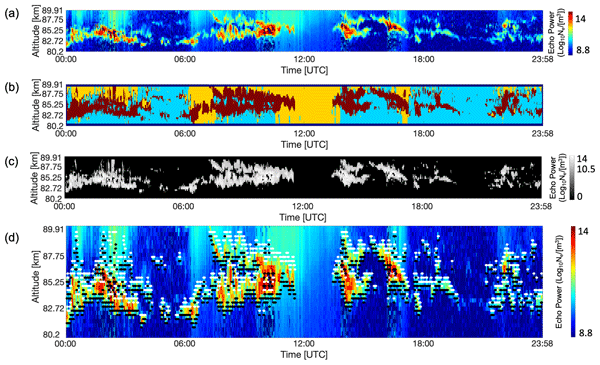
We investigated the relationship between polar mesospheric summer echo (PMSE) layers and the solar cycle. Our results indicate that the average altitude of PMSEs, the echo power in the PMSEs and the thickness of the layers are, on average, higher during the solar maximum than during the solar minimum. We infer that higher electron densities at ionospheric altitudes might be necessary to observe multilayered PMSEs. We observe that the thickness decreases as the number of multilayers increases.
Tinna L. Gunnarsdottir, Ingrid Mann, Wuhu Feng, Devin R. Huyghebaert, Ingemar Haeggstroem, Yasunobu Ogawa, Norihito Saito, Satonori Nozawa, and Takuya D. Kawahara
Ann. Geophys., 42, 213–228, https://doi.org/10.5194/angeo-42-213-2024, https://doi.org/10.5194/angeo-42-213-2024, 2024
Short summary
Short summary
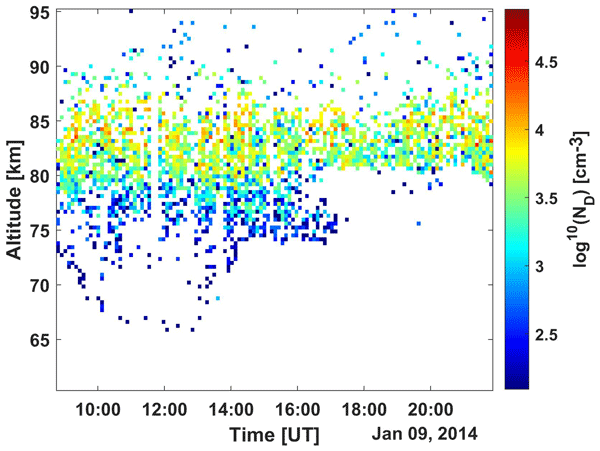
Several tons of meteoric particles burn up in our atmosphere each day. This deposits a great deal of material that binds with other atmospheric particles and forms so-called meteoric smoke particles. These particles are assumed to influence radar measurements. Here, we have compared radar measurements with simulations of a radar spectrum with and without dust particles and found that dust influences the radar spectrum in the altitude range of 75–85 km.
Yoshimasa Tanaka, Yasunobu Ogawa, Akira Kadokura, Takehiko Aso, Björn Gustavsson, Urban Brändström, Tima Sergienko, Genta Ueno, and Satoko Saita
Ann. Geophys., 42, 179–190, https://doi.org/10.5194/angeo-42-179-2024, https://doi.org/10.5194/angeo-42-179-2024, 2024
Short summary
Short summary
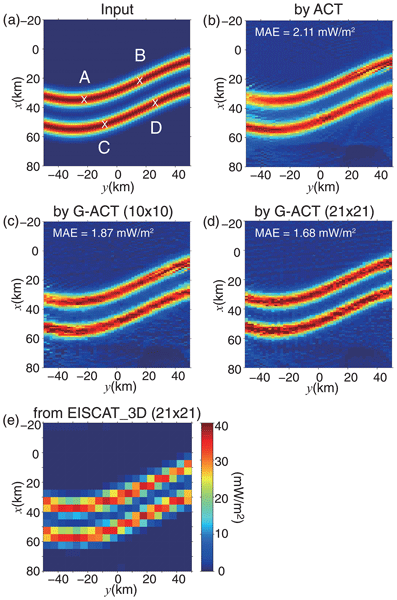
We present via simulation how useful monochromatic images taken by a multi-point imager network are for auroral research in the EISCAT_3D project. We apply the generalized-aurora computed tomography (G-ACT) to modeled multiple auroral images and ionospheric electron density data. It is demonstrated that G-ACT provides better reconstruction results than the normal ACT and can interpolate ionospheric electron density at a much higher spatial resolution than observed by the EISCAT_3D radar.
Samuel Kočiščák, Andreas Kvammen, Ingrid Mann, Nicole Meyer-Vernet, David Píša, Jan Souček, Audun Theodorsen, Jakub Vaverka, and Arnaud Zaslavsky
Ann. Geophys., 42, 191–212, https://doi.org/10.5194/angeo-42-191-2024, https://doi.org/10.5194/angeo-42-191-2024, 2024
Short summary
Short summary
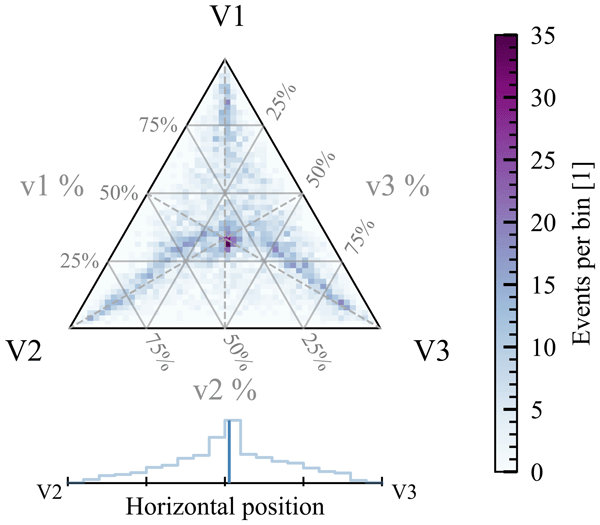
In situ observations are crucial for understanding interplanetary dust, yet not every spacecraft has a dedicated dust detector. Dust encounters happen at great speeds, leading to high energy density at impact, which leads to ionization and charge release, which is detected with electrical antennas. Our work looks at how the transient charge plume interacts with Solar Orbiter spacecraft. Our findings are relevant for the design of future experiments and the understanding of present data.
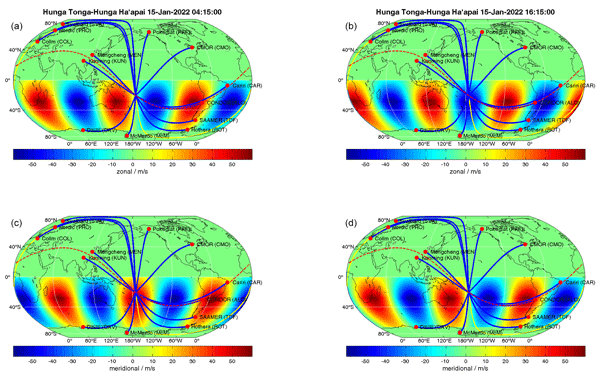
Gunter Stober, Sharon L. Vadas, Erich Becker, Alan Liu, Alexander Kozlovsky, Diego Janches, Zishun Qiao, Witali Krochin, Guochun Shi, Wen Yi, Jie Zeng, Peter Brown, Denis Vida, Neil Hindley, Christoph Jacobi, Damian Murphy, Ricardo Buriti, Vania Andrioli, Paulo Batista, John Marino, Scott Palo, Denise Thorsen, Masaki Tsutsumi, Njål Gulbrandsen, Satonori Nozawa, Mark Lester, Kathrin Baumgarten, Johan Kero, Evgenia Belova, Nicholas Mitchell, Tracy Moffat-Griffin, and Na Li
Atmos. Chem. Phys., 24, 4851–4873, https://doi.org/10.5194/acp-24-4851-2024, https://doi.org/10.5194/acp-24-4851-2024, 2024
Short summary
Short summary
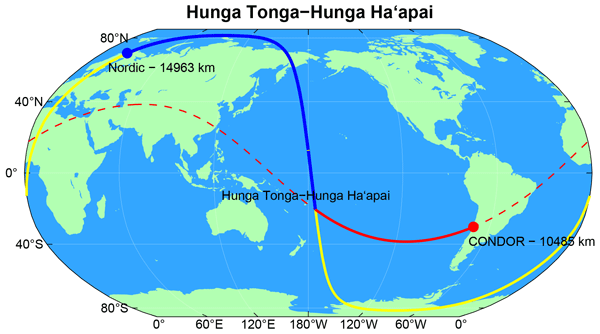
On 15 January 2022, the Hunga Tonga-Hunga Ha‘apai volcano exploded in a vigorous eruption, causing many atmospheric phenomena reaching from the surface up to space. In this study, we investigate how the mesospheric winds were affected by the volcanogenic gravity waves and estimated their propagation direction and speed. The interplay between model and observations permits us to gain new insights into the vertical coupling through atmospheric gravity waves.
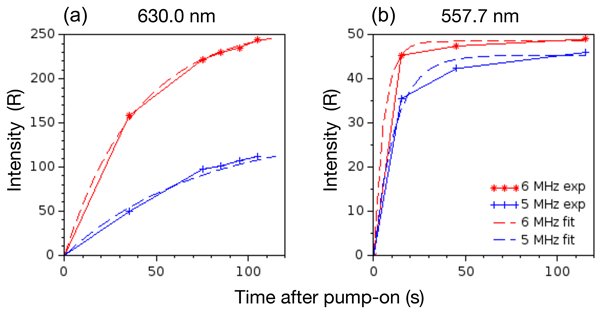
Thomas B. Leyser, Tima Sergienko, Urban Brändström, Björn Gustavsson, and Michael T. Rietveld
Ann. Geophys., 41, 589–600, https://doi.org/10.5194/angeo-41-589-2023, https://doi.org/10.5194/angeo-41-589-2023, 2023
Short summary
Short summary
Powerful radio waves transmitted into the ionosphere from the ground were used to study electron energization in the pumped ionospheric plasma turbulence, by detecting optical emissions from atomic oxygen. Our results obtained with the EISCAT (European Incoherent Scatter Scientific Association) facilities in northern Norway and optical detection with the ALIS (Auroral Large Imaging System) in northern Sweden suggest that long-wavelength upper hybrid waves are important in accelerating electrons.
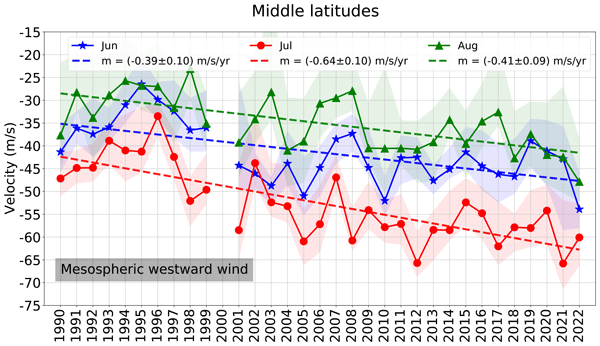
Juliana Jaen, Toralf Renkwitz, Huixin Liu, Christoph Jacobi, Robin Wing, Aleš Kuchař, Masaki Tsutsumi, Njål Gulbrandsen, and Jorge L. Chau
Atmos. Chem. Phys., 23, 14871–14887, https://doi.org/10.5194/acp-23-14871-2023, https://doi.org/10.5194/acp-23-14871-2023, 2023
Short summary
Short summary
Investigation of winds is important to understand atmospheric dynamics. In the summer mesosphere and lower thermosphere, there are three main wind flows: the mesospheric westward, the mesopause southward (equatorward), and the lower-thermospheric eastward wind. Combining almost 2 decades of measurements from different radars, we study the trend, their interannual oscillations, and the effects of the geomagnetic activity over these wind maxima.
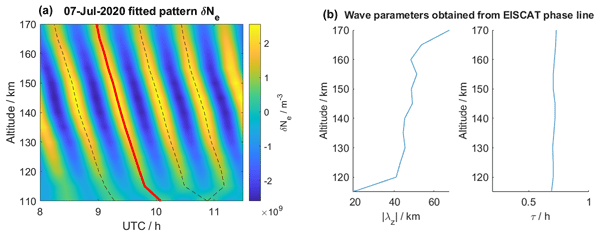
Florian Günzkofer, Dimitry Pokhotelov, Gunter Stober, Ingrid Mann, Sharon L. Vadas, Erich Becker, Anders Tjulin, Alexander Kozlovsky, Masaki Tsutsumi, Njål Gulbrandsen, Satonori Nozawa, Mark Lester, Evgenia Belova, Johan Kero, Nicholas J. Mitchell, and Claudia Borries
Ann. Geophys., 41, 409–428, https://doi.org/10.5194/angeo-41-409-2023, https://doi.org/10.5194/angeo-41-409-2023, 2023
Short summary
Short summary
Gravity waves (GWs) are waves in Earth's atmosphere and can be observed as cloud ripples. Under certain conditions, these waves can propagate up into the ionosphere. Here, they can cause ripples in the ionosphere plasma, observable as oscillations of the plasma density. Therefore, GWs contribute to the ionospheric variability, making them relevant for space weather prediction. Additionally, the behavior of these waves allows us to draw conclusions about the atmosphere at these altitudes.
Gunter Stober, Alan Liu, Alexander Kozlovsky, Zishun Qiao, Witali Krochin, Guochun Shi, Johan Kero, Masaki Tsutsumi, Njål Gulbrandsen, Satonori Nozawa, Mark Lester, Kathrin Baumgarten, Evgenia Belova, and Nicholas Mitchell
Ann. Geophys., 41, 197–208, https://doi.org/10.5194/angeo-41-197-2023, https://doi.org/10.5194/angeo-41-197-2023, 2023
Short summary
Short summary
The Hunga Tonga–Hunga Ha‘apai volcanic eruption was one of the most vigorous volcanic explosions in the last centuries. The eruption launched many atmospheric waves traveling around the Earth. In this study, we identify these volcanic waves at the edge of space in the mesosphere/lower-thermosphere, leveraging wind observations conducted with multi-static meteor radars in northern Europe and with the Chilean Observation Network De Meteor Radars (CONDOR).
Andreas Kvammen, Kristoffer Wickstrøm, Samuel Kociscak, Jakub Vaverka, Libor Nouzak, Arnaud Zaslavsky, Kristina Rackovic Babic, Amalie Gjelsvik, David Pisa, Jan Soucek, and Ingrid Mann
Ann. Geophys., 41, 69–86, https://doi.org/10.5194/angeo-41-69-2023, https://doi.org/10.5194/angeo-41-69-2023, 2023
Short summary
Short summary
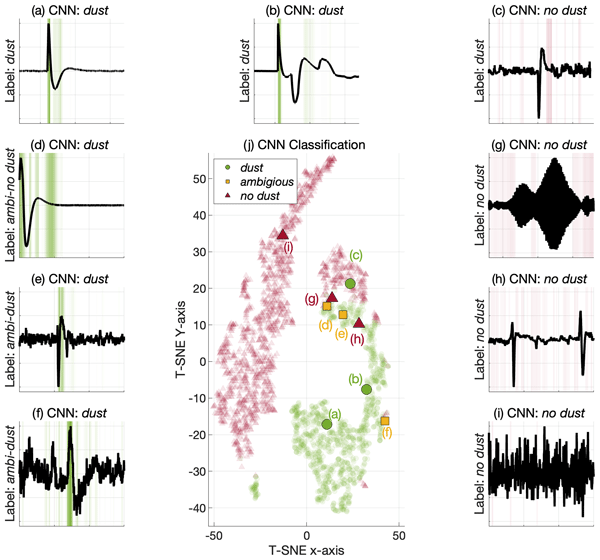
Collisional fragmentation of asteroids, comets and meteoroids is the main source of dust in the solar system. The dust distribution is however uncharted and the role of dust in the solar system is largely unknown. At present, the interplanetary medium is explored by the Solar Orbiter spacecraft. We present a novel method, based on artificial intelligence, that can be used for detecting dust impacts in Solar Orbiter observations with high accuracy, advancing the study of dust in the solar system.

Johann Stamm, Juha Vierinen, Björn Gustavsson, and Andres Spicher
Ann. Geophys., 41, 55–67, https://doi.org/10.5194/angeo-41-55-2023, https://doi.org/10.5194/angeo-41-55-2023, 2023
Short summary
Short summary
The study of some ionospheric events benefit from the knowledge of how the physics varies over a volume and over time. Examples are studies of aurora or energy deposition. With EISCAT3D, measurements of ion velocity vectors in a volume will be possible for the first time. We present a technique that uses a set of such measurements to estimate electric field and neutral wind. The technique relies on adding restrictions to the estimates. We successfully consider restrictions based on physics.
Daniel K. Whiter, Noora Partamies, Björn Gustavsson, and Kirsti Kauristie
Ann. Geophys., 41, 1–12, https://doi.org/10.5194/angeo-41-1-2023, https://doi.org/10.5194/angeo-41-1-2023, 2023
Short summary
Short summary
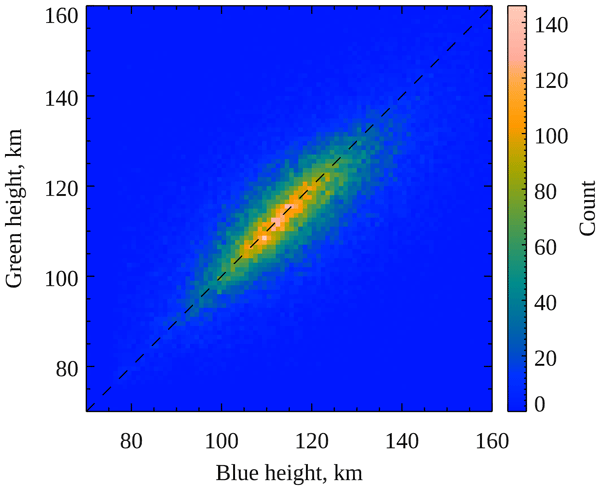
We measured the height of green and blue aurorae using thousands of camera images recorded over a 7-year period. Both colours are typically brightest at about 114 km altitude. When they peak at higher altitudes the blue aurora is usually higher than the green aurora. This information will help other studies which need an estimate of the auroral height. We used a computer model to explain our observations and to investigate how the green aurora is produced.
Gunter Stober, Alan Liu, Alexander Kozlovsky, Zishun Qiao, Ales Kuchar, Christoph Jacobi, Chris Meek, Diego Janches, Guiping Liu, Masaki Tsutsumi, Njål Gulbrandsen, Satonori Nozawa, Mark Lester, Evgenia Belova, Johan Kero, and Nicholas Mitchell
Atmos. Meas. Tech., 15, 5769–5792, https://doi.org/10.5194/amt-15-5769-2022, https://doi.org/10.5194/amt-15-5769-2022, 2022
Short summary
Short summary
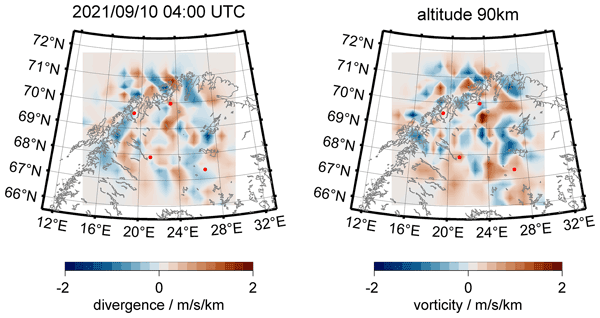
Precise and accurate measurements of vertical winds at the mesosphere and lower thermosphere are rare. Although meteor radars have been used for decades to observe horizontal winds, their ability to derive reliable vertical wind measurements was always questioned. In this article, we provide mathematical concepts to retrieve mathematically and physically consistent solutions, which are compared to the state-of-the-art non-hydrostatic model UA-ICON.
Knut Ola Dølven, Juha Vierinen, Roberto Grilli, Jack Triest, and Bénédicte Ferré
Geosci. Instrum. Method. Data Syst., 11, 293–306, https://doi.org/10.5194/gi-11-293-2022, https://doi.org/10.5194/gi-11-293-2022, 2022
Short summary
Short summary
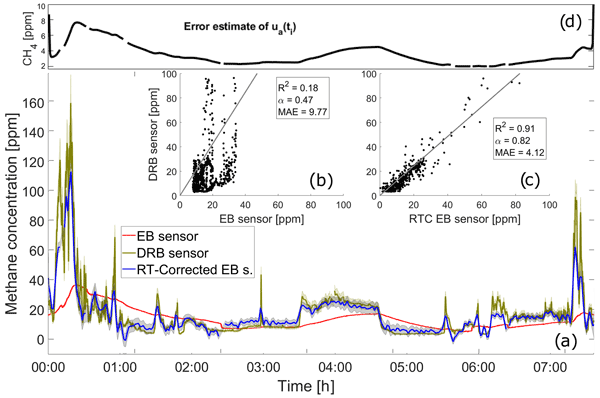
Sensors capable of measuring rapid fluctuations are important to improve our understanding of environmental processes. Many sensors are unable to do this, due to their reliance on the transfer of the measured property, for instance a gas, across a semi-permeable barrier. We have developed a mathematical tool which enables the retrieval of fast-response signals from sensors with this type of sensor design.
Carsten Baumann, Antti Kero, Shikha Raizada, Markus Rapp, Michael P. Sulzer, Pekka T. Verronen, and Juha Vierinen
Ann. Geophys., 40, 519–530, https://doi.org/10.5194/angeo-40-519-2022, https://doi.org/10.5194/angeo-40-519-2022, 2022
Short summary
Short summary
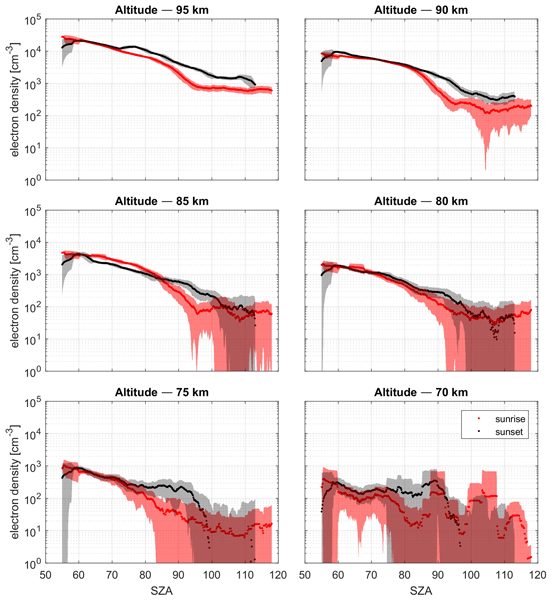
The Arecibo radar was used to probe free electrons of the ionized atmosphere between 70 and 100 km altitude. This is also the altitude region were meteors evaporate and form secondary particulate matter, the so-called meteor smoke particles (MSPs). Free electrons attach to these MSPs when the sun is below the horizon and cause a drop in the number of free electrons, which are the subject of these measurements. We also identified a different number of free electrons during sunset and sunrise.
Mizuki Fukizawa, Takeshi Sakanoi, Yoshimasa Tanaka, Yasunobu Ogawa, Keisuke Hosokawa, Björn Gustavsson, Kirsti Kauristie, Alexander Kozlovsky, Tero Raita, Urban Brändström, and Tima Sergienko
Ann. Geophys., 40, 475–484, https://doi.org/10.5194/angeo-40-475-2022, https://doi.org/10.5194/angeo-40-475-2022, 2022
Short summary
Short summary
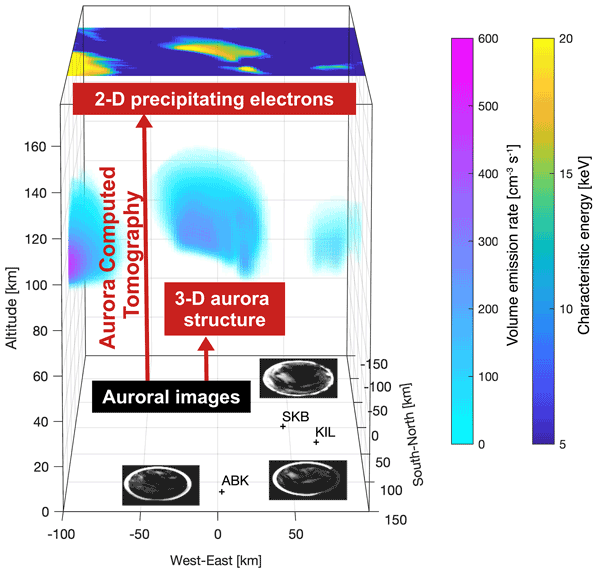
The pulsating auroral generation mechanism has been investigated by observing precipitating electrons using rockets or satellites. However, it is difficult for such observations to distinguish temporal changes from spatial ones. In this study, we reconstructed the horizontal 2-D distribution of precipitating electrons using only auroral images. The 3-D aurora structure was also reconstructed. We found that there were both spatial and temporal changes in the precipitating electron energy.

Derek McKay, Juha Vierinen, Antti Kero, and Noora Partamies
Geosci. Instrum. Method. Data Syst., 11, 25–35, https://doi.org/10.5194/gi-11-25-2022, https://doi.org/10.5194/gi-11-25-2022, 2022
Short summary
Short summary
When radio waves from our galaxy enter the Earth's atmosphere, they are absorbed by electrons in the upper atmosphere. It was thought that by measuring the amount of absorption, it would allow the height of these electrons in the atmosphere to be determined. If so, this would have significance for future instrument design. However, this paper demonstrates that it is not possible to do this, but it does explain how multiple-frequency measurements can nevertheless be useful.
Ryan Volz, Jorge L. Chau, Philip J. Erickson, Juha P. Vierinen, J. Miguel Urco, and Matthias Clahsen
Atmos. Meas. Tech., 14, 7199–7219, https://doi.org/10.5194/amt-14-7199-2021, https://doi.org/10.5194/amt-14-7199-2021, 2021
Short summary
Short summary
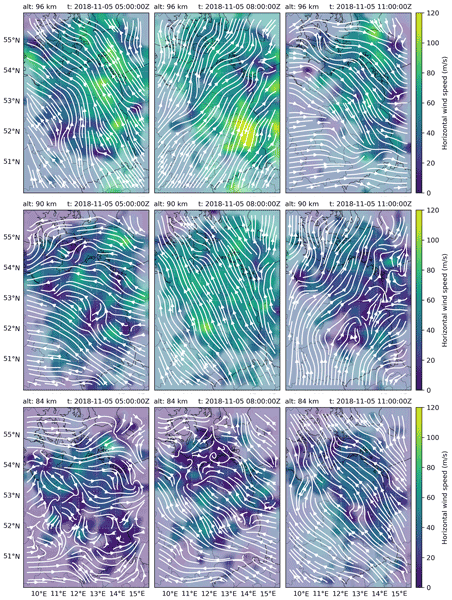
We introduce a new way of estimating winds in the upper atmosphere (about 80 to 100 km in altitude) from the observed Doppler shift of meteor trails using a statistical method called Gaussian process regression. Wind estimates and, critically, the uncertainty of those estimates can be evaluated smoothly (i.e., not gridded) in space and time. The effective resolution is set by provided parameters, which are limited in practice by the number density of the observed meteors.
Johann Stamm, Juha Vierinen, and Björn Gustavsson
Ann. Geophys., 39, 961–974, https://doi.org/10.5194/angeo-39-961-2021, https://doi.org/10.5194/angeo-39-961-2021, 2021
Short summary
Short summary
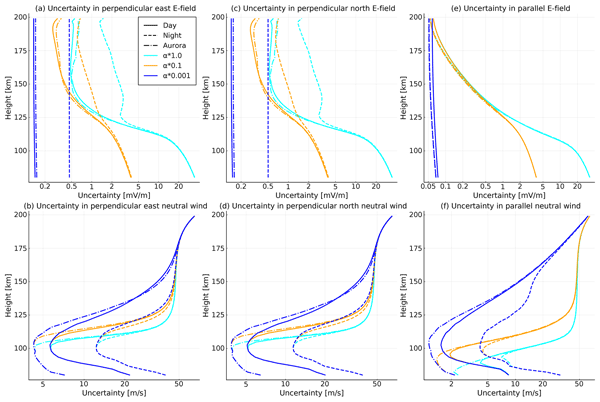
Measurements of the electric field and neutral wind in the ionosphere are important for understanding energy flows or electric currents. With incoherent scatter radars (ISRs), we can measure the velocity of the ions, which depends on both the electrical field and the neutral wind. In this paper, we investigate methods to use ISR data to find reasonable values for both parameters. We find that electric field can be well measured down to 125 km height and neutral wind below this height.
Cited articles
Ankita, M. and Ram, S. T.: Iterative Gradient Correction (IGC) Method for True Height Analysis of Ionograms, Radio Science, 58, 1–13, https://doi.org/10.1029/2023RS007808, 2023. a
Ankita, M. and Ram, S. T.: A Software Tool for the True Height Analysis of Ionograms Using the Iterative Gradient Correction (IGC) Method, Radio Science, 59, 1–10, https://doi.org/10.1029/2024RS007955, 2024. a
Beynon, W. J. G. and Williams, P. J. S.: Incoherent Scatter of Radio Waves from the Ionosphere, Reports on Progress in Physics, 41, 909–955, https://doi.org/10.1088/0034-4885/41/6/003, 1978. a
Bhattacharyya, A.: On a Measure of Divergence between Two Statistical Populations Defined by Their Probability Distributions, Bulletin of the Calcutta Mathematical Society, 35, 99–109, https://cir.nii.ac.jp/crid/1572261550690788352?lang=en (last accessed: 24 June 2025), 1943. a
Bilitza, D., Pezzopane, M., Truhlik, V., Altadill, D., Reinisch, B. W., and Pignalberi, A.: The International Reference Ionosphere Model: A Review and Description of an Ionospheric Benchmark, Reviews of Geophysics, 60, e2022RG000792, https://doi.org/10.1029/2022RG000792, 2022. a
Breit, G. and Tuve, M. A.: A Test of the Existence of the Conducting Layer, Physical Review, 28, 554–575, https://doi.org/10.1103/PhysRev.28.554, 1926. a
Breuillard, H., Dupuis, R., Retino, A., Le Contel, O., Amaya, J., and Lapenta, G.: Automatic Classification of Plasma Regions in Near-Earth Space with Supervised Machine Learning: Application to Magnetospheric Multi Scale 2016–2019 Observations, Frontiers in Astronomy and Space Sciences, 7, 55, https://doi.org/10.3389/fspas.2020.00055, 2020. a
Buonsanto, M. J. and Fuller-Rowell, T. J.: Strides Made in Understanding Space Weather at Earth, Eos Transactions American Geophysical Union, 78, 1–7, https://doi.org/10.1029/97EO00002, 1997. a
Camporeale, E.: The Challenge of Machine Learning in Space Weather: Nowcasting and Forecasting, Space Weather, 17, 1166–1207, https://doi.org/10.1029/2018SW002061, 2019. a
Chen, Z., Gong, Z., Zhang, F., and Fang, G.: A New Ionogram Automatic Scaling Method, Radio Science, 53, 1149–1164, https://doi.org/10.1029/2018RS006574, 2018. a
Clausen, L. B. N. and Nickisch, H.: Automatic Classification of Auroral Images from the Oslo Auroral THEMIS (OATH) Data Set Using Machine Learning, Journal of Geophysical Research: Space Physics, 123, 5640–5647, https://doi.org/10.1029/2018JA025274, 2018. a
Davies, K.: Ionospheric Radio Propagation, no. 80 in: National Bureau of Standards Monograph, U. S. Department of Commerce, National Bureau of Standards, Gaithersburg, MD, https://doi.org/10.6028/NBS.MONO.80, 1965. a
Davies, K.: Ionospheric Radio, no. 31 in IEE Electromagnetic Waves Series, The Institution of Engineering and Technology, Stevenage, UK, https://doi.org/10.1049/PBEW031E, 1990. a
Evans, J. V.: Theory and Practice of Ionosphere Study by Thomson Scatter Radar, Proceedings of the IEEE, 57, 496–530, https://doi.org/10.1109/PROC.1969.7005, 1969. a
Galkin, I. A., Khmyrov, G. M., Kozlov, A. V., Reinisch, B. W., Huang, X., and Paznukhov, V. V.: The Artist 5, in: Radio Sounding and Plasma Physics, edited by Song, P., Foster, J., Mendillo, M., and Bilitza, D., vol. 974 of American Institute of Physics Conference Series, AIP, pp. 150–159, https://doi.org/10.1063/1.2885024, 2008. a
Galkin, I. A., Reinisch, B. W., and Bilitza, D.: Realistic Ionosphere: Real-time Iononsode Service for ISWI, Sun & Geosphere, 13, 173–178, https://doi.org/10.31401/SunGeo.2018.02.09, 2018. a
Guo, L. and Xiong, J.: Multi-Scale Attention-Enhanced Deep Learning Model for Ionogram Automatic Scaling, Radio Science, 58, e2022RS007566, https://doi.org/10.1029/2022RS007566, 2023. a
Hall, C. M. and Hansen, T. L.: 20th Century Operation of the Tromsø Ionosonde, Advances in Polar Upper Atmosphere Research, 17, 155–166, http://polaris.nipr.ac.jp/~uap/apuar/apuar17/PUA1713.pdf (last access: 24 June 2025), 2003. a
Hastie, T., Friedman, J., and Tibshirani, R.: The Elements of Statistical Learning: Data Mining, Inference, and Prediction, 2nd edn., Springer Series in Statistics, Springer, New York, NY, https://doi.org/10.1007/978-0-387-84858-7, 2009. a
He, K., Zhang, X., Ren, S., and Sun, J.: Delving Deep into Rectifiers: Surpassing Human-Level Performance on ImageNet Classification, in: Proceedings of the IEEE International Conference on Computer Vision, pp. 1026–1034, https://doi.org/10.1109/ICCV.2015.123, 2015. a
Holt, J. M., Zhang, S., and Buonsanto, M. J.: Regional and Local Ionospheric Models Based on Millstone Hill Incoherent Scatter Radar Data, Geophysical Research Letters, 29, 48–1–48-3, https://doi.org/10.1029/2002GL014678, 2002. a, b
Huang, Y., Du, C., Xue, Z., Chen, X., Zhao, H., and Huang, L.: What Makes Multi-Modal Learning Better than Single (Provably), in: Advances in Neural Information Processing Systems, vol. 34, Curran Associates, Inc., pp. 10944–10956, https://doi.org/10.48550/arXiv.2106.04538, 2021. a
Huber, P. J.: Robust Estimation of a Location Parameter, The Annals of Mathematical Statistics, 35, 73–101, https://doi.org/10.1214/aoms/1177703732, 1964. a
Ioffe, S. and Szegedy, C.: Batch Normalization: Accelerating Deep Network Training by Reducing Internal Covariate Shift, in: Proceedings of the 32nd International Conference on Machine Learning, vol. 37 of Proceedings of Machine Learning Research, PMLR, pp. 448–456, https://doi.org/10.48550/arXiv.1502.03167, 2015. a, b, c
Iqbal, H.: HarisIqbal88/PlotNeuralNet v1.0.0, Zenodo, https://doi.org/10.5281/zenodo.2526396, 2018. a, b, c
Keskinen, M. J. and Ossakow, S. L.: Theories of High-Latitude Ionospheric Irregularities: A Review, Radio Science, 18, 1077–1091, https://doi.org/10.1029/RS018i006p01077, 1983. a
Kingma, D. P. and Ba, J.: Adam: A Method for Stochastic Optimization, arXiv preprint, https://doi.org/10.48550/arXiv.1412.6980, 2014. a
Koutroumbas, K. and Theodoridis, S.: Pattern Recognition, Academic Press, Burlington, MA, https://doi.org/10.1016/B978-0-12-369531-4.X5000-8, 2008. a
Kullback, S.: Information Theory and Statistics, Dover Books on Mathematics, revised ed. edn., Dover Publications, New York, NY, ISBN-10: 0486696847, 1997. a
Kvammen, A., Wickstrøm, K. K., McKay, D., and Partamies, N.: Auroral Image Classification with Deep Neural Networks, Journal of Geophysical Research: Space Physics, 125, e2020JA027808, https://doi.org/10.1029/2020JA027808, 2020. a
Kvammen, A., Vierinen, J., Huyghebaert, D., Rexer, T., Spicher, A., Gustavsson, B., and Floberg, J.: NOIRE-Net—a Convolutional Neural Network for Automatic Classification and Scaling of High-Latitude Ionograms, Frontiers in Astronomy and Space Sciences, 11, 1289840, https://doi.org/10.3389/fspas.2024.1289840, 2024. a, b, c
Lanzerotti, L. J.: Space Weather Effects on Communications: An Overview of Historical and Contemporary Impacts of Solar and Geospace Disturbances on Communications Systems, in: Space Storms and Space Weather Hazards, edited by: Daglis, I. A., vol. 38 of NATO Science Series II: Mathematics, Physics and Chemistry, Springer, Dordrecht, pp. 313–334, https://doi.org/10.1007/978-94-010-0983-6_12, 2001. a
Laštovička, J. and Burešová, D.: Relationships Between foF2 and Various Solar Activity Proxies, Space Weather, 21, e2022SW003359, https://doi.org/10.1029/2022SW003359, 2023. a
Lehtinen, M. S. and Huuskonen, A.: General Incoherent Scatter Analysis and GUISDAP, Journal of Atmospheric and Terrestrial Physics, 58, 435–452, https://doi.org/10.1016/0021-9169(95)00047-X, 1996. a
Levis, C., Johnson, J. T., and Teixeira, F. L.: Radiowave Propagation: Physics and Applications, John Wiley & Sons, Hoboken, NJ, ISBN-10: 0470542950, 2010. a
Liu, R. Y., Smith, P. A., and King, J. W.: A New Solar Index Which Leads to Improved foF2 Predictions Using the CCIR Atlas, ITU Telecommunication Journal, 50, 408–414, https://ui.adsabs.harvard.edu/abs/1983ITUTJ..50..408L/abstract (last access: 24 June 2025), 1983. a
Liu, W., Huang, X., Wei, N., and Deng, Z.: Automatic Scaling of Vertical Ionograms Based on Generative Adversarial Network, Radio Science, 60, 2024RS008123, https://doi.org/10.1029/2024RS008123, 2025. a
Liu, Y., Wang, J., Yang, C., Zheng, Y., and Fu, H.: A Machine Learning–Based Method for Modeling TEC Regional Temporal–Spatial Map, Remote Sensing, 14, 5579, https://doi.org/10.3390/rs14215579, 2022. a
Lundstedt, H.: Progress in Space Weather Predictions and Applications, Advances in Space Research, 36, 2516–2523, https://doi.org/10.1016/j.asr.2003.09.072, 2005. a
Mao, S., Li, H., Zhang, Y., and Shi, Y.: Prediction of Ionospheric Electron Density Distribution Based on CNN–LSTM Model, IEEE Geoscience and Remote Sensing Letters, 21, 1–5, https://doi.org/10.1109/LGRS.2024.3437650, 2024. a
Menéndez, M. L., Pardo, J. A., Pardo, L., and Pardo, M. d. C.: The Jensen–Shannon Divergence, Journal of the Franklin Institute, 334, 307–318, https://doi.org/10.1016/S0016-0032(96)00063-4, 1997. a
Minnis, C. M.: A New Index of Solar Activity Based on Ionospheric Measurements, Journal of Atmospheric and Terrestrial Physics, 7, 310–321, https://doi.org/10.1016/0021-9169(55)90136-7, 1955. a
Nair, V. and Hinton, G. E.: Rectified Linear Units Improve Restricted Boltzmann Machines, in: Proceedings of the 27th International Conference on Machine Learning, Omnipress, pp. 807–814, http://www.icml2010.org/papers/432.pdf (last access: 5 December 2025), 2010. a
Nanjo, S., Nozawa, S., Yamamoto, M., Kawabata, T., Johnsen, M. G., Tsuda, T. T., and Hosokawa, K.: An Automated Auroral Detection System Using Deep Learning: Real-Time Operation in Tromsø, Norway, Scientific Reports, 12, 8038, https://doi.org/10.1038/s41598-022-11686-8, 2022. a
Pezzopane, M. and Scotto, C.: Automatic scaling of critical frequency foF2 and MUF(3000)F2: A comparison between Autoscala and ARTIST 4.5 on Rome data, Radio Science, 42, 1–17, https://doi.org/10.1029/2006RS003581, 2007. a
Pinto, V. A., Keesee, A. M., Coughlan, M., Mukundan, R., Johnson, J. W., Ngwira, C. M., and Connor, H. K.: Revisiting the Ground Magnetic Field Perturbations Challenge: A Machine Learning Perspective, Frontiers in Astronomy and Space Sciences, 9, 869740, https://doi.org/10.3389/fspas.2022.869740, 2022. a
Pulkkinen, T.: Space Weather: Terrestrial Perspective, Living Reviews in Solar Physics, 4, 1, https://doi.org/10.12942/lrsp-2007-1, 2007. a
Rao, T. V., Sridhar, M., and Ratnam, D. V.: An Automatic CADI's Ionogram Scaling Software Tool for Large Ionograms Data Analytics, IEEE Access, 10, 22161–22168, https://doi.org/10.1109/ACCESS.2022.3153470, 2022. a
Reddi, S. J., Kale, S., and Kumar, S.: On the Convergence of Adam and Beyond, arXiv preprint, https://arxiv.org/abs/1904.09237 (last access: 5 December 2025), 2019. a
Reinisch, B. W. and Galkin, I. A.: Global Ionospheric Radio Observatory (GIRO), Earth, Planets and Space, 63, 377–381, https://doi.org/10.5047/eps.2011.03.001, 2011. a
Reinisch, B. W. and Huang, X.: Deducing Topside Profiles and Total Electron Content from Bottomside Ionograms, Advances in Space Research, 27, 23–30, https://doi.org/10.1016/S0273-1177(00)00136-8, 2001. a
Reinisch, B. W., Gamache, R. R., Tang, J. S., and Kitrosser, D. F.: Automatic Real Time Ionogram Scaler with True Height Analysis—ARTIST, Tech. Rep. AFGL-TR-83-0209, Air Force Geophysics Laboratory, https://apps.dtic.mil/sti/pdfs/ADA140664.pdf (last access: 5 December 2025), 1983. a
Reinisch, B. W., Haines, D. M., and Kuklinski, W. S.: The New Portable Digisonde for Vertical and Oblique Sounding, in: Proceedings of the AGARD EPP 50th Symposium, no. 502 in AGARD Conference Proceedings, pp. 11-1–11-11, https://ui.adsabs.harvard.edu/abs/1992rspe.agarQ....R/abstract (last access: 23 June 2025), 1992. a, b
Reinisch, B. W., Huang, X., Galkin, I. A., Paznukhov, V., and Kozlov, A. V.: Recent Advances in Real-Time Analysis of Ionograms and Ionospheric Drift Measurements with Digisondes, Journal of Atmospheric and Solar-Terrestrial Physics, 67, 1054–1062, https://doi.org/10.1016/j.jastp.2005.01.009, 2005. a, b, c, d
Reinisch, B. W., Galkin, I. A., Khmyrov, G. M., Kozlov, A. V., Lisysyan, I. A., Bibl, K., Cheney, G., Kitrosser, D., Stelmash, S., Roche, K., Luo, Y., Paznukhov, V. V., and Hamel, R.: Advancing Digisonde Technology: the DPS-4D, AIP Conference Proceedings, 974, 127–143, https://doi.org/10.1063/1.2885022, 2008. a
Rideout, W. and Coster, A.: Automated GPS Processing for Global Total Electron Content Data, GPS Solutions, 10, 219–228, https://doi.org/10.1007/s10291-006-0029-5, 2006. a
Rishbeth, H. and Williams, P. J. S.: The EISCAT Ionospheric Radar: The System and Its Early Results, Quarterly Journal of the Royal Astronomical Society, 26, 478–512, https://adsabs.harvard.edu/full/1985QJRAS..26..478R (last access: 24 June 2025), 1985. a
Robbins, H. and Monro, S.: A Stochastic Approximation Method, The Annals of Mathematical Statistics, 22, 400–407, https://doi.org/10.1214/aoms/1177729586, 1951. a
Sado, P., Clausen, L. B. N., Miloch, W. J., and Nickisch, H.: Substorm Onset Prediction Using Machine Learning Classified Auroral Images, Space Weather, 21, e2022SW003300, https://doi.org/10.1029/2022SW003300, 2023. a
Sartipzadeh, K., Kvammen, A., Gustavsson, B., Gulbrandsen, N., Johnsen, M. G., Huyghebaert, D., and Vierinen, J.: Replication Data for: Plasma Density Estimation from Ionograms and Geophysical Parameters with Deep Learning, UiT The Arctic University of Norway (DataverseNO), https://doi.org/10.18710/CFSVA2, 2026. a
Šauli, P., Mošna, Z., Boška, J., Kouba, D., Laštovička, J., and Altadill, D.: Comparison of True-Height Electron Density Profiles Derived by POLAN and NHPC Methods, Studia Geophysica et Geodaetica, 51, 449–459, https://doi.org/10.1007/s11200-007-0026-3, 2007. a
Sherstyukov, R., Moges, S., Kozlovsky, A., and Ulich, T.: A Deep Learning Approach for Automatic Ionogram Parameters Recognition with Convolutional Neural Networks, Earth and Space Science, 11, e2023EA003446, https://doi.org/10.1029/2023EA003446, 2024. a
Smith, S. L., Elsen, E., and De, S.: On the Generalization Benefit of Noise in Stochastic Gradient Descent, in: Proceedings of the 37th International Conference on Machine Learning, vol. 119 of Proceedings of Machine Learning Research, pp. 1–20, https://doi.org/10.48550/arXiv.2006.15081, 2020. a
Terven, J., Cordova-Esparza, D. M., Ramirez-Pedraza, A., Chavez-Urbiola, E. A., and Romero-Gonzalez, J. A.: Loss Functions and Metrics in Deep Learning, arXiv preprint , https://doi.org/10.48550/arXiv.2307.02694, 2023. a
Themens, D. R., Jayachandran, P. T., Galkin, I., and Hall, C.: The Empirical Canadian High Arctic Ionospheric Model (E-CHAIM): NmF2 and hmF2, Journal of Geophysical Research: Space Physics, 122, 9015–9031, https://doi.org/10.1002/2017JA024398, 2017. a, b, c
Themens, D. R., Jayachandran, P. T., Bilitza, D., Erickson, P. J., Häggström, I., Lyashenko, M. V., Reid, B., Varney, R. H., and Pustovalova, L.: Topside Electron Density Representations for Middle and High Latitudes: A Topside Parameterization for E-CHAIM Based On the NeQuick, Journal of Geophysical Research: Space Physics, 123, 1603–1617, https://doi.org/10.1002/2017JA024817, 2018. a
Themens, D. R., Jayachandran, P. T., McCaffrey, A. M., Reid, B., and Varney, R. H.: A Bottomside Parameterization for the Empirical Canadian High Arctic Ionospheric Model, Radio Science, 54, 397–414, https://doi.org/10.1029/2018RS006748, 2019. a
Titheridge, J. E.: Ionogram Analysis with the Generalised Program POLAN, NOAA Technical Report UAG-93, World Data Center A for Solar–Terrestrial Physics, National Environmental Satellite, Data, and Information Service, United States, https://repository.library.noaa.gov/view/noaa/1343 (last access: 23 June 2025), 1985. a
Tjulin, A.: EISCAT Experiments, Tech. rep., EISCAT Scientific Association, EISCAT Scientific Association, https://www.example.com/manual.pdf (last access: 10 November 2024), 2017. a
Villani, C.: The Wasserstein Distances, in: Optimal Transport: Old and New, vol. 338 of Grundlehren der Mathematischen Wissenschaften, Springer, Berlin, Heidelberg, pp. 93–111, https://doi.org/10.1007/978-3-540-71050-9_6, 2009. a
Voiculescu, M., Nygrén, T., Aikio, A., and Kuula, R.: An olden but golden EISCAT observation of a quiet-time ionospheric trough, Journal of Geophysical Research: Space Physics, 115, https://doi.org/10.1029/2010JA015557, 2010. a
Wang, S., Dehghanian, P., Li, L., and Wang, B.: A Machine Learning Approach to Detection of Geomagnetically Induced Currents in Power Grids, IEEE Transactions on Industry Applications, 56, 1098–1106, https://doi.org/10.1109/TIA.2019.2957471, 2019. a
Wintoft, P. and Lundstedt, H.: A Neural Network Study of the Mapping from Solar Magnetic Fields to the Daily Average Solar Wind Velocity, Journal of Geophysical Research: Space Physics, 104, 6729–6736, https://doi.org/10.1029/1998JA900183, 1999. a
Wintoft, P. and Wik, M.: Evaluation of Kp and Dst Predictions Using ACE and DSCOVR Solar Wind Data, Space Weather, 16, 1972–1983, https://doi.org/10.1029/2018SW001994, 2018. a
Zabotin, N. A., Wright, J. W., and Zhbankov, G. A.: NeXtYZ: Three-dimensional electron density inversion for dynasonde ionograms, Radio Science, 41, 1–12, https://doi.org/10.1029/2005RS003352, 2006. a, b
Zhang, S., Holt, J. M., van Eyken, A. P., McCready, M., Amory-Mazaudier, C., Fukao, S., and Sulzer, M.: Ionospheric Local Model and Climatology from Long-Term Databases of Multiple Incoherent Scatter Radars, Geophysical Research Letters, 32, L20102, https://doi.org/10.1029/2005GL023603, 2005. a, b
Zou, D., Cao, Y., Li, Y., and Gu, Q.: Understanding the Generalization of Adam in Learning Neural Networks with Proper Regularization, arXiv preprint, https://arxiv.org/abs/2108.11371 (last access: 5 December 2025), 2021. a
Short summary
Knowledge of the charged environment in the upper atmosphere is essential for understanding space weather effects on satellites and radio communication. This environment is difficult to estimate at high latitudes, where aurora cause strong variability. We developed an artificial intelligence model to estimate this environment continuously. Our results show that the model provides reliable estimates even during auroral activity, improving monitoring of the polar upper atmosphere.
Knowledge of the charged environment in the upper atmosphere is essential for understanding...


