
Articles | Volume 44, issue 2
https://doi.org/10.5194/angeo-44-773-2026
© Author(s) 2026. This work is distributed under
the Creative Commons Attribution 4.0 License.
the Creative Commons Attribution 4.0 License.
https://doi.org/10.5194/angeo-44-773-2026
© Author(s) 2026. This work is distributed under
the Creative Commons Attribution 4.0 License.
the Creative Commons Attribution 4.0 License.
Regular paper
| 
19 Aug 2026
Regular paper |
| 19 Aug 2026
| 19 Aug 2026
Storm-time energy budget in the high latitude lower thermosphere–ionosphere: quantification of energy exchange and comparison of different drivers in TIE-GCM
Stelios Tourgaidis
CORRESPONDING AUTHOR

Department of Electrical and Computer Engineering, Democritus University of Thrace, Xanthi, Greece
Theodoros Sarris
Department of Electrical and Computer Engineering, Democritus University of Thrace, Xanthi, Greece
Dimitrios Baloukidis
Department of Electrical and Computer Engineering, Democritus University of Thrace, Xanthi, Greece
Stephan Buchert
Swedish Institute of Space Physics, Uppsala, Sweden
Panagiotis Pirnaris
Department of Electrical and Computer Engineering, Democritus University of Thrace, Xanthi, Greece
Konstantinos Papadakis
Department of Physics, University of Helsinki, Helsinki, Finland
Athanasios Balafoutis
Department of Production and Management Engineering, Democritus University of Thrace, Xanthi, Greece
Related authors
Stelios Tourgaidis, Dimitris Baloukidis, Panagiotis Pirnaris, Theodoros Sarris, Aaron Ridley, and Gang Lu
Ann. Geophys., 43, 881–899, https://doi.org/10.5194/angeo-43-881-2025, https://doi.org/10.5194/angeo-43-881-2025, 2025
Short summary
Short summary
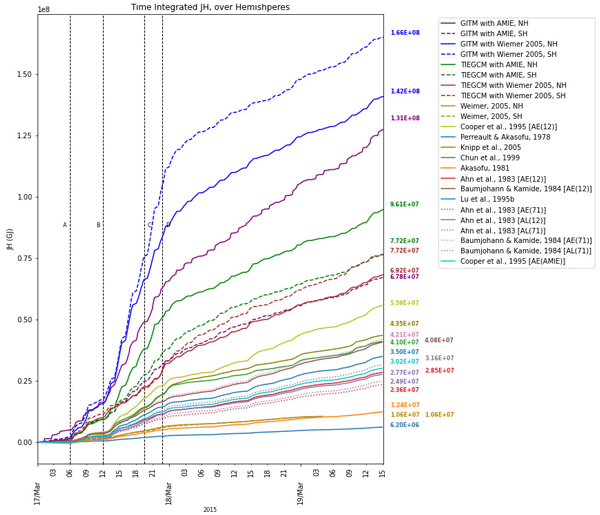
During geomagnetic storms, Joule heating is a major heating source of the upper atmosphere that is not well estimated, due to a lack of measurements. This leads to uncertainties in orbital calculations. We present simulations with commonly used physics-based models and empirical models that provide measurements of Joule heating. The results show great discrepancies, pointing to the need for measurements in the Earth's Lower Thermosphere-Ionosphere at altitudes where Joule heating maximizes.
Gabriella Stenberg Wieser, Martin Wieser, Stas Barabash, Philipp Wittmann, Leif Kalla, Markus Fränz, Elias Roussos, Audrey Vorburger, Peter Wurz, Jan-Erik Wahlund, Pontus C. Brandt, Yoshifumi Futaana, Manabu Shimoyama, Angèle Pontoni, André Galli, Andreas Riedo, George Ho, Donald G. Mitchell, George Clark, Peter Kollmann, Malamati Gkioulidou, Leonardo Regoli, Norbert Krupp, Robert Wimmer-Schweingruber, Kazushi Asamura, Esa Kallio, Andrea Opitz, Manuel Grande, Andrew Coates, Geraint Jones, Theodoros Sarris, Andrey Fedorov, Nicolas André, and Ján Baláž
Ann. Geophys., 44, 937–948, https://doi.org/10.5194/angeo-44-937-2026, https://doi.org/10.5194/angeo-44-937-2026, 2026
Short summary
Short summary
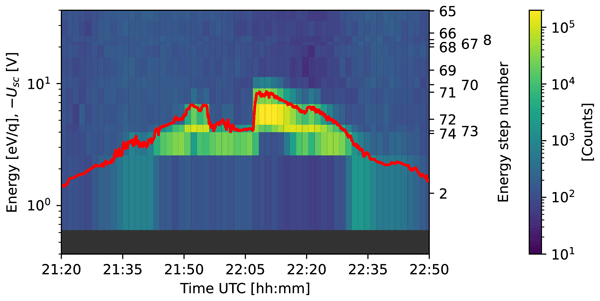
We used Juice flyby of Earth in August 2024 to evaluate the performance of the Jovian Plasma Dynamics and Composition analyzer (JDC). JDC measures positive and negative ions as well as electrons. When Juice arrives at Jupiter, one of the most challenging tasks for JDC is to record low energy ion populations. We used the data JDC recorded close to Earth, together with measurement in the laboratory on ground, to improve the future observations the sensor will make around Jupiter’s icy moons.
Harriet George, Andrew P. Dimmock, Vanina Lanabare, Heikki Vanhamäki, Ilkka Virtanen, Anita Aikio, Adrian Blagau, Octav Marghitu, Milla Myllymaa, Habtamu Tesfaw, Stephan Buchert, and Mykhaylo Shumko
EGUsphere, https://doi.org/10.5194/egusphere-2026-3108, https://doi.org/10.5194/egusphere-2026-3108, 2026
Short summary
Short summary
Bursty bulk flows are mesoscale ion flows that are ejected from magnetic reconnection sites in the Earth's magnetotail, and they couple to the ionosphere via field aligned currents that close through the ionosphere. We analyse unique triple-conjunctive observations of the coupled bursty bulk flow / current / ionosphere system to evaluate a case study of a bursty bulk flow and its ionospheric effects. We identify multiple current signatures of this bursty bulk flow within the ionosphere.
Vanina Lanabere, Stephan Buchert, Adrian Blagau, Harriet George, Sota Nanjo, Liisa Juusola, Andrew P. Dimmock, Samuel Wharton, Heikki Vanhamäki, Octav Marghitu, Louis Richard, Lei Cai, Alice V. L. Wallner, Daria Kotova, Yaqi Jin, Theresa Hoppe, Jennifer A. Carter, and Anita Aikio
EGUsphere, https://doi.org/10.5194/egusphere-2026-2997, https://doi.org/10.5194/egusphere-2026-2997, 2026
Short summary
Short summary
We studied a series of fast plasma streams that connected Earth’s nightside magnetic environment with the high‑latitude ionized upper atmosphere on 7 December 2023. Using satellite, auroral images and ground observations, we showed how each stream disturbed the upper atmosphere. Their repeated impact strengthened these disturbances until a substorm began, revealing how small events can build up to a larger magnetic disruption.
Markus Fraenz, Henning Fischer, Norbert Krupp, Elias Roussos, Philipp Wittmann, Patrick Bambach, Jan-Erik Wahlund, Gabriella Stenberg Wieser, Stas Barabash, Mika Holmberg, Maryam Zeroual, Pontus Brandt, Peter Wurz, Martin Wieser, Yoshifumi Futaana, Manabu Shimoyama, Angele Pontoni, Audrey Vorburger, Andre Galli, Andreas Riedo, George Ho, Donald Mitchell, George Clark, Peter Kollmann, Malamati Gkioulidou, Leonardo Regoli, Robert Wimmer-Schweingruber, Kazushi Asamura, Esa Kallio, Andrea Opitz, Manuel Grande, Andrew Coates, Geraint Jones, Theodoros Sarris, Andrey Fedorov, Nicolas André, and Ján Baláž
EGUsphere, https://doi.org/10.5194/egusphere-2026-2030, https://doi.org/10.5194/egusphere-2026-2030, 2026
Short summary
Short summary
During the first Earth gravity assist maneuver of the JUICE spacecraft in August 2024 the spacecraft passed through the Earth plasmasphere for about 2 hours. The ion spectrometer PEP JEI was able to make a very rare observation of the molecular ion fraction of the cold and dense plasma in the Earth plasmasphere. The observation shows that cold ions can emanate from the Earth ionosphere even at times when no magnetic storm enhances the ion extraction.
Stelios Tourgaidis, Dimitris Baloukidis, Panagiotis Pirnaris, Theodoros Sarris, Aaron Ridley, and Gang Lu
Ann. Geophys., 43, 881–899, https://doi.org/10.5194/angeo-43-881-2025, https://doi.org/10.5194/angeo-43-881-2025, 2025
Short summary
Short summary
During geomagnetic storms, Joule heating is a major heating source of the upper atmosphere that is not well estimated, due to a lack of measurements. This leads to uncertainties in orbital calculations. We present simulations with commonly used physics-based models and empirical models that provide measurements of Joule heating. The results show great discrepancies, pointing to the need for measurements in the Earth's Lower Thermosphere-Ionosphere at altitudes where Joule heating maximizes.
Yann Pfau-Kempf, Konstantinos Papadakis, Markku Alho, Markus Battarbee, Giulia Cozzani, Lauri Pänkäläinen, Urs Ganse, Fasil Kebede, Jonas Suni, Konstantinos Horaites, Maxime Grandin, and Minna Palmroth
Ann. Geophys., 43, 469–488, https://doi.org/10.5194/angeo-43-469-2025, https://doi.org/10.5194/angeo-43-469-2025, 2025
Short summary
Short summary
Flux ropes are peculiar structures of twisted magnetic field occurring in many regions of space, near Earth and other planets, at the Sun, and in astrophysical objects. We developed a new way of detecting flux ropes in large supercomputer simulations of near-Earth space, and we use it to follow the evolution of flux ropes for long distances past the Earth in the flow direction. This will be useful in future studies as these flux ropes are involved in the transport of matter and energy in space.
Urs Ganse, Yann Pfau-Kempf, Hongyang Zhou, Liisa Juusola, Abiyot Workayehu, Fasil Kebede, Konstantinos Papadakis, Maxime Grandin, Markku Alho, Markus Battarbee, Maxime Dubart, Leo Kotipalo, Arnaud Lalagüe, Jonas Suni, Konstantinos Horaites, and Minna Palmroth
Geosci. Model Dev., 18, 511–527, https://doi.org/10.5194/gmd-18-511-2025, https://doi.org/10.5194/gmd-18-511-2025, 2025
Short summary
Short summary
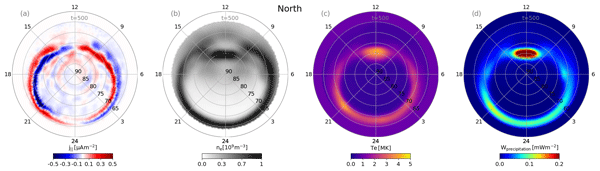
Vlasiator is a kinetic space plasma model that simulates the behavior of plasma, solar wind and magnetic fields in near-Earth space. So far, these simulations have been run without any interaction with the ionosphere, the uppermost layer of Earth's atmosphere. In this paper, we present the new methods that add an ionospheric electrodynamics model to Vlasiator, coupling it with the existing methods and presenting new simulation results of how space plasma and Earth's ionosphere interact.

Markku Alho, Giulia Cozzani, Ivan Zaitsev, Fasil Tesema Kebede, Urs Ganse, Markus Battarbee, Maarja Bussov, Maxime Dubart, Sanni Hoilijoki, Leo Kotipalo, Konstantinos Papadakis, Yann Pfau-Kempf, Jonas Suni, Vertti Tarvus, Abiyot Workayehu, Hongyang Zhou, and Minna Palmroth
Ann. Geophys., 42, 145–161, https://doi.org/10.5194/angeo-42-145-2024, https://doi.org/10.5194/angeo-42-145-2024, 2024
Short summary
Short summary
Magnetic reconnection is one of the main processes for energy conversion and plasma transport in space plasma physics, associated with plasma entry into the magnetosphere of Earth and Earth’s substorm cycle. Global modelling of these plasma processes enables us to understand the magnetospheric system in detail. However, finding sites of active reconnection from large simulation datasets can be challenging, and this paper develops tools to find magnetic topologies related to reconnection.
Jonas Suni, Minna Palmroth, Lucile Turc, Markus Battarbee, Giulia Cozzani, Maxime Dubart, Urs Ganse, Harriet George, Evgeny Gordeev, Konstantinos Papadakis, Yann Pfau-Kempf, Vertti Tarvus, Fasil Tesema, and Hongyang Zhou
Ann. Geophys., 41, 551–568, https://doi.org/10.5194/angeo-41-551-2023, https://doi.org/10.5194/angeo-41-551-2023, 2023
Short summary
Short summary
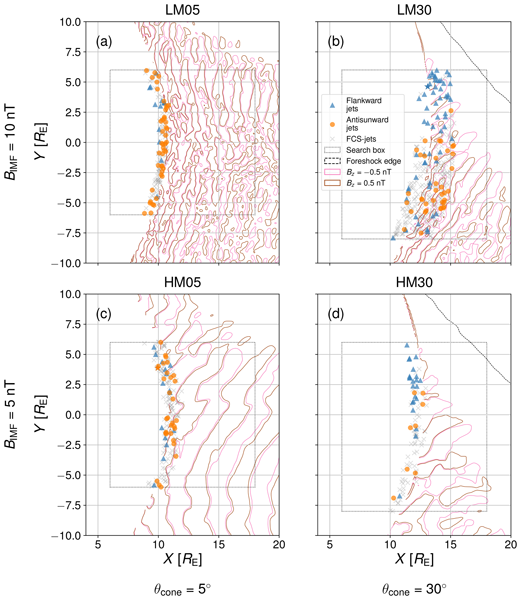
Magnetosheath jets are structures of enhanced plasma density and/or velocity in a region of near-Earth space known as the magnetosheath. When they propagate towards the Earth, these jets can disturb the Earth's magnetic field and cause hazards for satellites. In this study, we use a simulation called Vlasiator to model near-Earth space and investigate jets using case studies and statistical analysis. We find that jets that propagate towards the Earth are different from jets that do not.
Joachim Vogt, Octav Marghitu, Adrian Blagau, Leonie Pick, Nele Stachlys, Stephan Buchert, Theodoros Sarris, Stelios Tourgaidis, Thanasis Balafoutis, Dimitrios Baloukidis, and Panagiotis Pirnaris
Geosci. Instrum. Method. Data Syst., 12, 239–257, https://doi.org/10.5194/gi-12-239-2023, https://doi.org/10.5194/gi-12-239-2023, 2023
Short summary
Short summary
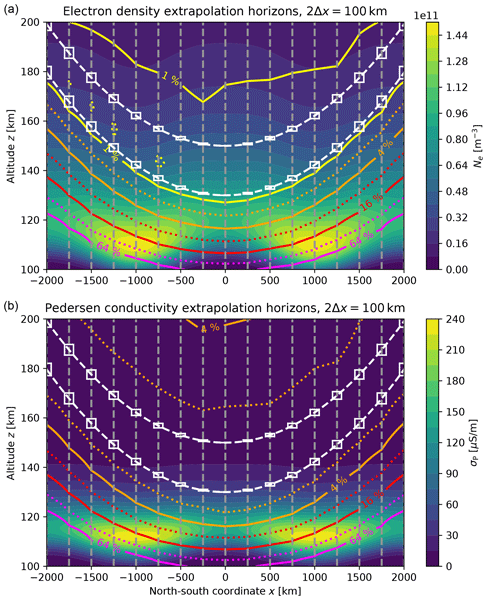
Motivated by recent community interest in a satellite mission to the atmospheric lower thermosphere and ionosphere (LTI) region (100–200 km altitude), the DIPCont project is concerned with the reconstruction quality of vertical profiles of key LTI variables using dual- and single-spacecraft observations. The report introduces the probabilistic DIPCont modeling framework, demonstrates its usage by means of a set of self-consistent parametric non-isothermal models, and discusses first results.
Panagiotis Pirnaris and Theodoros Sarris
Ann. Geophys., 41, 339–354, https://doi.org/10.5194/angeo-41-339-2023, https://doi.org/10.5194/angeo-41-339-2023, 2023
Short summary
Short summary
The relation between electron, ion and neutral temperatures in the lower thermosphere–ionosphere (LTI) is key to understanding the energy balance and transfer between species. However, their simultaneous measurement is rare in the LTI. Based on data from the AE-C, AE-D, AE-E and DE-2 satellites of the 1970s and 1980s, a large number of events where neutrals are hotter than ions are identified and statistically analyzed. Potential mechanisms that could trigger these events are proposed.

Konstantinos Papadakis, Yann Pfau-Kempf, Urs Ganse, Markus Battarbee, Markku Alho, Maxime Grandin, Maxime Dubart, Lucile Turc, Hongyang Zhou, Konstantinos Horaites, Ivan Zaitsev, Giulia Cozzani, Maarja Bussov, Evgeny Gordeev, Fasil Tesema, Harriet George, Jonas Suni, Vertti Tarvus, and Minna Palmroth
Geosci. Model Dev., 15, 7903–7912, https://doi.org/10.5194/gmd-15-7903-2022, https://doi.org/10.5194/gmd-15-7903-2022, 2022
Short summary
Short summary
Vlasiator is a plasma simulation code that simulates the entire near-Earth space at a global scale. As 6D simulations require enormous amounts of computational resources, Vlasiator uses adaptive mesh refinement (AMR) to lighten the computational burden. However, due to Vlasiator’s grid topology, AMR simulations suffer from grid aliasing artifacts that affect the global results. In this work, we present and evaluate the performance of a mechanism for alleviating those artifacts.
Filomena Catapano, Stephan Buchert, Enkelejda Qamili, Thomas Nilsson, Jerome Bouffard, Christian Siemes, Igino Coco, Raffaella D'Amicis, Lars Tøffner-Clausen, Lorenzo Trenchi, Poul Erik Holmdahl Olsen, and Anja Stromme
Geosci. Instrum. Method. Data Syst., 11, 149–162, https://doi.org/10.5194/gi-11-149-2022, https://doi.org/10.5194/gi-11-149-2022, 2022
Short summary
Short summary
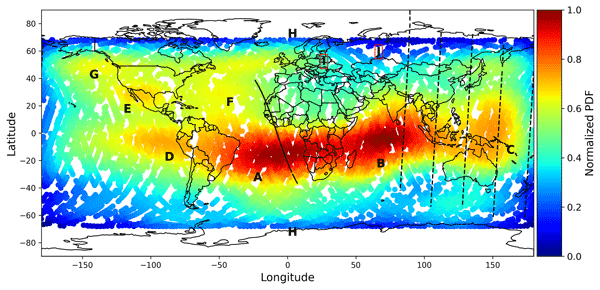
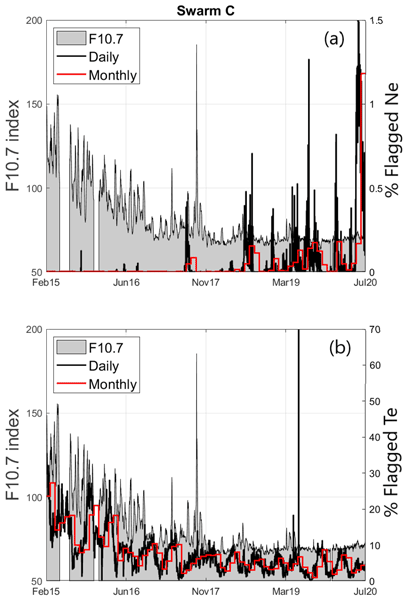
The quality control and validation activities performed by the Swarm data quality team reveal the good-quality LPs. The analysis demonstrated that the current baseline plasma data products are improved with respect to previous baseline. The LPs have captured the ionospheric plasma variability over more than half of a solar cycle, revealing the data quality dependence on the solar activity. The quality of the LP data will further improve promotion of their application to a broad range of studies.
Vertti Tarvus, Lucile Turc, Markus Battarbee, Jonas Suni, Xóchitl Blanco-Cano, Urs Ganse, Yann Pfau-Kempf, Markku Alho, Maxime Dubart, Maxime Grandin, Andreas Johlander, Konstantinos Papadakis, and Minna Palmroth
Ann. Geophys., 39, 911–928, https://doi.org/10.5194/angeo-39-911-2021, https://doi.org/10.5194/angeo-39-911-2021, 2021
Short summary
Short summary
We use simulations of Earth's magnetosphere and study the formation of transient wave structures in the region where the solar wind first interacts with the magnetosphere. These transients move earthward and play a part in the solar wind–magnetosphere interaction. We show that the transients are a common feature and their properties are altered as they move earthward, including an increase in temperature, decrease in solar wind speed and an alteration in their propagation properties.
Cited articles
Akasofu, S.-I.: Energy coupling between the solar wind and the magnetosphere, Space Science Rev., 28, 121–190, 1981. a
Baloukidis, D., Sarris, T., Tourgaidis, S., Pirnaris, P., Aikio, A., Virtanen, I., Buchert, S., and Papadakis, K.: A comparative assessment of the distribution of Joule heating in altitude as estimated in TIE-GCM and EISCAT over one solar cycle, J. Geophys. Res.-Space, 128, e2023JA031526, https://doi.org/10.1029/2023JA031526, 2023. a, b, c, d
Bilitza, D., Pezzopane, M., Truhlik, V., Altadill, D., Reinisch, B. W., and Pignalberi, A.: The International Reference Ionosphere model: A review and description of an ionospheric benchmark, Rev. Geophys., 60, e2022RG000792, https://doi.org/10.1029/2022RG000792, 2022. a
Brasseur, G. P. and Solomon, S.: Aeronomy of the middle atmosphere: Chemistry and physics of the stratosphere and mesosphere, Springer, https://doi.org/10.1007/1-4020-3824-0, 2005. a
Codrescu, M., Fuller-Rowell, T., and Foster, J.: On the importance of E-field variability for Joule heating in the high-latitude thermosphere, Geophys. Res. Lett., 22, 2393–2396, https://doi.org/10.1029/95GL01909, 1995. a
Dmitriev, A., Suvorova, A., Klimenko, M., Klimenko, V., Ratovsky, K., Rakhmatulin, R., and Parkhomov, V.: Predictable and unpredictable ionospheric disturbances during St. Patrick's Day magnetic storms of 2013 and 2015 and on 8–9 March 2008, J. Geophys. Res.-Space, 122, 2398–2423, 2017. a
Emmert, J. T., Drob, D. P., Picone, J. M., Siskind, D. E., Jones Jr., M., Mlynczak, M. G., Bernath, P. F., Chu, X., Doornbos, E., Funke, B., Goncharenko, L. P., Hervig, M. E., Schwartz, M. J., Sheese, P. E., Vargas, F., Williams, B. P., and Yuan, T.: NRLMSIS 2.0: A whole-atmosphere empirical model of temperature and neutral species densities, Earth Space Sci., 8, e2020EA001321, https://doi.org/10.1029/2020EA001321, 2021. a
ESA/NASA-ENLoTIS-Report: Exploring Earth's Interface with Space – The Scientific Case for a Satellite Mission to the Lower Thermosphere-Ionosphere Transition Region, Tech. Rep. ESA-EOPSM-ELTI-RP-4592/NASA/CR-20240013551, European Space Agency (ESA), Noordwijk, the Netherlands and National Aeronautics and Space Administration (NASA), Washington DC, United States of America, https://doi.org/10.5270/ESA-NASA.LTI-SC.2024-07-v1.0, 2024. a
Fang, X., Randall, C. E., Lummerzheim, D., Solomon, S. C., Mills, M. J., Marsh, D. R., Jackman, C. H., Wang, W., and Lu, G.: Electron impact ionization: A new parameterization for 100 eV to 1 MeV electrons, J. Geophys. Res.-Space, 113, https://doi.org/10.1029/2008JA013384, 2008. a
Galand, M.: Introduction to special section: Proton precipitation into the atmosphere, J. Geophys. Res.-Space, 106, 1–6, 2001. a
Galand, M. and Richmond, A. D.: Ionospheric electrical conductances produced by auroral proton precipitation, J. Geophys. Res.-Space, 106, 117–125, 2001. a
Galand, M., Fuller-Rowell, T., and Codrescu, M.: Response of the upper atmosphere to auroral protons, J. Geophys. Res.-Space, 106, 127–139, 2001. a
Goldstein, J., Angelopoulos, V., De Pascuale, S., Funsten, H. O., Kurth, W. S., LLera, K., McComas, D. J., Perez, J. D., Reeves, G. D., Spence, H. E., Thaller, S. A., Valek, P. W., and Wygant, J. R.: Cross-scale observations of the 2015 St. Patrick's day storm: THEMIS, Van Allen Probes, and TWINS, J. Geophys. Res.-Space, 122, 368–392, 2017. a
Hagan, M., Chang, J., and Avery, S.: Global-scale wave model estimates of nonmigrating tidal effects, J. Geophys. Res.-Atmos., 102, 16439–16452, 1997. a
Heelis, R. and Maute, A.: Challenges to understanding the Earth's ionosphere and thermosphere, J. Geophys. Res.-Space, 125, e2019JA027497, https://doi.org/10.1029/2019JA027497, 2020. a
Heelis, R., Lowell, J. K., and Spiro, R. W.: A model of the high-latitude ionospheric convection pattern, J. Geophys. Res.-Space, 87, 6339–6345, 1982. a
High Altitude Observatory: TIEGCM v3.0 (v1.0.0), Zenodo [code], https://doi.org/10.5281/zenodo.15214471, 2025. a
Hinteregger, H.: Representations of solar EUV fluxes for aeronomical applications, Adv. Space Res., 1, 39–52, 1981. a
Hudson, M., Jaynes, A., Kress, B., Li, Z., Patel, M., Shen, X.-C., Thaller, S., Wiltberger, M., and Wygant, J.: Simulated prompt acceleration of multi-MeV electrons by the 17 March 2015 interplanetary shock, J. Geophys. Res.-Space, 122, 10-036, https://doi.org/10.1002/2017JA024445, 2017. a
Jaynes, A. N., Ali, A., Elkington, S. R., Malaspina, D. M., Baker, D. N., Li, X., Kanekal, S. G., Henderson, M. G., Kletzing, C., and Wygant, J. R.: Fast diffusion of ultrarelativistic electrons in the outer radiation belt: 17 March 2015 storm event, Geophys. Res. Lett., 45, 10–874, 2018. a
Kan, J. and Lee, L.: Energy coupling function and solar wind-magnetosphere dynamo, Geophys. Res. Lett., 6, 577–580, 1979. a
Kanekal, S. G., Baker, D. N., Fennell, J. F., Jones, A., Schiller, Q., Richardson, I. G., Li, X., Turner, D. L., Califf, S., Claudepierre, S. G., Wilson III, L. B., Jaynes, A., Blake, J. B., Reeves, G. D., Spence, H. E., Kletzing, C. A., and Wygant J. R.: Prompt acceleration of magnetospheric electrons to ultrarelativistic energies by the 17 March 2015 interplanetary shock, J. Geophys. Res.-Space, 121, 7622–7635, 2016. a
Khazanov, G., Liemohn, M., Newman, T., Fok, M.-C., and Spiro, R.: Self-consistent magnetosphere-ionosphere coupling: Theoretical studies, J. Geophys. Res.-Space, 108, https://doi.org/10.1029/2002JA009624, 2003. a
Lomidze, L., Burchill, J., Knudsen, D., and Huba, J.: Estimation of ion temperature in the upper ionosphere along the Swarm satellite orbits, Earth Space Sci., 8, e2021EA001925, https://doi.org/10.1029/2021EA001925, 2021. a
Lyons, L., Gallardo-Lacourt, B., Zou, S., Weygand, J., Nishimura, Y., Li,W., Gkioulidou, M., Angelopoulos, V., Donovan, E., Ruohoniemi, J., Anderson, B. J., Shepherd, S. G., and Nishitani, N.: The 17 March 2013 storm: synergy of observations related to electric field modes and their ionospheric and magnetospheric effects, J. Geophys. Res.-Space, 121, 10–880, https://doi.org/10.1002/2016JA023237, 2016. a
Marsal, S., Torta, J., Segarra, A., and Araki, T.: Use of spherical elementary currents to map the polar current systems associated with the geomagnetic sudden commencements on 2013 and 2015 St. Patrick's Day storms, J. Geophys. Res.-Space, 122, 194–211, 2017. a
Matsuo, T. and Richmond, A. D.: Effects of high-latitude ionospheric electric field variability on global thermospheric Joule heating and mechanical energy transfer rate, J. Geophys. Res.-Space, 113, https://doi.org/10.1029/2007JA012993, 2008. a
Miyoshi, Y., Katoh, Y., Nishiyama, T., Sakanoi, T., Asamura, K., and Hirahara, M.: Time of flight analysis of pulsating aurora electrons, considering wave-particle interactions with propagating whistler mode waves, J. Geophys. Res.-Space, 115, https://doi.org/10.1029/2009JA015127, 2010. a
Mlynczak, M., Martin-Torres, F. J., Russell, J., Beaumont, K., Jacobson, S., Kozyra, J., Lopez-Puertas, M., Funke, B., Mertens, C., Gordley, L., Picard, R., Winick, J., Wintersteiner, P., and Paxton, L.: The natural thermostat of nitric oxide emission at 5.3 µm in the thermosphere observed during the solar storms of April 2002, Geophys. Res. Lett., 30, https://doi.org/10.1029/2003GL017693, 2003. a
Mlynczak, M. G., Martin-Torres, F. J., Crowley, G., Kratz, D. P., Funke, B., Lu, G., Lopez-Puertas, M., Russell III, J. M., Kozyra, J., Mertens, C., Sharma, R., Gordley, L., Picard, R., Winick, J., and Paxton, L.: Energy transport in the thermosphere during the solar storms of April 2002, J. Geophys. Res.-Space, 110, https://doi.org/10.1029/2005JA011141, 2005. a, b
Mlynczak, M. G., Hunt, L. A., Mertens, C. J., Thomas Marshall, B., Russell III, J. M., Woods, T., Earl Thompson, R., and Gordley, L. L.: Influence of solar variability on the infrared radiative cooling of the thermosphere from 2002 to 2014, Geophys. Res. Lett., 41, 2508–2513, 2014. a
Newell, P., Sotirelis, T., Liou, K., Meng, C.-I., and Rich, F.: A nearly universal solar wind-magnetosphere coupling function inferred from 10 magnetospheric state variables, J. Geophys. Res.-Space, 112, https://doi.org/10.1029/2006JA012015, 2007. a
Newell, P. T., Liou, K., and Wilson, G. R.: Polar cap particle precipitation and aurora: Review and commentary, J. Atmos. Sol.-Terr. Phy., 71, 199–215, 2009. a
Ozeke, L., Mann, I., Olifer, L., Dufresne, K., Morley, S., Claudepierre, S., Murphy, K., Spence, H., Baker, D., and Degeling, A.: Rapid outer radiation belt flux dropouts and fast acceleration during the March 2015 and 2013 storms: The role of ultra-low frequency wave transport from a dynamic outer boundary, J. Geophys. Res.-Space, 125, e2019JA027179, https://doi.org/10.1029/2019JA027179, 2020. a
Palmroth, M., Grandin, M., Sarris, T., Doornbos, E., Tourgaidis, S., Aikio, A., Buchert, S., Clilverd, M. A., Dandouras, I., Heelis, R., Hoffmann, A., Ivchenko, N., Kervalishvili, G., Knudsen, D. J., Kotova, A., Liu, H.-L., Malaspina, D. M., March, G., Marchaudon, A., Marghitu, O., Matsuo, T., Miloch, W. J., Moretto-Jørgensen, T., Mpaloukidis, D., Olsen, N., Papadakis, K., Pfaff, R., Pirnaris, P., Siemes, C., Stolle, C., Suni, J., van den IJssel, J., Verronen, P. T., Visser, P., and Yamauchi, M.: Lower-thermosphere–ionosphere (LTI) quantities: current status of measuring techniques and models, Ann. Geophys., 39, 189–237, https://doi.org/10.5194/angeo-39-189-2021, 2021. a
Peterson, W. K., Maruyama, N., Richards, P., Erickson, P. J., Christensen, A. B., and Yau, A. W.: What Is the Altitude of Thermal Equilibrium?, Geophys. Res. Lett., 50, e2023GL102758, https://doi.org/10.1029/2023GL102758, 2023. a, b
Pfaff, R., Rowland, D., Heelis, R., Clemmons, J., Kepko, L., Thayer, J., Benna, M., and Mesarch, M.: The Atmosphere-Space Transition Region Explorer (ASTRE)–A Low Perigee Satellite to Investigate the Coupling of the Earth's Upper Atmosphere and Magnetosphere, Tech. rep., NASA/TP-20220018963, https://ntrs.nasa.gov/api/citations/20220018963/downloads/NASA TP 20220018963.pdf (last access: 16 August 2026), 2022. a
Pirnaris, P. and Sarris, T.: Analysis of in situ measurements of electron, ion and neutral temperatures in the lower thermosphere–ionosphere, Ann. Geophys., 41, 339–354, https://doi.org/10.5194/angeo-41-339-2023, 2023. a, b
Prikryl, P., Ghoddousi-Fard, R.,Weygand, J., Viljanen, A., Connors, M., Danskin, D., Jayachandran, P., Jacobsen, K., Andalsvik, Y., Thomas, E., Ruohoniemi, J. M., Durgonics, T., Oksavik, K., Zhang, Y., Spanswick, E., Aquino, M., and Sreeja, V.: GPS phase scintillation at high latitudes during the geomagnetic storm of 17–18 March 2015, J. Geophys. Res.-Space, 121, 10–448, 2016. a
Randall, C., Harvey, V., Singleton, C., Bailey, S., Bernath, P., Codrescu, M., Nakajima, H., and Russell III, J.: Energetic particle precipitation effects on the Southern Hemisphere stratosphere in 1992–2005, J. Geophys. Res.-Atmos., 112, https://doi.org/10.1029/2006JD007696, 2007. a
Richards, P., Fennelly, J. a., and Torr, D.: EUVAC: A solar EUV flux model for aeronomic calculations, J. Geophys. Res.-Space, 99, 8981–8992, 1994. a
Richmond, A.: Ionospheric Electrodynamics Using Magnetic Apex Coordinates, J. Geomagn. Geoelectr., 47, https://doi.org/10.5636/jgg.47.191, 1995. a
Ridley, A., Deng, Y., and Tóth, G.: The global ionosphere–thermosphere model, J. Atmos. Sol.-Terr. Phy., 68, 839–864, 2006. a
Roble, R. G.: Energetics of the Mesosphere and Thermosphere, in: The Upper Mesosphere and Lower Thermosphere: A Review of Experiment and Theory, edited by: Johnson, R. M. and Killeen, T. L., AGU, Geophysical Monograph Series, https://doi.org/10.1029/GM087p0001, 1995. a
Sarris, T., Palmroth, M., Aikio, A., Buchert, S. C., Clemmons, J., Clilverd, M., Dandouras, I., Doornbos, E., Goodwin, L. V., Grandin, M., Heelis, R., Ivchenko, N., Moretto-Jørgensen, T., Kervalishvili, G., Knudsen, D., Liu, H.-L., Lu, G., Malaspina, D. M., Marghitu, O., Maute, A., Miloch, W. J., Olsen, N., Pfaff, R., Stolle, C., Talaat, E., Thayer, J., Tourgaidis, S., Verronen, P. T., and Yamauchi, M.: Plasma-neutral interactions in the lower thermosphere-ionosphere: The need for in situ measurements to address focused questions, Frontiers in Astronomy and Space Sciences, 9, https://doi.org/10.3389/fspas.2022.1063190, 2023a. a
Sarris, T. E.: Understanding the ionosphere thermosphere response to solar and magnetospheric drivers: status, challenges and open issues, Philos. T. R. Soc. A, 377, 20180101, https://doi.org/10.1098/rsta.2018.0101, 2019. a
Sarris, T. E., Talaat, E. R., Palmroth, M., Dandouras, I., Armandillo, E., Kervalishvili, G., Buchert, S., Tourgaidis, S., Malaspina, D. M., Jaynes, A. N., Paschalidis, N., Sample, J., Halekas, J., Doornbos, E., Lappas, V., Moretto Jørgensen, T., Stolle, C., Clilverd, M., Wu, Q., Sandberg, I., Pirnaris, P., and Aikio, A.: Daedalus: a low-flying spacecraft for in situ exploration of the lower thermosphere–ionosphere, Geosci. Instrum. Method. Data Syst., 9, 153–191, https://doi.org/10.5194/gi-9-153-2020, 2020. a, b
Sarris, T. E., Tourgaidis, S., Pirnaris, P., Baloukidis, D., Papadakis, K., Psychalas, C., Buchert, S. C., Doornbos, E., Clilverd, M. A., Verronen, P. T., Malaspina, D., Ahmadi, N., Dandouras, I., Kotova, A., Miloch, W. J., Knudsen, D., Olsen, N., Marghitu, O., Matsuo, T., Lu, G., Marchaudon, A., Hoffmann, A., Lajas, D., Strømme, A., Taylor, M., Aikio, A., Palmroth, M., Heelis, R., Ivchenko, N., Stolle, C., Kervalishvili, G., Moretto-Jørgensen, T., Pfaff, R., Siemes, C., Visser, P., van den Ijssel, J., Liu, H.-L., Sandberg, I., Papadimitriou, C., Vogt, J., Blagau, A., and Stachlys, N.: Daedalus MASE (mission assessment through simulation exercise): A toolset for analysis of in situ missions and for processing global circulation model outputs in the lower thermosphere-ionosphere, Frontiers in Astronomy and Space Sciences, 9, https://doi.org/10.3389/fspas.2022.1048318, 2023b. a, b, c, d
Sarris, T. E., Tourgaidis, S., Baloukidis, D., Grandin, M., Maute, A., Pfaff, R. F., Thayer, J., Clemmons, J., Laundal, K., Liu, H., Pirnaris, P., Partamies, Laskar, F. I., Berthelier, J. J., Ivchenko, M., Knudsen, D., Matsuo, T., Palmroth, M., Peterson, W. K., Perry, G., Stolle, C., Vines, S., Blanc, M., Barthelemy, M., and Nesse, H.: Open Questions on Ion–Neutral Collisions and Coupling in the Lower Thermosphere–Ionosphere: Electrodynamics, Energetics and Dynamics, Surv. Geophys., 1–40, 2026. a
Sinnhuber, M., Nieder, H., and Wieters, N.: Energetic particle precipitation and the chemistry of the mesosphere/lower thermosphere, Surv. Geophys., 33, 1281–1334, 2012. a
Solomon, S. C. and Qian, L.: Solar extreme-ultraviolet irradiance for general circulation models, J. Geophys. Res.-Space, 110, https://doi.org/10.1029/2005JA011160, 2005. a
Tesema, F., Partamies, N., Tyssøy, H. N., Kero, A., and Smith-Johnsen, C.: Observations of electron precipitation during pulsating aurora and its chemical impact, J. Geophys. Res.-Space, 125, e2019JA027713, https://doi.org/10.1029/2019JA027713, 2020. a
Tian, X., Yu, Y., and Yue, C.: Statistical survey of storm-time energetic particle precipitation, J. Atmos. Sol.-Terr. Phy., 199, 105204, https://doi.org/10.1016/j.jastp.2020.105204, 2020. a
Tourgaidis, S. and Sarris, T.: Wave-particle interactions toolset: A python-based toolset to model wave-particle interactions in the magnetosphere, Frontiers in Astronomy and Space Sciences, 9, 1005598, https://doi.org/10.3389/fspas.2022.1005598, 2022. a
Tourgaidis, S., Baloukidis, D., Pirnaris, P., Sarris, T., Ridley, A., and Lu, G.: Globally- and hemispherically-integrated Joule heating rates during the 17 March 2015 geomagnetic storm, according to physics-based and empirical models, Ann. Geophys., 43, 881–899, https://doi.org/10.5194/angeo-43-881-2025, 2025a. a, b, c, d, e, f
Turunen, E., Verronen, P. T., Seppälä, A., Rodger, C. J., Clilverd, M. A., Tamminen, J., Enell, C.-F., and Ulich, T.: Impact of different energies of precipitating particles on NOx generation in the middle and upper atmosphere during geomagnetic storms, J. Atmos. Sol.-Terr. Phy., 71, 1176–1189, 2009. a
Vasyliūnas, V. M. and Song, P.: Meaning of ionospheric Joule heating, J. Geophys. Res.-Space, 110, https://doi.org/10.1029/2004JA010615, 2005. a
Verkhoglyadova, O., Meng, X., Mannucci, A. J., Tsurutani, B. T., Hunt, L. A., Mlynczak, M. G., Hajra, R., and Emery, B. A.: Estimation of energy budget of ionosphere-thermosphere system during two CIR-HSS events: observations and modeling, J. Space Weather Spac., 6, A20, https://doi.org/10.1051/swsc/2016013, 2016. a, b
Verkhoglyadova, O., Meng, X., Mannucci, A., Mlynczak, M., Hunt, L., and Lu, G.: Ionosphere-thermosphere energy budgets for the ICME storms of March 2013 and 2015 estimated with GITM and observational proxies, Space Weather, 15, 1102–1124, 2017. a
Verronen, P. T., Andersson, M. E., Kero, A., Enell, C.-F., Wissing, J. M., Talaat, E. R., Kauristie, K., Palmroth, M., Sarris, T. E., and Armandillo, E.: Contribution of proton and electron precipitation to the observed electron concentration in October–November 2003 and September 2005, Ann. Geophys., 33, 381–394, https://doi.org/10.5194/angeo-33-381-2015, 2015. a
Verronen, P., Andersson, M., Marsh, D., Kovács, T., and Plane, J.: WACCM-D—Whole atmosphere community climate model with D-region ion chemistry, J. Adv. Model. Earth Sy., 8, 954–975, 2016. a
Vogt, J., Marghitu, O., Blagau, A., Pick, L., Stachlys, N., Buchert, S., Sarris, T., Tourgaidis, S., Balafoutis, T., Baloukidis, D., and Pirnaris, P.: Daedalus Ionospheric Profile Continuation (DIPCont): Monte Carlo studies assessing the quality of in situ measurement extrapolation, Geosci. Instrum. Method. Data Syst., 12, 239–257, https://doi.org/10.5194/gi-12-239-2023, 2023. a
Wei, D., Yu, Y., and He, F.: The magnetospheric driving source of double-peak subauroral ion drifts: Double ring current pressure peaks, Geophys. Res. Lett., 46, 7079–7087, 2019. a
Weimer, D.: Improved ionospheric electrodynamic models and application to calculating Joule heating rates, J. Geophys. Res.-Space, 110, https://doi.org/10.1029/2004JA010884, 2005. a, b
Woods, T. N. and Rottman, G. J.: Solar ultraviolet variability over time periods of aeronomic interest, Geophyscal Monograph-American Geophysical Union, 130, 221–234, https://doi.org/10.1029/130GM14, 2002. a
Wu, C.-C., Liou, K., Lepping, R. P., Hutting, L., Plunkett, S., Howard, R. A., and Socker, D.: The first super geomagnetic storm of solar cycle 24: “The St. Patrick's day event (17 March 2015)”, Earth Planets Space, 68, 1–12, 2016. a
Yue, X., Wan, W., Liu, L., Liu, J., Zhang, S., Schreiner, W. S., Zhao, B., and Hu, L.: Mapping the conjugate and corotating storm-enhanced density during 17 March 2013 storm through data assimilation, J. Geophys. Res.-Space, 121, 12-202, https://doi.org/10.1002/2016JA023038, 2016. a
Zakharenkova, I., Astafyeva, E., and Cherniak, I.: GPS and GLONASS observations of large-scale traveling ionospheric disturbances during the 2015 St. Patrick's Day storm, J. Geophys. Res.-Space, 121, 12-138, https://doi.org/10.1002/2016JA023332, 2016. a
Zhang, S.-R., Erickson, P. J., Zhang, Y., Wang, W., Huang, C., Coster, A. J., Holt, J. M., Foster, J. F., Sulzer, M., and Kerr, R.: Observations of ion-neutral coupling associated with strong electrodynamic disturbances during the 2015 St. Patrick's Day storm, J. Geophys. Res.-Space, 122, 1314–1337, 2017. a
Zou, S., Moldwin, M. B., Ridley, A. J., Nicolls, M. J., Coster, A. J., Thomas, E. G., and Ruohoniemi, J. M.: On the generation/decay of the storm-enhanced density plumes: Role of the convection flow and field-aligned ion flow, J. Geophys. Res.-Space, 119, 8543–8559, 2014. a
Short summary
The Lower Thermosphere-Ionosphere energy balance is driven by complex interactions between ions, neutrals and electrons. These processes are understood theoretically, but their estimates show large discrepancies between models. We calculate the storm-time energy budget according to the neutrals, ions and electrons using TIE-GCM (Thermosphere Ionosphere Electrodynamics General Circulation Model) using two different external drivers. Discrepancies between the model runs are discussed and the way forward to close the gaps in present knowledge is highlighted.
The Lower Thermosphere-Ionosphere energy balance is driven by complex interactions between ions,...


