
Articles | Volume 44, issue 2
https://doi.org/10.5194/angeo-44-1023-2026
© Author(s) 2026. This work is distributed under
the Creative Commons Attribution 4.0 License.
the Creative Commons Attribution 4.0 License.
https://doi.org/10.5194/angeo-44-1023-2026
© Author(s) 2026. This work is distributed under
the Creative Commons Attribution 4.0 License.
the Creative Commons Attribution 4.0 License.
Regular paper
| 
12 Oct 2026
Regular paper |
| 12 Oct 2026
| 12 Oct 2026
Statistical properties of internal modulation in pulsating aurora

Swedish Institute of Space Physics (IRF), Kiruna, Sweden
Tomoe Taki
Swedish Institute of Space Physics (IRF), Kiruna, Sweden
Keisuke Hosokawa
Department of Computer and Network Engineering, The University of Electro-Communications, Chofu, Japan
Urban Brändström
Swedish Institute of Space Physics (IRF), Kiruna, Sweden
Yoshizumi Miyoshi
Institute for Space-Earth Environmental Research (ISEE), Nagoya University, Nagoya, Japan
Magnar G. Johnsen
Tromsø Geophysical Observatory, UiT The Arctic University of Norway, Tromsø, Norway
Related authors
Vanina Lanabere, Stephan Buchert, Adrian Blagau, Harriet George, Sota Nanjo, Liisa Juusola, Andrew P. Dimmock, Samuel Wharton, Heikki Vanhamäki, Octav Marghitu, Louis Richard, Lei Cai, Alice V. L. Wallner, Daria Kotova, Yaqi Jin, Theresa Hoppe, Jennifer A. Carter, and Anita Aikio
Ann. Geophys., 44, 977–1001, https://doi.org/10.5194/angeo-44-977-2026, https://doi.org/10.5194/angeo-44-977-2026, 2026
Short summary
Short summary
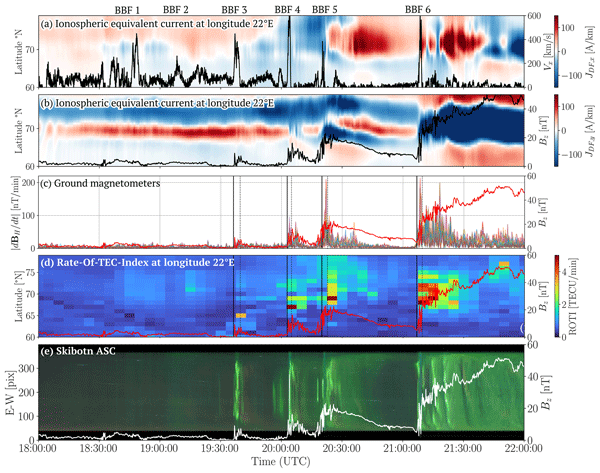
We studied a series of fast plasma streams that connected Earth’s nightside magnetic environment with the high‑latitude ionized upper atmosphere on 7 December 2023. Using satellite, auroral images and ground observations, we showed how each stream disturbed the upper atmosphere. Their repeated impact strengthened these disturbances until a substorm began, revealing how small events can build up to a larger magnetic disruption.
Sota Nanjo, Satoshi Kurita, Tima Sergienko, Yoshizumi Miyoshi, and Ryuho Kataoka
Ann. Geophys., 44, 959–975, https://doi.org/10.5194/angeo-44-959-2026, https://doi.org/10.5194/angeo-44-959-2026, 2026
Short summary
Short summary
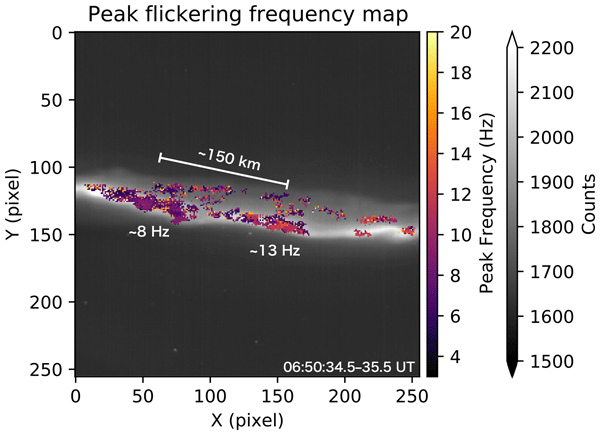
Using a high-speed camera with a wide view of the sky, we observed rapidly blinking aurora across several hundred kilometers. We found that different parts of the same auroral arc can blink at different rhythms at the same time, and that these rhythms move together with the arc. Although larger bright patches sometimes blink more slowly, this pattern does not hold overall. These results improve our understanding of how invisible space processes shape the visible northern lights.
Tomoe Taki, Tima Sergienko, Urban Brändström, Yasunobu Ogawa, Sota Nanjo, and Juan Araújo
EGUsphere, https://doi.org/10.5194/egusphere-2026-1133, https://doi.org/10.5194/egusphere-2026-1133, 2026
Short summary
Short summary
This study explored electric forces near a auroral arc during a rocket experiment in northern Sweden. A rocket released glowing clouds high above Earth, and we tracked their motion as an aurora passed through them. By reconstructing their motion in three dimensions, we estimated the magnitude and direction of the surrounding electric field. We found that the field changed direction and became weaker near the arc, revealing the structure of electric currents correspond to auroral activity.

Sota Nanjo, Katie Herlingshaw, Tima Sergienko, Gaël Cessateur, Noora Partamies, Magnar G. Johnsen, Keisuke Hosokawa, Hervé Lamy, Yasunobu Ogawa, Antti Kero, Shin-ichiro Oyama, and Masatoshi Yamauchi
Ann. Geophys., 44, 63–84, https://doi.org/10.5194/angeo-44-63-2026, https://doi.org/10.5194/angeo-44-63-2026, 2026
Short summary
Short summary
During the New Year’s Day storm of 2025, we observed rare auroral features: thin, short-lived green stripes and a “picket fence” near the poleward edge of the auroral oval. Using ground cameras and satellites, we found that the stripes sometimes appeared at widely separated longitudes at the same time and often tracked the motion of nearby red auroras. Some stripes were aligned with the magnetic field, while others were not, implying that multiple local processes contribute to their generation.
Gaël Cessateur, Keisuke Hosokawa, Hervé Lamy, Sota Nanjo, Mathieu Barthelemy, Magnar G. Johnsen, and Romain Maggiolo
EGUsphere, https://doi.org/10.5194/egusphere-2026-385, https://doi.org/10.5194/egusphere-2026-385, 2026
Short summary
Short summary
The Auroral Spectrograph in Skibotn has been measuring auroral light spectra since October 2023. We estimate the energy of electrons producing diffuse auroras from red oxygen and blue nitrogen emissions. Our statistical analysis shows that electron energy increases toward the morning sector, confirming previous studies: electron scattering by chorus waves can populate the loss cone and lead to precipitation, while changes in resonance conditions toward dawn favor harder electrons
Sota Nanjo, Masatoshi Yamauchi, Magnar Gullikstad Johnsen, Yoshihiro Yokoyama, Urban Brändström, Yasunobu Ogawa, Anna Naemi Willer, and Keisuke Hosokawa
Ann. Geophys., 43, 303–317, https://doi.org/10.5194/angeo-43-303-2025, https://doi.org/10.5194/angeo-43-303-2025, 2025
Short summary
Short summary
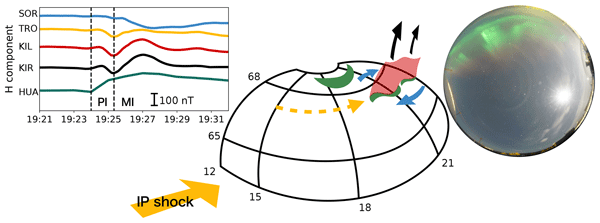
Our research explores the shock aurora, which is typically observed on the dayside due to the rapid compression of the Earth's magnetic field. We observed this rare aurora on the nightside, a region where such events are difficult to detect. Using ground-based cameras, we identified new features, including leaping and vortex-like patterns. These findings offer a fresh insight into the interactions between the solar wind and the magnetosphere, enhancing our understanding of space weather and its effects.
Vanina Lanabere, Stephan Buchert, Adrian Blagau, Harriet George, Sota Nanjo, Liisa Juusola, Andrew P. Dimmock, Samuel Wharton, Heikki Vanhamäki, Octav Marghitu, Louis Richard, Lei Cai, Alice V. L. Wallner, Daria Kotova, Yaqi Jin, Theresa Hoppe, Jennifer A. Carter, and Anita Aikio
Ann. Geophys., 44, 977–1001, https://doi.org/10.5194/angeo-44-977-2026, https://doi.org/10.5194/angeo-44-977-2026, 2026
Short summary
Short summary
We studied a series of fast plasma streams that connected Earth’s nightside magnetic environment with the high‑latitude ionized upper atmosphere on 7 December 2023. Using satellite, auroral images and ground observations, we showed how each stream disturbed the upper atmosphere. Their repeated impact strengthened these disturbances until a substorm began, revealing how small events can build up to a larger magnetic disruption.
Sota Nanjo, Satoshi Kurita, Tima Sergienko, Yoshizumi Miyoshi, and Ryuho Kataoka
Ann. Geophys., 44, 959–975, https://doi.org/10.5194/angeo-44-959-2026, https://doi.org/10.5194/angeo-44-959-2026, 2026
Short summary
Short summary
Using a high-speed camera with a wide view of the sky, we observed rapidly blinking aurora across several hundred kilometers. We found that different parts of the same auroral arc can blink at different rhythms at the same time, and that these rhythms move together with the arc. Although larger bright patches sometimes blink more slowly, this pattern does not hold overall. These results improve our understanding of how invisible space processes shape the visible northern lights.
Marie Vigger Eldor, Magnar Gullikstad Johnsen, Nils Olsen, and Anna Naemi Willer
Ann. Geophys., 44, 811–823, https://doi.org/10.5194/angeo-44-811-2026, https://doi.org/10.5194/angeo-44-811-2026, 2026
Short summary
Short summary
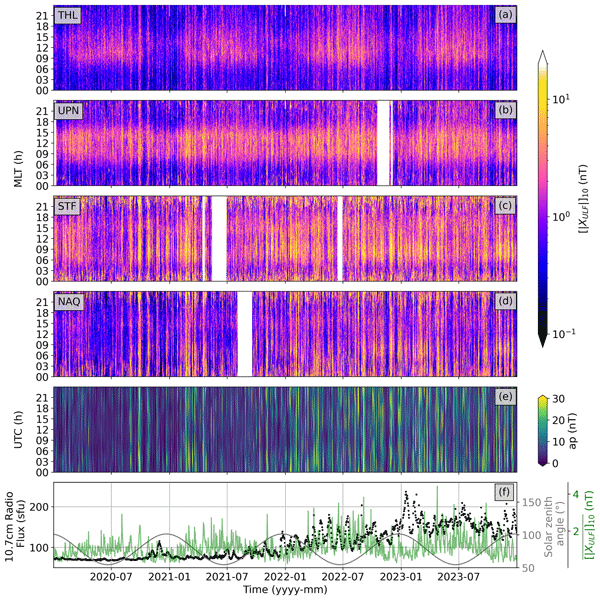
Rapid geomagnetic variations in the ultra-low frequency band are observed using ground-based magnetometers. We apply four years of data from West Greenland in a statistical analysis of the distribution of such variations. We identify a rapid geomagnetic variation population associated with the magnetospheric cusp that is separate from the auroral oval during summer. Earlier studies, which were mainly performed in winter, failed to unambiguously identify these variations.
Gaël Cessateur, Jean Lilensten, Hervé Lamy, Léo Bosse, Magnar G. Johnsen, Antonio Guerrero, David Bolsée, Mathieu Barthelemy, Thijs A. Stockmans, and Frans Snik
EGUsphere, https://doi.org/10.5194/egusphere-2026-3324, https://doi.org/10.5194/egusphere-2026-3324, 2026
This preprint is open for discussion and under review for Annales Geophysicae (ANGEO).
Short summary
Short summary
Auroras are more than beautiful lights: the way their light is polarized may reveal how charged particles enter the upper atmosphere. Such measurements have so far been limited to instruments that observe only a very small part of the sky. In this study, we show that a new polarization camera can map this signal across an aurora. We find that the polarization angle often changes coherently across the scene, while the polarization strength decreases in the brightest parts.
Thomas B. Leyser, Tima Sergienko, Yoshihiro Yokoyama, Tomoe Taki, and Urban Brändström
EGUsphere, https://doi.org/10.5194/egusphere-2026-2925, https://doi.org/10.5194/egusphere-2026-2925, 2026
Short summary
Short summary
The BROR rocket experiment, launched from Esrange near Kiruna, Sweden, involved releases of barium clouds in the thermosphere to study auroral structures. The barium was ejected by the explosion-like combustion of ignited thermite. Shock waves could be observed to follow the ejections when the rocket speed was supersonic, but not when subsonic. The shock waves are attributed to ejected particulate matter from the thermite combustion that traveled at supersonic speed.
Magnus F. Ivarsen, Glenn C. Hussey, Yoshizumi Miyoshi, David R. Themens, Atsuki Shinbori, and Shoichiro Yokota
EGUsphere, https://doi.org/10.5194/egusphere-2026-2345, https://doi.org/10.5194/egusphere-2026-2345, 2026
Short summary
Short summary
During aurorae, space-driven electric fields churn the upper atmosphere's plasma into millions of chaotic waves. We applied complexity-science methods to treat their collective electric fields as effective noise, and tested the theory against four years of radar and satellite data. The turbulence self-regulates: extra storm energy produces more waves, not faster ones, scaling predictably with driving power, and thereby we offer candidate transport equations for global space-weather models.
Magnus F. Ivarsen, Kaili Song, Luca Spogli, Jean-Pierre St-Maurice, Devin Ray Huyghebaert, Brian Pitzel, Saif Marei, Yangyang Shen, Satoshi Kasahara, Kunihiro Keika, Yoshizumi Miyoshi, Tomo Hori, Atsuki Shinbori, Kazuhiro Yamamoto, David Russel Themens, P. Thayyil Jayachandran, Yoichi Kazama, Shiang-Yu Wang, Ayako Matsuoka, Iku Shinohara, Takefumi Mitani, Takeshi Takashima, Shoichiro Yokota, Yoshiya Kasahara, and Glenn Hussey
EGUsphere, https://doi.org/10.5194/egusphere-2026-2344, https://doi.org/10.5194/egusphere-2026-2344, 2026
Short summary
Short summary
During geomagnetic storms, the sun drives auroral plasma turbulence that disrupts GPS signals. This turbulence spans sizes from hundreds of kilometers to meters, but most instruments see only a narrow slice. We combined radar and GPS receiver data to build a continuous turbulence spectrum across four orders of magnitude in scale, validated by satellite conjunctions. The spectrum suggests the ionosphere directly mirrors magnetospheric energy input, providing a baseline for space weather models.
Liisa Juusola, Ari Viljanen, Ilja Honkonen, Magnar Gullikstad Johnsen, Andrew Dimmock, Vanina Lanabere, and Alice Wallner
EGUsphere, https://doi.org/10.5194/egusphere-2026-1110, https://doi.org/10.5194/egusphere-2026-1110, 2026
Short summary
Short summary
During severe space storms, the induced geoelectric field has the potential to cause substantial problems in power grids. We examine the geomagnetically induced currents (GIC) the geoelectric field would have driven in a simple model power grid located in Northern Europe during the May 2024 superstorm. Our results help us understand how the complicated interaction between the driving from space and the response of the conducting ground produces the most intense GIC peaks.
Tomoe Taki, Tima Sergienko, Urban Brändström, Yasunobu Ogawa, Sota Nanjo, and Juan Araújo
EGUsphere, https://doi.org/10.5194/egusphere-2026-1133, https://doi.org/10.5194/egusphere-2026-1133, 2026
Short summary
Short summary
This study explored electric forces near a auroral arc during a rocket experiment in northern Sweden. A rocket released glowing clouds high above Earth, and we tracked their motion as an aurora passed through them. By reconstructing their motion in three dimensions, we estimated the magnitude and direction of the surrounding electric field. We found that the field changed direction and became weaker near the arc, revealing the structure of electric currents correspond to auroral activity.
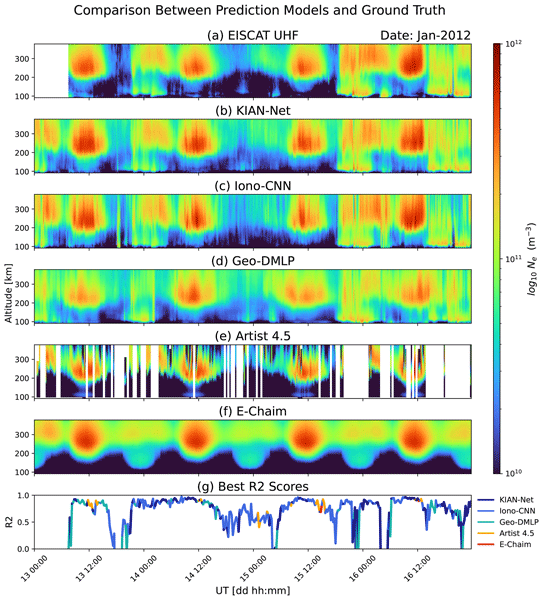
Kian Sartipzadeh, Andreas Kvammen, Björn Gustavsson, Njål Gulbrandsen, Magnar G. Johnsen, Devin Huyghebaert, and Juha Vierinen
Ann. Geophys., 44, 85–107, https://doi.org/10.5194/angeo-44-85-2026, https://doi.org/10.5194/angeo-44-85-2026, 2026
Short summary
Short summary
Knowledge of the charged environment in the upper atmosphere is essential for understanding space weather effects on satellites and radio communication. This environment is difficult to estimate at high latitudes, where aurora cause strong variability. We developed an artificial intelligence model to estimate this environment continuously. Our results show that the model provides reliable estimates even during auroral activity, improving monitoring of the polar upper atmosphere.
Sota Nanjo, Katie Herlingshaw, Tima Sergienko, Gaël Cessateur, Noora Partamies, Magnar G. Johnsen, Keisuke Hosokawa, Hervé Lamy, Yasunobu Ogawa, Antti Kero, Shin-ichiro Oyama, and Masatoshi Yamauchi
Ann. Geophys., 44, 63–84, https://doi.org/10.5194/angeo-44-63-2026, https://doi.org/10.5194/angeo-44-63-2026, 2026
Short summary
Short summary
During the New Year’s Day storm of 2025, we observed rare auroral features: thin, short-lived green stripes and a “picket fence” near the poleward edge of the auroral oval. Using ground cameras and satellites, we found that the stripes sometimes appeared at widely separated longitudes at the same time and often tracked the motion of nearby red auroras. Some stripes were aligned with the magnetic field, while others were not, implying that multiple local processes contribute to their generation.
Gaël Cessateur, Keisuke Hosokawa, Hervé Lamy, Sota Nanjo, Mathieu Barthelemy, Magnar G. Johnsen, and Romain Maggiolo
EGUsphere, https://doi.org/10.5194/egusphere-2026-385, https://doi.org/10.5194/egusphere-2026-385, 2026
Short summary
Short summary
The Auroral Spectrograph in Skibotn has been measuring auroral light spectra since October 2023. We estimate the energy of electrons producing diffuse auroras from red oxygen and blue nitrogen emissions. Our statistical analysis shows that electron energy increases toward the morning sector, confirming previous studies: electron scattering by chorus waves can populate the loss cone and lead to precipitation, while changes in resonance conditions toward dawn favor harder electrons
Stephen Omondi, Spencer Mark Hatch, Andreas Kvammen, Magnar Gullikstad Johnsen, Mathew J. Owens, Kristian Solheim Thinn, and Rodrigo López
EGUsphere, https://doi.org/10.5194/egusphere-2025-6298, https://doi.org/10.5194/egusphere-2025-6298, 2026
Short summary
Short summary
Researchers tested whether combining real-time solar wind data with forecasts can improve predictions of local geomagnetic activity in Norway. Using a machine learning model, they found that accurate solar wind speed and magnetic field direction are key for reliable forecasts over 3 hours ahead, while CME arrival time only helps if magnetic field data is precise.
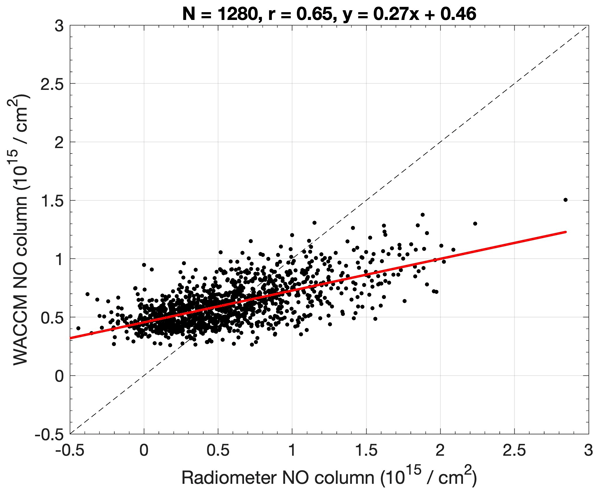
Pekka T. Verronen, Akira Mizuno, Yoshizumi Miyoshi, Sandeep Kumar, Taku Nakajima, Shin-Ichiro Oyama, Tomoo Nagahama, Satonori Nozawa, Monika E. Szeląg, Tuomas Häkkilä, Niilo Kalakoski, Antti Kero, Esa Turunen, Satoshi Kasahara, Shoichiro Yokota, Kunihiro Keika, Tomoaki Hori, Takefumi Mitani, Takeshi Takashima, and Iku Shinohara
Ann. Geophys., 43, 561–578, https://doi.org/10.5194/angeo-43-561-2025, https://doi.org/10.5194/angeo-43-561-2025, 2025
Short summary
Short summary
We use NO column density data from the Syowa station in Antarctica from 2012–2017. We compare these ground-based radiometer observations with results from a global atmosphere model to understand the year-to-year and day-to-day variability, shortcomings of current electron forcing, and how geomagnetic storms are driving the variability of NO. Our results demonstrate an underestimation in the magnitude of day-to-day variability in simulations, which calls for improved electron forcing in models.
Sota Nanjo, Masatoshi Yamauchi, Magnar Gullikstad Johnsen, Yoshihiro Yokoyama, Urban Brändström, Yasunobu Ogawa, Anna Naemi Willer, and Keisuke Hosokawa
Ann. Geophys., 43, 303–317, https://doi.org/10.5194/angeo-43-303-2025, https://doi.org/10.5194/angeo-43-303-2025, 2025
Short summary
Short summary
Our research explores the shock aurora, which is typically observed on the dayside due to the rapid compression of the Earth's magnetic field. We observed this rare aurora on the nightside, a region where such events are difficult to detect. Using ground-based cameras, we identified new features, including leaping and vortex-like patterns. These findings offer a fresh insight into the interactions between the solar wind and the magnetosphere, enhancing our understanding of space weather and its effects.
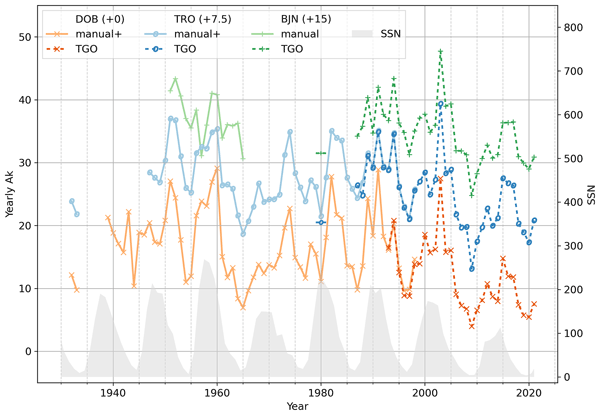
Ingeborg Frøystein and Magnar Gullikstad Johnsen
Ann. Geophys., 43, 241–269, https://doi.org/10.5194/angeo-43-241-2025, https://doi.org/10.5194/angeo-43-241-2025, 2025
Short summary
Short summary
The complete time series of the geomagnetic disturbance index (K) from Norwegian magnetic observatories have been digitized. We compare and discuss the tree methods used to derive the index, finding that each method has strengths and weaknesses. In total, we present all K indices derived from Norwegian observatories since the 1930s until today, the used derivation methods and the long historic time series as a whole, enabling critical use for future scientific work.
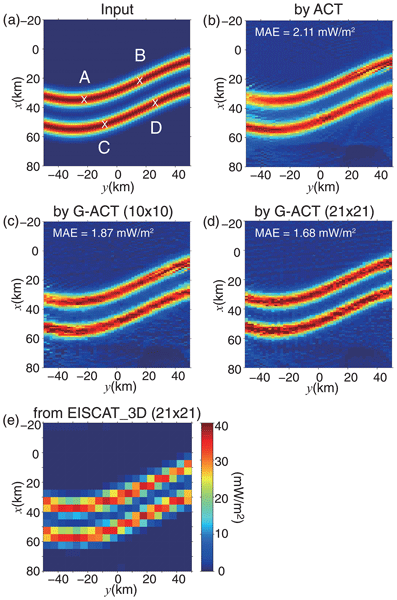
Yoshimasa Tanaka, Yasunobu Ogawa, Akira Kadokura, Takehiko Aso, Björn Gustavsson, Urban Brändström, Tima Sergienko, Genta Ueno, and Satoko Saita
Ann. Geophys., 42, 179–190, https://doi.org/10.5194/angeo-42-179-2024, https://doi.org/10.5194/angeo-42-179-2024, 2024
Short summary
Short summary
We present via simulation how useful monochromatic images taken by a multi-point imager network are for auroral research in the EISCAT_3D project. We apply the generalized-aurora computed tomography (G-ACT) to modeled multiple auroral images and ionospheric electron density data. It is demonstrated that G-ACT provides better reconstruction results than the normal ACT and can interpolate ionospheric electron density at a much higher spatial resolution than observed by the EISCAT_3D radar.
Peter Dalin, Urban Brändström, Johan Kero, Peter Voelger, Takanori Nishiyama, Trond Trondsen, Devin Wyatt, Craig Unick, Vladimir Perminov, Nikolay Pertsev, and Jonas Hedin
Atmos. Meas. Tech., 17, 1561–1576, https://doi.org/10.5194/amt-17-1561-2024, https://doi.org/10.5194/amt-17-1561-2024, 2024
Short summary
Short summary
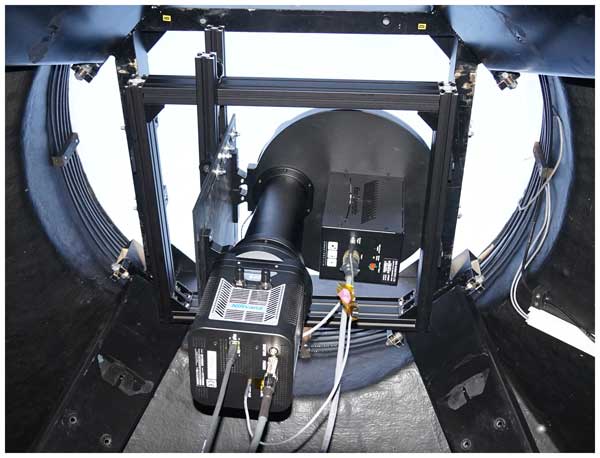
A novel infrared imaging instrument (OH imager) was put into operation in November 2022 at the Swedish Institute of Space Physics in Kiruna (Sweden). The OH imager is dedicated to the study of nightglow emissions coming from the hydroxyl (OH) and molecular oxygen (O2) layers in the mesopause (80–100 km). Based on a brightness ratio of two OH emission lines, the neutral temperature is estimated at around 87 km. The average daily winter temperature for the period January–April 2023 is 203±10 K.
Thomas B. Leyser, Tima Sergienko, Urban Brändström, Björn Gustavsson, and Michael T. Rietveld
Ann. Geophys., 41, 589–600, https://doi.org/10.5194/angeo-41-589-2023, https://doi.org/10.5194/angeo-41-589-2023, 2023
Short summary
Short summary
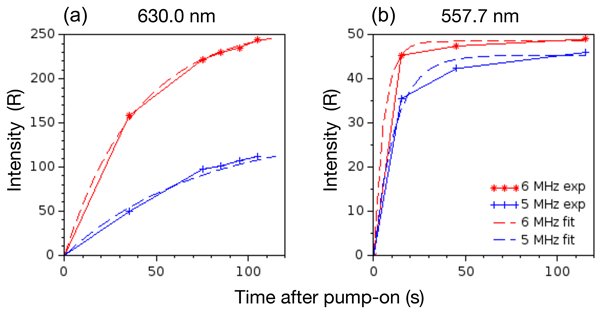
Powerful radio waves transmitted into the ionosphere from the ground were used to study electron energization in the pumped ionospheric plasma turbulence, by detecting optical emissions from atomic oxygen. Our results obtained with the EISCAT (European Incoherent Scatter Scientific Association) facilities in northern Norway and optical detection with the ALIS (Auroral Large Imaging System) in northern Sweden suggest that long-wavelength upper hybrid waves are important in accelerating electrons.
Mizuki Fukizawa, Yoshimasa Tanaka, Yasunobu Ogawa, Keisuke Hosokawa, Tero Raita, and Kirsti Kauristie
Ann. Geophys., 41, 511–528, https://doi.org/10.5194/angeo-41-511-2023, https://doi.org/10.5194/angeo-41-511-2023, 2023
Short summary
Short summary
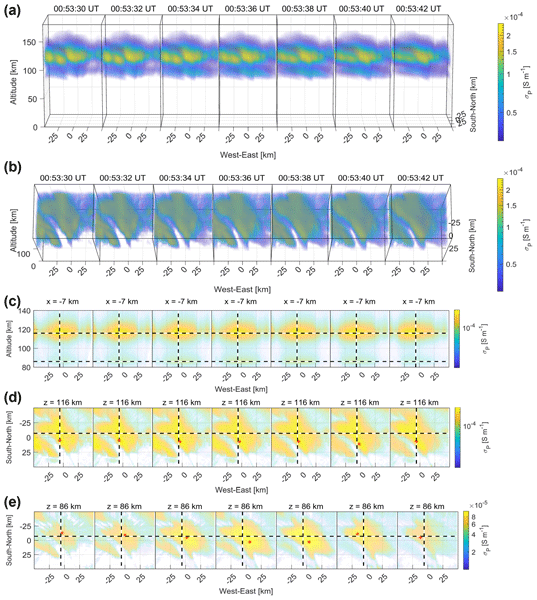
We use computed tomography to reconstruct the three-dimensional distributions of the Hall and Pedersen conductivities of pulsating auroras, a key research target for understanding the magnetosphere–ionosphere coupling process. It is suggested that the high-energy electron precipitation associated with pulsating auroras may have a greater impact on the closure of field-aligned currents in the ionosphere than has been previously reported.
Masatoshi Yamauchi and Urban Brändström
Geosci. Instrum. Method. Data Syst., 12, 71–90, https://doi.org/10.5194/gi-12-71-2023, https://doi.org/10.5194/gi-12-71-2023, 2023
Short summary
Short summary
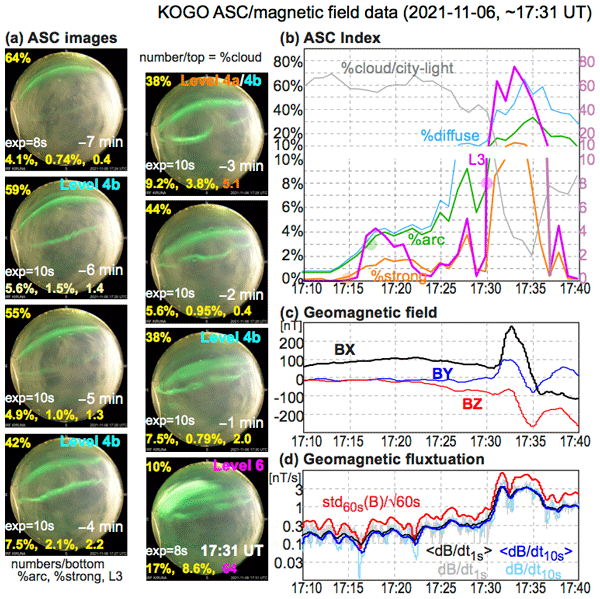
Potential users of all-sky aurora images even include power companies, tourists, and aurora enthusiasts. However, these potential users are normally not familiar with interpreting these images. To make them comprehensive for more users, we developed an automatic evaluation system of auroral activity level. The method involves two steps: first making a simple set of numbers that describes the auroral activity and then further simplifying them into several levels (Level 6 is an auroral explosion).
Mizuki Fukizawa, Takeshi Sakanoi, Yoshimasa Tanaka, Yasunobu Ogawa, Keisuke Hosokawa, Björn Gustavsson, Kirsti Kauristie, Alexander Kozlovsky, Tero Raita, Urban Brändström, and Tima Sergienko
Ann. Geophys., 40, 475–484, https://doi.org/10.5194/angeo-40-475-2022, https://doi.org/10.5194/angeo-40-475-2022, 2022
Short summary
Short summary
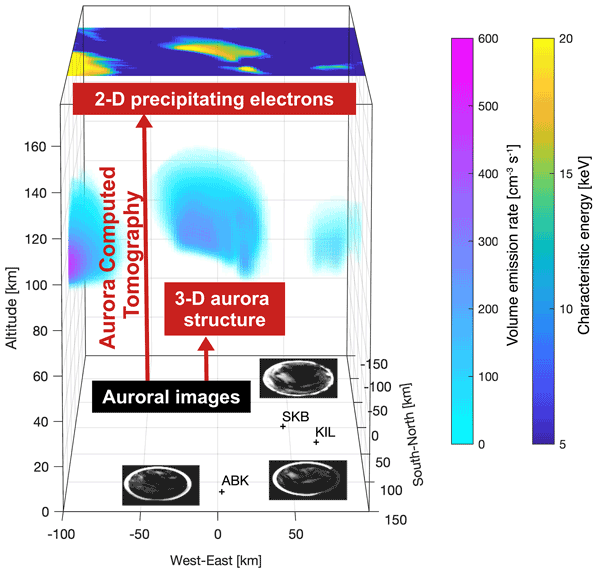
The pulsating auroral generation mechanism has been investigated by observing precipitating electrons using rockets or satellites. However, it is difficult for such observations to distinguish temporal changes from spatial ones. In this study, we reconstructed the horizontal 2-D distribution of precipitating electrons using only auroral images. The 3-D aurora structure was also reconstructed. We found that there were both spatial and temporal changes in the precipitating electron energy.
Cited articles
Angerami, J. J.: Whistler duct properties deduced from VLF observations made with the Ogo 3 satellite near the magnetic equator, J. Geophys. Res., 75, 6115–6135, https://doi.org/10.1029/JA075i031p06115, 1970. a
Brekke, A. and Pettersen, H.: Some observations of pulsating aurora at Spitzbergen, Planet. Space Sci., 19, 536–540, https://doi.org/10.1016/0032-0633(71)90171-1, 1971. a
Cessateur, G., Hosokawa, K., Lamy, H., Nanjo, S., Barthelemy, M., Johnsen, M. G., and Maggiolo, R.: Mean Energy variation of Diffuse Aurora Observed with the ASIS Spectrograph, EGUsphere [preprint], https://doi.org/10.5194/egusphere-2026-385, 2026. a
Chen, R., Miyoshi, Y., Gao, X., Lu, Q., Tsurutani, B. T., Hosokawa, K., Hori, T., Ogawa, Y., Oyama, S.-I., Kasahara, Y., Matsuda, S., Nakamura, S., Matsuoka, A., and Shinohara, I.: Observational Evidence for Three Time-Scale Modulations in the Pulsating Aurora, Geophys. Res. Lett., 51, e2024GL108253, https://doi.org/10.1029/2024GL108253, 2024. a, b
Chen, R., Miyoshi, Y., Zhao, H., Chen, H., Wang, X., Kasahara, Y., Matsuda, S., Hori, T., Tsuchiya, F., Kumamoto, A., Shinbori, A., Kasahara, S., Yokota, S., Keika, K., Mitani, T., Takashima, T., Matsuoka, A., Teramoto, M., Yamamoto, K., and Shinohara, I.: Observational Evidence for the Nonlinear Growth of Chorus Waves Caused by Substorm Injected Energetic Electrons, J. Geophys. Res.-Space, 130, e2025JA033931, https://doi.org/10.1029/2025JA033931, 2025. a
Douma, E., Rodger, C. J., Blum, L. W., and Clilverd, M. A.: Occurrence characteristics of relativistic electron microbursts from SAMPEX observations, J. Geophys. Res.-Space, 122, 8096–8107, https://doi.org/10.1002/2017JA024067, 2017. a
Elliott, S. S., Breneman, A. W., Colpitts, C., Pettit, J. M., Cattell, C. A., Halford, A. J., Shumko, M., Sample, J., Johnson, A. T., Miyoshi, Y., Kasahara, Y., Cully, C. M., Nakamura, S., Mitani, T., Hori, T., Shinohara, I., Shiokawa, K., Matsuda, S., Connors, M., Ozaki, M., and Manninen, J.: Quantifying the Size and Duration of a Microburst-Producing Chorus Region on 5 December 2017, Geophys. Res. Lett., 49, e2022GL099655, https://doi.org/10.1029/2022GL099655, 2022. a
Frey, H. U., Mende, S. B., Angelopoulos, V., and Donovan, E. F.: Substorm onset observations by IMAGE-FUV, J. Geophys. Res.-Space, 109, https://doi.org/10.1029/2004JA010607, 2004. a
Grono, E. and Donovan, E.: Surveying pulsating auroras, Ann. Geophys., 38, 1–8, https://doi.org/10.5194/angeo-38-1-2020, 2020. a
He, K., Zhang, X., Ren, S., and Sun, J.: Deep Residual Learning for Image Recognition, in: Proceedings of the IEEE Conference on Computer Vision and Pattern Recognition (CVPR), 770–778, https://doi.org/10.1109/CVPR.2016.90, 2016. a
Hosokawa, K. and Ogawa, Y.: Ionospheric variation during pulsating aurora, J. Geophys. Res.-Space, 120, 5943–5957, https://doi.org/10.1002/2015JA021401, 2015. a
Hosokawa, K., Miyoshi, Y., Ozaki, M., Oyama, S.-I., Ogawa, Y., Kurita, S., Kasahara, Y., Kasaba, Y., Yagitani, S., Matsuda, S., Tsuchiya, F., Kumamoto, A., Kataoka, R., Shiokawa, K., Raita, T., Turunen, E., Takashima, T., Shinohara, I., and Fujii, R.: Multiple time-scale beats in aurora: precise orchestration via magnetospheric chorus waves, Sci. Rep., 10, 3380, https://doi.org/10.1038/s41598-020-59642-8, 2020. a, b, c, d, e, f
Ito, Y., Hosokawa, K., Ogawa, Y., Miyoshi, Y., Tsuchiya, F., Fukizawa, M., Kasaba, Y., Kazama, Y., Oyama, S., Murase, K., Nakamura, S., Kasahara, Y., Matsuda, S., Kasahara, S., Hori, T., Yokota, S., Keika, K., Matsuoka, A., Teramoto, M., and Shinohara, I.: On the Factors Controlling the Relationship Between Type of Pulsating Aurora and Energy of Pulsating Auroral Electrons: Simultaneous Observations by Arase Satellite, Ground-Based All-Sky Imagers and EISCAT Radar, J. Geophys. Res.-Space, 129, e2024JA032617, https://doi.org/10.1029/2024JA032617, 2024. a
Kasahara, S., Miyoshi, Y., Yokota, S., Mitani, T., Kasahara, Y., Matsuda, S., Kumamoto, A., Matsuoka, A., Kazama, Y., Frey, H. U., Angelopoulos, V., Kurita, S., Keika, K., Seki, K., and Shinohara, I.: Pulsating aurora from electron scattering by chorus waves, Nature, 554, 337–340, https://doi.org/10.1038/nature25505, 2018. a
Kawamura, M., Sakanoi, T., Fukizawa, M., Miyoshi, Y., Hosokawa, K., Tsuchiya, F., Katoh, Y., Ogawa, Y., Asamura, K., Saito, S., Spence, H., Johnson, A., Oyama, S.-I., and Brändström, U.: Simultaneous Pulsating Aurora and Microburst Observations With Ground-Based Fast Auroral Imagers and CubeSat FIREBIRD-II, Geophys. Res. Lett., 48, e2021GL094494, https://doi.org/10.1029/2021GL094494, 2021. a
Kawamura, Y., Hosokawa, K., Nozawa, S., Ogawa, Y., Kawabata, T., Oyama, S.-I., Miyoshi, Y., Kurita, S., and Fujii, R.: Estimation of the emission altitude of pulsating aurora using the five-wavelength photometer, Earth, Planet. Space, 72, 96, https://doi.org/10.1186/s40623-020-01229-8, 2020. a
Kvammen, A., Wickstrøm, K., McKay, D., and Partamies, N.: Auroral Image Classification With Deep Neural Networks, J. Geophys. Res.-Space, 125, e2020JA027808, https://doi.org/10.1029/2020JA027808, 2020. a
Li, W., Bortnik, J., Thorne, R. M., and Angelopoulos, V.: Global distribution of wave amplitudes and wave normal angles of chorus waves using THEMIS wave observations, J. Geophys. Res.-Space, 116, https://doi.org/10.1029/2011JA017035, 2011. a
Meredith, N. P., Horne, R. B., Sicard-Piet, A., Boscher, D., Yearby, K. H., Li, W., and Thorne, R. M.: Global model of lower band and upper band chorus from multiple satellite observations, J. Geophys. Res.-Space, 117, https://doi.org/10.1029/2012JA017978, 2012. a
Meredith, N. P., Horne, R. B., Shen, X.-C., Li, W., and Bortnik, J.: Global Model of Whistler Mode Chorus in the Near-Equatorial Region (
Miyoshi, Y., Oyama, S., Saito, S., Kurita, S., Fujiwara, H., Kataoka, R., Ebihara, Y., Kletzing, C., Reeves, G., Santolik, O., Clilverd, M., Rodger, C. J., Turunen, E., and Tsuchiya, F.: Energetic electron precipitation associated with pulsating aurora: EISCAT and Van Allen Probe observations, J. Geophys. Res.-Space, 120, 2754–2766, https://doi.org/10.1002/2014JA020690, 2015a. a
Miyoshi, Y., Saito, S., Seki, K., Nishiyama, T., Kataoka, R., Asamura, K., Katoh, Y., Ebihara, Y., Sakanoi, T., Hirahara, M., Oyama, S., Kurita, S., and Santolik, O.: Relation between fine structure of energy spectra for pulsating aurora electrons and frequency spectra of whistler mode chorus waves, J. Geophys. Res.-Space, 120, 7728–7736, https://doi.org/10.1002/2015JA021562, 2015b. a, b, c, d
Miyoshi, Y., Saito, S., Kurita, S., Asamura, K., Hosokawa, K., Sakanoi, T., Mitani, T., Ogawa, Y., Oyama, S., Tsuchiya, F., Jones, S. L., Jaynes, A. N., and Blake, J. B.: Relativistic Electron Microbursts as High-Energy Tail of Pulsating Aurora Electrons, Geophys. Res. Lett., 47, e2020GL090360, https://doi.org/10.1029/2020GL090360, 2020. a
Namekawa, T., Mitani, T., Asamura, K., Miyoshi, Y., Hosokawa, K., Lessard, M., Moser, C., Halford, A. J., Sakanoi, T., Kawamura, M., Nose, M., Nomura, R., Teramoto, M., Shumko, M., Lynch, K. A., Jaynes, A. N., and McHarg, M. G.: Simultaneous Precipitation of Sub-Relativistic Electron Microburst and Pulsating Aurora Electrons, Geophys. Res. Lett., 50, e2023GL104001, https://doi.org/10.1029/2023GL104001, 2023. a
Nanjo, S., Hozumi, Y., Hosokawa, K., Kataoka, R., Miyoshi, Y., Oyama, S.-I., Ozaki, M., Shiokawa, K., and Kurita, S.: Periodicities and Colors of Pulsating Auroras: DSLR Camera Observations From the International Space Station, J. Geophys. Res.-Space, 126, e2021JA029564, https://doi.org/10.1029/2021JA029564, 2021. a
Nanjo, S., Nozawa, S., Yamamoto, M., Kawabata, T., Johnsen, M. G., Tsuda, T. T., and Hosokawa, K.: An automated auroral detection system using deep learning: real-time operation in Tromsø, Norway, Sci. Rep., 12, 8038, https://doi.org/10.1038/s41598-022-11686-8, 2022. a, b, c, d
Nanjo, S., Ebukuro, S., Nakamura, S., Miyoshi, Y., Kurita, S., Oyama, S.-I., Ogawa, Y., Keika, K., Kasahara, Y., Kasahara, S., Matsuoka, A., Hori, T., Yokota, S., Matsuda, S., Shinohara, I., Wang, S.-Y., Kazama, Y., Jun, C.-W., Kitahara, M., and Hosokawa, K.: An Implication of Detecting the Internal Modulation in a Pulsating Aurora: A Conjugate Observation by the Arase Satellite and All-Sky Imagers, J. Geophys. Res.-Space, 128, e2023JA031499, https://doi.org/10.1029/2023JA031499, 2023. a, b, c, d
Nanjo, S., Herlingshaw, K., Sergienko, T., Cessateur, G., Partamies, N., Johnsen, M. G., Hosokawa, K., Lamy, H., Ogawa, Y., Kero, A., Oyama, S., and Yamauchi, M.: Observations of fragmented aurora-like emissions and picket fence on the poleward edge of the auroral oval, Ann. Geophys., 44, 63–84, https://doi.org/10.5194/angeo-44-63-2026, 2026. a
Nishimura, Y., Bortnik, J., Li, W., Thorne, R. M., Lyons, L. R., Angelopoulos, V., Mende, S. B., Bonnell, J. W., Contel, O. L., Cully, C., Ergun, R., and Auster, U.: Identifying the Driver of Pulsating Aurora, Science, 330, 81–84, https://doi.org/10.1126/science.1193186, 2010. a
Nishimura, Y., Lessard, M. R., Katoh, Y., Miyoshi, Y., Grono, E., Partamies, N., Sivadas, N., Hosokawa, K., Fukizawa, M., Samara, M., Michell, R. G., Kataoka, R., Sakanoi, T., Whiter, D. K., Oyama, S.-I., Ogawa, Y., and Kurita, S.: Diffuse and Pulsating Aurora, Space Sci. Rev., 216, 4, https://doi.org/10.1007/s11214-019-0629-3, 2020. a
Nishiyama, T., Sakanoi, T., Miyoshi, Y., Hampton, D. L., Katoh, Y., Kataoka, R., and Okano, S.: Multiscale temporal variations of pulsating auroras: On-off pulsation and a few Hz modulation, J. Geophys. Res.-Space, 119, 3514–3527, https://doi.org/10.1002/2014JA019818, 2014. a
Nishiyama, T., Miyoshi, Y., Katoh, Y., Sakanoi, T., Kataoka, R., and Okano, S.: Substructures with luminosity modulation and horizontal oscillation in pulsating patch: Principal component analysis application to pulsating aurora, J. Geophys. Res.-Space, 121, 2360–2373, https://doi.org/10.1002/2015JA022288, 2016. a
Omura, Y.: Nonlinear wave growth theory of whistler-mode chorus and hiss emissions in the magnetosphere, Earth, Planet. Space, 73, 95, https://doi.org/10.1186/s40623-021-01380-w, 2021. a
Ozaki, M., Shiokawa, K., Miyoshi, Y., Hosokawa, K., Oyama, S., Yagitani, S., Kasahara, Y., Kasaba, Y., Matsuda, S., Kataoka, R., Ebihara, Y., Ogawa, Y., Otsuka, Y., Kurita, S., Moore, R. C., Tanaka, Y.-M., Nosé, M., Nagatsuma, T., Connors, M., Nishitani, N., Katoh, Y., Hikishima, M., Kumamoto, A., Tsuchiya, F., Kadokura, A., Nishiyama, T., Inoue, T., Imamura, K., Matsuoka, A., and Shinohara, I.: Microscopic Observations of Pulsating Aurora Associated With Chorus Element Structures: Coordinated Arase Satellite-PWING Observations, Geophys. Res. Lett., 45, 12125–12134, https://doi.org/10.1029/2018GL079812, 2018. a
Ozaki, M., Miyoshi, Y., Shiokawa, K., Hosokawa, K., Oyama, S.-I., Kataoka, R., Ebihara, Y., Ogawa, Y., Kasahara, Y., Yagitani, S., Kasaba, Y., Kumamoto, A., Tsuchiya, F., Matsuda, S., Katoh, Y., Hikishima, M., Kurita, S., Otsuka, Y., Moore, R. C., Tanaka, Y., Nosé, M., Nagatsuma, T., Nishitani, N., Kadokura, A., Connors, M., Inoue, T., Matsuoka, A., and Shinohara, I.: Visualization of rapid electron precipitation via chorus element wave–particle interactions, Nat. Commun., 10, 257, https://doi.org/10.1038/s41467-018-07996-z, 2019. a
Partamies, N., Whiter, D., Kadokura, A., Kauristie, K., Nesse Tyssøy, H., Massetti, S., Stauning, P., and Raita, T.: Occurrence and average behavior of pulsating aurora, J. Geophys. Res.-Space, 122, 5606–5618, https://doi.org/10.1002/2017JA024039, 2017. a
Partamies, N., Dol, B., Teissier, V., Juusola, L., Syrjäsuo, M., and Mulders, H.: Auroral breakup detection in all-sky images by unsupervised learning, Ann. Geophys., 42, 103–115, https://doi.org/10.5194/angeo-42-103-2024, 2024. a
Royrvik, O. and Davis, T. N.: Pulsating aurora: Local and global morphology, J. Geophys. Res., 82, 4720–4740, https://doi.org/10.1029/JA082i029p04720, 1977. a, b, c
Samara, M., Michell, R., and Hampton, D.: BG3 Glass Filter Effects on Quantifying Rapidly Pulsating Auroral Structures, Adv. Remote Sens., 1, 53–57, https://doi.org/10.4236/ars.2012.13005, 2012. a
Shepherd, S. G.: Altitude-adjusted corrected geomagnetic coordinates: Definition and functional approximations, J. Geophys. Res.-Space, 119, 7501–7521, https://doi.org/10.1002/2014JA020264, 2014. a
Shumko, M., Gallardo-Lacourt, B., Halford, A. J., Liang, J., Blum, L. W., Donovan, E., Murphy, K. R., and Spanswick, E.: A Strong Correlation Between Relativistic Electron Microbursts and Patchy Aurora, Geophys. Res. Lett., 48, e2021GL094696, https://doi.org/10.1029/2021GL094696, 2021. a
Shumko, M., Miyoshi, Y., Blum, L. W., Halford, A. J., Breneman, A. W., Johnson, A. T., Sample, J. G., Klumpar, D. M., and Spence, H. E.: Observation of an Electron Microburst With an Inverse Time-Of-Flight Energy Dispersion, Geophys. Res. Lett., 50, e2023GL104804, https://doi.org/10.1029/2023GL104804, 2023. a
Smith, R. L., Helliwell, R. A., and Yabroff, I. W.: A theory of trapping of whistlers in field-aligned columns of enhanced ionization, J. Geophys. Res., 65, 815–823, https://doi.org/10.1029/JZ065i003p00815, 1960. a
Yamamoto, T.: On the temporal fluctuations of pulsating auroral luminosity, J. Geophys. Res.-Space, 93, 897–911, https://doi.org/10.1029/JA093iA02p00897, 1988. a
Yearby, K. H., Balikhin, M. A., Khotyaintsev, Y. V., Walker, S. N., Krasnoselskikh, V. V., Alleyne, H. S. C. K., and Agapitov, O.: Ducted propagation of chorus waves: Cluster observations, Ann. Geophys., 29, 1629–1634, https://doi.org/10.5194/angeo-29-1629-2011, 2011. a
Short summary
Pulsating aurora often contains rapid brightness changes, but their overall behavior has not been well measured. We analyzed high-speed camera images from northern Sweden and Norway with machine learning to identify when these rapid changes occur. We found that they become more common toward the morning and at the lower-latitude sector. This suggests that small-scale auroral fluctuation can help reveal how particles from near-Earth space enter the upper atmosphere.
Pulsating aurora often contains rapid brightness changes, but their overall behavior has not...


