Articles | Volume 44, issue 2
https://doi.org/10.5194/angeo-44-855-2026
Regular paper
 | Highlight paper
 | 
27 Aug 2026
Regular paper | Highlight paper |  | 27 Aug 2026

Dune aurora: survey from a citizen science database

Maxime Grandin, Liisa Juusola, Noora Partamies, Emma Bruus, Joona Rautiainen, Donna Lach, Jia Jia, Max van de Kamp, Eero Karvinen, Kirsti Kauristie, and Theresa Hoppe

Related authors

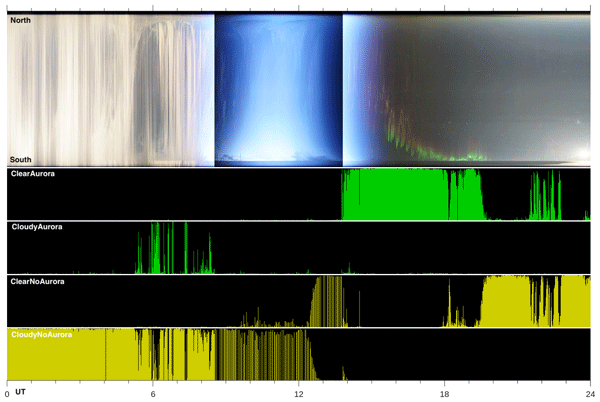
Global Citizen-Science Observations of Fragmented Aurora-Like Emissions
Lena Mielke, Katie Herlingshaw, Noora Partamies, Maxime Grandin, Emma Bruus, Rowan Dayton-Oxland, Donna Lach, Marjan Spijkers, Vincent Ledvina, Eero Karvinen, Andres Spicher, Benjamin Eberhardt, and Olivier Staiger
EGUsphere, https://doi.org/10.5194/egusphere-2026-3756,https://doi.org/10.5194/egusphere-2026-3756, 2026
This preprint is open for discussion and under review for Annales Geophysicae (ANGEO).
Short summary
Mapping transition region flows to the ionosphere in a global hybrid-Vlasov simulation
Venla Koikkalainen, Maxime Grandin, Emilia Kilpua, Abiyot Workayehu, Ivan Zaitsev, Liisa Juusola, Shi Tao, Markku Alho, Lauri Pänkäläinen, Giulia Cozzani, Konstantinos Horaites, Jonas Suni, Yann Pfau-Kempf, Urs Ganse, and Minna Palmroth
Ann. Geophys., 44, 227–243, https://doi.org/10.5194/angeo-44-227-2026,https://doi.org/10.5194/angeo-44-227-2026, 2026
Short summary
An empirical model of high-latitude ionospheric conductances based on EISCAT observations
Liisa Juusola, Ilkka Virtanen, Spencer Mark Hatch, Heikki Vanhamäki, Maxime Grandin, Noora Partamies, Urs Ganse, Ilja Honkonen, Abiyot Workayehu, Antti Kero, and Minna Palmroth
Ann. Geophys., 43, 755–781, https://doi.org/10.5194/angeo-43-755-2025,https://doi.org/10.5194/angeo-43-755-2025, 2025
Short summary
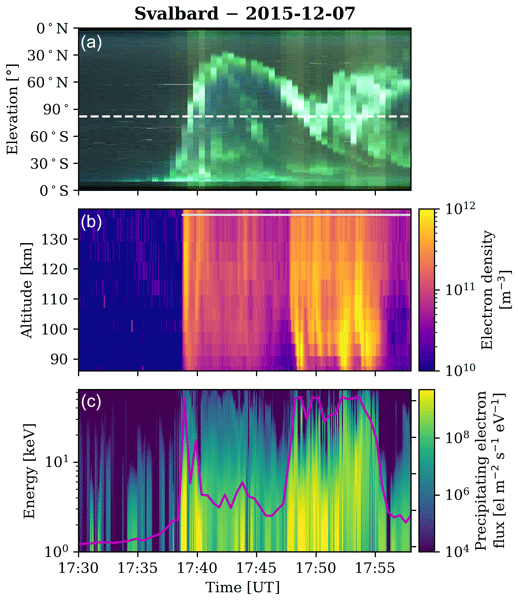
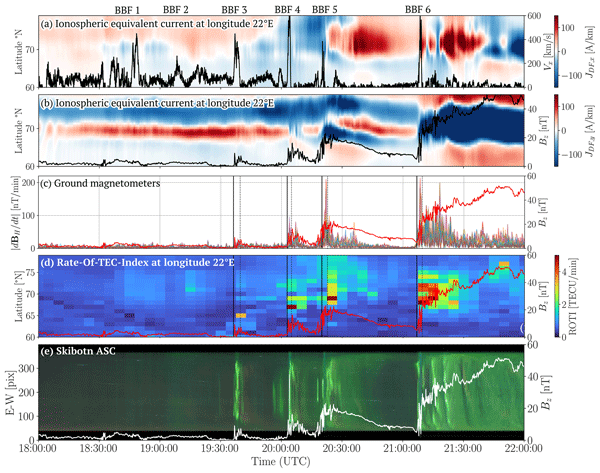
Ionospheric signatures of a Bursty Bulk Flow in the 6D Vlasiator simulation
Abiyot Workayehu, Minna Palmroth, Maxime Grandin, Liisa Juusola, Markku Alho, Ivan Zaitsev, Venla Koikkalainen, Konstantinos Horaites, Yann Pfau-Kempf, Urs Ganse, Markus Battarbee, and Jonas Suni
Ann. Geophys., 43, 723–737, https://doi.org/10.5194/angeo-43-723-2025,https://doi.org/10.5194/angeo-43-723-2025, 2025
Short summary
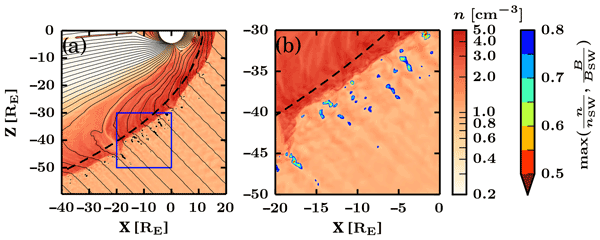
Global evolution of flux transfer events along the magnetopause from the dayside to the far tail
Yann Pfau-Kempf, Konstantinos Papadakis, Markku Alho, Markus Battarbee, Giulia Cozzani, Lauri Pänkäläinen, Urs Ganse, Fasil Kebede, Jonas Suni, Konstantinos Horaites, Maxime Grandin, and Minna Palmroth
Ann. Geophys., 43, 469–488, https://doi.org/10.5194/angeo-43-469-2025,https://doi.org/10.5194/angeo-43-469-2025, 2025
Short summary

Cited articles

Amm, O.: Ionospheric Elementary Current Systems in Spherical Coordinates and Their Application, J. Geomagn. Geoelectr., 49, 947–955, https://doi.org/10.5636/jgg.49.947, 1997. a
Archer, W. E., Gallardo-Lacourt, B., Perry, G. W., St. -Maurice, J. P., Buchert, S. C., and Donovan, E.: Steve: The Optical Signature of Intense Subauroral Ion Drifts, Geophys. Res. Lett., 46, 6279–6286, https://doi.org/10.1029/2019GL082687, 2019. a
Beldon, C. L. and Mitchell, N. J.: Gravity wave-tidal interactions in the mesosphere and lower thermosphere over Rothera, Antarctica (68° S, 68°W), J. Geophys. Res.-Atmos., 115, D18101, https://doi.org/10.1029/2009JD013617, 2010. a
Benjamini, Y. and Hochberg, Y.: Controlling the false discovery rate: a practical and powerful approach to multiple testing, J. R. Stat. Soc. B, 57, 289–300, https://doi.org/10.1111/j.2517-6161.1995.tb02031.x, 1995. a
Brown, L. B., Gerrard, A. J., Meriwether, J. W., and Makela, J. J.: All-sky imaging observations of mesospheric fronts in OI 557.7 nm and broadband OH airglow emissions: Analysis of frontal structure, atmospheric background conditions, and potential sourcing mechanisms, J. Geophys. Res.-Atmos., 109, D19104, https://doi.org/10.1029/2003JD004223, 2004. a
Download
Editorial statement
Dune aurora is a phenomenon which has only recently been reported in the scientific literature. This paper builds upon the earlier reports of this phenomenon by presenting the first statistical study of dune aurora. This work is interesting and valuable also because it draws on citizens' observations and insights. This will foster their interest in upper atmospheric phenomena at high latitudes, as well as in the scientific interpretation of these phenomena and future research.
Short summary
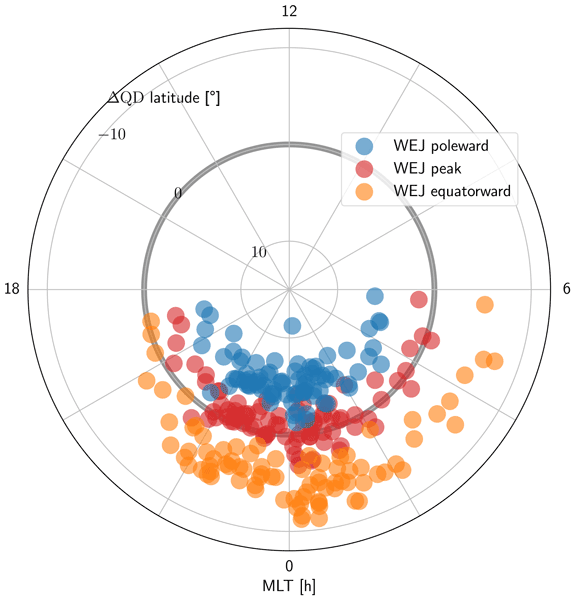
Dune aurora is an intriguing phenomenon recently discovered thanks to citizen science. It is a dim, diffuse auroral form exhibiting wave-like stripes of brighter emission. We carry out the first statistical study of dune aurora, using 308 observation reports submitted to the Skywarden database by citizen scientists from Europe, North America, and Oceania. We find that dunes are an evening phenomenon, most often reported in March and October and associated with currents in the auroral atmosphere.
Share