
Articles | Volume 44, issue 2
https://doi.org/10.5194/angeo-44-697-2026
© Author(s) 2026. This work is distributed under
the Creative Commons Attribution 4.0 License.
the Creative Commons Attribution 4.0 License.
https://doi.org/10.5194/angeo-44-697-2026
© Author(s) 2026. This work is distributed under
the Creative Commons Attribution 4.0 License.
the Creative Commons Attribution 4.0 License.
Regular paper
| 
28 Jul 2026
Regular paper |
| 28 Jul 2026
| 28 Jul 2026
High-latitude observations of ULF wave driven ion upflow
Charlotte M. van Hazendonk
CORRESPONDING AUTHOR

Department of Arctic Geophysics, The University Centre in Svalbard, Longyearbyen, Norway
Department of Physics and Technology, University of Bergen, Norway
Lisa J. Baddeley
Department of Arctic Geophysics, The University Centre in Svalbard, Longyearbyen, Norway
Department of Physics, University of Oslo, Norway
Karl M. Laundal
Division of Geomagnetism and Geospace, DTU Space, Technical University of Denmark, Copenhagen, Denmark
Department of Physics and Technology, University of Bergen, Norway
Noora Partamies
Department of Arctic Geophysics, The University Centre in Svalbard, Longyearbyen, Norway
Related authors
No articles found.
Jia Jia, Yvan Orsolini, Monika E. Szeląg, Antti Kero, Pekka T. Verronen, Maxime Grandin, Patrick J. Espy, Sebastian Käki, Neethal Thomas, Max van de Kamp, Sergey Koldobskiy, Jiarong Zhang, and Noora Partamies
EGUsphere, https://doi.org/10.5194/egusphere-2026-5829, https://doi.org/10.5194/egusphere-2026-5829, 2026
This preprint is open for discussion and under review for Atmospheric Chemistry and Physics (ACP).
Short summary
Short summary
Geomagnetic storms connect space weather to Earth's atmosphere. Analysing four major Solar Cycle 25 storms, we show that energetic particles cause mesospheric ozone losses of up to 80 %, with distinct responses to energetic electron precipitation and solar proton events. Combining observations and simulations reveals shortcomings in current representations of upper-atmospheric coupling and points to the need for sustained measurements of energetic particles and atmospheric composition.
Spencer Mark Hatch, Johnathan Burchill, Heikki Vanhamäki, Rafael Luiz Araujo de Mesquita, and Karl Magnus Laundal
Ann. Geophys., 44, 715–729, https://doi.org/10.5194/angeo-44-715-2026, https://doi.org/10.5194/angeo-44-715-2026, 2026
Short summary
Short summary
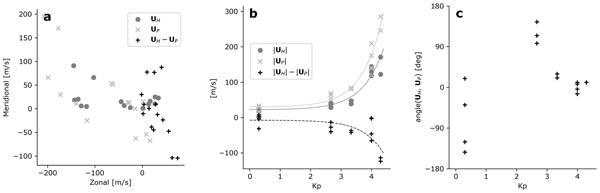
Atmospheric winds at high altitudes (> 100 km) can play an important role in the electrodynamic processes that govern how ionospheric plasma interacts with Earth's neutral atmosphere. Here we investigate how a common idea in studies of ionospheric electrodynamics—that atmospheric winds can be ignored or represented via an average value—ignores the high variability of these winds. This variability forces a different formulation of the equations that govern ionosphere-thermosphere electrodynamics.
Lena Mielke, Katie Herlingshaw, Noora Partamies, Maxime Grandin, Emma Bruus, Rowan Dayton-Oxland, Donna Lach, Marjan Spijkers, Vincent Ledvina, Eero Karvinen, Andres Spicher, Benjamin Eberhardt, and Olivier Staiger
EGUsphere, https://doi.org/10.5194/egusphere-2026-3756, https://doi.org/10.5194/egusphere-2026-3756, 2026
Short summary
Short summary
This study presents 26 citizen science observations of fragmented aurora-like emissions, here called fragments, from around the world. Using auroral images and satellite and solar wind data, we found that these short-lived fragments appear across a wide range of magnetic latitudes and local times. They can occur not only poleward of the auroral oval, but also within and equatorward of it. These findings broaden where fragments are known to occur and highlight the value of citizen science.
Jens Christian Hessen, Jone Peter Reistad, Spencer Mark Hatch, Karl Magnus Laundal, and Yongliang Zhang
Ann. Geophys., 44, 405–433, https://doi.org/10.5194/angeo-44-405-2026, https://doi.org/10.5194/angeo-44-405-2026, 2026
Short summary
Short summary
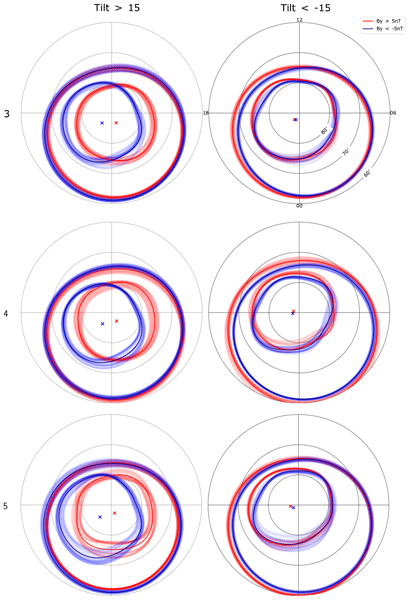
Auroras, the natural lights seen in Earth's sky near the poles, are shaped by both Earth's and the solar wind's magnetic fields, as well as charged solar particles. This study examines how auroras change when the solar wind's magnetic field is dawn-dusk oriented. Daytime observations are challenging due to sunlight, so we developed a method to further separate auroras from background light. In summer, auroras shift east or west with/against the solar wind's magnetic field.

Sota Nanjo, Katie Herlingshaw, Tima Sergienko, Gaël Cessateur, Noora Partamies, Magnar G. Johnsen, Keisuke Hosokawa, Hervé Lamy, Yasunobu Ogawa, Antti Kero, Shin-ichiro Oyama, and Masatoshi Yamauchi
Ann. Geophys., 44, 63–84, https://doi.org/10.5194/angeo-44-63-2026, https://doi.org/10.5194/angeo-44-63-2026, 2026
Short summary
Short summary
During the New Year’s Day storm of 2025, we observed rare auroral features: thin, short-lived green stripes and a “picket fence” near the poleward edge of the auroral oval. Using ground cameras and satellites, we found that the stripes sometimes appeared at widely separated longitudes at the same time and often tracked the motion of nearby red auroras. Some stripes were aligned with the magnetic field, while others were not, implying that multiple local processes contribute to their generation.
Rowan Dayton-Oxland, Fiona Ball, Daniel Whiter, Srimoyee Samaddar, Noora Partamies, Mathieu Barthelemy, Katie Herlingshaw, and Eero Karvinen
EGUsphere, https://doi.org/10.5194/egusphere-2025-5317, https://doi.org/10.5194/egusphere-2025-5317, 2025
Short summary
Short summary
GHOST is a pale mauve aurora, usually seen near noon in Svalbard during polar night, emitting a continuum spectrum across the visible range. Our fitting of high-resolution spectra shows that GHOST emission is best explained by extremely hot nitrogen and oxygen molecules, not by the more scarce nitrous oxide which is usually assumed. We propose that strong ionospheric flows, daylight, and incoming solar‑wind particles combine to heat the upper atmosphere, priming it to produce GHOST aurora.
Karl M. Laundal, Andreas S. Skeidsvoll, Beatrice Popescu Braileanu, Spencer M. Hatch, Nils Olsen, and Heikki Vanhamäki
Ann. Geophys., 43, 803–833, https://doi.org/10.5194/angeo-43-803-2025, https://doi.org/10.5194/angeo-43-803-2025, 2025
Short summary
Short summary
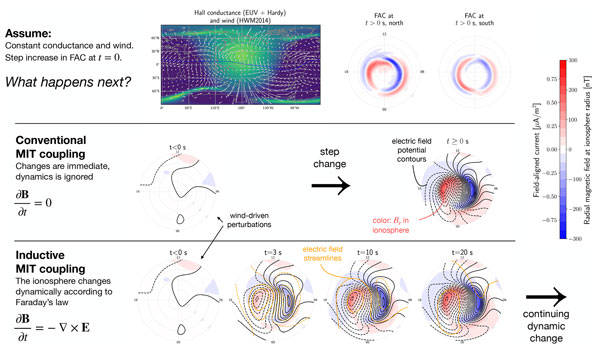
The ionosphere is where Earth’s atmosphere overlaps with a gas of charged particles in space. There, collisions with neutral air and electromagnetic forces driven by the solar wind control plasma motion. We created a global model that includes magnetic induction, explaining how electric currents and fields change, offering a more accurate view of atmosphere–space coupling than conventional models based on electric circuits.
Liisa Juusola, Ilkka Virtanen, Spencer Mark Hatch, Heikki Vanhamäki, Maxime Grandin, Noora Partamies, Urs Ganse, Ilja Honkonen, Abiyot Workayehu, Antti Kero, and Minna Palmroth
Ann. Geophys., 43, 755–781, https://doi.org/10.5194/angeo-43-755-2025, https://doi.org/10.5194/angeo-43-755-2025, 2025
Short summary
Short summary
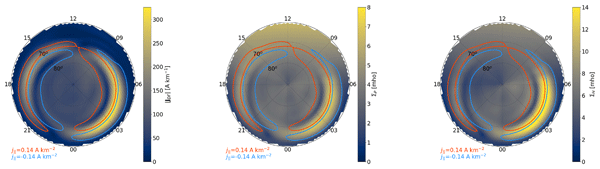
Key properties of the ionospheric electrodynamics are electric fields, currents, and conductances. They provide a window to the vast and distant near-Earth space, cause Joule heating that affect satellite orbits, and drive geomagnetically induced currents (GICs) in technological conductor networks. We have developed a new method for solving the key properties of ionospheric electrodynamics from ground-based magnetic field observations.
Spencer Mark Hatch, Ilkka Virtanen, Karl Magnus Laundal, Habtamu Wubie Tesfaw, Juha Vierinen, Devin Ray Huyghebaert, Andres Spicher, and Jens Christian Hessen
Ann. Geophys., 43, 633–649, https://doi.org/10.5194/angeo-43-633-2025, https://doi.org/10.5194/angeo-43-633-2025, 2025
Short summary
Short summary
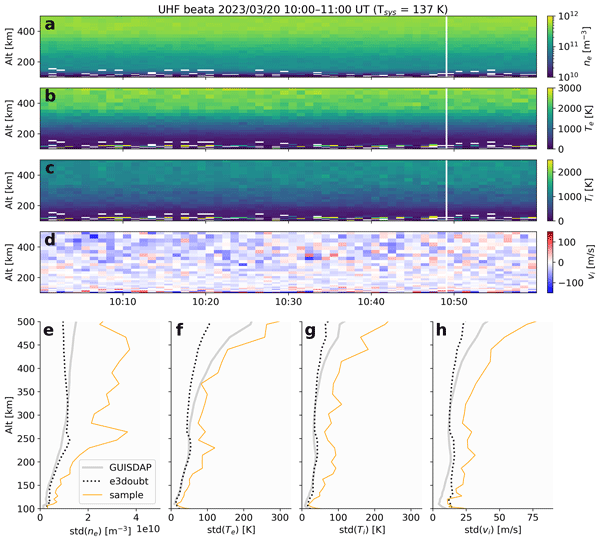
This study addresses the design of next-generation incoherent scatter radar experiments used to study the ionosphere, particularly with systems that have multiple sites. We have developed a method to estimate uncertainties of measurements of plasma density, temperature, and ion drift. Our method is open-source, and helps to optimize radar configurations and assess the effectiveness of an experiment. This method ultimately serves to enhance our understanding of Earth's space environment.
Devin Huyghebaert, Björn Gustavsson, Juha Vierinen, Andreas Kvammen, Matthew Zettergren, John Swoboda, Ilkka Virtanen, Spencer M. Hatch, and Karl M. Laundal
Ann. Geophys., 43, 99–113, https://doi.org/10.5194/angeo-43-99-2025, https://doi.org/10.5194/angeo-43-99-2025, 2025
Short summary
Short summary
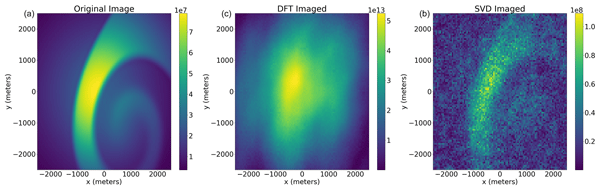
The EISCAT_3D radar is a new ionospheric radar under construction in the Fennoscandia region. The radar will make measurements of plasma characteristics at altitudes above approximately 60 km. The capability of the system to make these measurements at spatial scales of less than 100 m using multiple digitised signals from each of the radar antenna panels is highlighted. There are many ionospheric small-scale processes that will be further resolved using the techniques discussed here.
Hanne H. Christiansen, Ilkka S. O. Matero, Lisa Baddeley, Kim Holmén, Clara J. M. Hoppe, Maarten J. J. E. Loonen, Rune Storvold, Vito Vitale, Agata Zaborska, and Heikki Lihavainen
Earth Syst. Dynam., 15, 933–946, https://doi.org/10.5194/esd-15-933-2024, https://doi.org/10.5194/esd-15-933-2024, 2024
Short summary
Short summary
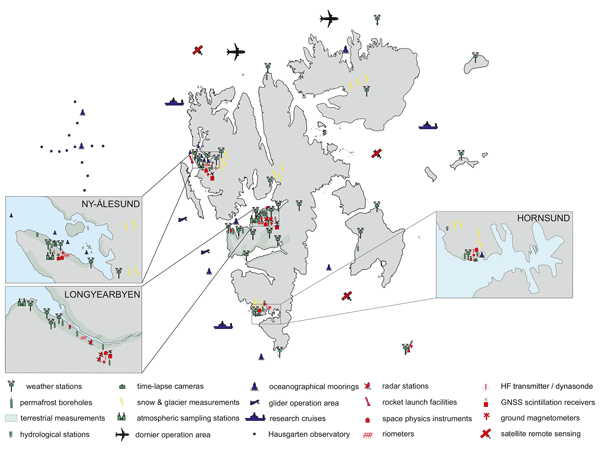
We provide an overview of the state and future of Earth system science in Svalbard as a synthesis of the recommendations made by the scientific community active in the archipelago. This work helped identify foci for developments of the observing system and a path forward to reach the full interdisciplinarity needed to operate at Earth system science scale. Better understanding of the processes in Svalbard will benefit both process-level understanding and Earth system models.
Spencer Mark Hatch, Heikki Vanhamäki, Karl Magnus Laundal, Jone Peter Reistad, Johnathan K. Burchill, Levan Lomidze, David J. Knudsen, Michael Madelaire, and Habtamu Tesfaw
Ann. Geophys., 42, 229–253, https://doi.org/10.5194/angeo-42-229-2024, https://doi.org/10.5194/angeo-42-229-2024, 2024
Short summary
Short summary
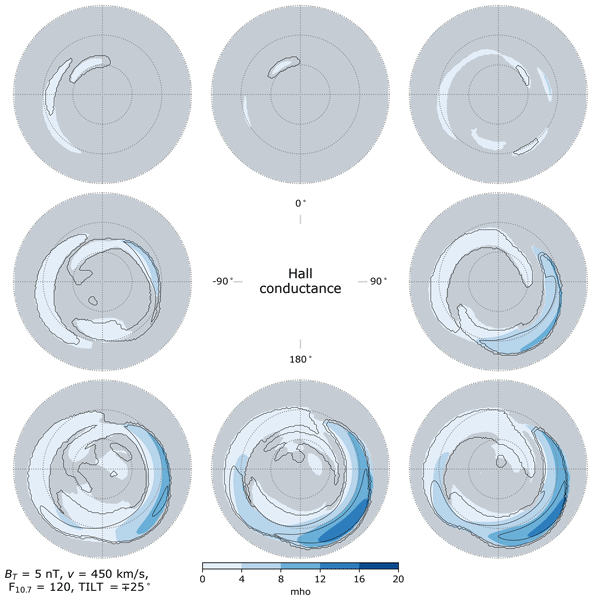
In studies of the Earth's ionosphere, a hot topic is how to estimate ionospheric conductivity. This is hard to do for a variety of reasons that mostly amount to a lack of measurements. In this study we use satellite measurements to estimate electromagnetic work and ionospheric conductances in both hemispheres. We identify where our model estimates are inconsistent with laws of physics, which partially solves a previous problem with unrealistic predictions of ionospheric conductances.
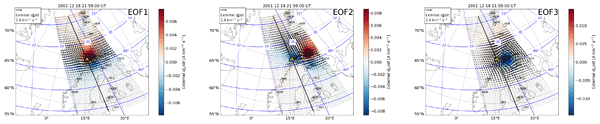
Liisa Juusola, Ari Viljanen, Noora Partamies, Heikki Vanhamäki, Mirjam Kellinsalmi, and Simon Walker
Ann. Geophys., 41, 483–510, https://doi.org/10.5194/angeo-41-483-2023, https://doi.org/10.5194/angeo-41-483-2023, 2023
Short summary
Short summary
At times when auroras erupt on the sky, the magnetic field surrounding the Earth undergoes rapid changes. On the ground, these changes can induce harmful electric currents in technological conductor networks, such as powerlines. We have used magnetic field observations from northern Europe during 28 such events and found consistent behavior that can help to understand, and thus predict, the processes that drive auroras and geomagnetically induced currents.
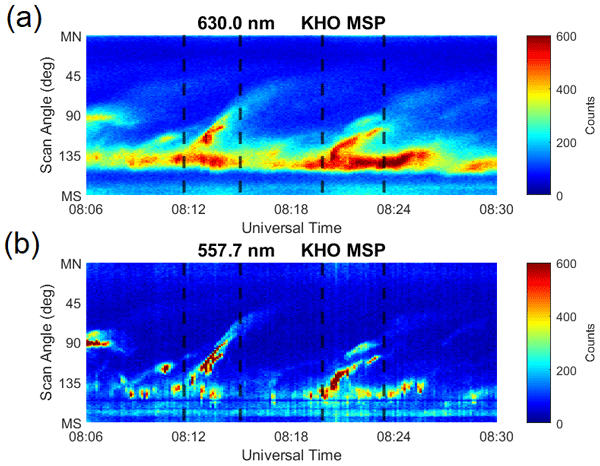
Anton Goertz, Noora Partamies, Daniel Whiter, and Lisa Baddeley
Ann. Geophys., 41, 115–128, https://doi.org/10.5194/angeo-41-115-2023, https://doi.org/10.5194/angeo-41-115-2023, 2023
Short summary
Short summary
Poleward moving auroral forms (PMAFs) are specific types of aurora believed to be the signature of the connection of Earth's magnetic field to that of the sun. In this paper, we discuss the evolution of PMAFs with regard to their auroral morphology as observed in all-sky camera images. We interpret different aspects of this evolution in terms of the connection dynamics between the magnetic fields of Earth and the sun. This sheds more light on the magnetic interaction between the sun and Earth.
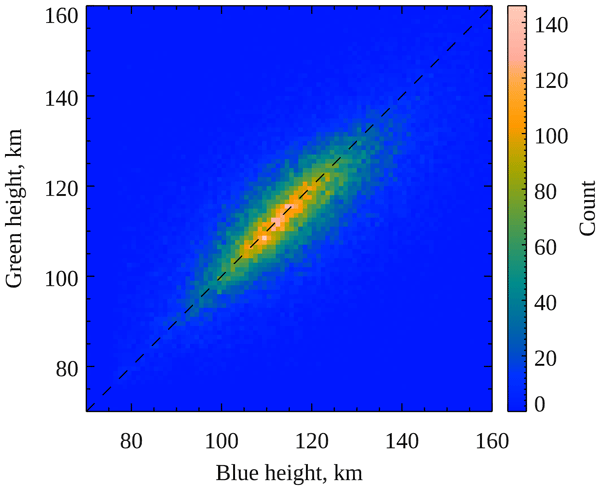
Daniel K. Whiter, Noora Partamies, Björn Gustavsson, and Kirsti Kauristie
Ann. Geophys., 41, 1–12, https://doi.org/10.5194/angeo-41-1-2023, https://doi.org/10.5194/angeo-41-1-2023, 2023
Short summary
Short summary
We measured the height of green and blue aurorae using thousands of camera images recorded over a 7-year period. Both colours are typically brightest at about 114 km altitude. When they peak at higher altitudes the blue aurora is usually higher than the green aurora. This information will help other studies which need an estimate of the auroral height. We used a computer model to explain our observations and to investigate how the green aurora is produced.
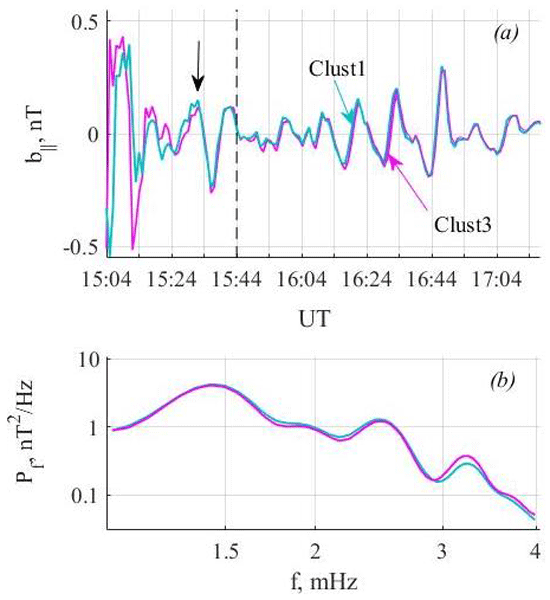
Nataliya Sergeevna Nosikova, Nadezda Viktorovna Yagova, Lisa Jane Baddeley, Dag Arne Lorentzen, and Dmitriy Anatolyevich Sormakov
Ann. Geophys., 40, 151–165, https://doi.org/10.5194/angeo-40-151-2022, https://doi.org/10.5194/angeo-40-151-2022, 2022
Short summary
Short summary
This paper presents a study of millihertz magnetic pulsations seen in the magnetosphere and on the Earth under quiet space weather conditions. We found that these fluctuations appear in the magnetosphere as soon as disturbances with the same frequency vanish in the solar wind. The results of this work show the possibility of a substorm developing under absolutely quiet external conditions and allow us to assume that these pulsations represent a substorm preparatory phase.

Derek McKay, Juha Vierinen, Antti Kero, and Noora Partamies
Geosci. Instrum. Method. Data Syst., 11, 25–35, https://doi.org/10.5194/gi-11-25-2022, https://doi.org/10.5194/gi-11-25-2022, 2022
Short summary
Short summary
When radio waves from our galaxy enter the Earth's atmosphere, they are absorbed by electrons in the upper atmosphere. It was thought that by measuring the amount of absorption, it would allow the height of these electrons in the atmosphere to be determined. If so, this would have significance for future instrument design. However, this paper demonstrates that it is not possible to do this, but it does explain how multiple-frequency measurements can nevertheless be useful.
Fasil Tesema, Noora Partamies, Daniel K. Whiter, and Yasunobu Ogawa
Ann. Geophys., 40, 1–10, https://doi.org/10.5194/angeo-40-1-2022, https://doi.org/10.5194/angeo-40-1-2022, 2022
Short summary
Short summary
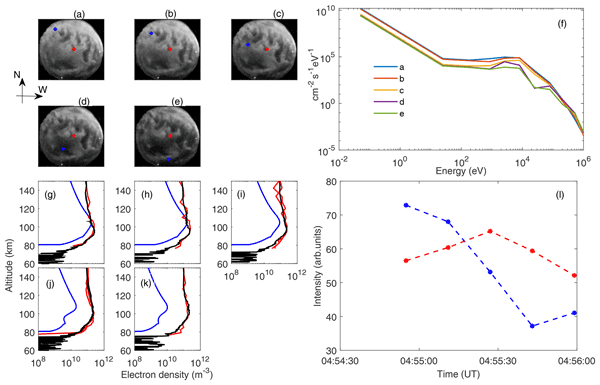
In this study, we present the comparison between an auroral model and EISCAT radar electron densities during pulsating aurorae. We test whether an overpassing satellite measurement of the average energy spectrum is a reasonable estimate for pulsating aurora electron precipitation. When patchy pulsating aurora is dominant in the morning sector, the overpass-averaged spectrum is found to be a reasonable estimate – but not when there is a mix of pulsating aurora types in the post-midnight sector.
Daniel K. Whiter, Hanna Sundberg, Betty S. Lanchester, Joshua Dreyer, Noora Partamies, Nickolay Ivchenko, Marco Zaccaria Di Fraia, Rosie Oliver, Amanda Serpell-Stevens, Tiffany Shaw-Diaz, and Thomas Braunersreuther
Ann. Geophys., 39, 975–989, https://doi.org/10.5194/angeo-39-975-2021, https://doi.org/10.5194/angeo-39-975-2021, 2021
Short summary
Short summary
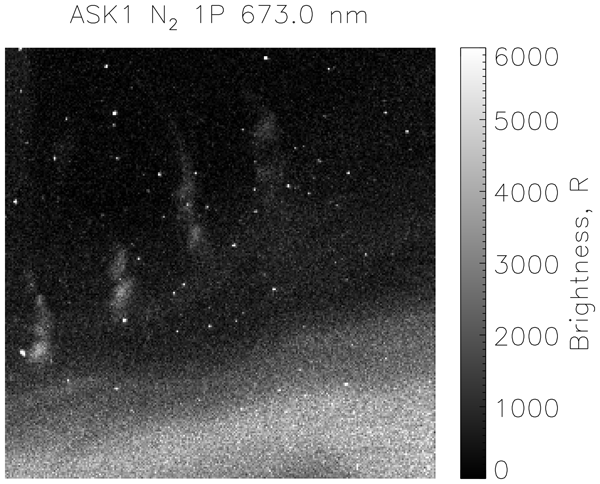
This paper presents an analysis of high-resolution optical and radar observations of a phenomenon called fragmented aurora-like emissions (FAEs) observed close to aurora in the high Arctic. The observations suggest that FAEs are not caused by high-energy electrons or protons entering the atmosphere along Earth's magnetic field and are, therefore, not aurora. The speeds of the FAEs and their internal dynamics were measured and used to evaluate theories for how the FAEs are produced.
Cited articles
Aikio, A. T., Cai, L., and Nygrén, T.: Statistical distribution of height-integrated energy exchange rates in the ionosphere, J. Geophys. Res.-Space, 117, A10325, https://doi.org/10.1029/2012JA018078, 2012. a, b, c
Anderson, B. J., Korth, H., Welling, D. T., Merkin, V. G., Wiltberger, M. J., Raeder, J., Barnes, R. J., Waters, C. L., Pulkkinen, A. A., and Rastaetter, L.: Comparison of predictive estimates of high-latitude electrodynamics with observations of global-scale Birkeland currents, Space Weather, 15, 352–373, https://doi.org/10.1002/2016SW001529, 2017. a
Baddeley, L. J., Yeoman, T. K., Wright, D. M., Trattner, K. J., and Kellet, B. J.: On the coupling between unstable magnetospheric particle populations and resonant high m ULF wave signatures in the ionosphere, Ann. Geophys., 23, 567–577, https://doi.org/10.5194/angeo-23-567-2005, 2005. a, b
Baddeley, L. J., Lorentzen, D. A., Partamies, N., Denig, M., Pilipenko, V. A., Oksavik, K., Chen, X., and Zhang, Y.: Equatorward propagating auroral arcs driven by ULF wave activity: Multipoint ground- and space-based observations in the dusk sector auroral oval, J. Geophys. Res.-Space, 122, 5591–5605, https://doi.org/10.1002/2016JA023427, 2017. a
Bjoland, L. M., Ogawa, Y., and Haaland, S.: Characteristics of the ambipolar electric field during ion upflow events, Earth Planet. Space, 77, 78, https://doi.org/10.1186/s40623-025-02217-6, 2025. a, b
Chartier, A. T. and Wiker, J. R.: SuperDARN Grid data in netCDF format (2021-Nov) (1.0), Zenodo [data set], https://doi.org/10.5281/zenodo.7821883, 2023. a
Chaston, C. C., Bonnell, J. W., Wygant, J. R., Kletzing, C. A., Reeves, G. D., Gerrard, A., Lanzerotti, L., and Smith, C. W.: Extreme ionospheric ion energization and electron heating in Alfvén waves in the storm time inner magnetosphere, Geophys. Res. Lett., 42, https://doi.org/10.1002/2015GL066674, 2015. a, b
David, T. W., Wright, D. M., Milan, S. E., Cowley, S. W. H., Davies, J. A., and McCrea, I.: A Study of Observations of Ionospheric Upwelling Made by the EISCAT Svalbard Radar During the International Polar Year Campaign of 2007, J. Geophys. Res.-Space, 123, 2192–2203, https://doi.org/10.1002/2017JA024802, 2018. a, b, c, d, e
David, T. W., Michael, C. M., Wright, D., Talabi, A. T., and Ajetunmobi, A. E.: Ionospheric upwelling and the level of associated noise at solar minimum, Ann. Geophys., 42, 349–354, https://doi.org/10.5194/angeo-42-349-2024, 2024. a
Fenrich, F. R., Gillies, D. M., Donovan, E., and Knudsen, D.: Flow Velocity and Field-Aligned Current Associated With Field Line Resonance: SuperDARN Measurements, J. Geophys. Res.-Space, 124, 4889–4904, https://doi.org/10.1029/2019JA026529, 2019. a, b, c
Gillies, D. M., Knudsen, D., Donovan, E., Jackel, B., Gillies, R., and Spanswick, E.: Identifying the 630 nm auroral arc emission height: A comparison of the triangulation, FAC profile, and electron density methods, J. Geophys. Res.-Space, 122, 8181–8197, https://doi.org/10.1002/2016JA023758, 2017. a
Gillies, D. M., Knudsen, D., Rankin, R., Milan, S., and Donovan, E.: A Statistical Survey of the 630.0-nm Optical Signature of Periodic Auroral Arcs Resulting From Magnetospheric Field Line Resonances, Geophys. Res. Lett., 45, 4648–4655, https://doi.org/10.1029/2018GL077491, 2018. a, b
Gjerloev, J. W.: The SuperMAG data processing technique, J. Geophys. Res.-Space, 117, 2012JA017683, https://doi.org/10.1029/2012JA017683, 2012. a
Godbole, N. H., Lessard, M. R., Kenward, D. R., Fritz, B. A., Varney, R. H., Michell, R. G., and Hampton, D.: Observations of ion upflow and 630.0 nm emission during pulsating aurora, Front. Phys., 10, 997229, https://doi.org/10.3389/fphy.2022.997229, 2022. a
Hartinger, M. D., Moldwin, M. B., Zou, S., Bonnell, J. W., and Angelopoulos, V.: ULF wave electromagnetic energy flux into the ionosphere: Joule heating implications, J. Geophys. Res.-Space, 120, 494–510, https://doi.org/10.1002/2014JA020129, 2015. a, b, c
Herlingshaw, K., Partamies, N., Van Hazendonk, C. M., Syrjäsuo, M., Baddeley, L. J., Johnsen, M. G., Eriksen, N. K., McWhirter, I., Aruliah, A., Engebretson, M. J., Oksavik, K., Sigernes, F., Lorentzen, D. A., Nishiyama, T., Cooper, M. B., Meriwether, J., Haaland, S., and Whiter, D.: Science highlights from the Kjell Henriksen Observatory on Svalbard, Arctic Science, 11, 1–25, https://doi.org/10.1139/as-2024-0009, 2025. a
Hovland, A. Ø., Laundal, K. M., Reistad, J. P., Hatch, S. M., Walker, S. J., Madelaire, M., and Ohma, A.: The Lompe code: A Python toolbox for ionospheric data analysis, Front. Astron. Space Sci., 9, 1025823, https://doi.org/10.3389/fspas.2022.1025823, 2022. a, b
Ji, E., Jee, G., and Lee, C.: Characteristics of the Occurrence of Ion Upflow in Association With Ion/Electron Heating in the Polar Ionosphere, J. Geophys. Res.-Space, 124, 6226–6236, https://doi.org/10.1029/2019JA026799, 2019. a
Juusola, L., Vanhamäki, H., Viljanen, A., and Smirnov, M.: Induced currents due to 3D ground conductivity play a major role in the interpretation of geomagnetic variations, Ann. Geophys., 38, 983–998, https://doi.org/10.5194/angeo-38-983-2020, 2020. a
Juusola, L., Virtanen, I., Hatch, S. M., Vanhamäki, H., Grandin, M., Partamies, N., Ganse, U., Honkonen, I., Workayehu, A., Kero, A., and Palmroth, M.: An empirical model of high-latitude ionospheric conductances based on EISCAT observations, Ann. Geophys., 43, 755–781, https://doi.org/10.5194/angeo-43-755-2025, 2025. a
Laundal, K. M., Skeidsvoll, A. S., Popescu Braileanu, B., Hatch, S. M., Olsen, N., and Vanhamäki, H.: Global inductive magnetosphere-ionosphere- thermosphere coupling, Ann. Geophys., 43, 803–833, https://doi.org/10.5194/angeo-43-803-2025, 2025. a, b
Lotko, W., Streltsov, A. V., and Carlson, C. W.: Discrete auroral arc, electrostatic shock and suprathermal electrons powered by dispersive, anomalously resistive field line resonance, Geophys. Res. Lett., 25, 4449–4452, https://doi.org/10.1029/1998GL900200, 1998. a
Lynch, K. A., Semeter, J. L., Zettergren, M., Kintner, P., Arnoldy, R., Klatt, E., LaBelle, J., Michell, R. G., MacDonald, E. A., and Samara, M.: Auroral ion outflow: low altitude energization, Ann. Geophys., 25, 1967–1977, https://doi.org/10.5194/angeo-25-1967-2007, 2007. a
Mager, O. V., Chelpanov, M. A., Mager, P. N., Klimushkin, D. Y., and Berngardt, O. I.: Conjugate Ionosphere-Magnetosphere Observations of a Sub-Alfvénic Compressional Intermediate-m Wave: A Case Study Using EKB Radar and Van Allen Probes, J. Geophys. Res.-Space, 124, 3276–3290, https://doi.org/10.1029/2019JA026541, 2019. a, b
Mann, I. R., Wright, A. N., and Cally, P. S.: Coupling of magnetospheric cavity modes to field line resonances: A study of resonance widths, J. Geophys. Res.-Space, 100, 19441–19456, https://doi.org/10.1029/95JA00820, 1995. a
Menk, F. W. and Waters, C. L.: Magnetoseismology: Ground-Based Remote Sensing of Earth's Magnetosphere, Wiley, 1 Edn., ISBN 978-3-527-41027-9 978-3-527-65205-1, https://doi.org/10.1002/9783527652051, 2013. a, b
Michael, C. M., Yeoman, T. K., Wright, D. M., Chelpanov, M. A., and Mager, P. N.: Evolving Phase Propagation in an Intermediate-m ULF Wave Driven by Substorm-Injected Particles, J. Geophys. Res.-Space, 129, e2023JA031654, https://doi.org/10.1029/2023JA031654, 2024. a
Milan, S. E., Sato, N., Ejiri, M., and Moen, J.: Auroral forms and the field-aligned current structure associated with field line resonances, J. Geophys. Res.-Space, 106, 25825–25833, https://doi.org/10.1029/2001JA900077, 2001. a
Moen, J. and Brekke, A.: The solar flux influence on quiet time conductances in the auroral ionosphere, Geophys. Res. Lett., 20, 971–974, https://doi.org/10.1029/92GL02109, 1993. a
Ogawa, Y., Fujii, R., Buchert, S. C., Nozawa, S., and Ohtani, S.: Simultaneous EISCAT Svalbard radar and DMSP observations of ion upflow in the dayside polar ionosphere, J. Geophys. Res.-Space, 108, 2002JA009590, https://doi.org/10.1029/2002JA009590, 2003. a
Ogawa, Y., Buchert, S. C., Häggström, I., Rietveld, M. T., Fujii, R., Nozawa, S., and Miyaoka, H.: On the statistical relation between ion upflow and naturally enhanced ion-acoustic lines observed with the EISCAT Svalbard radar, J. Geophys. Res.-Space, 116, https://doi.org/10.1029/2010JA015827, 2011. a
Partamies, N., Whiter, D., Kauristie, K., and Massetti, S.: Magnetic local time (MLT) dependence of auroral peak emission height and morphology, Ann. Geophys., 40, 605–618, https://doi.org/10.5194/angeo-40-605-2022, 2022. a
Partamies, N., Dayton-Oxland, R., Herlingshaw, K., Virtanen, I., Gallardo-Lacourt, B., Syrjäsuo, M., Sigernes, F., Nishiyama, T., Nishimura, T., Barthelemy, M., Aruliah, A., Whiter, D., Mielke, L., Grandin, M., Karvinen, E., Spijkers, M., and Ledvina, V. E.: First observations of continuum emission in dayside aurora, Ann. Geophys., 43, 349–367, https://doi.org/10.5194/angeo-43-349-2025, 2025. a
Paxton, L. J., Meng, C.-I., Fountain, G. H., Ogorzalek, B. S., Darlington, E. H., Gary, S. A., Goldsten, J. O., Kusnierkiewicz, D. Y., Lee, S. C., Linstrom, L. A., Maynard, J. J., Peacock, K., Persons, D. F., and Smith, B. E.: Special sensor ultraviolet spectrographic imager: an instrument description, 2–15, San Diego, CA, https://doi.org/10.1117/12.60595, 1992. a
Rae, I. J., Donovan, E. F., Mann, I. R., Fenrich, F. R., Watt, C. E. J., Milling, D. K., Lester, M., Lavraud, B., Wild, J. A., Singer, H. J., Rème, H., and Balogh, A.: Evolution and characteristics of global Pc5 ULF waves during a high solar wind speed interval, J. Geophys. Res.-Space, 110, https://doi.org/10.1029/2005JA011007, 2005. a
Rae, I. J., Watt, C. E. J., Fenrich, F. R., Mann, I. R., Ozeke, L. G., and Kale, A.: Energy deposition in the ionosphere through a global field line resonance, Ann. Geophys., 25, 2529–2539, https://doi.org/10.5194/angeo-25-2529-2007, 2007. a, b
Rankin, R., Gillies, D. M., and Degeling, A. W.: On the Relationship Between Shear Alfvén Waves, Auroral Electron Acceleration, and Field Line Resonances, Space Sci. Rev., 217, 60, https://doi.org/10.1007/s11214-021-00830-x, 2021. a, b
Redmon, R. J., Denig, W. F., Kilcommons, L. M., and Knipp, D. J.: New DMSP database of precipitating auroral electrons and ions, J. Geophys. Res.-Space, 122, 9056–9067, https://doi.org/10.1002/2016JA023339, 2017. a
Robinson, R. M., Zanetti, L., Anderson, B., Vines, S., and Gjerloev, J.: Determination of Auroral Electrodynamic Parameters From AMPERE Field-Aligned Current Measurements, Space Weather, 19, e2020SW002677, https://doi.org/10.1029/2020SW002677, 2021. a, b
Rubtsov, A. V., Agapitov, O. V., Mager, P. N., Klimushkin, D. Y., Mager, O. V., Mozer, F. S., and Angelopoulos, V.: Drift Resonance of Compressional ULF Waves and Substorm-Injected Protons From Multipoint THEMIS Measurements, J. Geophys. Res.-Space, 123, 9406–9419, https://doi.org/10.1029/2018JA025985, 2018. a
Samson, J. C., Rankin, R., and Tikhonchuk, V. T.: Optical signatures of auroral arcs produced by field line resonances: comparison with satellite observations and modeling, Ann. Geophys., 21, 933–945, https://doi.org/10.5194/angeo-21-933-2003, 2003. a, b
Shi, X., Hartinger, M. D., Baker, J. B. H., Ruohoniemi, J. M., Lin, D., Xu, Z., Coyle, S., Kunduri, B. S. R., Kilcommons, L. M., and Willer, A.: Multipoint Conjugate Observations of Dayside ULF Waves During an Extended Period of Radial IMF, J. Geophys. Res.-Space, 125, e2020JA028364, https://doi.org/10.1029/2020JA028364, 2020. a
Skjæveland, Å., Moen, J., and Carlson, H. C.: On the relationship between flux transfer events, temperature enhancements, and ion upflow events in the cusp ionosphere, J. Geophys. Res.-Space, 116, A10305, https://doi.org/10.1029/2011JA016480, 2011. a, b, c
Skjæveland, Å., Moen, J., and Carlson, H. C.: Which cusp upflow events can possibly turn into outflows?, J. Geophys. Res.-Space, 119, 6876–6890, https://doi.org/10.1002/2013JA019495, 2014. a
Takahashi, K., Hartinger, M. D., Angelopoulos, V., Glassmeier, K., and Singer, H. J.: Multispacecraft observations of fundamental poloidal waves without ground magnetic signatures, J. Geophys. Res.-Space, 118, 4319–4334, https://doi.org/10.1002/jgra.50405, 2013. a
Tanskanen, E. I.: A comprehensive high-throughput analysis of substorms observed by IMAGE magnetometer network: Years 1993–2003 examined, J. Geophys. Res.-Space, 114, 2008JA013682, https://doi.org/10.1029/2008JA013682, 2009. a
van Hazendonk, C.: MeridianScanning Photometer (MSP) data, NIRD RDA [data set], https://doi.org/10.11582/2025.b9fr665w, 2025. a
Virtanen, I. I., Gustavsson, B., Aikio, A., Kero, A., Asamura, K., and Ogawa, Y.: Electron Energy Spectrum and Auroral Power Estimation From Incoherent Scatter Radar Measurements, J. Geophys. Res.-Space, 123, 6865–6887, https://doi.org/10.1029/2018JA025636, 2018. a, b, c
Wahlund, J.-E., Opgenoorth, H. J., Häggström, I., Winser, K. J., and Jones, G. O. L.: EISCAT observations of topside ionospheric ion outflows during auroral activity: Revisited, J. Geophys. Res.-Space, 97, 3019–3037, https://doi.org/10.1029/91JA02438, 1992. a
Walker, A. D. M., Ruohoniemi, J. M., Baker, K. B., Greenwald, R. A., and Samson, J. C.: Spatial and temporal behavior of ULF pulsations observed by the Goose Bay HF Radar, J. Geophys. Res.-Space, 97, 12 187–12 202, https://doi.org/10.1029/92JA00329, 1992. a
Xing, Z., Yang, H., Han, D., Wu, Z., Hu, Z., Zhang, Q., Kamide, Y., Hu, H., Zhang, B., Liu, J., and Huang, D.: Poleward moving auroral forms (PMAFs) observed at the Yellow River Station: A statistical study of its dependence on the solar wind conditions, J. Atmos. Sol.-Terr. Phys., 86, 25–33, https://doi.org/10.1016/j.jastp.2012.06.004, 2012. a, b
Yang, Q. and Xiang, H.: Unsupervised Learning of Auroral Optical Flow for Recognition of Poleward Moving Auroral Forms, IEEE Trans. Geosci. Remote Sens., 60, 1–11, https://doi.org/10.1109/TGRS.2021.3083369, 2022. a
Yeoman, T. K., Klimushkin, D. Y., and Mager, P. N.: Intermediate-m ULF waves generated by substorm injection: a case study, Ann. Geophys., 28, 1499–1509, https://doi.org/10.5194/angeo-28-1499-2010, 2010. a
Zettergren, M., Semeter, J., Blelly, P., and Diaz, M.: Optical estimation of auroral ion upflow: Theory, J. Geophys. Res.-Space, 112, 2007JA012691, https://doi.org/10.1029/2007JA012691, 2007. a
Short summary
This study shows the first observations of the upflow of ions in the Earth's ionosphere generated by ultra-low frequency waves. These waves are visible as auroral arcs. Using various instruments and models, their complex dynamics and the coupling between the ionosphere and magnetosphere were highlighted. Results show significant energy dissipation and currents, even from small-scale waves, highlighting the importance of a multi-instrument approach to understanding such phenomena.
This study shows the first observations of the upflow of ions in the Earth's ionosphere...


