Articles | Volume 39, issue 4
https://doi.org/10.5194/angeo-39-759-2021
© Author(s) 2021. This work is distributed under
the Creative Commons Attribution 4.0 License.
https://doi.org/10.5194/angeo-39-759-2021
© Author(s) 2021. This work is distributed under
the Creative Commons Attribution 4.0 License.
Electromotive force in the solar wind
Yasuhito Narita
CORRESPONDING AUTHOR
Space Research Institute, Austrian Academy of Sciences, Schmiedlstr. 6, 8042 Graz, Austria
Related authors
Bruce T. Tsurutani, Gurbax S. Lakhina, Rajkumar Hajra, Richard B. Horne, Masatomi Iizawa, Yasuhito Narita, Ingo von Borstel, Karl-Heinz Glassmeier, Volker Bothmer, Klaus Reinsch, Philipp Schulz, and Sami Solanki
EGUsphere, https://doi.org/10.5194/egusphere-2025-5536, https://doi.org/10.5194/egusphere-2025-5536, 2025
This preprint is open for discussion and under review for Annales Geophysicae (ANGEO).
Short summary
Short summary
During the 10–11 May 2024 geomagnetic storm, the red auroral rays appear at higher altitudes and connect to green rays lower down. The effect is linked to energetic electrons precipitating into the atmosphere during the storm. As the electrons continue downward, they hit oxygen below 200 km altitude and produce green light (5577 Å), named Stable Auroral Green (SAG) arcs. These observations mark the first reported sightings of such detailed, combined features.
Yasuhito Narita, Daniel Schmid, and Uwe Motschmann
Ann. Geophys., 43, 417–425, https://doi.org/10.5194/angeo-43-417-2025, https://doi.org/10.5194/angeo-43-417-2025, 2025
Short summary
Short summary
It is often the case that only magnetic field data are available for in situ planetary studies using spacecraft. Either plasma data are not available or the data resolution is limited. Nevertheless, the theory of plasma instability tells us how to interpret the magnetic field data (wave frequency) in terms of flow speed and beam velocity, generating the instability. We invent an analysis tool for Mercury's upstream waves as an example.
Yasuhito Narita, Daniel Schmid, and Simon Toepfer
Ann. Geophys., 42, 79–89, https://doi.org/10.5194/angeo-42-79-2024, https://doi.org/10.5194/angeo-42-79-2024, 2024
Short summary
Short summary
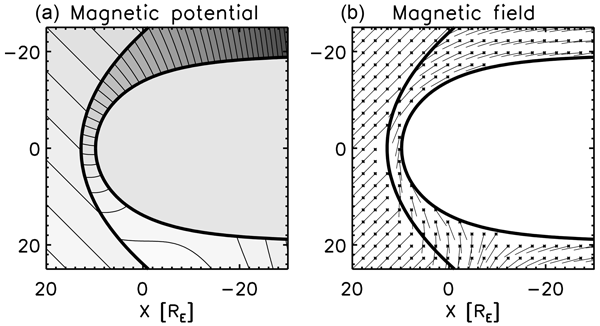
The magnetosheath is a transition layer surrounding the planetary magnetosphere. We develop an algorithm to compute the plasma flow velocity and magnetic field for a more general shape of magnetosheath using the concept of potential field and suitable coordinate transformation. Application to the empirical Earth magnetosheath region is shown in the paper. The developed algorithm is useful when interpreting the spacecraft data or simulation of the planetary magnetosheath region.
Yasuhito Narita, Simon Toepfer, and Daniel Schmid
Ann. Geophys., 41, 87–91, https://doi.org/10.5194/angeo-41-87-2023, https://doi.org/10.5194/angeo-41-87-2023, 2023
Short summary
Short summary
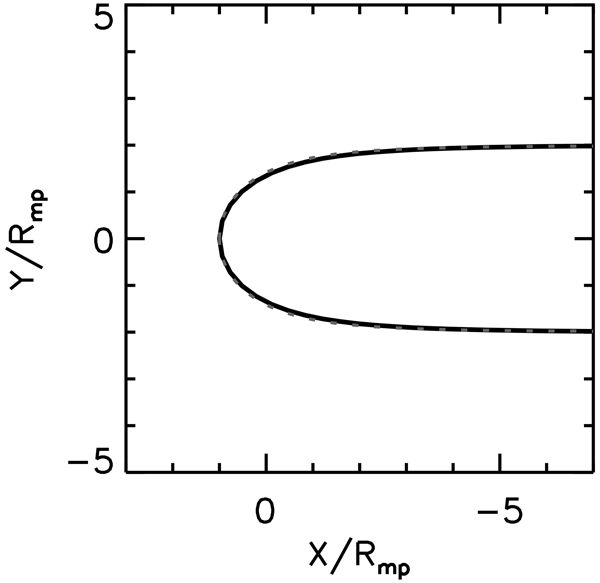
Magnetopause is a shielding boundary of planetary magnetic field. Many mathematical models have been proposed to describe or to reproduce the magnetopause location, but they are restricted to the real-number functions. In this work, we analytically develop a magnetopause model in the complex-number domain, which is advantageous in deforming the magnetopause shape in a conformal (angle-preserving) way, and is suited to compare different models or map one model onto another.
Daniel Schmid and Yasuhito Narita
Ann. Geophys. Discuss., https://doi.org/10.5194/angeo-2022-30, https://doi.org/10.5194/angeo-2022-30, 2023
Revised manuscript not accepted
Short summary
Short summary
Here we present a useful tool to diagnose the bow shock condition around planets on basis of magnetic field observations. From the upstream and downstream shock normal angle of the magnetic field, it is possible to approximate the relation between compression ratio, Alfvenic Mach number and the solar wind plasma beta. The tool is particularly helpful to study the solar wind conditions and bow shock characteristics during the planetary flybys of the ongoing BepiColombo mission.
Simon Toepfer, Ida Oertel, Vanita Schiron, Yasuhito Narita, Karl-Heinz Glassmeier, Daniel Heyner, Patrick Kolhey, and Uwe Motschmann
Ann. Geophys., 40, 91–105, https://doi.org/10.5194/angeo-40-91-2022, https://doi.org/10.5194/angeo-40-91-2022, 2022
Short summary
Short summary
Revealing the nature of Mercury’s internal magnetic field is one of the primary goals of the BepiColombo mission. Besides the parametrization of the magnetic field contributions, the application of a robust inversion method is of major importance. The present work provides an overview of the most commonly used inversion methods and shows that Capon’s method as well as the Tikhonov regularization enable a high-precision determination of Mercury’s internal magnetic field up to the fifth degree.
Daniel Schmid, Yasuhito Narita, Ferdinand Plaschke, Martin Volwerk, Rumi Nakamura, and Wolfgang Baumjohann
Ann. Geophys., 39, 563–570, https://doi.org/10.5194/angeo-39-563-2021, https://doi.org/10.5194/angeo-39-563-2021, 2021
Short summary
Short summary
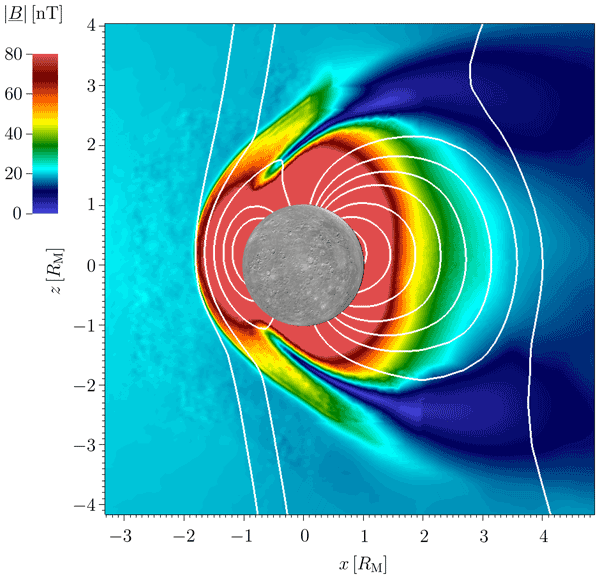
In this work we present the first analytical magnetosheath plasma flow model for the space environment around Mercury. The proposed model is relatively simple to implement and provides the possibility to trace the flow lines inside the Hermean magnetosheath. It can help to determine the the local plasma conditions of a spacecraft in the magnetosheath exclusively on the basis of the upstream solar wind parameters.
Horia Comişel, Yasuhito Narita, and Uwe Motschmann
Ann. Geophys., 39, 165–170, https://doi.org/10.5194/angeo-39-165-2021, https://doi.org/10.5194/angeo-39-165-2021, 2021
Short summary
Short summary
Identification of a large-amplitude Alfvén wave decaying into a pair of
ion-acoustic and daughter Alfvén waves is one of the major goals in the
observational studies of space plasma nonlinearity.
Growth-rate maps
may serve as a useful tool for predictions of the wavevector spectrum of density
or magnetic field fluctuations in various scenarios for the
wave–wave coupling processes developing at different stages in
space plasma turbulence.
Yasuhito Narita, Ferdinand Plaschke, Werner Magnes, David Fischer, and Daniel Schmid
Geosci. Instrum. Method. Data Syst., 10, 13–24, https://doi.org/10.5194/gi-10-13-2021, https://doi.org/10.5194/gi-10-13-2021, 2021
Short summary
Short summary
The systematic error of calibrated fluxgate magnetometer data is studied for a spinning spacecraft. The major error comes from the offset uncertainty when the ambient magnetic field is low, while the error represents the combination of non-orthogonality, misalignment to spacecraft reference direction, and gain when the ambient field is high. The results are useful in developing future high-precision magnetometers and an error estimate in scientific studies using magnetometer data.
Simon Toepfer, Yasuhito Narita, Daniel Heyner, Patrick Kolhey, and Uwe Motschmann
Geosci. Instrum. Method. Data Syst., 9, 471–481, https://doi.org/10.5194/gi-9-471-2020, https://doi.org/10.5194/gi-9-471-2020, 2020
Short summary
Short summary
The Capon method serves as a powerful and robust data analysis tool when working on various kinds of ill-posed inverse problems. Besides the analysis of waves, the method can be used in a generalized way to compare actual measurements with theoretical models, such as Mercury's magnetic field analysis. In view to the BepiColombo mission this work establishes a mathematical basis for the application of Capon's method to analyze Mercury's internal magnetic field in a robust and manageable way.
Bruce T. Tsurutani, Gurbax S. Lakhina, Rajkumar Hajra, Richard B. Horne, Masatomi Iizawa, Yasuhito Narita, Ingo von Borstel, Karl-Heinz Glassmeier, Volker Bothmer, Klaus Reinsch, Philipp Schulz, and Sami Solanki
EGUsphere, https://doi.org/10.5194/egusphere-2025-5536, https://doi.org/10.5194/egusphere-2025-5536, 2025
This preprint is open for discussion and under review for Annales Geophysicae (ANGEO).
Short summary
Short summary
During the 10–11 May 2024 geomagnetic storm, the red auroral rays appear at higher altitudes and connect to green rays lower down. The effect is linked to energetic electrons precipitating into the atmosphere during the storm. As the electrons continue downward, they hit oxygen below 200 km altitude and produce green light (5577 Å), named Stable Auroral Green (SAG) arcs. These observations mark the first reported sightings of such detailed, combined features.
Yasuhito Narita, Daniel Schmid, and Uwe Motschmann
Ann. Geophys., 43, 417–425, https://doi.org/10.5194/angeo-43-417-2025, https://doi.org/10.5194/angeo-43-417-2025, 2025
Short summary
Short summary
It is often the case that only magnetic field data are available for in situ planetary studies using spacecraft. Either plasma data are not available or the data resolution is limited. Nevertheless, the theory of plasma instability tells us how to interpret the magnetic field data (wave frequency) in terms of flow speed and beam velocity, generating the instability. We invent an analysis tool for Mercury's upstream waves as an example.
Yasuhito Narita, Daniel Schmid, and Simon Toepfer
Ann. Geophys., 42, 79–89, https://doi.org/10.5194/angeo-42-79-2024, https://doi.org/10.5194/angeo-42-79-2024, 2024
Short summary
Short summary
The magnetosheath is a transition layer surrounding the planetary magnetosphere. We develop an algorithm to compute the plasma flow velocity and magnetic field for a more general shape of magnetosheath using the concept of potential field and suitable coordinate transformation. Application to the empirical Earth magnetosheath region is shown in the paper. The developed algorithm is useful when interpreting the spacecraft data or simulation of the planetary magnetosheath region.
Yasuhito Narita, Simon Toepfer, and Daniel Schmid
Ann. Geophys., 41, 87–91, https://doi.org/10.5194/angeo-41-87-2023, https://doi.org/10.5194/angeo-41-87-2023, 2023
Short summary
Short summary
Magnetopause is a shielding boundary of planetary magnetic field. Many mathematical models have been proposed to describe or to reproduce the magnetopause location, but they are restricted to the real-number functions. In this work, we analytically develop a magnetopause model in the complex-number domain, which is advantageous in deforming the magnetopause shape in a conformal (angle-preserving) way, and is suited to compare different models or map one model onto another.
Daniel Schmid and Yasuhito Narita
Ann. Geophys. Discuss., https://doi.org/10.5194/angeo-2022-30, https://doi.org/10.5194/angeo-2022-30, 2023
Revised manuscript not accepted
Short summary
Short summary
Here we present a useful tool to diagnose the bow shock condition around planets on basis of magnetic field observations. From the upstream and downstream shock normal angle of the magnetic field, it is possible to approximate the relation between compression ratio, Alfvenic Mach number and the solar wind plasma beta. The tool is particularly helpful to study the solar wind conditions and bow shock characteristics during the planetary flybys of the ongoing BepiColombo mission.
Simon Toepfer, Ida Oertel, Vanita Schiron, Yasuhito Narita, Karl-Heinz Glassmeier, Daniel Heyner, Patrick Kolhey, and Uwe Motschmann
Ann. Geophys., 40, 91–105, https://doi.org/10.5194/angeo-40-91-2022, https://doi.org/10.5194/angeo-40-91-2022, 2022
Short summary
Short summary
Revealing the nature of Mercury’s internal magnetic field is one of the primary goals of the BepiColombo mission. Besides the parametrization of the magnetic field contributions, the application of a robust inversion method is of major importance. The present work provides an overview of the most commonly used inversion methods and shows that Capon’s method as well as the Tikhonov regularization enable a high-precision determination of Mercury’s internal magnetic field up to the fifth degree.
Daniel Schmid, Yasuhito Narita, Ferdinand Plaschke, Martin Volwerk, Rumi Nakamura, and Wolfgang Baumjohann
Ann. Geophys., 39, 563–570, https://doi.org/10.5194/angeo-39-563-2021, https://doi.org/10.5194/angeo-39-563-2021, 2021
Short summary
Short summary
In this work we present the first analytical magnetosheath plasma flow model for the space environment around Mercury. The proposed model is relatively simple to implement and provides the possibility to trace the flow lines inside the Hermean magnetosheath. It can help to determine the the local plasma conditions of a spacecraft in the magnetosheath exclusively on the basis of the upstream solar wind parameters.
Horia Comişel, Yasuhito Narita, and Uwe Motschmann
Ann. Geophys., 39, 165–170, https://doi.org/10.5194/angeo-39-165-2021, https://doi.org/10.5194/angeo-39-165-2021, 2021
Short summary
Short summary
Identification of a large-amplitude Alfvén wave decaying into a pair of
ion-acoustic and daughter Alfvén waves is one of the major goals in the
observational studies of space plasma nonlinearity.
Growth-rate maps
may serve as a useful tool for predictions of the wavevector spectrum of density
or magnetic field fluctuations in various scenarios for the
wave–wave coupling processes developing at different stages in
space plasma turbulence.
Yasuhito Narita, Ferdinand Plaschke, Werner Magnes, David Fischer, and Daniel Schmid
Geosci. Instrum. Method. Data Syst., 10, 13–24, https://doi.org/10.5194/gi-10-13-2021, https://doi.org/10.5194/gi-10-13-2021, 2021
Short summary
Short summary
The systematic error of calibrated fluxgate magnetometer data is studied for a spinning spacecraft. The major error comes from the offset uncertainty when the ambient magnetic field is low, while the error represents the combination of non-orthogonality, misalignment to spacecraft reference direction, and gain when the ambient field is high. The results are useful in developing future high-precision magnetometers and an error estimate in scientific studies using magnetometer data.
Simon Toepfer, Yasuhito Narita, Daniel Heyner, Patrick Kolhey, and Uwe Motschmann
Geosci. Instrum. Method. Data Syst., 9, 471–481, https://doi.org/10.5194/gi-9-471-2020, https://doi.org/10.5194/gi-9-471-2020, 2020
Short summary
Short summary
The Capon method serves as a powerful and robust data analysis tool when working on various kinds of ill-posed inverse problems. Besides the analysis of waves, the method can be used in a generalized way to compare actual measurements with theoretical models, such as Mercury's magnetic field analysis. In view to the BepiColombo mission this work establishes a mathematical basis for the application of Capon's method to analyze Mercury's internal magnetic field in a robust and manageable way.
Cited articles
Beck, R., Chamandy, L., Elson, E., and Blackman, E. G.:
Synthesizing observations and theory to understand
galactic magnetic fields: Progress and challenges,
Galaxies, 8, 4,
https://doi.org/10.3390/galaxies8010004, 2020. a
Benkhoff, J., van Casteren, J., Hayakawa, H., Fujimoto, M.,
Laakso, H., Novara, M., Ferri, P., Middleton, H. R., and Ziethe, R.:
BepiColombo – Comprehensive exploration of Mercury:
Mission overview and science goals,
Planet. Space Sci., 58, 2–20,
https://doi.org/10.1016/j.pss.2009.09.020, 2010. a
Berdyugina, S. V.:
Starspots: A key to the stellar dynamo,
Liv. Rev. Sol. Phys., 2, 8,
https://doi.org/10.12942/lrsp-2005-8, 2005. a
Berger, M. A.:
Introduction to magnetic helicity,
Plasma Phys. Control. Fusion, 41, B167–B175,
https://doi.org/10.1088/0741-3335/41/12B/312, 1999. a
Berger, M. A. and Field, G. B.:
The topological properties of magnetic helicity,
J. Fluid Mech., 147, 133–148,
https://doi.org/10.1017/S0022112084002019, 1984. a
Brandenburg, A.:
Advances in mean-field dynamo theory and
applications to astrophysical turbulence,
J. Plasma Phys., 84, 735840404,
https://doi.org/10.1017/S0022377818000806, 2018. a, b
Brun, A. S. and Browning, M. K.:
Magnetism, dynamo action and the solar-stellar connection,
Liv. Rev. Sol. Phys., 14, 4,
https://doi.org/10.1007/s41116-017-0007-8, 2017. a
Charbonneau, P.:
Dynamo models of the solar cycle,
Liv. Rev. Sol. Phys., 7, 3,
https://doi.org/10.12942/lrsp-2010-3, 2010. a
Charbonneau, P.:
Solar dynamo theory,
Annu. Rev. Astron. Astrophys., 52, 251–290,
https://doi.org/10.1146/annurev-astro-081913-040012, 2014. a
Elsasser, W. M.:
Hydromagnetic dynamo theory,
Rev. Mod. Phys., 28, 135–163,
https://doi.org/10.1103/RevModPhys.28.135, 1956. a
Fox, N. J., Velli, M. C., Bale, S. D., Deckert, R.,
Driesman, A.,
Howard, R. A., Kasper, J. C., Kinnison, J., Kusterer, M., Lario, D.,
Lockwood, M. K., McComas, D. J., Raouafi, N. E., and Szabo, A.: The Solar Probe Plus mission: Humanity’s first visit to our star,
Space Sci. Rev., 204, 7–48,
https://doi.org/10.1007/s11214-015-0211-6, 2016. a
Glatzmaier, G. A.:
Geodynamo simulations – How realistic are they?,
Annu. Rev. Earth Pl. Sc., 30, 237–257,
https://doi.org/10.1146/annurev.earth.30.091201.140817, 2002. a
Glatzmaier, G. A. and Roberts, P. H.: Dynamo theory then and now,
Int. J. Eng. Sci., 36, 1325–1338,
https://doi.org/10.1016/S0020-7225(98)00035-4, 1998. a
Hamba, F.:
Turbulent dynamo effect and cross helicity in magnetohydrodynamic flows,
Phys. Fluid. A, 4, 441–450,
https://doi.org/10.1063/1.858314, 1992. a
Jones, C. A.:
Planetary magnetic fields and fluid dynamocs,
Annu. Rev. Fluid Mech., 43, 583–614,
https://doi.org/10.1146/annurev-fluid-122109-160727, 2011. a
Kono, M. and Roberts, P. H.:
Recent geodynamo simulations and observations of the geomagnetic field,
Rev. Geophys., 40, 4,
https://doi.org/10.1029/2000RG000102, 2002. a
Krause, F. and Rädler, K.-H.:
Mean-field Magnetohydrodynamics and Dynamo Theory,
Pergamon, Oxford, 1980. a
Kronberg, P. P.:
Extragalactic magnetic fields,
Rep. Prog. Phys. 57, 325–382,
https://doi.org/10.1088/0034-4885/57/4/001, 1994. a
Mangano, V., Dósa, M., Fränz, M., Milillo, A.,
Oliveira, J. S., Lee, Y. J., McKenna-Lawlor, S.,
Grassi, D., Heyner, D., Kozyrev, A. S., Peron, R.,
Helbert, J., Besse, S., de la Fuente, S., Mongagnon, E.,
Zender, J., Volwerk, M., Chaufray, J.-Y., Slavin, J. A.,
Krüger, H., Maturilli, A., Cornet, T., Iwai, K.,
Miyoshi, Y., Lucente, M., Massetti, S., Schmidt, C. A.,
Dong, C., Quarati, F., Hirai, T., Varsani, A.,
Beyaev, D., Zhong, J., Kilpua, E. K. J., Jackson, B. V.,
Odstrcil, D., Plaschke, F., Vainio, R., Jarvinen, R.,
Ivanovski, S. L., Madár, Á., Erdős, G., Plainaki, C.,
Alberti, T., Aizawa, S., Benkhoff, J., Murakami, G.,
Quemerais, E., Hiesinger, H., Mitrofanov, I. G.,
Iess, L., Santoli, F., Orsini, S., Lichtenegger, H.,
Laky, G., Barabash, S., Moissl, R., Huovelin, J.,
Kasaba, Y., Saito, Y., Kobayashi, M., and Baumjohann, W.:
BepiColombo science investigations during cruise and
flybys at the Earth, Venus and Mercury,
Space Sci. Rev., 217, 23,
https://doi.org/10.1007/s11214-021-00797-9, 2021. a
Marsch, E. and Tu, C.-Y.:
Electric field fluctuations and possible
dynamo effects in the solar wind,
Solar Wind Seven, Proceedings of the 3rd COSPAR Colloquium,
Goslar, Germany, 16–20 September 1991,
edited by: Marsch, E. and Schwenn, R.,
Pergamonn Press, Oxford, 505–510,
https://doi.org/10.1016/B978-0-08-042049-3.50105-8, 1992. a, b, c, d, e, f
Marsch, E. and Tu, C.-Y.:
MHD turbulence in the solar wind
and interplanetary dynamo effects,
The Cosmic Dynamo,
Proceedings of the 157th Symposium of the International Astronomical
Union held in Potsdam, Germany, 7–11 September 1992,
edited by: Krause, F., Rädler, K.-H., and Rüdiger, G.,
International Astronomical Union, Springer, Dordrecht, 51–57,
https://doi.org/10.1007/978-94-011-0772-3_9, 1993. a, b
Matthaeus, W. H., Goldstein, M. L., and Smith, C.:
Evaluation of magnetic helicity in homogeneous turbulence,
Phys. Rev. Lett., 48, 1256–1259,
https://doi.org/10.1103/PhysRevLett.48.1256, 1982. a
Moffatt, H. K.:
Magnetic Field Generation in Electrically Conducting Fluids,
Cambridge University Press, Cambridge, 1978. a
Moffatt, H. K.:
Helicity and singular structures in fluid dynamics,
P. Natl. Acad. Sci. USA, 111, 3663–3670,
https://doi.org/10.1073/pnas.1400277111, 2014. a
Müller, D., St. Cyr, O. C., Zouganelis, I., Gilbert, H. R.,
Marsden, R., Nieves-Chinchilla, T., Antonucci, E., Auchère, F.,
Berghmans, D., Horbury, T. S., Howard, R. A., Krucker, S.,
Maksimovic, M., Owen, C. J., Rochus, P, Rodriguez-Pacheco, J.,
Romoli, M., Solanki, S. K., Bruno, R., Carlsson, M., Fludra, A.,
Harra, L., Hassler, M., Livi, S., Louarn, P., Peter, H., Schühle, U.,
Teriaca, L., del Toro Iniesta, J. C., Wimmer-Schweingruber, R. F.,
Marsch, E., Velli, M., De Groof, A., Walsh, A., and Williams, D.:
The Solar Orbiter mission,
Astron. Astrophys., 642, A1,
https://doi.org/10.1051/0004-6361/202038467, 2020. a
Narita, Y. and Vörös, Z.: Evaluation of electromotive force in interplanetary space, Ann. Geophys., 36, 101–106, https://doi.org/10.5194/angeo-36-101-2018, 2018. a, b, c, d
NASA Coordinated Data Analysis Web (CDAWeb): Helios data, CDAWeb [data set], available at: https://cdaweb.gsfc.nasa.gov, last access: 18 August 2021. a
Pouquet, A., Frisch, U., and Léorat, J.:
Strong MHD helical turbulence and the nonlinear dynamo effect,
J. Fluid Mech., 77, 321–354,
https://doi.org/10.1017/S0022112076002140, 1976. a, b
Roberts, P. and Glatzmaier, G. A.:
Geodynamo theory and simulations,
Rev. Mod. Phys., 72, 1081–1123,
https://doi.org/10.1103/RevModPhys.72.1081, 2000. a
Roberts, P. H. and Soward, A. M.:
Dynamo theory, Ann. Rev. Fluid Mech., 24, 459–512,
https://doi.org/10.1146/annurev.fl.24.010192.002331, 1992.
a
Sarson, G. R., Jones, C. A., Zhang, K., and Schubert, G.:
Magnetoconvection dynamos and the magnetic fields of Io and Ganumede,
Science, 276, 1106–1108,
https://doi.org/10.1126/science.276.5315.1106, 1997. a
Schubert, G., Zhang, K., Kivelson, M. G., and Anderson, J. D.:
The magnetic field and internal structure of Ganymede,
Nature, 384, 544–545,
https://doi.org/10.1038/384544a0, 1996. a
Steenbeck, M., Krause, F., and Rädler, K.-H.:
Berechnung der mittleren Lorentz-Feldstärke
für ein elektrisch leitendes Medium in turbulenter,
durch Coriolis-Kräfte beeinflußter Bewegung,
Z. Naturforsch., 21a, 369–376,
https://doi.org/10.1515/zna-1966-0401, 1966. a
Tu, C.-Y. and Marsch, E.:
MHD structures, waves and turbulence in the solar wind:
Observations and theories,
Space Sci. Rev., 73, 1–210, 1995. a
Vainshtein, S. I. and Ruzmaikin, A. A.:
Generation of the large-scale galactic magnetic field,
Astron. Z., 48, 902–909, 1971
(English translation in Sov. Astron. AJ, 15, 714–719, 1972). a
Widrow, L. M.:
Origin of galactic and extragalactic magnetic fields,
Rev. Mod. Phys., 74, 775–823,
https://doi.org/10.1103/RevModPhys.74.775, 2002. a
Yokoi, N.:
Cross helicity and related dynamo,
Geophys. Astrophys. Fluid Dyn., 107, 114–184,
https://doi.org/10.1080/03091929.2012.754022, 2013. a, b
Yokoi, N.:
Electromotive force in strongly compressible
magnetohydrodynamic turbulence,
J. Plasma Phys., 84, 735840501,
https://doi.org/10.1017/S0022377818000727, 2018a. a
Yokoi, N.:
Turbulent dynamos beyond the heuristic modelling:
Helicities and density variance,
AIP Conf. Proc., 1993. 020010,
https://doi.org/10.1063/1.5048720, 2018b. a
Yokoi, N. and Balarac, G.:
Cross-helicity effects and turbulent transport
in magnetohydrodyamic flow,
J. Phys. Conf. Ser., 318, 072039,
https://doi.org/10.1088/1742-6596/318/7/072039, 2011. a
Yoshizawa, A:
Self-consistent turbulent dynamo modeling of
reversed field pinches and planetary magnetic fields,
Phys. Fluids B, 2, 1589–1600,
https://doi.org/10.1063/1.859484, 1990. a, b
Yoshizawa, A.:
Hydrodynamic and Magnetohydrodynamic Turbulent Flows:
Modelling and Statistical Theory,
Kluwer Academic Publishers, Dordrecht, 1998. a

Short summary
The concept of electromotive force appears in various electromagnetic applications in geophysical and astrophysical fluid studies. The electromotive force is being recognized as a useful tool to construct a more complete picture of turbulent space plasma and has the potential to test for the fundamental processes of dynamo mechanism in space.
The concept of electromotive force appears in various electromagnetic applications in...