
Articles | Volume 44, issue 2
https://doi.org/10.5194/angeo-44-977-2026
© Author(s) 2026. This work is distributed under
the Creative Commons Attribution 4.0 License.
the Creative Commons Attribution 4.0 License.
https://doi.org/10.5194/angeo-44-977-2026
© Author(s) 2026. This work is distributed under
the Creative Commons Attribution 4.0 License.
the Creative Commons Attribution 4.0 License.
Regular paper
| 
30 Sep 2026
Regular paper |
| 30 Sep 2026
| 30 Sep 2026
Ionospheric currents and auroral signatures during successive earthward bursty bulk flows and dipolarization: a 7 December 2023 case study
Vanina Lanabere
CORRESPONDING AUTHOR

Swedish Institute of Space Physics, Uppsala, Sweden
Stephan Buchert
Swedish Institute of Space Physics, Uppsala, Sweden
Adrian Blagau
Institute of Space Science, Bucharest, Romania
Harriet George
Swedish Institute of Space Physics, Uppsala, Sweden
Sota Nanjo
Swedish Institute of Space Physics, Kiruna, Sweden
Liisa Juusola
Finnish Meteorological Institute, Helsinki, Finland
Andrew P. Dimmock
Swedish Institute of Space Physics, Uppsala, Sweden
Samuel Wharton
School of Physics and Astronomy, University of Leicester, Leicester, UK
Heikki Vanhamäki
Space Physics and Astronomy Research Unit, University of Oulu, Oulu, Finland
Octav Marghitu
Institute of Space Science, Bucharest, Romania
Louis Richard
Swedish Institute of Space Physics, Uppsala, Sweden
Space Physics and Astronomy Research Unit, University of Oulu, Oulu, Finland
Alice V. L. Wallner
Swedish Institute of Space Physics, Uppsala, Sweden
Department of Physics and Astronomy, Uppsala University, Uppsala, Sweden
Daria Kotova
Department of Physics, University of Oslo, Oslo, Norway
Department of Physics, University of Oslo, Oslo, Norway
Theresa Hoppe
Finnish Meteorological Institute, Helsinki, Finland
Jennifer A. Carter
School of Physics and Astronomy, University of Leicester, Leicester, UK
Anita Aikio
Space Physics and Astronomy Research Unit, University of Oulu, Oulu, Finland
Related authors
Harriet George, Andrew P. Dimmock, Vanina Lanabare, Heikki Vanhamäki, Ilkka Virtanen, Anita Aikio, Adrian Blagau, Octav Marghitu, Milla Myllymaa, Habtamu Tesfaw, Stephan Buchert, and Mykhaylo Shumko
EGUsphere, https://doi.org/10.5194/egusphere-2026-3108, https://doi.org/10.5194/egusphere-2026-3108, 2026
Short summary
Short summary
Bursty bulk flows are mesoscale ion flows that are ejected from magnetic reconnection sites in the Earth's magnetotail, and they couple to the ionosphere via field aligned currents that close through the ionosphere. We analyse unique triple-conjunctive observations of the coupled bursty bulk flow / current / ionosphere system to evaluate a case study of a bursty bulk flow and its ionospheric effects. We identify multiple current signatures of this bursty bulk flow within the ionosphere.
Vanina Lanabere, Andrew P. Dimmock, Sven Molenkamp Venholen, Alice V. L. Wallner, Andreas Johlander, Lisa Rosenqvist, and Johan Setréus
Ann. Geophys., 44, 245–261, https://doi.org/10.5194/angeo-44-245-2026, https://doi.org/10.5194/angeo-44-245-2026, 2026
Short summary
Short summary
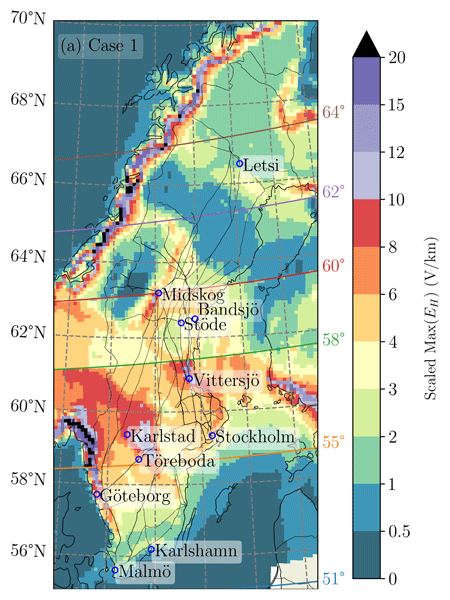
The goal of this study was to explore how a once-in-a-century geoelectric field event could affect the Swedish power grid by combining past storm data with a simplified model of the power grid. We identified regions that may be at higher risk and estimated how many power lines could be exposed to large voltages. These insights reveal vulnerable areas and provide a foundation for strengthening preparedness against rare, high-impact events.
Liisa Juusola, Ari Viljanen, Ilja Honkonen, Magnar Gullikstad Johnsen, Andrew Dimmock, Vanina Lanabere, and Alice Wallner
EGUsphere, https://doi.org/10.5194/egusphere-2026-1110, https://doi.org/10.5194/egusphere-2026-1110, 2026
Short summary
Short summary
During severe space storms, the induced geoelectric field has the potential to cause substantial problems in power grids. We examine the geomagnetically induced currents (GIC) the geoelectric field would have driven in a simple model power grid located in Northern Europe during the May 2024 superstorm. Our results help us understand how the complicated interaction between the driving from space and the response of the conducting ground produces the most intense GIC peaks.
Sota Nanjo, Satoshi Kurita, Tima Sergienko, Yoshizumi Miyoshi, and Ryuho Kataoka
Ann. Geophys., 44, 959–975, https://doi.org/10.5194/angeo-44-959-2026, https://doi.org/10.5194/angeo-44-959-2026, 2026
Short summary
Short summary
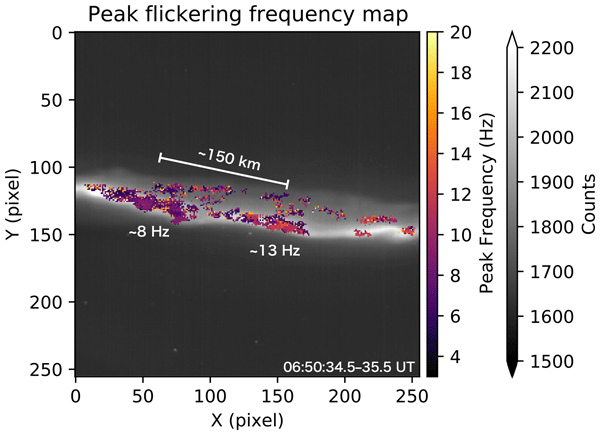
Using a high-speed camera with a wide view of the sky, we observed rapidly blinking aurora across several hundred kilometers. We found that different parts of the same auroral arc can blink at different rhythms at the same time, and that these rhythms move together with the arc. Although larger bright patches sometimes blink more slowly, this pattern does not hold overall. These results improve our understanding of how invisible space processes shape the visible northern lights.
Maxime Grandin, Liisa Juusola, Noora Partamies, Emma Bruus, Joona Rautiainen, Donna Lach, Jia Jia, Max van de Kamp, Eero Karvinen, Kirsti Kauristie, and Theresa Hoppe
Ann. Geophys., 44, 855–880, https://doi.org/10.5194/angeo-44-855-2026, https://doi.org/10.5194/angeo-44-855-2026, 2026
Short summary
Short summary
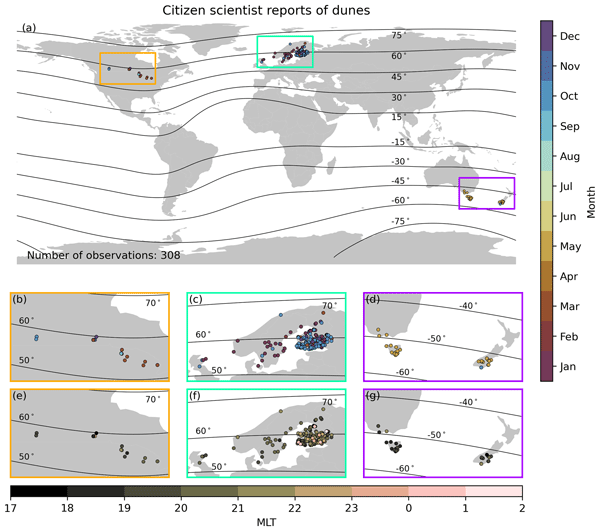
Dune aurora is an intriguing phenomenon recently discovered thanks to citizen science. It is a dim, diffuse auroral form exhibiting wave-like stripes of brighter emission. We carry out the first statistical study of dune aurora, using 308 observation reports submitted to the Skywarden database by citizen scientists from Europe, North America, and Oceania. We find that dunes are an evening phenomenon, most often reported in March and October and associated with currents in the auroral atmosphere.
Stelios Tourgaidis, Theodoros Sarris, Dimitrios Baloukidis, Stephan Buchert, Panagiotis Pirnaris, Konstantinos Papadakis, and Athanasios Balafoutis
Ann. Geophys., 44, 773–793, https://doi.org/10.5194/angeo-44-773-2026, https://doi.org/10.5194/angeo-44-773-2026, 2026
Short summary
Short summary
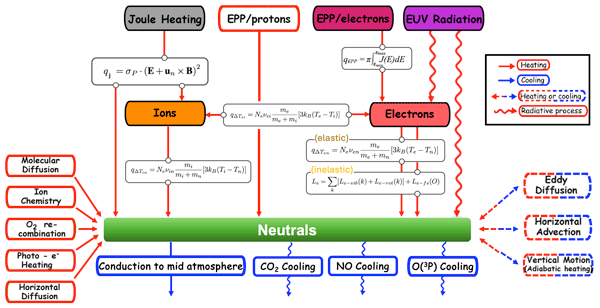
The Lower Thermosphere-Ionosphere energy balance is driven by complex interactions between ions, neutrals and electrons. These processes are understood theoretically, but their estimates show large discrepancies between models. We calculate the storm-time energy budget according to the neutrals, ions and electrons using TIE-GCM (Thermosphere Ionosphere Electrodynamics General Circulation Model) using two different external drivers. Discrepancies between the model runs are discussed and the way forward to close the gaps in present knowledge is highlighted.
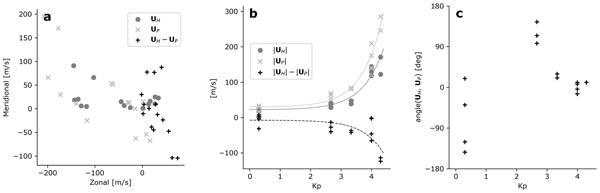
Spencer Mark Hatch, Johnathan Burchill, Heikki Vanhamäki, Rafael Luiz Araujo de Mesquita, and Karl Magnus Laundal
Ann. Geophys., 44, 715–729, https://doi.org/10.5194/angeo-44-715-2026, https://doi.org/10.5194/angeo-44-715-2026, 2026
Short summary
Short summary
Atmospheric winds at high altitudes (> 100 km) can play an important role in the electrodynamic processes that govern how ionospheric plasma interacts with Earth's neutral atmosphere. Here we investigate how a common idea in studies of ionospheric electrodynamics—that atmospheric winds can be ignored or represented via an average value—ignores the high variability of these winds. This variability forces a different formulation of the equations that govern ionosphere-thermosphere electrodynamics.
Harriet George, Andrew P. Dimmock, Vanina Lanabare, Heikki Vanhamäki, Ilkka Virtanen, Anita Aikio, Adrian Blagau, Octav Marghitu, Milla Myllymaa, Habtamu Tesfaw, Stephan Buchert, and Mykhaylo Shumko
EGUsphere, https://doi.org/10.5194/egusphere-2026-3108, https://doi.org/10.5194/egusphere-2026-3108, 2026
Short summary
Short summary
Bursty bulk flows are mesoscale ion flows that are ejected from magnetic reconnection sites in the Earth's magnetotail, and they couple to the ionosphere via field aligned currents that close through the ionosphere. We analyse unique triple-conjunctive observations of the coupled bursty bulk flow / current / ionosphere system to evaluate a case study of a bursty bulk flow and its ionospheric effects. We identify multiple current signatures of this bursty bulk flow within the ionosphere.
Sota Nanjo, Tomoe Taki, Keisuke Hosokawa, Urban Brändström, Yoshizumi Miyoshi, and Magnar G. Johnsen
EGUsphere, https://doi.org/10.5194/egusphere-2026-2506, https://doi.org/10.5194/egusphere-2026-2506, 2026
Short summary
Short summary
Pulsating aurora often contains rapid brightness changes, but their overall behavior has not been well measured. We analyzed high-speed camera images from northern Sweden and Norway with machine learning to identify when these rapid changes occur. We found that they become more common toward the morning and at the lower-latitude sector. This suggests that small-scale auroral fluctuation can help reveal how particles from near-Earth space enter the upper atmosphere.
Vanina Lanabere, Andrew P. Dimmock, Sven Molenkamp Venholen, Alice V. L. Wallner, Andreas Johlander, Lisa Rosenqvist, and Johan Setréus
Ann. Geophys., 44, 245–261, https://doi.org/10.5194/angeo-44-245-2026, https://doi.org/10.5194/angeo-44-245-2026, 2026
Short summary
Short summary
The goal of this study was to explore how a once-in-a-century geoelectric field event could affect the Swedish power grid by combining past storm data with a simplified model of the power grid. We identified regions that may be at higher risk and estimated how many power lines could be exposed to large voltages. These insights reveal vulnerable areas and provide a foundation for strengthening preparedness against rare, high-impact events.
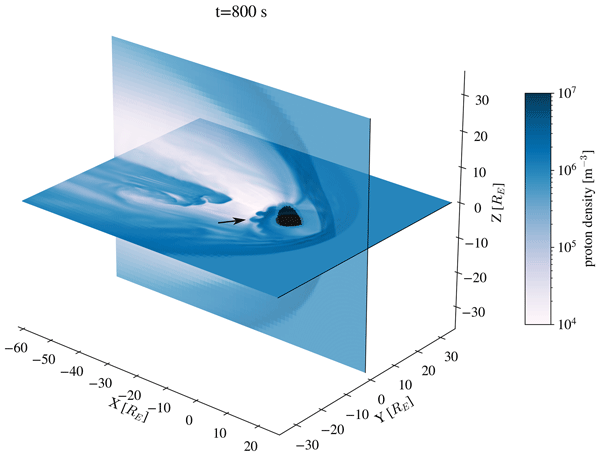
Venla Koikkalainen, Maxime Grandin, Emilia Kilpua, Abiyot Workayehu, Ivan Zaitsev, Liisa Juusola, Shi Tao, Markku Alho, Lauri Pänkäläinen, Giulia Cozzani, Konstantinos Horaites, Jonas Suni, Yann Pfau-Kempf, Urs Ganse, and Minna Palmroth
Ann. Geophys., 44, 227–243, https://doi.org/10.5194/angeo-44-227-2026, https://doi.org/10.5194/angeo-44-227-2026, 2026
Short summary
Short summary
We use a numerical simulation to study phenomena that occur between the Earth’s dipolar magnetic field and the nightside of near-Earth space. We observe the formation of large-scale vortex flows with scales of several Earth radii. On the ionospheric grid of the simulation we find that the field-aligned currents formed in the simulation reflect the vortex flow in the transition region. The main finding is that the vortex flow is a result of a combination of flow dynamics and a plasma instability.
Liisa Juusola, Ari Viljanen, Ilja Honkonen, Magnar Gullikstad Johnsen, Andrew Dimmock, Vanina Lanabere, and Alice Wallner
EGUsphere, https://doi.org/10.5194/egusphere-2026-1110, https://doi.org/10.5194/egusphere-2026-1110, 2026
Short summary
Short summary
During severe space storms, the induced geoelectric field has the potential to cause substantial problems in power grids. We examine the geomagnetically induced currents (GIC) the geoelectric field would have driven in a simple model power grid located in Northern Europe during the May 2024 superstorm. Our results help us understand how the complicated interaction between the driving from space and the response of the conducting ground produces the most intense GIC peaks.
Tomoe Taki, Tima Sergienko, Urban Brändström, Yasunobu Ogawa, Sota Nanjo, and Juan Araújo
EGUsphere, https://doi.org/10.5194/egusphere-2026-1133, https://doi.org/10.5194/egusphere-2026-1133, 2026
Short summary
Short summary
This study explored electric forces near a auroral arc during a rocket experiment in northern Sweden. A rocket released glowing clouds high above Earth, and we tracked their motion as an aurora passed through them. By reconstructing their motion in three dimensions, we estimated the magnitude and direction of the surrounding electric field. We found that the field changed direction and became weaker near the arc, revealing the structure of electric currents correspond to auroral activity.

Sota Nanjo, Katie Herlingshaw, Tima Sergienko, Gaël Cessateur, Noora Partamies, Magnar G. Johnsen, Keisuke Hosokawa, Hervé Lamy, Yasunobu Ogawa, Antti Kero, Shin-ichiro Oyama, and Masatoshi Yamauchi
Ann. Geophys., 44, 63–84, https://doi.org/10.5194/angeo-44-63-2026, https://doi.org/10.5194/angeo-44-63-2026, 2026
Short summary
Short summary
During the New Year’s Day storm of 2025, we observed rare auroral features: thin, short-lived green stripes and a “picket fence” near the poleward edge of the auroral oval. Using ground cameras and satellites, we found that the stripes sometimes appeared at widely separated longitudes at the same time and often tracked the motion of nearby red auroras. Some stripes were aligned with the magnetic field, while others were not, implying that multiple local processes contribute to their generation.
Gaël Cessateur, Keisuke Hosokawa, Hervé Lamy, Sota Nanjo, Mathieu Barthelemy, Magnar G. Johnsen, and Romain Maggiolo
EGUsphere, https://doi.org/10.5194/egusphere-2026-385, https://doi.org/10.5194/egusphere-2026-385, 2026
Short summary
Short summary
The Auroral Spectrograph in Skibotn has been measuring auroral light spectra since October 2023. We estimate the energy of electrons producing diffuse auroras from red oxygen and blue nitrogen emissions. Our statistical analysis shows that electron energy increases toward the morning sector, confirming previous studies: electron scattering by chorus waves can populate the loss cone and lead to precipitation, while changes in resonance conditions toward dawn favor harder electrons
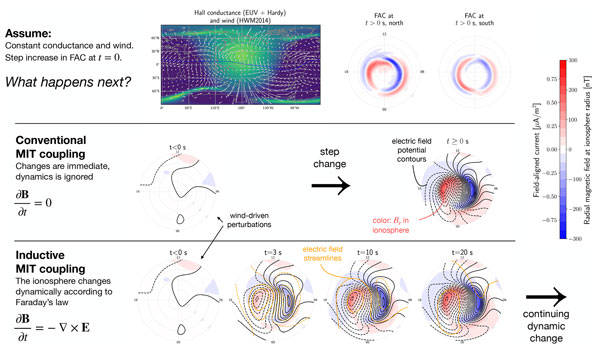
Karl M. Laundal, Andreas S. Skeidsvoll, Beatrice Popescu Braileanu, Spencer M. Hatch, Nils Olsen, and Heikki Vanhamäki
Ann. Geophys., 43, 803–833, https://doi.org/10.5194/angeo-43-803-2025, https://doi.org/10.5194/angeo-43-803-2025, 2025
Short summary
Short summary
The ionosphere is where Earth’s atmosphere overlaps with a gas of charged particles in space. There, collisions with neutral air and electromagnetic forces driven by the solar wind control plasma motion. We created a global model that includes magnetic induction, explaining how electric currents and fields change, offering a more accurate view of atmosphere–space coupling than conventional models based on electric circuits.
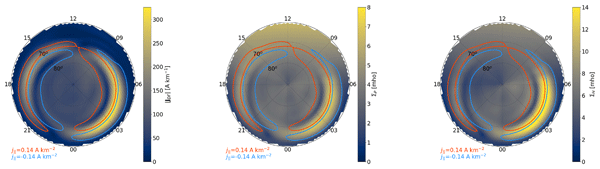
Liisa Juusola, Ilkka Virtanen, Spencer Mark Hatch, Heikki Vanhamäki, Maxime Grandin, Noora Partamies, Urs Ganse, Ilja Honkonen, Abiyot Workayehu, Antti Kero, and Minna Palmroth
Ann. Geophys., 43, 755–781, https://doi.org/10.5194/angeo-43-755-2025, https://doi.org/10.5194/angeo-43-755-2025, 2025
Short summary
Short summary
Key properties of the ionospheric electrodynamics are electric fields, currents, and conductances. They provide a window to the vast and distant near-Earth space, cause Joule heating that affect satellite orbits, and drive geomagnetically induced currents (GICs) in technological conductor networks. We have developed a new method for solving the key properties of ionospheric electrodynamics from ground-based magnetic field observations.
Abiyot Workayehu, Minna Palmroth, Maxime Grandin, Liisa Juusola, Markku Alho, Ivan Zaitsev, Venla Koikkalainen, Konstantinos Horaites, Yann Pfau-Kempf, Urs Ganse, Markus Battarbee, and Jonas Suni
Ann. Geophys., 43, 723–737, https://doi.org/10.5194/angeo-43-723-2025, https://doi.org/10.5194/angeo-43-723-2025, 2025
Short summary
Short summary
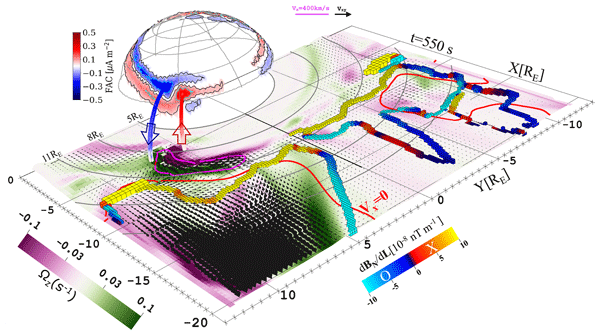
This study investigates the ionospheric signatures of a Bursty Bulk Flow in Earth’s magnetotail using a global 6D hybrid-Vlasov simulation coupled with an ionospheric model. The results show that a reconnection-driven Bursty Bulk Flow generates vortices that produce field-aligned currents, which map to the ionosphere with a distinct east–west orientation and exhibit a characteristic westward drift. Variations in ionospheric observables are identified as clear signatures of this flow.
Sota Nanjo, Masatoshi Yamauchi, Magnar Gullikstad Johnsen, Yoshihiro Yokoyama, Urban Brändström, Yasunobu Ogawa, Anna Naemi Willer, and Keisuke Hosokawa
Ann. Geophys., 43, 303–317, https://doi.org/10.5194/angeo-43-303-2025, https://doi.org/10.5194/angeo-43-303-2025, 2025
Short summary
Short summary
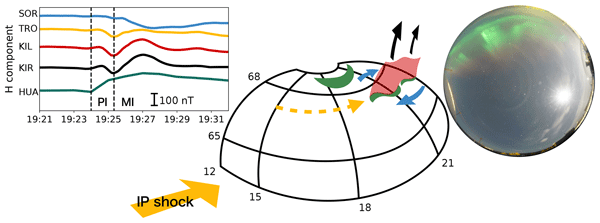
Our research explores the shock aurora, which is typically observed on the dayside due to the rapid compression of the Earth's magnetic field. We observed this rare aurora on the nightside, a region where such events are difficult to detect. Using ground-based cameras, we identified new features, including leaping and vortex-like patterns. These findings offer a fresh insight into the interactions between the solar wind and the magnetosphere, enhancing our understanding of space weather and its effects.
Liisa Juusola, Heikki Vanhamäki, Elena Marshalko, Mikhail Kruglyakov, and Ari Viljanen
Ann. Geophys., 43, 271–301, https://doi.org/10.5194/angeo-43-271-2025, https://doi.org/10.5194/angeo-43-271-2025, 2025
Short summary
Short summary
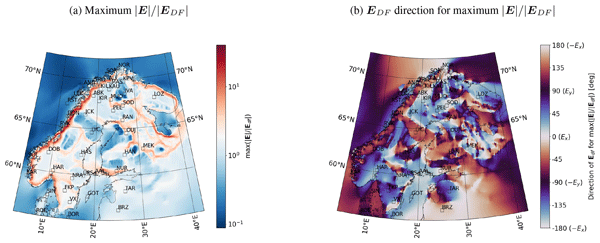
Interaction between the magnetic field of the rapidly varying electric currents in space and the conducting ground produces an electric field at the Earth's surface. This geoelectric field drives geomagnetically induced currents in technological conductor networks, which can affect the performance of critical ground infrastructure such as electric power transmission grids. We have developed a new method suitable for monitoring the geoelectric field based on ground magnetic field observations.
Urs Ganse, Yann Pfau-Kempf, Hongyang Zhou, Liisa Juusola, Abiyot Workayehu, Fasil Kebede, Konstantinos Papadakis, Maxime Grandin, Markku Alho, Markus Battarbee, Maxime Dubart, Leo Kotipalo, Arnaud Lalagüe, Jonas Suni, Konstantinos Horaites, and Minna Palmroth
Geosci. Model Dev., 18, 511–527, https://doi.org/10.5194/gmd-18-511-2025, https://doi.org/10.5194/gmd-18-511-2025, 2025
Short summary
Short summary
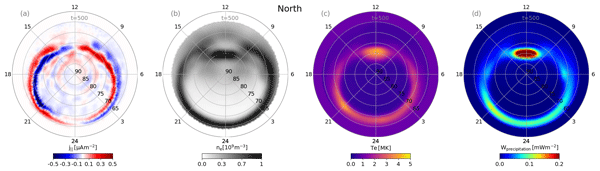
Vlasiator is a kinetic space plasma model that simulates the behavior of plasma, solar wind and magnetic fields in near-Earth space. So far, these simulations have been run without any interaction with the ionosphere, the uppermost layer of Earth's atmosphere. In this paper, we present the new methods that add an ionospheric electrodynamics model to Vlasiator, coupling it with the existing methods and presenting new simulation results of how space plasma and Earth's ionosphere interact.
Spencer Mark Hatch, Heikki Vanhamäki, Karl Magnus Laundal, Jone Peter Reistad, Johnathan K. Burchill, Levan Lomidze, David J. Knudsen, Michael Madelaire, and Habtamu Tesfaw
Ann. Geophys., 42, 229–253, https://doi.org/10.5194/angeo-42-229-2024, https://doi.org/10.5194/angeo-42-229-2024, 2024
Short summary
Short summary
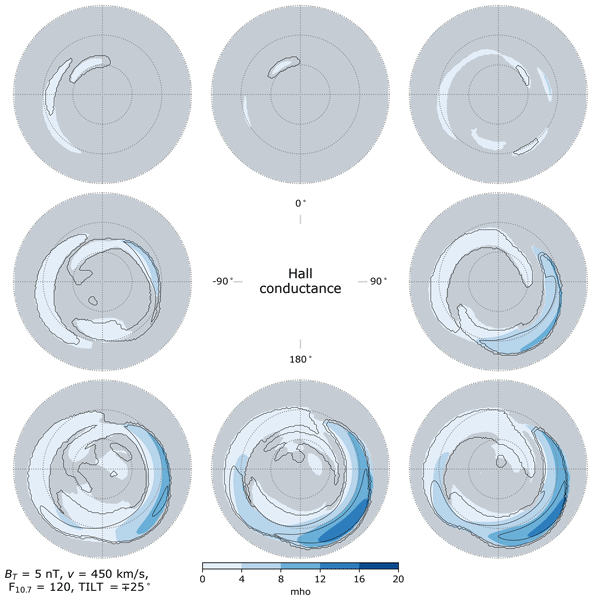
In studies of the Earth's ionosphere, a hot topic is how to estimate ionospheric conductivity. This is hard to do for a variety of reasons that mostly amount to a lack of measurements. In this study we use satellite measurements to estimate electromagnetic work and ionospheric conductances in both hemispheres. We identify where our model estimates are inconsistent with laws of physics, which partially solves a previous problem with unrealistic predictions of ionospheric conductances.
Noora Partamies, Bas Dol, Vincent Teissier, Liisa Juusola, Mikko Syrjäsuo, and Hjalmar Mulders
Ann. Geophys., 42, 103–115, https://doi.org/10.5194/angeo-42-103-2024, https://doi.org/10.5194/angeo-42-103-2024, 2024
Short summary
Short summary
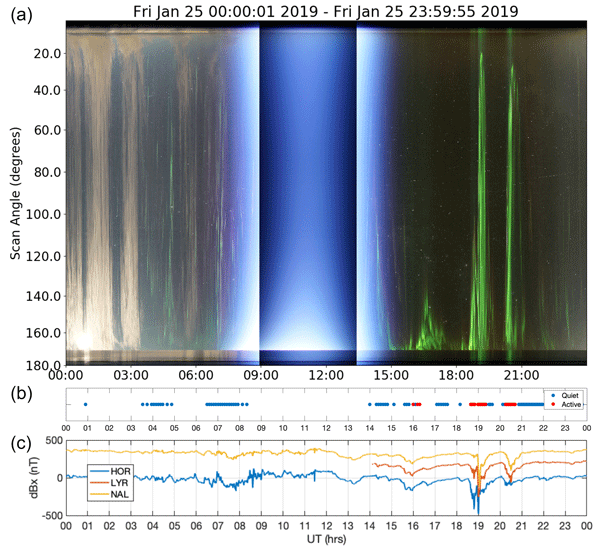
Auroral imaging produces large amounts of image data that can no longer be analyzed by visual inspection. Thus, every step towards automatic analysis tools is crucial. Previously supervised learning methods have been used in auroral physics, with a human expert providing ground truth. However, this ground truth is debatable. We present an unsupervised learning method, which shows promising results in detecting auroral breakups in the all-sky image data.
Joachim Vogt, Octav Marghitu, Adrian Blagau, Leonie Pick, Nele Stachlys, Stephan Buchert, Theodoros Sarris, Stelios Tourgaidis, Thanasis Balafoutis, Dimitrios Baloukidis, and Panagiotis Pirnaris
Geosci. Instrum. Method. Data Syst., 12, 239–257, https://doi.org/10.5194/gi-12-239-2023, https://doi.org/10.5194/gi-12-239-2023, 2023
Short summary
Short summary
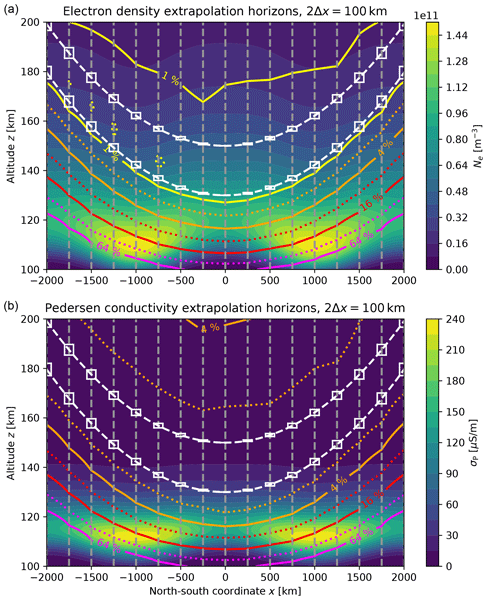
Motivated by recent community interest in a satellite mission to the atmospheric lower thermosphere and ionosphere (LTI) region (100–200 km altitude), the DIPCont project is concerned with the reconstruction quality of vertical profiles of key LTI variables using dual- and single-spacecraft observations. The report introduces the probabilistic DIPCont modeling framework, demonstrates its usage by means of a set of self-consistent parametric non-isothermal models, and discusses first results.
Liisa Juusola, Ari Viljanen, Noora Partamies, Heikki Vanhamäki, Mirjam Kellinsalmi, and Simon Walker
Ann. Geophys., 41, 483–510, https://doi.org/10.5194/angeo-41-483-2023, https://doi.org/10.5194/angeo-41-483-2023, 2023
Short summary
Short summary
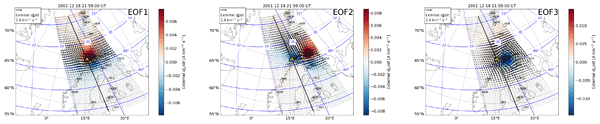
At times when auroras erupt on the sky, the magnetic field surrounding the Earth undergoes rapid changes. On the ground, these changes can induce harmful electric currents in technological conductor networks, such as powerlines. We have used magnetic field observations from northern Europe during 28 such events and found consistent behavior that can help to understand, and thus predict, the processes that drive auroras and geomagnetically induced currents.
Liisa Juusola, Ari Viljanen, Andrew P. Dimmock, Mirjam Kellinsalmi, Audrey Schillings, and James M. Weygand
Ann. Geophys., 41, 13–37, https://doi.org/10.5194/angeo-41-13-2023, https://doi.org/10.5194/angeo-41-13-2023, 2023
Short summary
Short summary
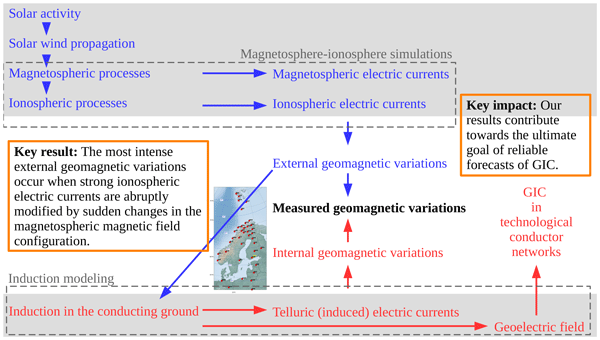
We have examined events during which the measured magnetic field on the ground changes very rapidly, causing a risk to technological conductor networks. According to our results, such events occur when strong electric currents in the ionosphere at 100 km altitude are abruptly modified by sudden compression or expansion of the magnetospheric magnetic field farther in space.

Konstantinos Papadakis, Yann Pfau-Kempf, Urs Ganse, Markus Battarbee, Markku Alho, Maxime Grandin, Maxime Dubart, Lucile Turc, Hongyang Zhou, Konstantinos Horaites, Ivan Zaitsev, Giulia Cozzani, Maarja Bussov, Evgeny Gordeev, Fasil Tesema, Harriet George, Jonas Suni, Vertti Tarvus, and Minna Palmroth
Geosci. Model Dev., 15, 7903–7912, https://doi.org/10.5194/gmd-15-7903-2022, https://doi.org/10.5194/gmd-15-7903-2022, 2022
Short summary
Short summary
Vlasiator is a plasma simulation code that simulates the entire near-Earth space at a global scale. As 6D simulations require enormous amounts of computational resources, Vlasiator uses adaptive mesh refinement (AMR) to lighten the computational burden. However, due to Vlasiator’s grid topology, AMR simulations suffer from grid aliasing artifacts that affect the global results. In this work, we present and evaluate the performance of a mechanism for alleviating those artifacts.
Mirjam Kellinsalmi, Ari Viljanen, Liisa Juusola, and Sebastian Käki
Ann. Geophys., 40, 545–562, https://doi.org/10.5194/angeo-40-545-2022, https://doi.org/10.5194/angeo-40-545-2022, 2022
Short summary
Short summary
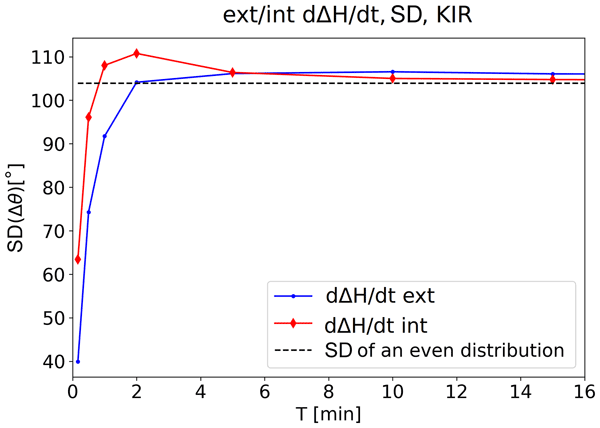
Eruptions from the Sun can pose a hazard to Earth's power grids via, e.g., geomagnetically induced currents (GICs). We study magnetic measurements from Fennoscandia to find ways to understand and forecast GIC. We find that the direction of the time derivative of the magnetic field has a short
reset time, about 2 min. We conclude that this result gives insight on the current systems high in Earth’s atmosphere, which are the main driver behind the time derivative’s behavior and GIC formation.
Filomena Catapano, Stephan Buchert, Enkelejda Qamili, Thomas Nilsson, Jerome Bouffard, Christian Siemes, Igino Coco, Raffaella D'Amicis, Lars Tøffner-Clausen, Lorenzo Trenchi, Poul Erik Holmdahl Olsen, and Anja Stromme
Geosci. Instrum. Method. Data Syst., 11, 149–162, https://doi.org/10.5194/gi-11-149-2022, https://doi.org/10.5194/gi-11-149-2022, 2022
Short summary
Short summary
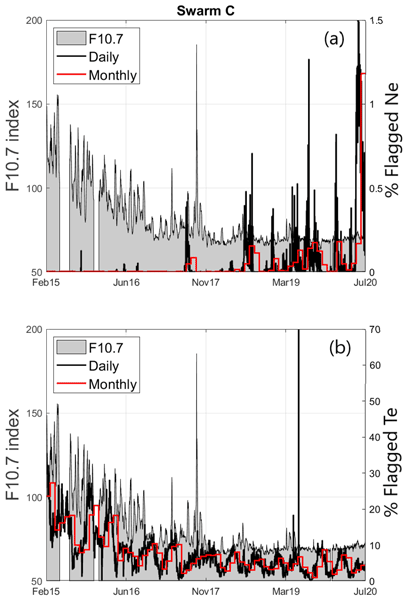
The quality control and validation activities performed by the Swarm data quality team reveal the good-quality LPs. The analysis demonstrated that the current baseline plasma data products are improved with respect to previous baseline. The LPs have captured the ionospheric plasma variability over more than half of a solar cycle, revealing the data quality dependence on the solar activity. The quality of the LP data will further improve promotion of their application to a broad range of studies.
Sebastian Käki, Ari Viljanen, Liisa Juusola, and Kirsti Kauristie
Ann. Geophys., 40, 107–119, https://doi.org/10.5194/angeo-40-107-2022, https://doi.org/10.5194/angeo-40-107-2022, 2022
Short summary
Short summary
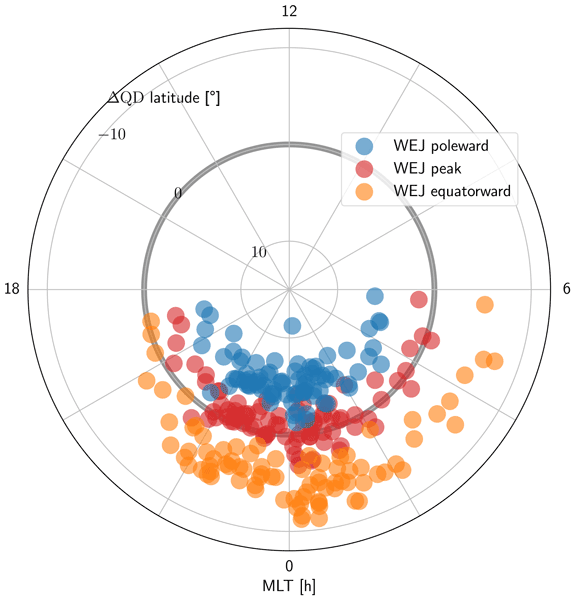
During auroral substorms, the ionospheric electric currents change rapidly, and a large amount of energy is dissipated. We combine ionospheric current data derived from the Swarm satellite mission with the substorm database from the SuperMAG ground magnetometer network. We obtain statistics of the strength and location of the currents relative to the substorm onset. Our results show that low-earth orbit satellites give a coherent picture of the main features in the substorm current system.
Cited articles
Akasofu, S.-I.: The development of the auroral substorm, Planet. Space Sci., 12, 273–282, https://doi.org/10.1016/0032-0633(64)90151-5, 1964. a, b
Amm, O.: Ionospheric Elementary Current Systems in Spherical Coordinates and Their Application., J. Geomagn. Geoelectr., 49, 947–955, https://doi.org/10.5636/jgg.49.947, 1997. a
Amm, O. and Viljanen, A.: Ionospheric disturbance magnetic field continuation from the ground to the ionosphere using spherical elementary current systems, Earth Planets Space, 51, 431, https://doi.org/10.1186/BF03352247, 1999. a
Angelopoulos, V.: The THEMIS Mission, Space Sci. Rev., 141, 5–34, https://doi.org/10.1007/s11214-008-9336-1, 2008. a
Baker, D. N., Pulkkinen, T. I., Hesse, M., and McPherron, R. L.: A quantitative assessment of energy storage and release in the Earth's magnetotail, J. Geophys. Res., 102, 7159–7168, https://doi.org/10.1029/96JA03961, 1997. a
Baker, K. B. and Wing, S.: A new magnetic coordinate system for conjugate studies at high latitudes, J. Geophys. Res., 94, 9139–9143, https://doi.org/10.1029/JA094iA07p09139, 1989. a
Baumjohann, W., Paschmann, G., and Lühr, H.: Characteristics of high-speed ion flows in the plasma sheet, J. Geophys. Res., 95, 3801–3809, https://doi.org/10.1029/JA095iA04p03801, 1990. a
Baumjohann, W., Hesse, M., Kokubun, S., Mukai, T., Nagai, T., and Petrukovich, A. A.: Substorm dipolarization and recovery, J. Geophys. Res., 104, 24995–25000, https://doi.org/10.1029/1999JA900282, 1999. a, b
Birn, J. and Hesse, M.: The substorm current wedge in MHD simulations, J. Geophys. Res., 118, 3364–3376, https://doi.org/10.1002/jgra.50187, 2013. a
Birn, J. and Hesse, M.: The substorm current wedge: Further insights from MHD simulations, J. Geophys. Res., 119, 3503–3513, https://doi.org/10.1002/2014JA019863, 2014. a
Birn, J., Raeder, J., Wang, Y. L., Wolf, R. A., and Hesse, M.: On the propagation of bubbles in the geomagnetic tail, Ann. Geophys., 22, 1773–1786, https://doi.org/10.5194/angeo-22-1773-2004, 2004. a
Blagau, A. and Vogt, J.: Multipoint Field-Aligned Current Estimates With Swarm, J. Geophys. Res., 124, 6869–6895, https://doi.org/10.1029/2018JA026439, 2019. a
Blagau, A. and Vogt, J.: SwarmFACE: A Python package for field-aligned currents exploration with Swarm, Frontiers in Astronomy and Space Sciences, 9, https://doi.org/10.3389/fspas.2022.1077845, 2023. a
Borodkova, N. L., Yahnin, A. G., Liou, K., Sauvaud, J.-A., Fedorov, A. O., Lutsenko, V. N., Nozdrachev, M. N., and Lyubchich, A. A.: Plasma sheet fast flows and auroral dynamics during substorm: a case study, Ann. Geophys., 20, 341–347, https://doi.org/10.5194/angeo-20-341-2002, 2002. a
Bunescu, C.: The Structure of Field-Aligned Current Systems as Inferred From the Multiscale Minimum Variance Analysis, Earth and Space Science, 11, e2024EA003708, https://doi.org/10.1029/2024EA003708, 2024. a
Bunescu, C., Marghitu, O., Constantinescu, D., Narita, Y., Vogt, J., and Blăgău, A.: Multiscale field-aligned current analyzer, J. Geophys. Res., 120, 9563–9577, https://doi.org/10.1002/2015JA021670, 2015. a
Bunescu, C., Vogt, J., Marghitu, O., and Blagau, A.: Multiscale estimation of the field-aligned current density, Ann. Geophys., 37, 347–373, https://doi.org/10.5194/angeo-37-347-2019, 2019. a
Burt, J. and Smith, B.: Deep space climate observatory: The DSCOVR mission, in: 2012 IEEE Aerospace Conference, IEEE, 1–13, https://doi.org/10.1109/AERO.2012.6187025, 2012. a
Buzulukova, N. and Tsurutani, B.: Space Weather: From solar origins to risks and hazards evolving in time, Frontiers in Astronomy and Space Sciences, 9, https://doi.org/10.3389/fspas.2022.1017103, 2022. a
Chisham, G., Lester, M., Milan, S. E., Freeman, M. P., Bristow, W. A., Grocott, A., McWilliams, K. A., Ruohoniemi, J. M., Yeoman, T. K., Dyson, P. L., Greenwald, R. A., Kikuchi, T., Pinnock, M., Rash, J. P. S., Sato, N., Sofko, G. J., Villain, J.-P., and Walker, A. D. M.: A decade of the Super Dual Auroral Radar Network (SuperDARN): scientific achievements, new techniques and future directions, Surv. Geophys., 28, 33–109, https://doi.org/10.1007/s10712-007-9017-8, 2007. a
Crooker, N. U., Kahler, S. W., Larson, D. E., and Lin, R. P.: Large-scale magnetic field inversions at sector boundaries, J. Geophys. Res., 109, https://doi.org/10.1029/2003JA010278, 2004. a
Davis, T. N. and Sugiura, M.: Auroral electrojet activity index AE and its universal time variations, J. Geophys. Res. (1896–1977), 71, 785–801, https://doi.org/10.1029/JZ071i003p00785, 1966. a
Engebretson, M. J., Gaffaney, S. A., Ochoa, J. A., Runov, A., Weygand, J. M., Nishimura, Y., Hartinger, M. D., Pilipenko, V. A., Moldwin, M. B., Connors, M. G., Mann, I. R., Xu, Z., and Rodriguez, J. V.: Signatures of Dipolarizing Flux Bundles in the Nightside Auroral Zone, J. Geophys. Res., 129, e2023JA032266, https://doi.org/10.1029/2023JA032266, 2024. a
Farris, M. H. and Russell, C. T.: Determining the standoff distance of the bow shock: Mach number dependence and use of models, J. Geophys. Res., 99, 17681–17690, https://doi.org/10.1029/94JA01020, 1994. a
Feng, X., Yang, J., Bortnik, J., Wang, C.-P., and Liu, J.: Predicting characteristics of bursty bulk flows in Earth’s plasma sheet using machine learning techniques, Frontiers in Astronomy and Space Sciences, 12, https://doi.org/10.3389/fspas.2025.1582607, 2025. a, b
Forsyth, C., Fazakerley, A. N., Rae, I. J., Watt, C. E. J., Murphy, K., Wild, J. A., Karlsson, T., Mutel, R., Owen, C. J., Ergun, R., Masson, A., Berthomier, M., Donovan, E., Frey, H. U., Matzka, J., Stolle, C., and Zhang, Y.: In situ spatiotemporal measurements of the detailed azimuthal substructure of the substorm current wedge, J. Geophys. Res., 119, 927–946, https://doi.org/10.1002/2013JA019302, 2014. a
Forsyth, C., Rae, I. J., Coxon, J. C., Freeman, M. P., Jackman, C. M., Gjerloev, J., and Fazakerley, A. N.: A new technique for determining Substorm Onsets and Phases from Indices of the Electrojet (SOPHIE), J. Geophys. Res., 120, 10592–10606, https://doi.org/10.1002/2015JA021343, 2015. a, b
Friis-Christensen, E., Lühr, H., Knudsen, D., and Haagmans, R.: Swarm – An Earth Observation Mission investigating Geospace, Adv. Space Res., 41, 210–216, https://doi.org/10.1016/j.asr.2006.10.008, 2008. a
Fukui, K., Miyashita, Y., Machida, S., Miyoshi, Y., Ieda, A., Nishimura, Y., and Angelopoulos, V.: A Statistical Study of Near-Earth Magnetotail Evolution During Pseudosubstorms and Substorms With THEMIS Data, J. Geophys. Res., 125, e2019JA026642, https://doi.org/10.1029/2019JA026642, 2020. a, b
George, H., Ergun, R., Rogers, A., Genestreti, K., and Gabrielse, C.: Cross-tail extent of magnetotail reconnection from bursty bulk flow distribution, ESS Open Archive, 0914, https://doi.org/10.22541/essoar.15008751/v1, 2026. a, b, c, d
Grimes, E. W., Harter, B., Hatzigeorgiu, N., Drozdov, A., Lewis, J. W., Angelopoulos, V., Cao, X., Chu, X., Hori, T., Matsuda, S., Jun, C.-W., Nakamura, S., Kitahara, M., Segawa, T., Miyoshi, Y., and Le Contel, O.: The Space Physics Environment Data Analysis System in Python, Frontiers in Astronomy and Space Sciences, 9, https://doi.org/10.3389/fspas.2022.1020815, 2022. a, b
Harten, R. and Clark, K.: The Design Features of the GGS Wind and Polar Spacecraft, Space Sci. Rev., 71, 23–40, https://doi.org/10.1007/BF00751324, 1995. a
Hoppe, T.: All-sky camera images from Kilpisjärvi (KIL) on December 7th, 2023 20:03–20:04 UT, Zenodo [figure], https://doi.org/10.5281/zenodo.21495156, 2026. a
Huang, C.-S., Foster, J. C., Goncharenko, L. P., Reeves, G. D., Chau, J. L., Yumoto, K., and Kitamura, K.: Variations of low-latitude geomagnetic fields and Dst index caused by magnetospheric substorms, J. Geophys. Res., 109, https://doi.org/10.1029/2003JA010334, 2004. a
Iyemori, T., Araki, T., Kamei, T., and Takeda, M.: Mid-latitude geomagnetic indices ASY and SYM (provisional) No. 1 1989, Data Analysis Center for Geomagnetism and Space Magnetism, Kyoto University, Kyoto, https://wdc.kugi.kyoto-u.ac.jp/wdc/pdf/indexplot/01%20Mid-latitude%20Geomagnetic%20Indices%20ASY%20and%20SYM%20(Provisional)(1989-1990).pdf (last access: 20 April 2026), 1992. a
Juusola, L., Nakamura, R., Amm, O., and Kauristie, K.: Conjugate ionospheric equivalent currents during bursty bulk flows, J. Geophys. Res., 114, https://doi.org/10.1029/2008JA013908, 2009. a
Juusola, L., Kauristie, K., Vanhamäki, H., Aikio, A., and van de Kamp, M.: Comparison of auroral ionospheric and field-aligned currents derived from Swarm and ground magnetic field measurements, J. Geophys. Res., 121, 9256–9283, https://doi.org/10.1002/2016JA022961, 2016. a
Juusola, L., Vanhamäki, H., Viljanen, A., and Smirnov, M.: Induced currents due to 3D ground conductivity play a major role in the interpretation of geomagnetic variations, Ann. Geophys., 38, 983–998, https://doi.org/10.5194/angeo-38-983-2020, 2020. a
Juusola, L., Viljanen, A., Partamies, N., Vanhamäki, H., Kellinsalmi, M., and Walker, S.: Three principal components describe the spatiotemporal development of mesoscale ionospheric equivalent currents around substorm onsets, Ann. Geophys., 41, 483–510, https://doi.org/10.5194/angeo-41-483-2023, 2023. a
Keiling, A., Angelopoulos, V., Runov, A., Weygand, J., Apatenkov, S. V., Mende, S., McFadden, J., Larson, D., Amm, O., Glassmeier, K.-H., and Auster, H. U.: Substorm current wedge driven by plasma flow vortices: THEMIS observations, J. Geophys. Res., 114, https://doi.org/10.1029/2009JA014114, 2009. a, b
Kepko, L., McPherron, R. L., Amm, O., Apatenkov, S., Baumjohann, W., Birn, J., Lester, M., Nakamura, R., Pulkkinen, T. I., and Sergeev, V.: Substorm Current Wedge Revisited, Space Sci. Rev., 190, 1–46, https://doi.org/10.1007/s11214-014-0124-9, 2015. a
Koskinen, H. E. J. and Pulkkinen, T. I.: Midnight velocity shear zone and the concept of Harang discontinuity, J. Geophys. Res., 100, 9539–9547, https://doi.org/10.1029/95JA00228, 1995. a
Lanabere, V.: Ionospheric currents and auroral signatures during successive earthward bursty bulk flows and dipolarization: a 7 December 2023 case study, TIB [video], https://doi.org/10.5446/73085, 2026. a
Lanabere, V., Dimmock, A. P., Richard, L., Buchert, S., Khotyaintsev, Y. V., and Marghitu, O.: Variability in footpoint mapping of bursty bulk flows using Tsyganenko models: impact on Swarm conjunctions, J. Space Weather Spac., 15, 41, https://doi.org/10.1051/swsc/2025035, 2025. a
Lepping, R. P., Acũna, M. H., Burlaga, L. F., Farrell, W. M., Slavin, J. A., Schatten, K. H., Mariani, F., Ness, N. F., Neubauer, F. M., Whang, Y. C., Byrnes, J. B., Kennon, R. S., Panetta, P. V., Scheifele, J., and Worley, E. M.: The Wind Magnetic Field Investigation, Space Sci. Rev., 71, 207–229, https://doi.org/10.1007/BF00751330, 1995. a
Liu, J., Angelopoulos, V., Runov, A., and Zhou, X.-Z.: On the current sheets surrounding dipolarizing flux bundles in the magnetotail: The case for wedgelets, J. Geophys. Res., 118, 2000–2020, https://doi.org/10.1002/jgra.50092, 2013. a
Liu, J., Angelopoulos, V., Chu, X., Zhou, X.-Z., and Yue, C.: Substorm current wedge composition by wedgelets, Geophys. Res. Lett., 42, 1669–1676, https://doi.org/10.1002/2015GL063289, 2015. a
MacDonald, E. A., Donovan, E., Nishimura, Y., Case, N. A., Gillies, D. M., Gallardo-Lacourt, B., Archer, W. E., Spanswick, E. L., Bourassa, N., Connors, M., Heavner, M., Jackel, B., Kosar, B., Knudsen, D. J., Ratzlaff, C., and Schofield, I.: New science in plain sight: Citizen scientists lead to the discovery of optical structure in the upper atmosphere, Science Advances, 4, eaaq0030, https://doi.org/10.1126/sciadv.aaq0030, 2018. a
McComas, D. J., Bame, S. J., Barker, P., Feldman, W. C., Phillips, J. L., Riley, P., and Griffee, J. W.: Solar Wind Electron Proton Alpha Monitor (SWEPAM) for the Advanced Composition Explorer, Space Sci. Rev., 86, 563–612, https://doi.org/10.1023/A:1005040232597, 1998. a
McFadden, J. P., Carlson, C. W., Larson, D., Ludlam, M., Abiad, R., Elliott, B., Turin, P., Marckwordt, M., and Angelopoulos, V.: The THEMIS ESA Plasma Instrument and In-flight Calibration, Space Sci. Rev., 141, 277–302, https://doi.org/10.1007/s11214-008-9440-2, 2008. a
McPherron, R. L., Russell, C. T., and Aubry, M. P.: Satellite studies of magnetospheric substorms on 15 August 1968: 9. Phenomenological model for substorms, J. Geophys. Res., 78, 3131, https://doi.org/10.1029/JA078i016p03131, 1973. a, b, c
Merkin, V. G., Panov, E. V., Sorathia, K. A., and Ukhorskiy, A. Y.: Contribution of Bursty Bulk Flows to the Global Dipolarization of the Magnetotail During an Isolated Substorm, J. Geophys. Res., 124, 8647–8668, https://doi.org/10.1029/2019JA026872, 2019. a
Nakamura, R., Baumjohann, W., Schödel, R., Brittnacher, M., Sergeev, V. A., Kubyshkina, M., Mukai, T., and Liou, K.: Earthward flow bursts, auroral streamers, and small expansions, J. Geophys. Res., 106, 10791–10802, https://doi.org/10.1029/2000JA000306, 2001. a
Nanjo, S., Yamauchi, M., Johnsen, M. G., Yokoyama, Y., Brändström, U., Ogawa, Y., Willer, A. N., and Hosokawa, K.: Leaping and vortex motion of the shock aurora toward the late evening sector observed on 26 February 2023, Ann. Geophys., 43, 303–317, https://doi.org/10.5194/angeo-43-303-2025, 2025. a
Ngwira, C. M., Nishimura, Y., Weygand, J. M., Engebretson, M. J., Pulkkinnen, A., and Schuck, P. W.: Observations of Localized Horizontal Geomagnetic Field Variations Associated With a Magnetospheric Fast Flow Burst During a Magnetotail Reconnection Event Detected by the THEMIS Spacecraft, J. Geophys. Res., 130, e2024JA032651, https://doi.org/10.1029/2024JA032651, 2025. a
Nishitani, N., Ruohoniemi, J. M., Lester, M., Baker, J. B. H., Koustov, A. V., Shepherd, S. G., Chisham, G., Hori, T., Thomas, E. G., Makarevich, R. A., Marchaudon, A., Ponomarenko, P., Wild, J. A., Milan, S. E., Bristow, W. A., Devlin, J., Miller, E., Greenwald, R. A., Ogawa, T., and Kikuchi, T.: Review of the accomplishments of mid-latitude Super Dual Auroral Radar Network (SuperDARN) HF radars, Progress in Earth and Planetary Science, 6, 27, https://doi.org/10.1186/s40645-019-0270-5, 2019. a
Ogilvie, K. W., Chornay, D. J., Fritzenreiter, R. J., Hunsaker, F., Keller, J., Lobell, J., Miller, G., Scudder, J. D., Sittler Jr., E. C., Torbert, R. B., Bodet, D., Needell, G., Lazarus, A. J., Steinberg, J. T., Tappan, J. H., Mavretic, A., and Gergin, E.: SWE, A Comprehensive Plasma Instrument for the Wind Spacecraft, Space Sci. Rev., 71, 55–77, https://doi.org/10.1007/BF00751326, 1995. a
Ohtani, S., Anderson, B. J., Sibeck, D. G., Newell, P. T., Zanetti, L. J., Potemra, T. A., Takahashi, K., Lopez, R. E., Angelopoulos, V., Nakamura, R., Klumpar, D. M., and Russell, C. T.: A multisatellite study of a pseudo-substorm onset in the near-Earth magnetotail, J. Geophys. Res., 98, 19355–19367, https://doi.org/10.1029/93JA01421, 1993. a
Panov, E. V., Baumjohann, W., Nakamura, R., Amm, O., Kubyshkina, M. V., Glassmeier, K.-H., Weygand, J. M., Angelopoulos, V., Petrukovich, A. A., and Sergeev, V.: Ionospheric response to oscillatory flow braking in the magnetotail, J. Geophys. Res., 118, 1529–1544, https://doi.org/10.1002/jgra.50190, 2013. a, b
Panov, E. V., Baumjohann, W., Wolf, R. A., Nakamura, R., Angelopoulos, V., Weygand, J. M., and Kubyshkina, M. V.: Magnetotail energy dissipation during an auroral substorm, Nat. Phys., 12, 1158–1163, https://doi.org/10.1038/nphys3905, 2016. a, b
Panov, E. V., Baumjohann, W., Nakamura, R., Weygand, J. M., Giles, B. L., Russell, C. T., Reeves, G., and Kubyshkina, M. V.: Continent-Wide R1/R2 Current System and Ohmic Losses by Broad Dipolarization-Injection Fronts, J. Geophys. Res., 124, 4064–4082, https://doi.org/10.1029/2019JA026521, 2019. a
Partamies, N., Kauristie, K., Donovan, E., Spanswick, E., and Liou, K.: Meso-scale aurora within the expansion phase bulge, Ann. Geophys., 24, 2209–2218, https://doi.org/10.5194/angeo-24-2209-2006, 2006. a
Rosenqvist, L., Johlander, A., Molenkamp, S., Dimmock, A. P., Setréus, J., and Lanabere, V.: A Novel Approach for Evaluating GIC Impacts in the Swedish Power Grid, Adv. Space Res., 23, e2024SW004313, https://doi.org/10.1029/2024SW004313, 2025. a, b
Sangalli, L., Partamies, N., Syrjäsuo, M., Enell, C.-F., Kauristie, K., and Mäkinen, S.: Performance study of the new EMCCD-based all-sky cameras for auroral imaging, Int. J. Remote Sens., 32, 2987–3003, https://doi.org/10.1080/01431161.2010.541505, 2011. a
Shepherd, S. G.: Altitude-adjusted corrected geomagnetic coordinates: Definition and functional approximations, J. Geophys. Res., 119, 7501–7521, https://doi.org/10.1002/2014JA020264, 2014. a
Shiokawa, K., Baumjohann, W., and Haerendel, G.: Braking of high-speed flows in the near-Earth tail, Geophys. Res. Lett., 24, 1179–1182, https://doi.org/10.1029/97GL01062, 1997. a
Shue, J.-H., Song, P., Russell, C. T., Steinberg, J. T., Chao, J. K., Zastenker, G., Vaisberg, O. L., Kokubun, S., Singer, H. J., Detman, T. R., and Kawano, H.: Magnetopause location under extreme solar wind conditions, J. Geophys. Res., 103, 17691–17700, https://doi.org/10.1029/98JA01103, 1998. a
Smith, A. R. A., Pačes, M., and Santillan, D.: ESA-VirES/VirES-Python-Client, Zenodo, https://doi.org/10.5281/zenodo.2554162, 2025. a
Smith, C. W., L'Heureux, J., Ness, N. F., Acuña, M. H., Burlaga, L. F., and Scheifele, J.: The ACE Magnetic Fields Experiment, Space Sci. Rev., 86, 613–632, https://doi.org/10.1023/A:1005092216668, 1998. a
Sun, W. J., Fu, S. Y., Parks, G. K., Liu, J., Yao, Z. H., Shi, Q. Q., Zong, Q.-G., Huang, S. Y., Pu, Z. Y., and Xiao, T.: Field-aligned currents associated with dipolarization fronts, Geophys. Res. Lett., 40, 4503–4508, https://doi.org/10.1002/grl.50902, 2013. a
Tanskanen, E. I.: A comprehensive high-throughput analysis of substorms observed by IMAGE magnetometer network: Years 1993–2003 examined, J. Geophys. Res., 114, https://doi.org/10.1029/2008JA013682, 2009. a
Temmer, M., Dumbović, M., Martinić, K., Cappello, G. M., Remeshan, A. K., Matković, F., Milosić, D., Koller, F., Calogović, J., Susino, R., and Romoli, M.: Comparative analysis of two episodes of strongly geoeffective coronal mass ejection events in November and December 2023, A&A, 695, A58, https://doi.org/10.1051/0004-6361/202451479, 2025. a
Tsyganenko, N. A.: A magnetospheric magnetic field model with a warped tail current sheet, Planet. Space Sci., 37, 5–20, https://doi.org/10.1016/0032-0633(89)90066-4, 1989. a
Vanhamäki, H. and Juusola, L.: Introduction to Spherical Elementary Current Systems, 5–33, Springer International Publishing, Cham, ISBN 978-3-030-26732-2, https://doi.org/10.1007/978-3-030-26732-2_2, 2020. a
Vogt, J., Sorbalo, E., He, M., and Blagau, A.: Gradient estimation using configurations of two or three spacecraft, Ann. Geophys., 31, 1913–1927, https://doi.org/10.5194/angeo-31-1913-2013, 2013. a
Wei, D., Dunlop, M. W., Yang, J., Dong, X., Yu, Y., and Wang, T.: Intense dB/dt Variations Driven by Near-Earth Bursty Bulk Flows (BBFs): A Case Study, Geophys. Res. Lett., 48, e2020GL091781, https://doi.org/10.1029/2020GL091781, 2021. a
Yamazaki, Y., Matzka, J., Stolle, C., Kervalishvili, G., Rauberg, J., Bronkalla, O., Morschhauser, A., Bruinsma, S., Shprits, Y. Y., and Jackson, D. R.: Geomagnetic Activity Index Hpo, Geophys. Res. Lett., 49, e98860, https://doi.org/10.1029/2022GL098860, 2022. a
Zhang, C. M., Dunlop, M. W., Yang, J. Y., Tan, X., Marghitu, O., Blagau, A., Xiong, C., Dong, X. C., Wei, D., Constantinescu, V., and Kervalishvili, G.: Joint Analysis With Swarm and Ground Stations: Ionospheric Current System and Geomagnetically Induced Currents, J. Geophys. Res., 131, e2025JA034698, https://doi.org/10.1029/2025JA034698, 2026. a
Short summary
We studied a series of fast plasma streams that connected Earth’s nightside magnetic environment with the high‑latitude ionized upper atmosphere on 7 December 2023. Using satellite, auroral images and ground observations, we showed how each stream disturbed the upper atmosphere. Their repeated impact strengthened these disturbances until a substorm began, revealing how small events can build up to a larger magnetic disruption.
We studied a series of fast plasma streams that connected Earth’s nightside magnetic environment...


