
Articles | Volume 44, issue 2
https://doi.org/10.5194/angeo-44-715-2026
© Author(s) 2026. This work is distributed under
the Creative Commons Attribution 4.0 License.
the Creative Commons Attribution 4.0 License.
https://doi.org/10.5194/angeo-44-715-2026
© Author(s) 2026. This work is distributed under
the Creative Commons Attribution 4.0 License.
the Creative Commons Attribution 4.0 License.
Regular paper
| 
05 Aug 2026
Regular paper |
| 05 Aug 2026
| 05 Aug 2026
What is the neutral wind in height-integrated ionospheric electrodynamics?

Department of Physics and Technology, University of Bergen, Bergen, Norway
Johnathan Burchill
Department of Physics and Astronomy, University of Calgary, Calgary, Alberta, Canada
Heikki Vanhamäki
Space Physics and Astronomy Research Unit, University of Oulu, Oulu, Finland
Rafael Luiz Araujo de Mesquita
Johns Hopkins University Applied Physics Laboratory, Laurel, MD, USA
Karl Magnus Laundal
Division of Geomagnetism and Geospace, DTU Space, Technical University of Denmark, Kongens Lyngby, Denmark
Related authors
Jens Christian Hessen, Jone Peter Reistad, Spencer Mark Hatch, Karl Magnus Laundal, and Yongliang Zhang
Ann. Geophys., 44, 405–433, https://doi.org/10.5194/angeo-44-405-2026, https://doi.org/10.5194/angeo-44-405-2026, 2026
Short summary
Short summary
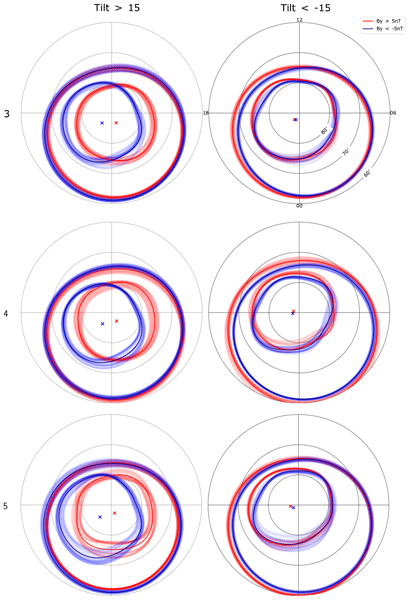
Auroras, the natural lights seen in Earth's sky near the poles, are shaped by both Earth's and the solar wind's magnetic fields, as well as charged solar particles. This study examines how auroras change when the solar wind's magnetic field is dawn-dusk oriented. Daytime observations are challenging due to sunlight, so we developed a method to further separate auroras from background light. In summer, auroras shift east or west with/against the solar wind's magnetic field.
Stephen Omondi, Spencer Mark Hatch, Andreas Kvammen, Magnar Gullikstad Johnsen, Mathew J. Owens, Kristian Solheim Thinn, and Rodrigo López
EGUsphere, https://doi.org/10.5194/egusphere-2025-6298, https://doi.org/10.5194/egusphere-2025-6298, 2026
Short summary
Short summary
Researchers tested whether combining real-time solar wind data with forecasts can improve predictions of local geomagnetic activity in Norway. Using a machine learning model, they found that accurate solar wind speed and magnetic field direction are key for reliable forecasts over 3 hours ahead, while CME arrival time only helps if magnetic field data is precise.
Karl M. Laundal, Andreas S. Skeidsvoll, Beatrice Popescu Braileanu, Spencer M. Hatch, Nils Olsen, and Heikki Vanhamäki
Ann. Geophys., 43, 803–833, https://doi.org/10.5194/angeo-43-803-2025, https://doi.org/10.5194/angeo-43-803-2025, 2025
Short summary
Short summary
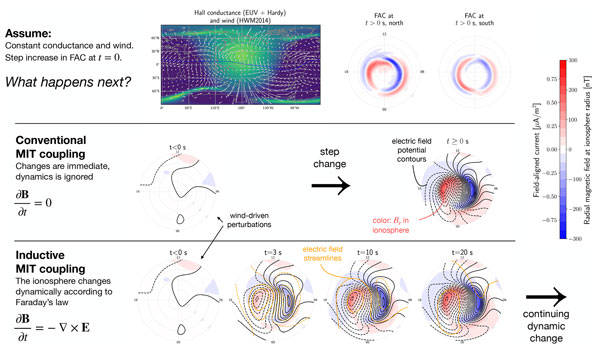
The ionosphere is where Earth’s atmosphere overlaps with a gas of charged particles in space. There, collisions with neutral air and electromagnetic forces driven by the solar wind control plasma motion. We created a global model that includes magnetic induction, explaining how electric currents and fields change, offering a more accurate view of atmosphere–space coupling than conventional models based on electric circuits.
Liisa Juusola, Ilkka Virtanen, Spencer Mark Hatch, Heikki Vanhamäki, Maxime Grandin, Noora Partamies, Urs Ganse, Ilja Honkonen, Abiyot Workayehu, Antti Kero, and Minna Palmroth
Ann. Geophys., 43, 755–781, https://doi.org/10.5194/angeo-43-755-2025, https://doi.org/10.5194/angeo-43-755-2025, 2025
Short summary
Short summary
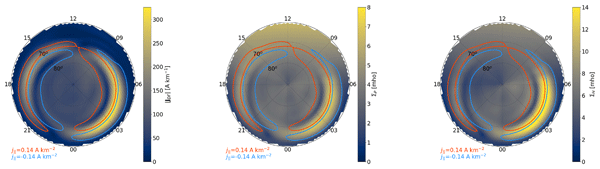
Key properties of the ionospheric electrodynamics are electric fields, currents, and conductances. They provide a window to the vast and distant near-Earth space, cause Joule heating that affect satellite orbits, and drive geomagnetically induced currents (GICs) in technological conductor networks. We have developed a new method for solving the key properties of ionospheric electrodynamics from ground-based magnetic field observations.
Spencer Mark Hatch, Ilkka Virtanen, Karl Magnus Laundal, Habtamu Wubie Tesfaw, Juha Vierinen, Devin Ray Huyghebaert, Andres Spicher, and Jens Christian Hessen
Ann. Geophys., 43, 633–649, https://doi.org/10.5194/angeo-43-633-2025, https://doi.org/10.5194/angeo-43-633-2025, 2025
Short summary
Short summary
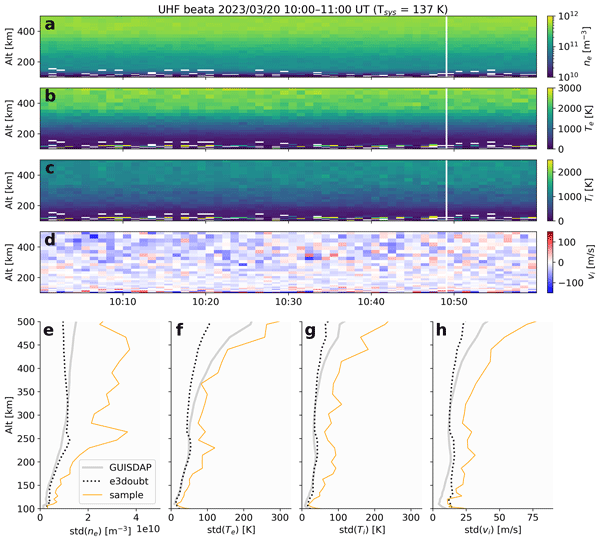
This study addresses the design of next-generation incoherent scatter radar experiments used to study the ionosphere, particularly with systems that have multiple sites. We have developed a method to estimate uncertainties of measurements of plasma density, temperature, and ion drift. Our method is open-source, and helps to optimize radar configurations and assess the effectiveness of an experiment. This method ultimately serves to enhance our understanding of Earth's space environment.
Devin Huyghebaert, Björn Gustavsson, Juha Vierinen, Andreas Kvammen, Matthew Zettergren, John Swoboda, Ilkka Virtanen, Spencer M. Hatch, and Karl M. Laundal
Ann. Geophys., 43, 99–113, https://doi.org/10.5194/angeo-43-99-2025, https://doi.org/10.5194/angeo-43-99-2025, 2025
Short summary
Short summary
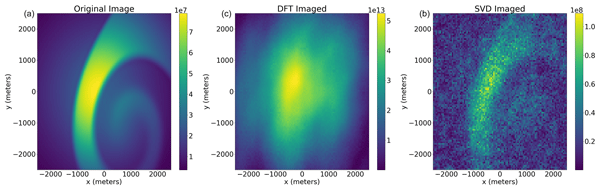
The EISCAT_3D radar is a new ionospheric radar under construction in the Fennoscandia region. The radar will make measurements of plasma characteristics at altitudes above approximately 60 km. The capability of the system to make these measurements at spatial scales of less than 100 m using multiple digitised signals from each of the radar antenna panels is highlighted. There are many ionospheric small-scale processes that will be further resolved using the techniques discussed here.
Spencer Mark Hatch, Heikki Vanhamäki, Karl Magnus Laundal, Jone Peter Reistad, Johnathan K. Burchill, Levan Lomidze, David J. Knudsen, Michael Madelaire, and Habtamu Tesfaw
Ann. Geophys., 42, 229–253, https://doi.org/10.5194/angeo-42-229-2024, https://doi.org/10.5194/angeo-42-229-2024, 2024
Short summary
Short summary
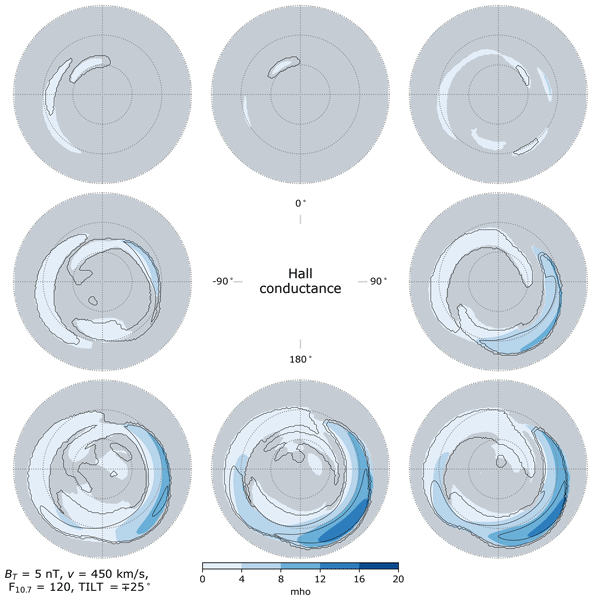
In studies of the Earth's ionosphere, a hot topic is how to estimate ionospheric conductivity. This is hard to do for a variety of reasons that mostly amount to a lack of measurements. In this study we use satellite measurements to estimate electromagnetic work and ionospheric conductances in both hemispheres. We identify where our model estimates are inconsistent with laws of physics, which partially solves a previous problem with unrealistic predictions of ionospheric conductances.
Vanina Lanabere, Stephan Buchert, Adrian Blagau, Harriet George, Sota Nanjo, Liisa Juusola, Andrew P. Dimmock, Samuel Wharton, Heikki Vanhamäki, Octav Marghitu, Louis Richard, Lei Cai, Alice V. L. Wallner, Daria Kotova, Yaqi Jin, Theresa Hoppe, Jennifer A. Carter, and Anita Aikio
Ann. Geophys., 44, 977–1001, https://doi.org/10.5194/angeo-44-977-2026, https://doi.org/10.5194/angeo-44-977-2026, 2026
Short summary
Short summary
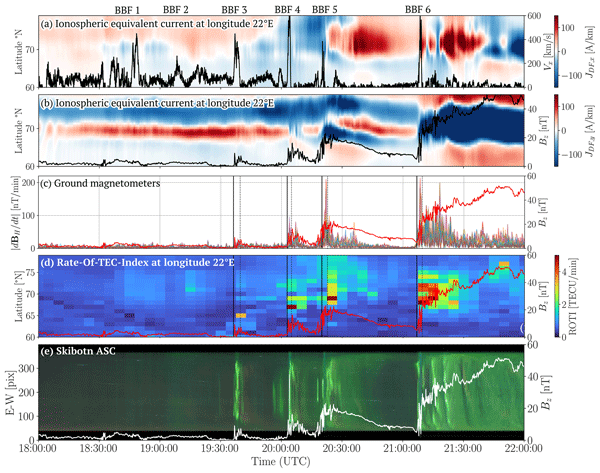
We studied a series of fast plasma streams that connected Earth’s nightside magnetic environment with the high‑latitude ionized upper atmosphere on 7 December 2023. Using satellite, auroral images and ground observations, we showed how each stream disturbed the upper atmosphere. Their repeated impact strengthened these disturbances until a substorm began, revealing how small events can build up to a larger magnetic disruption.
Charlotte M. van Hazendonk, Lisa J. Baddeley, Karl M. Laundal, and Noora Partamies
Ann. Geophys., 44, 697–714, https://doi.org/10.5194/angeo-44-697-2026, https://doi.org/10.5194/angeo-44-697-2026, 2026
Short summary
Short summary
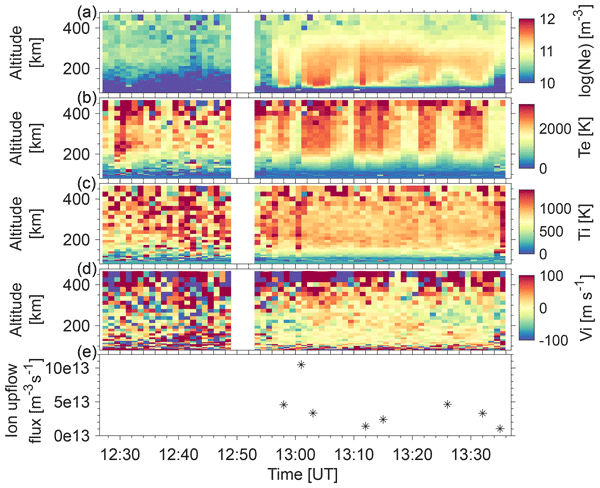
This study shows the first observations of the upflow of ions in the Earth's ionosphere generated by ultra-low frequency waves. These waves are visible as auroral arcs. Using various instruments and models, their complex dynamics and the coupling between the ionosphere and magnetosphere were highlighted. Results show significant energy dissipation and currents, even from small-scale waves, highlighting the importance of a multi-instrument approach to understanding such phenomena.
Harriet George, Andrew P. Dimmock, Vanina Lanabare, Heikki Vanhamäki, Ilkka Virtanen, Anita Aikio, Adrian Blagau, Octav Marghitu, Milla Myllymaa, Habtamu Tesfaw, Stephan Buchert, and Mykhaylo Shumko
EGUsphere, https://doi.org/10.5194/egusphere-2026-3108, https://doi.org/10.5194/egusphere-2026-3108, 2026
Short summary
Short summary
Bursty bulk flows are mesoscale ion flows that are ejected from magnetic reconnection sites in the Earth's magnetotail, and they couple to the ionosphere via field aligned currents that close through the ionosphere. We analyse unique triple-conjunctive observations of the coupled bursty bulk flow / current / ionosphere system to evaluate a case study of a bursty bulk flow and its ionospheric effects. We identify multiple current signatures of this bursty bulk flow within the ionosphere.
Jens Christian Hessen, Jone Peter Reistad, Spencer Mark Hatch, Karl Magnus Laundal, and Yongliang Zhang
Ann. Geophys., 44, 405–433, https://doi.org/10.5194/angeo-44-405-2026, https://doi.org/10.5194/angeo-44-405-2026, 2026
Short summary
Short summary
Auroras, the natural lights seen in Earth's sky near the poles, are shaped by both Earth's and the solar wind's magnetic fields, as well as charged solar particles. This study examines how auroras change when the solar wind's magnetic field is dawn-dusk oriented. Daytime observations are challenging due to sunlight, so we developed a method to further separate auroras from background light. In summer, auroras shift east or west with/against the solar wind's magnetic field.
Alex Timothy Chartier, Ryan Poffenbarger, Rafael Mesquita, Diego Janches, Jorge Chau, Toralf Renkwitz, Ralph Latteck, and William Bristow
EGUsphere, https://doi.org/10.5194/egusphere-2026-1634, https://doi.org/10.5194/egusphere-2026-1634, 2026
Short summary
Short summary
We created a new long-term record of upper atmosphere winds using data from a global network of radars spanning more than 30 years. Because these measurements do not directly show altitude, we developed a method to estimate where the signals come from and tested it against other observations and models. The results show good agreement, meaning these data can now be used with greater confidence to study atmospheric motion and its effects on communication and space systems.
Stephen Omondi, Spencer Mark Hatch, Andreas Kvammen, Magnar Gullikstad Johnsen, Mathew J. Owens, Kristian Solheim Thinn, and Rodrigo López
EGUsphere, https://doi.org/10.5194/egusphere-2025-6298, https://doi.org/10.5194/egusphere-2025-6298, 2026
Short summary
Short summary
Researchers tested whether combining real-time solar wind data with forecasts can improve predictions of local geomagnetic activity in Norway. Using a machine learning model, they found that accurate solar wind speed and magnetic field direction are key for reliable forecasts over 3 hours ahead, while CME arrival time only helps if magnetic field data is precise.
Karl M. Laundal, Andreas S. Skeidsvoll, Beatrice Popescu Braileanu, Spencer M. Hatch, Nils Olsen, and Heikki Vanhamäki
Ann. Geophys., 43, 803–833, https://doi.org/10.5194/angeo-43-803-2025, https://doi.org/10.5194/angeo-43-803-2025, 2025
Short summary
Short summary
The ionosphere is where Earth’s atmosphere overlaps with a gas of charged particles in space. There, collisions with neutral air and electromagnetic forces driven by the solar wind control plasma motion. We created a global model that includes magnetic induction, explaining how electric currents and fields change, offering a more accurate view of atmosphere–space coupling than conventional models based on electric circuits.
Liisa Juusola, Ilkka Virtanen, Spencer Mark Hatch, Heikki Vanhamäki, Maxime Grandin, Noora Partamies, Urs Ganse, Ilja Honkonen, Abiyot Workayehu, Antti Kero, and Minna Palmroth
Ann. Geophys., 43, 755–781, https://doi.org/10.5194/angeo-43-755-2025, https://doi.org/10.5194/angeo-43-755-2025, 2025
Short summary
Short summary
Key properties of the ionospheric electrodynamics are electric fields, currents, and conductances. They provide a window to the vast and distant near-Earth space, cause Joule heating that affect satellite orbits, and drive geomagnetically induced currents (GICs) in technological conductor networks. We have developed a new method for solving the key properties of ionospheric electrodynamics from ground-based magnetic field observations.
Spencer Mark Hatch, Ilkka Virtanen, Karl Magnus Laundal, Habtamu Wubie Tesfaw, Juha Vierinen, Devin Ray Huyghebaert, Andres Spicher, and Jens Christian Hessen
Ann. Geophys., 43, 633–649, https://doi.org/10.5194/angeo-43-633-2025, https://doi.org/10.5194/angeo-43-633-2025, 2025
Short summary
Short summary
This study addresses the design of next-generation incoherent scatter radar experiments used to study the ionosphere, particularly with systems that have multiple sites. We have developed a method to estimate uncertainties of measurements of plasma density, temperature, and ion drift. Our method is open-source, and helps to optimize radar configurations and assess the effectiveness of an experiment. This method ultimately serves to enhance our understanding of Earth's space environment.
Liisa Juusola, Heikki Vanhamäki, Elena Marshalko, Mikhail Kruglyakov, and Ari Viljanen
Ann. Geophys., 43, 271–301, https://doi.org/10.5194/angeo-43-271-2025, https://doi.org/10.5194/angeo-43-271-2025, 2025
Short summary
Short summary
Interaction between the magnetic field of the rapidly varying electric currents in space and the conducting ground produces an electric field at the Earth's surface. This geoelectric field drives geomagnetically induced currents in technological conductor networks, which can affect the performance of critical ground infrastructure such as electric power transmission grids. We have developed a new method suitable for monitoring the geoelectric field based on ground magnetic field observations.
Devin Huyghebaert, Björn Gustavsson, Juha Vierinen, Andreas Kvammen, Matthew Zettergren, John Swoboda, Ilkka Virtanen, Spencer M. Hatch, and Karl M. Laundal
Ann. Geophys., 43, 99–113, https://doi.org/10.5194/angeo-43-99-2025, https://doi.org/10.5194/angeo-43-99-2025, 2025
Short summary
Short summary
The EISCAT_3D radar is a new ionospheric radar under construction in the Fennoscandia region. The radar will make measurements of plasma characteristics at altitudes above approximately 60 km. The capability of the system to make these measurements at spatial scales of less than 100 m using multiple digitised signals from each of the radar antenna panels is highlighted. There are many ionospheric small-scale processes that will be further resolved using the techniques discussed here.
Spencer Mark Hatch, Heikki Vanhamäki, Karl Magnus Laundal, Jone Peter Reistad, Johnathan K. Burchill, Levan Lomidze, David J. Knudsen, Michael Madelaire, and Habtamu Tesfaw
Ann. Geophys., 42, 229–253, https://doi.org/10.5194/angeo-42-229-2024, https://doi.org/10.5194/angeo-42-229-2024, 2024
Short summary
Short summary
In studies of the Earth's ionosphere, a hot topic is how to estimate ionospheric conductivity. This is hard to do for a variety of reasons that mostly amount to a lack of measurements. In this study we use satellite measurements to estimate electromagnetic work and ionospheric conductances in both hemispheres. We identify where our model estimates are inconsistent with laws of physics, which partially solves a previous problem with unrealistic predictions of ionospheric conductances.
Liisa Juusola, Ari Viljanen, Noora Partamies, Heikki Vanhamäki, Mirjam Kellinsalmi, and Simon Walker
Ann. Geophys., 41, 483–510, https://doi.org/10.5194/angeo-41-483-2023, https://doi.org/10.5194/angeo-41-483-2023, 2023
Short summary
Short summary
At times when auroras erupt on the sky, the magnetic field surrounding the Earth undergoes rapid changes. On the ground, these changes can induce harmful electric currents in technological conductor networks, such as powerlines. We have used magnetic field observations from northern Europe during 28 such events and found consistent behavior that can help to understand, and thus predict, the processes that drive auroras and geomagnetically induced currents.
Cited articles
Aikio, A. T., Cai, L., and Nygrén, T.: Statistical distribution of height-integrated energy exchange rates in the ionosphere, J. Geophys. Res.-Space, 117, https://doi.org/10.1029/2012JA018078, 2012. a
Akbari, H., Pfaff, R., Clemmons, J., Freudenreich, H., Rowland, D., and Streltsov, A.: Resonant Alfvén waves in the lower auroral ionosphere: evidence for the nonlinear evolution of the ionospheric feedback instability, J. Geophys. Res.-Space, 127, https://doi.org/10.1029/2021JA029854, 2022. a
Amm, O.: Direct determination of the local ionospheric Hall conductance distribution from Two-dimensional electric and magnetic field data: application of the method using models of typical ionospheric electrodynamic situations, J. Geophys. Res.-Space, 100, 21473–21488, https://doi.org/10.1029/95JA02213, 1995. a, b
Amm, O.: The elementary current method for calculating ionospheric current systems from multisatellite and ground magnetometer data, J. Geophys. Res.-Space, 106, 24843–24855, https://doi.org/10.1029/2001JA900021, 2001. a
Amm, O., Aruliah, A., Buchert, S. C., Fujii, R., Gjerloev, J. W., Ieda, A., Matsuo, T., Stolle, C., Vanhamäki, H., and Yoshikawa, A.: Towards understanding the electrodynamics of the 3-dimensional high-latitude ionosphere: present and future, Ann. Geophys., 26, 3913–3932, https://doi.org/10.5194/angeo-26-3913-2008, 2008. a
Amm, O., Vanhamäki, H., Kauristie, K., Stolle, C., Christiansen, F., Haagmans, R., Masson, A., Taylor, M. G. G. T., Floberghagen, R., and Escoubet, C. P.: A method to derive maps of ionospheric conductances, currents, and convection from the Swarm multisatellite mission, J. Geophys. Res.-Space, 120, 3263–3282, https://doi.org/10.1002/2014JA020154, 2015. a
Baker, J. B. H., Zhang, Y., Greenwald, R. A., Paxton, L. J., and Morrison, D.: Height-integrated Joule and auroral particle heating in the night side high latitude thermosphere, Geophys. Res. Lett., 31, https://doi.org/10.1029/2004GL019535, 2004. a, b
Baloukidis, D., Sarris, T., Tourgaidis, S., Pirnaris, P., Aikio, A., Virtanen, I., Buchert, S., and Papadakis, K.: A comparative assessment of the distribution of Joule heating in altitude as estimated in TIE-GCM and EISCAT over one solar cycle, J. Geophys. Res.-Space, 128, e2023JA031526, https://doi.org/10.1029/2023JA031526, 2023. a
Bilitza, D., Altadill, D., Truhlik, V., Shubin, V., Galkin, I., Reinisch, B., and Huang, X.: International Reference Ionosphere 2016: from ionospheric climate to real time weather predictions, Space Weather, 15, 418–429, https://doi.org/10.1002/2016SW001593, 2017. a, b
Billett, D. D., Grocott, A., Wild, J. A., Walach, M.-T., and Kosch, M. J.: Diurnal variations in global Joule heating morphology and magnitude due to neutral winds, J. Geophys. Res.-Space, 123, 2398–2411, https://doi.org/10.1002/2017JA025141, 2018. a, b, c
Branning, K., Conde, M., Larsen, M., and Troyer, R.: Resolving vertical variations of horizontal neutral winds in Earth's high latitude Space Atmosphere Interaction Region (SAIR), J. Geophys. Res.-Space, 127, https://doi.org/10.1029/2021JA029805, 2022. a
Burchill, J. K., Clemmons, J. H., Knudsen, D. J., Larsen, M., Nicolls, M. J., Pfaff, R. F., Rowland, D., and Sangalli, L.: High latitude E region ionosphere thermosphere coupling: a comparative study using in situ and incoherent scatter radar observations, J. Geophys. Res.-Space, 117, https://doi.org/10.1029/2011JA017175, 2012. a, b, c, d
Chapman, S.: The electrical conductivity of the ionosphere: a review, Il Nuovo Cimento, 4, 1385–1412, https://doi.org/10.1007/BF02746310, 1956. a, b
Cole, K.: Energy deposition in the thermosphere caused by the solar wind, J. Atmos. Terr. Phys., 37, 939–949, https://doi.org/10.1016/0021-9169(75)90008-2, 1975. a
Dekking, F. M., Kraaikamp, C., Lopuhaä, H. P., and Meester, L. E.: A Modern Introduction to Probability and Statistics, Springer London, https://doi.org/10.1007/1-84628-168-7, 2005. a, b
Dhadly, M., Sassi, F., Emmert, J., Drob, D., Conde, M., Wu, Q., Makela, J., Budzien, S., and Nicholas, A.: Neutral winds from mesosphere to thermosphere – past, present, and future outlook, Frontiers in Astronomy and Space Sciences, 9, https://doi.org/10.3389/fspas.2022.1050586, 2023. a, b
Emmert, J. T., Drob, D. P., Picone, J. M., Siskind, D. E., Jones, M., Mlynczak, M. G., Bernath, P. F., Chu, X., Doornbos, E., Funke, B., Goncharenko, L. P., Hervig, M. E., Schwartz, M. J., Sheese, P. E., Vargas, F., Williams, B. P., and Yuan, T.: NRLMSIS 2.0: a whole atmosphere empirical model of temperature and neutral species densities, Earth and Space Science, https://doi.org/10.1029/2020EA001321, 2020. a, b
Farley, D. T.: A theory of electrostatic fields in a horizontally stratified ionosphere subject to a vertical magnetic field, J. Geophys. Res., 64, 1225–1233, https://doi.org/10.1029/JZ064i009p01225, 1959. a
Green, D. L., Waters, C. L., Korth, H., Anderson, B. J., Ridley, A. J., and Barnes, R. J.: Technique: large-scale ionospheric conductance estimated from combined satellite and ground-based electromagnetic data, J. Geophys. Res.-Space, 112, https://doi.org/10.1029/2006JA012069, 2007. a
Hatch, S. M. and Mesquita, R. L. A.: Resource for Hatch et al. (2024), “What is the neutral wind in height-integrated electrodynamics?”, Zenodo [data set] and [code], https://doi.org/10.5281/zenodo.11091983, 2024. a
Hatch, S. M., Vanhamäki, H., Laundal, K. M., Reistad, J. P., Burchill, J. K., Lomidze, L., Knudsen, D. J., Madelaire, M., and Tesfaw, H.: Does high-latitude ionospheric electrodynamics exhibit hemispheric mirror symmetry?, Ann. Geophys., 42, 229–253, https://doi.org/10.5194/angeo-42-229-2024, 2024. a, b, c
Heelis, R. and Maute, A.: Challenges to understanding the Earth's ionosphere and thermosphere, J. Geophys. Res.-Space, https://doi.org/10.1029/2019JA027497, 2020. a
Heppner, J. P. and Miller, M. L.: Thermospheric winds at high latitudes from chemical release observations, J. Geophys. Res.-Space, 87, 1633–1647, https://doi.org/10.1029/JA087iA03p01633, 1982. a
Hirsch, M.: iri2016, Zenodo [code], https://doi.org/10.5281/zenodo.240895, 2018. a
Hirsch, M.: nrlmsis2.0, GitHub [code], https://github.com/space-physics/nrlmsis2.0 (last access: 25 March 2024), 2020. a
Huber, P. J.: Robust regression: asymptotics, conjectures and Monte Carlo, Ann. Stat., 1, 799–821, https://doi.org/10.1214/aos/1176342503, 1973. a
Ieda, A.: Ion neutral collision frequencies for calculating ionospheric conductivity, J. Geophys. Res.-Space, 125, https://doi.org/10.1029/2019JA027128, 2020. a, b, c
Larsen, M. F.: Winds and shears in the mesosphere and lower thermosphere: results from four decades of chemical release wind measurements, J. Geophys. Res.-Space, 107, SIA 28-1–SIA 28-14, https://doi.org/10.1029/2001JA000218, 2002. a, b
Larsen, M. F., Pfaff, R. F., Mesquita, R., and Kaeppler, S. R.: Gradient winds and neutral flow dawn dusk asymmetry in the auroral oval during geomagnetically disturbed conditions, J. Geophys. Res.-Space, 127, https://doi.org/10.1029/2021JA029936, 2022. a
Laundal, K. M.: Pure Python International Geomagnetic Reference Field (ppigrf), Zenodo [code], https://doi.org/10.5281/zenodo.5962660, 2023. a
Laundal, K. M., Reistad, J. P., Hatch, S. M., Madelaire, M., Walker, S., Hovland, A. Ø., Ohma, A., Merkin, V. G., and Sorathia, K. A.: Local mapping of polar ionospheric electrodynamics, J. Geophys. Res.-Space, 127, https://doi.org/10.1029/2022JA030356, 2022. a
Laundal, K. M., Marchaudon, A., Maute, A., Hatch, S. M., Enengl, F., Matsuo, T., Decotte, M., Madelaire, M., Merkin, V. G., Sciola, A., Haberle, V., and Skeidsvoll, A. S.: Next-generation data assimilation methods for polar ionospheric electrodynamics, Surv. Geophys., https://doi.org/10.1007/s10712-025-09918-3, 2025a. a
Laundal, K. M., Skeidsvoll, A. S., Popescu Braileanu, B., Hatch, S. M., Olsen, N., and Vanhamäki, H.: Global inductive magnetosphere-ionosphere- thermosphere coupling, Ann. Geophys., 43, 803–833, https://doi.org/10.5194/angeo-43-803-2025, 2025b. a
Liu, H., Bardeen, C. G., Foster, B. T., Lauritzen, P., Liu, J., Lu, G., Marsh, D. R., Maute, A., McInerney, J. M., Pedatella, N. M., Qian, L., Richmond, A. D., Roble, R. G., Solomon, S. C., Vitt, F. M., and Wang, W.: Development and validation of the whole atmosphere community climate model with thermosphere and ionosphere extension (WACCM X 2.0), J. Adv. Model. Earth Sy., 10, 381–402, https://doi.org/10.1002/2017MS001232, 2018. a
Mannucci, A. J., McGranaghan, R., Meng, X., and Verkhoglyadova, O. P.: An analysis of magnetosphere ionosphere coupling that is independent of inertial reference frame, J. Geophys. Res.-Space, 127, https://doi.org/10.1029/2021JA030009, 2022. a, b
Matsuo, T.: Recent Progress on Inverse and Data Assimilation Procedure for High-Latitude Ionospheric Electrodynamics, Springer International Publishing, Cham, 219–232, https://doi.org/10.1007/978-3-030-26732-2_10, 2020. a, b
Maute, A., Richmond, A. D., Lu, G., Knipp, D. J., Shi, Y., and Anderson, B.: Magnetosphere ionosphere coupling via prescribed field aligned current simulated by the TIEGCM, J. Geophys. Res.-Space, 126, https://doi.org/10.1029/2020JA028665, 2021. a
Merkin, V. G. and Lyon, J. G.: Effects of the low-latitude ionospheric boundary condition on the global magnetosphere, J. Geophys. Res.-Space, 115, https://doi.org/10.1029/2010JA015461, 2010. a
Mesquita, R. L. A.: An Observational Investigation of Mid-Latitude Thermospheric Temperatures and High-Latitude E-Region Neutral Wind Structures, Dissertation, Clemson University, https://tigerprints.clemson.edu/all_dissertations/2802/ (last access: 23 March 2023), 2021. a
Mesquita, R. L. A., Larsen, M. F., Azeem, I., Stevens, M. H., Williams, B. P., Collins, R. L., and Li, J.: In situ observations of neutral shear instability in the statically stable high latitude mesosphere and lower thermosphere during quiet geomagnetic conditions, J. Geophys. Res.-Space, 125, https://doi.org/10.1029/2020JA027972, 2020. a
Mukhopadhyay, A., Jia, X., Welling, D. T., and Liemohn, M. W.: Global magnetohydrodynamic simulations: performance quantification of magnetopause distances and convection potential predictions, Frontiers in Astronomy and Space Sciences, 8, https://doi.org/10.3389/fspas.2021.637197, 2021. a
Palmroth, M., Grandin, M., Sarris, T., Doornbos, E., Tourgaidis, S., Aikio, A., Buchert, S., Clilverd, M. A., Dandouras, I., Heelis, R., Hoffmann, A., Ivchenko, N., Kervalishvili, G., Knudsen, D. J., Kotova, A., Liu, H.-L., Malaspina, D. M., March, G., Marchaudon, A., Marghitu, O., Matsuo, T., Miloch, W. J., Moretto-Jørgensen, T., Mpaloukidis, D., Olsen, N., Papadakis, K., Pfaff, R., Pirnaris, P., Siemes, C., Stolle, C., Suni, J., van den IJssel, J., Verronen, P. T., Visser, P., and Yamauchi, M.: Lower-thermosphere–ionosphere (LTI) quantities: current status of measuring techniques and models, Ann. Geophys., 39, 189–237, https://doi.org/10.5194/angeo-39-189-2021, 2021. a, b
Parker, E. N.: Conversations on Electric and Magnetic Fields in the Cosmos, Princeton University Press, https://doi.org/10.2307/j.ctt2111gdt, 2007. a
Qian, L., Burns, A. G., Emery, B. A., Foster, B., Lu, G., Maute, A., Richmond, A. D., Roble, R. G., Solomon, S. C., and Wang, W.: The NCAR TIE-GCM, John Wiley and Sons, Ltd, https://doi.org/10.1002/9781118704417.ch7, 73–83, 2014. a
Reistad, J. P., Hatch, S. M., Laundal, K. M., Oksavik, K., Zettergren, M., Vanhamäki, H., and Virtanen, I.: Volumetric reconstruction of ionospheric electric currents from tri-static incoherent scatter radar measurements, J. Geophys. Res.-Space, 129, e2024JA032744, https://doi.org/10.1029/2024JA032744, 2024. a
Richmond, A. D.: Ionospheric electrodynamics using magnetic apex coordinates, J. Geomagn. Geoelectr., 47, 191–212, https://doi.org/10.5636/jgg.47.191, 1995. a, b, c, d
Richmond, A. D. and Kamide, Y.: Mapping electrodynamic features of the high-latitude ionosphere from localized observations – technique, J. Geophys. Res., 93, 5741–5759, https://doi.org/10.1029/JA093iA06p05741, 1988. a
Sangalli, L., Knudsen, D. J., Larsen, M. F., Zhan, T., Pfaff, R. F., and Rowland, D.: Rocket-based measurements of ion velocity, neutral wind, and electric field in the collisional transition region of the auroral ionosphere, J. Geophys. Res.-Space, 114, https://doi.org/10.1029/2008JA013757, 2009. a, b, c, d, e
Sarris, T. E.: Understanding the ionosphere thermosphere response to solar and magnetospheric drivers: status, challenges and open issues, Philos. T. Roy. Soc. A, 377, 20180101, https://doi.org/10.1098/rsta.2018.0101, 2019. a
Schunk, R. and Nagy, A.: Ionospheres, Cambridge University Press, Cambridge, 2nd edn., https://doi.org/10.1017/CBO9780511635342, 2009. a
Scott, T.: Analysis of the Neutral Wind Profiles from the HEX II Experiment, https://open.clemson.edu/all_theses/654 (last access: 17 April 2026), 2009. a
Shiokawa, K., Kadota, T., Otsuka, Y., Ogawa, T., Nakamura, T., and Fukao, S.: A two-channel Fabry-Perot interferometer with thermoelectric-cooled CCD detectors for neutral wind measurement in the upper atmosphere, Earth Planets Space, 55, 271–275, https://doi.org/10.1186/BF03351759, 2014. a
Song, P., Vasyli
Strangeway, R. J.: The equivalence of Joule dissipation and frictional heating in the collisional ionosphere, J. Geophys. Res.-Space, 117, https://doi.org/10.1029/2011JA017302, 2012. a
Thayer, J. P.: Height-resolved Joule heating rates in the high-latitude E region and the influence of neutral winds, J. Geophys. Res.-Space, 103, 471–487, https://doi.org/10.1029/97JA02536, 1998. a, b, c
Vanhamäki, H. and Juusola, L.: Review of Data Analysis Techniques for Estimating Ionospheric Currents Based on MIRACLE and Satellite Observations, Chap. 24, American Geophysical Union (AGU), https://doi.org/10.1002/9781119324522.ch24, 407–426, 2018. a
Vasyli
Virtanen, P., Gommers, R., Oliphant, T. E., Haberland, M., Reddy, T., Cournapeau, D., Burovski, E., Peterson, P., Weckesser, W., Bright, J., van der Walt, S. J., Brett, M., Wilson, J., Millman, K. J., Mayorov, N., Nelson, A. R. J., Jones, E., Kern, R., Larson, E., Carey, C. J., Polat, İ., Feng, Y., Moore, E. W., VanderPlas, J., Laxalde, D., Perktold, J., Cimrman, R., Henriksen, I., Quintero, E. A., Harris, C. R., Archibald, A. M., Ribeiro, A. H., Pedregosa, F., van Mulbregt, P., and SciPy 1.0 Contributors: SciPy 1.0: fundamental algorithms for scientific computing in Python, Nat. Methods, 17, 261–272, https://doi.org/10.1038/s41592-019-0686-2, 2020. a
Walach, M., Grocott, A., and Milan, S. E.: Average ionospheric electric field morphologies during geomagnetic storm phases, J. Geophys. Res.-Space, 126, https://doi.org/10.1029/2020JA028512, 2021. a
Weimer, D. and Edwards, T.: Testing the electrodynamic method to derive height-integrated ionospheric conductances, Ann. Geophys., 39, 31–51, https://doi.org/10.5194/angeo-39-31-2021, 2021. a, b, c, d
Whiter, D. K., Partamies, N., Gustavsson, B., and Kauristie, K.: The altitude of green OI 557.7 nm and blue
Zhan, W. and Kaeppler, S. R.: Seasonal and geomagnetic activity dependence of auroral E region neutral winds at poker flat, J. Geophys. Res.-Space, 130, https://doi.org/10.1029/2024JA033074, 2025. a
Zhu, Q., Lu, G., Maute, A., Deng, Y., and Anderson, B.: Assessment of using field aligned currents to drive the global ionosphere thermosphere model: a case study for the 2013 St Patrick's Day geomagnetic storm, Space Weather, 20, https://doi.org/10.1029/2022SW003170, 2022. a
Short summary
Atmospheric winds at high altitudes (> 100 km) can play an important role in the electrodynamic processes that govern how ionospheric plasma interacts with Earth's neutral atmosphere. Here we investigate how a common idea in studies of ionospheric electrodynamics—that atmospheric winds can be ignored or represented via an average value—ignores the high variability of these winds. This variability forces a different formulation of the equations that govern ionosphere-thermosphere electrodynamics.
Atmospheric winds at high altitudes (> 100 km) can play an important role in the electrodynamic...


