Articles | Volume 44, issue 2
https://doi.org/10.5194/angeo-44-765-2026
© Author(s) 2026. This work is distributed under
the Creative Commons Attribution 4.0 License.
Special issue:
https://doi.org/10.5194/angeo-44-765-2026
© Author(s) 2026. This work is distributed under
the Creative Commons Attribution 4.0 License.
A near-sunset atmospheric sounding during the 14 October 2023 annular solar eclipse over Natal

Unidade Acadêmica de Física, Universidade Federal de Campina Grande, Campina Grande, PB, Brazil
Francisco Raimundo da Silva
Laboratório de Variáveis Ambientais e Tropicais, Instituto Nacional de Pesquisas Espaciais, Natal, RN, Brazil
Ana Roberta Paulino
Departamento de Física, Universidade Estadual da Paraíba, Campina Grande, PB, Brazil
Gilvan Borba
Departamento de Geofísica, Universidade Federal do Rio Grande do Norte, Natal, RN, Brazil
Related authors
Efua A. Ogobor, Igo Paulino, Vania F. Andrioli, Cristiano M. Wrasse, Hisao Takahashi, Amauri F. Medeiros, Paulo P. Batista, and Prosper K. Nyassor
EGUsphere, https://doi.org/10.5194/egusphere-2025-6569, https://doi.org/10.5194/egusphere-2025-6569, 2026
Short summary
Short summary
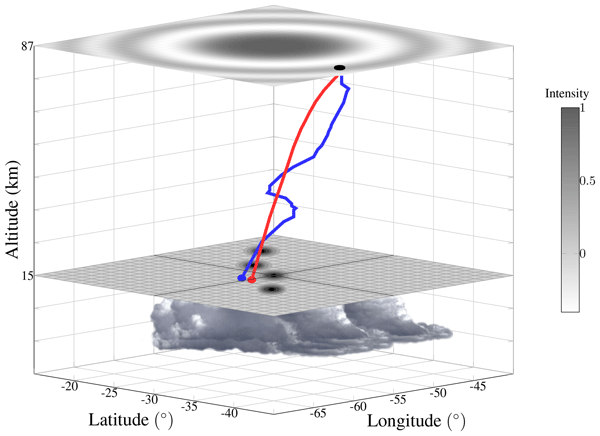
We studied four rare night-sky wave events over Brazil using coordinated all-sky airglow imager, meteor wind radar, and sodium laser temperature measurements. We found two undular and turbulent fronts shaped by layered winds and temperature, improving forecasts of upper-atmosphere changes that affect communications to understand how they form.
Anderson Vestena Bilibio, Igo Paulino, Cristiano Max Wrasse, Prosper Kwamla Nyassor, Ricardo Arlen Buriti, Cosme Alexandre de Oliveira Barros Figueiredo, Fábio Egito, Hisao Takahashi, Toyese Tunde Ayorinde, Lucas Vaz Peres, and Rodrigo da Silva
EGUsphere, https://doi.org/10.5194/egusphere-2025-6571, https://doi.org/10.5194/egusphere-2025-6571, 2026
Short summary
Short summary
This study examines gravity waves observed after the solar eclipse of 14 October 2023. Using ground-based sky cameras and atmospheric models, we traced the paths of these waves to identify their origins. Some waves were linked to cooling caused by the eclipse, while others were associated with storm activity. The results show that eclipses and weather systems can generate atmospheric disturbances, improving our understanding of how the upper atmosphere responds to natural events.
Igo Paulino, Paulo Roberto Fagundes, Ana Roberta Paulino, Maurício José Alves Bolzam, and Valdir Gil Pillat
EGUsphere, https://doi.org/10.5194/egusphere-2025-6570, https://doi.org/10.5194/egusphere-2025-6570, 2026
Short summary
Short summary
This study shows how the 2023 solar eclipse affected the ionosphere in Brazil. By tracking radio wave echoes, the results show that isoline for fixed-frequencies dropped significantly across the country as the sun was blocked. Even 1,500 km away from the main shadow, the ionosphere felt the impact. There was a 1.5-hour delay before the largest change occurred and the ionosphere in the equatorial region recovered faster than in low latitudes.
Ana Roberta Paulino, Igo Paulino, and José Augusto Pereira
EGUsphere, https://doi.org/10.5194/egusphere-2025-3085, https://doi.org/10.5194/egusphere-2025-3085, 2025
Short summary
Short summary
In this paper, atmospheric responses to the 23 October 2023 annular solar eclipse is discussed considering almost simultaneous temperature measurements from the TIMED/SABER satellite. Reductions of the temperature in troposphere, mesosphere and mesopause were observed. On the other hand, the temperature increased by about 7 K around 33 km. The temporal and spatial configuration of the measurements is consistent with the observed structures.
Prosper K. Nyassor, Cristiano M. Wrasse, Igo Paulino, Erdal Yiğit, Vera Y. Tsali-Brown, Ricardo A. Buriti, Cosme A. O. B. Figueiredo, Gabriel A. Giongo, Fábio Egito, Oluwasegun M. Adebayo, Hisao Takahashi, and Delano Gobbi
Atmos. Chem. Phys., 25, 4053–4082, https://doi.org/10.5194/acp-25-4053-2025, https://doi.org/10.5194/acp-25-4053-2025, 2025
Short summary
Short summary
This work explores the dynamics of the momentum and energy of propagating mesospheric gravity waves (GWs). A photometer was used to observe the vertical component of the GWs, whereas the horizontal component was observed by an all-sky imager. Using the parameters from these two instruments and background wind from meteor radar, the momentum flux and potential energy of the GWs were determined and studied. It is noted that the dynamics of the downward-propagating GWs were controlled by observed ducts.
Ana Roberta Paulino, Delis Otildes Rodrigues, Igo Paulino, Lourivaldo Mota Lima, Ricardo Arlen Buriti, Paulo Prado Batista, Aaron Ridley, and Chen Wu
Ann. Geophys., 43, 183–191, https://doi.org/10.5194/angeo-43-183-2025, https://doi.org/10.5194/angeo-43-183-2025, 2025
Short summary
Short summary
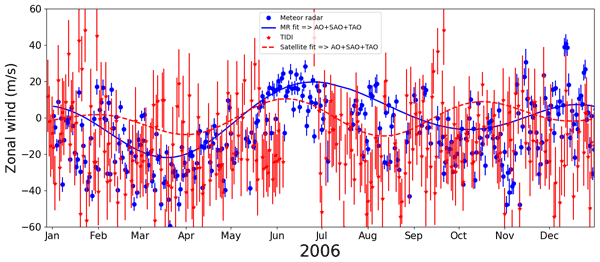
Comparisons of wind measurements using two different techniques (ground-based radar and satellite) in Brazil during 2006 were made in order to point out the advantages of each instrument for studies in the mesosphere and upper thermosphere. (i) For short-period variations, the measurements of the satellite were more advantageous. (ii) The monthly climatology using the radar was more appropriate. (iii) For long periods (longer than a few months), both instruments responded satisfactorily.
Josemaria Gomez Socola, Fabiano S. Rodrigues, Isaac G. Wright, Igo Paulino, and Ricardo Buriti
Atmos. Meas. Tech., 18, 909–919, https://doi.org/10.5194/amt-18-909-2025, https://doi.org/10.5194/amt-18-909-2025, 2025
Short summary
Short summary
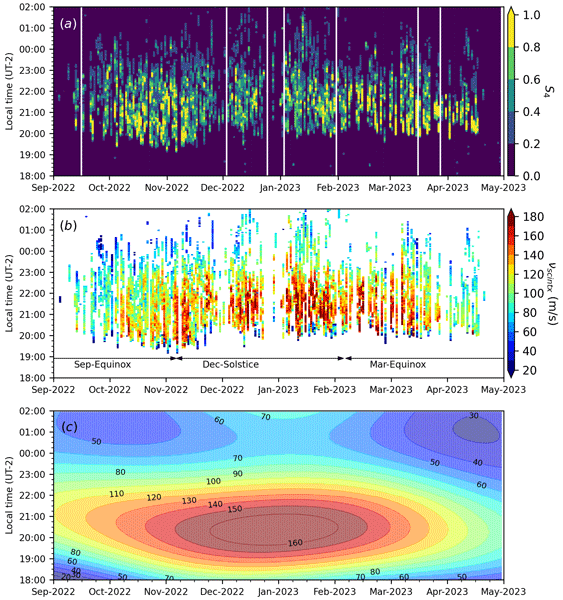
New low-cost, off-the-shelf Global Navigation Satellite System (GNSS) receivers enable the estimation of zonal ionospheric irregularity drifts using the scintillation spaced-receiver technique, previously tested only with commercial GNSS receivers. Despite their low C/No resolution (1 dB-Hz), we demonstrate that the recorded raw data can be used to estimate irregularity drifts. Further, our observations are consistent with the behavior of an empirical model of the thermospheric winds (HMW14).
Hisao Takahashi, Cosme A. O. B. Figueiredo, Patrick Essien, Cristiano M. Wrasse, Diego Barros, Prosper K. Nyassor, Igo Paulino, Fabio Egito, Geangelo M. Rosa, and Antonio H. R. Sampaio
Ann. Geophys., 40, 665–672, https://doi.org/10.5194/angeo-40-665-2022, https://doi.org/10.5194/angeo-40-665-2022, 2022
Short summary
Short summary
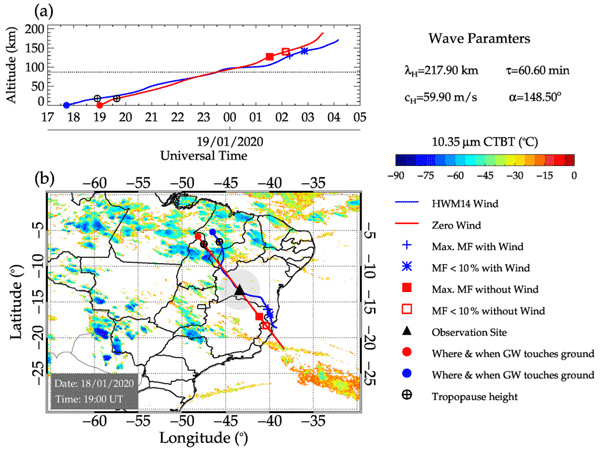
We observed two different wave propagations in the earth’s upper atmosphere: a gravity wave in the mesosphere and the ionospheric disturbances. We investigated the wave propagations by using airglow imaging techniques. It is found that there was a gravity wave generation from the tropospheric convection spot, and it propagated upward in the ionosphere. This reports observational evidence of gravity wave propagation from the troposphere to ionosphere.
Prosper K. Nyassor, Cristiano M. Wrasse, Igo Paulino, Eliah F. M. T. São Sabbas, José V. Bageston, Kleber P. Naccarato, Delano Gobbi, Cosme A. O. B. Figueiredo, Toyese T. Ayorinde, Hisao Takahashi, and Diego Barros
Atmos. Chem. Phys., 22, 15153–15177, https://doi.org/10.5194/acp-22-15153-2022, https://doi.org/10.5194/acp-22-15153-2022, 2022
Short summary
Short summary
This work investigates the sources of concentric gravity waves (CGWs) excited by a moving system of clouds with several overshooting regions on 1–2 October 2019 at São Martinho da Serra. The parameters of these waves were estimated using 2D spectral analysis and their source locations identified using backward ray tracing. Furthermore, the sources of these waves were properly identified by tracking the individual overshooting regions in space and time since the system of clouds was moving.
Igo Paulino, Ana Roberta Paulino, Amauri F. Medeiros, Cristiano M. Wrasse, Ricardo Arlen Buriti, and Hisao Takahashi
Ann. Geophys., 39, 1005–1012, https://doi.org/10.5194/angeo-39-1005-2021, https://doi.org/10.5194/angeo-39-1005-2021, 2021
Short summary
Short summary
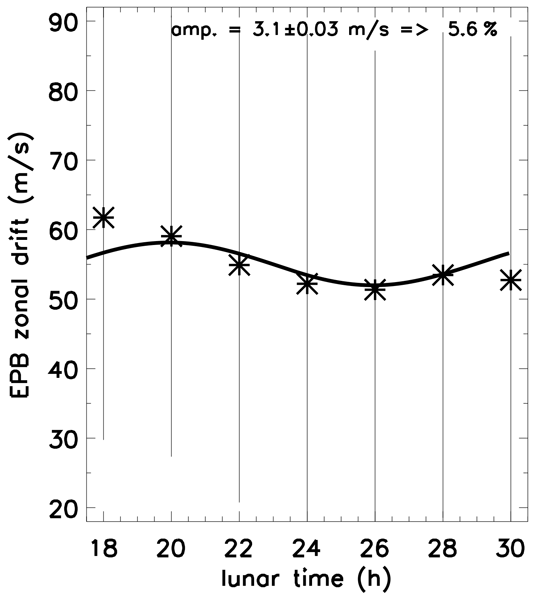
In the present work, the lunar semidiurnal tide (M2) was investigated in the equatorial plasma bubble (EPB) zonal drifts over Brazil from 2000 to 2007. On average, the M2 contributes 5.6 % to the variability of the EPB zonal drifts. A strong seasonal and solar cycle dependency was also observed, the amplitudes of the M2 being stronger during the summer and high solar activity periods.
Efua A. Ogobor, Igo Paulino, Vania F. Andrioli, Cristiano M. Wrasse, Hisao Takahashi, Amauri F. Medeiros, Paulo P. Batista, and Prosper K. Nyassor
EGUsphere, https://doi.org/10.5194/egusphere-2025-6569, https://doi.org/10.5194/egusphere-2025-6569, 2026
Short summary
Short summary
We studied four rare night-sky wave events over Brazil using coordinated all-sky airglow imager, meteor wind radar, and sodium laser temperature measurements. We found two undular and turbulent fronts shaped by layered winds and temperature, improving forecasts of upper-atmosphere changes that affect communications to understand how they form.
Anderson Vestena Bilibio, Igo Paulino, Cristiano Max Wrasse, Prosper Kwamla Nyassor, Ricardo Arlen Buriti, Cosme Alexandre de Oliveira Barros Figueiredo, Fábio Egito, Hisao Takahashi, Toyese Tunde Ayorinde, Lucas Vaz Peres, and Rodrigo da Silva
EGUsphere, https://doi.org/10.5194/egusphere-2025-6571, https://doi.org/10.5194/egusphere-2025-6571, 2026
Short summary
Short summary
This study examines gravity waves observed after the solar eclipse of 14 October 2023. Using ground-based sky cameras and atmospheric models, we traced the paths of these waves to identify their origins. Some waves were linked to cooling caused by the eclipse, while others were associated with storm activity. The results show that eclipses and weather systems can generate atmospheric disturbances, improving our understanding of how the upper atmosphere responds to natural events.
Igo Paulino, Paulo Roberto Fagundes, Ana Roberta Paulino, Maurício José Alves Bolzam, and Valdir Gil Pillat
EGUsphere, https://doi.org/10.5194/egusphere-2025-6570, https://doi.org/10.5194/egusphere-2025-6570, 2026
Short summary
Short summary
This study shows how the 2023 solar eclipse affected the ionosphere in Brazil. By tracking radio wave echoes, the results show that isoline for fixed-frequencies dropped significantly across the country as the sun was blocked. Even 1,500 km away from the main shadow, the ionosphere felt the impact. There was a 1.5-hour delay before the largest change occurred and the ionosphere in the equatorial region recovered faster than in low latitudes.
Anne M. Thompson, Ryan M. Stauffer, Debra E. Kollonige, Jerald R. Ziemke, Bryan J. Johnson, Gary A. Morris, Patrick Cullis, María Cazorla, Jorge Andres Diaz, Ankie Piters, Igor Nedeljkovic, Truus Warsodikromo, Francisco Raimundo Silva, E. Thomas Northam, Patrick Benjamin, Thumeka Mkololo, Tshidi Machinini, Christian Félix, Gonzague Romanens, Syprose Nyadida, Jérôme Brioude, Stéphanie Evan, Jean-Marc Metzger, Ambun Dindang, Yuzaimi B. Mahat, Mohan Kumar Sammathuria, Norazura Binti Zakaria, Ninong Komala, Shin-Ya Ogino, Nguyen Thi Quyen, Francis S. Mani, Miriama Vuiyasawa, David Nardini, Matthew Martinsen, Darryl T. Kuniyuki, Katrin Müller, Pawel Wolff, and Bastien Sauvage
Atmos. Chem. Phys., 25, 18475–18507, https://doi.org/10.5194/acp-25-18475-2025, https://doi.org/10.5194/acp-25-18475-2025, 2025
Short summary
Short summary
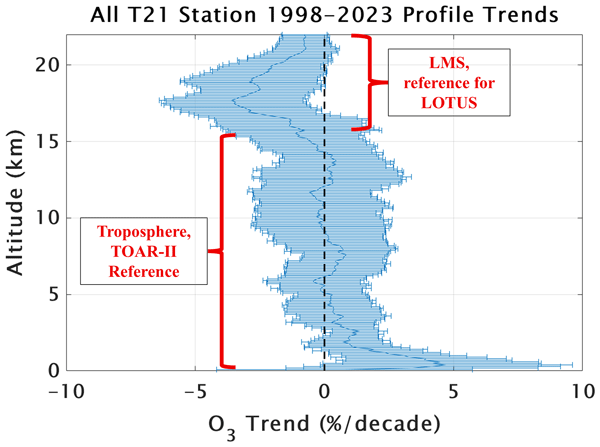
Ozone profile trends from SHADOZ sondes and IAGOS aircraft show that ozone in the tropical free troposphere (FT) is not growing fast except over equatorial SE Asia. This agrees with HEGIFTOM (Van Malderen et al., 2025), Stauffer et al. (2024) and Gaudel et al. (2024) TOAR-II papers. Other findings are as follows: (1) our trends are independent of method (QR, MLR) and (2) sample number (SN) (i.e., SHADOZ sampling is sufficient), and (3) all ground-based trends constitute the gold standard for satellite-derived trends.
Ana Roberta Paulino, Igo Paulino, and José Augusto Pereira
EGUsphere, https://doi.org/10.5194/egusphere-2025-3085, https://doi.org/10.5194/egusphere-2025-3085, 2025
Short summary
Short summary
In this paper, atmospheric responses to the 23 October 2023 annular solar eclipse is discussed considering almost simultaneous temperature measurements from the TIMED/SABER satellite. Reductions of the temperature in troposphere, mesosphere and mesopause were observed. On the other hand, the temperature increased by about 7 K around 33 km. The temporal and spatial configuration of the measurements is consistent with the observed structures.
Prosper K. Nyassor, Cristiano M. Wrasse, Igo Paulino, Erdal Yiğit, Vera Y. Tsali-Brown, Ricardo A. Buriti, Cosme A. O. B. Figueiredo, Gabriel A. Giongo, Fábio Egito, Oluwasegun M. Adebayo, Hisao Takahashi, and Delano Gobbi
Atmos. Chem. Phys., 25, 4053–4082, https://doi.org/10.5194/acp-25-4053-2025, https://doi.org/10.5194/acp-25-4053-2025, 2025
Short summary
Short summary
This work explores the dynamics of the momentum and energy of propagating mesospheric gravity waves (GWs). A photometer was used to observe the vertical component of the GWs, whereas the horizontal component was observed by an all-sky imager. Using the parameters from these two instruments and background wind from meteor radar, the momentum flux and potential energy of the GWs were determined and studied. It is noted that the dynamics of the downward-propagating GWs were controlled by observed ducts.
Ana Roberta Paulino, Delis Otildes Rodrigues, Igo Paulino, Lourivaldo Mota Lima, Ricardo Arlen Buriti, Paulo Prado Batista, Aaron Ridley, and Chen Wu
Ann. Geophys., 43, 183–191, https://doi.org/10.5194/angeo-43-183-2025, https://doi.org/10.5194/angeo-43-183-2025, 2025
Short summary
Short summary
Comparisons of wind measurements using two different techniques (ground-based radar and satellite) in Brazil during 2006 were made in order to point out the advantages of each instrument for studies in the mesosphere and upper thermosphere. (i) For short-period variations, the measurements of the satellite were more advantageous. (ii) The monthly climatology using the radar was more appropriate. (iii) For long periods (longer than a few months), both instruments responded satisfactorily.
Josemaria Gomez Socola, Fabiano S. Rodrigues, Isaac G. Wright, Igo Paulino, and Ricardo Buriti
Atmos. Meas. Tech., 18, 909–919, https://doi.org/10.5194/amt-18-909-2025, https://doi.org/10.5194/amt-18-909-2025, 2025
Short summary
Short summary
New low-cost, off-the-shelf Global Navigation Satellite System (GNSS) receivers enable the estimation of zonal ionospheric irregularity drifts using the scintillation spaced-receiver technique, previously tested only with commercial GNSS receivers. Despite their low C/No resolution (1 dB-Hz), we demonstrate that the recorded raw data can be used to estimate irregularity drifts. Further, our observations are consistent with the behavior of an empirical model of the thermospheric winds (HMW14).
Hisao Takahashi, Cosme A. O. B. Figueiredo, Patrick Essien, Cristiano M. Wrasse, Diego Barros, Prosper K. Nyassor, Igo Paulino, Fabio Egito, Geangelo M. Rosa, and Antonio H. R. Sampaio
Ann. Geophys., 40, 665–672, https://doi.org/10.5194/angeo-40-665-2022, https://doi.org/10.5194/angeo-40-665-2022, 2022
Short summary
Short summary
We observed two different wave propagations in the earth’s upper atmosphere: a gravity wave in the mesosphere and the ionospheric disturbances. We investigated the wave propagations by using airglow imaging techniques. It is found that there was a gravity wave generation from the tropospheric convection spot, and it propagated upward in the ionosphere. This reports observational evidence of gravity wave propagation from the troposphere to ionosphere.
Prosper K. Nyassor, Cristiano M. Wrasse, Igo Paulino, Eliah F. M. T. São Sabbas, José V. Bageston, Kleber P. Naccarato, Delano Gobbi, Cosme A. O. B. Figueiredo, Toyese T. Ayorinde, Hisao Takahashi, and Diego Barros
Atmos. Chem. Phys., 22, 15153–15177, https://doi.org/10.5194/acp-22-15153-2022, https://doi.org/10.5194/acp-22-15153-2022, 2022
Short summary
Short summary
This work investigates the sources of concentric gravity waves (CGWs) excited by a moving system of clouds with several overshooting regions on 1–2 October 2019 at São Martinho da Serra. The parameters of these waves were estimated using 2D spectral analysis and their source locations identified using backward ray tracing. Furthermore, the sources of these waves were properly identified by tracking the individual overshooting regions in space and time since the system of clouds was moving.
Igo Paulino, Ana Roberta Paulino, Amauri F. Medeiros, Cristiano M. Wrasse, Ricardo Arlen Buriti, and Hisao Takahashi
Ann. Geophys., 39, 1005–1012, https://doi.org/10.5194/angeo-39-1005-2021, https://doi.org/10.5194/angeo-39-1005-2021, 2021
Short summary
Short summary
In the present work, the lunar semidiurnal tide (M2) was investigated in the equatorial plasma bubble (EPB) zonal drifts over Brazil from 2000 to 2007. On average, the M2 contributes 5.6 % to the variability of the EPB zonal drifts. A strong seasonal and solar cycle dependency was also observed, the amplitudes of the M2 being stronger during the summer and high solar activity periods.
Daan Hubert, Klaus-Peter Heue, Jean-Christopher Lambert, Tijl Verhoelst, Marc Allaart, Steven Compernolle, Patrick D. Cullis, Angelika Dehn, Christian Félix, Bryan J. Johnson, Arno Keppens, Debra E. Kollonige, Christophe Lerot, Diego Loyola, Matakite Maata, Sukarni Mitro, Maznorizan Mohamad, Ankie Piters, Fabian Romahn, Henry B. Selkirk, Francisco R. da Silva, Ryan M. Stauffer, Anne M. Thompson, J. Pepijn Veefkind, Holger Vömel, Jacquelyn C. Witte, and Claus Zehner
Atmos. Meas. Tech., 14, 7405–7433, https://doi.org/10.5194/amt-14-7405-2021, https://doi.org/10.5194/amt-14-7405-2021, 2021
Short summary
Short summary
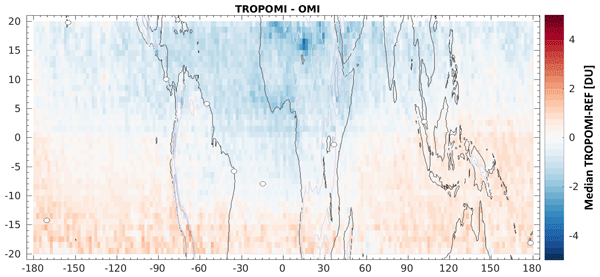
We assess the first 2 years of TROPOMI tropical tropospheric ozone column data. Comparisons to reference measurements by ozonesonde and satellite sensors show that TROPOMI bias (−0.1 to +2.3 DU) and precision (1.5 to 2.5 DU) meet mission requirements. Potential causes of bias and its spatio-temporal structure are discussed, as well as ways to identify sampling errors. Our analysis of known geophysical patterns demonstrates the improved performance of TROPOMI with respect to its predecessors.
Cited articles
Akhil Raj, S. and Ratnam, M. V.: Ozone vertical distribution during the solar eclipse of 26 December 2019 over Gadanki: Role of background dynamics, Atmos. Pollut. Res., 12, 101116, https://doi.org/10.1016/j.apr.2021.101116, 2021. a
Basha, G., Ratnam, M. V., Jiang, J. H., and Pangaluru, K.: Investigating the Effects of the Solar Eclipse on the Atmosphere over Land and Oceanic Regions: Observations from Ground Stations and COSMIC2 Data, Atmosphere, 16, https://doi.org/10.3390/atmos16070872, 2025. a, b, c, d
Bernhard, G. H., Janson, G. T., Simpson, S., Cordero, R. R., Sepúlveda Araya, E. I., Jorquera, J., Rayas, J. A., and Lind, R. N.: Does total column ozone change during a solar eclipse?, Atmos. Chem. Phys., 25, 819–841, https://doi.org/10.5194/acp-25-819-2025, 2025. a
Das, S. S., Kishore Kumar, K., Subrahmanyam, K. V., Venkat Ratnam, M., Suneeth, K. V., Sunilkumar, S. V., Sinha, P. R., Ghosh, A. K., Das, S. K., Sonwabne, S., Muralikrishna, U. V., Kolte, Y., Naja, M., Abhilash, S., Satheesan, K., Rakesh, V., Mahesh, P., Koushik, N., Satheesh Chandran, P. R., Girach, I. A., Namboodiri, K. V. S., Pandithurai, G., and Kirankumar, N. V. P.: Impact of Annular Solar Eclipse on the Trace Gases and Dynamics of the Lower and Middle Atmosphere: Results Inferred From an Integrated Campaign “Suryagrahan‐2019”, Earth and Space Science, 10, e2023EA003044, https://doi.org/10.1029/2023EA003044, 2023. a, b
Founda, D., Melas, D., Lykoudis, S., Lisaridis, I., Gerasopoulos, E., Kouvarakis, G., Petrakis, M., and Zerefos, C.: The effect of the total solar eclipse of 29 March 2006 on meteorological variables in Greece, Atmos. Chem. Phys., 7, 5543–5553, https://doi.org/10.5194/acp-7-5543-2007, 2007. a, b
Fournier d'Albe, E. M. and Rasool, S. I.: Observations of atmospheric ozone during a total eclipse of the sun, Ann. Geophys., 12, 72–74, 1956. a
Funari, F. L. and dos Santos, P. M.: O eclipse total do sol ocorrido em 12 de novembro de 1966 em Bagé (RS), Brasil, e seus efeitos nos parâmetros meteorológicos, Revista do Instituto Geológico, 39, https://doi.org/10.33958/revig.v39i3.603, 2018. a
Good, E.: Satellite observations of surface temperature during the March 2015 total solar eclipse, Philos. T. R. Soc. A, 374, 20150219, https://doi.org/10.1098/rsta.2015.0219, 2016. a
Harding, B. J., Drob, D. P., Buriti, R. A., and Makela, J. J.: Nightside Detection of a Large-Scale Thermospheric Wave Generated by a Solar Eclipse, Geophys. Res. Lett., 45, 3366–3373, https://doi.org/10.1002/2018GL077015, 2018. a
Harrison, R. G., Marlton, G. J., Williams, P. D., and Nicoll, K. A.: Coordinated weather balloon solar radiation measurements during a solar eclipse, Philos. T. R. Soc. A, 374, 20150221, https://doi.org/10.1098/rsta.2015.0221, 2016. a, b
Hersbach, H., Bell, B., Berrisford, P., Hirahara, S., Horányi, A., Muñoz-Sabater, J., Nicolas, J., Peubey, C., Radu, R., Schepers, D., Simmons, A., Soci, C., Abdalla, S., Abellan, X., Balsamo, G., Barbu, C., Bechtold, P., Bikmaev, B., Bidlot, J.-R., and Thépaut, J.-N.: The ERA5 global reanalysis, Q. J. Roy. Meteor. Soc., 146, 1999–2049, https://doi.org/10.1002/qj.3803, 2020. a
Hunt, B. G.: A theoretical study of the changes occurring in the ozonosphere during a total eclipse of the sun, Tellus, 17, 516–523, https://doi.org/10.3402/tellusa.v17i4.9158, 1965. a
Madhavan, B. and Venkat Ratnam, M.: Impact of a solar eclipse on surface radiation and photovoltaic energy, Sol. Energy, 223, 351–366, https://doi.org/10.1016/j.solener.2021.05.062, 2021. a
Manohar, G. K., Kandalgaonkar, S. S., and Kulkarni, M. K.: Impact of a total solar eclipse on surface atmospheric electricity, J. Geophys. Res.-Atmos., 100, 20805–20814, https://doi.org/10.1029/95JD01295, 1995. a
Mateos, D., Antón, M., and Vaquero, J.: Influence of solar eclipse of November 3rd, 2013 on the total ozone column over Badajoz, Spain, J. Atmos. Sol.-Terr. Phy., 112, 43–46, https://doi.org/10.1016/j.jastp.2014.02.005, 2014. a
McIntosh, B. A. and ReVelle, D. O.: Traveling atmospheric pressure waves measured during a solar eclipse, J. Geophys. Res.-Atmos., 89, 4953–4962, https://doi.org/10.1029/JD089iD03p04953, 1984. a
Met Office: Cartopy: a cartographic python library with a Matplotlib interface, Exeter, Devon, https://scitools.org.uk/cartopy (last access: 8 July 2026), 2010–2015. a
Miloshevich, L. M., Vömel, H., Whiteman, D. N., Lesht, B. M., Schmidlin, F. J., and Russo, F.: Accuracy assessment and correction of Vaisala RS92 radiosonde water vapor measurements, J. Geophys. Res.-Atmos., 114, D11305, https://doi.org/10.1029/2008JD011565, 2009. a, b
Namboodiri, K. V. S., Dileep, P. K., Mammen, K., Ramkumar, G., Kumar, N., Sreenivasan, S., Kumar, B. S., and Manchanda, R. K.: Effects of annular solar eclipse of 15 January 2010 on meteorological parameters in the 0 to 65 km region over Thumba, India, Meteorol. Z., 20, 635–647, https://doi.org/10.1127/0941-2948/2011/0253, 2011. a
Pasken, R., Halverson, J., and Braunschweig, P.: Surface Mesonet and Upper Air Analysis of the 21 August 2017 Total Solar Eclipse, Atmosphere, 14, https://doi.org/10.3390/atmos14091412, 2023. a, b, c
Paulino, A. R., Paulino, I., and Pereira, J. A.: Responses of the 14 October 2023 annular solar eclipse observed in satellite temperature profiles, EGUsphere [preprint], https://doi.org/10.5194/egusphere-2025-3085, 2025. a, b
Paulino, I., Figueiredo, C. A. O. B., Rodrigues, F. S., Buriti, R. A., Wrasse, C. M., Paulino, A. R., Barros, D., Takahashi, H., Batista, I. S., Medeiros, A. F., Batista, P. P., Abdu, M. A., de Paula, E. R., Denardini, C. M., Lima, L. M., Cueva, R. Y., and Makela, J. J.: Atmospheric Gravity Waves Observed in the Nightglow Following the 21 August 2017 Total Solar Eclipse, Geophys. Res. Lett., 47, e2020GL088924, https://doi.org/10.1029/2020GL088924, 2020. a, b
Picone, J. M., Hedin, A. E., Drob, D. P., and Aikin, A. C.: NRLMSISE-00 empirical model of the atmosphere: Statistical comparisons and scientific issues, J. Geophys. Res.-Space, 107, SIA 15-1–SIA 15–16, https://doi.org/10.1029/2002JA009430, 2002. a
Pratap, V., Kumar, A., and Singh, A. K.: Overview of solar eclipse of 21st June 2020 and its impact on solar irradiance, surface ozone and different meteorological parameters over eight cities of India, Adv. Space Res., 68, 4039–4049, https://doi.org/10.1016/j.asr.2021.08.014, 2021. a
Stranz, D.: Ozone measurements during solar eclipse, Tellus, 13, 276–279, https://doi.org/10.3402/tellusa.v13i2.9448, 1961. a
Thompson, A. M., Witte, J. C., Sterling, C., Jordan, A., Johnson, B. J., Oltmans, S. J., Fujiwara, M., Vömel, H., Allaart, M., Piters, A., Coetzee, G. J. R., Posny, F., Corrales, E., Diaz, J. A., Félix, C., Komala, N., Lai, N., Ahn Nguyen, H. T., Maata, M., Mani, F., Zainal, Z., Ogino, S.-y., Paredes, F., Penha, T. L. B., da Silva, F. R., Sallons-Mitro, S., Selkirk, H. B., Schmidlin, F. J., Stübi, R., and Thiongo, K.: First Reprocessing of Southern Hemisphere Additional Ozonesondes (SHADOZ) Ozone Profiles (1998–2016): 2. Comparisons With Satellites and Ground-Based Instruments, J. Geophys. Res.-Atmos., 122, 13000–13025, https://doi.org/10.1002/2017JD027406, 2017. a
Tzanis, C., Varotsos, C., and Viras, L.: Impacts of the solar eclipse of 29 March 2006 on the surface ozone concentration, the solar ultraviolet radiation and the meteorological parameters at Athens, Greece, Atmos. Chem. Phys., 8, 425–430, https://doi.org/10.5194/acp-8-425-2008, 2008. a, b
Witte, J. C., Thompson, A. M., Smit, H. G. J., Fujiwara, M., Posny, F., Coetzee, G. J. R., Northam, E. T., Johnson, B. J., Sterling, C. W., Mohamad, M., Ogino, S.-Y., Jordan, A., and da Silva, F. R.: First reprocessing of Southern Hemisphere ADditional OZonesondes (SHADOZ) profile records (1998–2015): 1. Methodology and evaluation, J. Geophys. Res.-Atmos., 122, 6611–6636, https://doi.org/10.1002/2016JD026403, 2017. a, b
Witte, J. C., Thompson, A. M., Smit, H. G. J., Vömel, H., Posny, F., and Stübi, R.: First Reprocessing of Southern Hemisphere ADditional OZonesondes Profile Records: 3. Uncertainty in Ozone Profile and Total Column, J. Geophys. Res.-Atmos., 123, 3243–3268, https://doi.org/10.1002/2017JD027791, 2018. a, b
Yang, X., Chen, P., Yao, Y., and Wu, M.: Response of the ionosphere to the total solar eclipse in the United States on April 8, 2024, Adv. Space Res., 76, 5566–5580, https://doi.org/10.1016/j.asr.2025.07.085, 2025. a
Zerefos, C. S., Balis, D. S., Meleti, C., Bais, A. F., Tourpali, K., Kourtidis, K., Vanicek, K., Cappellani, F., Kaminski, U., Colombo, T., Stübi, R., Manea, L., Formenti, P., and Andreae, M. O.: Changes in surface solar UV irradiances and total ozone during the solar eclipse of August 11, 1999, J. Geophys. Res.-Atmos., 105, 26463–26473, https://doi.org/10.1029/2000JD900412, 2000. a, b
Zhang, S.-R., Erickson, P. J., Goncharenko, L. P., Coster, A. J., Rideout, W., and Vierinen, J.: Ionospheric Bow Waves and Perturbations Induced by the 21 August 2017 Solar Eclipse, Geophys. Res. Lett., 44, 12067–12073, https://doi.org/10.1002/2017GL076054, 2017. a
Short summary
The study utilized a stratospheric balloon over Natal, Brazil, to investigate the atmospheric response to the 14 October 2023 annular solar eclipse near sunset. Measurements included temperature, pressure, relative humidity and ozone. Significant changes in these parameters were found at different altitudes. These complex changes confirm the importance of the annular eclipses as a driver of localized atmospheric dynamics.
The study utilized a stratospheric balloon over Natal, Brazil, to investigate the atmospheric...