Articles | Volume 44, issue 1
https://doi.org/10.5194/angeo-44-353-2026
© Author(s) 2026. This work is distributed under
the Creative Commons Attribution 4.0 License.
https://doi.org/10.5194/angeo-44-353-2026
© Author(s) 2026. This work is distributed under
the Creative Commons Attribution 4.0 License.
High-latitude MSTIDs over the EISCAT-3D site: solar activity and seasonal dependency
Rahul Rathi
Physics Department, Lancaster University, Lancaster, UK
Tim K. Yeoman
School of Physics and Astronomy, University of Leicester, Leicester, UK
Mark Lester
School of Physics and Astronomy, University of Leicester, Leicester, UK
Related authors
No articles found.
Loretta Pearl Poku, Gunter Stober, Witali Krochin, Alan Liu, Alexander Kozlovsky, Diego Janches, Jie Zeng, Wen Yi, Masaki Tsutsumi, Njål Gulbrandsen, Satonori Nozawa, Mark Lester, Johan Kero, and Nicholas Mitchell
EGUsphere, https://doi.org/10.5194/egusphere-2025-6377, https://doi.org/10.5194/egusphere-2025-6377, 2026
This preprint is open for discussion and under review for Atmospheric Measurement Techniques (AMT).
Short summary
Short summary
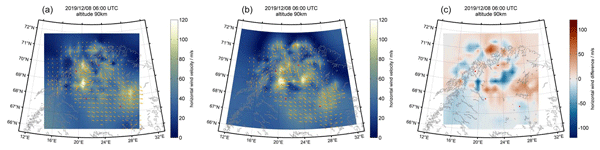
This study presents 3D spatially resolved wind fields in the MLT using advanced retrieval techniques. Specifically, a novel SVVP method in spherical coordinates to enhance the physical consistency of wind retrievals compared to the conventional VVP method in plane geometry and the 3DVAR+DIV method. The SVVP provides a robust framework for future MLT dynamics studies, and the 3DVAR+DIV retrieval is beneficial for high-resolution case studies due to its ability to capture small-scale variability.
Arthur Gauthier, Claudia Borries, Alexander Kozlovsky, Diego Janches, Peter Brown, Denis Vida, Christoph Jacobi, Damian Murphy, Masaki Tsutsumi, Njål Gulbrandsen, Satonori Nozawa, Mark Lester, Johan Kero, Nicholas Mitchell, Tracy Moffat-Griffin, and Gunter Stober
Ann. Geophys., 43, 427–440, https://doi.org/10.5194/angeo-43-427-2025, https://doi.org/10.5194/angeo-43-427-2025, 2025
Short summary
Short summary
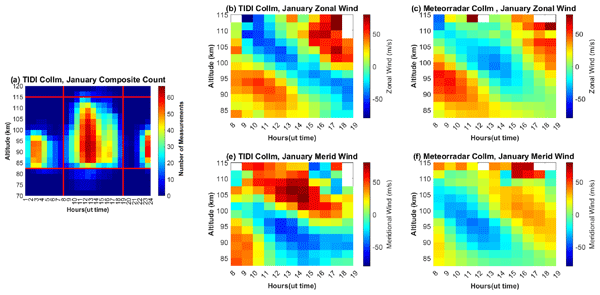
This study focuses on a TIMED Doppler Interferometer (TIDI)–meteor radar (MR) comparison of zonal and meridional winds and their dependence on local time and latitude. The correlation calculation between TIDI wind measurements and MR winds shows good agreement. A TIDI–MR seasonal comparison and analysis of the altitude–latitude dependence for winds are performed. TIDI reproduces the mean circulation well when compared with MRs and may be a useful lower boundary for general circulation models.
Gunter Stober, Sharon L. Vadas, Erich Becker, Alan Liu, Alexander Kozlovsky, Diego Janches, Zishun Qiao, Witali Krochin, Guochun Shi, Wen Yi, Jie Zeng, Peter Brown, Denis Vida, Neil Hindley, Christoph Jacobi, Damian Murphy, Ricardo Buriti, Vania Andrioli, Paulo Batista, John Marino, Scott Palo, Denise Thorsen, Masaki Tsutsumi, Njål Gulbrandsen, Satonori Nozawa, Mark Lester, Kathrin Baumgarten, Johan Kero, Evgenia Belova, Nicholas Mitchell, Tracy Moffat-Griffin, and Na Li
Atmos. Chem. Phys., 24, 4851–4873, https://doi.org/10.5194/acp-24-4851-2024, https://doi.org/10.5194/acp-24-4851-2024, 2024
Short summary
Short summary
On 15 January 2022, the Hunga Tonga-Hunga Ha‘apai volcano exploded in a vigorous eruption, causing many atmospheric phenomena reaching from the surface up to space. In this study, we investigate how the mesospheric winds were affected by the volcanogenic gravity waves and estimated their propagation direction and speed. The interplay between model and observations permits us to gain new insights into the vertical coupling through atmospheric gravity waves.
Florian Günzkofer, Dimitry Pokhotelov, Gunter Stober, Ingrid Mann, Sharon L. Vadas, Erich Becker, Anders Tjulin, Alexander Kozlovsky, Masaki Tsutsumi, Njål Gulbrandsen, Satonori Nozawa, Mark Lester, Evgenia Belova, Johan Kero, Nicholas J. Mitchell, and Claudia Borries
Ann. Geophys., 41, 409–428, https://doi.org/10.5194/angeo-41-409-2023, https://doi.org/10.5194/angeo-41-409-2023, 2023
Short summary
Short summary
Gravity waves (GWs) are waves in Earth's atmosphere and can be observed as cloud ripples. Under certain conditions, these waves can propagate up into the ionosphere. Here, they can cause ripples in the ionosphere plasma, observable as oscillations of the plasma density. Therefore, GWs contribute to the ionospheric variability, making them relevant for space weather prediction. Additionally, the behavior of these waves allows us to draw conclusions about the atmosphere at these altitudes.
Gunter Stober, Alan Liu, Alexander Kozlovsky, Zishun Qiao, Witali Krochin, Guochun Shi, Johan Kero, Masaki Tsutsumi, Njål Gulbrandsen, Satonori Nozawa, Mark Lester, Kathrin Baumgarten, Evgenia Belova, and Nicholas Mitchell
Ann. Geophys., 41, 197–208, https://doi.org/10.5194/angeo-41-197-2023, https://doi.org/10.5194/angeo-41-197-2023, 2023
Short summary
Short summary
The Hunga Tonga–Hunga Ha‘apai volcanic eruption was one of the most vigorous volcanic explosions in the last centuries. The eruption launched many atmospheric waves traveling around the Earth. In this study, we identify these volcanic waves at the edge of space in the mesosphere/lower-thermosphere, leveraging wind observations conducted with multi-static meteor radars in northern Europe and with the Chilean Observation Network De Meteor Radars (CONDOR).
Gunter Stober, Alan Liu, Alexander Kozlovsky, Zishun Qiao, Ales Kuchar, Christoph Jacobi, Chris Meek, Diego Janches, Guiping Liu, Masaki Tsutsumi, Njål Gulbrandsen, Satonori Nozawa, Mark Lester, Evgenia Belova, Johan Kero, and Nicholas Mitchell
Atmos. Meas. Tech., 15, 5769–5792, https://doi.org/10.5194/amt-15-5769-2022, https://doi.org/10.5194/amt-15-5769-2022, 2022
Short summary
Short summary
Precise and accurate measurements of vertical winds at the mesosphere and lower thermosphere are rare. Although meteor radars have been used for decades to observe horizontal winds, their ability to derive reliable vertical wind measurements was always questioned. In this article, we provide mathematical concepts to retrieve mathematically and physically consistent solutions, which are compared to the state-of-the-art non-hydrostatic model UA-ICON.
Motoharu Nowada, Adrian Grocott, and Quan-Qi Shi
Ann. Geophys., 40, 299–314, https://doi.org/10.5194/angeo-40-299-2022, https://doi.org/10.5194/angeo-40-299-2022, 2022
Short summary
Short summary
We report that the ionospheric plasma flow patterns associated with the J-shaped transpolar arc (a type of nightside distorted TPA), detected by the SuperDARN radar, reveal the formation process of the nightside distortion of a TPA. Equatorward flows at the TPA growth point were observed flowing out of the polar cap and then turning toward the pre-midnight main auroral oval along the TPA nightside distortion. These ionospheric flow patterns would cause the distortion at the TPA nightside end.
James H. Lane, Adrian Grocott, Nathan A. Case, and Maria-Theresia Walach
Ann. Geophys., 39, 1037–1053, https://doi.org/10.5194/angeo-39-1037-2021, https://doi.org/10.5194/angeo-39-1037-2021, 2021
Short summary
Short summary
The Sun's magnetic field is carried across space by the solar wind – a hot plasma
streamof ions and electrons – forming the interplanetary magnetic field (IMF). The IMF can introduce asymmetries in the Earth's magnetic field, giving plasma flowing within it a direction dependent on IMF orientation. Electric currents in near-Earth space can also influence these plasma flows. We investigate these two competing mechanisms and find that the currents can prevent the IMF from controlling the flow.
Gunter Stober, Alexander Kozlovsky, Alan Liu, Zishun Qiao, Masaki Tsutsumi, Chris Hall, Satonori Nozawa, Mark Lester, Evgenia Belova, Johan Kero, Patrick J. Espy, Robert E. Hibbins, and Nicholas Mitchell
Atmos. Meas. Tech., 14, 6509–6532, https://doi.org/10.5194/amt-14-6509-2021, https://doi.org/10.5194/amt-14-6509-2021, 2021
Short summary
Short summary
Wind observations at the edge to space, 70–110 km altitude, are challenging. Meteor radars have become a widely used instrument to obtain mean wind profiles above an instrument for these heights. We describe an advanced mathematical concept and present a tomographic analysis using several meteor radars located in Finland, Sweden and Norway, as well as Chile, to derive the three-dimensional flow field. We show an example of a gravity wave decelerating the mean flow.
Cited articles
Boyde, B., Wood, A., Dorrian, G., Fallows, R. A., Themens, D., Mielich, J., Elvidge, S., Mevius, M., Zucca, P., Dabrowski, B., Krankowski, A., Vocks, C., and Bisi, M.: Lensing from small-scale travelling ionospheric disturbances observed using LOFAR, J. Space Weather Space Clim., 12, 34, https://doi.org/10.1051/swsc/2022030, 2022.
Boyde, B., Wood, A., Dorrian, G., de Gasperin, F., and Mevius, M.: Statistics of travelling ionospheric disturbances observed using the LOFAR radio telescope, J. Space Weather Space Clim., 15, 6, https://doi.org/10.1051/swsc/2025002, 2025.
Carter, B. A., Pradipta, R., Dao, T., Currie, J. L., Choy, S., Wilkinson, P., Maher, P., Marshall, R., Harima, K., Le Huy, M., Nguyen Chien, T., Nguyen Ha, T., and Harris, T. J.: The ionospheric effects of the 2022 Hunga Tonga Volcano eruption and the associated impacts on GPS Precise Point Positioning across the Australian region, Space Weather, 21, e2023SW003476, https://doi.org/10.1029/2023SW003476, 2023.
Chisham, G., Lester, M., Milan, S.E., Freeman, M. P., Bristow, W. A., Grocott, A., McWilliams, K. A., Ruohoniemi, J. M., Yeoman, T. K., Dyson, P. L., Greenwald, R. A., Kikuchi, T., Pinnock, M., Rash, J. P. S., Sato, N., Sofko, G. J., Villain, J. P., and Walker, A. D. M.: A decade of the Super Dual Auroral Radar Network (SuperDARN): scientific achievements, new techniques and future directions, Surv. Geophys., 28, 33–109, https://doi.org/10.1007/s10712-007-9017-8, 2007.
Ding, F., Wan, W., Liu, L., Afraimovich, E. L., Voeykov, S. V., and Perevalova, N. P.: A statistical study of large-scale traveling ionospheric disturbances observed by GPS TEC during major magnetic storms over the years 2003–2005, J. Geophys. Res., 113, A00A01, https://doi.org/10.1029/2008JA013037, 2008.
Ding, F., Wan, W., Xu, G., Yu, T., Yang, G., and Wang, J.: Climatology of medium-scale traveling ionospheric disturbances observed by a GPS network in central China, J. Geophys. Res., 116, A09327, https://doi.org/10.1029/2011ja016545, 2011.
Fisher, R. A.: The logic of inductive inference, J. Royal Statistical Society, 98, 39–82, https://doi.org/10.2307/2342435, 1935.
Frissell, N. A., Baker, J. B., Ruohoniemi, J. M., Greenwald, R. A., Gerrard, A. J., Miller, E. S., and West, M. L.: Sources and characteristics of medium-scale traveling ionospheric disturbances observed by high-frequency radars in the North American sector, J. Geophys. Res.-Space Phys., 121, 3722–3739, https://doi.org/10.1002/2015JA022168, 2016.
Fritts, D. C. and Vadas, S. L.: Gravity wave penetration into the thermosphere: sensitivity to solar cycle variations and mean winds, Ann. Geophys., 26, 3841–3861, https://doi.org/10.5194/angeo-26-3841-2008, 2008.
Greenwald, R. A., Baker, K. B., Dudeney, J. R., Pinnock, M., Jones, T. B., Thomas, E. C., Villain, J. P., Cerisier, J. C., Senior, C., Hanuise, C., Hunsucker, R. D., Sofko, G., Koehler, J., Nielsen, E., Pellinen, R., Walker, A. D. M., Sato, N., and Yamagishi, H.: Darn/SuperDarn: A global view of the dynamics of high-latitude convection, Space Sci. Rev., 71, 761–796, https://doi.org/10.1007/BF00751350, 1995.
Grocott, A., Hosokawa, K., Ishida, T., Lester, M., Milan, S. E., Freeman, M. P., Sato, N., and Yukimatu, A. S.: Characteristics of medium-scale traveling ionospheric disturbances observed near the Antarctic Peninsula by HF radar, J. Geophys. Res.-Space Phys., 118, 5830–5841, https://doi.org/10.1002/jgra.50515, 2013.
Hei, H., Tsuda, T., and Hirooka, T.: Characteristics of atmospheric gravity wave activity in the polar regions revealed by GPS radio occultation data with CHAMP, J. Geophys. Res., 113, D04107, https://doi.org/10.1029/2007JD008938, 2008.
Hines, C. O.: Internal atmospheric gravity waves at ionospheric heights, Can. J. Phys., 38, 1441–1481, https://doi.org/10.1139/p60-150, 1960.
Hocke, K. and Schlegel, K.: A review of atmospheric gravity waves and travelling ionospheric disturbances: 1982–1995, Ann. Geophys., 14, 917, https://doi.org/10.1007/s005850050357, 1996.
Hoffmann, L., Xue, X., and Alexander, M. J.: A global view of stratospheric gravity wave hotspots located with Atmospheric Infrared Sounder observations, J. Geophys. Res. Atmos., 118, 416–434, https://doi.org/10.1029/2012JD018658, 2013.
Huang, F., Dou, X., Lei, J., Lin, J., Ding, F., and Zhong, J.: Statistical analysis of nighttime medium-scale traveling ionospheric disturbancesusing airglow images and GPS observations over central China, J. Geophys. Res.-Space Phys., 121, 8887–8899, https://doi.org/10.1002/2016ja022760, 2016.
Hunsucker, R. D.: Atmospheric gravity waves generated in the high latitude ionosphere: A review, Rev. Geophys., 20, 293–315, https://doi.org/10.1029/rg020i002p00293, 1982.
Ishida, T., Hosokawa, K., Shibata, T., Suzuki, S., Nishitani, N., and Ogawa, T.: SuperDARN observations of daytime MSTIDs in the auroral and mid-latitudes: Possibility of long-distance propagation, Geophys. Res. Lett., 35, L13102, https://doi.org/10.1029/2008gl034623, 2008.
Maletckii, B. and Astafyeva, E.: Near-real-time identification of the source of ionospheric disturbances, J. Geophys. Res.-Space Phys., 129, e2024JA032664, https://doi.org/10.1029/2024JA032664, 2024.
Milan, S.E., Yeoman, T.K., Lester, M., Thomas, E. C., and Jones, T. B.: Initial backscatter occurrence statistics from the CUTLASS HF radars, Ann. Geophys., 15, 703–718, https://doi.org/10.1007/s00585-997-0703-0, 1997.
Moges, S. T., Kozlovsky, A., Sherstyukov, R. O., and Ulich, T.: Solar activity dependence of traveling Ionospheric disturbance amplitudes using a rapid-run ionosonde in high latitudes, J. Geophys. Res.-Space Phys., 129, e2024JA033013, https://doi.org/10.1029/2024JA033013, 2024a.
Moges, S. T., Sherstyukov, R. O., Kozlovsky, A., Ulich, T., and Lester, M.: Statistics of traveling ionospheric disturbances at high latitudes using a rapid- run ionosonde, J. Geophys. Res.-Space Phys., 129, e2023JA031694, https://doi.org/10.1029/2023JA031694, 2024b.
Negale, M. R., Taylor, M. J., Nicolls, M., Vadas, S. L., Nielsen, K., and Heinselman, C. J.: Seasonal propagation characteristics of MSTIDs observed at high latitudes over central Alaska using the poker flat incoherent scatter radar, J. Geophys. Res.-Space Phys., 123, 5717–5737, https://doi.org/10.1029/2017ja024876, 2018.
Ogawa, T., Igarashi, K., Aikyo, K., and Maeno, H.: NNSS Satellite-observations of medium-scale traveling ionospheric disturbances at southern high-latitudes, J. Geomagn. Geoelectr., 39, 709–721, https://doi.org/10.5636/jgg.39.709, 1987.
Prikryl, P., Gillies, R. G., Themens, D. R., Weygand, J. M., Thomas, E. G., and Chakraborty, S.: Multi-instrument observations of polar cap patches and traveling ionospheric disturbances generated by solar wind Alfvén waves coupling to the dayside magnetosphere, Ann. Geophys., 40, 619–639, https://doi.org/10.5194/angeo-40-619-2022, 2022.
Prikryl, P., Themens, D. R., Chum, J., Chakraborty, S., Gillies, R. G., and Weygand, J. M.: Observations of traveling ionospheric disturbances driven by gravity waves from sources in the upper and lower atmosphere, Ann. Geophys., 43, 511–534, https://doi.org/10.5194/angeo-43-511-2025, 2025.
Rathi, R., Sivakandan, M., Chakrabarty, D., Sunil Krishna, M. V., Upadhayaya, A. K., and Sarkhel, S.: Evidence for the evolution and decay of an electrified medium scale traveling ionospheric disturbances during two consecutive substorms: First results, Adv. Space Res., 75, 6, https://doi.org/10.1016/j.asr.2025.01.007, 2025.
Samson, J., Greenwald, R., Ruohoniemi, J., and Baker, K.: High-frequency radar observations of atmospheric gravity waves in the high-latitude ionosphere, Geophys. Res. Lett., 16, 875–878, https://doi.org/10.1029/gl016i008p00875, 1989.
Samson, J., Greenwald, R., Ruohoniemi, J., Frey, A., and Baker, K.: Goose bay radar observations of Earth-reflected, atmospheric gravity waves in the high-latitude ionosphere, J. Geophys. Res., 95, 7693–7709, https://doi.org/10.1029/ja095ia06p07693, 1990.
Shibata, T.: Application of multichannel maximum-entropy spectral-analysis to the HF Doppler data of medium-scale TID, J. Geomagn. Geoelectr., 39, 247–260, https://doi.org/10.5636/jgg.39.247, 1987.
Shiokawa, K., Ihara, C., Otsuka, Y., and Ogawa, T.: Statistical study of nighttime medium-scale traveling ionospheric disturbances using midlatitude airglow images, J. Geophys. Res., 108, https://doi.org/10.1029/2002ja009491, 2003.
Shiokawa, K., Mori, M., Otsuka, Y., Oyama, S., Nozawa, S., Suzuki, S., and Connors, M.: Observation of nighttime medium-scale traveling ionospheric disturbances by two 630 nm airglow imagers near the auroral zone, J. Atmos. Sol.-Terr. Phy., 103, 184–194, https://doi.org/10.1016/j.jastp.2013.03.024, 2013.
Strand, O. N.: Multichannel complex maximum entropy (autoregressive) spectral analysis, IEEE Trans. Autom. Control, 22, 634–640, https://doi.org/10.1109/TAC.1977.1101545, 1977.
SuperDARN Data Analysis Working Group, Thomas, E. G., Burrell, A. G., Ponomarenko, P. V., Bland, E. C., Sterne, K. T., Rohel, R. A., Shepherd, S. G., Billet, D. D., Schmidt, M. T., and Walach, M.-T.: SuperDARN Radar Software Toolkit (RST) 5.1 (v5.1), Zenodo [code], https://doi.org/10.5281/zenodo.4435150, 2025.
SuperDARN Data Visualization Working Group, Martin, C. J., Rohel, R. A., Billett, D. D., Pitzer, P., Galeshuck, D., Kunduri, B. S. R., Khanal, K., Hiyadutuje, A., Chakraborty, S., Detwiller, M., and Schmidt, M. T.: SuperDARN/pydarn: pyDARN v4.1.2 (v4.1.2), Zenodo [code], https://doi.org/10.5281/zenodo.15441879, 2025.
Tsugawa, T., Saito, A., and Otsuka, Y.: A statistical study of large-scale traveling ionospheric disturbances using the GPS network in Japan, J. Geophys. Res., 109, A06302, https://doi.org/10.1029/2003JA010302, 2004.
Ulrych, T. J. and Bishop, T. N.: Maximum entropy spectral analysis and autoregressive decomposition, Rev. Geophys, 13, 183–200, https://doi.org/10.1029/RG013i001p00183, 1975.
Vadas, S. L.: Horizontal and vertical propagation and dissipation of gravity waves in the thermosphere from lower atmospheric and thermospheric sources, J. Geophys. Res., 112, A06305, https://doi.org/10.1029/2006JA011845, 2007.
Vlasov, A., Kauristie, K., van de Kamp, M., Luntama, J.-P., and Pogoreltsev, A.: A study of Traveling Ionospheric Disturbances and Atmospheric Gravity Waves using EISCAT Svalbard Radar IPY-data, Ann. Geophys., 29, 2101–2116, https://doi.org/10.5194/angeo-29-2101-2011, 2011.
Xiong, Y., Liu, H., Shi, R., Xing, Z., Lu, S., Zhang, Q., Wang, Z., and Han, D.: Generation of quasi-periodic dayside medium scale traveling ionospheric disturbances (MSTIDs) by intermittent lobe reconnection, Geophys. Res. Lett., 52, e2024GL113857, https://doi.org/10.1029/2024GL113857, 2025.
Yoshiki, M. and Sato, K.: A statistical study of gravity waves in the polar regions based on operational radiosonde data, J. Geophys. Res., 105, 17995–18011, https://doi.org/10.1029/2000JD900204, 2000.
Short summary
We investigate high-latitude medium scale traveling ionospheric disturbances (MSTIDs) over European Incoherent Scatter (EISCAT)-3D site. Using Hankasalmi radar data during solar max & min years of solar cycles 23 & 24, we observed that MSTIDs normally propagate equatorward with velocity and period of 50–150 m s-1 and 30–60 minutes, respectively. Along with seasonal variation, MSTIDs showed dependency on solar activity as well as on northward and southward interplanetary magnetic field (IMF) Bz.
We investigate high-latitude medium scale traveling ionospheric disturbances (MSTIDs) over...