Articles | Volume 44, issue 2
https://doi.org/10.5194/angeo-44-1441-2026
© Author(s) 2026. This work is distributed under
the Creative Commons Attribution 4.0 License.
https://doi.org/10.5194/angeo-44-1441-2026
© Author(s) 2026. This work is distributed under
the Creative Commons Attribution 4.0 License.
Introduction to ”The first-ever lunar–Earth flyby: a unique test environment for Juice” special issue

Joana S. Oliveira
CORRESPONDING AUTHOR
Telespazio UK S.L. for the European Space Agency (ESA), European Space Astronomy Centre (ESAC), Madrid, Spain
Elias Roussos
Max Planck Institute for Solar System Research, Justus-von-Liebig-Weg 3, 37077 Göttingen, Germany
Stephanie C. Werner
Centre for Planetary Habitability, Department of Geosciences, University of Oslo, 0315, Oslo, Norway
Related authors
No articles found.
Konstantinos Dialynas, Matina Gkioulidou, Donald G. Mitchell, Pontus C. Brandt, George Clark, Elias Roussos, Peter Kollmann, Leonardo Regoli, Frederic Allegrini, Nicolas Andre, Xianzhe Jia, Krishan Khurana, Carol Paty, Stas Barabash, Peter Wurz, Gabriella Stenberg Wieser, Martin Wieser, Philipp Wittmann, Leif Kalla, Markus Fraenz, Audrey Vorburger, Jan-Erik Wahlund, Yoshifumi Futaana, Manabu Shimoyama, Angele Pontoni, Andre Galli, Andreas Riedo, George Ho, Norbert Krupp, Robert F. Wimmer-Schweingruber, Kazushi Asamura, Esa Kallio, Andrea Opitz, Manuel Grande, Andrew J. Coates, Geraint H. Jones, Theodoros Sarris, Andrey Fedorov, and Ján Baláž
Ann. Geophys., 44, 1369–1379, https://doi.org/10.5194/angeo-44-1369-2026, https://doi.org/10.5194/angeo-44-1369-2026, 2026
Short summary
Short summary
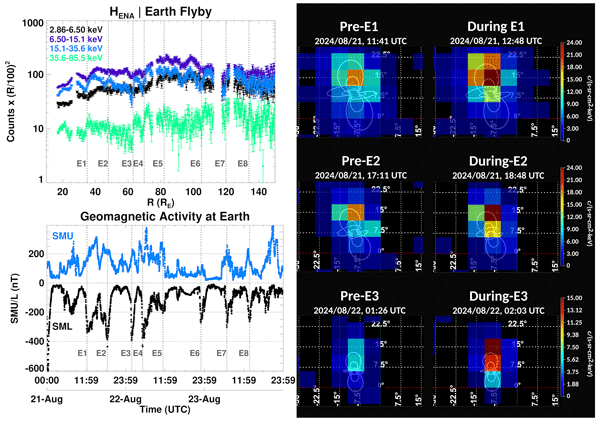
Energetic Neutral Atom (ENA) images of Earth's magnetosphere from the Particle Environment Package/Jovian Energetic Neutrals and Ions detector on the Jupiter icy Moons Explorer spacecraft, at distances of ~17 to ~150 Earth Radii during the Lunar and Earth Gravity Assist. We demonstrate the detector's good performance and discus substorm dynamics. We show increased ENA emissions associated with the onsets of substorm events, suggesting direct responses to the increased energetic ion activity.
Markus Fränz, Henning Fischer, Norbert Krupp, Elias Roussos, Philipp Wittmann, Patrick Bambach, Jan-Erik Wahlund, Gabriella Stenberg Wieser, Stas Barabash, Mika Holmberg, Maryam Zeroual, Pontus C. Brandt, Peter Wurz, Martin Wieser, Yoshifumi Futaana, Manabu Shimoyama, Angèle Pontoni, Audrey Vorburger, André Galli, Andreas Riedo, George Ho, Donald G. Mitchell, George Clark, Peter Kollmann, Malamati Gkioulidou, Leonardo Regoli, Robert Wimmer-Schweingruber, Kazushi Asamura, Esa Kallio, Andrea Opitz, Manuel Grande, Andrew Coates, Geraint Jones, Theodoros Sarris, Andrey Fedorov, Nicolas André, and Ján Baláž
Ann. Geophys., 44, 1143–1165, https://doi.org/10.5194/angeo-44-1143-2026, https://doi.org/10.5194/angeo-44-1143-2026, 2026
Short summary
Short summary
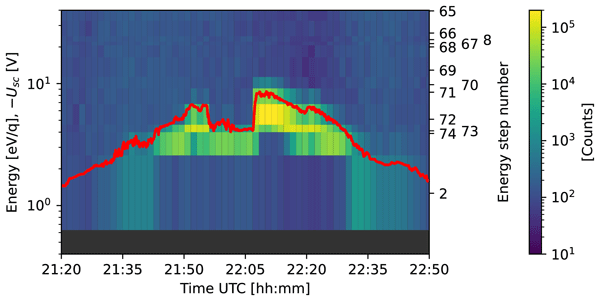
During the first Earth gravity assist maneuver of the Jupiter Icy Moons Explorer spacecraft in August 2024 the spacecraft passed through the Earth plasmasphere for about 2 hours. The Jovian Ion and Electron spectrometer was able to make a very rare observation of the molecular ion fraction of the cold and dense plasma in the Earth plasmasphere. The analysis also shows that the spectrometer can resolve ion masses by using the negative potential of the spacecraft.
Gabriella Stenberg Wieser, Martin Wieser, Stas Barabash, Philipp Wittmann, Leif Kalla, Markus Fränz, Elias Roussos, Audrey Vorburger, Peter Wurz, Jan-Erik Wahlund, Pontus C. Brandt, Yoshifumi Futaana, Manabu Shimoyama, Angèle Pontoni, André Galli, Andreas Riedo, George Ho, Donald G. Mitchell, George Clark, Peter Kollmann, Malamati Gkioulidou, Leonardo Regoli, Norbert Krupp, Robert Wimmer-Schweingruber, Kazushi Asamura, Esa Kallio, Andrea Opitz, Manuel Grande, Andrew Coates, Geraint Jones, Theodoros Sarris, Andrey Fedorov, Nicolas André, and Ján Baláž
Ann. Geophys., 44, 937–948, https://doi.org/10.5194/angeo-44-937-2026, https://doi.org/10.5194/angeo-44-937-2026, 2026
Short summary
Short summary
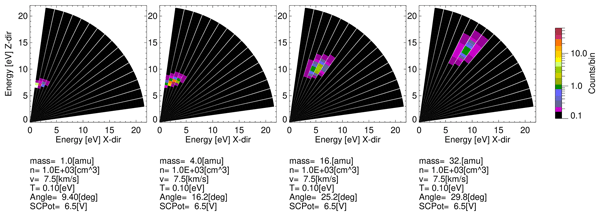
We used Juice flyby of Earth in August 2024 to evaluate the performance of the Jovian Plasma Dynamics and Composition analyzer (JDC). JDC measures positive and negative ions as well as electrons. When Juice arrives at Jupiter, one of the most challenging tasks for JDC is to record low energy ion populations. We used the data JDC recorded close to Earth, together with measurement in the laboratory on ground, to improve the future observations the sensor will make around Jupiter’s icy moons.
Marco Pinto, André Rodrigues, Elias Roussos, Daniel Schmid, Martin Volwerk, Stavros Kotsiaros, Patrick Brown, Michele Dougherty, Luísa Arruda, and Olivier Witasse
EGUsphere, https://doi.org/10.5194/egusphere-2026-2055, https://doi.org/10.5194/egusphere-2026-2055, 2026
Short summary
Short summary
During its flyby of the Moon and Earth, the Jupiter Icy Moons Explorer crossed Earth's radiation belts and gave us a rare chance to test the Radiation Hard Electron Monitor in space. By studying how its measurements changed along the path, we showed that the instrument can clearly detect trapped electrons and protons. This gives confidence for future operations at Jupiter, where the radiation environment is far harsher and these measurements will be especially valuable.
François Poulet, Giuseppe Piccioni, Yves Langevin, Cydalise Dumesnil, Vincent Carlier, Benoit Seignovert, Marc Dexet, Leigh N. Fletcher, Cédric Leyrat, Francesca Altieri, John Carter, Emiliano D'Aversa, Maria De Sanctis, Davide Grassi, Sandrine Guerlet, Stéphane Le Mouélic, Alessandra Migliorini, Fabrizio Oliva, Clément Royer, Sébastien Rodriguez, Katrin Stephan, Federico Tosi, Francesca Zambon, Alberto Adriani, Gabriele Arnold, Jean-Pierre Bibring, Dominique Bockelée, Rosario Brunetto, Fabrizio Capaccioni, Cristian Carli, Thibault Cavalié, Miriam Cisneros González, Mauro Ciarnello, Simone De Angelis, Pierre Drossart, Gianrico Filacchione, Thierry Fouchet, Jean-Claude Gérard, Denis Grodent, Patrick Irwin, Sophie Jacquinod, Ozgur Karatekin, Emmanuel Lellouch, Nicolas Ligier, Nicolas Mangold, Magali Mebsout, Frédéric Merlin, Alessandro Morbidelli, Alessandro Mura, Andreas Nathues, Maria E. Palumbo, Cédric Pilorget, Olivier Poch, Eric Quirico, Andrea Raponi, Séverine Robert, Elias Roussos, Agustin Sanchez-Lavega, Bernard Schmitt, Giuseppe Sindoni, Marcel Snels, Roberto Sordini, Stefania Stefani, Giovanni Strazzulla, Tim Trent, Gabriel Tobie, Diego Turrini, Ann-Carine Vandaele, Mathieu Vincendon, Olivier Witasse, Claire Vallat, and Alessandro Moraino
Ann. Geophys., 44, 163–193, https://doi.org/10.5194/angeo-44-163-2026, https://doi.org/10.5194/angeo-44-163-2026, 2026
Short summary
Short summary
During the double Lunar-Earth Gravitational Assist with the ESA/JUICE (Jupiter Icy Moons Explorer) spacecraft in August 2024, we acquired hyperspectral data cubes of both the Moon and Earth with the MAJIS (Moons And Jupiter Imaging Spectrometer) imaging spectrometer under challenging, real in-flight conditions. This allowed to characterize surface materials and thermophysical properties on the Moon, identify various cloud phases and gases in Earth's atmosphere, and thoroughly validate the performance of the instrument.
Short summary
The Editors invite the reader to explore the collection “The first-ever lunar-Earth flyby: a unique test environment for JUICE” and discover the diversity of investigations enabled by Lunar–Earth Gravity Assist (LEGA), from the scientific observations acquired during the encounter to the technical and operational insights gained along the way.
The Editors invite the reader to explore the collection “The first-ever lunar-Earth flyby: a...