
the Creative Commons Attribution 4.0 License.
the Creative Commons Attribution 4.0 License.
 | 16 Nov 2026
Energetic neutral atom images of the Earth's magnetosphere from the JENI instrument on board the JUICE mission during the lunar and earth gravity assist
Konstantinos Dialynas

Matina Gkioulidou
Donald G. Mitchell
Pontus C. Brandt
George Clark
Elias Roussos
Peter Kollmann
Leonardo Regoli
Frederic Allegrini
Nicolas Andre
Xianzhe Jia
Krishan Khurana
Carol Paty
Stas Barabash
Peter Wurz
Gabriella Stenberg Wieser
Martin Wieser
Philipp Wittmann
Leif Kalla
Markus Fraenz
Audrey Vorburger
Jan-Erik Wahlund
Yoshifumi Futaana
Manabu Shimoyama
Angele Pontoni
Andre Galli
Andreas Riedo
George Ho
Norbert Krupp
Robert F. Wimmer-Schweingruber
Kazushi Asamura
Esa Kallio
Andrea Opitz
Manuel Grande
Andrew J. Coates
Geraint H. Jones
Theodoros Sarris
Andrey Fedorov
Ján Baláž
The Jovian Energetic Neutrals and Ions (JENI), part of the Particle Environment Package (PEP) on the Jupiter Icy Moons Explorer (JUICE) spacecraft, is a state-of-the-art instrument, capable of analyzing the energy and direction of incident Energetic Neutral Atoms (ENAs) from planetary magnetospheres. Our analysis focuses on 2.86–85.5 keV Hydrogen ENA measurements between 21 to 24 August 2024 when JUICE performed the Lunar and Earth Gravity Assist (LEGA). During the LEGA, JENI had a unique opportunity to obtain continuous, 7.5 min accumulation time global images of the terrestrial magnetosphere as the spacecraft moved outward from ∼ 17 to 150 Earth Radii. Although there were no indications of substantial geomagnetic storms developing during that time, substorm activity was observed based on eight distinct dips of the SuperMAG AL (SML) index down to approximately −250 nT to even approximately −400 nT. Although the primary purpose of this study is to demonstrate the good performance of JENI during the LEGA, a preliminary analysis on the ENA images showed increased ENA emissions associated with the onsets of these events, suggesting that they are likely responses to the increased energetic ion activity during those substorm events. Unlike the periods of intense geomagnetic storms, during which proton intensities build up the ring current, evolving from an asymmetric distribution during the main phase, to a roughly symmetric distribution during the recovery phase, the images from JENI during this interval show non-uniform ENA emissions in the plasma sheet, suggesting transient processes, such as a series of repeated nightside injections. The nightside ENA intensities are generally brighter than those from the dayside, possibly reflecting processes in the magnetotail associated with energetic ions being injected.
- Article
(3101 KB) - Full-text XML
- BibTeX
- EndNote


Energetic neutral atom (ENA) imaging has emerged over the years as a powerful means to diagnose the global, underlying ion distributions of the terrestrial magnetosphere (e.g. Brandt, 2021; Brandt et al., 2022), the magnetospheres of the outer planets, together with the extent and interactions of moons exospheres (e.g. Krimigis et al., 2002; Mauk et al., 2003, 2004; Mitchell et al., 2004, Barabash et al., 2006; 2007, Orsini et al., 2010, Brandt et al., 2008, 2010, 2012, Dialynas et al., 2013). As a magnetically trapped ion in the magnetosphere exchanges charge with a stable, cold neutral particle, the ion is thereby neutralized and becomes an ENA. Sufficiently energetic ENAs, i.e. exceeding their escape energies (e.g. hydrogen with E >1 eV at Earth), travel in ballistic trajectories from their origin, maintaining their direction, energy, and species. Thus, ENA imaging provides global images of the underlying plasma distributions together with valuable compositional and spectral information, being the only technique capable of imaging the dynamics of the ion population over large parts of a magnetosphere simultaneously, e.g. the Earth's plasma sheet and ring current (Wurz, 2000).
From reconstructed ENA images based on IMP-7/8 measurements (e.g. Roelof et al., 1985) to the first ENA images of the terrestrial ring current from MEPI/ISSE-1 (e.g. Roelof, 1989), or subsequent ones from Cassini/INCA in 1997 (e.g. Krimigis et al., 2004) and the Low Altitude Emissions from Astrid (e.g. Brandt et al., 1997), the modern ENA cameras, like the Imager for Magnetopause-to-Aurora Global Exploration (IMAGE; Burch, 2000) and the Two Wide angle Imaging Neutral-atom Spectrometers (TWINS; McComas et al., 2009), have provided detailed ENA observations of the plasma sheet (e.g. Brandt et al., 2002) and the global state of the ring current during geomagnetic storms (Mitchell et al., 2003).
Substorm injections have been observed with the IMAGE/HENA ENA camera (Brandt, 2021; Mitchell et al., 2003). However, HENA's spin duty cycle and low sensitivity only allowed for tens of minutes time-averaged measurements. Keesee et al. (2021) used TWINS ENA data to develop ∼ 3 min averaged (i.e., during 2 sweeps of the actuator that rotates to provide the second spatial dimension) “effective” temperature maps. They presented localized regions of increased ion temperature by projecting the pixels to the magnetic equator. Those regions were associated with a dipolarization front with bursty ion flows measured in-situ by the Magnetospheric Multiscale (MMS) mission (Burch et al., 2016). However, due to low sensitivity of the ENA camera onboard TWINS (due to very small geometric factor and duty cycle; McComas et al., 2009), only measurements in a limited energy range can be used (2–32 keV), assuming a Maxwellian distribution, to retrieve those temperatures.
Ion injections at Earth are a complex phenomenon, but the storm-time cases compared to the non storm-time ones exhibit some clear signatures in particle dynamics that can be easily identified in ENA images. In brief, storm-time substorms include a gradual increase of hydrogen ENA intensities in both the plasma sheet and the ring current, together with a very sudden intensification of oxygen ENAs related to non-adiabatic acceleration of ions during rapid magnetic field reconfigurations (e.g. Mitchell et al., 2003). Similar characteristics have been reported at Saturn using Cassini measurements (e.g. Mitchell et al., 2005; Dialynas et al., 2009). Injection events that are not related to geomagnetic storms show weak, or no intensification of oxygen ENAs due to the lack of significant amounts of singly ionized oxygen in the plasma sheet (e.g. Nosé et al., 2010). Whatever the mechanism responsible for plasma transport and acceleration in the magnetosphere, the ring current injections occur consistently with substorm auroral activity (e.g. Liou et al., 2000).
In the present analysis we employ Hydrogen ENA observations from the Jovian Energetic Neutrals and Ions (JENI) instrument on the Jupiter Icy Moons Explorer (JUICE) spacecraft to demonstrate its performance during the Lunar and Earth Gravity Assist (LEGA; 19–23 August 2024). This imaging opportunity also allowed us to discuss substorm dynamics based on the observed ENA emissions around Earth from vantage points much further away from the Earth than any other previous mission. Section 2 describes the measurement techniques, Sect. 3 describes our analysis of the measured ENAs, whereas Sects. 4 and 5 provide a short discussion of our results and a short summary, respectively.
We use ENA measurements from the Jovian Energetic Neutrals and Ions (JENI) instrument (Mitchell et al., 2016), part of the Particle Environment Package (PEP) suite on board the Jupiter Icy Moons Explorer (JUICE) mission to Jupiter. JENI is a combined ENA and ion camera with a large field of view () that builds on the heritage of the High-Energy Neutral Atom (HENA) camera (Mitchell et al., 2000) on board the IMAGE mission and the Ion and Neutral Camera (INCA) on the Cassini spacecraft (Krimigis et al., 2004) that operated between 1997 to 2017, and it is almost an identical copy to the IMAP-Ultra detector (Gkioulidou et al., 2026), taking high signal-to-noise images of Energetic Neutral Atoms (ENAs).
JENI is capable of alternating between ion and ENA modes. During the observation period analyzed here, JENI was operated in ENA mode, where its thin conductive plates were held at a relatively low voltage of about 1 kV deflecting charged particles up to about 20 keV q−1, but will be run at a higher voltage during its prime mission at Jupiter. A variable aperture slit can accommodate different geometric factors (0.001–1.85 cm2 sr) and effectively filter Ultraviolet (UV) light when the Sun is in JENI's field of view (FOV). JENI can analyze separately the gross composition, velocity and direction of the incident ENAs, based on the time-of-flight (TOF) technique and defines several energy channels within the energy range of ∼ 1 to ∼ 110 keV. The nominal angular resolution of JENI is ∼ 10° FWHM at ∼ 5 keV incident energy for hydrogen, ∼ 10° at ∼ 20 keV incident energy for Oxygen (∼ 20° at 10 keV total energy), but can be energy dependent, increasing toward lower energies. More details about JENI can be found in Brandt et al. (2026, this issue).
The JUICE spacecraft performed the so-called Lunar and Earth Gravity Assist (LEGA) during the time period between 19 and 23 August 2024 to direct its trajectory towards Venus for a scheduled gravity assist flyby (August 2025). As depicted in the left panel of Fig. 1, the spacecraft entered the Earth's magnetosphere from the tail and approached Earth at 21:16 UTC on 19 August 2024. At the outbound leg of this trajectory, between 21 August 2024 (∼ 00:15 UTC) and 23 August 2024 (∼ 22:50 UTC) JENI was set to ENA mode, providing remote observations of the terrestrial environment (middle and right panels of Fig. 1).
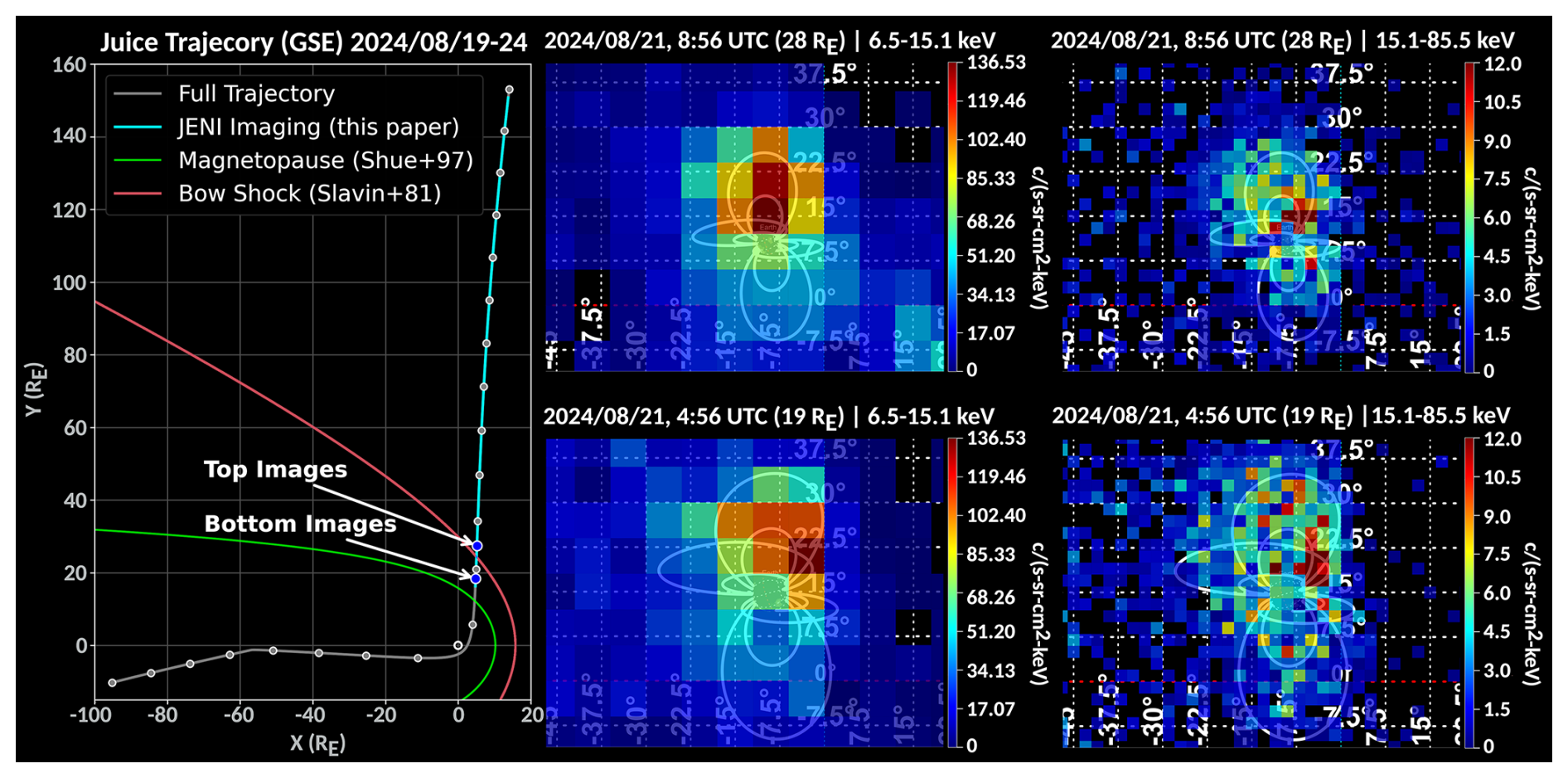
Figure 1(left) The trajectory of JUICE between 19 and 24 August 2024 in the Geocentric Solar Ecliptic (GSE) coordinate system, in which the x-axis is pointing towards the Sun, the z-axis points toward north (perpendicular to the ecliptic plane), and the y-axis completes the right hand system, pointing towards dusk. In this projection, JUICE approaches from the left. A small trajectory deflection is observed at the Moon flyby. Markers along the trajectory are spaced every 6 h, whereas the positions where the ENA images were collected are also indicated. The magnetopause and the bow shock are drawn here using the Shue et al. (1997) and Slavin and Holzer (1981) models, respectively (with Pd=1.5 nPa; solar wind dynamic pressure and nT; z-component of the interplanetary magnetic field). (Middle) Characteristic, 7.5 min accumulation time, high energy resolution images of 6.5–15.1 keV ENAs from JENI, after JUICE crossed the magnetopause. The Earth is shown in the middle of these images, whereas its dipole L-shell lines at L=4 and L=8 at local times 00:00 (top of the images), 06:00 (left of the images), 12:00 (bottom of the images), and 18:00 (right of the images) are also included for reference. (Right) The corresponding high angular resolution images of 15.1–85.5 keV ENAs from JENI. In both data plots, the flipped appearance of the Earth's magnetosphere is due to the projection of the observations in the instrument frame.
During the time period where JENI was set to ENA mode, JUICE was surveying the equatorial plane and moving away from Earth, through a radial distance of about 17 RE and beyond, resulting in a series of more than 500 continuous 7.5 min accumulation time images up to ∼ 150 RE (1RE∼6378 km). As noted earlier, during the entire imaging period, the voltage at JENI's deflection plates was set to relatively low values, i.e. ∼ 1.0 kV, but was adequate to sweep out protons from the detector up to about 20 keV. JENI does not have ion contamination beyond about 20 keV, because of quiet solar wind conditions. Therefore, given that JUICE is mostly outside Earth's magnetosphere, the foreground ion intensities are substantially lower than the ENA intensities. The images in the right panels of Fig. 1 provide first observations from JENI regarding the variation of the Hydrogen ENA emission from the terrestrial ring current and plasma sheet. The bright, predominantly night-side emission in Fig. 1, where JUICE was close to Earth at ∼ 19 RE is slightly diminished about 4 h later, as it moved further away by ∼ 9 RE (i.e., out to ∼ 28 RE). The fainter ENA emissions from the dayside exhibit a similar variability, although they look less prominent. These images can be considered to be representative of the Hydrogen ENA emissions around Earth at energies beyond ∼ 6.5 keV.
Figure 2 provides a more comprehensive view of the variability of the ENA emissions from Earth during the LEGA. The top left panel of Fig. 2, showing a sum of ENA counts (C) around Earth for various energies within 2.86–85.5 keV, multiplied by R2 (where R is Earth's Radius), and normalized at 100 RE, indicates that the quantity CR2 remains roughly constant as the spacecraft increases its distance from Earth. Earth cannot be considered a point source from the distances that JENI was imaging its magnetosphere, thus justifying deviations of CR2 being entirely flat, but the near constancy of CR2 suggests that the overall ENA signal strength falls off roughly as the square of the spacecraft's distance to Earth, a characteristic that was also identified at both Jupiter's (e.g. Mitchell et al., 2004) and Saturn's (Paranicas et al., 2005) magnetospheres, using Cassini/INCA measurements. However, as clearly shown in Fig. 2, the rough R−2 trend is interrupted by slight enhancements (Ei, i=1–8, where “E” stands for “Event”) in the total counts, apparent throughout the 2.86–85.5 keV energy range (although the changes in the 2.86–6.5 keV channel are somewhat less pronounced) which roughly coincide with the time periods where the SuperMAG AL (SML) index (e.g. Newell and Gjerloev, 2011), a generalization of the AL index capturing the magnitude of substorms (bottom left panel in Fig. 2), is minimum. As the spacecraft moves away from Earth, several pixels at the location of its magnetosphere may accumulate enough counts, but resolving these ENA emissions becomes increasingly more complicated due to the instrument's angular resolution, an inherent limitation that may cause ENA structures at Earth to spread over multiple pixels. Nevertheless, the histories of total ENA counts around Earth shown in the top panel of Fig. 2 reveal enhancements to distances up to at least 135 RE.
Albeit the interplanetary magnetic field (IMF) did not display any noteworthy magnitude and/or direction changes (e.g. Brandt et al., 2026, this issue) and there were no indications of any substantial geomagnetic storm developing during the time period where JENI was imaging the terrestrial magnetosphere (e.g. Kyoto Dst index service; https://wdc.kugi.kyoto-u.ac.jp/dstdir, last access: July 2026), the SML index shows clear substorm activity. While ENAs are considered to be long distance communicators of the processes that their parent ion distributions undergo, we conclude that these increased ENA emissions are most likely associated with the increased energetic ion activity during those substorm events. A future, rigorous analysis that would take into consideration the physics of injections would further establish causation. The series of 15.1–35.6 keV Hydrogen ENA images in the right panel of Fig. 2 further corroborate this conclusion, showing that ENA emissions around Earth broaden and increase in intensity during each substorm event (here we focused only on the first three substorm events, E1–E3). We note that the travel time of these ENAs from Earth to the spacecraft is small and should not be considered a limiting factor. For example, a ∼ 10 keV HENA travelling with ∼ 1400 km s−1 requires ∼ 2.6 min to reach the spacecraft at ∼ 35 RE, whereas a 45 keV HENA travelling with ∼ 2,800 km s−1 requires ∼ 1.3 min.
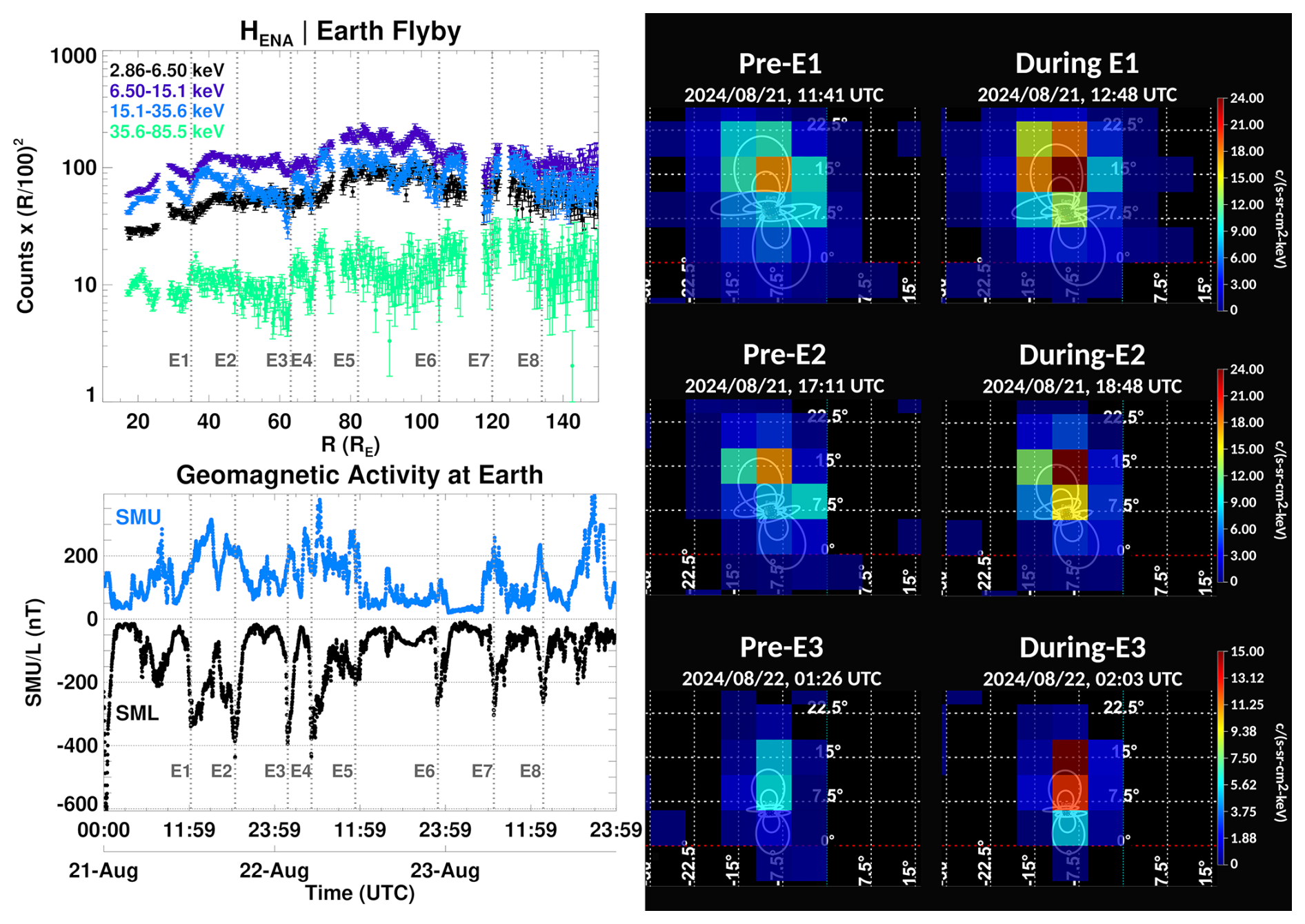
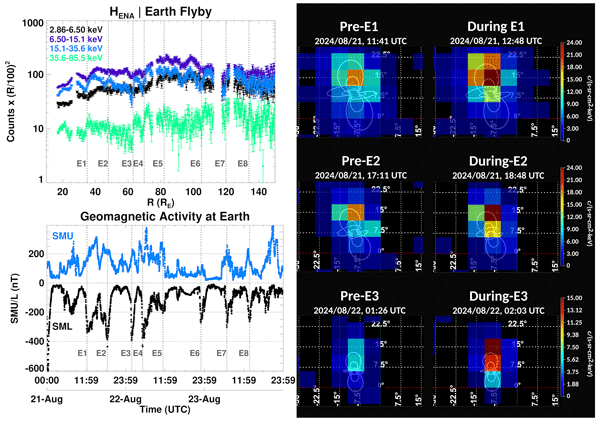
Figure 2(top left) Hydrogen ENA counts for different energies between 2.86 and 85.5 keV, summed over selected pixels around Earth that include the entire magnetosphere (both the dayside and nightside), multiplied with and plotted as a function of JUICE's distance to Earth. Each datapoint corresponds to a 7.5 min accumulation time image. The dashed gray vertical lines indicate events of increased geomagnetic activity according to the SML index. (bottom left) One minute resolution SMU (Maximum eastward auroral electrojets strength) and SML (Maximum westward auroral electrojets strength) indices provided by the SuperMAG collaborators (Newell and Gjerloev, 2011) that correspond to JENI's observation period (21 to 24 August 2024) plotted as a function of time. The time periods where the SML index suggests substorm activity are indicated with dashed gray lines. (Right) A series of 7.5 min accumulation time, 15.1–35.6 keV Hydrogen ENA images before and during the periods of increased geomagnetic activity.
Studying the terrestrial plasma sheet (or the ring current) with ENA images requires excluding pixels, i.e viewing directions, that can be attributed to Low Altitude Emissions (LAEs). LAEs are due to mirroring ions that undergo charge exchange with the ambient singly ionized oxygen at the top layers of the terrestrial atmosphere (e.g. Roelof, 1997; Brandt et al., 2001; Goldstein et al., 2018) and can substantially dominate the ENA emissions compared to those from the plasma sheet. Our analysis is not able to resolve possible LAE contributions, a task that would require forward modelling or other inversion techniques. To roughly differentiate between ENAs that are due to LAE and those that originate from the plasmasheet, Fig. 3 shows the intensities of 2.86–85.5 keV ENAs using selected pixels from the dayside and the nightside, away from Earth.
Clearly, the nightside plasmasheet has higher ENA intensities, and the ENA flux decay is somewhat less steep as a function of distance than the ENA flux associated with the dayside. Most importantly, unlike the dayside ENA intensities that keep decreasing, the ENA flux on the nightside increases right after the E1 event. This suggests that we are likely looking at transient processes, such as a series of repeated nightside injections that are not necessarily related to a global process, e.g. a global geomagnetic storm, where the Hydrogen ENA flux would be enhanced nearly symmetrically around Earth (e.g. Daglis, 1997; Daglis et al., 1999; Mitchell, et al., 2003).
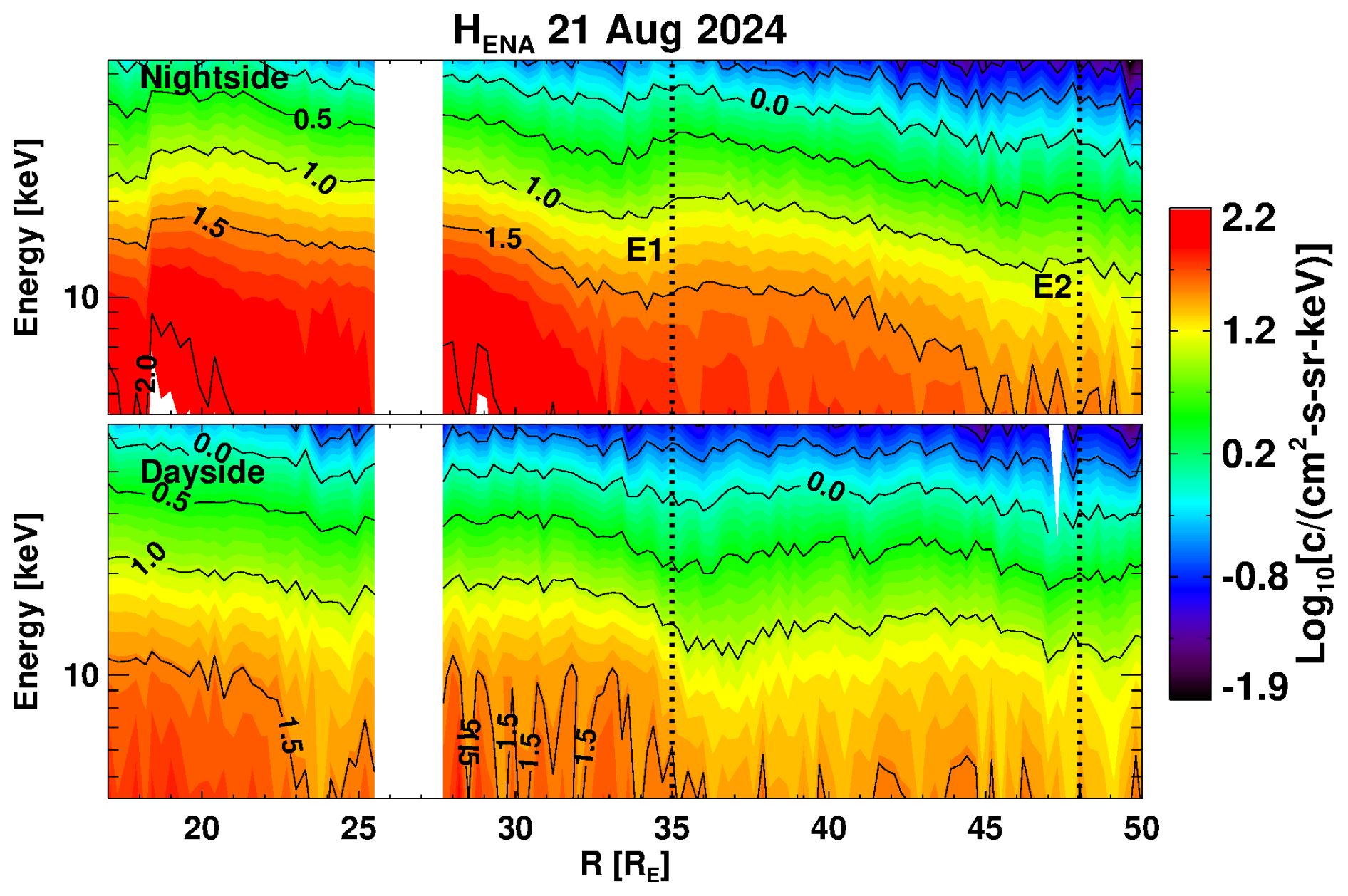
Figure 3Color-coded ENA flux as a function of distance produced by averaging, high energy resolution, 2.86–85.5 keV Hydrogen ENA intensities over selected pixels from the (top) nightside and (bottom) dayside magnetosphere, avoiding pixels close to Earth (below the L∼4 line) that could be attributed to Low Altitude Emissions (LAE). As JUICE moves away from Earth, the process of avoiding pixels that possibly include LAEs becomes increasingly difficult and the ENA emissions from the plasmasheet can be fairly resolved up to ∼ 50 RE, and this is why E3 (>60 RE) is not plotted here. The use of high angular resolution images would extend this range to longer distances, but would not allow resolving the energies in four discrete energy channels between 2.86–85.5 keV, as shown here. The dashed black lines correspond to the first two substorm events identified via the SML index in Fig. 2.
A closer investigation of the ENA enhancements for E1 is shown in Fig. 4 (E2 and beyond show similar signatures). The image on the top left panel of Fig. 4 (12:03 UTC) exhibits enhanced ENA emissions close to Earth, roughly around the L=8 line, followed by a large intensification of the nightside emissions (13:03 UTC) consistent with E1 identified in Fig. 2. The ENA emissions on the nightside remain high for more than 2 hrs (15:11 UTC) after the onset of E1. The dayside ENA emissions do not show the same variability as the nightside, but remain nearly constant throughout the E1 event. This is consistent with the findings in Fig. 3, taking into consideration that most of the dayside ENA variability in and beyond E1 occurs at energies lower than about 20 keV, whereas the ENA emissions in Fig. 4 span over the energy range of 15.1–85.5 keV.
These characteristics are very consistent with other non-storm time injection events identified previously at Earth by the IMAGE/HENA instrument (e.g. Brandt, 2021). In addition to the nightside enhancements, the images after the onset of E1 show a distinct enhancement in ENA intensities at low altitudes (compared to the one before E1), possibly indicative of LAEs. While particles of ∼ 10 keV to a few 100s of keV dominate most of the total current density in the ring current (e.g. Daglis et al., 1999), it is possible that a fraction of these ions that are injected from the plasma sheet forming the ring current, are charge exchanging and being lost as LAEs (e.g. Mackler et al., 2016). However, our preliminary analysis of these ENA emissions cannot resolve these effects and conclude whether these low altitude ENA enhancements are a direct response to the E1. Such questions can be addressed via forward models or other inversion techniques (e.g. Roelof and Skinner, 2000; DeMajistre et al., 2004; Brandt et al., 2022), a task that goes beyond the scope of the present study.
The 2.86–85.5 keV ENA intensities deviate from a standard power law form in energy (Right panel in Fig. 4). The ENA energy spectra seem to develop a slight roll off below ∼ 6.5 keV. Albeit the nightside intensities are persistently higher than those from the dayside, we do not observe changes in the slopes or the peaks of the distributions, at least not for the ENA energy spectra surrounding E1. Notably, most of the change between the pre- and post-event spectra occurs at energies between 6.5 and 55 keV whereas the higher energy ENA intensities are higher before the E1 event. Although this may be part of the standard ENA intensity variation/fluctuation at this energy, it is also not inconsistent with the fact that during injections, ions with energies below about a few tens of keV contribute more significantly to the ring current and plasma sheet than those with higher energies (e.g. >100 keV). Higher-energy protons usually dominate during quiet times, and – although not specific to our analysis – also during the recovery phase following a geomagnetic storm (e.g. Gkioulidou et al., 2016). However, it is still puzzling why the 35.6–85.5 keV channel is low in intensities during the event.
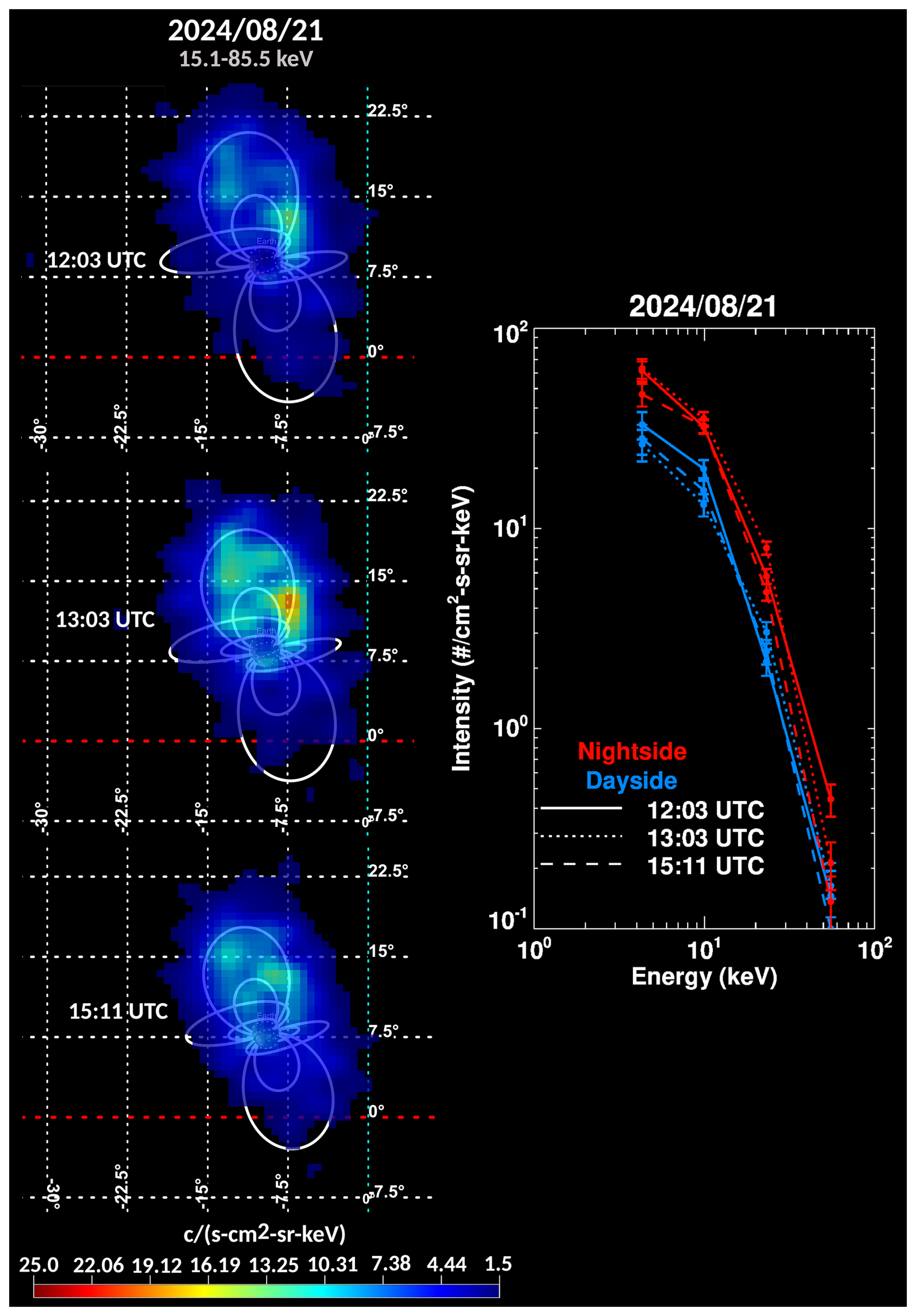
Figure 4(left) A series of 37.5 min accumulation time, 15.1–85.5 keV high angular resolution images of Hydrogen ENAs (top) right before E1 (middle) right after E1 and (bottom) as E1 progresses (details about E1 and other events are shown in Fig. 2). The selected time scale is comparable to the time scales of non-storm time substorm injections (e.g. Partamies et al., 2013). (right) The corresponding energy spectra of 2.86–85.5 keV Hydrogen ENAs from the measurements shown in Fig. 3.
Our analysis indicates that the overall morphology of the 2.86–85.5 keV ENA emissions during the LEGA is not consistent with a global process, such as a global geomagnetic storm, but it can be explained by transient processes, such as a series of repeated nightside injections, associated with non-storm time substorm activity. This is further corroborated by the fact that during the LEGA there are no indications of a geomagnetic storm, but only changes in the SML index that point toward non-storm injections from substorm auroral activity. The correlation between ENA and the non-storm time substorm activity has been documented before (e.g. Brandt et al., 2018, and references therein), not only for Earth, but also for Saturn (e.g. Mitchell et al., 2005). Apparently, even localized magnetospheric processes, such as the nightside injections, produce pressure driven currents that trigger the aurora, and ENA imaging provides a very efficient way to capture the dynamics of the system.
There are still two open questions concerning our results, requiring further analysis in the future. The first is that the low energy ENA channel (2.86–6.5 keV) is less responsive to the injection events than the ENA channels of higher energies (6.5–85.5 keV). This may be due to the fact that the total current density at Earth's plasmasheet is dominated by particles of ∼ 10 keV to a few 100s of keV (e.g. Daglis et al., 1999). The second question concerns the observed ENA enhancements between E5 and E6, which may correspond to a very small change in the SML index, meaning that ENA variability at Earth is complex and may not be uniquely attributed to those nightside injections.
The JENI instrument is designed to provide ENA images of the plasma and neutral gas environment of Jupiter's system. The fact that the LEGA observations demonstrated the capability of JENI to achieve a continuous survey of a much weaker ENA emitting system, gives us confidence that its observations, combined with those by the companion ENA imager on PEP taking ENAs at lower energies, the Jovian Neutrals Analyzer (JNA), will also allow us to identify and disentangle variability components in a complex system like Jupiter. JENI was able to provide a detailed view of the entirety of the nightside injection events during the LEGA, even (possibly) resolving at the same time finer structures such as LAEs (although this should be discussed in a future analysis), demonstrating its unique capabilities. For example, although previous analyses (e.g. Runov et al., 2011) have shown that the full width at half maximum of injections is rather small (∼ 1 RE), JENI proved to be capable of imaging the ENA variability of the terrestrial environment continuously from a vantage point of ∼ 17 RE even up to ∼ 150 RE. This argues for the expected performance of JENI at the Jovian environment where the scale sizes of important targets are far larger than Earth's, e.g. the Io torus has a diameter of ∼ 12 RJ (1 RJ ∼ 69 911 km), the Europa gas torus has a diameter of about 25 RJ, whereas Jupiter itself is ∼ 11 RE.
We employed a set of 7.5 min accumulation time images of 2.86–85.5 keV Hydrogen ENAs obtained by the JENI detector on board the JUICE spacecraft during the LEGA, to demonstrate the instrument capabilities and discern substorm dynamics around Earth. During the imaging period, the spacecraft moved away from Earth through ∼ 17 RE to ∼ 150 RE, providing images of Hydrogen ENAs from the terrestrial ring current and plasma sheet. The observations are consistent with previous observations of ENAs around Earth, during similar conditions (e.g. IMAGE/HENA) and can be summarized as follows:
-
The overall ENA signal strength throughout the 2.86–85.5 keV energy range falls off as the spacecraft moves away from the ENA source following roughly a R−2 line.
-
The rough R−2 fall-off is interrupted by enhancements in ENA emissions, apparent throughout the 2.86–85.5 keV ENA energies, which roughly coincide with time periods where the SML index becomes minimum, indicating enhanced substorm auroral activity. Future analyses will reveal the details of this apparent correlation.
-
The nightside ENA emissions around Earth broaden and increase in intensity during each substorm event, whereas the dayside ENA emissions do not show a similar behavior, indicating that the overall ENA morphology around Earth is consistent with transient processes, such as a series of repeated nightside injections and not a global process, such as a global geomagnetic storm, where the Hydrogen ENA intensity would be enhanced nearly symmetrically around Earth.
The ENA images around the substorm events also show clear enhancements at low altitudes, that are possibly indicative of LAEs from the plasma sheet injected ions forming the ring current that are charge exchanging and being lost as LAEs. This would be addressed in a future analysis.
The JENI data acquired during the JUICE Moon-Earth flyby in August 2024 are currently under the mission's cruise-phase proprietary period. These data will be made available through the ESA Planetary Science Archive following the first Cruise Archive Delivery, which is currently scheduled for six months after Earth Gravity Assist #3 in 2029. Data sets can be made available upon reasonable request
The data analysis was performed by KD, MG, PB, DGM and ER. KD and MG contributed most of the text. PK contributed to the planning of the PEP-Hi observation sequences. Other co-authors supported the preparation of this article by contributing to the text, reviewing and commenting on the results.
At least one of the (co-)authors is a member of the editorial board of Annales Geophysicae. The peer-review process was guided by an independent editor, and the authors also have no other competing interests to declare.
Publisher's note: Copernicus Publications remains neutral with regard to jurisdictional claims made in the text, published maps, institutional affiliations, or any other geographical representation in this paper. The authors bear the ultimate responsibility for providing appropriate place names. Views expressed in the text are those of the authors and do not necessarily reflect the views of the publisher.
This article is part of the special issue “The first-ever lunar–Earth flyby: a unique test environment for Juice”. It is not associated with a conference.
The authors would like to acknowledge the valuable contributions to this paper of Mats Holmström, Hans Nilsson, Anders Eriksson, Marek Tulej, Nicolas Thomas, Bernd Heber, Helmut Lammer, Tielong Zhang, Hans Huybrighs, Tom Krimigis, Dennis Grodent, Alessandro Retino and Ronan Modolo. We also thank Susan McKenna-Lawlor of the Maynooth University, Ireland, for supporting the PEP instrument development. JUICE is a mission under ESA leadership with contributions from its Member States, NASA, JAXA, and the Israel Space Agency. It is the first Large-class mission in ESA's Cosmic Vision programme. For the generation of the trajectory plot and the analysis of the geometry of observations we used a series of tools available at https://gitlab.gwdg.de/juice (last access: August 2026). ER is supported by the German Federal Ministry for Economic Affairs and Climate Action/German Federal Ministry of Research, Technology and Space (BMFTR) through the German Space Agency at DLR on the basis of a resolution of the German Bundestag (Funding codes: 50QJ1301, 50QJ1503 and 50QJ2303) and by the Max Planck Society. NA acknowledges the support of CNES for the Juice mission. AJC and GHJ gratefully acknowledge support from the UK Space Agency.
This work was performed under NASA Task Order 80MSFC23F0077 under contract 80MSFC20D0004 (ARDES II). French co-authors acknowledge the support of CNES for the Juice mission.
This paper was edited by Joana S. Oliveira and reviewed by Anna Milillo and one anonymous referee.
Barabash, S., Lundin, R., Andersson, H., Brinkfeldt, K., Grigoriev, A., Gunell, H., Holmström, M., Yamauchi, M., Asamura, K., Bochsler, P., Wurz, P., Cerulli-Irelli, R., Mura, A., Milillo, A., Maggi, M., Orsini, S., Coates, A. J., Linder, D. R., Kataria, D. O., Curtis, C. C., Hsieh, K. C., Sandel, B. R., Frahm, R. A., Sharber, J. R., Winningham, J. D., Grande, M., Kallio, E., Koskinen, H., Riihelä, P., Schmidt, W., Säles, T., Kozyra, J. U., Krupp, N., Woch, J., Livi, S., Luhmann, J. G., McKenna-Lawlor, S., Roelof, E. C., Williams, D. J., Sauvaud, J.-A., Fedorov, A., and Thocaven, J.-J.: The Analyzer of Space Plasmas and Energetic Atoms (ASPERA-3) for the Mars Express mission, Space Sci. Rev., 126, 113–164, https://doi.org/10.1007/s11214-006-9124-8, 2006.
Barabash, S., Sauvaud, J.-A., Gunell, H., Andersson, H., Grigoriev, A., Brinkfeldt, K., Holmström, M., Lundin, R., Yamauchi, M., Asamura, K., Baumjohann, W., Zhang, T. L., Coates, A. J., Linder, D. R., Kataria, D. O., Curtis, C. C., Hsieh, K. C., Sandel, B. R., Fedorov, A., Mazelle, C., Thocaven, J.-J., Grande, M., Koskinen, Hannu E. J., Kallio, E., Säles, T., Riihela, P., Kozyra, J., Krupp, N., Woch, J., Luhmann, J., McKenna-Lawlor, S., Orsini, S., Cerulli-Irelli, R., Mura, M., Milillo, M., Maggi, M., Roelof, E., Brandt, P., Russell, C. T., Szego, K., Winningham, J. D., Frahm, R. A., Scherrer, J., Sharber, J. R., Wurz, P., and Bochsler, P.: The Analyser of Space Plasmas and Energetic Atoms (ASPERA-4) for the Venus Express mission, Planet. Space Sci., 55, 1772–1792, https://doi.org/10.1016/j.pss.2007.01.014, 2007.
Brandt, P. C., Barabash, S., Norberg, O., Lundin, R., Roelof, E. C., Chase, C. J., Mauk, B. H., and Thomsen, M.: ENA imaging from the Swedish micro satellite Astrid during the magnetic storm of 8 February, 1995, Adv. Space Res., 20, 1061–1066, https://doi.org/10.1016/S0273-1177(97)00561-9, 1997.
Brandt, P., Barabash, S., Roelof, E. C., and Chase, C. J.: Energetic neutral atom imaging at low altitudes from the Swedish microsatellite Astrid: Extraction of the equatorial ion distribution, J. Geophys. Res.-Space, 106, 25731–25744, https://doi.org/10.1029/2000ja900023, 2001.
Brandt, P. C., DeMajistre, R., Roelof, E. C., Mitchell, D. G., and Mende S.: IMAGE/HENA: Global ENA imaging of the plasmasheet and ring current during substorms, J. Geophys. Res., 107, 1454, https://doi.org/10.1029/2002JA009307, 2002.
Brandt, P. C., Paranicas, C. P., Carbary, J. F., Mitchell, D. G., Mauk, B. H., and Krimigis, S. M.: Understanding the global evolution of Saturn's ring current, Geophys. Res. Lett., 35, https://doi.org/10.1029/2008gl034969, 2008.
Brandt, P. C., Khurana, K. K., Mitchell, D. G., Sergis, N., Dialynas, K., Carbary, J. F., Roelof, E. C., Paranicas, C. P., Krimigis, S. M., and Mauk, B. H.: Saturn's periodic magnetic field perturbations caused by a rotating partial ring current, Geophys. Res. Lett., 37, https://doi.org/10.1029/2010gl045285, 2010.
Brandt, P. C., Dialynas, K., Dandouras, I., Mitchell, D. G. Garnier, P., and Krimigis, S. M.: The distribution of Titan's high-altitude (out to ∼50,000km) exosphere from energetic neutral atom (ENA) measurements by Cassini/INCA. Planetary and Space Science, 60, 107–114, https://doi.org/10.1016/j.pss.2011.04.014, 2012.
Brandt, P. C., Hsieh, S. Y., DeMajistre, R., and Mitchell, D. G.: ENA Imaging of planetary ring currents, in: Electric Currents in Geospace and Beyond, Geophysical Monograph Series, vol. 235, edited by: Keiling, A., Marghitu, O., and Wheatland, M., American Geophysical Union, Washington, DC, 93–114, https://doi.org/10.1002/9781119324522.ch6, 2018.
Brandt, P. C.: Global Energetic Neutral Atom (ENA) Imaging of Magnetospheres, in: Space Physics and Aeronomy Collection Volume 2: Magnetospheres in the Solar System, Geophysical Monograph 259, first edn., edited by: Maggiolo, R., André, N., Hasegawa, H., and Welling, D. T., John Wiley & Sons, Inc., https://doi.org/10.1002/9781119815624.ch42, 2021.
Brandt, P. C., Nikoukar, R., DeMajistre, R., Allen, R. C., Mitchell, D. G., Roelof, E. C., Gkioulidou, M., and Parker, C. W.: Chapter 2 – Energetic neutral atom imaging of the terrestrial global magnetosphere, in: Understanding the Space Environment through Global Measurements, edited by: Colado-Vega, Y., Gallagher, D., Frey H., and Wing, S., Elsevier, https://doi.org/10.1016/B978-0-12-820630-0.00007-6, 2022.
Brandt, P. C., Clark, G., Mitchell, D. G., Kollmann, P., Gkioulidou, M., Regoli, L., Dialynas, K., Allegrini, F., Andre, N., Jia, X., Khurana, K., Paty, C., Barabash, S., and Wurz, P.: In-Situ and Remote Observations of the Ring Current and Radiation Belt during JUICE Lunar Earth Gravity Assist, EGUsphere [preprint], https://doi.org/10.5194/egusphere-2026-2050, 2026.
Burch, J. L.: The Image Mission, Springer Dordrecht, XI, 506, https://doi.org/10.1007/978-94-011-4233-5, 2000.
Burch, J. L., Moore, T. E., Torbert, R. B., and Giles, B. L.: Magnetospheric Multiscale Overview and Science Objectives, Space Sci. Rev., 199, 5–21, https://doi.org/10.1007/s11214-015-0164-9, 2016.
Daglis, I. A.: The role of magnetosphere-ionosphere coupling in magnetic storm dynamics, in: Magnetic Storms, edited by: B. T. Tsurutani, W. D. Gonzalez, Y. Kamide, and J. K. Arballo, American Geophysical Union, Washington, DC, 107–116, https://doi.org/10.1029/GM098p0107, 1997.
Daglis, I. A., Kasotakis, G., Sarris, E. T., Kamide, Y., Livi, S., and Wilken, B.: Variations of the ion composition during a large magnetic storm and their consequences, Phys. Chem. Earth, 24, 229–232, 1999.
DeMajistre, R., Roelof, E. C., Brandt, P. C., and Mitchell, D. G.: Retrieval of global magnetospheric ion distributions from high-energy neutral atom measurements made by the IMAGE/HENA instrument, J. Geophys. Res.-Space, (1978–2012), https://doi.org/10.1029/2003ja010322, 109, 2004.
Dialynas, K., Krimigis, S. M., Mitchell, D. G., Hamilton, D. C., Krupp, N., and Brandt P. C.: Energetic ion spectral characteristics in the Saturnian magnetosphere using Cassini/MIMI measurements, J. Geophys. Res., 114, A01212, https://doi.org/10.1029/2008JA013761, 2009.
Dialynas, K., Brandt, P. C., Krimigis, S. M., Mitchell, D. G., Hamilton, D. C., Krupp, N., and Rymer, A. M.: The extended Saturnian neutral cloud as revealed by global ENA simulations using Cassini/MIMI measurements, J. Geophys. Res.-Space, 118, 3027–3041, https://doi.org/10.1002/jgra.50295, 2013.
Gkioulidou, M., Ukhorskiy, A. Y., Mitchell, D. G., and Lanzerotti L. J.: Storm time dynamics of ring current protons: Implications for the long-term energy budget in the inner magnetosphere, Geophys. Res. Lett., 43, 4736–4744, https://doi.org/10.1002/2016GL068013, 2016.
Gkioulidou, M., Clark, G. B., Mitchell, D. G., Dupont, A. R., Anderson, K. L., Begley, S., Bzowski, M., Christian, E. R., Cook, C. E., Crew, A. B., Cully, M. J., DeMajistre, R., Diaz, T. J., Drexler, R. J., Dutton, N. T., Gingrich, C. J., Hayes, J. R., Huber, C. M., Hutcheson, J., Jaskulek, S. E., Kollmann, P., LeBlanc, M. T., Lees, J., McComas, D. J., Nelson, K. S., Parker, C. W., Reisenfeld, D. B., Rollend, E. A., Schlemm, C. E., Schwadron, N. A., Verrill, R., Yen. J., and Yin, J.: The IMAP-Ultra Energetic Neutral Atom (ENA) Imager, Space Sci. Rev., 222, 4, https://doi.org/10.1007/s11214-025-01256-5, 2026.
Goldstein, J., Lera, K. L., McComas, D. J., Redfern, J., and Valek, P. W.: Empirical Characterization of Low-Altitude Ion Flux Derived from TWINS, J. Geophys. Res.-Space, 123, 3672, https://doi.org/10.1029/2017ja024957, 2018.
Keesee, A. M., Buzulukova, N., Mouikis, C., and Scime, E. E.: Mesoscale structures in Earth's magnetotail observed using energetic neutral atom imaging, Geophys. Res. Lett., 48, e2020GL091467, https://doi.org/10.1029/2020GL091467, 2021.
Krimigis, S. M., Mitchell, D. G., Hamilton, D. C., Dandouras, J., Armstrong, T. P., Bolton, S. J., Cheng, A. F., Gloeckler, G., Hsieh, K. C., Keath, E. P., Krupp, N., Lagg, A., Lanzerotti, L. J., Livi, S., Mauk, B. H., McEntire, R. W., Roelof, E. C., Wilken B., and Williams, D. J.: A nebula of gases from Io surrounding Jupiter, Nature 415, 994–996, https://doi.org/10.1038/415994a, 2002.
Krimigis, S. M., Mitchell, D. G., Hamilton, D. C., Livi, S., Dandouras, J., Jaskulek, S., Armstrong, T. P., Boldt, J. D., Cheng, A. F., Gloeckler, G., Hayes, J. R., Hsieh, K. C., Ip, W.-H., Keath, E. P., Kirsch, E., Krupp, N., Lanzerotti, L. J., Lundgren, R., Mauk, B. H., McEntire, R. W., Roelof, E. C., Schlemm, C. E., Tossman, B. E., Wilken, B., and Williams, D. J.: Magnetosphere Imaging Instrument (MIMI) on the Cassini Mission to Saturn/Titan, Space Sci. Rev., 114, 233–329, https://doi.org/10.1007/s11214-004-1410-8, 2004.
Liou, K., Meng, C. I., Lui, A. T. Y., Newell, P. T., and Anderson, R. R.: Auroral kilometric radiation at substorm onset, J. Geophys. Res.-Space, 105, 25325–25331, https://doi.org/10.1029/2000JA000038, 2000.
Mackler, D. A., Jahn, J.-M., Perez, J. D., Pollock, C. J., and Valek, P. W.: Statistical correlation of low-altitude ENA emissions with geomagnetic activity from IMAGE/MENA observations, J. Geophys. Res. Space, 121, 2046–2066, https://doi.org/10.1002/2015JA021545, 2016.
Mauk, B. H., Mitchell, D. G., Krimigis, S. M., Roelof, E. C., and Paranicas, C. P.: Energetic neutral atoms from a trans-Europa gas torus at Jupiter, Nature, 421, 920, https://doi.org/10.1038/nature01431, 2003.
Mauk, B. H., Mitchell, D. G., McEntire, R. W., Paranicas, C. P., Roelof, E. C., Williams, D. J., Krimigis, S. M., and Lagg, A.: Energetic ion characteristics and neutral gas interactions in Jupiter's magnetosphere, J. Geophys. Res.-Space, 109, https://doi.org/10.1029/2003JA010270, 2004.
McComas, D. J., Allegrini, F., Baldonado, J., Blake, B., Brandt, P. C., Burch, J., Clemmons, J., Crain, W., Delapp, D., DeMajistre, R., Everett, D., Fahr, H., Friesen, L., Funsten, H., Goldstein, J., Gruntman, M., Harbaugh, R., Harper, R., Henkel, H., Holmlund, C., Lay, G., Mabry, D., Mitchell, D., Nass, U., Pollock, C., Pope, S., Reno, M., Ritzau, S., Roelof, E., Scime, E., Sivjee, M., Skoug, R., Sotirelis, T. S., Thomsen, M., Urdiales, C., Valek, P., Viherkanto, K., Weidner, S., Ylikorpi, T., Young, M., and Zoennchen, J.: The Two Wide-angle Imaging Neutral-atom Spectrometers (TWINS) NASA Mission-of-Opportunity, Space Sci. Rev., 142, 157–231, https://doi.org/10.1007/s11214-008-9467-4, 2009.
Mitchell, D. G., Jaskulek, S. E., Schlemm, C. E., Keath, E. P., Thompson, R. E., Tossman, B. E., Boldt, J. D., Hayes, J. R., Andrews, G. B., Paschalidis, N., Hamilton, D. C., Lundgren, R. A., Tums, E. O., Wilson IV, P., Voss, H. D., Prentice, D., Hsieh, K. C., Curtis, C. C., and Powell, F. R.: High energy neutral atom (HENA) imager for the IMAGE mission, Space Sci. Rev. 91, 67–112, https://doi.org/10.1023/A:1005207308094, 2000.
Mitchell, D. G., Brandt, P. C., Roelof, E. C., Hamilton, D. C., Retterer, K. C., and Mende, S.: Global imaging of O+ from IMAGE/HENA, Space Sci. Rev., 109, 63–75, 2003.
Mitchell, D. G., Paranicas, C. P., Mauk, B. H., Roelof, E. C., and Krimigis, S. M.: Energetic neutral atoms from Jupiter measured with the Cassini magnetospheric imaging instrument: Time dependence and composition, J. Geophys. Res., 109, A09S11, https://doi.org/10.1029/2003JA010120, 2004.
Mitchell, D. G., Brandt, P. C., Roelof, E. C., Dandouras, J., Krimigis, S. M., Mauk, B. H., Paranicas, C. P., Krupp, N., Hamilton, D. C., Kurth, W. S., Zarka, P., Dougherty, M. K., Bunce, E. J., and Shemansky, D. E.: Energetic ion acceleration in Saturn's magetosphere: Substorms on Saturn?, Geophys. Res. Lett., 32, L20S01, https://doi.org/10.1029/2005GL022647, 2005.
Mitchell, D. G., Brandt, P. C., Westlake, J. H., Jaskulek, S. E., Andrews, G. B., and Nelson, K. S.: Energetic particle imaging: The evolution of techniques in imaging high-energy neutral atom emissions, J. Geophys. Res.-Space, 121, 8804–8820, https://doi.org/10.1002/2016JA022586, 2016.
Newell, P. T. and Gjerloev, J. W.: Evaluation of SuperMAG auroral electrojet indices as indicators of substorms and auroral power, J. Geophys. Res., 116, A12211, https://doi.org/10.1029/2011JA016779, 2011.
Nosé, M., Koshiishi, H., Matsumoto, H., Brandt, C. P., Keika, K., Koga, K., Goka, T., and Obara, T.: Magnetic field dipolarization in the deep inner magnetosphere and its role in development of O+-rich ring current, J. Geophys. Res.-Space, 115, https://doi.org/10.1029/2010ja015321, 2010.
Orsini, S., Livi, S., Torkar, K., Barabash, S., Milillo, A., Wurz, P., Di Lellis, A. M., Kallio, E., and the SERENA team: SERENA: A suite of four instruments (ELENA, STROFIO, PICAM and MIPA) on board BepiColombo-MPO for particle detection in the Hermean environment, Planet. Space Sci., 58, 166–181, https://doi.org/10.1016/j.pss.2008.09.012, 2010.
Paranicas, C., Mitchell, D. G., Roelof, E. C., Brandt, P. C., Williams, D. J., Krimigis S. M., and Mauk, B. H.: Periodic intensity variations in global ENA images of Saturn, Geophys. Res. Lett., 32, L21101, https://doi.org/10.1029/2005GL023656, 2005.
Partamies, N., Juusola, L., Tanskanen, E., and Kauristie, K.: Statistical properties of substorms during different storm and solar cycle phases, Ann. Geophys., 31, 349–358, https://doi.org/10.5194/angeo-31-349-2013, 2013.
Roelof, E. C.: Remote Sensing of the Ring Current Using Energetic Neutral Atoms, Adv. Space Res. 9, 195–203, 1989.
Roelof, E. C.: ENA emission from nearly-mirroring magnetospheric ions interacting with the exosphere, Adv. Space Res., 20, 361–366, https://doi.org/10.1016/s0273-1177(97)00692-3, 1997.
Roelof, E. C. and Skinner, A. J.: Extraction of ion distributions from magnetospheric ENA and EUV images, Space Sci. Rev., 91, 437–459, https://doi.org/10.1023/a:1005281424449, 2000.
Roelof, E. C., Mitchell, D. G., and Williams, D. J.: Energetic neutral atoms (E∼50 keV) from the ring current: IMP 7/8 and ISEE 1, J. Geophys. Res.-Space, 90, 10991–11008, https://doi.org/10.1029/JA090iA11p10991, 1985.
Runov, A., Angelopoulos, V., Zhou, X. Z., Zhang, X.J., Li, S., Plaschke, F., and Bonnell, J.: A THEMIS multicase study of dipolarization fronts in the magnetotail plasma sheet, J. Geophys. Res.-Space, 116, https://doi.org/10.1029/2010ja016316, 2011.
Shue, J. H., Chao, J. K., Fu, H. C., Russell, C. T., Song, P., Khurana, K. K., and Singer, H. J.: A new functional form to study the solar wind control of the magnetopause size and shape, J. Geophys. Res., 102, 9497–9511, https://doi.org/10.1029/97JA00196, 1997.
Slavin, J. A. and Holzer, R. E.:, Solar wind flow about the terrestrial planets 1. Modeling bow shock position and shape, J. Geophys. Res., 86, 11401–11418, https://doi.org/10.1029/JA086iA13p11401, 1981.
Wurz, P.: Detection of energetic neutral atoms, in: The outer heliosphere: beyond the planets, Based on the spring school “Die äußere Heliosphäre – Jenseits der Planeten”, Bad Honnef, Germany, 12–16 April 1999, edited by: Scherer, K., Fichtner, H., and Marsch, E., 251–288, ISBN 3-9804862-3-0, 2000, 2000.