
Articles | Volume 44, issue 1
https://doi.org/10.5194/angeo-44-123-2026
© Author(s) 2026. This work is distributed under
the Creative Commons Attribution 4.0 License.
the Creative Commons Attribution 4.0 License.
https://doi.org/10.5194/angeo-44-123-2026
© Author(s) 2026. This work is distributed under
the Creative Commons Attribution 4.0 License.
the Creative Commons Attribution 4.0 License.
Regular paper
| 
17 Feb 2026
Regular paper |
| 17 Feb 2026
| 17 Feb 2026
Effect of Ionospheric Variability on the Electron Energy Spectrum estimated from Incoherent Scatter Radar Measurements
Oliver Stalder
CORRESPONDING AUTHOR

Department of Physics and Technology, University of Tromsø, Tromsø, Norway
Björn Gustavsson
Department of Physics and Technology, University of Tromsø, Tromsø, Norway
Ilkka Virtanen
Space Physics and Astronomy research unit, University of Oulu, Oulu, Finland
Related authors
No articles found.
Margaretha Myrvang and Björn Gustavsson
Ann. Geophys., 44, 921–935, https://doi.org/10.5194/angeo-44-921-2026, https://doi.org/10.5194/angeo-44-921-2026, 2026
Short summary
Short summary
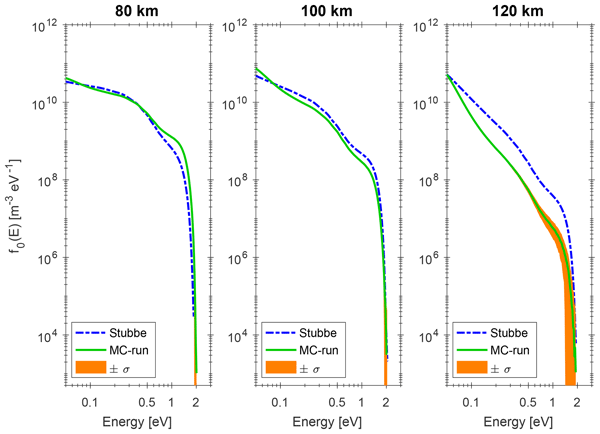
This paper investigate how radio wave heating affect the electron distribution in the D region. Radio wave heating can lead to absorption of radio wave energy by electrons, thereby increasing the temperature. Electrons are cooled by inelastic collisions with the neutrals atmosphere, affecting the electron distribution since electrons lose energy by exciting different states in neutrals. Thus, electrons are redistributed to lower energies, which changes the shape of the electron distribution.
Etienne Gavazzi, Andres Spicher, Björn Gustavsson, Juha Vierinen, James Clemmons, Robert Pfaff, and Douglas Rowland
Ann. Geophys., 44, 903–920, https://doi.org/10.5194/angeo-44-903-2026, https://doi.org/10.5194/angeo-44-903-2026, 2026
Short summary
Short summary
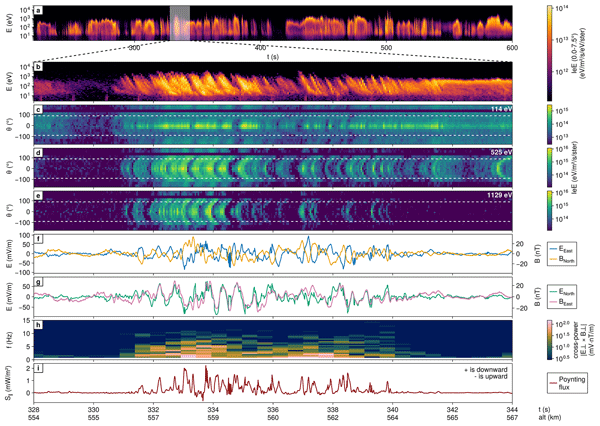
Auroras are caused by energetic electrons entering the upper atmosphere. For the smallest and most dynamic auroras, scientists think electrons are accelerated by waves (called Alfvén waves) thousands of kilometers above Earth. In this paper, we analyse data from a rocket that flew through auroras, applying existing and new techniques to estimate where the acceleration took place. Our results match theory, and we show how they can be used to study conditions in the near-Earth space environment.
Devin Huyghebaert, Juha Vierinen, Björn Gustavsson, Ralph Latteck, Toralf Renkwitz, Marius Zecha, Claudia C. Stephan, J. Federico Conte, Daniel Kastinen, Johan Kero, and Jorge L. Chau
Atmos. Meas. Tech., 19, 4277–4292, https://doi.org/10.5194/amt-19-4277-2026, https://doi.org/10.5194/amt-19-4277-2026, 2026
Short summary
Short summary
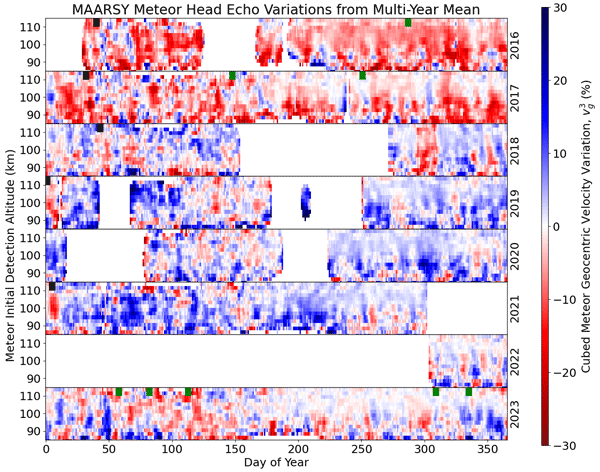
The phenomena of meteors occurs at altitudes of 60–120 km and can be used to measure the neutral atmosphere. We use a large high power radar system in Norway (Middle Atmosphere Alomar Radar System (MAARSY)) to measure the meteors and determine changes to the atmospheric density between the years of 2016–2023 at altitudes of 85–115 km. The same time period between years are compared, minimizing changes to the measurements due to factors other than the atmosphere.
Harriet George, Andrew P. Dimmock, Vanina Lanabare, Heikki Vanhamäki, Ilkka Virtanen, Anita Aikio, Adrian Blagau, Octav Marghitu, Milla Myllymaa, Habtamu Tesfaw, Stephan Buchert, and Mykhaylo Shumko
EGUsphere, https://doi.org/10.5194/egusphere-2026-3108, https://doi.org/10.5194/egusphere-2026-3108, 2026
Short summary
Short summary
Bursty bulk flows are mesoscale ion flows that are ejected from magnetic reconnection sites in the Earth's magnetotail, and they couple to the ionosphere via field aligned currents that close through the ionosphere. We analyse unique triple-conjunctive observations of the coupled bursty bulk flow / current / ionosphere system to evaluate a case study of a bursty bulk flow and its ionospheric effects. We identify multiple current signatures of this bursty bulk flow within the ionosphere.
Juha Vierinen, Dabrowka Knach, Jorge Luis Chau, Gerd Baumgarten, Devin Huyghebaert, Matthias Clahsen, Nico Pfeffer, Toralf Renkwitz, Robin Wing, Kenneth Obenberger, Björn Gustavsson, and Daniel Kastinen
EGUsphere, https://doi.org/10.5194/egusphere-2026-2857, https://doi.org/10.5194/egusphere-2026-2857, 2026
Short summary
Short summary
We observed the re-entry of a Falcon 9 rocket upper stage over Europe using a network of cameras and radars normally used to study meteors. The measurements showed how hot ionized gas formed around the debris during hypervelocity entry, producing strong radio echoes high in the atmosphere. As the number of satellites and rocket launches increases, these observations can help improve monitoring of space waste re-entering the atmosphere and its possible environmental effects.
Theresa Rexer, Björn Gustavsson, Juha Vierinen, Andres Spicher, Devin Ray Huyghebaert, Andreas Kvammen, Robert Gillies, and Asti Bhatt
Geosci. Instrum. Method. Data Syst., 15, 127–139, https://doi.org/10.5194/gi-15-127-2026, https://doi.org/10.5194/gi-15-127-2026, 2026
Short summary
Short summary
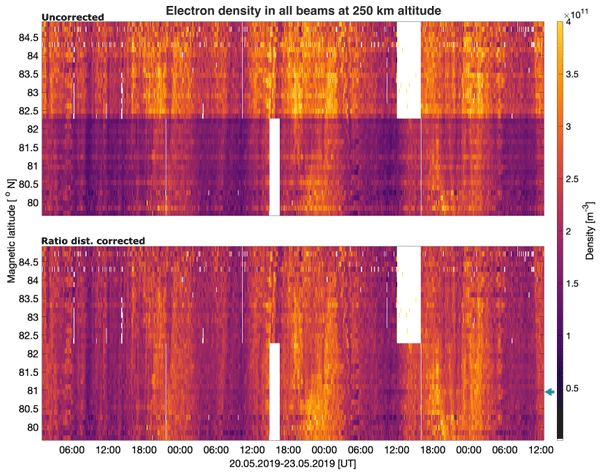
We present a second-level calibration method for electron density measurements from multi-beam incoherent scatter radars. It is based on the well-known Flat field correction method used in imaging and photography. The method improves data quality and useability as it accounts for unaccounted and unpredictable variations in the radar system. This is valuable for studies where inter-beam calibration is important such as studies of polar cap patches, plasma irregularities and turbulence.
Margaretha Myrvang and Björn Johan Gustavsson
EGUsphere, https://doi.org/10.5194/egusphere-2026-1118, https://doi.org/10.5194/egusphere-2026-1118, 2026
Short summary
Short summary
This is the second of two papers. The first paper demonstrate that the electron distribution becomes non-Maxwellian during radio wave heating. Electron cooling rates are macroscopic properties of the electron gas, where electrons transfer some of their kinetic energy through collisions with neutrals and ions, and can be determined by integrating over the electron distribution. Any changes in the electron distribution affect the cooling rates.
Kian Sartipzadeh, Andreas Kvammen, Björn Gustavsson, Njål Gulbrandsen, Magnar G. Johnsen, Devin Huyghebaert, and Juha Vierinen
Ann. Geophys., 44, 85–107, https://doi.org/10.5194/angeo-44-85-2026, https://doi.org/10.5194/angeo-44-85-2026, 2026
Short summary
Short summary
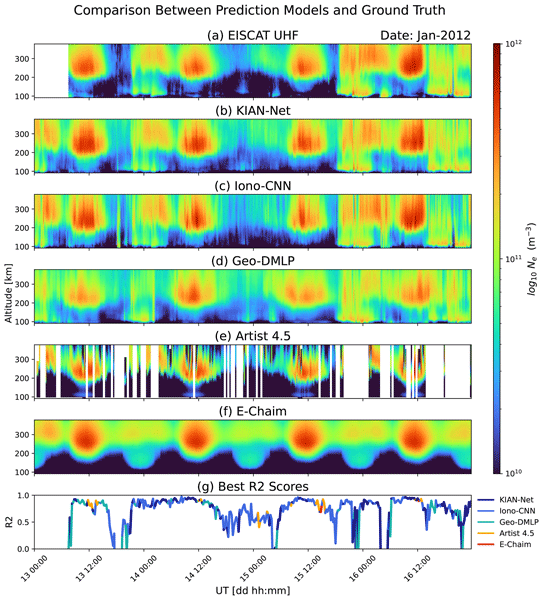
Knowledge of the charged environment in the upper atmosphere is essential for understanding space weather effects on satellites and radio communication. This environment is difficult to estimate at high latitudes, where aurora cause strong variability. We developed an artificial intelligence model to estimate this environment continuously. Our results show that the model provides reliable estimates even during auroral activity, improving monitoring of the polar upper atmosphere.

Etienne Gavazzi, Andres Spicher, Björn Gustavsson, James Clemmons, Robert Pfaff, and Douglas Rowland
Ann. Geophys., 44, 1–15, https://doi.org/10.5194/angeo-44-1-2026, https://doi.org/10.5194/angeo-44-1-2026, 2026
Short summary
Short summary
Auroral precipitation refers to energetic particles that come down into the upper part of our atmosphere, the ionosphere. There, they collide with atoms and molecules and transfer some of their energy, causing aurora. The most rapid time-variation of this energy deposition and its consequences on the ionosphere are not fully understood. We show here that one can use a new model to study auroral precipitation on sub-second timescales and advance our understanding about small-scale dynamic aurora.
Liisa Juusola, Ilkka Virtanen, Spencer Mark Hatch, Heikki Vanhamäki, Maxime Grandin, Noora Partamies, Urs Ganse, Ilja Honkonen, Abiyot Workayehu, Antti Kero, and Minna Palmroth
Ann. Geophys., 43, 755–781, https://doi.org/10.5194/angeo-43-755-2025, https://doi.org/10.5194/angeo-43-755-2025, 2025
Short summary
Short summary
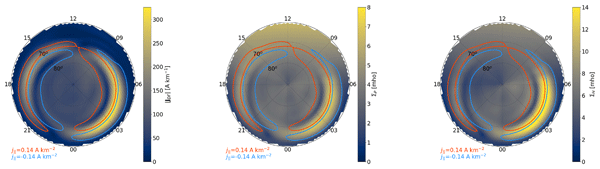
Key properties of the ionospheric electrodynamics are electric fields, currents, and conductances. They provide a window to the vast and distant near-Earth space, cause Joule heating that affect satellite orbits, and drive geomagnetically induced currents (GICs) in technological conductor networks. We have developed a new method for solving the key properties of ionospheric electrodynamics from ground-based magnetic field observations.
Ilkka I. Virtanen, Ayanew Nigusie, Antti Kero, Neethal Thomas, and Juhana Lankinen
Atmos. Meas. Tech., 18, 5895–5917, https://doi.org/10.5194/amt-18-5895-2025, https://doi.org/10.5194/amt-18-5895-2025, 2025
Short summary
Short summary
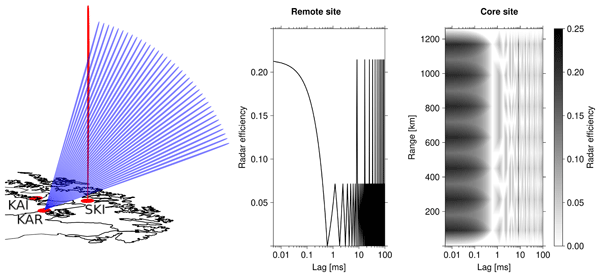
EISCAT3D is an ionospheric radar currently under construction in Northern Fenno-Scandinavia. The radar will make 3D measurements of the ionosphere at 50–1000 km altitudes. We show that the so-called multipurpose radar modulations and optimal data analysis can improve the time resolution of the measurements by more than an order of magnitude, and they enable one to measure ion-neutral collision frequencies, which are proportional to neutral particle density, in the lower ionosphere.
Spencer Mark Hatch, Ilkka Virtanen, Karl Magnus Laundal, Habtamu Wubie Tesfaw, Juha Vierinen, Devin Ray Huyghebaert, Andres Spicher, and Jens Christian Hessen
Ann. Geophys., 43, 633–649, https://doi.org/10.5194/angeo-43-633-2025, https://doi.org/10.5194/angeo-43-633-2025, 2025
Short summary
Short summary
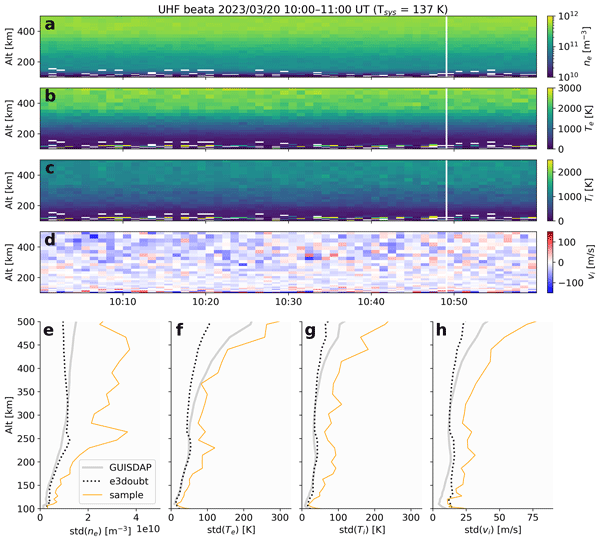
This study addresses the design of next-generation incoherent scatter radar experiments used to study the ionosphere, particularly with systems that have multiple sites. We have developed a method to estimate uncertainties of measurements of plasma density, temperature, and ion drift. Our method is open-source, and helps to optimize radar configurations and assess the effectiveness of an experiment. This method ultimately serves to enhance our understanding of Earth's space environment.
Noora Partamies, Rowan Dayton-Oxland, Katie Herlingshaw, Ilkka Virtanen, Bea Gallardo-Lacourt, Mikko Syrjäsuo, Fred Sigernes, Takanori Nishiyama, Toshi Nishimura, Mathieu Barthelemy, Anasuya Aruliah, Daniel Whiter, Lena Mielke, Maxime Grandin, Eero Karvinen, Marjan Spijkers, and Vincent E. Ledvina
Ann. Geophys., 43, 349–367, https://doi.org/10.5194/angeo-43-349-2025, https://doi.org/10.5194/angeo-43-349-2025, 2025
Short summary
Short summary
We studied the first broad band emissions, called continuum, in the dayside aurora. They are similar to Strong Thermal Emission Velocity Enhancement (STEVE) with white-, pale-pink-, or mauve-coloured light. But unlike STEVE, they follow the dayside aurora forming rays and other dynamic shapes. We used ground optical and radar observations and found evidence of heating and upwelling of both plasma and neutral air. This study provides new information on conditions for continuum emission, but its understanding will require further work.
Devin Huyghebaert, Björn Gustavsson, Juha Vierinen, Andreas Kvammen, Matthew Zettergren, John Swoboda, Ilkka Virtanen, Spencer M. Hatch, and Karl M. Laundal
Ann. Geophys., 43, 99–113, https://doi.org/10.5194/angeo-43-99-2025, https://doi.org/10.5194/angeo-43-99-2025, 2025
Short summary
Short summary
The EISCAT_3D radar is a new ionospheric radar under construction in the Fennoscandia region. The radar will make measurements of plasma characteristics at altitudes above approximately 60 km. The capability of the system to make these measurements at spatial scales of less than 100 m using multiple digitised signals from each of the radar antenna panels is highlighted. There are many ionospheric small-scale processes that will be further resolved using the techniques discussed here.
Maxime Grandin, Noora Partamies, and Ilkka I. Virtanen
Ann. Geophys., 42, 355–369, https://doi.org/10.5194/angeo-42-355-2024, https://doi.org/10.5194/angeo-42-355-2024, 2024
Short summary
Short summary
Auroral displays typically take place at high latitudes, but the exact latitude where the auroral breakup occurs can vary. In this study, we compare the characteristics of the fluxes of precipitating electrons from space during auroral breakups occurring above Tromsø (central part of the auroral zone) and above Svalbard (poleward boundary of the auroral zone). We find that electrons responsible for the aurora above Tromsø carry more energy than those precipitating above Svalbard.
Yoshimasa Tanaka, Yasunobu Ogawa, Akira Kadokura, Takehiko Aso, Björn Gustavsson, Urban Brändström, Tima Sergienko, Genta Ueno, and Satoko Saita
Ann. Geophys., 42, 179–190, https://doi.org/10.5194/angeo-42-179-2024, https://doi.org/10.5194/angeo-42-179-2024, 2024
Short summary
Short summary
We present via simulation how useful monochromatic images taken by a multi-point imager network are for auroral research in the EISCAT_3D project. We apply the generalized-aurora computed tomography (G-ACT) to modeled multiple auroral images and ionospheric electron density data. It is demonstrated that G-ACT provides better reconstruction results than the normal ACT and can interpolate ionospheric electron density at a much higher spatial resolution than observed by the EISCAT_3D radar.
Thomas B. Leyser, Tima Sergienko, Urban Brändström, Björn Gustavsson, and Michael T. Rietveld
Ann. Geophys., 41, 589–600, https://doi.org/10.5194/angeo-41-589-2023, https://doi.org/10.5194/angeo-41-589-2023, 2023
Short summary
Short summary
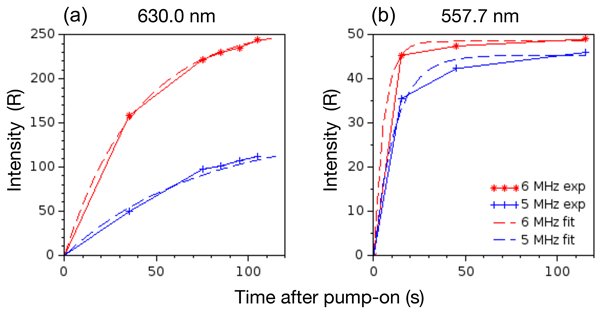
Powerful radio waves transmitted into the ionosphere from the ground were used to study electron energization in the pumped ionospheric plasma turbulence, by detecting optical emissions from atomic oxygen. Our results obtained with the EISCAT (European Incoherent Scatter Scientific Association) facilities in northern Norway and optical detection with the ALIS (Auroral Large Imaging System) in northern Sweden suggest that long-wavelength upper hybrid waves are important in accelerating electrons.

Johann Stamm, Juha Vierinen, Björn Gustavsson, and Andres Spicher
Ann. Geophys., 41, 55–67, https://doi.org/10.5194/angeo-41-55-2023, https://doi.org/10.5194/angeo-41-55-2023, 2023
Short summary
Short summary
The study of some ionospheric events benefit from the knowledge of how the physics varies over a volume and over time. Examples are studies of aurora or energy deposition. With EISCAT3D, measurements of ion velocity vectors in a volume will be possible for the first time. We present a technique that uses a set of such measurements to estimate electric field and neutral wind. The technique relies on adding restrictions to the estimates. We successfully consider restrictions based on physics.
Daniel K. Whiter, Noora Partamies, Björn Gustavsson, and Kirsti Kauristie
Ann. Geophys., 41, 1–12, https://doi.org/10.5194/angeo-41-1-2023, https://doi.org/10.5194/angeo-41-1-2023, 2023
Short summary
Short summary
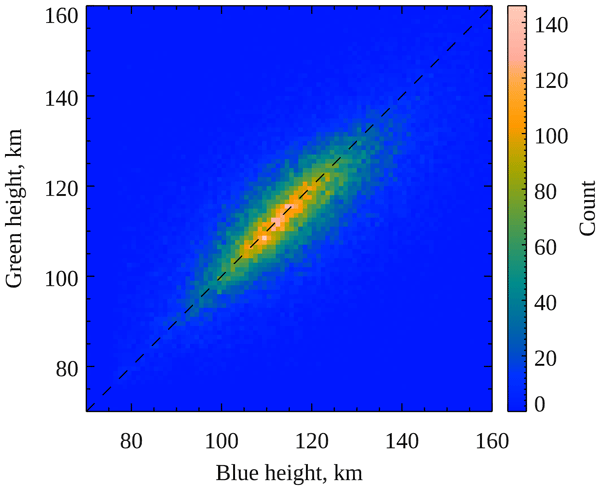
We measured the height of green and blue aurorae using thousands of camera images recorded over a 7-year period. Both colours are typically brightest at about 114 km altitude. When they peak at higher altitudes the blue aurora is usually higher than the green aurora. This information will help other studies which need an estimate of the auroral height. We used a computer model to explain our observations and to investigate how the green aurora is produced.
Mizuki Fukizawa, Takeshi Sakanoi, Yoshimasa Tanaka, Yasunobu Ogawa, Keisuke Hosokawa, Björn Gustavsson, Kirsti Kauristie, Alexander Kozlovsky, Tero Raita, Urban Brändström, and Tima Sergienko
Ann. Geophys., 40, 475–484, https://doi.org/10.5194/angeo-40-475-2022, https://doi.org/10.5194/angeo-40-475-2022, 2022
Short summary
Short summary
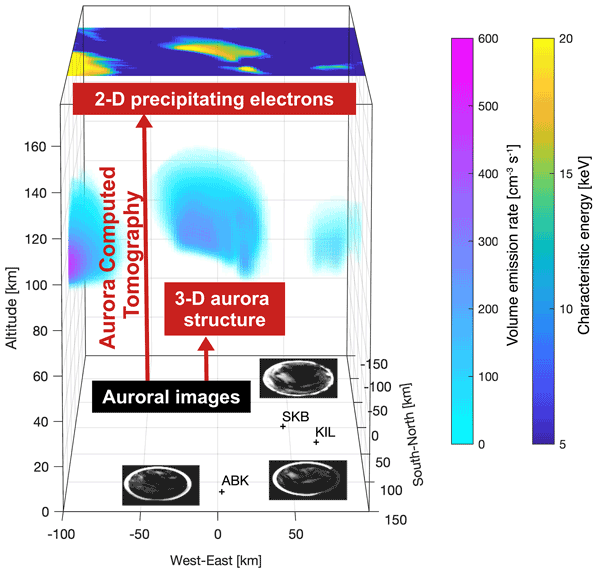
The pulsating auroral generation mechanism has been investigated by observing precipitating electrons using rockets or satellites. However, it is difficult for such observations to distinguish temporal changes from spatial ones. In this study, we reconstructed the horizontal 2-D distribution of precipitating electrons using only auroral images. The 3-D aurora structure was also reconstructed. We found that there were both spatial and temporal changes in the precipitating electron energy.
Snizhana Ross, Arttu Arjas, Ilkka I. Virtanen, Mikko J. Sillanpää, Lassi Roininen, and Andreas Hauptmann
Atmos. Meas. Tech., 15, 3843–3857, https://doi.org/10.5194/amt-15-3843-2022, https://doi.org/10.5194/amt-15-3843-2022, 2022
Short summary
Short summary
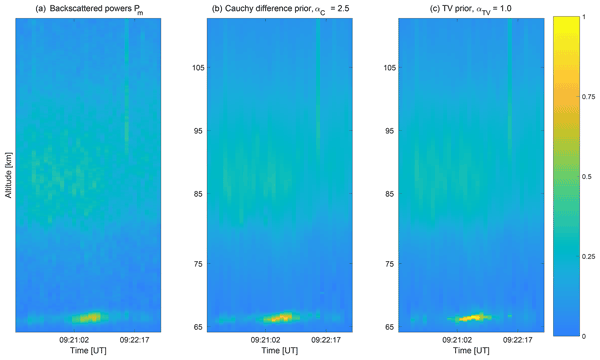
Radar measurements of thermal fluctuations in the Earth's ionosphere produce weak signals, and tuning to specific altitudes results in suboptimal resolution for other regions, making an accurate analysis of these changes difficult. A novel approach to improve the resolution and remove measurement noise is considered. The method can capture variable characteristics, making it ideal for the study of a large range of data. Synthetically generated examples and two measured datasets were considered.
Johann Stamm, Juha Vierinen, and Björn Gustavsson
Ann. Geophys., 39, 961–974, https://doi.org/10.5194/angeo-39-961-2021, https://doi.org/10.5194/angeo-39-961-2021, 2021
Short summary
Short summary
Measurements of the electric field and neutral wind in the ionosphere are important for understanding energy flows or electric currents. With incoherent scatter radars (ISRs), we can measure the velocity of the ions, which depends on both the electrical field and the neutral wind. In this paper, we investigate methods to use ISR data to find reasonable values for both parameters. We find that electric field can be well measured down to 125 km height and neutral wind below this height.
Cited articles
Bailey, S. M., Barth, C. A., and Solomon, S. C.: A model of nitric oxide in the lower thermosphere, Journal of Geophysical Research: Space Physics, 107, SIA 22-1–SIA 22-12, https://doi.org/10.1029/2001JA000258, 2002. a, b
Bilitza, D., Altadill, D., Zhang, Y., Mertens, C., Truhlik, V., Richards, P., McKinnell, L.-A., and Reinisch, B.: The International Reference Ionosphere 2012 – a model of international collaboration, Journal of Space Weather and Space Climate, 4, A07, https://doi.org/10.1051/swsc/2014004, 2014. a
Dahlgren, H., Gustavsson, B., Lanchester, B. S., Ivchenko, N., Brändström, U., Whiter, D. K., Sergienko, T., Sandahl, I., and Marklund, G.: Energy and flux variations across thin auroral arcs, Annales Geophysicae, 29, 1699–1712, https://doi.org/10.5194/angeo-29-1699-2011, 2011. a, b, c
Emmert, J. T., Jones Jr, M., Siskind, D. E., Drob, D. P., Picone, J. M., Stevens, M. H., Bailey, S. M., Bender, S., Bernath, P. F., Funke, B., Hervig, M. E., and Pérot, K.: NRLMSIS 2.1: An Empirical Model of Nitric Oxide Incorporated Into MSIS, Journal of Geophysical Research: Space Physics, 127, e2022JA030896, https://doi.org/10.1029/2022JA030896, 2022. a
Fang, X., Randall, C. E., Lummerzheim, D., Wang, W., Lu, G., Solomon, S. C., and Frahm, R. A.: Parameterization of monoenergetic electron impact ionization, Geophysical Research Letters, 37, https://doi.org/10.1029/2010GL045406, 2010. a
Gustavsson, B., Virtanen, I., and Stalder, O.: ELSPEC_recursive, Github [data set], https://github.com/ostald/ELSPEC/tree/recursive, last access: 11 February 2026. a
Jones, R. A. and Rees, M. H.: Time dependent studies of the aurora – I. Ion density and composition, Planetary and Space Science, 21, 537–557, https://doi.org/10.1016/0032-0633(73)90069-X, 1973. a
Kaeppler, S. R., Hampton, D. L., Nicolls, M. J., Strømme, A., Solomon, S. C., Hecht, J. H., and Conde, M. G.: An investigation comparing ground-based techniques that quantify auroral electron flux and conductance, Journal of Geophysical Research: Space Physics, 120, 9038–9056, https://doi.org/10.1002/2015JA021396, 2015. a
Kirkwood, S. and Eliasson, L.: Energetic particle precipitation in the substorm growth phase measured by EISCAT and Viking, Journal of Geophysical Research: Space Physics, 95, 6025–6037, https://doi.org/10.1029/JA095iA05p06025, 1990. a
Lehtinen, M. S. and Huuskonen, A.: General incoherent scatter analysis and GUISDAP, Journal of Atmospheric and Terrestrial Physics, 58, 435–452, https://doi.org/10.1016/0021-9169(95)00047-X, 1996. a
Lummerzheim, D., Rees, M. H., and Anderson, H. R.: Angular dependent transport of auroral electrons in the upper atmosphere, Planetary and Space Science, 37, 109–129, https://doi.org/10.1016/0032-0633(89)90074-3, 1989. a
McCrea, I., Aikio, A., Alfonsi, L., Belova, E., Buchert, S., Clilverd, M., Engler, N., Gustavsson, B., Heinselman, C., Kero, J., Kosch, M., Lamy, H., Leyser, T., Ogawa, Y., Oksavik, K., Pellinen-Wannberg, A., Pitout, F., Rapp, M., Stanislawska, I., and Vierinen, J.: The science case for the EISCAT_3D radar, Progress in Earth and Planetary Science, 2, 21, https://doi.org/10.1186/s40645-015-0051-8, 2015. a
Miyoshi, Y., Oyama, S., Saito, S., Kurita, S., Fujiwara, H., Kataoka, R., Ebihara, Y., Kletzing, C., Reeves, G., Santolik, O., Clilverd, M., Rodger, C. J., Turunen, E., and Tsuchiya, F.: Energetic electron precipitation associated with pulsating aurora: EISCAT and Van Allen Probe observations, Journal of Geophysical Research: Space Physics, 120, 2754–2766, https://doi.org/10.1002/2014JA020690, 2015. a
Nikolaeva, V., Gordeev, E., Sergienko, T., Makarova, L., and Kotikov, A.: AIM-E: E-Region Auroral Ionosphere Model, Atmosphere, 12, 748, https://doi.org/10.3390/atmos12060748, 2021. a
Palmroth, M., Janhunen, P., Germany, G., Lummerzheim, D., Liou, K., Baker, D. N., Barth, C., Weatherwax, A. T., and Watermann, J.: Precipitation and total power consumption in the ionosphere: Global MHD simulation results compared with Polar and SNOE observations, Annales Geophysicae, 24, 861–872, https://doi.org/10.5194/angeo-24-861-2006, 2006. a
Rees, M. H.: Physics and Chemistry of the Upper Atmosphere, Cambridge Atmospheric and Space Science Series, Cambridge University Press, Cambridge, ISBN 978-0-521-36848-3, https://doi.org/10.1017/CBO9780511573118, 1989. a, b, c
Reimer, A., amisr user, and FGuenzkofer: amisr/flipchem: v2021.2.2 Bugfix Release, Zenodo, https://doi.org/10.5281/zenodo.5719844, 2021. a, b
Richards, P. G. and Voglozin, D.: Reexamination of ionospheric photochemistry, Journal of Geophysical Research: Space Physics, 116, https://doi.org/10.1029/2011JA016613, 2011. a, b
Richards, P. G., Bilitza, D., and Voglozin, D.: Ion density calculator (IDC): A new efficient model of ionospheric ion densities, Radio Science, 45, https://doi.org/10.1029/2009RS004332, 2010. a
Roble, R. G. and Rees, M. H.: Time-dependent studies of the aurora: Effects of particle precipitation on the dynamic morphology of ionospheric and atmospheric properties, Planetary and Space Science, 25, 991–1010, https://doi.org/10.1016/0032-0633(77)90146-5, 1977. a
Semeter, J. and Kamalabadi, F.: Determination of primary electron spectra from incoherent scatter radar measurements of the auroral E region, Radio Science, 40, https://doi.org/10.1029/2004RS003042, 2005. a, b, c
Sergienko, T. and Ivanov, V.: A new approach to calculate the excitation of atmospheric gases by auroral electrons, Annales Geophysicae, 11, 717–727, 1993. a
Stalder, O.: ostald/juliaIC: IonChem first release, Zenodo [code], https://doi.org/10.5281/zenodo.18631983, 2026. a
Tesfaw, H. W., Virtanen, I. I., Aikio, A. T., Nel, A., Kosch, M., and Ogawa, Y.: Precipitating Electron Energy Spectra and Auroral Power Estimation by Incoherent Scatter Radar With High Temporal Resolution, Journal of Geophysical Research: Space Physics, 127, e2021JA029880, https://doi.org/10.1029/2021JA029880, 2022. a
Tesfaw, H. W., Virtanen, I. I., and Aikio, A. T.: Characteristics of Auroral Electron Precipitation at Geomagnetic Latitude 67° Over Tromsø, Journal of Geophysical Research: Space Physics, 128, e2023JA031382, https://doi.org/10.1029/2023JA031382, 2023. a
Turunen, E., Kero, A., Verronen, P. T., Miyoshi, Y., Oyama, S.-I., and Saito, S.: Mesospheric ozone destruction by high-energy electron precipitation associated with pulsating aurora, Journal of Geophysical Research: Atmospheres, 121, 11852–11861, https://doi.org/10.1002/2016JD025015, 2016. a
Tuttle, S., Gustavsson, B., and Lanchester, B.: Temporal and spatial evolution of auroral electron energy spectra in a region surrounding the magnetic zenith, Journal of Geophysical Research: Space Physics, 119, 2318–2327, https://doi.org/10.1002/2013JA019627, 2014. a, b
Ulich, T., Turunen, E., and Nygrén, T.: Effective recombination coefficient in the lower ionosphere during bursts of auroral electrons, Advances in Space Research, 25, 47–50, https://doi.org/10.1016/S0273-1177(99)00896-0, 2000. a
Vierinen, J., Bhatt, A., Hirsch, M. A., Strømme, A., Semeter, J. L., Zhang, S.-R., and Erickson, P. J.: High temporal resolution observations of auroral electron density using superthermal electron enhancement of Langmuir waves, Geophysical Research Letters, 43, 5979–5987, https://doi.org/10.1002/2016GL069283, 2016. a
Virtanen, I. and Gustavsson, B.: ELSPEC, Zenodo [data set], https://doi.org/10.5281/zenodo.6644454, 2026. a
Virtanen, I. I., Gustavsson, B., Aikio, A., Kero, A., Asamura, K., and Ogawa, Y.: Electron Energy Spectrum and Auroral Power Estimation From Incoherent Scatter Radar Measurements, Journal of Geophysical Research: Space Physics, 123, 6865–6887, https://doi.org/10.1029/2018JA025636, 2018. a, b, c
Waldteufel, P.: Combined incoherent-scatter F 1-region observations, Journal of Geophysical Research, 76, 6995–6999, https://doi.org/10.1029/JA076i028p06995, 1971. a
Wedlund, C. S., Lamy, H., Gustavsson, B., Sergienko, T., and Brändström, U.: Estimating energy spectra of electron precipitation above auroral arcs from ground-based observations with radar and optics, Journal of Geophysical Research: Space Physics, 118, 3672–3691, https://doi.org/10.1002/jgra.50347, 2013. a
Zettergren, M., Semeter, J., Burnett, B., Oliver, W., Heinselman, C., Blelly, P.-L., and Diaz, M.: Dynamic variability in F-region ionospheric composition at auroral arc boundaries, Annales Geophysicae, 28, 651–664, https://doi.org/10.5194/angeo-28-651-2010, 2010. a
Short summary
The rapid changes in ion composition during auroral are dynamically modeled by integrating the coupled continuity equations for 15 ionospheric species. The effect of the ionospheric variation on the inversion of incoherent scatter radar (ISR) electron density profiles to differential energy spectra of precipitating electrons is studied. A systematic overestimation at high electron energies can be removed using a dynamic model. Comparisons are made with static and steady-state ionospheric models.
The rapid changes in ion composition during auroral are dynamically modeled by integrating the...


