
Articles | Volume 44, issue 2
https://doi.org/10.5194/angeo-44-881-2026
© Author(s) 2026. This work is distributed under
the Creative Commons Attribution 4.0 License.
the Creative Commons Attribution 4.0 License.
https://doi.org/10.5194/angeo-44-881-2026
© Author(s) 2026. This work is distributed under
the Creative Commons Attribution 4.0 License.
the Creative Commons Attribution 4.0 License.
Regular paper
| 
01 Sep 2026
Regular paper |
| 01 Sep 2026
| 01 Sep 2026
Magnetotail response to corotating interaction region driven geomagnetic storms: Cluster observations
Adriane Marques de Souza Franco
CORRESPONDING AUTHOR

Federal University of Jataí (UFJ), Jataí, Brazil
Federal University of Southern and Southeastern Pará (UNIFESSPA), Marabá, Brazil
Rashmi Rawat
National Centre for Polar and Ocean Research (NCPOR), Goa, India
Mauricio José Alves Bolzan
Federal University of Southern and Southeastern Pará (UNIFESSPA), Marabá, Brazil
Ezequiel Echer
Instituto Nacional de Pesquisas Espaciais (INPE), São José dos Campos, Brazil
Related authors
Adriane Marques de Souza Franco, Rajkumar Hajra, Ezequiel Echer, and Mauricio José Alves Bolzan
Ann. Geophys., 39, 929–943, https://doi.org/10.5194/angeo-39-929-2021, https://doi.org/10.5194/angeo-39-929-2021, 2021
Short summary
Short summary
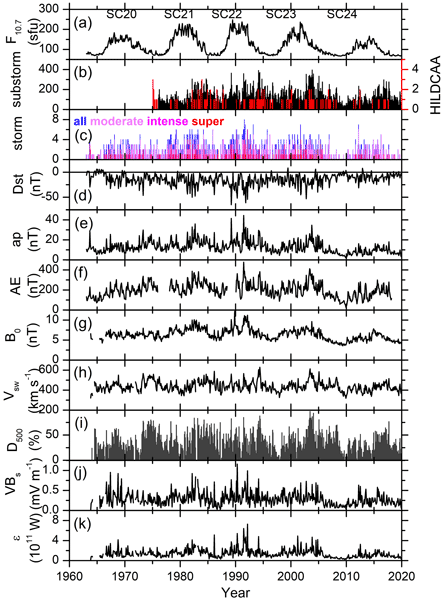
We used up-to-date substorms, HILDCAAs and geomagnetic storms of varying intensity along with all available geomagnetic indices during the space exploration era to explore the seasonal features of the geomagnetic activity and their drivers. As substorms, HILDCAAs and magnetic storms of varying intensity have varying solar/interplanetary drivers, such a study is important for acomplete understanding of the seasonal features of the geomagnetic response to the solar/interplanetary events.
Fernando L. Guarnieri, Bruce T. Tsurutani, Rajkumar Hajra, Ezequiel Echer, and Gurbax S. Lakhina
Nonlin. Processes Geophys., 32, 75–88, https://doi.org/10.5194/npg-32-75-2025, https://doi.org/10.5194/npg-32-75-2025, 2025
Short summary
Short summary
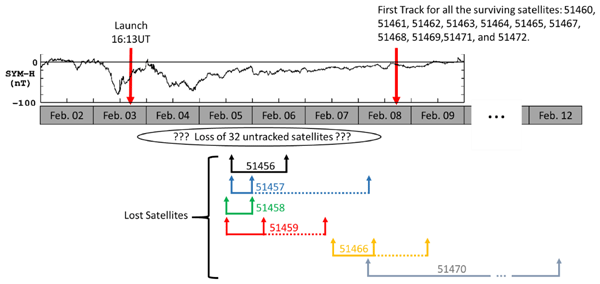
On February 03 2022, SpaceX launched a new group of satellites for its Starlink constellation. This launch simultaneously released 49 satellites into orbits between 200 km and 250 km height. The launches occurred during a geomagnetic storm that was followed by a second storm. There was an immediate loss of 32 satellites. The satellite losses may have been caused by an unusually high level of atmospheric drag (unexplained by current theory or modeling) or a high level of satellite collisions.
Adriane Marques de Souza Franco, Rajkumar Hajra, Ezequiel Echer, and Mauricio José Alves Bolzan
Ann. Geophys., 39, 929–943, https://doi.org/10.5194/angeo-39-929-2021, https://doi.org/10.5194/angeo-39-929-2021, 2021
Short summary
Short summary
We used up-to-date substorms, HILDCAAs and geomagnetic storms of varying intensity along with all available geomagnetic indices during the space exploration era to explore the seasonal features of the geomagnetic activity and their drivers. As substorms, HILDCAAs and magnetic storms of varying intensity have varying solar/interplanetary drivers, such a study is important for acomplete understanding of the seasonal features of the geomagnetic response to the solar/interplanetary events.
Cited articles
Abbo, L., Ofman, L., Antiochos, S. K., Hansteen, V. H., Harra, L., Ko, Y.-K., Lapenta, G., Li, B., Riley, P., Strachan, L., von Steiger, R., and Wang, Y.-M.: Slow solar wind: Observations and modeling, Space Sci. Rev., 201, 55–108, https://doi.org/10.1007/s11214-016-0264-1, 2016.
Alves, M., Echer, E., and Gonzalez, W.: Geoeffectiveness of corotating interaction regions as measured by Dst index, J. Geophys. Res.-Space, 111, A07S05, https://doi.org/10.1029/2005JA011379, 2006.
Antonova, E. E. and Stepanova, M. V.: The impact of turbulence on physics of the geomagnetic tail, Frontiers in Astronomy and Space Sciences, 8, 622570, https://doi.org/10.3389/fspas.2021.622570, 2021.
Baumjohann, W. and Nakamura, R.: Magnetospheric contributions to the terrestrial magnetic field, Developments in Earth and Environmental Sciences, 5, 77–92, https://doi.org/10.1016/B978-044452748-6.00088-2, 2007.
Bolzan, M. J. A.: Statistical and wavelet analysis of the solar wind data, Braz. J. Phys., 35, 592–596, https://doi.org/10.1590/S0103-97332005000400002, 2005.
Bolzan, M. J. A. and Echer, E.: A multifractal approach applied to the magnetic field turbulence in Jupiter's magnetosheath, Planet. Space Sci., 91, 77–82, https://doi.org/10.1016/j.pss.2013.12.004, 2014.
Bolzan, M. J. A., Franco, A. M. S., and Echer, E.: A wavelet based method to remove the long term periodicities of geophysical time series, Adv. Space Res., 66, 299–306, https://doi.org/10.1016/j.asr.2020.04.014, 2020.
Borovsky, J. E. and Denton, M. H.: Differences between CME-driven storms and CIR-driven storms, J. Geophys. Res.-Space, 111, A07S08, https://doi.org/10.1029/2005JA011447, 2006.
Borovsky, J. E., Nemzek, R. J., and Belian, R. D.: The occurrence rate of magnetospheric-substorm onsets: Random and periodic substorms, J. Geophys. Res.-Space, 98, 3807–3813, https://doi.org/10.1029/92JA02556, 1993.
Bruno, R., Carbone, V., Veltri, P., Politano, H., and Malara, F.: Identification of cascade in the solar wind: The role of the cross-helicity, Planet. Space Sci., 53, 49–54, https://doi.org/10.1016/j.pss.2004.09.023, 2005.
Chen, Y., Wang, W., Burns, A. G., Liu, S., Gong, J., Yue, X., Jiang, G., and Coster, A.: Ionospheric response to CIR-induced recurrent geomagnetic activity during the declining phase of solar cycle 23, J. Geophys. Res.-Space, 120, 1394–1418, https://doi.org/10.1002/2014JA020657, 2015.
Chian, A., Miranda, R., Bertucci, C., Blanco-Cano, X., Borovsky, J., Dasso, S., Echer, E., Franco, A., Girgis, K. M., González-Esparza, J. A., Hada, T., Hasegawa, H., Hsieh, S.-Y., Kajdič, P., Mazelle, C., Rempel, E., Rojas-Castillo, D., Sánchez-Cano, B., Sibeck, D., Stepanova, M., Valdés-Galicia, J., and Valdivia, J.: Terrestrial and Martian space weather: A complex systems approach, J. Atmos. Sol.-Terr. Phy., 259, 106253, https://doi.org/10.1016/j.jastp.2024.106253, 2024.
Davis, T. N. and Sugiura, M.: Auroral electrojet activity index AE and its universal time variations, J. Geophys. Res., 71, 785–801, https://doi.org/10.1029/JZ071i003p00785, 1966.
Denton, M., Borovsky, J., Skoug, R., Thomsen, M., Lavraud, B., Henderson, M., McPherron, R. L., Zhang, J. C., and Liemohn, M.: Geomagnetic storms driven by ICME- and CIR-dominated solar wind, J. Geophys. Res.-Space, 111, A07S07, https://doi.org/10.1029/2005JA011436, 2006.
Despirak, I., Lubchich, A., and Koleva, R.: Magnetospheric signatures of auroral disturbances during the passage of the solar wind's CIR and sheath regions, Cosmic Res., 52, 37–45, https://doi.org/10.1134/S001095251401002X, 2014.
Despirak, I. V., Lyubchich, A. A., and Koleva, R.: Magnetotail signatures of auroral disturbances associated with Sheath and CIR regions in the solar wind, in: Proceedings of the fifth workshop “Solar influences on the magnetosphere”, edited by: Georgieva, K., Nessebar, Bulgaria, 3–7 June 2013, E13, http://ws-sozopol.stil.bas.bg/ (last access: 24 August 2026), 2013.
Echer, E., Gonzalez, W. D., Tsurutani, B. T., and Gonzalez, A. L. C.: Interplanetary conditions causing intense geomagnetic storms (
Echer, E., González, W. D., Tsurutani, B. T., and Alves, M. V.: Interplanetary conditions leading to intense geomagnetic storms (
Echer, E., Korth, A., Bolzan, M. J. A., and Friedel, R. H. W.: Global geomagnetic responses to the IMF Bz fluctuations during the September/October 2003 high-speed stream intervals, Ann. Geophys., 35, 853–868, https://doi.org/10.5194/angeo-35-853-2017, 2017.
Echer, E., Franco, A. M. S., da Costa Junior, E., Hajra, R., and Bolzan, M. J. A.: Solar-wind high-speed stream (HSS) Alfvén wave fluctuations at high heliospheric latitudes: Ulysses observations during two solar-cycle minima, Sol. Phys., 297, https://doi.org/10.1007/s11207-022-02070-w, 2022.
Echer, E., Franco, A. M. S., Magalhães, F. P., Bolzan, M. J. A., and Hajra, R.: Study of Neptune dayside magnetosheath fluctuations during Voyager-2 flyby, Adv. Space Res., 71, 3468–3478, https://doi.org/10.1016/j.asr.2022.12.022, 2023.
Gonzalez, W., Tsurutani, B., and Clúa de Gonzalez, A.: Interplanetary origin of geomagnetic storms, Space Sci. Rev., 88, 529–562, https://doi.org/10.1023/A:1005160129098, 1999.
Gonzalez, W., Echer, E., Clua-Gonzalez, A., and Tsurutani, B.: Interplanetary origin of intense geomagnetic storms (
Gonzalez, W. D., Joselyn, J. A., Kamide, Y., Kroehl, H. W., Rostoker, G., Tsurutani, B. T., and Vasyliunas, V. M.: What is a geomagnetic storm?, J. Geophys. Res.-Space, 99, 5771–5792, https://doi.org/10.1029/93JA02867, 1994.
Gosling, J. T., Borrini, G., Asbridge, J. R., Bame, S. J., Feldman, W. C., and Hansen, R. T.: Coronal streamers in the solar wind at 1 AU, J. Geophys. Res., 86, 5438–5448, https://doi.org/10.1029/JA086iA07p05438, 1981.
Grinsted, A., Moore, J. C., and Jevrejeva, S.: Application of the cross wavelet transform and wavelet coherence to geophysical time series, Nonlin. Processes Geophys., 11, 561–566, https://doi.org/10.5194/npg-11-561-2004, 2004.
GSFC: OMNIWeb Plus: Near-Earth Heliosphere Data, NASA Goddard Space Flight Center [data set], https://omniweb.gsfc.nasa.gov/, last access: 14 August 2026.
Hajra, R., Echer, E., Franco, A. M. d. S., and Bolzan, M. J. A.: Earth's magnetotail variability during supersubstorms (SSSs): A study on solar wind–magnetosphere–ionosphere coupling, Adv. Space Res., 72, 1208–1223, https://doi.org/10.1016/j.asr.2023.04.013, 2023.
Hajra, R., Echer, E., Tsurutani, B. T., and Gonzalez, W. D.: Solar cycle dependence of high-intensity long-duration continuous AE activity (HILDCAA) events, relativistic electron predictors?, J. Geophys. Res.-Space, 118, 5626–5638, https://doi.org/10.1002/jgra.50530, 2013.
Hundhausen, A. J.: The Solar Wind, in: Introduction to Space Physics, edited by: Kivelson, M. G. and Russell, C. T., Cambridge University Press, Cambridge, 91–128, https://doi.org/10.1017/9781139878296, 1995.
Iyemori, T.: Storm-time magnetospheric currents inferred from mid-latitude geomagnetic field variations, J. Geomagn.Geoelectr., 42, 1249–1265, https://doi.org/10.5636/jgg.42.1249, 1990.
Kamide, Y., Baumjohann, W., Daglis, I. A., Gonzalez, W. D., Grande, M., Joselyn, J. A., McPherron, R. L., Phillips, J. L., Reeves, E. G. D., Rostoker, G., Sharma, A. S., Singer, H. J., Tsurutani, B. T., and Vasyliunas, V. M.: Current understanding of magnetic storms: Storm-substorm relationships, J. Geophys. Res.-Space, 103, 17705–17728, https://doi.org/10.1029/98JA01426, 1998.
Koller, F., Temmer, M., Preisser, L., Plaschke, F., Geyer, P., Jian, L. K., Roberts, O. W., Hietala, H., and Lamoury, A. T.: Magnetosheath jet occurrence rate in relation to CMEs and SIRs, J. Geophys. Res.-Space, 127, e2021JA030230, https://doi.org/10.1029/2021JA030230, 2022.
Kolmogorov, A. N.: The local structure of turbulence in an incompressible viscous fluid for very large Reynolds numbers, Dokl. Akad. Nauk SSSR, 30, 299–304, 1941.
Korth, A., Echer, E., Guarnieri, F. L., Franz, M., Friedel, R., Gonzalez, W. D., Mouikis, C. G., and Reme, H.: Cluster observations of plasma sheet activity during the 14–28 September 2003 corotating high speed stream event, in: Proceedings of the Eighth International Conference on Substorms (ICS-8), edited by: Syrjäsuo, A. and Donovan, E., Banff, Alberta, Canada, 27–31 March 2006, 133–138, https://ics8.ca/proc_files/korth.pdf (last access: 24 August 2026), 2006.
Korth, A., Echer, E., Zong, Q.-G., Guarnieri, F., Fraenz, M., and Mouikis, C.: The response of the polar cusp to a high-speed solar wind stream studied by a multispacecraft wavelet analysis, J. Atmos. Sol.-Terr. Phy., 73, 52–60, https://doi.org/10.1016/j.jastp.2009.10.004, 2011.
Krieger, A. S., Timothy, A. F., and Roelof, E. C.: A coronal hole and its identification as the source of a high velocity solar wind stream, Sol. Phys., 29, 505–525, https://doi.org/10.1007/BF00150828, 1973.
Lee, D.-Y., and Min, K. W.: Statistical features of substorm indicators during geomagnetic storms, J. Geophys. Res.-Space, 107, 1362, https://doi.org/10.1029/2002JA009243, 2002.
Lee, D.-Y., Lyons, L., Kim, K.-C., Baek, J.-H., Kim, K.-H., Weygand, J., Moon, Y.-J., Cho, K.-S., Park, Y. D., and Han, W.: Repetitive substorms caused by Alfvénic waves of the interplanetary magnetic field during high-speed solar wind streams, J. Geophys. Res.-Space, 111, A12S09, https://doi.org/10.1029/2006JA011685, 2006.
Marques de Souza, A., Echer, E., Bolzan, M. J. A., and Hajra, R.: Cross-correlation and cross-wavelet analyses of the solar wind IMF Bz and auroral electrojet index AE coupling during HILDCAAs, Ann. Geophys., 36, 205–211, https://doi.org/10.5194/angeo-36-205-2018, 2018.
Marques de Souza Franco, A., Echer, E., and José Alves Bolzan, M.: Wavelet analysis of the magnetotail response to solar wind fluctuations during HILDCAA events, Ann. Geophys., 37, 919–929, https://doi.org/10.5194/angeo-37-919-2019, 2019.
McPherron, R. L., Russell, C. T., and Aubry, M.: Satellite studies of magnetospheric substorms on 15 August 1968: 5. Phenomenological model for substorms, J. Geophys. Res., 78, 3131–3143, https://doi.org/10.1029/JA078i016p03131, 1973.
Müller, W.-C., and Biskamp, D.: Scaling properties of three-dimensional magnetohydrodynamic turbulence, Phys. Rev. Lett., 84, 475–478, https://doi.org/10.1103/PhysRevLett.84.475, 2000.
Nakamura, R. and Kokubun, S.: Tail configuration during storms, Adv. Space Res., 25, 1631–1638, https://doi.org/10.1016/S0273-1177(99)00677-8, 2000.
Nakamura, R., Baumjohann, W., Klecker, B., Bogdanova, Y., Balogh, A., Rème, H., Bosqued, J. M., Dandouras, I., Sauvaud, J. A., Glassmeier, K. -H., Kistler, L., Mouikis, C., Zhang, T. L., Eichelberger, H., and Runov, A.: Motion of the dipolarization front during a flow burst event observed by Cluster, Geophys. Res. Lett., 29, 3-1–3-4, https://doi.org/10.1029/2002GL015763, 2002.
Nakamura, R., Nagai, T., Birn, J., Sergeev, V., Contel, O. L., Varsani, A., Baumjohann, W., Nakamura, T., Apatenkov, S., Artemyev, A., Ergun, R. E., Fuselier, S. A., Gershman, D. J., Giles, B. J., Khotyaintsev, Y. V., Lindqvist, P.-A., Magnes, W., Mauk, B., Russell, C. T., Singer, H. J., Stawarz, J., Strangeway, R. J., Anderson, B., Bromund, K. R., Fischer, D., Kepko, L., Le, G., Plaschke, F., Slavin, J. A., Cohen, I., Jaynes, A., and Turner, D. L.: Near-earth plasma sheet boundary dynamics during substorm dipolarization, Earth Planets Space, 69, 16, https://doi.org/10.1186/s40623-017-0707-2, 2017.
Parker, E. N.: Dynamics of the interplanetary gas and magnetic fields, Astrophys. J., 128, 664, https://doi.org/10.1086/146579, 1958.
Phillips, J., Bame, S., Feldman, W., Gosling, J., Hammond, C., McComas, D., Goldstein, B. E., Neugebauer, M., Scime, E. E., and Suess, S.: Ulysses solar wind plasma observations at high southerly latitudes, Science, 2685213, 1030–1033, https://doi.org/10.1126/science.268.5213.1030, 1995.
Rakhmanova, L. S., Riazantseva, M. O., Zastenker, G. N., Yermolaev, Y. I., and Lodkina, I. G.: Dependence of the properties of a turbulent cascade behind the bow shock on the dynamics of the solar wind parameters, Cosmic Res., 58, 478–486, 2020.
Rawat, R., Echer, E., and Gonzalez, W. D.: How different are the solar wind-interplanetary conditions and the consequent geomagnetic activity during the ascending and early descending phases of the solar cycles 23 and 24?, J. Geophys. Res.-Space, 123, 6621–6638, https://doi.org/10.1029/2018JA025683, 2018.
Richardson, I. G.: The formation of CIRs at stream-stream interfaces and resultant geomagnetic activity, in: Recurrent magnetic storms: Corotating solar wind streams, American Geophysical Union (AGU), 45–58, https://doi.org/10.1029/167GM06, 2006.
Rostoker, G.: Geomagnetic indices, Rev. Geophys., 10, 935–950, https://doi.org/10.1029/RG010i004p00935, 1972.
Runov, A., Sergeev, V. A., Baumjohann, W., Nakamura, R., Apatenkov, S., Asano, Y., Volwerk, M., Vörös, Z., Zhang, T. L., Petrukovich, A., Balogh, A., Sauvaud, J.-A., Klecker, B., and Rème, H.: Electric current and magnetic field geometry in flapping magnetotail current sheets, Ann. Geophys., 23, 1391–1403, https://doi.org/10.5194/angeo-23-1391-2005, 2005.
Sánchez-García, E., Gonzalez-Esparza, J. A., Aguilar-Rodríguez, E., and Corona-Romero, P.: Statistical study of the geoeffectiveness of CIRs during solar cycles 23 and 24, J. Geophys. Res.-Space, 129, e2023JA031685, https://doi.org/10.1029/2023JA031685, 2024.
Schwenn, R.: Space weather: The solar perspective, Living Rev. Sol. Phys., 3, https://doi.org/10.12942/lrsp-2006-2, 2006.
Smith, E. J. and Wolfe, J. H.: Observations of interaction regions and corotating shocks between one and five AU: Pioneers 10 and 11, Geophys. Res. Lett., 3, 137–140, https://doi.org/10.1029/GL003i003p00137, 1976.
Smith, E. J., Balogh, A., Neugebauer, M., and McComas, D.: Ulysses observations of Alfvén waves in the southern and northern solar hemispheres, Geophys. Res. Lett., 22, 3381–3384, https://doi.org/10.1029/95GL03268, 1995.
Souza, A., Echer, E., Bolzan, M., and Hajra, R.: A study on the main periodicities in interplanetary magnetic field Bz component and geomagnetic AE index during HILDCAA events using wavelet analysis, J. Atmos. Sol.-Terr. Phy., 149, 81–86, https://doi.org/10.1016/j.jastp.2016.09.006, 2016.
Souza, A. M.: Estudo do acoplamento vento solar-magnetosfera durante eventos HILDCAAS utilizando análise por wavelets, Doctoral dissertation, Instituto Nacional de Pesquisas Espaciais, http://urlib.net/sid.inpe.br/mtc-m21b/2015/02.10.16.57 (last access: 24 August 2026), 2015.
Souza Echer, M. P. A., Echer, E., Domingues, M., Mendes, O., Seo, R. T., and Gonzalez, W.: Wavelet analysis of low frequency magnetic field fluctuations in the Jupiter's magnetotail, Adv. Space Res., 68, 246–258, https://doi.org/10.1016/j.asr.2021.03.003, 2021.
Strugarek, A., Janitzek, N., Lee, A., Löschl, P., Seifert, B., Hoilijoki, S., Kraaikamp, E., Mrigakshi, A. I., Philippe, T., Spina, S., Bröse, M., Massahi, S., O’Halloran, L., Pereira Blanco, V., Stausland, C., Escoubet, P., and Kargl, G.: A space weather mission concept: Observatories of the solar corona and active regions (OSCAR), Proc. SPIE, 9143, 91430E, https://doi.org/10.1051/swsc/2016040, 2014.
Suess, S. T., Ko, Y.-K., von Steiger, R., and Moore, R. L.: Quiescent current sheets in the solar wind and origins of slow wind, J. Geophys. Res.-Space, 114, A04103, https://doi.org/10.1029/2008JA013704, 2009.
Sugiura, M.: Hourly values of equatorial Dst for the IGY, Annals of the International Geophysical Year, 35, 9–45, 1964.
Torrence, C. and Compo, G. P.: A practical guide to wavelet analysis, B. Am. Meteorol. Soc., 79, 61–78, https://doi.org/10.1175/1520-0477(1998)079<0061:APGTWA>2.0.CO;2, 1998.
Tsurutani, B. T. and Gonzalez, W. D.: The cause of high-intensity long-duration continuous AE activity (HILDCAAs): Interplanetary Alfvén wave trains, Planet. Space Sci., 35, 405–412, https://doi.org/10.1016/0032-0633(87)90097-3, 1987.
Tsurutani, B. T., Sugiura, M., Iyemori, T., Goldstein, B. E., Gonzalez, W. D., Akasofu, S. I., and Smith, E. J.: The nonlinear response of AE to the IMF BS driver: A spectral break at 5 h, Geophys. Res. Lett., 17, 279–282, https://doi.org/10.1029/GL017i003p00279, 1990.
Tsurutani, B. T., Gonzalez, W. D., Gonzalez, A. L. C., Tang, F., Arballo, J. K., and Okada, M.: Interplanetary origin of geomagnetic activity in the declining phase of the solar cycle, J. Geophys. Res.-Space, 100, 21717–21733, https://doi.org/10.1029/95JA01476, 1995.
Tsurutani, B. T., Gonzalez, W. D., Gonzalez, A. L. C., Guarnieri, F. L., Gopalswamy, N., Grande, M., Kamide, Y., Kasahara, Y., Lu, G., Mann, I., McPherron, R., Soraas, F., and Vasyliunas, V.: Corotating solar wind streams and recurrent geomagnetic activity: A review, J. Geophys. Res.-Space, 111, A07S01, https://doi.org/10.1029/2005JA011273, 2006.
Turner, N. E., Cramer, W. D., Earles, S. K., and Emery, B. A.: Geoefficiency and energy partitioning in CIR-driven and CME-driven storms, J. Atmos. Sol.-Terr. Phys., 71, 1023–1031, https://doi.org/10.1016/j.jastp.2009.02.005, 2009.
Turner, N. E., Mitchell, E. J., Knipp, D. J., and Emery, B. A.: Energetics of magnetic storms driven by corotating interaction regions: A study of geoeffectiveness, In Recurrent magnetic storms: Corotating solar wind streams, American Geophysical Union (AGU), 113–124, https://doi.org/10.1029/167GM11, 2006.
WDC: World Data Center for Geomagnetism, Kyoto: AE index data, World Data Center for Geomagnetism, http://wdc.kugi.kyoto-u.ac.jp/dstae/index.html, last access: 14 August 2026.
Short summary
This study investigates 40 geomagnetic storms driven by corotating interaction regions and their impact on Earth's magnetotail. We find that short, 4 h energy pulses dominate the magnetotail during cyclic substorms. Furthermore, High-Intensity, Long-Duration, Continuous Auroral Activity (HILDCAA) events in the recovery phase facilitate energy distribution across 2–12 h periodicities in the auroral region. Spectral indices indicate strong turbulence in both regions.
This study investigates 40 geomagnetic storms driven by corotating interaction regions and their...


