
Articles | Volume 44, issue 2
https://doi.org/10.5194/angeo-44-811-2026
© Author(s) 2026. This work is distributed under
the Creative Commons Attribution 4.0 License.
the Creative Commons Attribution 4.0 License.
https://doi.org/10.5194/angeo-44-811-2026
© Author(s) 2026. This work is distributed under
the Creative Commons Attribution 4.0 License.
the Creative Commons Attribution 4.0 License.
Regular paper
| 
24 Aug 2026
Regular paper |
| 24 Aug 2026
| 24 Aug 2026
High latitude, dayside rapid geomagnetic variations observed with ground-based magnetometers in Greenland
Marie Vigger Eldor
CORRESPONDING AUTHOR

Division of Geomagnetism and Geospace, DTU Space, National Space Institute, Technical University of Denmark, Akademivej 356, 2800 Kgs. Lyngby, Denmark
Tromsø Geophysical Observatory (TGO), UiT the Arctic University of Norway, 9037 Tromsø, Norway
Magnar Gullikstad Johnsen
Tromsø Geophysical Observatory (TGO), UiT the Arctic University of Norway, 9037 Tromsø, Norway
Nils Olsen
Division of Geomagnetism and Geospace, DTU Space, National Space Institute, Technical University of Denmark, Akademivej 356, 2800 Kgs. Lyngby, Denmark
Anna Naemi Willer
Division of Geomagnetism and Geospace, DTU Space, National Space Institute, Technical University of Denmark, Akademivej 356, 2800 Kgs. Lyngby, Denmark
Related authors

Anna Willer, Lars William Pedersen, Jan Oechsle, and Marie Vigger Eldor
Geosci. Instrum. Method. Data Syst., 15, 1–6, https://doi.org/10.5194/gi-15-1-2026, https://doi.org/10.5194/gi-15-1-2026, 2026
Short summary
Short summary
The new Arctic magnetic observatory at Pituffik in Greenland is strategically located in a sparsely monitored high-latitude region. Analysis of over a year of data, including baseline stability, temperature control, and calibrated magnetic field measurements demonstrates high data quality and confirms the observatory’s readiness for contribution to the international geomagnetic community.
Gaël Cessateur, Christian Buil, Guillaume Bertrand, Matthieu Le Lain, Valérie Desnoux, Olivier Garde, Hervé Lamy, Mathieu Barthelemy, Magnar Gullikstad Johnsen, David Bolsée, Urban Brändström, Antoine Calegaro, Fabien Darrouzet, Rowan Dayton-Oxland, Johan De Keyser, Maxime Grandin, Kirsti Kauristie, Romain Maggiolo, Sota Nanjo, and Noora Partamies
EGUsphere, https://doi.org/10.5194/egusphere-2026-5461, https://doi.org/10.5194/egusphere-2026-5461, 2026
This preprint is open for discussion and under review for Geoscientific Instrumentation, Methods and Data Systems (GI).
Short summary
Short summary
We developed a compact, portable instrument that records the colours of auroras across a broad range of visible and near-infrared light. Field tests in northern Norway showed that it can capture several important auroral emissions at the same time and can be operated with simple portable equipment. This makes it suitable for coordinated observations from multiple sites, helping researchers study how auroras vary in space and time.
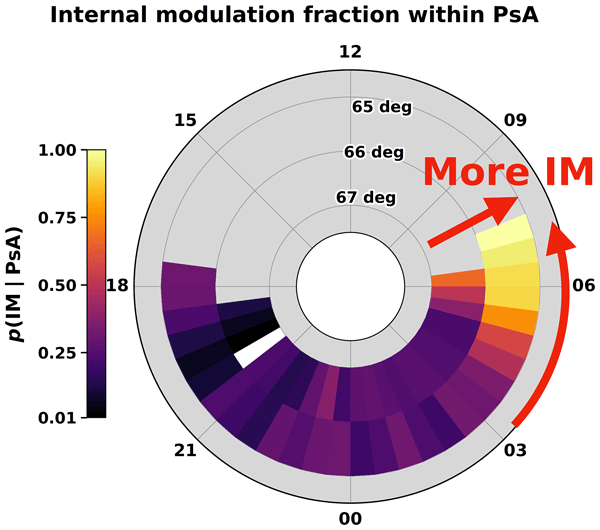
Sota Nanjo, Tomoe Taki, Keisuke Hosokawa, Urban Brändström, Yoshizumi Miyoshi, and Magnar G. Johnsen
Ann. Geophys., 44, 1023–1042, https://doi.org/10.5194/angeo-44-1023-2026, https://doi.org/10.5194/angeo-44-1023-2026, 2026
Short summary
Short summary
Pulsating aurora often contains rapid brightness changes, but their overall behavior has not been well measured. We analyzed high-speed camera images from northern Sweden and Norway with machine learning to identify when these rapid changes occur. We found that they become more common toward the morning and at the lower-latitude sector. This suggests that small-scale auroral fluctuation can help reveal how particles from near-Earth space enter the upper atmosphere.
Gaël Cessateur, Jean Lilensten, Hervé Lamy, Léo Bosse, Magnar G. Johnsen, Antonio Guerrero, David Bolsée, Mathieu Barthelemy, Thijs A. Stockmans, and Frans Snik
EGUsphere, https://doi.org/10.5194/egusphere-2026-3324, https://doi.org/10.5194/egusphere-2026-3324, 2026
This preprint is open for discussion and under review for Annales Geophysicae (ANGEO).
Short summary
Short summary
Auroras are more than beautiful lights: the way their light is polarized may reveal how charged particles enter the upper atmosphere. Such measurements have so far been limited to instruments that observe only a very small part of the sky. In this study, we show that a new polarization camera can map this signal across an aurora. We find that the polarization angle often changes coherently across the scene, while the polarization strength decreases in the brightest parts.
Liisa Juusola, Ari Viljanen, Ilja Honkonen, Magnar Gullikstad Johnsen, Andrew Dimmock, Vanina Lanabere, and Alice Wallner
EGUsphere, https://doi.org/10.5194/egusphere-2026-1110, https://doi.org/10.5194/egusphere-2026-1110, 2026
Short summary
Short summary
During severe space storms, the induced geoelectric field has the potential to cause substantial problems in power grids. We examine the geomagnetically induced currents (GIC) the geoelectric field would have driven in a simple model power grid located in Northern Europe during the May 2024 superstorm. Our results help us understand how the complicated interaction between the driving from space and the response of the conducting ground produces the most intense GIC peaks.
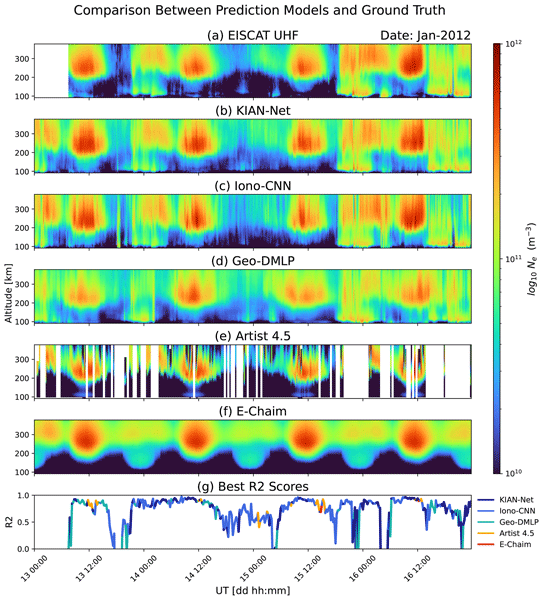
Kian Sartipzadeh, Andreas Kvammen, Björn Gustavsson, Njål Gulbrandsen, Magnar G. Johnsen, Devin Huyghebaert, and Juha Vierinen
Ann. Geophys., 44, 85–107, https://doi.org/10.5194/angeo-44-85-2026, https://doi.org/10.5194/angeo-44-85-2026, 2026
Short summary
Short summary
Knowledge of the charged environment in the upper atmosphere is essential for understanding space weather effects on satellites and radio communication. This environment is difficult to estimate at high latitudes, where aurora cause strong variability. We developed an artificial intelligence model to estimate this environment continuously. Our results show that the model provides reliable estimates even during auroral activity, improving monitoring of the polar upper atmosphere.

Sota Nanjo, Katie Herlingshaw, Tima Sergienko, Gaël Cessateur, Noora Partamies, Magnar G. Johnsen, Keisuke Hosokawa, Hervé Lamy, Yasunobu Ogawa, Antti Kero, Shin-ichiro Oyama, and Masatoshi Yamauchi
Ann. Geophys., 44, 63–84, https://doi.org/10.5194/angeo-44-63-2026, https://doi.org/10.5194/angeo-44-63-2026, 2026
Short summary
Short summary
During the New Year’s Day storm of 2025, we observed rare auroral features: thin, short-lived green stripes and a “picket fence” near the poleward edge of the auroral oval. Using ground cameras and satellites, we found that the stripes sometimes appeared at widely separated longitudes at the same time and often tracked the motion of nearby red auroras. Some stripes were aligned with the magnetic field, while others were not, implying that multiple local processes contribute to their generation.
Gaël Cessateur, Keisuke Hosokawa, Hervé Lamy, Sota Nanjo, Mathieu Barthelemy, Magnar G. Johnsen, and Romain Maggiolo
EGUsphere, https://doi.org/10.5194/egusphere-2026-385, https://doi.org/10.5194/egusphere-2026-385, 2026
Short summary
Short summary
The Auroral Spectrograph in Skibotn has been measuring auroral light spectra since October 2023. We estimate the energy of electrons producing diffuse auroras from red oxygen and blue nitrogen emissions. Our statistical analysis shows that electron energy increases toward the morning sector, confirming previous studies: electron scattering by chorus waves can populate the loss cone and lead to precipitation, while changes in resonance conditions toward dawn favor harder electrons
Stephen Omondi, Spencer Mark Hatch, Andreas Kvammen, Magnar Gullikstad Johnsen, Mathew J. Owens, Kristian Solheim Thinn, and Rodrigo López
EGUsphere, https://doi.org/10.5194/egusphere-2025-6298, https://doi.org/10.5194/egusphere-2025-6298, 2026
Short summary
Short summary
Researchers tested whether combining real-time solar wind data with forecasts can improve predictions of local geomagnetic activity in Norway. Using a machine learning model, they found that accurate solar wind speed and magnetic field direction are key for reliable forecasts over 3 hours ahead, while CME arrival time only helps if magnetic field data is precise.
Anna Willer, Lars William Pedersen, Jan Oechsle, and Marie Vigger Eldor
Geosci. Instrum. Method. Data Syst., 15, 1–6, https://doi.org/10.5194/gi-15-1-2026, https://doi.org/10.5194/gi-15-1-2026, 2026
Short summary
Short summary
The new Arctic magnetic observatory at Pituffik in Greenland is strategically located in a sparsely monitored high-latitude region. Analysis of over a year of data, including baseline stability, temperature control, and calibrated magnetic field measurements demonstrates high data quality and confirms the observatory’s readiness for contribution to the international geomagnetic community.
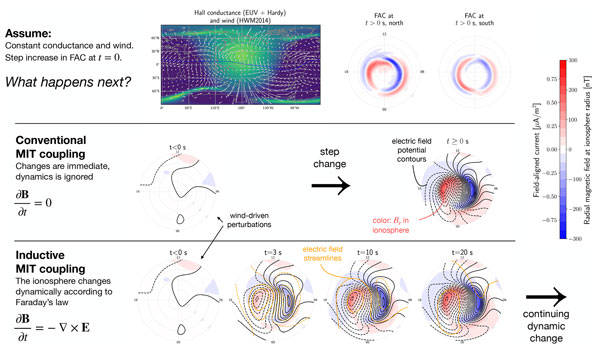
Karl M. Laundal, Andreas S. Skeidsvoll, Beatrice Popescu Braileanu, Spencer M. Hatch, Nils Olsen, and Heikki Vanhamäki
Ann. Geophys., 43, 803–833, https://doi.org/10.5194/angeo-43-803-2025, https://doi.org/10.5194/angeo-43-803-2025, 2025
Short summary
Short summary
The ionosphere is where Earth’s atmosphere overlaps with a gas of charged particles in space. There, collisions with neutral air and electromagnetic forces driven by the solar wind control plasma motion. We created a global model that includes magnetic induction, explaining how electric currents and fields change, offering a more accurate view of atmosphere–space coupling than conventional models based on electric circuits.
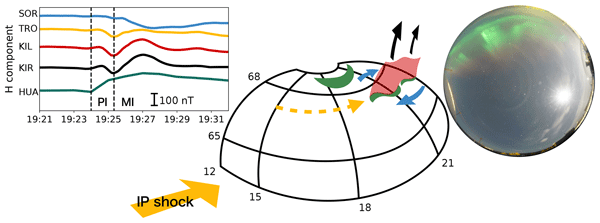
Sota Nanjo, Masatoshi Yamauchi, Magnar Gullikstad Johnsen, Yoshihiro Yokoyama, Urban Brändström, Yasunobu Ogawa, Anna Naemi Willer, and Keisuke Hosokawa
Ann. Geophys., 43, 303–317, https://doi.org/10.5194/angeo-43-303-2025, https://doi.org/10.5194/angeo-43-303-2025, 2025
Short summary
Short summary
Our research explores the shock aurora, which is typically observed on the dayside due to the rapid compression of the Earth's magnetic field. We observed this rare aurora on the nightside, a region where such events are difficult to detect. Using ground-based cameras, we identified new features, including leaping and vortex-like patterns. These findings offer a fresh insight into the interactions between the solar wind and the magnetosphere, enhancing our understanding of space weather and its effects.
Ingeborg Frøystein and Magnar Gullikstad Johnsen
Ann. Geophys., 43, 241–269, https://doi.org/10.5194/angeo-43-241-2025, https://doi.org/10.5194/angeo-43-241-2025, 2025
Short summary
Short summary
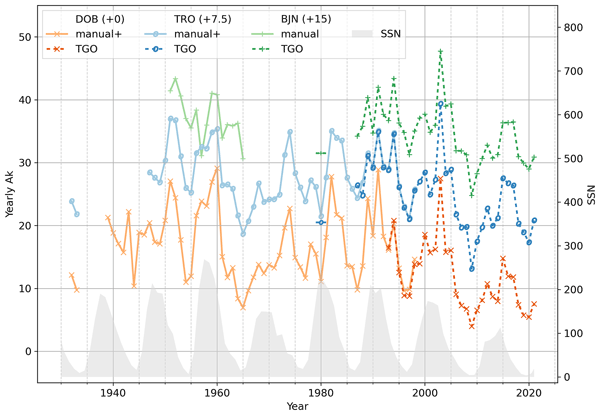
The complete time series of the geomagnetic disturbance index (K) from Norwegian magnetic observatories have been digitized. We compare and discuss the tree methods used to derive the index, finding that each method has strengths and weaknesses. In total, we present all K indices derived from Norwegian observatories since the 1930s until today, the used derivation methods and the long historic time series as a whole, enabling critical use for future scientific work.
Cited articles
Banks, P. M., Chappell, C. R., and Nagy, A. F.: A new model for the interaction of auroral electrons with the atmosphere: Spectral degradation, backscatter, optical emission, and ionization, J. Geophys. Res., 79, 1459–1470, https://doi.org/10.1029/JA079i010p01459, 1974. a, b
Bartels, J.: Annals of The International Geophysical Year, Vol. 4,, chap. 4, The technique of scaling indices K and Q of geomagnetic activity, Pergamon Press, London, New York, Paris, 215–226, https://doi.org/10.1016/B978-1-4832-1304-0.50006-3, 1957. a
Brekke, A., Feder, T., and Berger, S.: Pc4 giant pulsations recorded in Tromso, 1929–1985, J. Atmos. Terr. Phys., 49, 1027–1032, https://doi.org/10.1016/0021-9169(87)90109-7, 1987. a
Elphic, R. C., Lockwood, M., Cowley, S. W. H., and Sandholt, P. E.: Flux transfer events at the magnetopause and in the ionosphere, Geophys. Res. Lett., 17, 2241–2244, https://doi.org/10.1029/gl017i012p02241, 1990. a
Engebretson, M. J., Hughes, W. J., Alford, J. L., Zesta, E., Cahill, L. J., Arnoldy, R. L., and Reeves, G. D.: Magnetometer array for cusp and cleft studies observations of the spatial extent of broadband ULF magnetic pulsations at cusp/cleft latitudes, J. Geophys. Res.-Space, 100, 19 371–19 386, https://doi.org/10.1029/95ja00768, 1995. a, b, c, d
Engebretson, M. J., Posch, J. L., Pilipenko, V. A., and Chugunova, O. M.: ULF waves at very high latitudes, American Geophysical Union, 137–156, https://doi.org/10.1029/169gm10, 2006. a
Eschenhagen, M.: On minute, rapid, periodic changes of the Earth’s magnetism, Terrestrial Magnetism, 2, 105–114, https://doi.org/10.1029/tm002i003p00105, 1897. a
Feldstein, Y. and Starkov, G.: Dynamics of auroral belt and polar geomagnetic disturbances, Planet. Space Sci., 15, 209–229, https://doi.org/10.1016/0032-0633(67)90190-0, 1967. a
Friis-Christensen, E. and Wilhjelm, J.: Polar cap currents for different directions of the interplanetary magnetic field in the Y-Z plane, J. Geophys. Res., 80, 1248–1260, https://doi.org/10.1029/ja080i010p01248, 1975. a, b
Friis-Christensen, E., McHenry, M. A., Clauer, C. R., and Vennerstrøm, S.: Ionospheric traveling convection vortices observed near the polar cleft: A triggered response to sudden changes in the solar wind, Geophys. Res. Lett., 15, 253–256, https://doi.org/10.1029/gl015i003p00253, 1988. a, b
Fuselier, S. A., Kletzing, C. A., Petrinec, S. M., Trattner, K. J., George, D., Bounds, S. R., Sawyer, R. P., Bonnell, J. W., Burch, J. L., Giles, B. L., and Strangeway, R. J.: Multiple Reconnection X-Lines at the Magnetopause and Overlapping Cusp Ion Injections, J. Geophys. Res.-Space, 127, e30354, https://doi.org/10.1029/2022JA030354, 2022. a
Glassmeier, K. H.: ULF pulsations in the polar cusp and cap, in: Electromagnetic Coupling in the Polar Clefts and Caps, edited by: Sandholt, P. E. and Egeland, A., 167 pp., https://doi.org/10.1007/978-94-009-0979-3_12, 1989. a
Greenstadt, E. W., Inouye, G. T., Green, I. M., and Judge, D. L.: Vela 3 magnetograms at 18 RE structure and pulsations in the magnetosheath, J. Geophys. Res., 72, 3855–3876, https://doi.org/10.1029/jz072i015p03855, 1967. a
Harang, L.: Observations of micropulsations in the magnetic records at Tromsø, Terrestrial Magnetism and Atmospheric Electricity, 37, 57, https://doi.org/10.1029/TE037i001p00057, 1932. a
Hasegawa, H., Wang, J., Dunlop, M. W., Pu, Z. Y., Zhang, Q. H., Lavraud, B., Taylor, M. G. G. T., Constantinescu, O. D., Berchem, J., Angelopoulos, V., McFadden, J. P., Frey, H. U., Panov, E. V., Volwerk, M., and Bogdanova, Y. V.: Evidence for a flux transfer event generated by multiple X-line reconnection at the magnetopause, Geophys. Res. Lett., 37, L16101, https://doi.org/10.1029/2010GL044219, 2010. a
Heppner, J. P., Sugiura, M., Skillman, T. L., Ledley, B. G., and Campbell, M.: OGO-A magnetic field observations, J. Geophys. Res., 72, 5417–5471, https://doi.org/10.1029/jz072i021p05417, 1967. a
Holzworth, R. H. and Meng, C.: Mathematical representation of the auroral oval, Geophys. Res. Lett., 2, 377–380, https://doi.org/10.1029/gl002i009p00377, 1975. a
Jacobs, J. A.: Geomagnetic micropulsations, vol. 1, Springer Verlag, https://doi.org/10.1007/978-3-642-86828-3, 1970. a
Jacobs, J. A., Kato, Y., Matsushita, S., and Troitskaya, V. A.: Classification of geomagnetic micropulsations, J. Geophys. Res., 69, 180–181, https://doi.org/10.1029/jz069i001p00180, 1964. a, b
Johnsen, M. G. and Lorentzen, D. A.: A statistical analysis of the optical dayside open/closed field line boundary, J. Geophys. Res.-Space, 117, https://doi.org/10.1029/2011ja016984, 2012. a, b
Kepko, L. and Kivelson, M.: Generation of Pi2 pulsations by bursty bulk flows, J. Geophys. Res.-Space, 104, 25021–25034, https://doi.org/10.1029/1999ja900361, 1999. a
Kozyreva, O., Pilipenko, V., Lorentzen, D., Baddeley, L., and Hartinger, M.: Transient Oscillations Near the Dayside Open‐Closed Boundary: Evidence of Magnetopause Surface Mode?, J. Geophys. Res.-Space, 124, 9058–9074, https://doi.org/10.1029/2018ja025684, 2019. a
Lee, L. C., Shi, Y., and Lanzerotti, L. J.: A mechanism for the generation of cusp region hydromagnetic waves, J. Geophys. Res., 93, 7578–7585, https://doi.org/10.1029/JA093iA07p07578, 1988. a
Lester, M., Hughes, J. W., and Singer, H. J.: Polarization patterns of Pi 2 magnetic pulsations and the substorm current wedge, J. Geophys. Res.-Space, 88, 7958–7966, https://doi.org/10.1029/ja088ia10p07958, 1983. a
Lockwood, M. and Wild, M. N.: On the quasi-periodic nature of magnetopause flux transfer events, J. Geophys. Res., 98, 5935–5940, https://doi.org/10.1029/92JA02375, 1993. a
Mantas, G. P. and Walker, J. C.: The penetration of soft electrons into the ionosphere, Planet. Space Sci., 24, 409–423, https://doi.org/10.1016/0032-0633(76)90085-4, 1976. a, b
Matzka, J., Bronkalla, O., Tornow, K., Elger, K., and Stolle, C.: Geomagnetic Kp index, https://doi.org/10.5880/KP.0001, 2021a. a
Matzka, J., Stolle, C., Yamazaki, Y., Bronkalla, O., and Morschhauser, A.: The Geomagnetic Kp Index and Derived Indices of Geomagnetic Activity, Space Weather, 19, https://doi.org/10.1029/2020sw002641, 2021b. a
McHarg, M. G. and Olson, J. V.: Correlated optical and ULF magnetic observations of the winter cusp – Boundary layer system, Geophysical Res. Lett., 19, 817–820, https://doi.org/10.1029/92gl00117, 1992. a
McHarg, M. G., Olson, J. V., and Newell, P. T.: ULF cusp pulsations: Diurnal variations and interplanetary magnetic field correlations with ground‐based observations, J. Geophys. Res.-Space, 100, 19729–19742, https://doi.org/10.1029/94ja03054, 1995. a, b
Moen, J. and Brekke, A.: The solar flux influence on quiet time conductances in the auroral ionosphere, Geophys. Res. Lett., 20, 971–974, https://doi.org/10.1029/92gl02109, 1993. a, b
Motoba, T., Ebihara, Y., Ogawa, Y., Kadokura, A., Engebretson, M. J., Angelopoulos, V., Gerrard, A. J., and Weatherwax, A. T.: On the Driver of Daytime Pc3 Auroral Pulsations, Geophys. Res. Lett., 46, 553–561, https://doi.org/10.1029/2018gl080842, 2019. a, b, c
Newell, P. T. and Meng, C.: The cusp and the cleft/boundary layer: Low‐altitude identification and statistical local time variation, J. Geophys. Res.-Space, 93, 14549–14556, https://doi.org/10.1029/ja093ia12p14549, 1988. a
Newell, P. T. and Meng, C.-I.: Dipole tilt angle effects on the latitude of the cusp and cleft/low-latitude boundary layer, J. Geophys. Res.-Space, 94, 6949–6953, https://doi.org/10.1029/JA094iA06p06949, 1989. a, b
Newell, P. T., Meng, C., Sibeck, D. G., and Lepping, R.: Some low‐altitude cusp dependencies on the interplanetary magnetic field, J. Geophys. Res.-Space, 94, 8921–8927, https://doi.org/10.1029/ja094ia07p08921, 1989. a
Newell, P. T., Ruohoniemi, J. M., and Meng, C.: Maps of precipitation by source region, binned by IMF, with inertial convection streamlines, J. Geophys. Res.-Space , 109, https://doi.org/10.1029/2004ja010499, 2004. a, b
Pilipenko, V., Belakhovsky, V., Engebretson, M. J., Kozlovsky, A., and Yeoman, T.: Are dayside long-period pulsations related to the cusp?, Ann. Geophys., 33, 395–404, https://doi.org/10.5194/angeo-33-395-2015, 2015. a, b, c
Pinnock, M., Rodger, A. S., Dudeney, J. R., Baker, K. B., Newell, P. T., Greenwald, R. A., and Greenspan, M. E.: Observations of an enhanced convection channel in the cusp ionosphere, J. Geophys. Res., 98, 3767–3776, https://doi.org/10.1029/92JA01382, 1993. a
Richmond, A. D.: Ionospheric Electrodynamics Using Magnetic Apex Coordinates, J. Geomagn. Geoelectr., 47, 191–212, https://doi.org/10.5636/jgg.47.191, 1995. a
Rinne, Y., Moen, J., Oksavik, K., and Carlson, H. C.: Reversed flow events in the winter cusp ionosphere observed by the European Incoherent Scatter (EISCAT) Svalbard radar, J. Geophys. Res.-Space, 112, A10313, https://doi.org/10.1029/2007JA012366, 2007. a
Rolf, B.: Giant micropulsations at Abisko, Terrestrial Magnetism and Atmospheric Electricity, 36, 9, https://doi.org/10.1029/TE036i001p00009, 1931. a
Rostoker, G., Samson, J. C., and Higuchi, Y.: Occurrence of Pc 4, 5 micropulsation activity at the polar cusp, J. Geophys. Res., 77, 4700–4706, https://doi.org/10.1029/JA077i025p04700, 1972. a, b, c
Russell, C. T. and Elphic, R. C.: Initial ISEE Magnetometer Results: Magnetopause Observations, Space Sci. Rev., 22, 681–715, https://doi.org/10.1007/BF00212619, 1978. a
Russell, C. T. and Elphic, R. C.: ISEE observations of flux transfer events at the dayside magnetopause, Geophys. Res. Lett., 6, 33–36, https://doi.org/10.1029/gl006i001p00033, 1979. a
Sakurai, T. and McPherron, R. L.: Satellite observations of Pi 2 activity at synchronous orbit, J. Geophys. Res.-Space, 88, 7015–7027, https://doi.org/10.1029/ja088ia09p07015, 1983. a, b
Samson, J. C., Harrold, B. G., Ruohoniemi, J. M., Greenwald, R. A., and Walker, A. D. M.: Field line resonances associated with MHD waveguides in the magnetosphere, Geophys. Res. Lett., 19, 441–444, https://doi.org/10.1029/92gl00116, 1992. a
Sandholt, P. E. and Farrugia, C. J.: On the dynamic cusp aurora and IMF By, J. Geophys. Res.-Space, 104, 12461–12472, https://doi.org/10.1029/1999ja900126, 1999. a, b
Sonett, C. P., Judge, D. L., and Kelso, J. M.: Evidence concerning instabilities of the distant geomagnetic field: Pioneer I, J. Geophys. Res., 64, 941–943, https://doi.org/10.1029/jz064i008p00941, 1959. a
Sonnerup, B. U. Ö., Cahill, L. J., and Davis, L. R.: Resonant vibration of the magnetosphere observed from Explorer 26, J. Geophys. Res., 74, 2276–2288, https://doi.org/10.1029/ja074i009p02276, 1969. a
Stauning, P.: Investigations of ionospheric radio wave absorption processes using imaging riometer techniques, J. Atmos. Terr. Phy., 58, 753–764, https://doi.org/10.1016/0021-9169(95)00072-0, 1996. a
Stauning, P.: Polar convection-related ionospheric radiowave absorption processes observed by imaging riometers, Adv. Space Res., 22, 1279–1288, https://doi.org/10.1016/S0273-1177(98)00172-0, 1998. a
Takahashi, K. and Liou, K.: Longitudinal structure of low-latitude Pi2 pulsations and its dependence on aurora, J. Geophys. Res.-Space, 109, A12206, https://doi.org/10.1029/2004JA010580, 2004. a
Vennerstrøm, S.: Dayside magnetic ULF power at high latitudes: A possible long-term proxy for the solar wind velocity?, J. Geophys. Res.-Space, 104, 10145–10157, https://doi.org/10.1029/1999ja900015, 1999. a
Øieroset, M., Sandholt, P. E., Lühr, H., Denig, W. F., and Moretto, T.: Auroral and geomagnetic events at cusp/mantle latitudes in the prenoon sector during positive IMF By conditions: Signatures of pulsed magnetopause reconnection, J. Geophys. Res.-Space, 102, 7191–7205, https://doi.org/10.1029/96ja03716, 1997. a
Short summary
Rapid geomagnetic variations in the ultra-low frequency band are observed using ground-based magnetometers. We apply four years of data from West Greenland in a statistical analysis of the distribution of such variations. We identify a rapid geomagnetic variation population associated with the magnetospheric cusp that is separate from the auroral oval during summer. Earlier studies, which were mainly performed in winter, failed to unambiguously identify these variations.
Rapid geomagnetic variations in the ultra-low frequency band are observed using ground-based...


