
Articles | Volume 44, issue 2
https://doi.org/10.5194/angeo-44-743-2026
© Author(s) 2026. This work is distributed under
the Creative Commons Attribution 4.0 License.
the Creative Commons Attribution 4.0 License.
https://doi.org/10.5194/angeo-44-743-2026
© Author(s) 2026. This work is distributed under
the Creative Commons Attribution 4.0 License.
the Creative Commons Attribution 4.0 License.
Regular paper
| 
17 Aug 2026
Regular paper |
| 17 Aug 2026
| 17 Aug 2026
Magnetosphere–ionosphere response to the 21 and 25 June 2015 coronal mass ejections
Somaiyeh Sabri
CORRESPONDING AUTHOR
Institute of Geophysics, University of Tehran, Tehran, Iran
Stefaan Poedts
Center for mathematical Plasma Astrophysics, Department of Mathematics, KU Leuven, Celestijnenlaan 200B, 3001 Leuven, Belgium
Institute of Physics, University of Maria Curie-Skłodowska, ul. Radziszewskiego 10, 20-031 Lublin, Poland
Related authors
Anita Mohebbi and Somaiyeh Sabri
ISPRS Ann. Photogramm. Remote Sens. Spatial Inf. Sci., X-4-W8-2025, 541–547, https://doi.org/10.5194/isprs-annals-X-4-W8-2025-541-2026, https://doi.org/10.5194/isprs-annals-X-4-W8-2025-541-2026, 2026
Somaiyeh Sabri and Stefaan Poedts
EGUsphere, https://doi.org/10.5194/egusphere-2024-1921, https://doi.org/10.5194/egusphere-2024-1921, 2024
Preprint archived
Short summary
Short summary
The study highlights that interactions of CMEs play a significant role in determining their impact on Earth, highlighting that their initial speeds, while similar, are less influential. Besides, the EUHFORIA numerical model align with the findings of the GFZ German research center, this implies that EUHFORIA has also the capability to compute and potentially forecast the impact of CMEs on the Earth.
Anita Mohebbi and Somaiyeh Sabri
ISPRS Ann. Photogramm. Remote Sens. Spatial Inf. Sci., X-4-W8-2025, 541–547, https://doi.org/10.5194/isprs-annals-X-4-W8-2025-541-2026, https://doi.org/10.5194/isprs-annals-X-4-W8-2025-541-2026, 2026
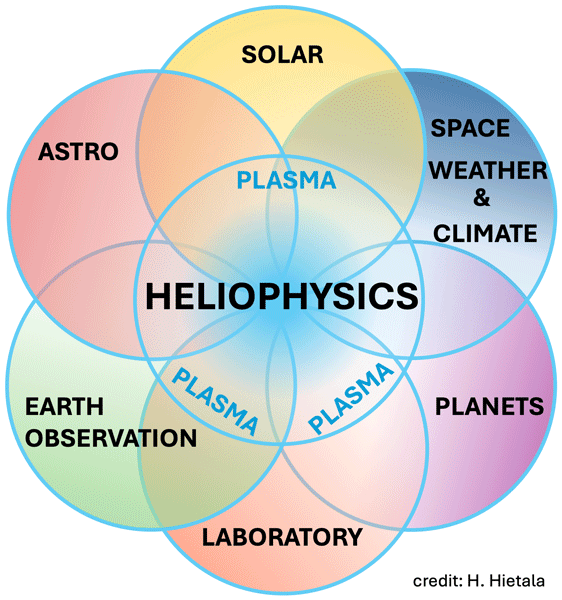
Rumi Nakamura, Thierry Dudok de Wit, Geraint H. Jones, Matt G. G. T. Taylor, Nicolas André, Charlotte Goetz, Lina Z. Hadid, Laura A. Hayes, Heli Hietala, Caitríona M. Jackman, Larry Kepko, Aurélie Marchaudon, Adam Masters, Mathew Owens, Noora Partamies, Stefaan Poedts, Jonathan Rae, Yuri Shprits, Manuela Temmer, Daniel Verscharen, and Robert F. Wimmer-Schweingruber
Ann. Geophys., 43, 855–879, https://doi.org/10.5194/angeo-43-855-2025, https://doi.org/10.5194/angeo-43-855-2025, 2025
Short summary
Short summary
Heliophysics spans a wide range of disciplines covering the study of the Sun and the different Solar System bodies, such as Earth and other planets, moons, comets, and asteroids, and their interactions with the Sun, focusing on plasma and atmospheric processes. A grass-roots effort has been recently started toward establishing a European Heliophysics Community (https://www.heliophysics.eu/). This white paper outlines the motivation, priorities, and a future vision of Heliophysics in Europe.
Somaiyeh Sabri and Stefaan Poedts
EGUsphere, https://doi.org/10.5194/egusphere-2024-1921, https://doi.org/10.5194/egusphere-2024-1921, 2024
Preprint archived
Short summary
Short summary
The study highlights that interactions of CMEs play a significant role in determining their impact on Earth, highlighting that their initial speeds, while similar, are less influential. Besides, the EUHFORIA numerical model align with the findings of the GFZ German research center, this implies that EUHFORIA has also the capability to compute and potentially forecast the impact of CMEs on the Earth.
Cited articles
Angelopoulos, V., McFadden, J. P., Larson, D., Carlson, C. W., Mende, S. B., Frey, H., Phan, T., Sibeck, D. G., Glassmeier, K.-H., Auster, U., Donovan, E., Mann, I. R., Rae, I. J., Russell, C. T., Runov, A., Zhou, X.-Y., and Kepko, L.: Tail Reconnection Triggering Substorm Onset, Science, 321, 931–935, https://doi.org/10.1126/science.1160495, 2008. a, b
Araki, T.: A physical model of the geomagnetic sudden commencement, J. Geophys. Res., 79, 3131–3138, https://doi.org/10.1029/GM081p0183, 1974. a
Araki, T.: A Physical Model of the Geomagnetic Sudden Commencement, in: Solar Wind Sources of Magnetospheric Ultra-Low-Frequency Waves, edited by: Russell, J. L. and Southwood, D. J., Geophysical Monograph Series, 81, American Geophysical Union, Washington, DC, 183–200, https://doi.org/10.1029/GM081p0183, 1994. a, b
Astafyeva, E., Yasyukevich, Y., Maksikov, A., and Zhivetiev, I.: Geomagnetic storms, super-storms, and their impacts on GPS-based navigation systems, Space Weather, 12, 508–525, https://doi.org/10.1002/2014SW001072, 2014. a
Axford, W. I. and Hines, C. O.: A unifying theory of high-latitude geophysical phenomena and geomagnetic storms, Can. J. Phys., 39, 1433–1464, https://doi.org/10.1139/p61-172, 1961. a
Baker, D. N., Pulkkinen, T. I., Angelopoulos, V., Baumjohann, W., and McPherron, R. L.: Neutral line model of substorms: Past results and present view, J. Geophys. Res., 101, 12975–13010, https://doi.org/10.1029/95JA03753, 1996. a, b
Bartels, J. and Veldkamp, J.: International data on magnetic disturbances, first quarter, 1949, J. Geophys. Res., 54, 295–299, https://doi.org/10.1029/JZ054i003p00295, 1949. a
Bartels, J. and Veldkamp, J.: International data on magnetic disturbances, fourth quarter, 1949, J. Geophys. Res., 55, 214–216, https://doi.org/10.1029/JZ055i002p00214, 1950.
Benson, D. J.: A simple finite element formulation for computing stress in large deformation problems, Comput. Methods Appl. Mech. Eng., 99, 235–252, https://doi.org/10.1016/0045-7825(92)90042-I, 1992. a
Burgess, D. and Scholer, M.: Collisionless Shocks, Space Sci. Rev., 178, 513–533, https://doi.org/10.1007/s11214-013-9969-6, 2013. a, b
Chittenden, J. P., Lebedev, S. V., Jennings, C. A., Bland, S. N., and Ciardi, A.: X-ray generation mechanisms in three-dimensional simulations of wire array Z-pinches, Plasma Phys. Control. Fusion, 46, B457–B476, https://doi.org/10.1088/0741-3335/46/12B/039, 2004. a, b, c, d
Ciardi, A., Lebedev, S. V., Frank, A., Blackman, E. G., Chittenden, J. P., Jennings, C. A., Ampleford, D. J., Bland, S. N., Bott, S. C. C., Rapley, J., Hall, G. N., Sherlock, M., Lery, T., Begg, S. V., Farley, M., Rubery, M., Mills, S., Huang, J., Zhou, C., Yan, J., Qiu, M., Zhang, P., Li, L., Chen, M., Wang, P., Liu, H., Yang, X., Zhao, Y., Wu, H., Lin, C., Zheng, H., Sun, X., Ma, Z., Zhu, G., Hu, Q., Guo, F., He, Q., Luo, J., Deng, X., Peng, F., Xu, M., Feng, X., Cao, J., Song, Y., Xie, H., Tang, C., Fan, C., Jiang, Y., Yu, S., Du, G., Xia, J., Wei, J., Jia, M., Cui, C., Ning, Z., Gao, Y., Shen, X., Zou, B., Dai, L., Ren, H., Shi, Y., Xue, J., Hou, G., Lei, M., Bai, Z., Dong, W., Yin, F., Lv, Y., Tao, C., Cai, X., Xiang, Z., Kong, Y., Qian, J., Tu, C., Lan, Y., Sheng, Z., Cao, Y., and Xia, X.: The evolution of magnetic tower jets in the laboratory, Phys. Plasmas, 14, 056501, https://doi.org/10.1063/1.2436479, 2007. a, b, c, d
Demyanov, V. V., Yasyukevich, Yu. V., Ishin, A. B., and Astafyeva, E. I.: Ionospheric super-bubble effects on the GPS positioning relative to the orientation of signal path and geomagnetic field direction, GPS Solut., 16, 181–189. https://doi.org/10.1007/s10291-011-0217-9, 2012. a
Dryer, M.: Interplanetary studies: Propagation of disturbances between the Sun and the magnetosphere, Space Sci. Rev., 67, 363–419, https://doi.org/10.1007/BF00756075, 1994. a
Dryer, M., Merritt, D. L., and Aronson, P. M.: Interaction of a plasma cloud with the Earth's magnetosphere, J. Geophys. Res., 72, 2955–2962, https://doi.org/10.1029/JZ072i011p02955, 1967. a
Dungey, J. W.: Interplanetary Magnetic Field and the Auroral Zones, Phys. Rev. Lett., 6, 47–48, https://doi.org/10.1103/PhysRevLett.6.47, 1961. a
Eastwood, J. P., Biffis, E., Hapgood, M. A., Green, L., Bisi, M. M., Bentley, R. D., Wicks, R., McKinnel, L. A., Gibbs, M., and Burnett, C.: Quantifying the economic value of space weather forecasting for power grids: An exploratory study, Space Weather, 16, 2052–2067, https://doi.org/10.1029/2018SW002003, 2018. a
Eggington, J. W. B., Eastwood, J. P., Mejnertsen, L., Desai, R. T., and Chittenden, J. P.: Dipole tilt effect on magnetopause reconnection and the steady-state magnetosphere-ionosphere system: Global MHD simulations, J. Geophys. Res.-Space, 125, e2019JA027510, https://doi.org/10.1029/2019JA027510, 2020. a, b, c, d
Goldstein, H. and Schindler, K.: On the role of the ionosphere in substorms: Generation of field-aligned currents, J. Geophys. Res., 83, 2574, https://doi.org/10.1029/JA083iA06p02574, 1978. a
Gombosi, T. I., Chen, Y., Glocer, A., Huang, Z., Jia, X., Liemohn, M. W., Manchester, W. B., Pulkkinen, T., Sachdeva, N., Al Shidi, Q., Sokolov, I. V., Szente, J., Tenishev, V., Tóth, G., van der Holst, B., Welling, D. T., Zhao, L., and Zou, S.: What sustained multi-disciplinary research can achieve: The space weather modeling framework, J. Space Weather Space Clim., 11, 42, https://doi.org/10.1051/swsc/2021020, 2021. a
Gonzalez, W. D., Joselyn, J. A., Kamide, Y., Kroehl, H. W., Rostoker, G., Tsurutani, B. T., and Vasyliūnas, V. M.: What is a geomagnetic storm?, J. Geophys. Res., 99, 5771–5792, https://doi.org/10.1029/93JA02867, 1994. a, b, c
Gordeev, E., Sergeev, V., Honkonen, I., and Wiltberger, M.: Global MHD simulation of the magnetotail reconnection during the substorm growth phase, Space Weather, 13, 868–881, https://doi.org/10.1002/2015SW001279, 2015. a
Gosling, J. T.: The solar flare myth, J. Geophys. Res., 98, 18937–18959, https://doi.org/10.1029/93JA01896, 1993. a
Grib, S. A., Brunelli, B. E., Dryer, M., and Shen, W. W.: Interaction of non-perpendicular/parallel solar wind shock waves with the Earth's bow shock, J. Geophys. Res., 84, 5907–5912, https://doi.org/10.1029/JA084iA10p05907, 1979. a
Hayes, L. A., Gallagher, P. T., McCauley, J., Dennis, B. R., Ireland, J., and Inglis, A.: Pulsations in the Earth's lower ionosphere synchronized with solar flare emission, J. Geophys. Res.-Space Phys., 122, 9841–9847, https://doi.org/10.1002/2017JA024647, 2017. a
Hesse, M., Birn, J., and Kuznetsova, M.: Collisionless magnetic reconnection: Electron processes and transport modeling, J. Geophys. Res.-Space Phys., 106, 3721–3735, https://doi.org/10.1029/1999JA001002, 2001. a, b
Iyemori, T.: Storm-time magnetospheric currents inferred from mid-latitude geomagnetic field variations, J. Geomag. Geoelectr., 42, 1249–1265, https://doi.org/10.5636/jgg.42.1249, 1990. a
Jennings, C. A., Cuneo, M. E., Waisman, E. M., Sinars, D. B., Ampleford, D. J., Bennett, G. R., Bland, S. N., Bott, S. C. C., Chittenden, J. P., Harvey-Thompson, A. J., Hui, H., Lebedev, S. V., Ruiz, D. E., and Schollmeier, M. S.: Simulations of the implosion and stagnation of compact wire arrays, Phys. Plasmas, 17, 092703, https://doi.org/10.1063/1.3474947, 2010. a, b
Kappenman, J. G.: An introduction to power grid impacts and vulnerabilities from space weather, in: Space Storms and Space Weather Hazards, edited by: Daglis, I. A., 287–299, Springer, https://doi.org/10.1007/978-94-010-0983-6_13, 2001. a
Lucek, E. A., Constantinescu, D., Goldstein, M. L., Pickett, J., Pinçon, J.-L., Sahraoui, F., Treumann, R. A., and Walker, S. N.: The magnetosheath, Space Sci. Rev., 118, 95–152, https://doi.org/10.1007/s11214-005-3825-2, 2005. a, b
Lyon, J. G.: The solar wind-magnetosphere-ionosphere system, Science, 288, 1987, https://doi.org/10.1126/science.288.5473.1987, 2000. a
Mejnertsen, L., Eastwood, J. P., Chittenden, J. P., and Masters, A.: Global MHD simulations of the Earth's bow shock shape, J. Geophys. Res.-Space, 121, 7497–7512, https://doi.org/10.1002/2016JA022708, 2016. a, b, c
Mejnertsen, L., Eastwood, J. P., Hietala, H., Schwartz, S. J., and Chittenden, J. P.: Dipole tilt effect on magnetopause reconnection and the steady-state magnetosphere-ionosphere system: Global MHD simulations, J. Geophys. Res.-Space, 123, 259–273, https://doi.org/10.1002/2017JA024764, 2018. a, b, c, d
Merka, J., Szabo, A., Slavin, J. A., and Peredo, M.: Global distribution of the magnetopause, J. Geophys. Res., 110, A04202, https://doi.org/10.1029/2004JA010729, 2005. a
Moore, T. E., Peterson, W. K., Russell, C. T., Chandler, M. O., Collier, M. R., Delcourt, D. C., Fung, S. F., Green, J. L., Horwitz, J. L., Moore, C. J., Rasmussen, C. E., Reiff, P. H., Scudder, J. D., and Waite, J. H.: The Wind Plasma and Energetic Particle Experiment, Geophys. Res. Lett., 26, 2343–2346, https://doi.org/10.1029/1999GL900495, 1999. a
Newell, P. T., Sotirelis, T., Liou, K., and Rich, F. J.: Phase boundaries, fair-weather, and the polar cap, J. Geophys. Res., 113, A04218, https://doi.org/10.1029/2007JA012845, 2008. a
Ogino, T., Walker, R. J., and Ashour-Abdalla, M.: A global magnetohydrodynamic simulation of the response of the magnetosphere to a northward turning of the interplanetary magnetic field, J. Geophys. Res.-Space Phys., 99, 11027–11042, https://doi.org/10.1029/93JA03313, 1994. a
Pallocchia, G.: A sunward propagating fast wave in the magnetosheath observed after the passage of an interplanetary shock, J. Geophys. Res.-Space Phys., 118, 331–339, https://doi.org/10.1029/2012JA017851, 2013. a
Peredo, M., Slavin, J. A., Mazur, E., and Curtis, S. A.: Three-dimensional position and shape of the bow shock and their variation with Alfvénic, sonic and magnetosonic Mach numbers and interplanetary magnetic field orientation, J. Geophys. Res.-Space Phys., 100, 7907–7916, https://doi.org/10.1029/94JA02545, 1995. a
Pirjola, R., Kauristie, K., Lappalainen, H., Viljanen, A., and Pulkkinen, A.: Space weather risk, Space Weather, 3, S02A02, https://doi.org/10.1029/2004SW000112, 2005. a
Pomoell, J. and Poedts, S.: EUHFORIA: European Heliospheric Forecasting Information Asset, J. Space Weather Space Clim., 8, A35, https://doi.org/10.1051/swsc/2018020, 2018. a, b
Poedts, S., Kochanov, A., Lani, A., Teunissen, J., and Pomoell, J.: EUHFORIA predictions for the 10 September 2017 CME event, J. Space Weather Space Clim., 10, 14, https://doi.org/10.1051/swsc/2020017, 2020. a
Priyadarshi, S., Zhang, Q. H., Ma, Y. Z., Wang, Y., and Xing, Z. Y.: Global MHD simulation of the magnetopause reconnection, J. Geophys. Res.-Space, 121, 5706–5718, https://doi.org/10.1002/2015JA022182, 2016. a
Pulkkinen, T.: Spontaneous formation of the magnetotail current sheet, Living Rev. Sol. Phys., 4, 1, https://doi.org/10.12942/lrsp-2007-1, 2007. a, b
Raeder, J., Walker, R. J., and Ashour-Abdalla, M.: The structure of the distant geomagnetic tail during long periods of northward IMF, Geophys. Res. Lett., 22, 349–352, https://doi.org/10.1029/94GL03380, 1995. a
Rama Rao, P. V. S., Gopi Krishna, S., Vara Prasad, J., Prasad, S. N. V. S., Prasad, D. S. V. V. D., and Niranjan, K.: Geomagnetic storm effects on GPS based navigation, Ann. Geophys., 27, 2101–2110, https://doi.org/10.5194/angeo-27-2101-2009, 2009. a
Ridley, A. J., Gombosi, T. I., and DeZeeuw, D. L.: Ionospheric control of the magnetosphere: conductance, Ann. Geophys., 22, 567–584, https://doi.org/10.5194/angeo-22-567-2004, 2004. a, b
Robinson, R. M., Vondrak, R. R., Miller, K., Vesecky, J., and Wallis, D.: Estimating auroral ionospheric conductivities from auroral electron precipitation parameters, J. Geophys. Res., 92, 2565–2569, https://doi.org/10.1029/JA092iA03p02565, 1987. a, b
Rodgers-Lee, D., Davies, J. A., Barnard, L. A., and Poedts, S.: EUHFORIA predictions for the 10 September 2017 CME event, Space Weather, 19, e2020SW002694, https://doi.org/10.1029/2020SW002694, 2021. a
Sabri, S. and Poedts, S.: Investigation of the May 2024 solar storm through EUHFORIA/gorgon-space simulations and global SuperDARN observations, Adv. Space Res., 77, 4000–4017, https://doi.org/10.1016/j.asr.2025.11.081, 2025. a, b
Sabri, S., Mahmoudian, A., and Poedts, S.: Investigation of the May 2024 solar storm through EUHFORIA/Gorgon-Space simulations and global SuperDARN observations, J. Geophys. Res.-Space Phys., 130, e2024JA033554, https://doi.org/10.1029/2024JA033554, 2025.
Sabri, S., Mahmoudian, A., and Poedts, S.: Investigation of the May 2024 solar storm through EUHFORIA/gorgon-space simulations and global SuperDARN observations, J. Geophys. Res.-Space, 130, e2024JA033554, https://doi.org/10.1029/2024JA033554, 2025. a
Samsonov, A. A., Sibeck, D. G., and Imber, J.: MHD simulation for the interaction of an interplanetary shock with the Earth's magnetosphere, J. Geophys. Res., 112, A12220, https://doi.org/10.1029/2007JA012627, 2007. a
Scolini, C., Poedts, S., Rodriguez, L., Mierla-Chanocas, B., Verbeeck, C., Zhong, Z., West, M. J., and Lamy, P.: EUHFORIA predictions for the 10 September 2017 CME event, Astron. Astrophys., 642, A138, https://doi.org/10.1051/0004-6361/202038489, 2020. a
Smith, A. W., Freeman, M. P., Rae, I. J., and Forsyth, C.: The space weather impacts of the 11 September 2017 solar flares, Space Weather, 17, 1605–1618, https://doi.org/10.1029/2019SW002257, 2019. a
Smith, R. A., Lazarus, J., Hohenberger, M., Marocchino, A., Robinson, J. S., Lebedev, S. V., Bland, S. N., and Chittenden, J. P.: X-ray generation mechanisms in three-dimensional simulations of wire array Z-pinches, Plasma Phys. Control. Fusion, 49, B117–B124, https://doi.org/10.1088/0741-3335/49/12B/S11, 2007. a
Sorathia, K. A., Michael, A., Merkin, V. G., Ohtani, S., Keesee, A. M., Sciola, A., Lin, D., Garretson, J., Ukhorskiy, A. Y., Bao, S., Roedig, C. B., and Pulkkinen, A.: Multiscale magnetosphere-ionosphere coupling during stormtime: A case study of the dawnside current wedge, J. Geophys. Res.-Space Phys., 128, e2023JA031594, https://doi.org/10.1029/2023JA031594, 2023. a
Spreiter, J. R., Summers, A. L., and Alksne, A. Y.: The interaction of the solar wind with the magnetosphere, J. Geophys. Res., 71, 1–24, https://doi.org/10.1029/JZ071i001p00001, 1966. a, b, c
Sugiura, M.: Hourly values of equatorial Dst for the IGY, Ann. Int. Geophys. Y., 35, 7–20, 1964. a
Wiltberger, M., Rigler, E. J., Merkin, V., and Lyon, J. G.: Global MHD simulation of the magnetopause reconnection, J. Geophys. Res.-Space, 122, 7055–7070, https://doi.org/10.1002/2017JA024082, 2017. a, b
Yagi, M., Seki, K., and Matsumoto, Y.: Development of a magnetohydrodynamic simulation code satisfying the solenoidal magnetic field condition, Comput. Phys. Commun., 180, 1550, https://doi.org/10.1016/j.cpc.2009.04.010, 2009. a
Short summary
Coronal mass ejections (CMEs) threaten Earth. We studied their interaction with the magnetosphere and ionosphere. Using the European Heliospheric Forecasting Information Asset (EUHFORIA), we calculated CME arrival times and investigated Earth's responses. Results show EUHFORIA and Gorgon-Space codes agree well in simulating CME propagation and interactions.
Coronal mass ejections (CMEs) threaten Earth. We studied their interaction with the...


