
Articles | Volume 44, issue 2
https://doi.org/10.5194/angeo-44-595-2026
© Author(s) 2026. This work is distributed under
the Creative Commons Attribution 4.0 License.
the Creative Commons Attribution 4.0 License.
https://doi.org/10.5194/angeo-44-595-2026
© Author(s) 2026. This work is distributed under
the Creative Commons Attribution 4.0 License.
the Creative Commons Attribution 4.0 License.
Regular paper
| 
07 Jul 2026
Regular paper |
| 07 Jul 2026
| 07 Jul 2026
Characterising mesoscale magnetopause surface waves within magnetosphere–ionosphere–ground coupling

Department of Physics, Imperial College London, London, United Kingdom
David Southwood
Department of Physics, Imperial College London, London, United Kingdom
Song Zhang
Department of Physics, Imperial College London, London, United Kingdom
now at: HEC Paris, Paris, France
Qiran Sun
Department of Physics, Imperial College London, London, United Kingdom
Mike Heyns
Department of Physics, Imperial College London, London, United Kingdom
now at: Trillium Technologies, London, United Kingdom
Related authors
Niklas Grimmich, Adrian Pöppelwerth, Martin Owain Archer, David Gary Sibeck, Ferdinand Plaschke, Wenli Mo, Vicki Toy-Edens, Drew Lawson Turner, Hyangpyo Kim, and Rumi Nakamura
Ann. Geophys., 43, 151–173, https://doi.org/10.5194/angeo-43-151-2025, https://doi.org/10.5194/angeo-43-151-2025, 2025
Short summary
Short summary
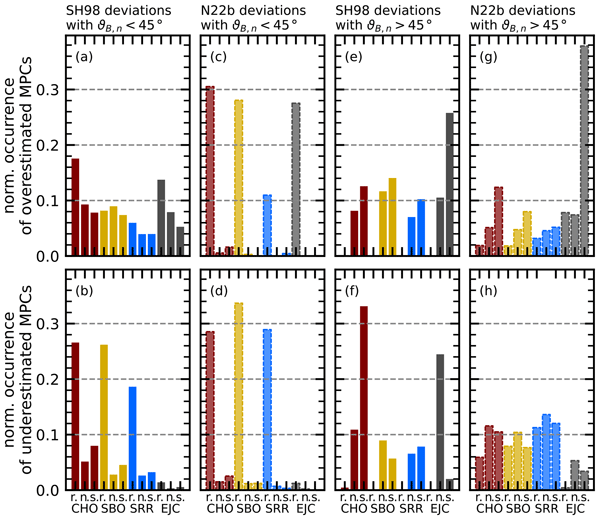
The boundary of Earth's magnetic field, the magnetopause, deflects and reacts to the solar wind, the energetic particles emanating from the Sun. We find that certain types of solar wind favour the occurrence of deviations between the magnetopause locations observed by spacecraft and those predicted by models. In addition, the turbulent region in front of the magnetopause, the foreshock, has a large influence on the location of the magnetopause and thus on the accuracy of the model predictions.
Niklas Grimmich, Ferdinand Plaschke, Benjamin Grison, Fabio Prencipe, Christophe Philippe Escoubet, Martin Owain Archer, Ovidiu Dragos Constantinescu, Stein Haaland, Rumi Nakamura, David Gary Sibeck, Fabien Darrouzet, Mykhaylo Hayosh, and Romain Maggiolo
Ann. Geophys., 42, 371–394, https://doi.org/10.5194/angeo-42-371-2024, https://doi.org/10.5194/angeo-42-371-2024, 2024
Short summary
Short summary
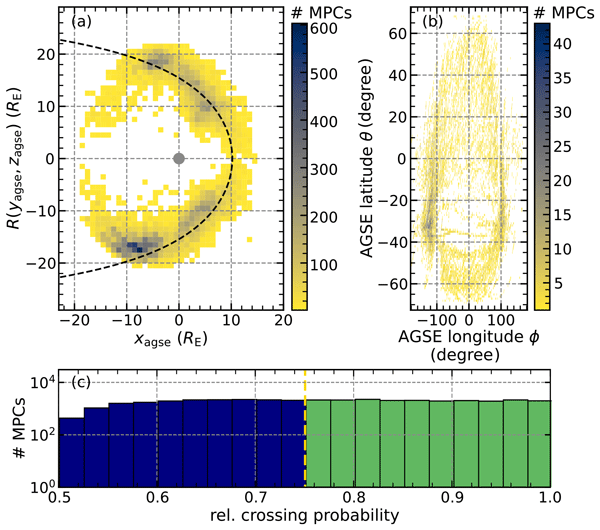
In our study, we looked at the boundary between the Earth's magnetic field and the interplanetary magnetic field emitted by the Sun, called the magnetopause. While other studies focus on the magnetopause motion near Earth's Equator, we have studied it in polar regions. The motion of the magnetopause is faster towards the Earth than towards the Sun. We also found that the occurrence of unusual magnetopause locations is due to similar solar influences in the equatorial and polar regions.
Martin O. Archer, Cara L. Waters, Shafiat Dewan, Simon Foster, and Antonio Portas
Geosci. Commun., 5, 119–123, https://doi.org/10.5194/gc-5-119-2022, https://doi.org/10.5194/gc-5-119-2022, 2022
Short summary
Short summary
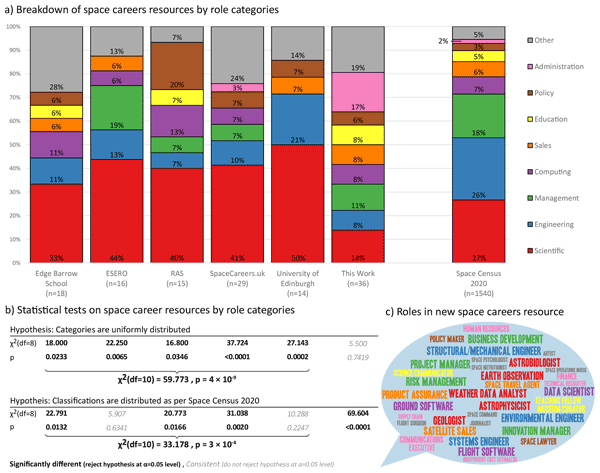
Educational research highlights that improved careers education is needed to increase participation in science, technology, engineering, and mathematics (STEM). Current UK careers resources in the space sector, however, are found to perhaps not best reflect the diversity of roles present and may in fact perpetuate misconceptions about the usefulness of science. We, therefore, compile a more diverse set of space-related jobs, which will be used in the development of a new space careers resource.
Niklas Grimmich, Adrian Pöppelwerth, Martin Owain Archer, David Gary Sibeck, Ferdinand Plaschke, Wenli Mo, Vicki Toy-Edens, Drew Lawson Turner, Hyangpyo Kim, and Rumi Nakamura
Ann. Geophys., 43, 151–173, https://doi.org/10.5194/angeo-43-151-2025, https://doi.org/10.5194/angeo-43-151-2025, 2025
Short summary
Short summary
The boundary of Earth's magnetic field, the magnetopause, deflects and reacts to the solar wind, the energetic particles emanating from the Sun. We find that certain types of solar wind favour the occurrence of deviations between the magnetopause locations observed by spacecraft and those predicted by models. In addition, the turbulent region in front of the magnetopause, the foreshock, has a large influence on the location of the magnetopause and thus on the accuracy of the model predictions.
Niklas Grimmich, Ferdinand Plaschke, Benjamin Grison, Fabio Prencipe, Christophe Philippe Escoubet, Martin Owain Archer, Ovidiu Dragos Constantinescu, Stein Haaland, Rumi Nakamura, David Gary Sibeck, Fabien Darrouzet, Mykhaylo Hayosh, and Romain Maggiolo
Ann. Geophys., 42, 371–394, https://doi.org/10.5194/angeo-42-371-2024, https://doi.org/10.5194/angeo-42-371-2024, 2024
Short summary
Short summary
In our study, we looked at the boundary between the Earth's magnetic field and the interplanetary magnetic field emitted by the Sun, called the magnetopause. While other studies focus on the magnetopause motion near Earth's Equator, we have studied it in polar regions. The motion of the magnetopause is faster towards the Earth than towards the Sun. We also found that the occurrence of unusual magnetopause locations is due to similar solar influences in the equatorial and polar regions.
Martin O. Archer, Cara L. Waters, Shafiat Dewan, Simon Foster, and Antonio Portas
Geosci. Commun., 5, 119–123, https://doi.org/10.5194/gc-5-119-2022, https://doi.org/10.5194/gc-5-119-2022, 2022
Short summary
Short summary
Educational research highlights that improved careers education is needed to increase participation in science, technology, engineering, and mathematics (STEM). Current UK careers resources in the space sector, however, are found to perhaps not best reflect the diversity of roles present and may in fact perpetuate misconceptions about the usefulness of science. We, therefore, compile a more diverse set of space-related jobs, which will be used in the development of a new space careers resource.
Cited articles
Akima, H.: A new method of interpolation and smooth curve fitting based on local procedures, J. ACM, 17, 589–602, https://doi.org/10.1145/321607.321609, 1970. a
Archer, M., Shi, X., Walach, M.-T., Hartinger, M. D., Gillies, D. M., Di Matteo, S., Staples, F., and Nykyri, K.: Crucial future observations and directions for unveiling magnetopause dynamics and their geospace impacts, Front. Astron. Space Sci., 11, 1430099, https://doi.org/10.3389/fspas.2024.1430099, 2024a. a, b, c, d
Archer, M. O.: Magnetopause surface wave magnetosphere–ionosphere–ground coupling code, Imperial [code], https://doi.org/10.14469/hpc/15489, 2025. a
Archer, M. O. and Plaschke, F.: What frequencies of standing surface waves can the subsolar magnetopause support?, J. Geophys Res., 120, 3632–3646, https://doi.org/10.1002/2014JA020545, 2015. a, b, c
Archer, M. O., Hartinger, M. D., Plaschke, F., Southwood, D. J., and Rastaetter, L.: Magnetopause ripples going against the flow form azimuthally stationary surface waves, Nat. Commun., 12, 5697, https://doi.org/10.1038/s41467-021-25923-7, 2021. a, b, c, d
Archer, M. O., Southwood, D. J., Hartinger, M. D., Rastaetter, L., and Wright, A. N.: How a realistic magnetosphere alters the polarizations of surface, fast magnetosonic, and Alfvén waves, J. Geophys. Res.-Space, 127, e2021JA030032, https://doi.org/10.1029/2021JA030032, 2022. a, b
Archer, M. O., Hartinger, M. D., Rastátter, L., Southwood, D. J., Heyns, M., Eggington, J. W. B., Wright, A. N., Plaschke, F., and Shi, X.: Auroral, ionospheric and ground magnetic signatures of magnetopause surface modes, J. Geophys. Res.-Space, 128, e2022JA031081, https://doi.org/10.1029/2022JA031081, 2023. a, b, c, d, e, f, g, h, i, j, k, l, m, n, o, p, q
Axford, W. I.: Viscous interaction between the solar wind and the earth's magnetosphere, Planet. Space Sci., 12, 45–53, https://doi.org/10.1016/0032-0633(64)90067-4, 1964. a
Bedrosian, P. A. and Love, J. J.: Mapping geoelectric fields during magnetic storms: Synthetic analysis of empirical United States impedances, Geophys. Res. Lett., 42, 10160–10170, https://doi.org/10.1002/2015GL066636, 2015. a
Belakhovsky, V., Pilipenko, V., Engebretson, M., Sakharov, Y., and Selivanov, V.: Impulsive disturbances of the geomagnetic field as a cause of induced currents of electric power lines, J. Space Weather Spac., 9, A18, https://doi.org/10.1051/swsc/2019015, 2019. a
Berchem, J. and Russell, C. T.: The thickness of the magnetopause current layer: ISEE 1 and 2 observations, J. Geophys. Res., 87, 2108–2114, https://doi.org/10.1029/JA087iA04p02108, 1982. a
Bhattarai, S. K. and Lopez, R. E.: Reduction of viscous potential for northward interplanetary magnetic field as seen in the LFM simulation, J. Geophys. Res.-Space, 118, 3314–3322, https://doi.org/10.1002/jgra.50368, 2013. a
Boteler, D. H. and Pirjola, R. J.: The complex-image method for calculating the magnetic and electric fields produced at the surface of the Earth by the auroral electrojet, Geophys. J. Int., 132, 31–40, https://doi.org/10.1046/j.1365-246x.1998.00388.x, 1998. a
Brenner, A., Pulkkinen, T. I., and Liemohn, M. W.: Solar Wind-Magnetosphere Coupling Under Interim Steady Conditions, J. Geophys. Res.-Space, 130, e2025JA033771, https://doi.org/10.1029/2025JA033771, 2025. a
Bristow, W. A., Sibeck, D. G., Jacquey, C., Greenwald, R. A., Sofko, G. J., Mukai, T., Yamamoto, T., Kokubun, S., Hughes, T. J., Hughes, W. J., and Engebretson, M. J.: Observations of convection vortices in the afternoon sector using the SuperDARN HF radars, J. Geophys. Res.-Space, 100, 19743–19756, https://doi.org/10.1029/95JA01301, 1995. a
Carter, J. A., Dunlop, M., Forsyth, C., Oksavik, K., Donovon, E., Kavanagh, A., Milan, S. E., Sergienko, T., Fear, R. C., Sibeck, D. G., Connors, M., Yeoman, T., Tan, X., Taylor, M. G. G. T., McWilliams, K., Gjerloev, J., Barnes, R., Billet, D. D., Chisham, G., Dimmock, A., Freeman, M. P., Han, D.-S., Hartinger, M. D., Hsieh, S.-Y. W., Hu, Z.-J., James, M. K., Juusola, L., Kauristie, K., Kronberg, E. A., Lester, M., Manuel, J., Matzka, J., McCrea, I., Miyoshi, Y., Rae, J., Ren, L., Sigernes, F., Spanswick, E., Sterne, K., Steuwer, A., Sun, T., Walach, M.-T., Walsh, B., Wang, C., Weygand, J., Wild, J., Yan, J., Zhang, J., and Zhang, Q.-H.: Ground-based and additional science support for SMILE, Earth and Planetary Physics, 8, 275–298, https://doi.org/10.26464/epp2023055, 2024. a
Chisham, G., Lester, M., Milan, S. E., Freeman, M. P., Bristow, W. A., Grocott, A., McWilliams, K. A., Ruohoniemi, J. M., Yeoman, T. K., Dyson, P. L., Greenwald, R. A., Kikuchi, T., Pinnock, M., Rash, J. P. S., Sato, N., Sofko, G. J., Villain, J.-P., and Walker, A. D. M.: A decade of the Super Dual Auroral Radar Network (SuperDARN): scientific achievements, new techniques and future directions, Surv. Geophys., 28, 33–109, https://doi.org/10.1007/s10712-007-9017-8, 2007. a
Claudepierre, S., Wiltberger, M., Elkington, S., Lotko, W., and Hudson, M.: Magnetospheric cavity modes driven by solar wind dynamic pressure fluctuations, Geophys. Res. Lett., 36, L13101, https://doi.org/10.1029/2009GL039045, 2009. a
Cohen, D. and Hosaka, H.: Part II magnetic field produced by a current dipole, J. Electrocardiol., 9, 409–417, https://doi.org/10.1016/S0022-0736(76)80041-6, 1976. a
Collett, E.: Field Guide to Polarization, SPIE press, Bellingham, WA, USA, ISBN 0-8194-5868-6, 2005. a
Connor, H. K., Sun, T., Samsanov, A., Liang, J., Read, A., Li, D., Cucho-Padin, G., Jung, J., Bickner, B., Escoubet, C. P., Forsyth, C., Sembay, S., Sibeck, D., Spanswick, E., Sydorenko, D., and Wang, C.: SMILE Modeling Working Group: Modeling and Analysis of X-ray and Ultraviolet Images of Solar Wind – Earth Interactions, Space Sci. Rev., 221, 46, https://doi.org/10.1007/s11214-025-01172-8, 2025. a
Degeling, A. W., Rankin, R., Kabin, K., Rae, I. J., and Fenrich, F. R.: Modeling ULF waves in a compressed dipole magnetic field, J. Geophys. Res., 115, A10212, https://doi.org/10.1029/2010JA015410, 2010. a
Elsden, T., Southwood, D. J., Allanson, O., Archer, M. O., Hartinger, M. D., and Wright, A. N.: Theory and Modeling of Large Scale Plasmapause Surface Waves, J. Geophys. Res.-Space, 130, e2025JA033830, https://doi.org/10.1029/2025JA033830, 2025. a, b
Fairfield, D. H., Otto, A., Mukai, T., Kokubun, S., Lepping, R. P., Steinberg, J. T., Lazarus, A. J., and Yamamoto, T.: Geotail observations of the Kelvin–Helmholtz instability at the equatorial magnetotail boundary for parallel northward fields, J. Geophys. Res., 105, 21159–21174, https://doi.org/10.1029/1999JA000316, 2000. a, b, c
Fenrich, F. R., Samson, J. C., Sofko, G., and Greenwald, R. A.: ULF high- and low-m field line resonances observed with the Super Dual Auroral Radar Network, J. Geophys. Res.-Space, 100, 21535–21547, https://doi.org/10.1029/95JA02024, 1995. a
Fenrich, F. R., Gillies, D. M., Donovan, E., and Knudsen, D.: Flow Velocity and Field-Aligned Current Associated With Field Line Resonance: SuperDARN Measurements, J. Geophys. Res.-Space, 124, 4889–4904, https://doi.org/10.1029/2019JA026529, 2019. a
Friis-Christensen, E., McHenry, M. A., Clauer, C. R., and Vennerstrøm, S.: Ionospheric traveling convection vortices observed near the polar cleft: A triggered response to sudden changes in the solar wind, Geophys. Res. Lett., 15, 253–256, https://doi.org/10.1029/GL015i003p00253, 1988. a
Ganushkina, N. Y., Liemohn, M. W., and Dubyagin, S.: Current Systems in the Earth's Magnetosphere, Rev. Geophys., 56, 309–332, https://doi.org/10.1002/2017RG000590, 2018. a
GeoSci.xyz Project: EM GeoSci: A online textbook for electromagnetic geophysics, https://doi.org/10.5281/zenodo.2548027, https://em.geosci.xyz (last access: 19 August 2024), 2015. a
Glassmeier, K.-H.: Traveling magnetospheric convection twin-vortices: observations and theory, Ann. Geophys., 10, 1992. a
Glassmeier, K.-H. and Heppner, C.: Traveling magnetospheric convection twin vortices: Another case study, global characteristics, and a model, J. Geophys. Res.-Space, 97, 3977–3992, https://doi.org/10.1029/91JA02464, 1992. a
Goodman, M. L.: A three-dimensional, iterative mapping procedure for the implementation of an ionosphere-magnetosphere anisotropic Ohm's law boundary condition in global magnetohydrodynamic simulations, Ann. Geophys., 13, 843–853, https://doi.org/10.1007/s00585-995-0843-z, 1995. a
Greenwald, R. A. and Walker, A. D. M.: Energetics of long period resonant hydromagnetic waves, Geophys. Res. Lett., 7, 745–748, https://doi.org/10.1029/GL007i010p00745, 1980. a
Griffiths, D. J. and Heald, M. A.: Time-dependent generalizations of the Biot–Savart and Coulomb laws, Am. J. Phys., 59, 111–117, https://doi.org/10.1119/1.16589, 1991. a
Guio, P. and Pécseli, H. L.: The Impact of Turbulence on the Ionosphere and Magnetosphere, Front. Astron. Space Sci., 7, 573746, https://doi.org/10.3389/fspas.2020.573746, 2021. a
Hartinger, M. D., Moldwin, M. B., Zou, S., Bonnell, J. W., and Angelopoulos, V.: ULF wave electromagnetic energy flux into the ionosphere: Joule heating implications, J. Geophys. Res.-Space, 120, 494–510, https://doi.org/10.1002/2014JA020129, 2015a. a
Hartinger, M. D., Plaschke, F., Archer, M. O., Welling, D. T., Moldwin, M. B., and Ridley, A.: The global structure and time evolution of dayside magnetopause surface eigenmodes, Geophys. Res. Lett., 42, 2594–2602, https://doi.org/10.1002/2015GL063623, 2015b. a, b, c
Hartinger, M. D., Shi, X., Lucas, G. M., Murphy, B. S., Kelbert, A., Baker, J. B. H., Rigler, E. J., and Bedrosian, P. A.: Simultaneous Observations of Geoelectric and Geomagnetic Fields Produced by Magnetospheric ULF Waves, Geophys. Res. Lett., 47, e2020GL089441, https://doi.org/10.1029/2020GL089441, 2020. a, b
Hasegawa, A.: Particle acceleration by MHD surface wave and formation of aurora, J. Geophys. Res., 81, 5083–5090, https://doi.org/10.1029/JA081i028p05083, 1976. a
He, F., Guo, R.-L., Dunn, W. R., Yao, Z.-H., Zhang, H.-S., Hao, Y.-X., Shi, Q.-Q., Rong, Z.-J., Liu, J., Tian, A.-M., Zhang, X.-X., Wei, Y., Zhang, Y.-L., Zong, Q.-G., Pu, Z.-Y., and Wan, W.-X.: Plasmapause surface wave oscillates the magnetosphere and diffuse aurora, Nat. Commun., 11, 1668, https://doi.org/10.1038/s41467-020-15506-3, 2020. a, b
Heelis, R. A. and Maute, A.: Challenges to understanding the Earth's ionosphere and thermosphere, J. Geophys. Res.-Space, 125, e2019JA027497, https://doi.org/10.1029/2019JA027497, 2020. a
Heyns, M. J., Lotz, S. I., and Gaunt, C. T.: Geomagnetic Pulsations Driving Geomagnetically Induced Currents, Space Weather, 19, e2020SW002557, https://doi.org/10.1029/2020SW002557, 2021. a
Horvath, I. and Lovell, B. C.: Subauroral Flow Channel Structures and Auroral Undulations Triggered by Kelvin–Helmholtz Waves, J. Geophys. Res.-Space, 126, e2021JA029144, https://doi.org/10.1029/2021JA029144, 2021. a
Huang, N. E., Zheng, S., Long, S. R., Wu, M. C., Shih, H. H., Zheng, Q., Yen, N.-C., Tung, C. C., and Liu, H. H.: The Empirical Mode Decomposition and the Hilbert Spectrum for Nonlinear and Non-Stationary Time Series Analysis, P. R. Soc. A, 454, 903–995, https://doi.org/10.1098/rspa.1998.0193, 1971. a
Huber, P. J.: Robust Statistics, Wiley Series in Probability, John Wiley & Sons, ISBN 978-0471650720, 1981. a
Hurd, L. D. and Larsen, M. F.: Small-scale fluctuations in barium drifts at high latitudes and associated Joule heating effects, J. Geophys. Res.-Space, 121, 779–789, https://doi.org/10.1002/2015JA021868, 2016. a
Hwang, K.-J., Weygand, J. M., Sibeck, D. G., Burch, J. L., Goldstein, M. L., Escoubet, C. P., Choi, E., Dokgo, K., Giles, B. L., Pollock, C. J., Gershman, D. J., Russell, C. T., Strangeway, R. J., and Torbert, R. B.: Kelvin–Helmholtz Vortices as an Interplay of Magnetosphere-Ionosphere Coupling, Front. Astron. Space Sci., 9, 895514, https://doi.org/10.3389/fspas.2022.895514, 2022. a
Imperial College: Imperial College Research Computing Service, https://doi.org/10.14469/hpc/2232, last access: 1 October 2025. a
Jacobs, J., Kato, Y., Matsushita, S., and Troitskaya, V.: Classification of geomagnetic micropulsations, J. Geophys. Res., 69, 180–181, https://doi.org/10.1029/JZ069i001p00180, 1964. a
Johnson, J. R., Wing, S., Delamere, P., Petrinec, S., and Kavosi, S.: Field-Aligned Currents in Auroral Vortices, J. Geophys. Res.-Space, 126, e2020JA028583, https://doi.org/10.1029/2020JA028583, 2021. a
Juusola, L., Vanhamäki, H., Viljanen, A., and Smirnov, M.: Induced currents due to 3D ground conductivity play a major role in the interpretation of geomagnetic variations, Ann. Geophys., 38, 983–998, https://doi.org/10.5194/angeo-38-983-2020, 2020. a
Kivelson, M. G. and Chen, S.-H.: Physics of the Magnetopause, chap. The Magnetopause: Surface Waves and Instabilities and their Possible Dynamical Consequences, 257–268, Geoph. Monog. Series, American Geophysical Union, Washington DC, USA, https://doi.org/10.1029/GM090p0257, 1995. a
Kivelson, M. G. and Pu, Z.-Y.: The Kelvin–Helmholtz instability on the magnetopause, Planet. Space Sci., 32, 1335–1341, https://doi.org/10.1016/0032-0633(84)90077-1, 1984. a
Kivelson, M. G. and Southwood, D. J.: Hydromagnetic waves and the ionosphere, Geophys. Res. Lett., 15, 1271–1274, https://doi.org/10.1029/GL015i011p01271, 1988. a, b
Knight, S.: Parallel electric fields, Planet. Space Sci., 21, 741–750, https://doi.org/10.1016/0032-0633(73)90093-7, 1973. a
Landal, K. M. and Gjerloev, J. W.: What is the appropriate coordinate system for magnetometer data when analyzing ionospheric currents?, J. Geophys. Res.-Space, 119, 8637–8647, https://doi.org/10.1002/2014JA020484, 2014. a
Laundal, K. M., Haaland, S. E., Lehtinen, N., Gjerloev, J. W., Østgaard, N., Tenfjord, P., Reistad, J. P., Snekvik, K., Milan, S. E., Ohtani, S., and Anderson, B. J.: Birkeland current effects on high-latitude ground magnetic field perturbations, Geophys. Res. Lett., 42, 7248–7254, https://doi.org/10.1002/2015GL065776, 2015. a, b, c
Lee, L. C. and Fu, Z. F.: A theory of magnetic flux transfer at the Earth's magnetopause, Geophys. Res. Lett., 12, 105–108, https://doi.org/10.1029/GL012i002p00105, 1985. a
Lee, L. C., Johnson, J. R., and Ma, Z. W.: Kinetic Alfvén waves as a source of plasma transport at the dayside magnetopause, J. Geophys. Res.-Space, 99, 17405–17411, https://doi.org/10.1029/94JA01095, 1994. a
Leonovich, A. S. and Kozlov, D. A.: Kelvin–Helmholtz Instability in a Dipole Magnetosphere: The Magnetopause as a Tangential Discontinuity, J. Geophys. Res.-Space, 124, 7936–7953, https://doi.org/10.1029/2019JA026842, 2019. a
Lester, M., Chapman, P. J., Cowley, S. W. H., Crooks, S. J., Davies, J. A., Hamadyk, P., McWilliams, K. A., Milan, S. E., Parsons, M. J., Payne, D. B., Thomas, E. C., Thornhill, J. D., Wade, N. M., Yeoman, T. K., and Barnes, R. J.: Stereo CUTLASS – A new capability for the SuperDARN HF radars, Ann. Geophys., 22, 459–473, https://doi.org/10.5194/angeo-22-459-2004, 2004. a
Lin, D., Wang, C., Li, W., Tang, B., Guo, X., and Peng, Z.: Properties of Kelvin–Helmholtz waves at the magnetopause under northward interplanetary magnetic field: Statistical study, J. Geophys. Res.-Space, 119, 7485–7494, https://doi.org/10.1002/2014JA020379, 2014. a
Lotko, W.: Inductive magnetosphere-ionosphere coupling, J. Atmos. Sol.-Terr. Phy., 66, 1443–1456, https://doi.org/10.1016/j.jastp.2004.03.027, 2004. a
Lyons, L. R.: Generation of large-scale regions of auroral currents, electric potentials, and precipitation by the divergence of the convection electric field, J. Geophys. Res.-Space, 85, 17–24, https://doi.org/10.1029/JA085iA01p00017, 1980. a
Lysak, R. L.: Magnetosphere-ionosphere coupling by Alfvén waves at midlatitudes, J. Geophys. Res.-Space, 109, A07201, https://doi.org/10.1029/2004JA010454, 2004. a
Lysak, R. L. and Song, Y.: Magnetosphere–ionosphere coupling by Alfvén waves: Beyond current continuity, Adv. Space Res., 38, 1713–1719, https://doi.org/10.1016/j.asr.2005.08.038, 2006. a, b
Lysak, R. L., Song, Y., Waters, C. L., Sciffer, M. D., and Obana, Y.: Numerical Investigations of Interhemispheric Asymmetry due to Ionospheric Conductance, J. Geophys. Res.-Space, 125, e2020JA027866, https://doi.org/10.1029/2020JA027866, 2020. a, b
McLean, W.: Strongly Elliptic Systems and Boundary Integral Equations, Cambridge University Press, Cambridge, UK, ISBN 978-0521663328, 2000. a
McWilliams, K. A., Detwiller, M., Kotyk, K., Krieger, K., Rohel, R., Billet, D. D., Huyghebart, D., and Ponomarenko, P.: Borealis: An Advanced Digital Hardware and Software Design for SuperDARN Radar Systems, Radio Sci., 58, e2022RS007591, https://doi.org/10.1029/2022RS007591, 2023. a
Miura, A. and Pritchett, P. L.: Nonlocal stability analysis of the MHD Kelvin–Helmholtz instability in a compressible plasma, J. Geophys. Res.-Space, 87, 7431–7444, https://doi.org/10.1029/JA087iA09p07431, 1982. a, b
Nenovski, P., Villante, U., Francia, P., Vellante, M., and Bochev, A.: Do we need a surface wave approach to the magnetospheric resonances?, Planet. Space Sci., 55, 680–693, https://doi.org/10.1016/j.pss.2006.04.038, 2007. a
Nishitani, N., Ruohoniemi, J. M., Lester, M., Baker, J. B. H., Koustov, A. V., Shepherd, S. G., Chisham, G., Hori, T., Thomas, E. G., Makarevich, R. A., Marchaudon, A., Ponomarenko, P., Wild, J. A., Milan, S. E., Bristow, W. A., Devlin, J., Miller, E., Greenwald, R. A., Ogawa, T., and Kikuchi, T.: Review of the accomplishments of mid-latitude Super Dual Auroral Radar Network (SuperDARN) HF radars, Progress in Earth and Planetary Science, 6, 27, https://doi.org/10.1186/s40645-019-0270-5, 2019. a
Ozeke, L. G., Mann, I. R., and Rae, I. J.: Mapping guided Alfvén wave magnetic field amplitudes observed on the ground to equatorial electric field amplitudes in space, J. Geophys. Res.-Space, 114, A01214, https://doi.org/10.1029/2008JA013041, 2009. a
Pakhotin, I. P. and Mann, I. R.: Alfvén Waves Across Heliophysics: Progress, Challenges, and Opportunities, chap. Role of Alfvén Waves in Dynamic Magnetosphere–Ionosphere Coupling: New Perspectives From Satellite and Ground Observations, 177–213, Geophysical Monograph Series, John Wiley & Sons, Inc., Hoboken, NJ, USA, https://doi.org/10.1002/9781394195985.ch9, 2024. a
Pilipenko, V. A., Kozyreva, O. V., Baddeley, L., Lorentzen, D. A., and Belakhovsky, V. B.: Suppression of the dayside magnetopause surface modes, Solar-Terrestrial Physics, 3, 17–25, https://doi.org/10.12737/stp-34201702, 2017. a, b
Pilipenko, V. A., Kozyreva, O. V., A.Lorentzen, D., and Baddeley, L. J.: The correspondence between dayside long-period geomagnetic pulsations and the open-closed field line boundary, J. Atmos. Terr. Phys., 170, 64–74, https://doi.org/10.1016/j.jastp.2018.02.012, 2018. a, b
Pirjola, R. and Viljanen, A.: Complex image method for calculating electric and magnetic fields produced by an auroral electrojet of finite length, Ann. Geophys., 16, 1434–1444, https://doi.org/10.1007/s00585-998-1434-6, 1998. a, b
Plaschke, F., Glassmeier, K.-H., Auster, H. U., Constantinescu, O. D., Magnes, W., Angelopoulos, V., Sibeck, D. G., and McFadden, J. P.: Standing Alfvén waves at the magnetopause, Geophys. Res. Lett., 36, L02104, https://doi.org/10.1029/2008GL036411, 2009a. a
Poikonen, A., Suppala, I., and Sulkanen, K.: Studies on Underwater Electric Potential (UEP), in: Proc. Marine Electromagnetics (Marelec97), June 1997, London, UK, 1997. a
Pu, Z.-Y. and Kivelson, M. G.: Kelvin–Helmholtz Instability at the magnetopause: Solution for compressible plasmas, J. Geophys. Res., 88, 841–852, https://doi.org/10.1029/JA088iA02p00841, 1983. a
Radoski, H. R.: A note on the problem of hydromagnetic resonances in the magnetosphere, Planet. Space Sci., 19, 1012–1013, https://doi.org/10.1016/0032-0633(71)90152-8, 1971. a
Raeder, J.: Modeling the magnetosphere for northward interplanetary magnetic field: Effects of electrical resistivity, J. Geophys. Res.-Space, 104, 17357–17367, https://doi.org/10.1029/1999JA900159, 1999. a
Rahman, Q. I. and Schmeisser, G.: Characterization of the speed of convergence of the trapezoidal rule, Numer. Math., 57, 123–138, https://doi.org/10.1007/BF01386402, 1990. a
Rastätter, L., Tóth, G., Kuznetsova, M. M., and Pulkkinen, A. A.: CalcDeltaB: An efficient postprocessing tool to calculate ground-level magnetic perturbations from global magnetosphere simulations, Space Weather, 12, 553–565, https://doi.org/10.1002/2014SW001083, 2014. a
Ridley, A. J., Gombosi, T. I., and DeZeeuw, D. L.: Ionospheric control of the magnetosphere: conductance, Ann. Geophys., 22, 567–584, https://doi.org/10.5194/angeo-22-567-2004, 2004. a, b, c, d
Sarvas, J.: Basic mathematical and electromagnetic concepts of the biomagnetic inverse problem, Phys. Med. Biol., 32, 11–22, https://doi.org/10.1088/0031-9155/32/1/004, 1987. a
Schulz, H.: Physik mit Bleistift: das analytische Handwerkszeug des Naturwissenschaftlers, Harri Deutsch, Frankfurt am Main, Germany, ISBN 3808557885, 2001. a
Shi, X., Hartinger, M. D., Baker, J. B. H., Murphy, B. S., Bedrosian, P. A., Kelbert, A., and Rigler, E. J.: Characteristics and Sources of Intense Geoelectric Fields in the United States: Comparative Analysis of Multiple Geomagnetic Storms, Space Weather, 20, https://doi.org/10.1029/2021sw002967, 2022. a, b
Shi, X., Chakraborty, S., Baker, J. H., Hartinger, M. D., Wang, W., Ruohoniemi, J. M., Lin, D., Lotko, W., Sterne, K., and McWilliams, K. A.: Statistical Characterization of Joule Heating Associated With Ionospheric ULF Perturbations Using SuperDARN Data, J. Geophys. Res.-Space, 130, e2024JA033452, https://doi.org/10.1029/2024JA033452, 2025a. a
Shi, X., Hartiner, M. D., Zou, Y., Rigler, E. J., Weygand, J. M., Kelbert, A., Lucas, G. M., Baker, J. B. H., and Angelopoulos, V.: Multi-Scale Intense Geoelectric and Geomagnetic Field Perturbations Observed After an Interplanetary Magnetic Field Turning, Space Weather, 23, e2024SW004046, https://doi.org/10.1029/2024SW004046, 2025b. a, b
Shue, J.-H., Chao, J.-K., Song, P., McFadden, J. P., Suvorova, A., Angelopoulos, V., Glassmeier, K. H., and Plaschke, F.: Anomalous magnetosheath flows and distorted subsolar magnetopause for radial interplanetary magnetic fields, Geophys. Res. Lett., 36, L18112, https://doi.org/10.1029/2009GL039842, 2009. a, b
Sibeck, D. G.: A model for the transient magnetospheric response to sudden solar wind dynamic pressure variations, J. Geophys. Res., 95, 3755–3771, https://doi.org/10.1029/JA095iA04p03755, 1990. a
Sibeck, D. G., Baumjohann, W., Elphic, R. C., Fairfield, D. H., Fennell, J. F., Gail, W. B., Lanzerotti, L. J., Lopez, R. E., Luehr, H., Lui, A. T. Y., Maclennan, C. G., McEntire, R. W., Potemra, T. A., Rosenberg, T. J., and Takahashi, K.: The magnetospheric response to 8-minute-period strong-amplitude upstream pressure variations, J. Geophys. Res., 94, 2505–2519, https://doi.org/10.1029/JA094iA03p02505, 1989. a
Slinker, S. P., Fedder, J. A., Hughes, W. J., and Lyon, J. G.: Response of the ionosphere to a density pulse in the solar wind: Simulation of traveling convection vortices, Geophys. Res. Lett., 26, 3549–3552, https://doi.org/10.1029/1999GL010688, 1999. a
Smith, D. A. and Sojka, J. J.: Model-Based Properties of the Dayside Open/Closed Boundary: Is There a UT-Dependent Variation?, Space Weather, 17, 1639–1649, https://doi.org/10.1029/2019SW002299, 2019. a
Sorathia, K. A., Merkin, V. G., Ukhorskiy, A. Y., Mauk, B. H., and Sibeck, D. G.: Energetic particle loss through the magnetopause: A combined global MHD and test-particle study, J. Geophys. Res.-Space, 122, 9329–9343, https://doi.org/10.1002/2017JA024268, 2017. a
Southwood, D. J.: Some features of field line resonances in the magnetosphere, Planet. Space Sci., 22, 483–491, https://doi.org/10.1016/0032-0633(74)90078-6, 1974. a, b, c, d
Southwood, D. J. and Kivelson, M. G.: The magnetohydrodynamic response of the magnetospheric cavity to changes in solar wind pressure, J. Geophys. Res.-Space, 95, 2301–2309, https://doi.org/10.1029/JA095iA03p02301, 1990. a, b
Southwood, D. J. and Kivelson, M. G.: An approximate description of field-aligned currents in a planetary magnetic field, J. Geophys. Res.-Space, 96, 67–75, https://doi.org/10.1029/90JA01806, 1991. a, b
Stokes, G. G.: On the composition and resolution of streams of polarized light from different sources, Transactions of the Cambridge Philosophical Society, 9, 399–416, 1852. a
Sydorenko, D. and Rankin, R.: Simulation of ionospheric disturbances created by Alfvén waves, J. Geophys. Res.-Space, 118, A09229, https://doi.org/10.1029/2012JA017693, 2012. a
Tanaka, T., Ebihara, Y., Watanabe, M., Den, M., Fujita, S., Kikuchi, T., Hashimoto, K. K., and Kataoka, R.: Reproduction of Ground Magnetic Variations During the SC and the Substorm From the Global Simulation and Biot-Savart's Law, J. Geophys. Res.-Space, 125, e2019JA027172, https://doi.org/10.1029/2019JA027172, 2020. a
Thomson, D. J. and Weaver, J. T.: The complex image approximaton for induction in a multilayered Earth, J. Geophys. Res., 80, 123–129, https://doi.org/10.1029/JA080i001p00123, 1975. a, b, c, d
Tsyganenko, N. A.: Modeling the Earth's Magnetospheric Magnetic Field Confined Within a Realistic Magnetopause, J. Geophys. Res., 100, 5599–5612, https://doi.org/10.1029/94JA03193, 1995. a
Untiedt, J. and Baumjohann, W.: Studies of polar current systems using the IMS Scandinavian magnetometer array, Space Sci. Rev., 63, 245–390, https://doi.org/10.1007/BF00750770, 1993. a
Vasyliunas, V. M.: Electric field and plasma flow: What drives what?, Geophys. Res. Lett., 28, 2177–2180, https://doi.org/10.1029/2001gl013014, 2001. a
Vennerstrom, S., Moretto, T., Rastätter, L., and Raeder, J.: Field-aligned currents during northward interplanetary magnetic field: Morphology and causes, J. Geophys. Res.-Space, 110, A06205, https://doi.org/10.1029/2004JA010802, 2005. a
Viall, N. M., Kepko, L., and Spence, H. E.: Relative occurrence rates and connection of discrete frequency oscillations in the solar wind density and dayside magnetosphere, J. Geophys. Res.-Space, 114, A01201, https://doi.org/10.1029/2008JA013334, 2009. a, b
Wait, J. R. and Spies, K. P.: On the image representation of the quasi-static fields of a line current source above the ground, Can. J. Phys., 47, 2731–2733, https://doi.org/10.1139/p69-334, 1969. a, b
Walach, M.-T., Milan, S. E., Murphy, K. R., Carter, J. A., Hubert, B. A., and Grocott, A.: Comparative study of large-scale auroral signatures of substorms, steady magnetospheric convection events, and sawtooth events, J. Geophys. Res.-Space, 122, 6357–6373, https://doi.org/10.1002/2017JA023991, 2017. a
Walach, M. T., Soobiah, Y., Carter, J. A., Whiter, D. K., Kavanagh, A. J., Hartinger, M. D., Oksavik, K., Salzano, M. L., and Archer, M. O.: SMILE winter campaign, RASTI, 3, 722–723, https://doi.org/10.1093/rasti/rzae048, 2024. a
Wang, C., Branduardi-Raymont, G., Escoubet, C. P., and Forsyth, C.: Solar Wind Magnetosphere Ionosphere Link Explorer (SMILE): Science and Mission Overview, Space Sci. Rev., 221, 9, https://doi.org/10.1007/s11214-024-01126-6, 2025. a
Weaver, J. T.: The General Theory of Electromagnetic Induction in a Conducting Half-Space, Geophys. J. Int., 22, 83–100, https://doi.org/10.1111/j.1365-246X.1971.tb03584.x, 1971. a, b
Weideman, J. A. C.: Numerical Integration of Periodic Functions: A Few Examples, Am. Math. Mon., 109, 21–36, https://doi.org/10.2307/2695765, 2002. a
Wolf, R. A.: Ionosphere-magnetosphere coupling, Space Sci. Rev., 17, 537–562, https://doi.org/10.1007/BF00718584, 1975. a
Wright, A. N. and Elsden, T.: Simulations of MHD wave propagation and coupling in a 3-D magnetosphere, J. Geophys. Res.-Space, 125, e2019JA027589, https://doi.org/10.1029/2019JA027589, 2020. a, b
Wright, A. N., Hartinger, M. D., Takahashi, K., and Elsden, T.: Alfvén Waves in the Earth's Magnetosphere, in: Alfvén Waves Across Heliophysics: Progress, Challenges, and Opportunities, edited by Keiling, A., Wiley, vol. 285, 215–247, https://doi.org/10.1002/9781394195985.ch10, 2024. a
Yerg, D. G.: A tentative evaluation of kinematic viscosity for ionospheric regions, J. Geophys. Res., 5, 217–220, https://doi.org/10.1029/JZ057i002p00217, 1952. a
Yoshikawa, A.: Excitation of a Hall-current generator by field-aligned current closure, via an ionospheric, divergent Hall-current, during the transient phase of magnetosphere–ionosphere coupling, J. Geophys. Res.-Space, 107, 1445, https://doi.org/10.1029/2001JA009170, 2002. a
Yoshikawa, A., Amm, O., Vanhamäki, H., and Fujii, R.: A self-consistent synthesis description of magnetosphere-ionosphere coupling and scale-dependent auroral process using shear Alfvén wave, J. Geophys. Res.-Space, 116, A08218, https://doi.org/10.1029/2011JA016460, 2011. a
Zhang, B., Sorathia, K. A., Lyon, J. G., Merkin, V. G., Garretson, J. S., and Wiltberger, M.: GAMERA: A Three-dimensional Finite-volume MHD Solver for Non-orthogonal Curvilinear Geometries, ApJ, 244, 20, https://doi.org/10.3847/1538-4365/ab3a4c, 2019. a, b
Short summary
Waves on the boundary of our magnetic shield, the magnetosphere, act as a source of electrical currents in space that flow between outer space and the ionised top of our atmosphere. We develop a simple numerical model of how these waves couple to different regions of geospace to determine their likely impacts in the context of space weather and how these vary with conditions. We find the waves’ impacts can be significant, though are typically highly localised.
Waves on the boundary of our magnetic shield, the magnetosphere, act as a source of electrical...


