
Articles | Volume 44, issue 1
https://doi.org/10.5194/angeo-44-577-2026
© Author(s) 2026. This work is distributed under
the Creative Commons Attribution 4.0 License.
the Creative Commons Attribution 4.0 License.
https://doi.org/10.5194/angeo-44-577-2026
© Author(s) 2026. This work is distributed under
the Creative Commons Attribution 4.0 License.
the Creative Commons Attribution 4.0 License.
Regular paper
| 
01 Jul 2026
Regular paper |
| 01 Jul 2026
| 01 Jul 2026
Spatial characteristics of the dayside auroral ionosphere observed by Incoherent Scatter Radar
Ingeborg Frøystein
CORRESPONDING AUTHOR

Department of Physics and Technology, UiT the Arctic University of Norway, Tromsø, Norway
Andres Spicher
Department of Physics and Technology, UiT the Arctic University of Norway, Tromsø, Norway
Kjellmar Oksavik
Department of Physics and Technology, University of Bergen, Bergen, Norway
Department of Arctic Geophysics, The University Centre in Svalbard, Longyearbyen, Norway
Related authors
Ingeborg Frøystein and Magnar Gullikstad Johnsen
Ann. Geophys., 43, 241–269, https://doi.org/10.5194/angeo-43-241-2025, https://doi.org/10.5194/angeo-43-241-2025, 2025
Short summary
Short summary
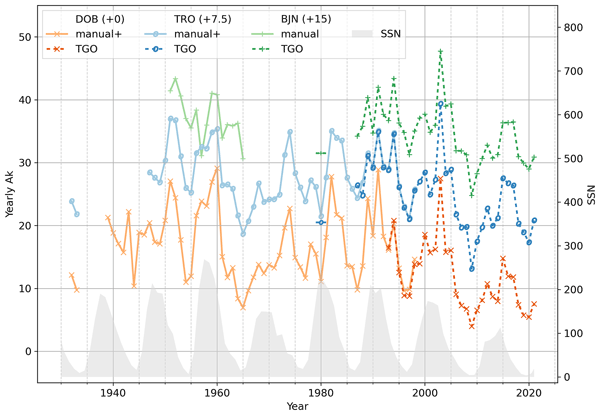
The complete time series of the geomagnetic disturbance index (K) from Norwegian magnetic observatories have been digitized. We compare and discuss the tree methods used to derive the index, finding that each method has strengths and weaknesses. In total, we present all K indices derived from Norwegian observatories since the 1930s until today, the used derivation methods and the long historic time series as a whole, enabling critical use for future scientific work.
Etienne Gavazzi, Andres Spicher, Björn Gustavsson, Juha Vierinen, James Clemmons, Robert Pfaff, and Douglas Rowland
Ann. Geophys., 44, 903–920, https://doi.org/10.5194/angeo-44-903-2026, https://doi.org/10.5194/angeo-44-903-2026, 2026
Short summary
Short summary
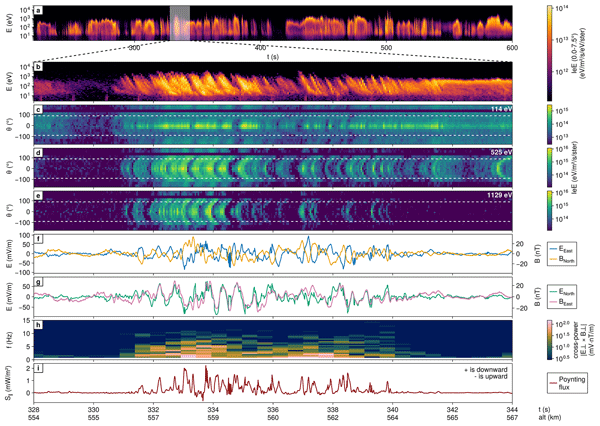
Auroras are caused by energetic electrons entering the upper atmosphere. For the smallest and most dynamic auroras, scientists think electrons are accelerated by waves (called Alfvén waves) thousands of kilometers above Earth. In this paper, we analyse data from a rocket that flew through auroras, applying existing and new techniques to estimate where the acceleration took place. Our results match theory, and we show how they can be used to study conditions in the near-Earth space environment.
Lena Mielke, Katie Herlingshaw, Noora Partamies, Maxime Grandin, Emma Bruus, Rowan Dayton-Oxland, Donna Lach, Marjan Spijkers, Vincent Ledvina, Eero Karvinen, Andres Spicher, Benjamin Eberhardt, and Olivier Staiger
EGUsphere, https://doi.org/10.5194/egusphere-2026-3756, https://doi.org/10.5194/egusphere-2026-3756, 2026
Short summary
Short summary
This study presents 26 citizen science observations of fragmented aurora-like emissions, here called fragments, from around the world. Using auroral images and satellite and solar wind data, we found that these short-lived fragments appear across a wide range of magnetic latitudes and local times. They can occur not only poleward of the auroral oval, but also within and equatorward of it. These findings broaden where fragments are known to occur and highlight the value of citizen science.
Theresa Rexer, Björn Gustavsson, Juha Vierinen, Andres Spicher, Devin Ray Huyghebaert, Andreas Kvammen, Robert Gillies, and Asti Bhatt
Geosci. Instrum. Method. Data Syst., 15, 127–139, https://doi.org/10.5194/gi-15-127-2026, https://doi.org/10.5194/gi-15-127-2026, 2026
Short summary
Short summary
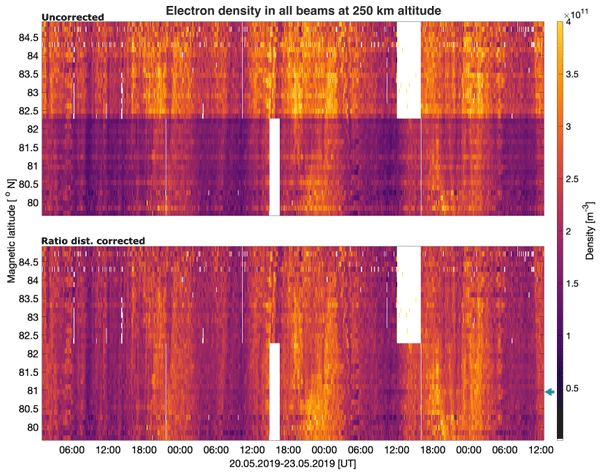
We present a second-level calibration method for electron density measurements from multi-beam incoherent scatter radars. It is based on the well-known Flat field correction method used in imaging and photography. The method improves data quality and useability as it accounts for unaccounted and unpredictable variations in the radar system. This is valuable for studies where inter-beam calibration is important such as studies of polar cap patches, plasma irregularities and turbulence.

Etienne Gavazzi, Andres Spicher, Björn Gustavsson, James Clemmons, Robert Pfaff, and Douglas Rowland
Ann. Geophys., 44, 1–15, https://doi.org/10.5194/angeo-44-1-2026, https://doi.org/10.5194/angeo-44-1-2026, 2026
Short summary
Short summary
Auroral precipitation refers to energetic particles that come down into the upper part of our atmosphere, the ionosphere. There, they collide with atoms and molecules and transfer some of their energy, causing aurora. The most rapid time-variation of this energy deposition and its consequences on the ionosphere are not fully understood. We show here that one can use a new model to study auroral precipitation on sub-second timescales and advance our understanding about small-scale dynamic aurora.
Spencer Mark Hatch, Ilkka Virtanen, Karl Magnus Laundal, Habtamu Wubie Tesfaw, Juha Vierinen, Devin Ray Huyghebaert, Andres Spicher, and Jens Christian Hessen
Ann. Geophys., 43, 633–649, https://doi.org/10.5194/angeo-43-633-2025, https://doi.org/10.5194/angeo-43-633-2025, 2025
Short summary
Short summary
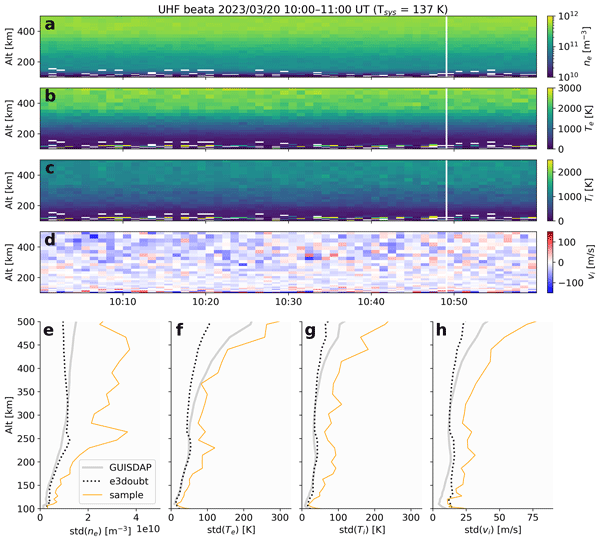
This study addresses the design of next-generation incoherent scatter radar experiments used to study the ionosphere, particularly with systems that have multiple sites. We have developed a method to estimate uncertainties of measurements of plasma density, temperature, and ion drift. Our method is open-source, and helps to optimize radar configurations and assess the effectiveness of an experiment. This method ultimately serves to enhance our understanding of Earth's space environment.
Ingeborg Frøystein and Magnar Gullikstad Johnsen
Ann. Geophys., 43, 241–269, https://doi.org/10.5194/angeo-43-241-2025, https://doi.org/10.5194/angeo-43-241-2025, 2025
Short summary
Short summary
The complete time series of the geomagnetic disturbance index (K) from Norwegian magnetic observatories have been digitized. We compare and discuss the tree methods used to derive the index, finding that each method has strengths and weaknesses. In total, we present all K indices derived from Norwegian observatories since the 1930s until today, the used derivation methods and the long historic time series as a whole, enabling critical use for future scientific work.

Johann Stamm, Juha Vierinen, Björn Gustavsson, and Andres Spicher
Ann. Geophys., 41, 55–67, https://doi.org/10.5194/angeo-41-55-2023, https://doi.org/10.5194/angeo-41-55-2023, 2023
Short summary
Short summary
The study of some ionospheric events benefit from the knowledge of how the physics varies over a volume and over time. Examples are studies of aurora or energy deposition. With EISCAT3D, measurements of ion velocity vectors in a volume will be possible for the first time. We present a technique that uses a set of such measurements to estimate electric field and neutral wind. The technique relies on adding restrictions to the estimates. We successfully consider restrictions based on physics.
Cited articles
Aggarwal, K., Nath, N., and Setty, C.: Collision frequency and transport properties of electrons in the ionosphere, Planet. Space Sci., 27, 753–768, https://doi.org/10.1016/0032-0633(79)90004-7, 1979. a
Baddeley, L., Lorentzen, D., Haaland, S., Heino, E., Mann, I., Miloch, W., Oksavik, K., Partamies, N., Spicher, A., and Vierinen, J.: Space and atmospheric physics on Svalbard: a case for continued incoherent scatter radar measurements under the cusp and in the polar cap boundary region, Progress in Earth and Planetary Science, 10, 53, https://doi.org/10.1186/s40645-023-00585-9 2023. a
Blanchard, G. T., Ellington, C. L., and Baker, K. B.: Comparison of dayside magnetic separatrix signatures in HF and incoherent scatter radar data, J. Geophys. Res.-Space, 108, https://doi.org/10.1029/2003JA009910, 2003. a
Burrell, A. G., van der Meeren, C., Laundal, K. M., and van Kemenade, H.: aburrell/aacgmv2: Version 2.6.3, Zenodo [code], https://doi.org/10.5281/zenodo.7621545, 2023. a, b
Carlson, H. C.: Sharpening our thinking about polar cap ionospheric patch morphology, research, and mitigation techniques, Radio Sci., 47, https://doi.org/10.1029/2011RS004946, 2012. a, b
Carlson, H. C., Moen, J., Oksavik, K., Nielsen, C. P., McCrea, I. W., Pedersen, T. R., and Gallop, P.: Direct observations of injection events of subauroral plasma into the polar cap, Geophys. Res. Lett., 33, L05103, https://doi.org/10.1029/2005GL025230, 2006. a
Davis, T. N. and Sugiura, M.: Auroral electrojet activity index AE and its universal time variations, J. Geophys. Res., 71, 785–801, https://doi.org/10.1029/JZ071i003p00785, 1966. a, b, c, d
Doe, R. A., Kelly, J. D., and Sánchez, E. R.: Observations of persistent dayside F region electron temperature enhancements associated with soft magnetosheathlike precipitation, J. Geophys. Res.-Space, 106, 3615–3630, https://doi.org/10.1029/2000JA000186, 2001. a, b, c
Fasel, G. J., Minow, J. I., Smith, R. W., Deehr, C. S., and Lee, L. C.: Multiple brightenings of transient dayside auroral forms during oval expansions, Geophys. Res. Lett., 19, 2429–2432, https://doi.org/10.1029/92GL02103, 1992. a, b
Frey, H. U., Han, D., Kataoka, R., Lessard, M. R., Milan, S. E., Nishimura, Y., Strangeway, R. J., and Zou, Y.: Dayside aurora, Space Sci. Rev., 215, 51, https://doi.org/10.1007/s11214-019-0617-7, 2019. a
Frøystein, I., Spicher, A., Gustavsson, B., Oksavik, K., and Johnsen, M. G.: On the identification of the dayside auroral region using incoherent scatter radar, J. Geophys. Res., 129, 2024JA033361, https://doi.org/10.1029/2024JA033361, 2024. a, b, c, d
Hunter, J. D.: Matplotlib: a 2D graphics environment, Comput. Sci. Eng., 9, 90–95, https://doi.org/10.1109/MCSE.2007.55, 2007. a
Jin, Y., Moen, J. I., Spicher, A., Liu, J., Clausen, L. B. N., and Miloch, W. J.: Ionospheric flow vortex induced by the sudden decrease in the solar wind dynamic pressure, J. Geophys. Res.-Space, 128, e2023JA031690, https://doi.org/10.1029/2023JA031690, 2023. a
Johnsen, M. G. and Lorentzen, D. A.: The dayside open/closed field line boundary as seen from space- and ground-based instrumentation, J. Geophys. Res., 117, A03320, https://doi.org/10.1029/2011JA016983, 2012a. a
Johnsen, M. G. and Lorentzen, D. A.: A statistical analysis of the optical dayside open/closed field line boundary, J. Geophys. Res., 117, A02218, https://doi.org/10.1029/2011JA016984, 2012b. a, b
King, J. H. and Papitashvili, N. E.: Solar wind spatial scales in and comparisons of hourly Wind and ACE plasma and magnetic field data, J. Geophys. Res.-Space, 110, https://doi.org/10.1029/2004JA010649, 2005. a, b
King, J. H. and Papitashvili, N. E.: OMNI 1-min Data Set, Space Physics Data Facility [data set], https://doi.org/10.48322/45BB-8792, 2020. a, b
Kofman, W. and Wickwar, V. B.: Very high electron temperatures in the daytime F region at Sondrestrom, Geophys. Res. Lett., 11, 919–922, https://doi.org/10.1029/GL011i009p00919, 1984. a, b
Kwagala, N. K., Oksavik, K., Lorentzen, D. A., and Johnsen, M. G.: On the contribution of thermal excitation to the total 630.0 nm emissions in the northern cusp ionosphere, J. Geophys. Res.-Space, 122, 1234–1245, https://doi.org/10.1002/2016JA023366, 2017. a
Lehtinen, M. S. and Huuskonen, A.: General incoherent scatter analysis and GUISDAP, J. Atmos. Terr. Phys., 58, 435–452, https://doi.org/10.1016/0021-9169(95)00047-X, 1996. a
Lessard, M. R., Fritz, B., Sadler, B., Cohen, I., Kenward, D., Godbole, N., Clemmons, J. H., Hecht, J. H., Lynch, K. A., Harrington, M., Roberts, T. M., Hysell, D., Crowley, G., Sigernes, F., Syrjäsuo, M., Ellingsen, P., Partamies, N., Moen, J., Clausen, L., Oksavik, K., and Yeoman, T.: Overview of the Rocket Experiment for Neutral Upwelling Sounding Rocket 2 (RENU2), Geophys. Res. Lett., 47, e2018GL081885, https://doi.org/10.1029/2018GL081885, 2020. a
Lockwood, M., Denig, W. F., Farmer, A. D., Davda, V. N., Cowley, S. W. H., and Luehr, H.: Ionospheric signatures of pulsed reconnection at the Earth's magnetopause, Nature, 361, 424–428, https://doi.org/10.1038/361424a0, 1993. a, b, c, d
Lockwood, M., McCrea, I. W., Milan, S. E., Moen, J., Cerisier, J. C., and Thorolfsson, A.: Plasma structure within poleward-moving cusp/cleft auroral transients: EISCAT Svalbard radar observations and an explanation in terms of large local time extent of events, Ann. Geophys., 18, 1027–1042, https://doi.org/10.1007/s00585-000-1027-5, 2000. a, b, c, d
Lockwood, M., Moen, J., van Eyken, A. P., Davies, J. A., Oksavik, K., and McCrea, I. W.: Motion of the dayside polar cap boundary during substorm cycles: I. Observations of pulses in the magnetopause reconnection rate, Ann. Geophys., 23, 3495–3511, https://doi.org/10.5194/angeo-23-3495-2005, 2005. a, b, c
Lorentzen, D. A., Moen, J., Oksavik, K., Sigernes, F., Saito, Y., and Johnsen, M. G.: In situ measurement of a newly created polar cap patch, J. Geophys. Res.-Space, 115, https://doi.org/10.1029/2010JA015710, 2010. a
Maeda, K.: Conductivity and drifts in the ionosphere, J. Atmos. Terr. Phys., 39, 1041–1053, https://doi.org/10.1016/0021-9169(77)90013-7, 1977. a, b
Mantas, G. P. and Walker, J. C.: The penetration of soft electrons into the ionosphere, Planet. Space Sci., 24, 409–423, https://doi.org/10.1016/0032-0633(76)90085-4, 1976. a, b
McCrea, I. W., Lockwood, M., Moen, J., Pitout, F., Eglitis, P., Aylward, A. D., Cerisier, J.-C., Thorolfssen, A., and Milan, S. E.: ESR and EISCAT observations of the response of the cusp and cleft to IMF orientation changes, Ann. Geophys., 18, 1009–1026, https://doi.org/10.1007/s00585-000-1009-7, 2000. a, b, c, d
Mende, S. B., Frey, H. U., and Angelopoulos, V.: Source of the dayside cusp aurora, J. Geophys. Res.-Space, 121, 7728–7738, https://doi.org/10.1002/2016JA022657, 2016. a
Milan, S. E., Lester, M., Cowley, S. W. H., Moen, J., Sandholt, P. E., and Owen, C. J.: Meridian-scanning photometer, coherent HF radar, and magnetometer observations of the cusp: a case study, Ann. Geophys., 17, 159–172, https://doi.org/10.1007/s00585-999-0159-5, 1999. a
Milan, S. E., Lester, M., Cowley, S. W. H., Oksavik, K., Brittnacher, M., Greenwald, R. A., Sofko, G., and Villain, J.-P.: Variations in the polar cap area during two substorm cycles, Ann. Geophys., 21, 1121–1140, https://doi.org/10.5194/angeo-21-1121-2003, 2003. a
Milan, S. E., Carter, J. A., Bower, G. E., Fleetham, A. L., and Anderson, B. J.: Influence of off-Sun-Earth line distance on the accuracy of L1 solar wind monitoring, J. Geophys. Res., 127, e30212, https://doi.org/10.1029/2021JA030212, 2022. a
Millward, G. H., Moffett, R. J., Balmforth, H. F., and Rodger, A. S.: Modeling the ionospheric effects of ion and electron precipitation in the cusp, J. Geophys. Res.-Space, 104, 24603–24612, https://doi.org/10.1029/1999JA900249, 1999. a
Moen, J., van Eyken, A. P., and Carlson, H. C.: EISCAT Svalbard Radar observations of ionospheric plasma dynamics in relation to dayside auroral transients, J. Geophys. Res.-Space, 106, 21453–21461, https://doi.org/10.1029/2000JA000378, 2001. a
Moen, J., Lockwood, M., Oksavik, K., Carlson, H. C., Denig, W. F., van Eyken, A. P., and McCrea, I. W.: The dynamics and relationships of precipitation, temperature and convection boundaries in the dayside auroral ionosphere, Ann. Geophys., 22, 1973–1987, https://doi.org/10.5194/angeo-22-1973-2004, 2004. a, b
Newell, P. T., Meng, C.-I., Sibeck, D. G., and Lepping, R.: Some low-altitude cusp dependencies on the interplanetary magnetic field, J. Geophys. Res.-Space, 94, 8921–8927, https://doi.org/10.1029/JA094iA07p08921, 1989. a, b, c, d
Newell, P. T., Ruohoniemi, J. M., and Meng, C. I.: Maps of precipitation by source region, binned by IMF, with inertial convection streamlines, J. Geophys. Res., 109, A10206, https://doi.org/10.1029/2004JA010499, 2004. a, b, c
Newell, P. T., Sotirelis, T., Liou, K., Meng, C. I., and Rich, F. J.: Cusp latitude and the optimal solar wind coupling function, J. Geophys. Res., 111, A09207, https://doi.org/10.1029/2006JA011731, 2006. a, b, c, d
Newell, P. T., Sotirelis, T., Liou, K., Meng, C.-I., and Rich, F. J.: A nearly universal solar wind-magnetosphere coupling function inferred from 10 magnetospheric state variables, J. Geophys. Res.-Space, 112, https://doi.org/10.1029/2006JA012015, 2007. a, b, c
Petrinec, S. M., Kletzing, C. A., Bounds, S. R., Fuselier, S. A., Trattner, K. J., and Sawyer, R. P.: TRICE-2 rocket observations in the low-altitude cusp: boundaries and comparisons with models, J. Geophys. Res.-Space, 128, e2022JA030952, https://doi.org/10.1029/2022JA030952, 2023. a
Prölss, G. W.: Electron temperature enhancement beneath the magnetospheric cusp, J. Geophys. Res.-Space, 111, https://doi.org/10.1029/2006JA011618, 2006. a
Samsonov, A. A., Sibeck, D. G., Dmitrieva, N. P., Semenov, V. S., Slivka, K. Y., Šafránkova, J., and Němeček, Z.: Magnetosheath propagation time of solar wind directional discontinuities, J. Geophys. Res.-Space, 123, 3727–3741, https://doi.org/10.1029/2017JA025174, 2018. a
Sandholt, P. E. and Farrugia, C. J.: Poleward moving auroral forms (PMAFs) revisited: responses of aurorae, plasma convection and Birkeland currents in the pre- and postnoon sectors under positive and negative IMF By conditions, Ann. Geophys., 25, 1629–1652, https://doi.org/10.5194/angeo-25-1629-2007, 2007. a
Sandholt, P.-E., Henriksen, K., Deehr, C., Sivjee, G., Romick, G. J., and Egeland, A.: Dayside cusp auroral morphology related to nightside magnetic activity, J. Geophys. Res.-Space, 85, 4132–4138, https://doi.org/10.1029/JA085iA08p04132, 1980. a
Sandholt, P. E., Deehr, C. S., Egeland, A., Lybekk, B., Viereck, R., and Romick, G. J.: Signatures in the dayside aurora of plasma transfer from the magnetosheath, J. Geophys. Res.-Space, 91, 10063–10079, https://doi.org/10.1029/JA091iA09p10063, 1986. a
Sandholt, P. E., Farrugia, C. J., Moen, J., Noraberg, Ø, Lybekk, B., Sten, T., and Hansen, T.: A classification of dayside auroral forms and activities as a function of interplanetary magnetic field orientation, J. Geophys. Res.-Space, 103, 23325–23345, https://doi.org/10.1029/98JA02156, 1998. a
Schunk, R. and Nagy, A.: Ionospheres: Physics, Plasma Physics, and Chemistry, Cambridge Atmospheric and Space Science Series, Cambridge University Press, 2nd edn., https://doi.org/10.1017/CBO9780511635342, 2009. a, b
Shepherd, S. G.: Altitude-adjusted corrected geomagnetic coordinates: definition and functional approximations, J. Geophys. Res.-Space, 119, 7501–7521, https://doi.org/10.1002/2014JA020264, 2014. a, b
Troshichev, O. A., Andrezen, V. G., Vennerstrom, S., and Friis-Christensen, E.: Magnetic activity in the polar cap – a new index, Planet. Space Sci., 36, 1095–1102, https://doi.org/10.1016/0032-0633(88)90063-3, 1988. a, b, c
Vontrat-Reberac, A., Fontaine, D., Blelly, P.-L., and Galand, M.: Theoretical predictions of the effect of cusp and dayside precipitation on the polar ionosphere, J. Geophys. Res., 106, 28857–28866, https://doi.org/10.1029/2001JA900131, 2001. a, b, c
Wild, J. A., Cowley, S. W. H., Davies, J. A., Khan, H., Lester, M., Milan, S. E., Provan, G., Yeoman, T. K., Balogh, A., Dunlop, M. W., Fornaçon, K.-H., and Georgescu, E.: First simultaneous observations of flux transfer events at the high-latitude magnetopause by the Cluster spacecraft and pulsed radar signatures in the conjugate ionosphere by the CUTLASS and EISCAT radars, Ann. Geophys., 19, 1491–1508, https://doi.org/10.5194/angeo-19-1491-2001, 2001. a, b
Wing, S., Newell, P. T., and Ruohoniemi, J. M.: Double cusp: model prediction and observational verification, J. Geophys. Res.-Space, 106, 25571–25594, https://doi.org/10.1029/2000JA000402, 2001. a, b
World Data Center For Geomagnetism, Copenhagen: The Polar Cap North (PCN) index (definitive), dTU Space, Geomagnetism, Data Center For Geomagnetism, Copenhagen [data set], https://doi.org/10.11581/DTU:00000057, 2019. a, b
World Data Center for Geomagnetism, Kyoto, Imajo. S., Matsuoka, A., Toh, H., and Iyemori, T.: Geomagnetic AE index, World Data Center for Geomagnetism, Kyoto [data set], https://doi.org/10.17593/15031-54800, 2015. a, b
Short summary
The dayside auroral region is a highly dynamic region of the ionosphere that is influenced by the coupling between the solar wind, magnetosphere, and ionosphere. In this paper, we illustrate this dynamic nature and present a quantitative analysis of both altitudinal and latitudinal variation within the region. In addition, ionospheric parameters on closed field lines, along the open-closed field line boundary and in the polar cap are statistically compared.
The dayside auroral region is a highly dynamic region of the ionosphere that is influenced by...


