
Articles | Volume 44, issue 1
https://doi.org/10.5194/angeo-44-331-2026
© Author(s) 2026. This work is distributed under
the Creative Commons Attribution 4.0 License.
the Creative Commons Attribution 4.0 License.
https://doi.org/10.5194/angeo-44-331-2026
© Author(s) 2026. This work is distributed under
the Creative Commons Attribution 4.0 License.
the Creative Commons Attribution 4.0 License.
Regular paper
| 
18 May 2026
Regular paper |
| 18 May 2026
| 18 May 2026
Studies of noctilucent clouds from the stratosphere during the 2024 TRANSAT balloon flight

Swedish Institute of Space Physics, Kiruna, Sweden
Hidehiko Suzuki
School of Science and Technology, Meiji University, Kawasaki, Japan
Nikolay Pertsev
A.M. Obukhov Institute of Atmospheric Physics RAS, Moscow, Russia
Vladimir Perminov
A.M. Obukhov Institute of Atmospheric Physics RAS, Moscow, Russia
Linda Megner
Department of Meteorology (MISU), Stockholm University, Stockholm, Sweden
Johan Kero
Swedish Institute of Space Physics, Kiruna, Sweden
Peter Voelger
Swedish Institute of Space Physics, Kiruna, Sweden
Jonas Hedin
Department of Meteorology (MISU), Stockholm University, Stockholm, Sweden
Gerd Baumgarten
Leibniz Institute of Atmospheric Physics, Rostock University, Kühlungsborn, Germany
Anne Réchou
Lacy Laboratory of Atmosphere and Cyclones, Université de La Réunion, Réunion, France
Denis Efremov
Aerospace Laboratory “Stratonautica”, Moscow, Russia
Related authors
Peter Dalin, Urban Brändström, Johan Kero, Peter Voelger, Takanori Nishiyama, Trond Trondsen, Devin Wyatt, Craig Unick, Vladimir Perminov, Nikolay Pertsev, and Jonas Hedin
Atmos. Meas. Tech., 17, 1561–1576, https://doi.org/10.5194/amt-17-1561-2024, https://doi.org/10.5194/amt-17-1561-2024, 2024
Short summary
Short summary
A novel infrared imaging instrument (OH imager) was put into operation in November 2022 at the Swedish Institute of Space Physics in Kiruna (Sweden). The OH imager is dedicated to the study of nightglow emissions coming from the hydroxyl (OH) and molecular oxygen (O2) layers in the mesopause (80–100 km). Based on a brightness ratio of two OH emission lines, the neutral temperature is estimated at around 87 km. The average daily winter temperature for the period January–April 2023 is 203±10 K.
Tinna L. Gunnarsdottir, Arne Poggenpohl, Ingrid Mann, Alireza Mahmoudian, Peter Dalin, Ingemar Haeggstroem, and Michael Rietveld
Ann. Geophys., 41, 93–114, https://doi.org/10.5194/angeo-41-93-2023, https://doi.org/10.5194/angeo-41-93-2023, 2023
Short summary
Short summary
Temperatures at 85 km around Earth's poles in summer can be so cold that small ice particles form. These can become charged, and, combined with turbulence at these altitudes, they can influence the many electrons present. This can cause large radar echoes called polar mesospheric summer echoes. We use radio waves to heat these echoes on and off when the sun is close to or below the horizon. This allows us to gain some insight into these ice particles and how the sun influences the echoes.
Ronald Eixmann, Thorben H. Lüke-Mense, Jan Froh, Michael Gerding, Josef Höffner, Christian Löns, Robin Wing, Christian von Savigny, and Gerd Baumgarten
Atmos. Meas. Tech., 19, 5309–5324, https://doi.org/10.5194/amt-19-5309-2026, https://doi.org/10.5194/amt-19-5309-2026, 2026
Short summary
Short summary
We introduce a new lidar-based measurement technique that can observe small particles in the middle atmosphere, up to 30 km altitude, both during the day and at night. The compact instrument, with a volume of about one cubic meter, provides high-accuracy vertical profiles of aerosols and can be deployed at different locations worldwide. Comparisons with satellite data show strong agreement, highlighting its potential for longterm monitoring of stratospheric aerosols.
Juha Vierinen, Dabrowka Knach, Jorge Luis Chau, Gerd Baumgarten, Devin Huyghebaert, Matthias Clahsen, Nico Pfeffer, Toralf Renkwitz, Robin Wing, Kenneth Obenberger, Björn Gustavsson, and Daniel Kastinen
EGUsphere, https://doi.org/10.5194/egusphere-2026-2857, https://doi.org/10.5194/egusphere-2026-2857, 2026
Short summary
Short summary
We observed the re-entry of a Falcon 9 rocket upper stage over Europe using a network of cameras and radars normally used to study meteors. The measurements showed how hot ionized gas formed around the debris during hypervelocity entry, producing strong radio echoes high in the atmosphere. As the number of satellites and rocket launches increases, these observations can help improve monitoring of space waste re-entering the atmosphere and its possible environmental effects.
Thomas Hocking, Linda Megner, Maria Hakuba, and Thorsten Mauritsen
Atmos. Meas. Tech., 19, 1643–1674, https://doi.org/10.5194/amt-19-1643-2026, https://doi.org/10.5194/amt-19-1643-2026, 2026
Short summary
Short summary
The imbalance between the energy the Earth absorbs from the Sun and emits back to space gives rise to climate change, but measuring the small imbalance is challenging. The Earth surface reflects sunlight more in some directions than in others, as with e.g. ocean sunglint. We simulate satellites to investigate how this uneven reflection impacts estimates of the imbalance. We identify orbits that cover all directions well, so that the impact is small.
Jens Fiedler, Gerd Baumgarten, Michael Gerding, Torsten Köpnick, Reik Ostermann, and Bernd Kaifler
Geosci. Instrum. Method. Data Syst., 15, 17–26, https://doi.org/10.5194/gi-15-17-2026, https://doi.org/10.5194/gi-15-17-2026, 2026
Short summary
Short summary
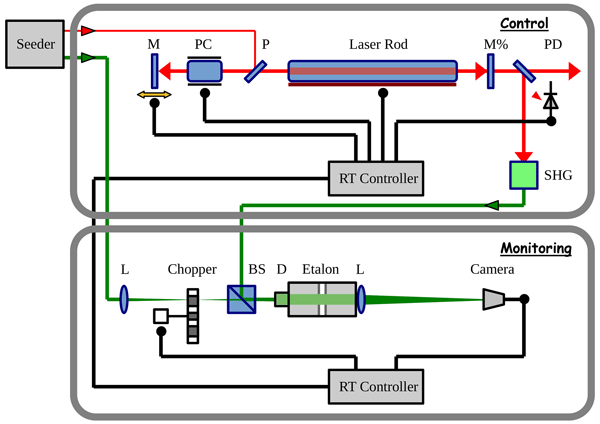
We developed a system for frequency control and monitoring of pulsed high-power lasers. It works in real-time, controls the laser cavity length, and performs a spectral analyzes of each individual laser pulse. The motivation for this work was to improve the retrieval of Doppler winds measured by lidar in the middle atmosphere by taking the frequency stability of the lidar transmitter into account.
Linda Megner, Jörg Gumbel, Ole Martin Christensen, Björn Linder, Donal P. Murtagh, Nickolay Ivchenko, Lukas Krasauskas, Jonas Hedin, Joachim Dillner, Gabriel Giono, Georgi Olentsenko, Louis Kern, Joakim Möller, Ida-Sofia Skyman, and Jacek Stegman
Atmos. Meas. Tech., 18, 6869–6892, https://doi.org/10.5194/amt-18-6869-2025, https://doi.org/10.5194/amt-18-6869-2025, 2025
Short summary
Short summary
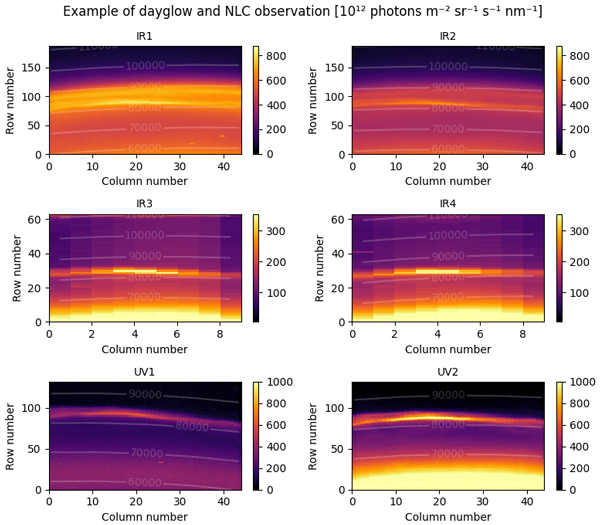
The MATS satellite mission studies atmospheric gravity waves, crucial for momentum transport between atmospheric layers. Launched in November 2022, MATS uses a limb-viewing telescope to capture high-resolution images of noctilucent clouds and airglow, visualising wave patterns in the high atmosphere. This paper accompanies the public release of the Level 1b dataset, i.e. calibrated limb images. Later products will provide global maps of gravity wave properties, airglow, and noctilucent clouds.
Judit Pérez-Coll Jiménez, Nickolay Ivchenko, Ceona Lindstein, Lukas Krasauskas, Jonas Hedin, Donal P. Murtagh, Linda Megner, Björn Linder, and Jörg Gumbel
Ann. Geophys., 43, 701–707, https://doi.org/10.5194/angeo-43-701-2025, https://doi.org/10.5194/angeo-43-701-2025, 2025
Short summary
Short summary
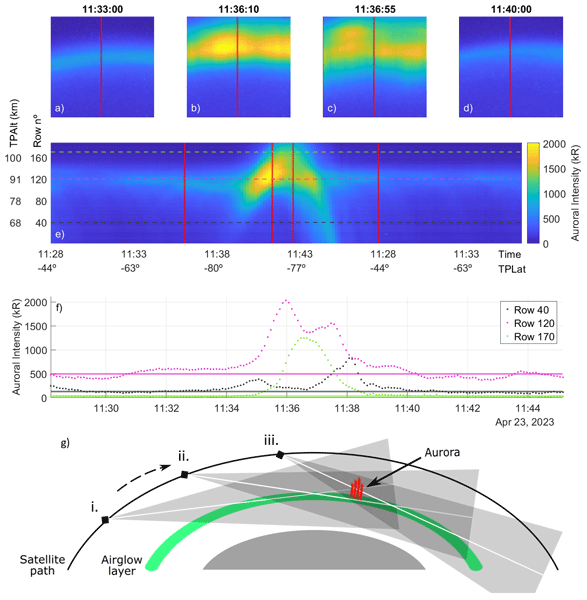
This study uses images taken by the Swedish satellite MATS (Mesospheric Airglow Tomography and Spectroscopy) to conduct a statistical analysis of the molecular oxygen atmospheric band emissions in the aurora. This auroral emission can not be observed from the ground, making it one of the least understood auroral emissions. Our results provide a new dataset with information on the peak altitude, geomagnetic location, and auroral intensity of 378 events detected between February and April 2023.
Mohamed Mossad, Irina Strelnikova, Robin Wing, Gerd Baumgarten, and Michael Gerding
Atmos. Chem. Phys., 25, 14839–14864, https://doi.org/10.5194/acp-25-14839-2025, https://doi.org/10.5194/acp-25-14839-2025, 2025
Short summary
Short summary
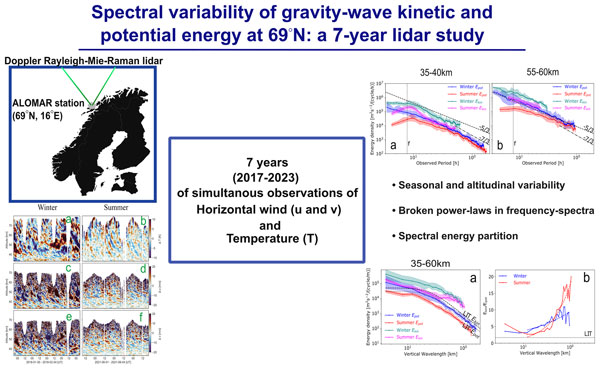
We studied gravity waves using a unique lidar that measures both temperature and wind. This is the first long-term study of how their energies vary with height and season in the middle atmosphere near the Arctic. Waves were stronger and varied more in winter, while in summer slow waves tied to Earth's rotation dominated. We also observed new patterns in how energy is shared between both energy types and height-dependent changes in wave behaviour. These results refine our view of such waves.
Björn Linder, Lukas Krasauskas, Linda Megner, and Donal P. Murtagh
Atmos. Chem. Phys., 25, 12843–12851, https://doi.org/10.5194/acp-25-12843-2025, https://doi.org/10.5194/acp-25-12843-2025, 2025
Short summary
Short summary
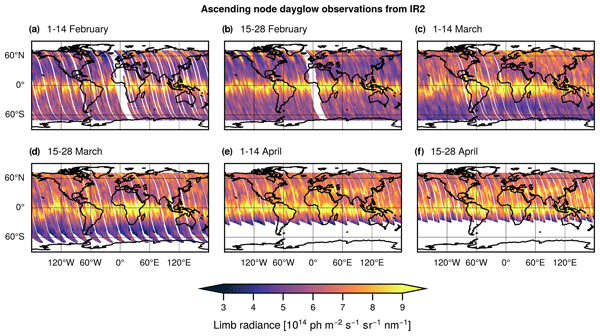
The Swedish satellite MATS (Mesospheric Airglow/Aerosol Tomography and Spectroscopy) conducts global measurements of atmospheric airglow in the mesosphere and lower thermosphere. In this article, we present the first global results from the mission. Observations from February to April 2023 show that the emission strength is largely controlled by atmospheric tides and by perturbations introduced by a propagating planetary wave.
Björn Linder, Jörg Gumbel, Donal P. Murtagh, Linda Megner, Lukas Krasauskas, Doug Degenstein, Ole Martin Christensen, and Nickolay Ivchenko
Atmos. Meas. Tech., 18, 4453–4466, https://doi.org/10.5194/amt-18-4453-2025, https://doi.org/10.5194/amt-18-4453-2025, 2025
Short summary
Short summary
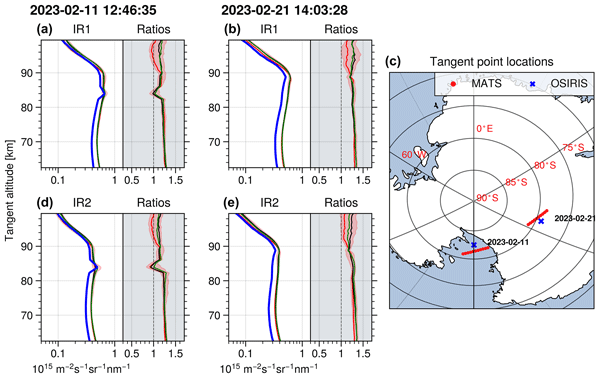
In this study, the primary instrument carried by the satellite MATS is compared to the OSIRIS instrument on board the Odin satellite. A total of 36 close approaches between December 2022 and February 2023 were identified and analysed. The comparison reveals that the two instruments have good structural agreement and that MATS detects a signal that is ~20 % stronger than what is measured by OSIRIS.
Thomas Hocking, Thorsten Mauritsen, and Linda Megner
Atmos. Meas. Tech., 17, 7077–7095, https://doi.org/10.5194/amt-17-7077-2024, https://doi.org/10.5194/amt-17-7077-2024, 2024
Short summary
Short summary
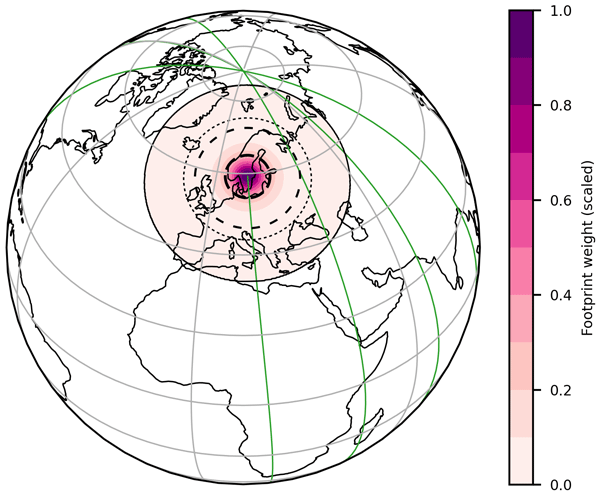
The imbalance between the energy the Earth absorbs from the Sun and the energy the Earth emits back into space gives rise to climate change, but measuring the small imbalance is challenging. We simulate satellites in various orbits to investigate how well they sample the imbalance and find that the best option is to combine at least two satellites that see complementary parts of the Earth and cover the daily and annual cycles. This information is useful when planning future satellite missions.
Natalie Kaifler, Bernd Kaifler, Markus Rapp, Guiping Liu, Diego Janches, Gerd Baumgarten, and Jose-Luis Hormaechea
Atmos. Chem. Phys., 24, 14029–14044, https://doi.org/10.5194/acp-24-14029-2024, https://doi.org/10.5194/acp-24-14029-2024, 2024
Short summary
Short summary
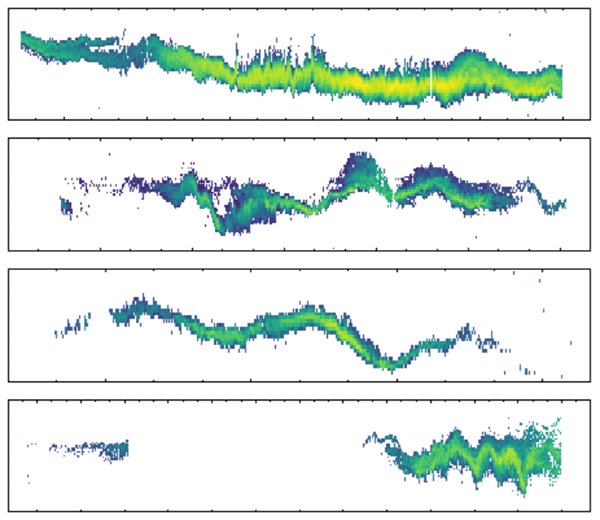
Noctilucent clouds (NLCs) are silvery clouds that can be viewed during twilight and indicate atmospheric conditions like temperature and water vapor in the upper mesosphere. High-resolution measurements from a remote sensing laser instrument provide NLC height, brightness, and occurrence rate since 2017. Most observations occur in the morning hours, likely caused by strong tidal winds, and NLC ice particles are thus transported from elsewhere to the observing location in the Southern Hemisphere.
Jens Fiedler and Gerd Baumgarten
Atmos. Meas. Tech., 17, 5841–5859, https://doi.org/10.5194/amt-17-5841-2024, https://doi.org/10.5194/amt-17-5841-2024, 2024
Short summary
Short summary
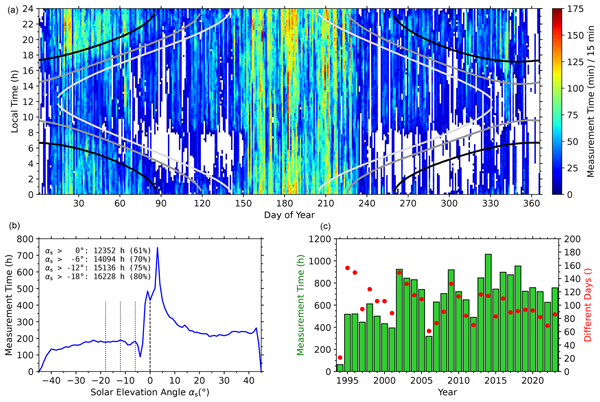
This article describes the current status of a lidar installed at ALOMAR in northern Norway. It has investigated the Arctic middle atmosphere on a climatological basis for 30 years. We discuss major upgrades of the system implemented during recent years, including methods for reliable remote operation of this complex lidar. We also show examples that illustrate the performance of the lidar during measurements at different altitude ranges and timescales.
Björn Linder, Peter Preusse, Qiuyu Chen, Ole Martin Christensen, Lukas Krasauskas, Linda Megner, Manfred Ern, and Jörg Gumbel
Atmos. Meas. Tech., 17, 3829–3841, https://doi.org/10.5194/amt-17-3829-2024, https://doi.org/10.5194/amt-17-3829-2024, 2024
Short summary
Short summary
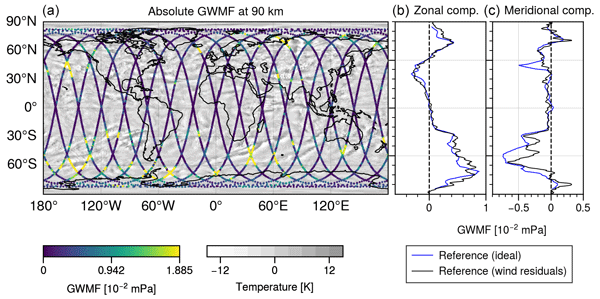
The Swedish research satellite MATS (Mesospheric Airglow/Aerosol Tomography and Spectroscopy) is designed to study atmospheric waves in the mesosphere and lower thermosphere. These waves perturb the temperature field, and thus, by observing three-dimensional temperature fluctuations, their properties can be quantified. This pre-study uses synthetic MATS data generated from a general circulation model to investigate how well wave properties can be retrieved.
Michael Gerding, Robin Wing, Eframir Franco-Diaz, Gerd Baumgarten, Jens Fiedler, Torsten Köpnick, and Reik Ostermann
Atmos. Meas. Tech., 17, 2789–2809, https://doi.org/10.5194/amt-17-2789-2024, https://doi.org/10.5194/amt-17-2789-2024, 2024
Short summary
Short summary
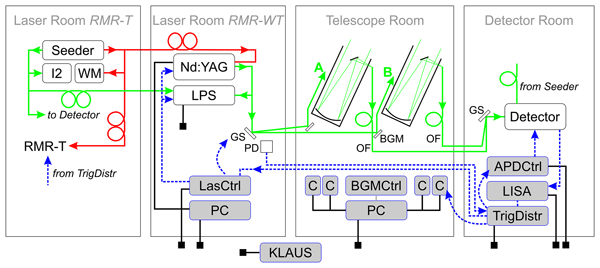
This paper describes a new lidar system developed in Germany intended to study wind and temperature at night in the middle atmosphere. The paper explains how we have set up the system to work automatically and gives technical details for anyone who wants to build a similar system. We present a case study showing temperatures and winds at different altitudes. In a future article, we will present how we process the data and deal with uncertainties.
Maud Leriche, Pierre Tulet, Laurent Deguillaume, Frédéric Burnet, Aurélie Colomb, Agnès Borbon, Corinne Jambert, Valentin Duflot, Stéphan Houdier, Jean-Luc Jaffrezo, Mickaël Vaïtilingom, Pamela Dominutti, Manon Rocco, Camille Mouchel-Vallon, Samira El Gdachi, Maxence Brissy, Maroua Fathalli, Nicolas Maury, Bert Verreyken, Crist Amelynck, Niels Schoon, Valérie Gros, Jean-Marc Pichon, Mickael Ribeiro, Eric Pique, Emmanuel Leclerc, Thierry Bourrianne, Axel Roy, Eric Moulin, Joël Barrie, Jean-Marc Metzger, Guillaume Péris, Christian Guadagno, Chatrapatty Bhugwant, Jean-Mathieu Tibere, Arnaud Tournigand, Evelyn Freney, Karine Sellegri, Anne-Marie Delort, Pierre Amato, Muriel Joly, Jean-Luc Baray, Pascal Renard, Angelica Bianco, Anne Réchou, and Guillaume Payen
Atmos. Chem. Phys., 24, 4129–4155, https://doi.org/10.5194/acp-24-4129-2024, https://doi.org/10.5194/acp-24-4129-2024, 2024
Short summary
Short summary
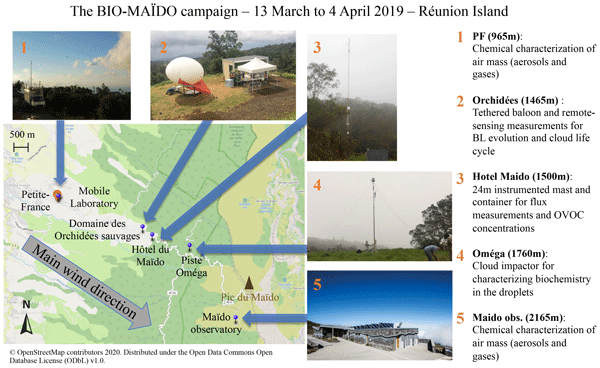
Aerosol particles in the atmosphere play a key role in climate change and air pollution. A large number of aerosol particles are formed from the oxidation of volatile organic compounds (VOCs and secondary organic aerosols – SOA). An important field campaign was organized on Réunion in March–April 2019 to understand the formation of SOA in a tropical atmosphere mostly influenced by VOCs emitted by forest and in the presence of clouds. This work synthesizes the results of this campaign.
Thorben H. Mense, Josef Höffner, Gerd Baumgarten, Ronald Eixmann, Jan Froh, Alsu Mauer, Alexander Munk, Robin Wing, and Franz-Josef Lübken
Atmos. Meas. Tech., 17, 1665–1677, https://doi.org/10.5194/amt-17-1665-2024, https://doi.org/10.5194/amt-17-1665-2024, 2024
Short summary
Short summary
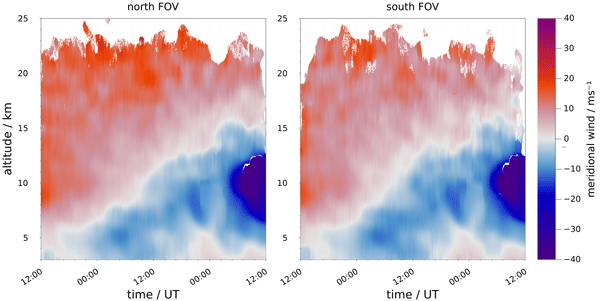
A novel lidar system with five beams measured horizontal and vertical winds together, reaching altitudes up to 25 km. Developed in Germany, it revealed accurate horizontal wind data compared to forecasts, but vertical wind estimates differed. The lidar's capability to detect small-scale wind patterns was highlighted, advancing atmospheric research.
Peter Dalin, Urban Brändström, Johan Kero, Peter Voelger, Takanori Nishiyama, Trond Trondsen, Devin Wyatt, Craig Unick, Vladimir Perminov, Nikolay Pertsev, and Jonas Hedin
Atmos. Meas. Tech., 17, 1561–1576, https://doi.org/10.5194/amt-17-1561-2024, https://doi.org/10.5194/amt-17-1561-2024, 2024
Short summary
Short summary
A novel infrared imaging instrument (OH imager) was put into operation in November 2022 at the Swedish Institute of Space Physics in Kiruna (Sweden). The OH imager is dedicated to the study of nightglow emissions coming from the hydroxyl (OH) and molecular oxygen (O2) layers in the mesopause (80–100 km). Based on a brightness ratio of two OH emission lines, the neutral temperature is estimated at around 87 km. The average daily winter temperature for the period January–April 2023 is 203±10 K.
Eframir Franco-Diaz, Michael Gerding, Laura Holt, Irina Strelnikova, Robin Wing, Gerd Baumgarten, and Franz-Josef Lübken
Atmos. Chem. Phys., 24, 1543–1558, https://doi.org/10.5194/acp-24-1543-2024, https://doi.org/10.5194/acp-24-1543-2024, 2024
Short summary
Short summary
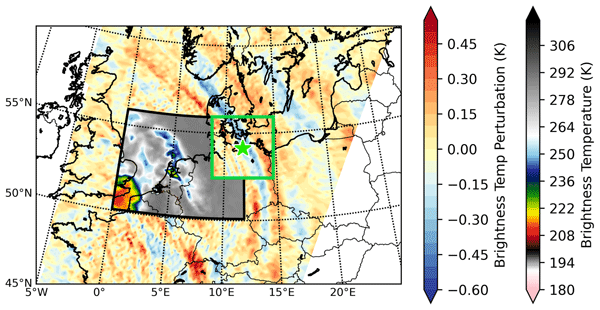
We use satellite, lidar, and ECMWF data to study storm-related waves that propagate above Kühlungsborn, Germany, during summer. Although these events occur in roughly half of the years of the satellite data we analyzed, we focus our study on two case study years (2014 and 2015). These events could contribute significantly to middle atmospheric circulation and are not accounted for in weather and climate models.
Mohamed Mossad, Irina Strelnikova, Robin Wing, and Gerd Baumgarten
Atmos. Meas. Tech., 17, 783–799, https://doi.org/10.5194/amt-17-783-2024, https://doi.org/10.5194/amt-17-783-2024, 2024
Short summary
Short summary
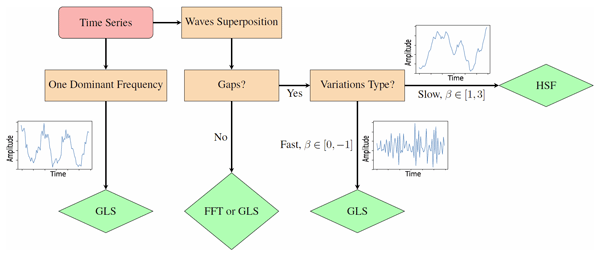
This numerical study addresses observational gaps' impact on atmospheric gravity wave spectra. Three methods, fast Fourier transform (FFT), generalized Lomb–Scargle periodogram (GLS), and Haar structure function (HSF), were tested on synthetic data. HSF is best for spectra with negative slopes. GLS excels for flat and positive slopes and identifying dominant frequencies. Accurately estimating these aspects is crucial for understanding gravity wave dynamics and energy transfer in the atmosphere.
Ashique Vellalassery, Gerd Baumgarten, Mykhaylo Grygalashvyly, and Franz-Josef Lübken
Ann. Geophys., 41, 289–300, https://doi.org/10.5194/angeo-41-289-2023, https://doi.org/10.5194/angeo-41-289-2023, 2023
Short summary
Short summary
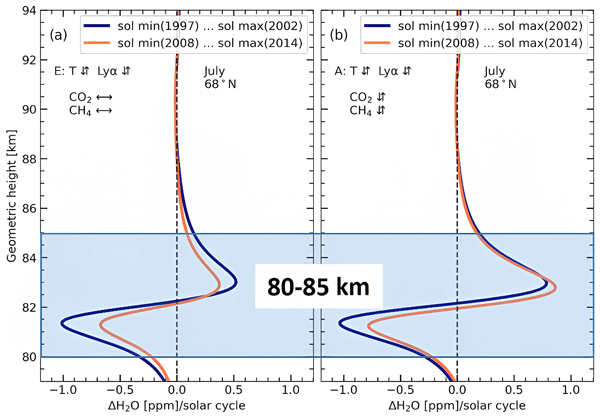
The solar cycle affects the H2O concentration in the upper mesosphere mainly in two ways: directly through photolysis and, at the time and place of NLC formation, indirectly through temperature changes. The H2O–Lyman-α response is modified by NLC formation, resulting in a positive response at the ice formation region (due to the temperature change effect on the ice formation rate) and a negative response at the sublimation zone (due to the photolysis effect).
Tinna L. Gunnarsdottir, Arne Poggenpohl, Ingrid Mann, Alireza Mahmoudian, Peter Dalin, Ingemar Haeggstroem, and Michael Rietveld
Ann. Geophys., 41, 93–114, https://doi.org/10.5194/angeo-41-93-2023, https://doi.org/10.5194/angeo-41-93-2023, 2023
Short summary
Short summary
Temperatures at 85 km around Earth's poles in summer can be so cold that small ice particles form. These can become charged, and, combined with turbulence at these altitudes, they can influence the many electrons present. This can cause large radar echoes called polar mesospheric summer echoes. We use radio waves to heat these echoes on and off when the sun is close to or below the horizon. This allows us to gain some insight into these ice particles and how the sun influences the echoes.
Bingkun Yu, Xianghui Xue, Christopher J. Scott, Mingjiao Jia, Wuhu Feng, John M. C. Plane, Daniel R. Marsh, Jonas Hedin, Jörg Gumbel, and Xiankang Dou
Atmos. Chem. Phys., 22, 11485–11504, https://doi.org/10.5194/acp-22-11485-2022, https://doi.org/10.5194/acp-22-11485-2022, 2022
Short summary
Short summary
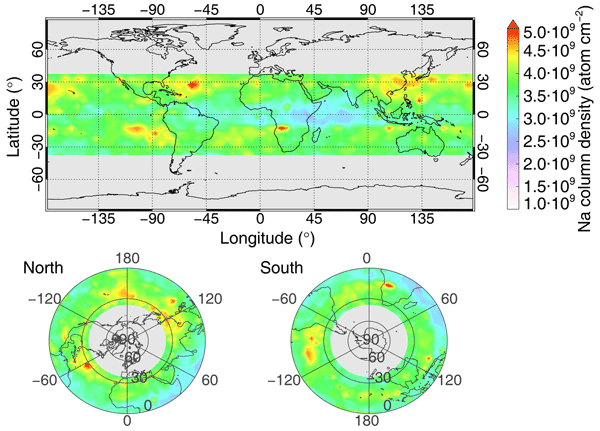
We present a study on the climatology of the metal sodium layer in the upper atmosphere from the ground-based measurements obtained from a lidar network, the Odin satellite measurements, and a global model of meteoric sodium in the atmosphere. Comprehensively, comparisons show good agreement and some discrepancies between ground-based observations, satellite measurements, and global model simulations.
Anna Lange, Gerd Baumgarten, Alexei Rozanov, and Christian von Savigny
Ann. Geophys., 40, 407–419, https://doi.org/10.5194/angeo-40-407-2022, https://doi.org/10.5194/angeo-40-407-2022, 2022
Short summary
Short summary
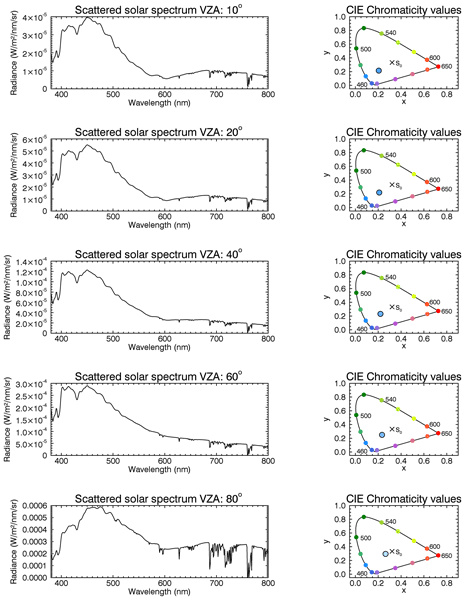
We investigate the influence of different parameters on the colour of noctilucent clouds (highest clouds in the atmosphere), using radiative transfer calculations. We determined the effect of the particle size, optical depth, single scattering/multiple scattering and ozone. For sufficiently large optical depth and for specific viewing geometries, ozone plays only a minor role in the blueish colour of noctilucent clouds (new result).
Cited articles
Bailey, S. M., Thomas, G. E., Rusch, D. W., Merkel, A. W., Jeppesen, C., Carstens, J. N., Randall, C. E., McClintock, W. E., and Russell, J. M.: Phase functions of polar mesospheric cloud ice as observed by the CIPS instrument on the AIM satellite, J. Atmos. Sol.-Terr. Phy., 71, 373–380, https://doi.org/10.1016/j.jastp.2008.09.039, 2009.
Baumgarten, G.: Doppler Rayleigh/Mie/Raman lidar for wind and temperature measurements in the middle atmosphere up to 80 km, Atmos. Meas. Tech., 3, 1509–1518, https://doi.org/10.5194/amt-3-1509-2010, 2010.
Baumgarten, G. and Fritts, D. C.: Quantifying Kelvin-Helmholtz instability dynamics observed in noctilucent clouds: 1. Methods and observations, J. Geophys. Res.-Atmos., 119, 9324–9337, https://doi.org/10.1002/2014JD021832, 2014.
Baumgarten, G., Fiedler, J., Fricke, K. H., Gerding, M., Hervig, M., Hoffmann, P., Müller, N., Pautet, P.-D., Rapp, M., Robert, C., Rusch, D., von Savigny, C., and Singer, W.: The noctilucent cloud (NLC) display during the ECOMA/MASS sounding rocket flights on 3 August 2007: morphology on global to local scales, Ann. Geophys., 27, 953–965, https://doi.org/10.5194/angeo-27-953-2009, 2009.
Baumgarten, G., Chandran, A., Fiedler, J., Hoffmann, P., Kaifler, N., Lumpe, J., Merkel, A., Randall, C. E., Rusch, D., and Thomas, G.: On the horizontal and temporal structure of noctilucent clouds as observed by satellite and lidar at ALOMAR (69N), Geophys. Res. Lett., 39, L01803, https://doi.org/10.1029/2011GL049935, 2012.
Berger, U. and von Zahn, U.: Icy particles in the summer mesopause region: three-dimensional modeling of their environment and two-dimensional modeling of their transport, J. Geophys. Res., 107, 1366, https://doi.org/10.1029/2001JA000316, 2002.
Blum, U. and Fricke, K. H.: The Bonn University lidar at the Esrange: technical description and capabilities for atmospheric research, Ann. Geophys., 23, 1645–1658, https://doi.org/10.5194/angeo-23-1645-2005, 2005.
Chkhetiani, O. and Shalimov, S.: On anomalous wind amplitudes in the lower ionosphere, J. Atmos. Sol.-Terr. Phy., 240, 105960, https://doi.org/10.1016/j.jastp.2022.105960, 2022.
Chkhetiani, O. G. and Shalimov, S. L.: Helicity in the upper atmosphere and Ekman-type instabilities, Dokl. Earth Sc., 431, 345–350, https://doi.org/10.1134/S1028334X10030177, 2010.
Conte, J. F., Chau, J. L., Renkwitz, T., Latteck, R., Tsutsumi, M., Jacobi, C., Gulbrandsen, N., and Nozawa, S.: Observing mesoscale dynamics with multistatic specular meteor radars: first climatology of momentum flux, horizontal divergence and relative vorticity over northern central Europe, Ann. Geophys., 43, 603–619, https://doi.org/10.5194/angeo-43-603-2025, 2025.
Dalin, P.: Noctilucent clouds observed from the stratosphere during the 2024 TRANSAT balloon flight, Harvard Dataverse, V1 [data set], https://doi.org/10.7910/DVN/1PHRZU, 2025a.
Dalin, P.: Two layers in noctilucent clouds seen from the stratosphere during the 2024 TRANSAT balloon flight, Harvard Dataverse, V1 [data set], https://doi.org/10.7910/DVN/AKJK4P, 2025b.
Dalin, P., Pertsev, N., Zadorozhny, A., Connors, M., Schofield, I., Shelton, I., Zalcik, M., McEwan, T., McEachran, I., Frandsen, S., Hansen, O., Andersen, H., Sukhodoev, V., Perminov, V., and Romejko, V.: Ground-based observations of noctilucent clouds with a northern hemisphere network of automated digital cameras, J. Atmos. Sol.-Terr. Phy., 70, 1460–1472, https://doi.org/10.1016/j.jastp.2008.04.018, 2008.
Dalin, P., Pertsev, N., Frandsen, S., Hansen, O., Andersen, H., Dubietis, A., and Balciunas, R.: A case study of the evolution of a Kelvin-Helmholtz wave and turbulence in noctilucent clouds, J. Atmos. Sol.-Terr. Phy., 72, 1129–1138, https://doi.org/10.1016/j.jastp.2010.06.011, 2010.
Dalin, P., Pertsev, N., Dubietis, A., Zalcik, M., Zadorozhny, A., Connors, M., Schofield, I., McEwan, T., McEachran, I., Frandsen, S., Hansen, O., Andersen, H., Sukhodoev, V., Perminov, V., Balčiunas, R., and Romejko, V.: A comparison between ground-based observations of noctilucent clouds and Aura satellite data, J. Atmos. Sol.-Terr. Phy., 73, 2097–2109, https://doi.org/10.1016/j.jastp.2011.01.020, 2011.
Dalin, P., Pogoreltsev, A., Pertsev, N., Perminov, V., Shevchuk, N., Dubietis, A., Zalcik, M., Kulikov, S., Zadorozhny, A., Kudabayeva, D., Solodovnik, A., Salakhutdinov, G., and Grigoryeva, I.: Evidence of the formation of noctilucent clouds due to propagation of an isolated gravity wave caused by a tropospheric occluded front, Geophys. Res. Lett., 42, 2037–2046, https://doi.org/10.1002/2014GL062776, 2015.
Dalin, P., Pertsev, N., Perminov, V., Efremov, D., and Romejko, V.: Looking at “night-shining” clouds from the stratosphere, Eos–AGU, 100, https://doi.org/10.1029/2019EO118439, 2019.
Dalin, P., Pertsev, N., Perminov, V., Efremov, D., and Romejko, V.: Stratospheric observations of noctilucent clouds: a new approach in studying middle- and large-scale mesospheric dynamics, Ann. Geophys., 38, 61–71, https://doi.org/10.5194/angeo-38-61-2020, 2020.
Dalin, P., Suzuki, H., Pertsev, N., Perminov, V., Efremov, D., Voelger, P., Narayanan, V. L., Mann, I., Häggström, I., Zalcik, M., Ugolnikov, O., Hedin, J., Gumbel, J., Latteck, R., and Baumgarten, G.: Studies of noctilucent clouds from the stratosphere during the SONC balloon-borne experiment in 2021, J. Atmos. Sol.-Terr. Phy., 240, 105959, https://doi.org/10.1016/j.jastp.2022.105959, 2022.
DeLand, M. T. and Thomas, G. E.: Updated PMC trends derived from SBUV data, J. Geophys. Res.-Atmos., 120, 2140–2166, https://doi.org/10.1002/2014JD022253, 2015.
Demissie, T. D., Espy, P. J., Kleinknecht, N. H., Hatlen, M., Kaifler, N., and Baumgarten, G.: Characteristics and sources of gravity waves observed in noctilucent cloud over Norway, Atmos. Chem. Phys., 14, 12133–12142, https://doi.org/10.5194/acp-14-12133-2014, 2014.
Dubinskii, A. Yu. and Popel, S. I.: Formation and evolution of dusty plasma structures in the ionosphere, JETP Lett., 96, 21–26, https://doi.org/10.1134/S0021364012130048, 2012.
Eckermann, S. D.: Hodographic analysis of gravity waves: relationships among Stokes parameters, rotary spectra and cross-spectral methods, J. Geophys. Res., 101, 19169–19174, https://doi.org/10.1029/96JD01578, 1996.
Fiedler, J., Baumgarten, G., Berger, U., Hoffmann, P., Kaifler, N., and Lübken, F.-J.: NLC and the background atmosphere above ALOMAR, Atmos. Chem. Phys., 11, 5701–5717, https://doi.org/10.5194/acp-11-5701-2011, 2011.
Fritts, D. C., Wang, L., Baumgarten, G., Miller, A. D., Geller, M. A., Jones, G., Limon, M., Chapman, D., Didier, J., Kjellstrand, C. B., Araujo, D., Hillbrand, S., Korotkov, A., Tucker, G., and Vinokurov, J.: High-resolution observations and modeling of turbulence sources, structures, and intensities in the upper mesosphere, J. Atmos. Sol.-Terr. Phy., 162, 57–78, https://doi.org/10.1016/j.jastp.2016.11.006, 2017.
Fritts, D. C., Miller, A. D., Kjellstrand, C. B., Geach, C., Williams, B. P., Kaifler, B., Kaifler, N., Jones, G., Rapp, M., Limon, M., Reimuller, J., Wang, L., Hanany, S., Gisinger, S., Zhao, Y., Stober, G., and Randall, C. E.: PMC Turbo: Studying gravity wave and instability dynamics in the summer mesosphere using polar mesospheric cloud imaging and profiling from a stratospheric balloon, J. Geophys. Res.-Atmos., 124, 6423–6443, https://doi.org/10.1029/2019JD030298, 2019.
Froidevaux, L., Livesey, N. J., Read, W. G., Jiang, Y. B., Jiménez, C. C., Filipiak, M. J., Schwartz, M. J., Santee, M. L., Pumphrey, H. C., Jiang, J. H., Wu, D. L., Manney, G. L., Drouin, B. J., Waters, J. W., Fetzer, E. J., Bernath, P. F., Boone, C. D., Walker, K. A., Jucks, K. W., Toon, G. C., Margitan, J. J., Sen, B., Webster, C. R., Christensen, L. E., Elkins, J. W., Atlas, E., Lueb, R. A., and Hendershot, R.: Early validation analyses of atmospheric profiles from EOS MLS on the Aura satellite, IEEE T. Geosci. Remote, 44, 1106–1121, https://doi.org/10.1109/TGRS.2006.864366, 2006.
Gadsden, M. and Schröder, W.: Noctilucent Clouds, Springer, New York, https://doi.org/10.1007/978-3-642-48626-5, 1989.
Gao, H., Shepherd, G. G., Tang, Y., Bu, L., and Wang, Z.: Double-layer structure in polar mesospheric clouds observed from SOFIE/AIM, Ann. Geophys., 35, 295–309, https://doi.org/10.5194/angeo-35-295-2017, 2017.
Gerding, M., Höffner, J., Hoffmann, P., Kopp, M., and Lübken, F.-J.: Noctilucent cloud variability and mean parameters from 15 years of lidar observations at a mid-latitude site (54°N, 12°E), J. Geophys. Res.-Atmos., 118, 317–328, https://doi.org/10.1029/2012JD018319, 2013.
Gossard, E. E. and Hooke, W. H.: Waves in the atmosphere: atmospheric infrasound and gravity waves – their generation and propagation, Elsevier Scientific Publishing Co, Amsterdam, https://www.amazon.com/Waves-Atmosphere-Atmospheric-Propagation-Developments/dp/0444411968 (last access: 27 April 2026), 1975.
Gumbel, J. and Witt, G.: Rocket-borne photometry of NLC particle populations, Adv. Space Res., 28, 1053–1058, https://doi.org/10.1016/S0273-1177(01)80036-3, 2001.
Gumbel, J., Megner, L., Christensen, O. M., Ivchenko, N., Murtagh, D. P., Chang, S., Dillner, J., Ekebrand, T., Giono, G., Hammar, A., Hedin, J., Karlsson, B., Krus, M., Li, A., McCallion, S., Olentšenko, G., Pak, S., Park, W., Rouse, J., Stegman, J., and Witt, G.: The MATS satellite mission – gravity wave studies by Mesospheric Airglow/Aerosol Tomography and Spectroscopy, Atmos. Chem. Phys., 20, 431–455, https://doi.org/10.5194/acp-20-431-2020, 2020.
Hervig, M. E., Siskind, D. E., Bailey, S. M., and Russell III, J. M.: The influence of PMCs on water vapor and drivers behind PMC variability from SOFIE observations, J. Atmos. Sol.-Terr. Phy., 132, 124–134, https://doi.org/10.1016/j.jastp.2015.07.010, 2015.
Kaifler, N., Baumgarten, G., Klekociuk, A. R., Alexander, S. P., Fiedler, J., and Lübken, F.-J.: Small scale structures of NLC observed by lidar at 69°N/69°S and their possible relation to gravity waves, J. Atmos. Sol.-Terr. Phy., 104, 244–252, https://doi.org/10.1016/j.jastp.2013.01.004, 2013.
Karlsson, B. and Gumbel, J.: Challenges in the limb retrieval of noctilucent cloud properties from Odin/OSIRIS, Adv. Space Res., 36, 935–942, https://doi.org/10.1016/j.asr.2005.04.074, 2005.
Koshin, D., Sato, K., Miyazaki, K., and Watanabe, S.: An ensemble Kalman filter data assimilation system for the whole neutral atmosphere, Geosci. Model Dev., 13, 3145–3177, https://doi.org/10.5194/gmd-13-3145-2020, 2020.
Koshin, D., Sato, K., Kohma, M., and Watanabe, S.: An update on the 4D-LETKF data assimilation system for the whole neutral atmosphere, Geosci. Model Dev., 15, 2293–2307, https://doi.org/10.5194/gmd-15-2293-2022, 2022.
Koshin, D., Sato, K., Watanabe, S., and Miyazaki, K.: The JAGUAR-DAS whole neutral atmosphere reanalysis: JAWARA, Prog. Earth Planet. Sci., 12, 1, https://doi.org/10.1186/s40645-024-00674-3, 2025.
Lambert, A., Read, W. G., Livesey, N. J., Santee, M. L., Manney, G. L., Froidevaux, L., Wu, D. L., Schwartz, M. J., Pumphrey, H. C., Jimenez, C., Nedoluha, G. E., Cofield, R. E., Cuddy, D. T., Daffer, W. H., Drouin, B. J., Fuller, R. A., Jarnot, R. F., Knosp, B. W., Pickett, H. M., Perun, V. S., Snyder, W. V., Stek, P. C., Thurstans, R. P., Wagner, P. A., Waters, J. W., Jucks, K. W., Toon, G. C., Stachnik, R. A., Bernath, P. F., Boone, C. D., Walker, K. A., Urban, J., Murtagh, D., Elkins, J. W., and Atlas, E.: Validation of the Aura Microwave Limb Sounder middle atmosphere water vapor and nitrous oxide measurements, J. Geophys. Res., 112, D24S36, https://doi.org/10.1029/2007JD008724, 2007.
Li, H., Wu, J., and Zhou, Z.: The formation of multiple layers of ice particles in the polar summer mesopause region, Ann. Geophys., 34, 117–122, https://doi.org/10.5194/angeo-34-117-2016, 2016.
Liu, X., Yue, J., Xu, J., Yuan, W., Russell III, J. M., Hervig, M. E., and Nakamura, T.: Persistent longitudinal variations in 8 years of CIPS/AIM polar mesospheric clouds, J. Geophys. Res.-Atmos., 121, 8390–8409, https://doi.org/10.1002/2015JD024624, 2016.
Megner, L., Gumbel, J., Christensen, O. M., Linder, B., Murtagh, D., Ivchenko, N., Krasauskas, L., Hedin, J., Dillner, J., and Stegman, J.: MATS satellite images (level 1b) of airglow and noctilucent clouds in the mesosphere/lower thermosphere, February–May 2023, Dataset version 1.0, Bolin Centre Database [data set], https://doi.org/10.17043/mats-level-1b-limb-cropd-1.0, 2025.
Miller, A. D., Fritts, D. C., Chapman, D., Jones, G., Limon, M., Araujo, D., Didier, J., Hillbrand, S., Kjellstrand, C. B., Korotkov, A., Tucker, G., Vinokurov, Y., Wan, K., and Wang, L.: Stratospheric imaging of polar mesospheric clouds: a new window on small-scale atmospheric dynamics, Geophys. Res. Lett., 42, 6058–6065, https://doi.org/10.1002/2015GL064758, 2015.
Murphy, D. M. and Koop, T.: Review of the vapour pressures of ice and supercooled water for atmospheric applications, Q. J. Roy. Meteor. Soc., 131, 1539–1565, https://doi.org/10.1256/qj.04.94, 2005.
Pautet, P.-D., Stegman, J., Wrasse, C. M., Nielsen, K., Takahashi, H., Taylor, M. J., Hoppel, K. W., and Eckermann, S. D.: Analysis of gravity waves structures visible in noctilucent cloud images, J. Atmos. Sol.-Terr. Phy., 73, 2082–2090, https://doi.org/10.1016/j.jastp.2010.06.001, 2011.
Pertsev, N. N., Dalin, P. A., Perminov, V. I., Gusev, N. K., Tsimerinov, E. Yu., Solodovnik, A. A., Zadorozhny, A. M., Korotyshkin, D. V., and Bordonskiy, G. S.: Analysis of noctilucent cloud fields according to ground-based network and airborne photography data, Izv. Atmos. Ocean. Phys., 60, 187–194, https://doi.org/10.1134/S0001433824700191, 2024.
Portnyagin, Y. I. and Solovjova, T. V.: Global empirical wind model for the upper mesosphere/lower thermosphere. I. Prevailing wind, Ann. Geophys., 18, 300–315, https://doi.org/10.1007/s00585-000-0300-y, 2000.
Randall, C. E., Carstens, J., France, J. A., Harvey, V. L., Hoffmann, L., Bailey, S. M., Alexander, M. J., Lumpe, J. D., Yue, J., Thurairajah, B., Siskind, D. E., Zhao, Y., Taylor, M. J., and Russell III, J. M.: New AIM/CIPS global observations of gravity waves near 50–55 km, Geophys. Res. Lett., 44, 7044–7052, https://doi.org/10.1002/2017GL073943, 2017.
Rapp, M., Lubken, F.-J., Müllemann, A., Thomas, G. E., and Jensen, E. J.: Small-scale temperature variations in the vicinity of NLC: Experimental and model results, J. Geophys. Res., 107, 4392, https://doi.org/10.1029/2001JD001241, 2002.
Read, W. G., Lambert, A., Bacmeister, J., Cofield, R. E., Christensen, L. E., Cuddy, D. T., Daffer, W. H., Drouin, B. J., Fetzer, E., Froidevaux, L., Fuller, R., Herman, R., Jarnot, R. F., Jiang, J. H., Jiang, Y. B., Kelly, K., Knosp, B. W., Kovalenko, L. J., Livesey, N. J., Liu, H.-C., Manney, G. L., Pickett, H. M., Pumphrey, H. C., Rosenlof, K. H., Sabounchi, X., Santee, M. L., Schwartz, M. J., Snyder, W. V., Stek, P. C., Su, H., Takacs, L. L., Thurstans, R. P., Vömel, H., Wagner, P. A., Waters, J. W., Webster, C. R., Weinstock, E. M., and Wu, D. L.: Aura Microwave Limb Sounder upper tropospheric and lower stratospheric H2O and relative humidity with respect to ice validation, J. Geophys. Res., 112, D24S35, https://doi.org/10.1029/2007JD008752, 2007.
Reimuller, J. D., Thayer, J. P., Baumgarten, G., Chandran, A., Hulley, B., Rusch, D., Nielsen, K., and Lumpe, J.: Synchronized imagery of noctilucent clouds at the day-night terminator using airborne and spaceborne platforms, J. Atmos. Sol.-Terr. Phy., 73, 2091–2096, https://doi.org/10.1016/j.jastp.2010.11.022, 2011.
Schwartz, M. J., Lambert, A., Manney, G. L., Read, W. G., Livesey, N. J., Froidevaux, L., Ao, C. O., Bernath, P. F., Boone, C. D., Cofield, R. E., Daffer, W. H., Drouin, B. J., Fetzer, E. J., Fuller, R. A., Jarnot, R. F., Jiang, J. H., Jiang, Y. B., Knosp, B. W., Krüger, K., Li, J.-L. F., Mlynczak, M. G., Pawson, S., Russell III, J. M., Santee, M. L., Snyder, W. V., Stek, P. C., Thurstans, R. P., Tompkins, A. M., Wagner, P. A., Walker, K. A., Waters, J. W., and Wu, D. L.: Validation of the Aura Microwave Limb Sounder temperature and geopotential height measurements, J. Geophys. Res., 113, D15S11, https://doi.org/10.1029/2007JD008783, 2008.
Suzuki, H., Matsumoto, A., Dalin, P., Nakamura, Y., Ishii, S., Sakanoi, K., Sakaguchi, K., Takada, T., Tsuda, T. T., and Hozumi, Y.: Capability of airline jets as an observation platform for noctilucent clouds at middle latitudes, Prog. Earth Planet. Sci., 9, 11, https://doi.org/10.1186/s40645-022-00469-4, 2022.
Thomas, G. E.: Solar Mesosphere Explorer measurements of polar mesospheric clouds (noctilucent clouds), J. Atmos. Terr. Phys., 46, 819–824, 1984.
Tsuda, T. T., Hozumi, Y., Kawaura, K., Tatsuzawa, K., Ando, Y., Hosokawa, K., Suzuki, H., Murata, K. T., Nakamura, T., Yue, J., and Nielsen, K.: Detection of polar mesospheric clouds utilizing Himawari-8/AHI full-disk images, Earth Space Sci., 9, 2021EA002076, https://doi.org/10.1029/2021EA002076, 2022.
Wallis, S., DeLand, M., and von Savigny, C.: Did the 2022 Hunga eruption impact the noctilucent cloud season in 2023/24 and 2024?, Atmos. Chem. Phys., 25, 3635–3645, https://doi.org/10.5194/acp-25-3635-2025, 2025.
Zadorozhny, A. M., Tyutin, A. A., Witt, G., Wilhelm, N., Wälchli, U., Cho, J. Y. N., and Swartz, W. E.: Electric field measurements in the vicinity of noctilucent clouds and PMSE, Geophys. Res. Lett., 20, 2299–2302, https://doi.org/10.1029/93GL02626, 1993.
Short summary
A transatlantic scientific balloon flight (TRANSAT) was conducted in June 2024. The TRANSAT balloon floated in the stratosphere at approximately 40 km altitude between Sweden and Canada for about 4 days. An optical imager was installed on the TRANSAT balloon to study noctilucent cloud (NLC). Nearly continuous observations of NLC were obtained during the entire flight. A complex NLC structures exhibiting different motions were found to result from wind rotation with altitude between 80 and 94 km.
A transatlantic scientific balloon flight (TRANSAT) was conducted in June 2024. The TRANSAT...


