
Articles | Volume 43, issue 2
https://doi.org/10.5194/angeo-43-881-2025
© Author(s) 2025. This work is distributed under
the Creative Commons Attribution 4.0 License.
the Creative Commons Attribution 4.0 License.
https://doi.org/10.5194/angeo-43-881-2025
© Author(s) 2025. This work is distributed under
the Creative Commons Attribution 4.0 License.
the Creative Commons Attribution 4.0 License.
Regular paper
| 
17 Dec 2025
Regular paper |
| 17 Dec 2025
| 17 Dec 2025
Globally- and hemispherically-integrated Joule heating rates during the 17 March 2015 geomagnetic storm, according to physics-based and empirical models
Stelios Tourgaidis
CORRESPONDING AUTHOR

Department of Electrical and Computer Engineering, Democritus University of Thrace, Xanthi, Greece
Dimitris Baloukidis
Department of Electrical and Computer Engineering, Democritus University of Thrace, Xanthi, Greece
Panagiotis Pirnaris
Department of Electrical and Computer Engineering, Democritus University of Thrace, Xanthi, Greece
Theodoros Sarris
CORRESPONDING AUTHOR
Department of Electrical and Computer Engineering, Democritus University of Thrace, Xanthi, Greece
Aaron Ridley
Department of Atmosphere, Oceanic and Space Sciences, University of Michigan,Michigan,USA
Gang Lu
High Altitude Observatory, National Center for Atmospheric Research, Boulder, Colorado, USA
Related authors
Stelios Tourgaidis, Theodoros Sarris, Dimitrios Baloukidis, Stephan Buchert, Panagiotis Pirnaris, Konstantinos Papadakis, and Athanasios Balafoutis
Ann. Geophys., 44, 773–793, https://doi.org/10.5194/angeo-44-773-2026, https://doi.org/10.5194/angeo-44-773-2026, 2026
Short summary
Short summary
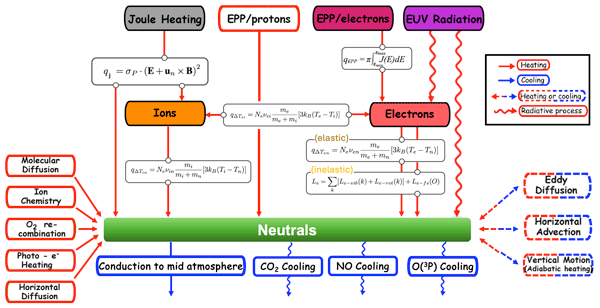
The Lower Thermosphere-Ionosphere energy balance is driven by complex interactions between ions, neutrals and electrons. These processes are understood theoretically, but their estimates show large discrepancies between models. We calculate the storm-time energy budget according to the neutrals, ions and electrons using TIE-GCM (Thermosphere Ionosphere Electrodynamics General Circulation Model) using two different external drivers. Discrepancies between the model runs are discussed and the way forward to close the gaps in present knowledge is highlighted.
Gabriella Stenberg Wieser, Martin Wieser, Stas Barabash, Philipp Wittmann, Leif Kalla, Markus Fränz, Elias Roussos, Audrey Vorburger, Peter Wurz, Jan-Erik Wahlund, Pontus C. Brandt, Yoshifumi Futaana, Manabu Shimoyama, Angèle Pontoni, André Galli, Andreas Riedo, George Ho, Donald G. Mitchell, George Clark, Peter Kollmann, Malamati Gkioulidou, Leonardo Regoli, Norbert Krupp, Robert Wimmer-Schweingruber, Kazushi Asamura, Esa Kallio, Andrea Opitz, Manuel Grande, Andrew Coates, Geraint Jones, Theodoros Sarris, Andrey Fedorov, Nicolas André, and Ján Baláž
Ann. Geophys., 44, 937–948, https://doi.org/10.5194/angeo-44-937-2026, https://doi.org/10.5194/angeo-44-937-2026, 2026
Short summary
Short summary
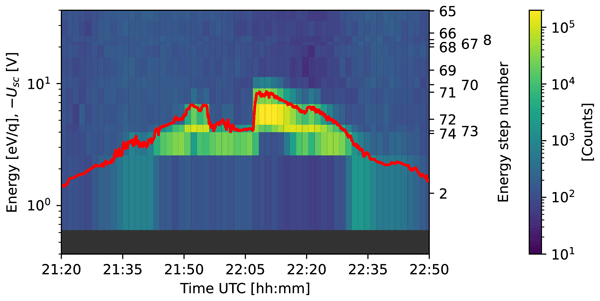
We used Juice flyby of Earth in August 2024 to evaluate the performance of the Jovian Plasma Dynamics and Composition analyzer (JDC). JDC measures positive and negative ions as well as electrons. When Juice arrives at Jupiter, one of the most challenging tasks for JDC is to record low energy ion populations. We used the data JDC recorded close to Earth, together with measurement in the laboratory on ground, to improve the future observations the sensor will make around Jupiter’s icy moons.
Stelios Tourgaidis, Theodoros Sarris, Dimitrios Baloukidis, Stephan Buchert, Panagiotis Pirnaris, Konstantinos Papadakis, and Athanasios Balafoutis
Ann. Geophys., 44, 773–793, https://doi.org/10.5194/angeo-44-773-2026, https://doi.org/10.5194/angeo-44-773-2026, 2026
Short summary
Short summary
The Lower Thermosphere-Ionosphere energy balance is driven by complex interactions between ions, neutrals and electrons. These processes are understood theoretically, but their estimates show large discrepancies between models. We calculate the storm-time energy budget according to the neutrals, ions and electrons using TIE-GCM (Thermosphere Ionosphere Electrodynamics General Circulation Model) using two different external drivers. Discrepancies between the model runs are discussed and the way forward to close the gaps in present knowledge is highlighted.
Markus Fraenz, Henning Fischer, Norbert Krupp, Elias Roussos, Philipp Wittmann, Patrick Bambach, Jan-Erik Wahlund, Gabriella Stenberg Wieser, Stas Barabash, Mika Holmberg, Maryam Zeroual, Pontus Brandt, Peter Wurz, Martin Wieser, Yoshifumi Futaana, Manabu Shimoyama, Angele Pontoni, Audrey Vorburger, Andre Galli, Andreas Riedo, George Ho, Donald Mitchell, George Clark, Peter Kollmann, Malamati Gkioulidou, Leonardo Regoli, Robert Wimmer-Schweingruber, Kazushi Asamura, Esa Kallio, Andrea Opitz, Manuel Grande, Andrew Coates, Geraint Jones, Theodoros Sarris, Andrey Fedorov, Nicolas André, and Ján Baláž
EGUsphere, https://doi.org/10.5194/egusphere-2026-2030, https://doi.org/10.5194/egusphere-2026-2030, 2026
Short summary
Short summary
During the first Earth gravity assist maneuver of the JUICE spacecraft in August 2024 the spacecraft passed through the Earth plasmasphere for about 2 hours. The ion spectrometer PEP JEI was able to make a very rare observation of the molecular ion fraction of the cold and dense plasma in the Earth plasmasphere. The observation shows that cold ions can emanate from the Earth ionosphere even at times when no magnetic storm enhances the ion extraction.
Florian Günzkofer, Anders Tjulin, Gang Lu, Hanli Liu, and Gunter Stober
EGUsphere, https://doi.org/10.5194/egusphere-2026-823, https://doi.org/10.5194/egusphere-2026-823, 2026
Short summary
Short summary
Incoherent scatter radars (ISRs) are an important measurement tool for space weather research. However, ISR measurements require previous knowledge of the state of the ionosphere, especially the ratio of atomic oxygen ions (O+) to electrons. We present ISR measurements during the May 2024 "Mothers' Day Storm" and apply data assimilation-based O+ ratios, which should result in more accurate ISR measurements. The advantages and disadvantages of our method are compared to those of other approaches.
Ana Roberta Paulino, Delis Otildes Rodrigues, Igo Paulino, Lourivaldo Mota Lima, Ricardo Arlen Buriti, Paulo Prado Batista, Aaron Ridley, and Chen Wu
Ann. Geophys., 43, 183–191, https://doi.org/10.5194/angeo-43-183-2025, https://doi.org/10.5194/angeo-43-183-2025, 2025
Short summary
Short summary
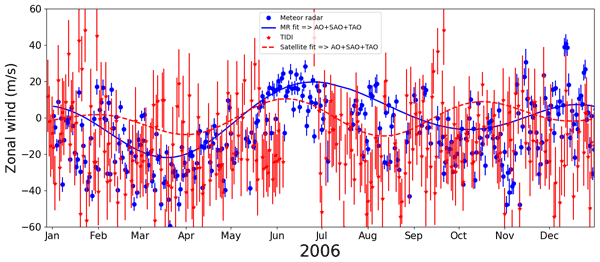
Comparisons of wind measurements using two different techniques (ground-based radar and satellite) in Brazil during 2006 were made in order to point out the advantages of each instrument for studies in the mesosphere and upper thermosphere. (i) For short-period variations, the measurements of the satellite were more advantageous. (ii) The monthly climatology using the radar was more appropriate. (iii) For long periods (longer than a few months), both instruments responded satisfactorily.
Joachim Vogt, Octav Marghitu, Adrian Blagau, Leonie Pick, Nele Stachlys, Stephan Buchert, Theodoros Sarris, Stelios Tourgaidis, Thanasis Balafoutis, Dimitrios Baloukidis, and Panagiotis Pirnaris
Geosci. Instrum. Method. Data Syst., 12, 239–257, https://doi.org/10.5194/gi-12-239-2023, https://doi.org/10.5194/gi-12-239-2023, 2023
Short summary
Short summary
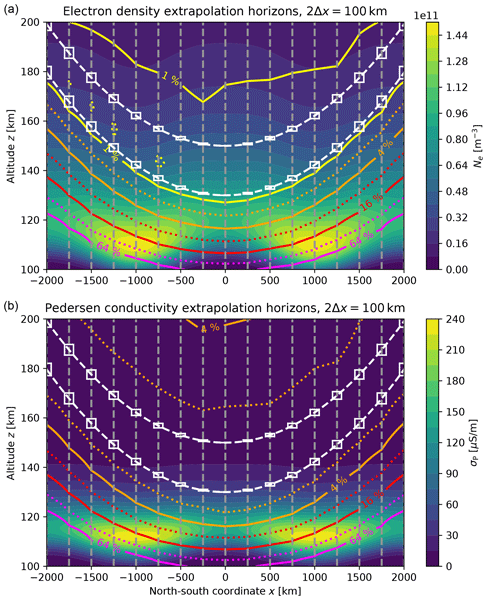
Motivated by recent community interest in a satellite mission to the atmospheric lower thermosphere and ionosphere (LTI) region (100–200 km altitude), the DIPCont project is concerned with the reconstruction quality of vertical profiles of key LTI variables using dual- and single-spacecraft observations. The report introduces the probabilistic DIPCont modeling framework, demonstrates its usage by means of a set of self-consistent parametric non-isothermal models, and discusses first results.
Panagiotis Pirnaris and Theodoros Sarris
Ann. Geophys., 41, 339–354, https://doi.org/10.5194/angeo-41-339-2023, https://doi.org/10.5194/angeo-41-339-2023, 2023
Short summary
Short summary
The relation between electron, ion and neutral temperatures in the lower thermosphere–ionosphere (LTI) is key to understanding the energy balance and transfer between species. However, their simultaneous measurement is rare in the LTI. Based on data from the AE-C, AE-D, AE-E and DE-2 satellites of the 1970s and 1980s, a large number of events where neutrals are hotter than ions are identified and statistically analyzed. Potential mechanisms that could trigger these events are proposed.
Cited articles
Ahn, B.-H., Kroehl, H., Kamide, Y., and Gorney, D.: Estimation of ionospheric electrodynamic parameters using ionospheric conductance deduced from bremsstrahlung X ray image data, J. Geophys. Res.-Space, 94, 2565–2586, 1989. a
Aksnes, A., Stadsnes, J., Lu, G., Østgaard, N., Vondrak, R. R., Detrick, D. L., Rosenberg, T. J., Germany, G. A., and Schulz, M.: Effects of energetic electrons on the electrodynamics in the ionosphere, Ann. Geophys., 22, 475–496, https://doi.org/10.5194/angeo-22-475-2004, 2004. a
Amm, O.: Ionospheric elementary current systems in spherical coordinates and their application, Journal of Geomagnetism and Geoelectricity, 49, 947–955, https://doi.org/10.5636/jgg.49.947, 1997. a, b
Baloukidis, D., Sarris, T., Tourgaidis, S., Pirnaris, P., Aikio, A., Virtanen, I., Buchert, S., and Papadakis, K.: A comparative assessment of the distribution of Joule heating in altitude as estimated in TIE-GCM and EISCAT over one solar cycle, J. Geophys. Res.-Space, 128, e2023JA031526, https://doi.org/10.1029/2023JA031526, 2023. a
Bergin, A., Chapman, S. C., and Gjerloev, J. W.: AE, DST, and their SuperMAG counterparts: the effect of improved spatial resolution in geomagnetic indices, J. Geophys. Res.-Space, 125, e2020JA027828, https://doi.org/10.1029/2020JA027828, 2020. a
Bilitza, D.: IRI the International Standard for the Ionosphere, Adv. Radio Sci., 16, 1–11, https://doi.org/10.5194/ars-16-1-2018, 2018. a, b
Bougher, S. W., Pawlowski, D., Bell, J. M., Nelli, S., McDunn, T., Murphy, J. R., Chizek, M., and Ridley, A.: Mars Global Ionosphere-Thermosphere Model: Solar cycle, seasonal, and diurnal variations of the Mars upper atmosphere, J. Geophys. Res.-Planet., 120, 311–342, https://doi.org/10.1002/2014JE004715, 2015. a
Bristow, W. A., Hampton, D. L., and Otto, A.: High-spatial-resolution velocity measurements derived using Local Divergence-Free Fitting of SuperDARN observations, J. Geophys. Res.-Space, 121, 1349–1361, https://doi.org/10.1002/2015JA021862, 2016. a, b
Cosgrove, R. B. and Codrescu, M.: Electric field variability and model uncertainty: a classification of source terms in estimating the squared electric field from an electric field model, J. Geophys. Res.-Space, 114, https://doi.org/10.1029/2008JA013929, 2009. a, b
Cosgrove, R., McCready, M., Tsunoda, R., and Stromme, A.: The bias on the Joule heating estimate: small-scale variability versus resolved-scale model uncertainty and the correlation of electric field and conductance, J. Geophys. Res.-Space, 116, https://doi.org/10.1029/2011JA016665, 2011. a
Cosgrove, R. B., Bahcivan, H., Chen, S., Sanchez, E., and Knipp, D.: Violation of hemispheric symmetry in integrated Poynting flux via an empirical model, Geophys. Res. Lett., 49, e2021GL097329, https://doi.org/10.1029/2021GL097329, 2022. a
Dang, T., Li, X., Luo, B., Li, R., Zhang, B., Pham, K., Ren, D., Chen, X., Lei, J., and Wang, Y.: Unveiling the space weather during the Starlink satellites destruction event on 4 February 2022, Space Weather, 20, e2022SW003152, https://doi.org/10.1029/2022SW003152, 2022. a
Deng, Y., Maute, A., Richmond, A. D., and Roble, R. G.: Impact of electric field variability on Joule heating and thermospheric temperature and density, Geophys. Res. Lett., 36, https://doi.org/10.1029/2008GL036916, 2009. a
Deng, Y., Heelis, R., Lyons, L., Nishimura, Y., and Gabrielse, C.: Impact of flow bursts in the auroral zone on the ionosphere and thermosphere, J. Geophys. Res.-Space, 124, https://doi.org/10.1029/2019JA026755, 2019. a
Dmitriev, A. V., Suvorova, A. V., Klimenko, M. V., Klimenko, V. V., Ratovsky, K. G., Rakhmatulin, R. A., and Parkhomov, V. A.: Predictable and unpredictable ionospheric disturbances during St. Patrick's Day magnetic storms of 2013 and 2015 and on 8–9 March 2008, J. Geophys. Res.-Space, 122, 2398–2423, https://doi.org/10.1002/2016JA023260, 2017. a
Drob, D. P., Emmert, J. T., Crowley, G., Picone, J. M., Shepherd, G. G., Skinner, W., Hays, P., Niciejewski, R. J., Larsen, M., She, C. Y., Meriwether, J. W., Hernandez, G., Jarvis, M. J., Sipler, D. P., Tepley, C. A., O'Brien, M. S., Bowman, J. R., Wu, Q., Murayama, Y., Kawamura, S., Reid, I. M., and Vincent, R. A.: An empirical model of the Earth's horizontal wind fields: HWM07, J. Geophys. Res.-Space, 113, https://doi.org/10.1029/2008JA013668, 2008. a
Emery, B., Lathuillere, C., Richards, P., Roble, R., Buonsanto, M., Knipp, D., Wilkinson, P., Sipler, D., and Niciejewski, R.: Time dependent thermospheric neutral response to the 2–11 November 1993 storm period, J. Atmos. Sol.-Terr. Phy., 61, 329–350, https://doi.org/10.1016/S1364-6826(98)00137-0, 1999. a
Emery, B., Roble, R., Ridley, E., Richmond, A., Knipp, D., Crowley, G., Evans, D., Rich, F., and Maeda, S.: Parameterization of the ion convection and the auroral oval in the NCAR Thermospheric General Circulation Models, Tech. rep., https://doi.org/10.5065/D6N29TXZ, 2012. a, b
ESA/NASA-ENLoTIS-Report: Exploring Earth's Interface with Space – The Scientific Case for a Satellite Mission to the Lower Thermosphere-Ionosphere Transition Region, Tech. Rep. ESA-EOPSM-ELTI-RP-4592 / NASA/CR-20240013551, European Space Agency (ESA), Noordwijk, The Netherlands and National Aeronautics and Space Administration (NASA), Washington DC, USA, https://doi.org/10.5270/ESA-NASA.LTI-SC.2024-07-v1.0, 2024. a
Gjerloev, J. W.: The SuperMAG data processing technique, J. Geophys. Res.-Space, 117, https://doi.org/10.1029/2012JA017683, 2012. a
Hapgood, M., Liu, H., and Lugaz, N.: SpaceX – sailing close to the space weather?, Space Weather, 20, e2022SW003074, https://doi.org/10.1029/2022SW003074, 2022. a
Hong, Y., Deng, Y., Zhu, Q., Maute, A., Sheng, C., Welling, D., and Lopez, R.: Impacts of different causes on the inter-hemispheric asymmetry of ionosphere-thermosphere system at mid- and high-latitudes: GITM simulations, Space Weather, 19, https://doi.org/10.1029/2021sw002856, 2021. a, b
Huang, Y., Richmond, A. D., Deng, Y., and Roble, R.: Height distribution of Joule heating and its influence on the thermosphere, J. Geophys. Res.-Space, 117, https://doi.org/10.1029/2012JA017885, 2012. a
Hudson, M., Jaynes, A., Kress, B., Li, Z., Patel, M., Shen, X.-C., Thaller, S., Wiltberger, M., and Wygant, J.: Simulated prompt acceleration of multi-MeV electrons by the 17 March 2015 interplanetary shock, J. Geophys. Res.-Space, 122, 10036–10046, https://doi.org/10.1002/2017JA024445, 2017. a
Jaynes, A. N., Ali, A. F., Elkington, S. R., Malaspina, D. M., Baker, D. N., Li, X., Kanekal, S. G., Henderson, M. G., Kletzing, C. A., and Wygant, J. R.: Fast diffusion of ultrarelativistic electrons in the outer radiation belt: 17 March 2015 storm event, Geophys. Res. Lett., 45, 10874–10882, https://doi.org/10.1029/2018GL079786, 2018. a
Kanekal, S. G., Baker, D. N., Fennell, J. F., Jones, A., Schiller, Q., Richardson, I. G., Li, X., Turner, D. L., Califf, S., Claudepierre, S. G., Wilson III, L. B., Jaynes, A., Blake, J. B., Reeves, G. D., Spence, H. E., Kletzing, C. A., and Wygant, J. R.: Prompt acceleration of magnetospheric electrons to ultrarelativistic energies by the 17 March 2015 interplanetary shock, J. Geophys. Res.-Space, 121, 7622–7635, https://doi.org/10.1002/2016JA022596, 2016. a
Knipp, D., Kilcommons, L., Hairston, M., and Coley, W. R.: Hemispheric asymmetries in Poynting flux derived from DMSP spacecraft, Geophys. Res. Lett., 48, https://doi.org/10.1029/2021gl094781, 2021. a
Laundal, K. M., Cnossen, I., Milan, S. E., Haaland, S. E., Coxon, J., Pedatella, N. M., Förster, M., and Reistad, J. P.: North–South asymmetries in Earth's magnetic field, Space Sci. Rev., 206, 225–257, https://doi.org/10.1007/s11214-016-0273-0, 2017. a
Lu, G., Pi, X., Richmond, A. D., and Roble, R. G.: Variations of total electron content during geomagnetic disturbances: a model/observation comparison, Geophys. Res. Lett., 25, 253–256, https://doi.org/10.1029/97gl03778, 1998. a, b
Lu, G., Zakharenkova, I., Cherniak, I., and Dang, T.: Large-scale ionospheric disturbances during the 17 March 2015 storm: a model-data comparative study, J. Geophys. Res.-Space, 125, e2019JA027726, https://doi.org/10.1029/2019JA027726, 2020. a
Lu, X., Wu, H., Kaeppler, S., Meriwether, J., Nishimura, Y., Wang, W., Li, J., and Shi, X.: Understanding strong neutral vertical winds and ionospheric responses to the 2015 St. Patrick's Day storm using TIEGCM driven by data-assimilated aurora and electric fields, Space Weather, 21, https://doi.org/10.1029/2022sw003308, 2023. a, b, c
Lyons, L. R., Gallardo-Lacourt, B., Zou, S., Weygand, J. M., Nishimura, Y., Li, W., Gkioulidou, M., Angelopoulos, V., Donovan, E. F., Ruohoniemi, J. M., Anderson, B. J., Shepherd, S. G., and Nishitani, N.: The 17 March 2013 storm: synergy of observations related to electric field modes and their ionospheric and magnetospheric effects, J. Geophys. Res.-Space, 121, 10880–10897, https://doi.org/10.1002/2016JA023237, 2016. a
Marsal, S., Torta, J. M., Segarra, A., and Araki, T.: Use of spherical elementary currents to map the polar current systems associated with the geomagnetic sudden commencements on 2013 and 2015 St. Patrick's Day storms, J. Geophys. Res.-Space, 122, 194–211, https://doi.org/10.1002/2016JA023166, 2017. a
McHarg, M., Chun, F., Knipp, D., Lu, G., Emery, B., and Ridley, A.: High-latitude Joule heating response to IMF inputs, J. Geophys. Res.-Space, 110, https://doi.org/10.1029/2004JA010949, 2005. a
Nisbet, J.: Relations between the Birkeland currents, the auroral electrojet indices and high latitude Joule heating, J. Atmos. Terr. Phys., 44, 797–809, https://doi.org/10.1016/0021-9169(82)90009-5, 1982. a
Ozeke, L. G., Mann, I. R., Claudepierre, S. G., Henderson, M., Morley, S. K., Murphy, K. R., Olifer, L., Spence, H. E., and Baker, D. N.: The March 2015 superstorm revisited: phase space density profiles and fast ULF wave diffusive transport, J. Geophys. Res.-Space, 124, 1143–1156, https://doi.org/10.1029/2018JA026326, 2019. a
Pakhotin, I. P., Mann, I. R., Xie, K., Burchill, J. K., and Knudsen, D. J.: Northern preference for terrestrial electromagnetic energy input from space weather, Nat. Commun., 12, https://doi.org/10.1038/s41467-020-20450-3, 2021. a
Palmroth, M., Janhunen, P., Pulkkinen, T. I., Aksnes, A., Lu, G., Østgaard, N., Watermann, J., Reeves, G. D., and Germany, G. A.: Assessment of ionospheric Joule heating by GUMICS-4 MHD simulation, AMIE, and satellite-based statistics: towards a synthesis, Ann. Geophys., 23, 2051–2068, https://doi.org/10.5194/angeo-23-2051-2005, 2005. a
Palmroth, M., Grandin, M., Sarris, T., Doornbos, E., Tourgaidis, S., Aikio, A., Buchert, S., Clilverd, M. A., Dandouras, I., Heelis, R., Hoffmann, A., Ivchenko, N., Kervalishvili, G., Knudsen, D. J., Kotova, A., Liu, H.-L., Malaspina, D. M., March, G., Marchaudon, A., Marghitu, O., Matsuo, T., Miloch, W. J., Moretto-Jørgensen, T., Mpaloukidis, D., Olsen, N., Papadakis, K., Pfaff, R., Pirnaris, P., Siemes, C., Stolle, C., Suni, J., van den IJssel, J., Verronen, P. T., Visser, P., and Yamauchi, M.: Lower-thermosphere–ionosphere (LTI) quantities: current status of measuring techniques and models, Ann. Geophys., 39, 189–237, https://doi.org/10.5194/angeo-39-189-2021, 2021. a, b, c
Perreault, P. and Akasofu, S. I.: A study of geomagnetic storms, Geophys. J. Int., 54, 547–573, https://doi.org/10.1111/j.1365-246X.1978.tb05494.x, 1978. a, b, c
Pfaff, R., Rowland, D., Heelis, R., Clemmons, J., Kepko, L., Thayer, J., Benna, M., and Mesarch, M.: The Atmosphere-Space Transition Region Explorer (ASTRE)–A Low Perigee Satellite to Investigate the Coupling of the Earth's Upper Atmosphere and Magnetosphere, Tech. rep., NASA/TP-20220018963, 2022. a
Picone, J. M., Hedin, A. E., Drob, D. P., and Aikin, A. C.: NRLMSISE-00 empirical model of the atmosphere: statistical comparisons and scientific issues, J. Geophys. Res.-Space, 107, SIA 15-1–SIA 15-16, https://doi.org/10.1029/2002JA009430, 2002. a, b
Pirnaris, P., Sarris, T., Tourgaidis, S., Lu, G., and Ridley, A.: Joule Heating calculation during St Patrick's day storm of March 2015, using GCMs and Emprirical formulation, Zenodo [data set], https://doi.org/10.5281/zenodo.10869507, 2024. a, b, c
Prikryl, P., Ghoddousi-Fard, R., Weygand, J. M., Viljanen, A., Connors, M., Danskin, D. W., Jayachandran, P. T., Jacobsen, K. S., Andalsvik, Y. L., Thomas, E. G., Ruohoniemi, J. M., Durgonics, T., Oksavik, K., Zhang, Y., Spanswick, E., Aquino, M., and Sreeja, V.: GPS phase scintillation at high latitudes during the geomagnetic storm of 17–18 March 2015, J. Geophys. Res.-Space, 121, 10448–10465, https://doi.org/10.1002/2016JA023171, 2016. a
Qian, L., Burns, A. G., Emery, B. A., Foster, B., Lu, G., Maute, A., Richmond, A. D., Roble, R. G., Solomon, S. C., and Wang, W.: The NCAR TIE‐GCM: A community model of the coupled thermosphere/ionosphere system, in: Modeling the ionosphere–thermosphere system, American Geophysical Union (AGU), 73–83, https://doi.org/10.1002/9781118704417.ch7, 2014. a, b, c
Raeder, J., McPherron, R. L., Frank, L. A., Kokubun, S., Lu, G., Mukai, T., Paterson, W. R., Sigwarth, J. B., Singer, H. J., and Slavin, J. A.: Global simulation of the Geospace Environment Modeling substorm challenge event, J. Geophys. Res.-Space, 106, 381–395, https://doi.org/10.1029/2000JA000605, 2001. a, b, c
Richmond, A. D. and Maute, A.: Ionospheric electrodynamics modeling, in: Modeling the Ionosphere–Thermosphere System, 57–71, https://doi.org/10.1002/9781118704417.ch6, 2014. a
Richmond, A., Kamide, Y., Akasofu, S.-I., Alcaydé, D., Blanc, M., De la Beaujardière, O., Evans, D., Foster, J., Friis-Christensen, E., Holt, J., Pellinen, R. J., Senior, C. and Zaitzev, A. N.: Global measures of ionospheric electrodynamic activity inferred from combined incoherent scatter radar and ground magnetometer observations, J. Geophys. Res.-Space, 95, 1061–1071, https://doi.org/10.1029/JA095iA02p01061, 1990. a
Ridley, A., Crowley, G., and Freitas, C.: An empirical model of the ionospheric electric potential, Geophys. Res. Lett., 27, 3675–3678, 2000. a
Ridley, A., Deng, Y., and Tóth, G.: The global ionosphere–thermosphere model, J. Atmos. Sol.-Terr. Phy., 68, 839–864, https://doi.org/10.1016/j.jastp.2006.01.008, 2006. a, b
Ridley, A., Bukowski, A., spacecataz, Öztürk, D. C. S., Ponder, B., Chen, Y., Meng, X., Gyori, B. M., and Brandt, D.: GITMCode/GITM: v25.11.13 (v25.11.13), Zenodo [code], https://doi.org/10.5281/zenodo.17603653, 2025. a
Roble, R. G. and Ridley, E. C.: An auroral model for the NCAR thermospheric general circulation model (TGCM), Annales Geophysicae, 5, 369–382, 1987. a
Rodger, A. S., Wells, G. D., Moffett, R. J., and Bailey, G. J.: The variability of Joule heating, and its effects on the ionosphere and thermosphere, Ann. Geophys., 19, 773–781, https://doi.org/10.5194/angeo-19-773-2001, 2001. a
Sarris, T. E.: Understanding the ionosphere thermosphere response to solar and magnetospheric drivers: status, challenges and open issues, Philos. T. Roy. Soc. A, 377, 20180101, https://doi.org/10.1098/rsta.2018.0101, 2019. a
Sarris, T. E., Talaat, E. R., Palmroth, M., Dandouras, I., Armandillo, E., Kervalishvili, G., Buchert, S., Tourgaidis, S., Malaspina, D. M., Jaynes, A. N., Paschalidis, N., Sample, J., Halekas, J., Doornbos, E., Lappas, V., Moretto Jørgensen, T., Stolle, C., Clilverd, M., Wu, Q., Sandberg, I., Pirnaris, P., and Aikio, A.: Daedalus: a low-flying spacecraft for in situ exploration of the lower thermosphere–ionosphere, Geosci. Instrum. Method. Data Syst., 9, 153–191, https://doi.org/10.5194/gi-9-153-2020, 2020. a, b
Sarris, T., Palmroth, M., Aikio, A., Buchert, S. C., Clemmons, J., Clilverd, M., Dandouras, I., Doornbos, E., Goodwin, L. V., Grandin, M., Heelis, R., Ivchenko, N., Moretto-Jørgensen, T., Kervalishvili, G., Knudsen, D., Liu, H.-L., Lu, G., Malaspina, D. M., Marghitu, O., Maute, A., Miloch, W. J., Olsen, N., Pfaff, R., Stolle, C., Talaat, E., Thayer, J., Tourgaidis, S., Verronen, P. T., and Yamauchi, M.: Plasma-neutral interactions in the lower thermosphere-ionosphere: the need for in situ measurements to address focused questions, Frontiers in Astronomy and Space Sciences, 9, https://doi.org/10.3389/fspas.2022.1063190, 2023a. a, b, c
Sarris, T. E., Tourgaidis, S., Pirnaris, P., Baloukidis, D., Papadakis, K., Psychalas, C., Buchert, S. C., Doornbos, E., Clilverd, M. A., Verronen, P. T., Malaspina, D., Ahmadi, N., Dandouras, I., Kotova, A., Miloch, W. J., Knudsen, D., Olsen, N., Marghitu, O., Matsuo, T., Lu, G., Marchaudon, A., Hoffmann, A., Lajas, D., Strømme, A., Taylor, M., Aikio, A., Palmroth, M., Heelis, R., Ivchenko, N., Stolle, C., Kervalishvili, G., Moretto-Jørgensen, T., Pfaff, R., Siemes, C., Visser, P., van den Ijssel, J., Liu, H.-L., Sandberg, I., Papadimitriou, C., Vogt, J., Blagau, A., and Stachlys, N.: Daedalus MASE (mission assessment through simulation exercise): a toolset for analysis of in situ missions and for processing global circulation model outputs in the lower thermosphere-ionosphere, Frontiers in Astronomy and Space Sciences, 9, https://doi.org/10.3389/fspas.2022.1048318, 2023b. a, b, c
Schunk, R. and Nagy, A.: Ionospheres: Physics, Plasma Physics, and Chemistry, Cambridge Atmospheric and Space Science Series, Cambridge University Press, 2nd edn., https://doi.org/10.1017/CBO9780511635342, 2009. a
Sharber, J. R., Link, R., Frahm, R. A., Winningham, J. D., Lummerzheim, D., Rees, M. H., Chenette, D. L., and Gaines, E. E.: Validation of UARS particle environment monitor electron energy deposition, J. Geophys. Res.-Atmos., 101, 9571–9582, https://doi.org/10.1029/95JD02702, 1996. a
Smith, A. R., Ozturk, D. S., Delamere, P., Lu, G., and Kim, H.: Investigating the interhemispheric asymmetry in Joule heating during the 2013 St. Patrick's Day geomagnetic storm, Space Weather, 21, e2023SW003523, https://doi.org/10.1029/2023SW003523, 2023. a
Spearman, C.: The proof and measurement of association between two things, The American Journal of Psychology, 15, 72–101, 1904. a
Strangeway, R. J.: The equivalence of Joule dissipation and frictional heating in the collisional ionosphere, J. Geophys. Res.-Space, 117, https://doi.org/10.1029/2011JA017302, 2012. a
Suji, K. J. and Prince, P. R.: Global and local Joule heating during substorms in St. Patrick's Day 2015 geomagnetic storm, Earth Planets Space, 70, https://doi.org/10.1186/s40623-018-0940-3, 2018. a, b
Thayer, J. P.: Height-resolved Joule heating rates in the high-latitude E region and the influence of neutral winds, J. Geophys. Res.-Space, 103, 471–487, https://doi.org/10.1029/97JA02536, 1998. a
Ullrich, P. A., Jablonowski, C., and van Leer, B.: High-order finite-volume methods for the shallow-water equations on the sphere, J. Comput. Phys., 229, 6104–6134, https://doi.org/10.1016/j.jcp.2010.04.044, 2010. a, b
Verkhoglyadova, O. P., Meng, X., Mannucci, A. J., Mlynczak, M. G., Hunt, L. A., and Lu, G.: Ionosphere-thermosphere energy budgets for the ICME storms of March 2013 and 2015 estimated with GITM and observational proxies, Space Weather, 15, 1102–1124, https://doi.org/10.1002/2017SW001650, 2017. a, b
Vichare, G., Ridley, A., and Yiğit, E.: Quiet-time low latitude ionospheric electrodynamics in the non-hydrostatic Global Ionosphere–Thermosphere Model, J. Atmos. Sol.-Terr. Phy., 80, 161–172, https://doi.org/10.1016/j.jastp.2012.01.009, 2012. a, b
Wanliss, J. A. and Showalter, K. M.: High-resolution global storm index: Dst versus SYM-H, J. Geophys. Res.-Space, 111, A02202, https://doi.org/10.1029/2005JA011034, 2006. a
Wei, D., Yu, Y., and He, F.: The magnetospheric driving source of double-peak subauroral ion drifts: double ring current pressure peaks, Geophys. Res. Lett., 46, 7079–7087, https://doi.org/10.1029/2019GL083186, 2019. a
Wu, C., Ridley, A. J., DeJong, A. D., and Paxton, L. J.: FTA: a feature tracking empirical model of auroral precipitation, Space Weather, 19, e2020SW002629, https://doi.org/10.1029/2020SW002629, 2021. a, b, c
Wu, H. and Lu, X.: Data assimilation of high-latitude electric fields: extension of a multi-resolution Gaussian process model (Lattice Kriging) to vector fields, Space Weather, 20, e2021SW002880, https://doi.org/10.1029/2021SW002880, 2022. a, b
Yue, X., Wan, W., Liu, L., Liu, J., Zhang, S., Schreiner, W. S., Zhao, B., and Hu, L.: Mapping the conjugate and corotating storm-enhanced density during 17 March 2013 storm through data assimilation, J. Geophys. Res.-Space, 121, 12202–12210, https://doi.org/10.1002/2016JA023038, 2016. a
Zakharenkova, I., Astafyeva, E., and Cherniak, I.: GPS and GLONASS observations of large-scale traveling ionospheric disturbances during the 2015 St. Patrick's Day storm, J. Geophys. Res.-Space, 121, 12138–12156, https://doi.org/10.1002/2016JA023332, 2016. a
Zhang, D., Liu, W., Du, J., Yu, Y., Li, X., and Sarris, T.: Response of electric field in terrestrial magnetosphere to interplanetary shock, Astrophys. J., 938, https://doi.org/10.3847/1538-4357/ac90cc, 2022a. a
Zhang, S.-R., Erickson, P. J., Zhang, Y., Wang, W., Huang, C., Coster, A. J., Holt, J. M., Foster, J. F., Sulzer, M., and Kerr, R.: Observations of ion-neutral coupling associated with strong electrodynamic disturbances during the 2015 St. Patrick's Day storm, J. Geophys. Res.-Space, 122, 1314–1337, https://doi.org/10.1002/2016JA023307, 2017. a
Zhang, Y., Paxton, L. J., Schaefer, R., and Swartz, W. H.: Thermospheric conditions associated with the loss of 40 Starlink satellites, Space Weather 20, e2022SW003168, https://doi.org/10.1029/2022SW003168, 2022b. a
Short summary
During geomagnetic storms, Joule heating is a major heating source of the upper atmosphere that is not well estimated, due to a lack of measurements. This leads to uncertainties in orbital calculations. We present simulations with commonly used physics-based models and empirical models that provide measurements of Joule heating. The results show great discrepancies, pointing to the need for measurements in the Earth's Lower Thermosphere-Ionosphere at altitudes where Joule heating maximizes.
During geomagnetic storms, Joule heating is a major heating source of the upper atmosphere that...


