
Articles | Volume 43, issue 2
https://doi.org/10.5194/angeo-43-803-2025
© Author(s) 2025. This work is distributed under
the Creative Commons Attribution 4.0 License.
the Creative Commons Attribution 4.0 License.
https://doi.org/10.5194/angeo-43-803-2025
© Author(s) 2025. This work is distributed under
the Creative Commons Attribution 4.0 License.
the Creative Commons Attribution 4.0 License.
Regular paper
| Highlight paper
| 
10 Dec 2025
Regular paper | Highlight paper |
| 10 Dec 2025
| 10 Dec 2025
Global inductive magnetosphere-ionosphere- thermosphere coupling

Division of Geomagnetism and Geospace, DTU Space, Technical University of Denmark, Kongens Lyngby, Denmark
Department of Physics and Technology, University of Bergen, Bergen, Norway
Andreas S. Skeidsvoll
Department of Physics and Technology, University of Bergen, Bergen, Norway
Beatrice Popescu Braileanu
Department of Physics and Technology, University of Bergen, Bergen, Norway
Spencer M. Hatch
Department of Physics and Technology, University of Bergen, Bergen, Norway
Nils Olsen
Division of Geomagnetism and Geospace, DTU Space, Technical University of Denmark, Kongens Lyngby, Denmark
Heikki Vanhamäki
Space Physics and Astronomy Research Unit, University of Oulu, Oulu, Finland
Related authors
Spencer Mark Hatch, Johnathan Burchill, Heikki Vanhamäki, Rafael Luiz Araujo de Mesquita, and Karl Magnus Laundal
Ann. Geophys., 44, 715–729, https://doi.org/10.5194/angeo-44-715-2026, https://doi.org/10.5194/angeo-44-715-2026, 2026
Short summary
Short summary
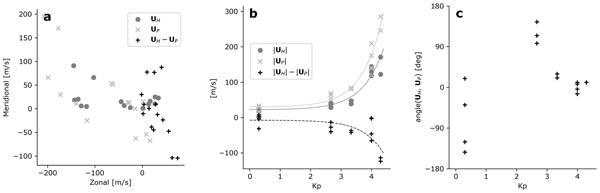
Atmospheric winds at high altitudes (> 100 km) can play an important role in the electrodynamic processes that govern how ionospheric plasma interacts with Earth's neutral atmosphere. Here we investigate how a common idea in studies of ionospheric electrodynamics—that atmospheric winds can be ignored or represented via an average value—ignores the high variability of these winds. This variability forces a different formulation of the equations that govern ionosphere-thermosphere electrodynamics.
Charlotte M. van Hazendonk, Lisa J. Baddeley, Karl M. Laundal, and Noora Partamies
Ann. Geophys., 44, 697–714, https://doi.org/10.5194/angeo-44-697-2026, https://doi.org/10.5194/angeo-44-697-2026, 2026
Short summary
Short summary
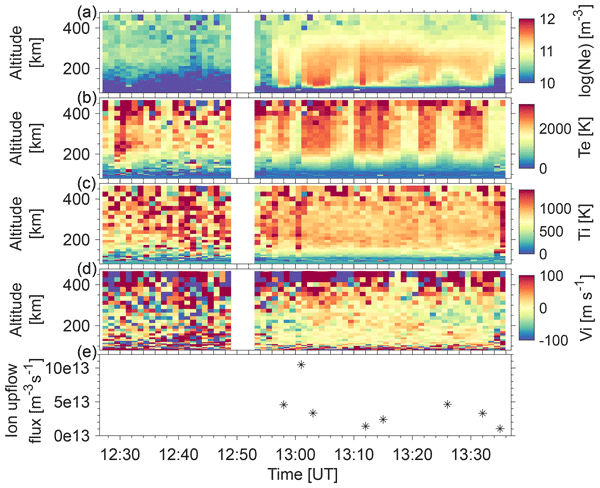
This study shows the first observations of the upflow of ions in the Earth's ionosphere generated by ultra-low frequency waves. These waves are visible as auroral arcs. Using various instruments and models, their complex dynamics and the coupling between the ionosphere and magnetosphere were highlighted. Results show significant energy dissipation and currents, even from small-scale waves, highlighting the importance of a multi-instrument approach to understanding such phenomena.
Jens Christian Hessen, Jone Peter Reistad, Spencer Mark Hatch, Karl Magnus Laundal, and Yongliang Zhang
Ann. Geophys., 44, 405–433, https://doi.org/10.5194/angeo-44-405-2026, https://doi.org/10.5194/angeo-44-405-2026, 2026
Short summary
Short summary
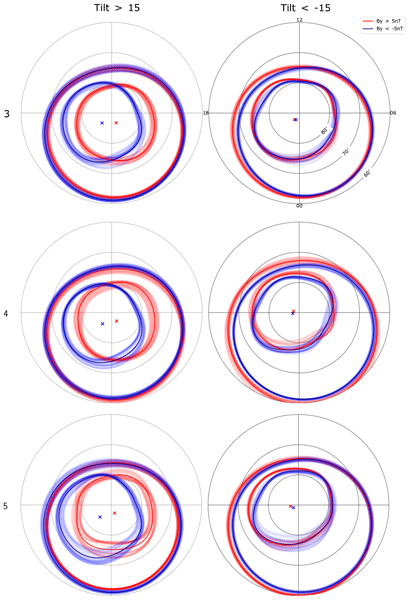
Auroras, the natural lights seen in Earth's sky near the poles, are shaped by both Earth's and the solar wind's magnetic fields, as well as charged solar particles. This study examines how auroras change when the solar wind's magnetic field is dawn-dusk oriented. Daytime observations are challenging due to sunlight, so we developed a method to further separate auroras from background light. In summer, auroras shift east or west with/against the solar wind's magnetic field.
Spencer Mark Hatch, Ilkka Virtanen, Karl Magnus Laundal, Habtamu Wubie Tesfaw, Juha Vierinen, Devin Ray Huyghebaert, Andres Spicher, and Jens Christian Hessen
Ann. Geophys., 43, 633–649, https://doi.org/10.5194/angeo-43-633-2025, https://doi.org/10.5194/angeo-43-633-2025, 2025
Short summary
Short summary
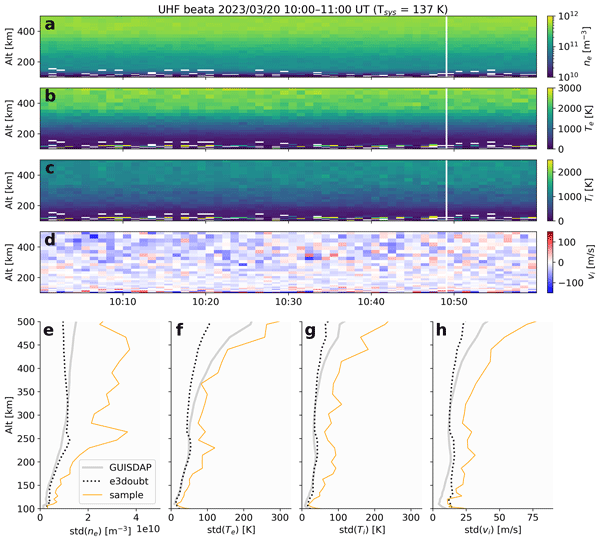
This study addresses the design of next-generation incoherent scatter radar experiments used to study the ionosphere, particularly with systems that have multiple sites. We have developed a method to estimate uncertainties of measurements of plasma density, temperature, and ion drift. Our method is open-source, and helps to optimize radar configurations and assess the effectiveness of an experiment. This method ultimately serves to enhance our understanding of Earth's space environment.
Devin Huyghebaert, Björn Gustavsson, Juha Vierinen, Andreas Kvammen, Matthew Zettergren, John Swoboda, Ilkka Virtanen, Spencer M. Hatch, and Karl M. Laundal
Ann. Geophys., 43, 99–113, https://doi.org/10.5194/angeo-43-99-2025, https://doi.org/10.5194/angeo-43-99-2025, 2025
Short summary
Short summary
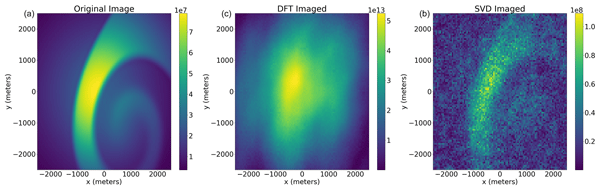
The EISCAT_3D radar is a new ionospheric radar under construction in the Fennoscandia region. The radar will make measurements of plasma characteristics at altitudes above approximately 60 km. The capability of the system to make these measurements at spatial scales of less than 100 m using multiple digitised signals from each of the radar antenna panels is highlighted. There are many ionospheric small-scale processes that will be further resolved using the techniques discussed here.
Spencer Mark Hatch, Heikki Vanhamäki, Karl Magnus Laundal, Jone Peter Reistad, Johnathan K. Burchill, Levan Lomidze, David J. Knudsen, Michael Madelaire, and Habtamu Tesfaw
Ann. Geophys., 42, 229–253, https://doi.org/10.5194/angeo-42-229-2024, https://doi.org/10.5194/angeo-42-229-2024, 2024
Short summary
Short summary
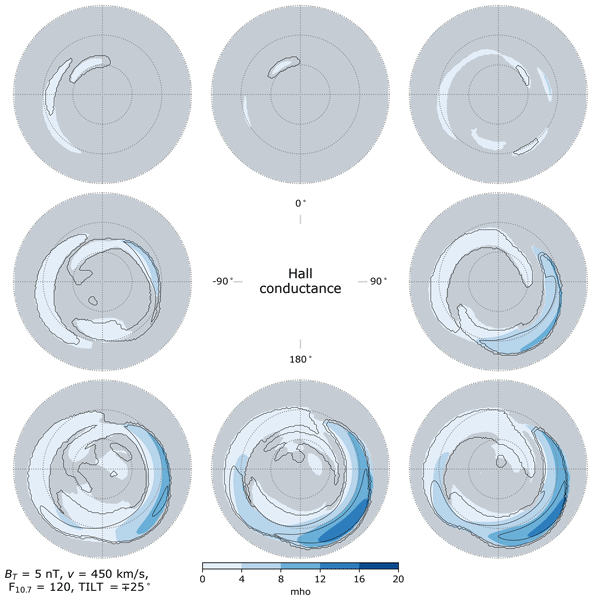
In studies of the Earth's ionosphere, a hot topic is how to estimate ionospheric conductivity. This is hard to do for a variety of reasons that mostly amount to a lack of measurements. In this study we use satellite measurements to estimate electromagnetic work and ionospheric conductances in both hemispheres. We identify where our model estimates are inconsistent with laws of physics, which partially solves a previous problem with unrealistic predictions of ionospheric conductances.
Marie Vigger Eldor, Magnar Gullikstad Johnsen, Nils Olsen, and Anna Naemi Willer
Ann. Geophys., 44, 811–823, https://doi.org/10.5194/angeo-44-811-2026, https://doi.org/10.5194/angeo-44-811-2026, 2026
Short summary
Short summary
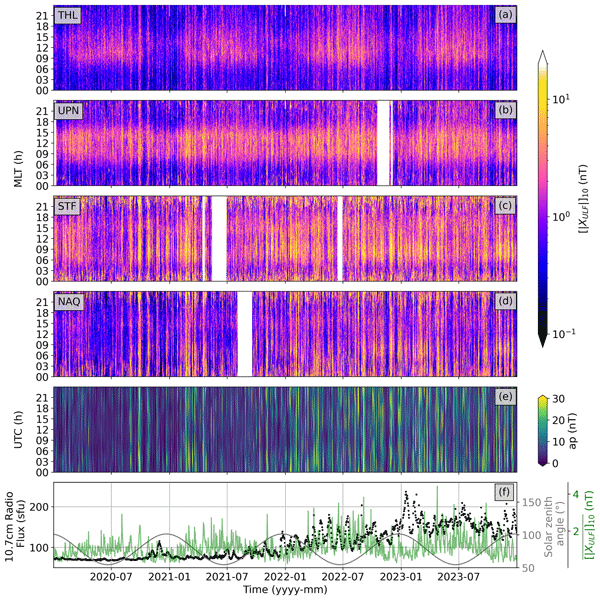
Rapid geomagnetic variations in the ultra-low frequency band are observed using ground-based magnetometers. We apply four years of data from West Greenland in a statistical analysis of the distribution of such variations. We identify a rapid geomagnetic variation population associated with the magnetospheric cusp that is separate from the auroral oval during summer. Earlier studies, which were mainly performed in winter, failed to unambiguously identify these variations.
Spencer Mark Hatch, Johnathan Burchill, Heikki Vanhamäki, Rafael Luiz Araujo de Mesquita, and Karl Magnus Laundal
Ann. Geophys., 44, 715–729, https://doi.org/10.5194/angeo-44-715-2026, https://doi.org/10.5194/angeo-44-715-2026, 2026
Short summary
Short summary
Atmospheric winds at high altitudes (> 100 km) can play an important role in the electrodynamic processes that govern how ionospheric plasma interacts with Earth's neutral atmosphere. Here we investigate how a common idea in studies of ionospheric electrodynamics—that atmospheric winds can be ignored or represented via an average value—ignores the high variability of these winds. This variability forces a different formulation of the equations that govern ionosphere-thermosphere electrodynamics.
Charlotte M. van Hazendonk, Lisa J. Baddeley, Karl M. Laundal, and Noora Partamies
Ann. Geophys., 44, 697–714, https://doi.org/10.5194/angeo-44-697-2026, https://doi.org/10.5194/angeo-44-697-2026, 2026
Short summary
Short summary
This study shows the first observations of the upflow of ions in the Earth's ionosphere generated by ultra-low frequency waves. These waves are visible as auroral arcs. Using various instruments and models, their complex dynamics and the coupling between the ionosphere and magnetosphere were highlighted. Results show significant energy dissipation and currents, even from small-scale waves, highlighting the importance of a multi-instrument approach to understanding such phenomena.
Harriet George, Andrew P. Dimmock, Vanina Lanabare, Heikki Vanhamäki, Ilkka Virtanen, Anita Aikio, Adrian Blagau, Octav Marghitu, Milla Myllymaa, Habtamu Tesfaw, Stephan Buchert, and Mykhaylo Shumko
EGUsphere, https://doi.org/10.5194/egusphere-2026-3108, https://doi.org/10.5194/egusphere-2026-3108, 2026
Short summary
Short summary
Bursty bulk flows are mesoscale ion flows that are ejected from magnetic reconnection sites in the Earth's magnetotail, and they couple to the ionosphere via field aligned currents that close through the ionosphere. We analyse unique triple-conjunctive observations of the coupled bursty bulk flow / current / ionosphere system to evaluate a case study of a bursty bulk flow and its ionospheric effects. We identify multiple current signatures of this bursty bulk flow within the ionosphere.
Vanina Lanabere, Stephan Buchert, Adrian Blagau, Harriet George, Sota Nanjo, Liisa Juusola, Andrew P. Dimmock, Samuel Wharton, Heikki Vanhamäki, Octav Marghitu, Louis Richard, Lei Cai, Alice V. L. Wallner, Daria Kotova, Yaqi Jin, Theresa Hoppe, Jennifer A. Carter, and Anita Aikio
EGUsphere, https://doi.org/10.5194/egusphere-2026-2997, https://doi.org/10.5194/egusphere-2026-2997, 2026
Short summary
Short summary
We studied a series of fast plasma streams that connected Earth’s nightside magnetic environment with the high‑latitude ionized upper atmosphere on 7 December 2023. Using satellite, auroral images and ground observations, we showed how each stream disturbed the upper atmosphere. Their repeated impact strengthened these disturbances until a substorm began, revealing how small events can build up to a larger magnetic disruption.
Jens Christian Hessen, Jone Peter Reistad, Spencer Mark Hatch, Karl Magnus Laundal, and Yongliang Zhang
Ann. Geophys., 44, 405–433, https://doi.org/10.5194/angeo-44-405-2026, https://doi.org/10.5194/angeo-44-405-2026, 2026
Short summary
Short summary
Auroras, the natural lights seen in Earth's sky near the poles, are shaped by both Earth's and the solar wind's magnetic fields, as well as charged solar particles. This study examines how auroras change when the solar wind's magnetic field is dawn-dusk oriented. Daytime observations are challenging due to sunlight, so we developed a method to further separate auroras from background light. In summer, auroras shift east or west with/against the solar wind's magnetic field.
Stephen Omondi, Spencer Mark Hatch, Andreas Kvammen, Magnar Gullikstad Johnsen, Mathew J. Owens, Kristian Solheim Thinn, and Rodrigo López
EGUsphere, https://doi.org/10.5194/egusphere-2025-6298, https://doi.org/10.5194/egusphere-2025-6298, 2026
Short summary
Short summary
Researchers tested whether combining real-time solar wind data with forecasts can improve predictions of local geomagnetic activity in Norway. Using a machine learning model, they found that accurate solar wind speed and magnetic field direction are key for reliable forecasts over 3 hours ahead, while CME arrival time only helps if magnetic field data is precise.
Liisa Juusola, Ilkka Virtanen, Spencer Mark Hatch, Heikki Vanhamäki, Maxime Grandin, Noora Partamies, Urs Ganse, Ilja Honkonen, Abiyot Workayehu, Antti Kero, and Minna Palmroth
Ann. Geophys., 43, 755–781, https://doi.org/10.5194/angeo-43-755-2025, https://doi.org/10.5194/angeo-43-755-2025, 2025
Short summary
Short summary
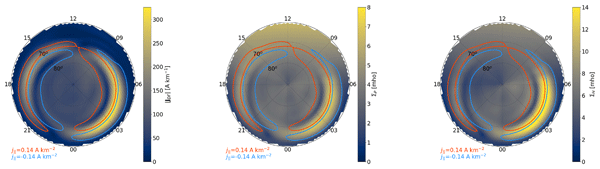
Key properties of the ionospheric electrodynamics are electric fields, currents, and conductances. They provide a window to the vast and distant near-Earth space, cause Joule heating that affect satellite orbits, and drive geomagnetically induced currents (GICs) in technological conductor networks. We have developed a new method for solving the key properties of ionospheric electrodynamics from ground-based magnetic field observations.
Spencer Mark Hatch, Ilkka Virtanen, Karl Magnus Laundal, Habtamu Wubie Tesfaw, Juha Vierinen, Devin Ray Huyghebaert, Andres Spicher, and Jens Christian Hessen
Ann. Geophys., 43, 633–649, https://doi.org/10.5194/angeo-43-633-2025, https://doi.org/10.5194/angeo-43-633-2025, 2025
Short summary
Short summary
This study addresses the design of next-generation incoherent scatter radar experiments used to study the ionosphere, particularly with systems that have multiple sites. We have developed a method to estimate uncertainties of measurements of plasma density, temperature, and ion drift. Our method is open-source, and helps to optimize radar configurations and assess the effectiveness of an experiment. This method ultimately serves to enhance our understanding of Earth's space environment.
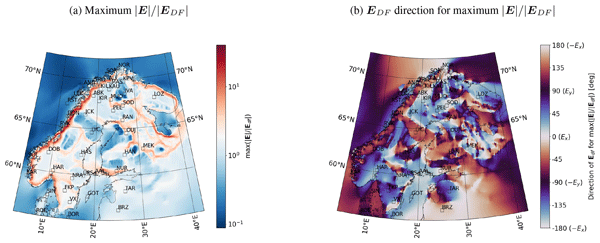
Liisa Juusola, Heikki Vanhamäki, Elena Marshalko, Mikhail Kruglyakov, and Ari Viljanen
Ann. Geophys., 43, 271–301, https://doi.org/10.5194/angeo-43-271-2025, https://doi.org/10.5194/angeo-43-271-2025, 2025
Short summary
Short summary
Interaction between the magnetic field of the rapidly varying electric currents in space and the conducting ground produces an electric field at the Earth's surface. This geoelectric field drives geomagnetically induced currents in technological conductor networks, which can affect the performance of critical ground infrastructure such as electric power transmission grids. We have developed a new method suitable for monitoring the geoelectric field based on ground magnetic field observations.
Devin Huyghebaert, Björn Gustavsson, Juha Vierinen, Andreas Kvammen, Matthew Zettergren, John Swoboda, Ilkka Virtanen, Spencer M. Hatch, and Karl M. Laundal
Ann. Geophys., 43, 99–113, https://doi.org/10.5194/angeo-43-99-2025, https://doi.org/10.5194/angeo-43-99-2025, 2025
Short summary
Short summary
The EISCAT_3D radar is a new ionospheric radar under construction in the Fennoscandia region. The radar will make measurements of plasma characteristics at altitudes above approximately 60 km. The capability of the system to make these measurements at spatial scales of less than 100 m using multiple digitised signals from each of the radar antenna panels is highlighted. There are many ionospheric small-scale processes that will be further resolved using the techniques discussed here.
Spencer Mark Hatch, Heikki Vanhamäki, Karl Magnus Laundal, Jone Peter Reistad, Johnathan K. Burchill, Levan Lomidze, David J. Knudsen, Michael Madelaire, and Habtamu Tesfaw
Ann. Geophys., 42, 229–253, https://doi.org/10.5194/angeo-42-229-2024, https://doi.org/10.5194/angeo-42-229-2024, 2024
Short summary
Short summary
In studies of the Earth's ionosphere, a hot topic is how to estimate ionospheric conductivity. This is hard to do for a variety of reasons that mostly amount to a lack of measurements. In this study we use satellite measurements to estimate electromagnetic work and ionospheric conductances in both hemispheres. We identify where our model estimates are inconsistent with laws of physics, which partially solves a previous problem with unrealistic predictions of ionospheric conductances.
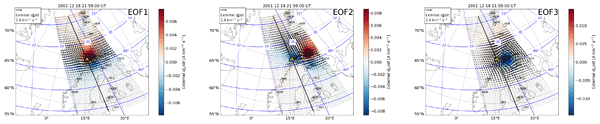
Liisa Juusola, Ari Viljanen, Noora Partamies, Heikki Vanhamäki, Mirjam Kellinsalmi, and Simon Walker
Ann. Geophys., 41, 483–510, https://doi.org/10.5194/angeo-41-483-2023, https://doi.org/10.5194/angeo-41-483-2023, 2023
Short summary
Short summary
At times when auroras erupt on the sky, the magnetic field surrounding the Earth undergoes rapid changes. On the ground, these changes can induce harmful electric currents in technological conductor networks, such as powerlines. We have used magnetic field observations from northern Europe during 28 such events and found consistent behavior that can help to understand, and thus predict, the processes that drive auroras and geomagnetically induced currents.
Cited articles
Alken, P.: Observations and modeling of the ionospheric gravity and diamagnetic current systems from CHAMP and Swarm measurements, Journal of Geophysical Research: Space Physics, 121, 589–601, https://doi.org/10.1002/2015JA022163, 2016. a
Alken, P., Thébault, E., Beggan, C. D., Amit, H., Aubert, J., Baerenzung, J., Bondar, T. N., Brown, W. J., Califf, S., Chambodut, A., Chulliat, A., Cox, G. A., Finlay, C. C., Fournier, A., Gillet, N., Grayver, A., Hammer, M. D., Holschneider, M., Huder, L., Hulot, G., Jager, T., Kloss, C., Korte, M., Kuang, W., Kuvshinov, A., Langlais, B., Léger, J.-M., Lesur, V., Livermore, P. W., Lowes, F. J., Macmillan, S., Magnes, W., Mandea, M., Marsal, S., Matzka, J., Metman, M. C., Minami, T., Morschhauser, A., Mound, J. E., Nair, M., Nakano, S., Olsen, N., Pavón-Carrasco, F. J., Petrov, V. G., Ropp, G., Rother, M., Sabaka, T. J., Sanchez, S., Saturnino, D., Schnepf, N. R., Shen, X., Stolle, C., Tangborn, A., Tøffner-Clausen, L., Toh, H., Torta, J. M., Varner, J., Vervelidou, F., Vigneron, P., Wardinski, I., Wicht, J., Woods, A., Yang, Y., Zeren, Z., and Zhou, B.: International Geomagnetic Reference Field: the thirteenth generation, Earth, Planets and Space, 73, 49, https://doi.org/10.1186/s40623-020-01288-x, 2021. a
Amm, O.: Comment on “A three-dimensional, iterative mapping procedure for the implementation of an ionosphere–magnetosphere anisotropic Ohm's law boundary condition in global magnetohydrodynamic simulations” by Michael L. Goodman, Annales Geophysicae, 14, 773–774, 1996. a
Amm, O.: Ionospheric Elementary Current Systems in Spherical Coordinates and Their Application, Journal of Geomagnetism and Geoelectricity, 49, 947–955, https://doi.org/10.5636/jgg.49.947, 1997. a
Backus, G.: Poloidal and toroidal fields in geomagnetic field modeling, Reviews of Geophysics, 24, 75–109, https://doi.org/10.1029/RG024i001p00075, 1986. a, b, c
Brekke, A.: Physics of the Upper Polar Atmosphere, Springer Atmospheric Sciences, Springer Berlin Heidelberg, Berlin, Heidelberg, ISBN 978-3-642-27400-8 978-3-642-27401-5, https://doi.org/10.1007/978-3-642-27401-5, 2013. a, b, c, d
Buchert, S. C.: Entangled dynamos and Joule heating in the Earth's ionosphere, Annales Geophysicae, 38, 1019–1030, https://doi.org/10.5194/angeo-38-1019-2020, 2020. a, b
Buchert, S. C. and Budnik, F.: Field‐aligned current distributions generated by a divergent Hall current, Geophysical Research Letters, 24, 297–300, https://doi.org/10.1029/97GL00064, 1997. a
Chen, C.-T.: Linear system theory and design, Oxford University Press, New York, international 4th Edn., ISBN 978-0-19-996454-3, 2014. a
Dreher, J.: On the self‐consistent description of dynamic magnetosphere‐ionosphere coupling phenomena with resolved ionosphere, Journal of Geophysical Research: Space Physics, 102, 85–94, https://doi.org/10.1029/96JA02800, 1997. a, b, c
Drob, D. P., Emmert, J. T., Meriwether, J. W., Makela, J. J., Doornbos, E., Conde, M., Hernandez, G., Noto, J., Zawdie, K. A., McDonald, S. E., Huba, J. D., and Klenzing, J. H.: An update to the Horizontal Wind Model (HWM): The quiet time thermosphere, Earth and Space Science, 2, 301–319, https://doi.org/10.1002/2014EA000089, 2015. a, b, c, d
Emmert, J. T., Richmond, A. D., and Drob, D. P.: A computationally compact representation of Magnetic‐Apex and Quasi‐Dipole coordinates with smooth base vectors, Journal of Geophysical Research: Space Physics, 115, 2010JA015326, https://doi.org/10.1029/2010JA015326, 2010. a
Fillion, M., Hulot, G., Alken, P., and Chulliat, A.: Modeling the Climatology of Low‐ and Mid‐Latitude F‐Region Ionospheric Currents Using the Swarm Constellation, Journal of Geophysical Research: Space Physics, 128, e2023JA031344, https://doi.org/10.1029/2023JA031344, 2023. a
Fukushima, N.: Generalized theorem of no ground magnetic effect of vertical current connected with Pedersen currents in the uniform conductivity ionosphere, Rep. Ionos. Space Res. Jpn., 30, 35–40, 1976. a
Ganse, U., Pfau-Kempf, Y., Zhou, H., Juusola, L., Workayehu, A., Kebede, F., Papadakis, K., Grandin, M., Alho, M., Battarbee, M., Dubart, M., Kotipalo, L., Lalagüe, A., Suni, J., Horaites, K., and Palmroth, M.: The Vlasiator 5.2 ionosphere – coupling a magnetospheric hybrid-Vlasov simulation with a height-integrated ionosphere model, Geosci. Model Dev., 18, 511–527, https://doi.org/10.5194/gmd-18-511-2025, 2025. a, b
Grayver, A. V., Kuvshinov, A., and Werthmüller, D.: Time‐Domain Modeling of Three‐Dimensional Earth's and Planetary Electromagnetic Induction Effect in Ground and Satellite Observations, Journal of Geophysical Research: Space Physics, 126, e2020JA028672, https://doi.org/10.1029/2020JA028672, 2021. a
Hardy, D. A., Gussenhoven, M. S., Raistrick, R., and McNeil, W. J.: Statistical and functional representations of the pattern of auroral energy flux, number flux, and conductivity, Journal of Geophysical Research: Space Physics, 92, 12275–12294, https://doi.org/10.1029/JA092iA11p12275, 1987. a, b
Hatch, S. M., Burchill, J. K., Vanhamäki, H., de Mesquita, R. L. A., Laundal, K., and Knudsen, D. J.: What is the neutral wind in height-integrated ionospheric electrodynamics?, 3, 344061, https://doi.org/10.22541/essoar.171472681.15570950/v1, 2024. a
Hesse, M., Birn, J., and Hoffman, R. A.: On the mapping of ionospheric convection into the magnetosphere, Journal of Geophysical Research: Space Physics, 102, 9543–9551, https://doi.org/10.1029/96JA03999, 1997. a, b, c, d
Huba, J. D., Joyce, G., and Krall, J.: Three‐dimensional equatorial spread F modeling, Geophysical Research Letters, 35, 2008GL033509, https://doi.org/10.1029/2008GL033509, 2008. a
Ilma, R.: rilma/pyHWM14: Official release of the HWM14 wrapper in Python, Zenodo, https://doi.org/10.5281/ZENODO.240890, 2017. a
Juusola, L., Kauristie, K., Vanhamäki, H., Aikio, A., and Van De Kamp, M.: Comparison of auroral ionospheric and field‐aligned currents derived from Swarm and ground magnetic field measurements, Journal of Geophysical Research: Space Physics, 121, 9256–9283, https://doi.org/10.1002/2016JA022961, 2016. a
Juusola, L., Vanhamäki, H., Viljanen, A., and Smirnov, M.: Induced currents due to 3D ground conductivity play a major role in the interpretation of geomagnetic variations, Ann. Geophys. 38, 983–998, https://doi.org/10.5194/angeo-38-983-2020, 2020. a
Juusola, L., Vanhamäki, H., Marshalko, E., Kruglyakov, M., and Viljanen, A.: Estimation of the 3-D geoelectric field at the Earth's surface using Spherical Elementary Current Systems, EGUsphere [preprint], https://doi.org/10.5194/egusphere-2024-2831, 2024. a
Kamide, Y., Richmond, A. D., and Matsushita, S.: Estimation of ionospheric electric fields, ionospheric currents, and field‐aligned currents from ground magnetic records, Journal of Geophysical Research: Space Physics, 86, 801–813, https://doi.org/10.1029/JA086iA02p00801, 1981. a
Laundal, K. M. and Richmond, A. D.: Magnetic Coordinate Systems, Space Science Reviews, 206, 27–59, https://doi.org/10.1007/s11214-016-0275-y, 2017. a, b
Laundal, K. M., Haaland, S. E., Lehtinen, N., Gjerloev, J. W., Østgaard, N., Tenfjord, P., Reistad, J. P., Snekvik, K., Milan, S. E., Ohtani, S., and Anderson, B. J.: Birkeland current effects on high‐latitude ground magnetic field perturbations, Geophysical Research Letters, 42, 7248–7254, https://doi.org/10.1002/2015GL065776, 2015. a
Laundal, K. M., Finlay, C. C., and Olsen, N.: Sunlight effects on the 3D polar current system determined from low Earth orbit measurements, Earth, Planets and Space, 68, 142, https://doi.org/10.1186/s40623-016-0518-x, 2016. a, b
Laundal, K. M., Finlay, C. C., Olsen, N., and Reistad, J. P.: Solar Wind and Seasonal Influence on Ionospheric Currents From Swarm and CHAMP Measurements, Journal of Geophysical Research: Space Physics, 123, 4402–4429, https://doi.org/10.1029/2018JA025387, 2018. a, b, c, d
Laundal, K. M., Hatch, S. M., and Moretto, T.: Magnetic Effects of Plasma Pressure Gradients in the Upper F Region, Geophysical Research Letters, 46, 2355–2363, https://doi.org/10.1029/2019GL081980, 2019. a
Laundal, K. M., Madelaire, M., Ohma, A., Reistad, J., and Hatch, S.: The relationship between interhemispheric asymmetries in polar ionospheric convection and the magnetic field line footpoint displacement field, Frontiers in Astronomy and Space Sciences, 9, 957223, https://doi.org/10.3389/fspas.2022.957223, 2022a. a
Laundal, K. M., Reistad, J. P., Hatch, S. M., Madelaire, M., Walker, S., Hovland, A. O., Ohma, A., Merkin, V. G., and Sorathia, K. A.: Local Mapping of Polar Ionospheric Electrodynamics, Journal of Geophysical Research: Space Physics, 127, e2022JA030356, https://doi.org/10.1029/2022JA030356, 2022b. a
Leake, J. E., DeVore, C. R., Thayer, J. P., Burns, A. G., Crowley, G., Gilbert, H. R., Huba, J. D., Krall, J., Linton, M. G., Lukin, V. S., and Wang, W.: Ionized Plasma and Neutral Gas Coupling in the Sun’s Chromosphere and Earth’s Ionosphere/Thermosphere, Space Science Reviews, 184, 107–172, https://doi.org/10.1007/s11214-014-0103-1, 2014. a, b, c, d
Lotko, W.: Inductive magnetosphere–ionosphere coupling, Journal of Atmospheric and Solar-Terrestrial Physics, 66, 1443–1456, https://doi.org/10.1016/j.jastp.2004.03.027, 2004. a, b
Lysak, R. and Song, Y.: Magnetosphere–ionosphere coupling by Alfvén waves: Beyond current continuity, Advances in Space Research, 38, 1713–1719, https://doi.org/10.1016/j.asr.2005.08.038, 2006. a
Lysak, R. L.: Magnetosphere‐ionosphere coupling by Alfvén waves at midlatitudes, Journal of Geophysical Research: Space Physics, 109, 2004JA010454, https://doi.org/10.1029/2004JA010454, 2004. a
Lysak, R. L., Song, Y., Waters, C. L., Sciffer, M. D., and Obana, Y.: Numerical Investigations of Interhemispheric Asymmetry due to Ionospheric Conductance, Journal of Geophysical Research: Space Physics, 125, e2020JA027866, https://doi.org/10.1029/2020JA027866, 2020. a
Madelaire, M., Laundal, K. M., Reistad, J. P., Hatch, S. M., and Ohma, A.: Transient high latitude geomagnetic response to rapid increases in solar wind dynamic pressure, Frontiers in Astronomy and Space Sciences, 9, 953954, https://doi.org/10.3389/fspas.2022.953954, 2022. a
Madelaire, M., Laundal, K., Hatch, S., Vanhamäki, H., Reistad, J., Ohma, A., Merkin, V., and Lin, D.: Estimating the Ionospheric Induction Electric Field Using Ground Magnetometers, Geophysical Research Letters, 51, e2023GL105443, https://doi.org/10.1029/2023GL105443, 2024. a, b
Maute, A., Richmond, A. D., Lu, G., Knipp, D. J., Shi, Y., and Anderson, B.: Magnetosphere‐Ionosphere Coupling via Prescribed Field‐Aligned Current Simulated by the TIEGCM, Journal of Geophysical Research: Space Physics, 126, e2020JA028665, https://doi.org/10.1029/2020JA028665, 2021. a
Merkin, V. G. and Lyon, J. G.: Effects of the low‐latitude ionospheric boundary condition on the global magnetosphere, Journal of Geophysical Research: Space Physics, 115, 2010JA015461, https://doi.org/10.1029/2010JA015461, 2010. a, b, c, d
Moen, J. and Brekke, A.: The solar flux influence on quiet time conductances in the auroral ionosphere, Geophysical Research Letters, 20, 971–974, https://doi.org/10.1029/92GL02109, 1993. a
Nagata, T.: Solar Flare Effect on the Geomagnetic Field, Journal of geomagnetism and geoelectricity, 18, 197–219, https://doi.org/10.5636/jgg.18.197, 1966. a
Olsen, N.: Ionospheric F region currents at middle and low latitudes estimated from Magsat data, Journal of Geophysical Research: Space Physics, 102, 4563–4576, https://doi.org/10.1029/96JA02949, 1997. a, b, c, d
Olsen, N., Glassmeier, K.-H., and Jia, X.: Separation of the Magnetic Field into External and Internal Parts, Space Science Reviews, 152, 135–157, https://doi.org/10.1007/s11214-009-9563-0, 2010. a
O'Sullivan, S. and Downes, T. P.: An explicit scheme for multifluid magnetohydrodynamics, Monthly Notices of the Royal Astronomical Society, 366, 1329–1336, https://doi.org/10.1111/j.1365-2966.2005.09898.x, 2006. a
Otto, A. and Zhu, H.: Fluid Plasma Simulation of Coupled Systems: Ionosphere and Magnetosphere, in: Space Plasma Simulation, edited by Büchner, J., Scholer, M., and Dum, C. T., vol. 615, pp. 193–211, Springer Berlin Heidelberg, Berlin, Heidelberg, ISBN 978-3-540-00698-5, https://doi.org/10.1007/3-540-36530-3_10, 2003. a, b, c
Parker, E. N.: The alternative paradigm for magnetospheric physics, Journal of Geophysical Research: Space Physics, 101, 10587–10625, https://doi.org/10.1029/95JA02866, 1996. a, b, c, d
Qian, L., Burns, A. G., Emery, B. A., Foster, B., Lu, G., Maute, A., Richmond, A. D., Roble, R. G., Solomon, S. C., and Wang, W.: The NCAR TIE‐GCM: A Community Model of the Coupled Thermosphere/Ionosphere System, in: Geophysical Monograph Series, edited by: Huba, J., Schunk, R., and Khazanov, G., 73–83, Wiley, 1st Edn., ISBN 978-0-87590-491-7 978-1-118-70441-7, https://doi.org/10.1002/9781118704417.ch7, 2014. a
Richmond, A. D.: Ionospheric Electrodynamics, in: Space Weather Fundamentals, edited by: Khazanov, G. V., 245–259, CRC Press, 1st Edn., ISBN 978-1-315-36847-4, https://doi.org/10.1201/9781315368474-15, 2016. a, b, c
Richmond, A. D. and Maute, A.: Ionospheric Electrodynamics Modeling, in: Geophysical Monograph Series, edited by: Huba, J., Schunk, R., and Khazanov, G., 57–71, Wiley, 1 Edn., ISBN 978-0-87590-491-7 978-1-118-70441-7, https://doi.org/10.1002/9781118704417.ch6, 2014. a
Richmond, A. D., Blanc, M., Emery, B. A., Wand, R. H., Fejer, B. G., Woodman, R. F., Ganguly, S., Amayenc, P., Behnke, R. A., Calderon, C., and Evans, J. V.: An empirical model of quiet‐day ionospheric electric fields at middle and low latitudes, Journal of Geophysical Research: Space Physics, 85, 4658–4664, https://doi.org/10.1029/JA085iA09p04658, 1980. a
Ridley, A., Deng, Y., and Tóth, G.: The global ionosphere–thermosphere model, Journal of Atmospheric and Solar-Terrestrial Physics, 68, 839–864, https://doi.org/10.1016/j.jastp.2006.01.008, 2006. a
Ridley, A. J., Gombosi, T. I., and DeZeeuw, D. L.: Ionospheric control of the magnetosphere: conductance, Ann. Geophys., 22, 567–584, https://doi.org/10.5194/angeo-22-567-2004, 2004. a, b
Rishbeth, H. and Garriott, O. K.: Introduction to Ionospheric Physics, Vol. 14 of International Geophysics Series, Academic Press, New York, ISBN 0125889402, 1969. a
Robinson, R. M., Vondrak, R. R., Miller, K., Dabbs, T., and Hardy, D.: On calculating ionospheric conductances from the flux and energy of precipitating electrons, Journal of Geophysical Research: Space Physics, 92, 2565–2569, https://doi.org/10.1029/JA092iA03p02565, 1987. a
Robinson, R. M., Zanetti, L., Anderson, B., Vines, S., and Gjerloev, J.: Determination of Auroral Electrodynamic Parameters From AMPERE Field‐Aligned Current Measurements, Space Weather, 19, e2020SW002677, https://doi.org/10.1029/2020SW002677, 2021. a
Sabaka, T. J., Hulot, G., and Olsen, N.: Mathematical Properties Relevant to Geomagnetic Field Modeling, in: Handbook of Geomathematics, edited by Freeden, W., Nashed, M. Z., and Sonar, T., pp. 1–37, Springer Berlin Heidelberg, Berlin, Heidelberg, ISBN 978-3-642-27793-1, https://doi.org/10.1007/978-3-642-27793-1_17-2, 2013. a, b, c
Sciffer, M. D., Waters, C. L., and Menk, F. W.: Propagation of ULF waves through the ionosphere: Inductive effect for oblique magnetic fields, Ann. Geophys., 22, 1155–1169, https://doi.org/10.5194/angeo-22-1155-2004, 2004. a
Skeidsvoll, A. S. and Laundal, K. M.: DynaMIT-uib/PynaMIT: v1.0.0, Zenodo, https://doi.org/10.5281/zenodo.17421994, 2025. a, b
Sorathia, K. A., Merkin, V. G., Panov, E. V., Zhang, B., Lyon, J. G., Garretson, J., Ukhorskiy, A. Y., Ohtani, S., Sitnov, M., and Wiltberger, M.: Ballooning‐Interchange Instability in the Near‐Earth Plasma Sheet and Auroral Beads: Global Magnetospheric Modeling at the Limit of the MHD Approximation, Geophysical Research Letters, 47, e2020GL088227, https://doi.org/10.1029/2020GL088227, 2020. a
Strangeway, R. J.: The equivalence of Joule dissipation and frictional heating in the collisional ionosphere, Journal of Geophysical Research: Space Physics, 117, 2011JA017302, https://doi.org/10.1029/2011JA017302, 2012. a
Tamao, T.: Direct contribution of oblique field‐aligned currents to ground magnetic fields, Journal of Geophysical Research: Space Physics, 91, 183–189, https://doi.org/10.1029/JA091iA01p00183, 1986. a
Tu, J. and Song, P.: A two‐dimensional global simulation study of inductive‐dynamic magnetosphere‐ionosphere coupling, Journal of Geophysical Research: Space Physics, 121, https://doi.org/10.1002/2016JA023393, 2016. a, b, c, d
Tu, J. and Song, P.: On the Momentum Transfer From Polar to Equatorial Ionosphere, Journal of Geophysical Research: Space Physics, 124, 6064–6073, https://doi.org/10.1029/2019JA026760, 2019. a, b, c, d
Tu, J., Song, P., and Vasyliūnas, V. M.: Ionosphere/thermosphere heating determined from dynamic magnetosphere-ionosphere/thermosphere coupling: BRIEF REPORT, Journal of Geophysical Research: Space Physics, 116, https://doi.org/10.1029/2011JA016620, 2011. a
Tu, J., Song, P., and Vasyliūnas, V. M.: Inductive‐dynamic magnetosphere‐ionosphere coupling via MHD waves, Journal of Geophysical Research: Space Physics, 119, 530–547, https://doi.org/10.1002/2013JA018982, 2014. a
Tóth, G., Van Der Holst, B., Sokolov, I. V., De Zeeuw, D. L., Gombosi, T. I., Fang, F., Manchester, W. B., Meng, X., Najib, D., Powell, K. G., Stout, Q. F., Glocer, A., Ma, Y.-J., and Opher, M.: Adaptive numerical algorithms in space weather modeling, Journal of Computational Physics, 231, 870–903, https://doi.org/10.1016/j.jcp.2011.02.006, 2012. a
Untiedt, J. and Baumjohann, W.: Studies of polar current systems using the IMS Scandinavian magnetometer array, Space Science Reviews, 63, 245–390, https://doi.org/10.1007/BF00750770, 1993. a
van der Meeren, C., Laundal, K. M., Burrell, A. G., Lamarche, L. L., Starr, G., Reimer, A. S., Morschhauser, A., Michaelis, I., and Klenzing, J.: aburrell/apexpy: ApexPy Version 2.1.0, Zenodo, https://doi.org/10.5281/ZENODO.1214206, 2025. a
Vanhamäki, H.: Inductive ionospheric solver for magnetospheric MHD simulations, Ann. Geophys., 29, 97–108, https://doi.org/10.5194/angeo-29-97-2011, 2011. a, b, c
Vanhamäki, H. and Juusola, L.: Introduction to Spherical Elementary Current Systems, in: Ionospheric Multi-Spacecraft Analysis Tools, edited by: Dunlop, M. W. and Lühr, H., 5–33, Springer International Publishing, Cham, ISBN 978-3-030-26731-5 978-3-030-26732-2, https://doi.org/10.1007/978-3-030-26732-2_2, 2020. a
Vanhamäki, H., Viljanen, A., and Amm, O.: Induction effects on ionospheric electric and magnetic fields, Annales Geophysicae, 23, 1735–1746, https://doi.org/10.5194/angeo-23-1735-2005, 2005. a
Vanhamäki, H., Maute, A., Alken, P., and Liu, H.: Dipolar elementary current systems for ionospheric current reconstruction at low and middle latitudes, Earth, Planets and Space, 72, 146, https://doi.org/10.1186/s40623-020-01284-1, 2020. a
Vasyliūnas, V. M.: Electric field and plasma flow: What drives what?, Geophysical Research Letters, 28, 2177–2180, https://doi.org/10.1029/2001GL013014, 2001. a
Vasyliūnas, V. M.: Relation between magnetic fields and electric currents in plasmas, Annales Geophysicae, 23, 2589–2597, https://doi.org/10.5194/angeo-23-2589-2005, 2005. a, b
Vasyliūnas, V. M.: The mechanical advantage of the magnetosphere: solar-wind-related forces in the magnetosphere-ionosphere-Earth system, Annales Geophysicae, 25, 255–269, https://doi.org/10.5194/angeo-25-255-2007, 2007. a
Vasyliūnas, V. M.: The physical basis of ionospheric electrodynamics, Ann. Geophys., 30, 357–369, https://doi.org/10.5194/angeo-30-357-2012, 2012. a, b, c, d
Vasyliūnas, V. M. and Song, P.: Meaning of ionospheric Joule heating, Journal of Geophysical Research: Space Physics, 110, 2004JA010615, https://doi.org/10.1029/2004JA010615, 2005. a, b
Von Alfthan, S., Pokhotelov, D., Kempf, Y., Hoilijoki, S., Honkonen, I., Sandroos, A., and Palmroth, M.: Vlasiator: First global hybrid-Vlasov simulations of Earth's foreshock and magnetosheath, Journal of Atmospheric and Solar-Terrestrial Physics, 120, 24–35, https://doi.org/10.1016/j.jastp.2014.08.012, 2014. a
Waters, C. L. and Sciffer, M. D.: Field line resonant frequencies and ionospheric conductance: Results from a 2‐D MHD model, Journal of Geophysical Research: Space Physics, 113, 2007JA012822, https://doi.org/10.1029/2007JA012822, 2008. a
Wright, A. N.: Transfer of magnetosheath momentum and energy to the ionosphere along open field lines, Journal of Geophysical Research: Space Physics, 101, 13169–13178, https://doi.org/10.1029/96JA00541, 1996. a, b
Yamauchi, M., Johnsen, M. G., Enell, C.-F., Tjulin, A., Willer, A., and Sormakov, D. A.: High-latitude crochet: solar-flare-induced magnetic disturbance independent from low-latitude crochet, Ann. Geophys., 38, 1159–1170, https://doi.org/10.5194/angeo-38-1159-2020, 2020. a
Yamazaki, Y. and Maute, A.: Sq and EEJ – A Review on the Daily Variation of the Geomagnetic Field Caused by Ionospheric Dynamo Currents, Space Science Reviews, 206, 299–405, https://doi.org/10.1007/s11214-016-0282-z, 2017. a, b, c, d
Yoshikawa, A. and Itonaga, M.: Reflection of shear Alfvén waves at the ionosphere and the divergent Hall current, Geophysical Research Letters, 23, 101–104, https://doi.org/10.1029/95GL03580, 1996. a
Zettergren, M. D. and Snively, J. B.: Ionospheric response to infrasonic‐acoustic waves generated by natural hazard events, Journal of Geophysical Research: Space Physics, 120, 8002–8024, https://doi.org/10.1002/2015JA021116, 2015. a
Zhang, B., Sorathia, K. A., Lyon, J. G., Merkin, V. G., Garretson, J. S., and Wiltberger, M.: GAMERA: A Three-dimensional Finite-volume MHD Solver for Non-orthogonal Curvilinear Geometries, The Astrophysical Journal Supplement Series, 244, 20, https://doi.org/10.3847/1538-4365/ab3a4c, 2019. a
Editorial statement
The paper represents a significant step forward in the numerical modelling of global ionospheric electrodynamics, incorporating the time-dependent effects of magnetic induction, with the potential for further extension to other planets in the Solar System.
The paper represents a significant step forward in the numerical modelling of global ionospheric...
Short summary
The ionosphere is where Earth’s atmosphere overlaps with a gas of charged particles in space. There, collisions with neutral air and electromagnetic forces driven by the solar wind control plasma motion. We created a global model that includes magnetic induction, explaining how electric currents and fields change, offering a more accurate view of atmosphere–space coupling than conventional models based on electric circuits.
The ionosphere is where Earth’s atmosphere overlaps with a gas of charged particles in space....


