Articles | Volume 44, issue 2
https://doi.org/10.5194/angeo-44-655-2026
© Author(s) 2026. This work is distributed under
the Creative Commons Attribution 4.0 License.
https://doi.org/10.5194/angeo-44-655-2026
© Author(s) 2026. This work is distributed under
the Creative Commons Attribution 4.0 License.
A numerical model for solving the linearized gravity-wave equations by a multilayer method

Alexandru Doicu
independent researcher: 82110 Germering, Germany
Dmitry S. Efremenko
CORRESPONDING AUTHOR
Deutsches Zentrum für Luft- und Raumfahrt (DLR), Institut für Methodik der Fernerkundung (IMF), 82234 Oberpfaffenhofen, Germany
Thomas Trautmann
Deutsches Zentrum für Luft- und Raumfahrt (DLR), Institut für Methodik der Fernerkundung (IMF), 82234 Oberpfaffenhofen, Germany
Related authors
No articles found.
Maria-Elissavet Koukouli, Konstantinos Michailidis, Pascal Hedelt, Isabelle A. Taylor, Antje Inness, Lieven Clarisse, Dimitris Balis, Dmitry Efremenko, Diego Loyola, Roy G. Grainger, and Christian Retscher
Atmos. Chem. Phys., 22, 5665–5683, https://doi.org/10.5194/acp-22-5665-2022, https://doi.org/10.5194/acp-22-5665-2022, 2022
Short summary
Short summary
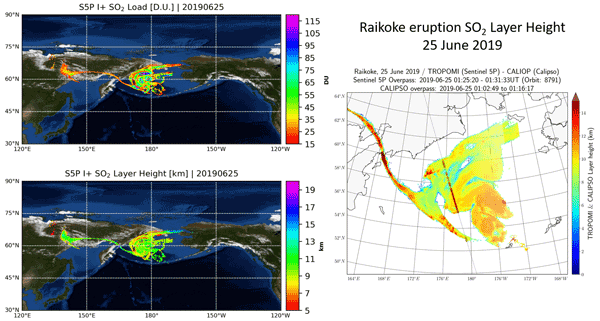
Volcanic eruptions eject large amounts of ash and trace gases into the atmosphere. The use of space-borne instruments enables the global monitoring of volcanic SO2 emissions in an economical and risk-free manner. The main aim of this paper is to present its extensive verification, accomplished within the ESA S5P+I: SO2LH project, over major recent volcanic eruptions, against collocated space-borne measurements, as well as assess its impact on the forecasts provided by CAMS.
Antje Inness, Melanie Ades, Dimitris Balis, Dmitry Efremenko, Johannes Flemming, Pascal Hedelt, Maria-Elissavet Koukouli, Diego Loyola, and Roberto Ribas
Geosci. Model Dev., 15, 971–994, https://doi.org/10.5194/gmd-15-971-2022, https://doi.org/10.5194/gmd-15-971-2022, 2022
Short summary
Short summary
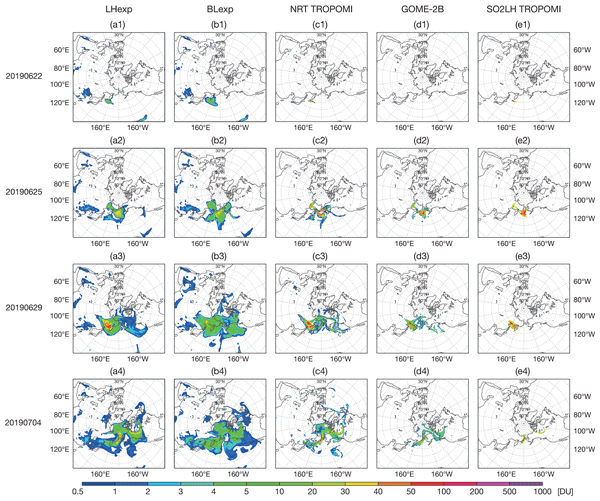
This paper describes the way that the Copernicus Atmosphere Monitoring Service (CAMS) produces forecasts of volcanic SO2. These forecasts are provided routinely every day. They are created by blending SO2 data from satellite instruments (TROPOMI and GOME-2) with the CAMS model. We show that the quality of the CAMS SO2 forecasts can be improved if additional information about the height of volcanic plumes is provided in the satellite data.
Cited articles
Anderson, E., Bai, Z., Bischof, C., Blackford, L. S., Demmel, J., Dongarra, J., Du Croz, J., Greenbaum, A., Hammarling, S., McKenney, A., and Sorensen, D.: LAPACK Users’ Guide, Society for Industrial and Applied Mathematics, https://doi.org/10.1137/1.9780898719604, 1999. a, b
Buchert, S. C.: Entangled dynamos and Joule heating in the Earth's ionosphere, Ann. Geophys., 38, 1019–1030, https://doi.org/10.5194/angeo-38-1019-2020, 2020. a
Budak, V. P., Klyuykov, D. A., and Korkin, S. V.: Complete matrix solution of radiative transfer equation for PILE of horizontally homogeneous slabs, J. Quant. Spectrosc. Ra., 112, 1141–1148, https://doi.org/10.1016/j.jqsrt.2010.08.028, 2011. a, b
Budak, V. P., Efremenko, D. S., and Shagalov, O. V.: Efficiency of algorithm for solution of vector radiative transfer equation in turbid medium slab, J. Phys. Conf. Ser., 369, 012021, https://doi.org/10.1088/1742-6596/369/1/012021, 2012. a, b
Chandrasekhar, S.: Radiative Transfer, Dover Publications, Inc., New York, ISBN 9780486605906, 1960. a
Dalgarno, A. and Smith, F.: The thermal conductivity and viscosity of atomic oxygen, Planet. Space Sci., 9, 1–2, https://doi.org/10.1016/0032-0633(62)90064-8, 1962. a
Doicu, A. and Efremenko, D.: AlexandruDoicu/Gravity-Waves: Gravity Waves Code (Version v1.0.0), Zenodo [code], https://doi.org/10.5281/zenodo.21410453, 2026. a, b, c
Doicu, A. and Trautmann, T.: Discrete-ordinate method with matrix exponential for a pseudo-spherical atmosphere: Scalar case, J. Quant. Spectrosc. Ra., 110, 146–158, https://doi.org/10.1016/j.jqsrt.2008.09.014, 2009a. a, b
Doicu, A. and Trautmann, T.: Discrete-ordinate method with matrix exponential for a pseudo-spherical atmosphere: Vector case, J. Quant. Spectrosc. Ra., 110, 159–172, https://doi.org/10.1016/j.jqsrt.2008.09.013, 2009b. a, b
Drob, D. P., Emmert, J. T., Meriwether, J. W., Makela, J. J., Doornbos, E., Conde, M., Hernandez, G., Noto, J., Zawdie, K. A., McDonald, S. E., Huba, J. D., and Klenzing, J. H.: An update to the Horizontal Wind Model (HWM): The quiet time thermosphere, Earth Space Sci., 2, 301–319, https://doi.org/10.1002/2014ea000089, 2015. a
Dungey, J. W.: Interplanetary Magnetic Field and the Auroral Zones, Phys. Rev. Lett., 6, 47–48, https://doi.org/10.1103/physrevlett.6.47, 1961. a
Efremenko, D. S., Molina García, V., Gimeno García, S., and Doicu, A.: A review of the matrix-exponential formalism in radiative transfer, J. Quant. Spectrosc. Ra., 196, 17–45, https://doi.org/10.1016/j.jqsrt.2017.02.015, 2017. a
Emmert, J. T., Drob, D. P., Picone, J. M., Siskind, D. E., Jones, M., Mlynczak, M. G., Bernath, P. F., Chu, X., Doornbos, E., Funke, B., Goncharenko, L. P., Hervig, M. E., Schwartz, M. J., Sheese, P. E., Vargas, F., Williams, B. P., and Yuan, T.: NRLMSIS 2.0: A Whole‐Atmosphere Empirical Model of Temperature and Neutral Species Densities, Earth Space Sci., 8, https://doi.org/10.1029/2020ea001321, 2021. a
Fritts, D. C., Laughman, B., Lund, T. S., and Snively, J. B.: Self‐acceleration and instability of gravity wave packets: 1. Effects of temporal localization, J. Geophys. Res.-Atmos., 120, 8783–8803, https://doi.org/10.1002/2015jd023363, 2015. a
Fuller-Rowell, T. and Rees, D.: Interpretation of an anticipated long-lived vortex in the lower thermosphere following simulation of an isolated substorm, Planet. Space Sci., 32, 69–85, https://doi.org/10.1016/0032-0633(84)90043-6, 1984. a
Heale, C. J., Snively, J. B., Hickey, M. P., and Ali, C. J.: Thermospheric dissipation of upward propagating gravity wave packets, J. Geophys. Res.-Space, 119, 3857–3872, https://doi.org/10.1002/2013ja019387, 2014. a
Hedin, A. E.: MSIS‐86 Thermospheric Model, J. Geophys. Res.-Space, 92, 4649–4662, https://doi.org/10.1029/ja092ia05p04649, 1987. a
Hedin, A. E., Biondi, M. A., Burnside, R. G., Hernandez, G., Johnson, R. M., Killeen, T. L., Mazaudier, C., Meriwether, J. W., Salah, J. E., Sica, R. J., Smith, R. W., Spencer, N. W., Wickwar, V. B., and Virdi, T. S.: Revised global model of thermosphere winds using satellite and ground‐based observations, J. Geophys. Res.-Space, 96, 7657–7688, https://doi.org/10.1029/91ja00251, 1991. a
Hickey, M. P., Taylor, M. J., Gardner, C. S., and Gibbons, C. R.: Full‐wave modeling of small‐scale gravity waves using Airborne Lidar and Observations of the Hawaiian Airglow (ALOHA‐93) O(1S) images and coincident Na wind/temperature lidar measurements, J. Geophys. Res.-Atmos., 103, 6439–6453, https://doi.org/10.1029/97jd03373, 1998. a
Hickey, M. P., Schubert, G., and Walterscheid, R. L.: Propagation of tsunami‐driven gravity waves into the thermosphere and ionosphere, J. Geophys. Res.-Space, 114, https://doi.org/10.1029/2009ja014105, 2009. a
Hines, C. O.: Internal atmospheric gravity waves at ionosphric heights, Can. J. Phys., 38, 1441–1481, https://doi.org/10.1139/p60-150, 1960. a
Hines, C. O.: A critique of multilayer analyses in application to the propagation of acoustic-gravity waves, J. Geophys. Res., 78, 265–273, https://doi.org/10.1029/ja078i001p00265, 1973. a, b
Huba, J. D.: On the Development of the SAMI2 Ionosphere Model, Perspect. Earth Space Sci., 4, https://doi.org/10.1029/2022cn000195, 2023. a
Huba, J. D., Joyce, G., and Fedder, J. A.: Sami2 is Another Model of the Ionosphere (SAMI2): A new low‐latitude ionosphere model, J. Geophys. Res.-Space, 105, 23035–23053, https://doi.org/10.1029/2000ja000035, 2000. a, b, c, d
Huba, J. D., Joyce, G., and Krall, J.: Three‐dimensional equatorial spread F modeling, Geophys. Res. Lett., 35, https://doi.org/10.1029/2008gl033509, 2008. a
Inoue, Y. and Horowitz, S.: Numerical Solution of Full‐Wave Equation With Mode Coupling, Radio Sci., 1, 957–970, https://doi.org/10.1002/rds196618957, 1966. a
Kattawar, G. W., Plass, G. N., and Catchings, F. E.: Matrix Operator Theory of Radiative Transfer 2: Scattering from Maritime Haze, Appl. Optics, 12, 1071, https://doi.org/10.1364/ao.12.001071, 1973. a
Klostermeyer, J.: Computation of acoustic‐gravity waves, Kelvin‐Helmholtz instabilities,and wave‐induced eddy transport in realistic atmospheric models, J. Geophys. Res.-Oceans, 85, 2829–2839, https://doi.org/10.1029/jc085ic05p02829, 1980. a, b, c
Knight, H. K., Broutman, D., and Eckermann, S. D.: A causality-preserving Fourier method for gravity waves in a viscous, thermally diffusive, and vertically varying atmosphere, Wave Mot., 88, 226–256, https://doi.org/10.1016/j.wavemoti.2019.06.001, 2019. a, b, c, d, e, f, g, h, i, j, k, l, m, n, o, p
Knight, H. K., Richards, P. G., Martinis, C. R., and Goncharenko, L. P.: Modeling MSTIDs Produced by Gravity Waves With Parameters Obtained From All‐Sky Imager Observations and Comparisons to Incoherent Scatter Radar Observations, J. Geophys. Res.-Space., 130, https://doi.org/10.1029/2025ja033906, 2025. a, b, c
Laundal, K. M., Skeidsvoll, A. S., Popescu Braileanu, B., Hatch, S. M., Olsen, N., and Vanhamäki, H.: Global inductive magnetosphere-ionosphere- thermosphere coupling, Ann. Geophys., 43, 803–833, https://doi.org/10.5194/angeo-43-803-2025, 2025. a
Lindzen, R. S. and Kuo, H.-L.: A Reliable Method for the Numerical Integration of a Large Class of Ordinary and Partial Differential Equations, Month. Weather Rev., 97, 732–734, https://doi.org/10.1175/1520-0493(1969)097<0732:armftn>2.3.co;2, 1969. a
Liu, X., Xu, J., Yue, J., and Vadas, S. L.: Numerical modeling study of the momentum deposition of small amplitude gravity waves in the thermosphere, Ann. Geophys., 31, 1–14, https://doi.org/10.5194/angeo-31-1-2013, 2013. a
Maeda, S.: Numerical solutions of the coupled equations for acoustic-gravity waves in the upper thermosphere, J. Atmos. Sol.-Terr. Phys., 47, 965–972, https://doi.org/10.1016/0021-9169(85)90074-1, 1985. a, b
Nakajima, T. and Tanaka, M.: Matrix formulations for the transfer of solar radiation in a plane-parallel scattering atmosphere, J. Quant. Spectrosc. Ra., 35, 13–21, https://doi.org/10.1016/0022-4073(86)90088-9, 1986. a
Pérez-Álvarez, R. and García-Moliner, F.: Transfer Matrix, Green Function, And Related Techniques: Tools For The Study Of Multilayer Heterostructures, Universitat Jaume I, Castelló de la Plana, Spain, ISBN 978-84-8021-472-8, 2004. a
Pfeffer, R. L. and Zarichny, J.: Acoustic-Gravity Wave Propagation from Nuclear Explosions in the Earth’s Atmosphere, J. Atmos. Sci., 19, 256–263, https://doi.org/10.1175/1520-0469(1962)019<0256:agwpfn>2.0.co;2, 1962. a
Plass, G. N., Kattawar, G. W., and Catchings, F. E.: Matrix Operator Theory of Radiative Transfer 1: Rayleigh Scattering, Appl. Optics, 12, 314, https://doi.org/10.1364/ao.12.000314, 1973. a
Pütz, C., Schlutow, M., and Klein, R.: Initiation of ray tracing models: evolution of small-amplitude gravity wave packets in non-uniform background, Theor. Comput. Fluid Dyn., 33, 509–535, https://doi.org/10.1007/s00162-019-00504-z, 2019. a
N Reinsch, C. H.: Smoothing by spline functions, Numer. Math., 10, 177–183, https://doi.org/10.1007/bf02162161, 1967. a
Richards, P. G. and Peterson, W. K.: Measured and modeled backscatter of ionospheric photoelectron fluxes, J. Geophys. Res.-Space, 113, https://doi.org/10.1029/2008ja013092, 2008. a
Richmond, A. D. and Matsushita, S.: Thermospheric response to a magnetic substorm, J. Geophys. Res., 80, 2839–2850, https://doi.org/10.1029/ja080i019p02839, 1975. a
Schunk, R. and Nagy, A.: Ionospheres: Physics, Plasma Physics, and Chemistry, Cambridge University Press, https://doi.org/10.1017/cbo9780511635342, 2009. a
Shibata, T.: A numerical calculation of the ionospheric response to atmospheric gravity waves in the F-region, J. Atmos. Sol.-Terr. Phys., 45, 797–809, https://doi.org/10.1016/s0021-9169(22)00009-5, 1983. a, b
Stamnes, K.: The theory of multiple scattering of radiation in plane parallel atmospheres, Rev. Geophys., 24, 299–310, https://doi.org/10.1029/rg024i002p00299, 1986. a
Stamnes, K. and Swanson, R.: A New Look at the Discrete Ordinate Method for Radiative Transfer Calculations in Anisotropically Scattering Atmospheres, J. Atmos. Sci., 38, 387–389, https://doi.org/10.1175/1520-0469(1981)038<0387:ANLATD>2.0.CO, 1981. a
Stubbe, P.: Frictional forces and collision frequencies between moving ion and neutral gases, J. Atmos. Sol.-Terr. Phys., 30, 1965–1985, https://doi.org/10.1016/0021-9169(68)90004-4, 1968. a
van de Hulst, H.: A new look at multiple scattering. Tech. Rep., Goddard Institute for Space Studies, NASA TM-I03044, 81 pp., 1963. a
Wahba, G.: Spline Models for Observational Data, Society for Industrial and Applied Mathematics, https://doi.org/10.1137/1.9781611970128, 1990. a
Weimer, D. R.: Improved ionospheric electrodynamic models and application to calculating Joule heating rates, J. Geophys. Res.-Space, 110, https://doi.org/10.1029/2004ja010884, 2005. a, b
Wick, G. C.: Über ebene Diffusionsprobleme, Z. Phys., 121, 702–718, https://doi.org/10.1007/bf01339167, 1943. a
Yeh, K. C. and Liu, C. H.: Acoustic‐gravity waves in the upper atmosphere, Rev. Geophys., 12, 193–216, https://doi.org/10.1029/rg012i002p00193, 1974. a, b, c
Short summary
We created a new computer model to study gravity waves, which are ripples in the atmosphere that affect weather and climate. Our research aimed to improve how these waves are simulated, as they play a key role in understanding atmospheric behavior. We developed a stable and efficient model that can model gravity waves in the atmosphere. Our method is fast and accurate, offering better tools for scientists to predict atmospheric changes.
We created a new computer model to study gravity waves, which are ripples in the atmosphere that...