
Articles | Volume 44, issue 1
https://doi.org/10.5194/angeo-44-263-2026
© Author(s) 2026. This work is distributed under
the Creative Commons Attribution 4.0 License.
the Creative Commons Attribution 4.0 License.
https://doi.org/10.5194/angeo-44-263-2026
© Author(s) 2026. This work is distributed under
the Creative Commons Attribution 4.0 License.
the Creative Commons Attribution 4.0 License.
Regular paper
| 
09 Apr 2026
Regular paper |
| 09 Apr 2026
| 09 Apr 2026
Subauroral contamination in POES/Metop TED channels

German Aerospace Center (DLR), Institute for Solar-Terrestrial Physics, Neustrelitz, Germany
Olesya Yakovchuk
Institute of Physics, University of Rostock, Rostock, Germany
Stefan Bender
Instituto de Astrofísica de Andalucía (CSIC), Granada, Spain
Christina Arras
GFZ Helmholtz-Centre for Geosciences, Potsdam, Germany
Berlin University of Technology, Berlin, Germany
Related authors
Miriam Sinnhuber, Christina Arras, Stefan Bender, Bernd Funke, Hanli Liu, Daniel R. Marsh, Thomas Reddmann, Eugene Rozanov, Timofei Sukhodolov, Monika E. Szelag, and Jan Maik Wissing
Atmos. Chem. Phys., 25, 14719–14734, https://doi.org/10.5194/acp-25-14719-2025, https://doi.org/10.5194/acp-25-14719-2025, 2025
Short summary
Short summary
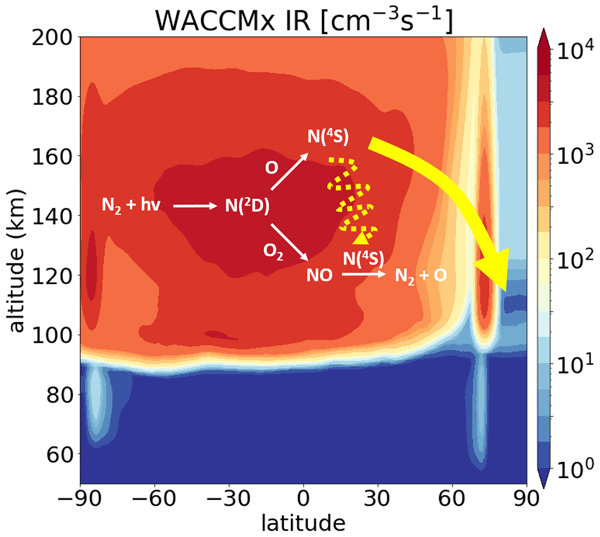
Nitric oxide in the upper atmosphere varies with solar activity. Observations show that this starts a chain of processes affecting the ozone layer and climate system. This is often underestimated in models. We compare five models which show large differences in simulated NO. Analysis of these discrepancies identify two processes which interact with each other: the balance between atomic and molecular oxygen in the thermosphere, and a poleward - downward transport in the winter thermosphere.
Jan Maik Wissing and Olesya Yakovchuk
Ann. Geophys. Discuss., https://doi.org/10.5194/angeo-2023-33, https://doi.org/10.5194/angeo-2023-33, 2023
Revised manuscript not accepted
Short summary
Short summary
We investigated a subauroral particle flux maximum (located at 60 N/S with focus at 0–100 E) seen in the NOAA POES detector, which we attributed to crosstalk contamination of radiation belt electrons. Affected are the processed TED proton channels (which should already be corrected by NOAA) and lower MEPED channels. The particle flux in the contaminated area can be more than factor 2 higher than typical auroral flux. The region of intense particle crosstalk may be removed by a latitudinal cut.
Monali Borthakur, Miriam Sinnhuber, Alexandra Laeng, Thomas Reddmann, Peter Braesicke, Gabriele Stiller, Thomas von Clarmann, Bernd Funke, Ilya Usoskin, Jan Maik Wissing, and Olesya Yakovchuk
Atmos. Chem. Phys., 23, 12985–13013, https://doi.org/10.5194/acp-23-12985-2023, https://doi.org/10.5194/acp-23-12985-2023, 2023
Short summary
Short summary
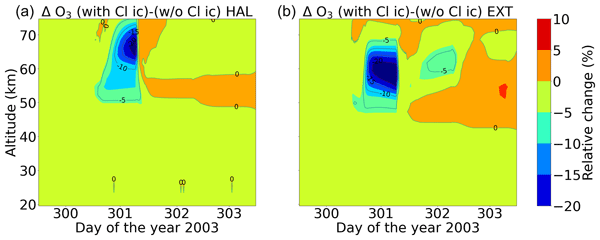
Reduced ozone levels resulting from ozone depletion mean more exposure to UV radiation, which has various effects on human health. We analysed solar events to see what influence it has on the chemistry of Earth's atmosphere and how this atmospheric chemistry change can affect the ozone. To do this, we used an atmospheric model considering only chemistry and compared it with satellite data. The focus was mainly on the contribution of chlorine, and we found about 10 %–20 % ozone loss due to that.
Thomas Reddmann, Miriam Sinnhuber, Jan Maik Wissing, Olesya Yakovchuk, and Ilya Usoskin
Atmos. Chem. Phys., 23, 6989–7000, https://doi.org/10.5194/acp-23-6989-2023, https://doi.org/10.5194/acp-23-6989-2023, 2023
Short summary
Short summary
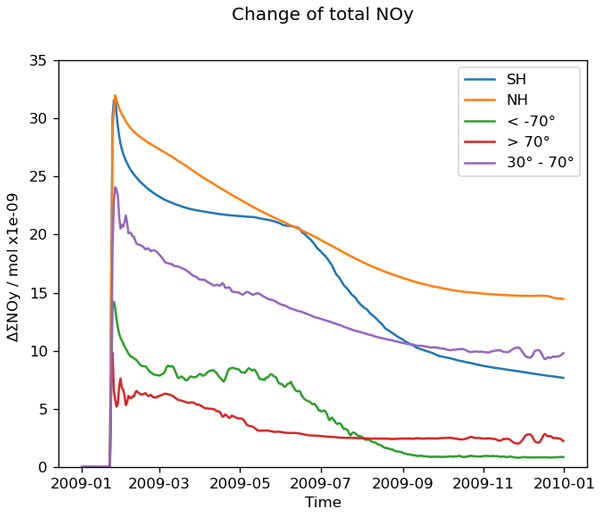
Recent analyses of isotopic records of ice cores and sediments have shown that very strong explosions may occur on the Sun, perhaps about one such explosion every 1000 years. Such explosions pose a real threat to humankind. It is therefore of great interest to study the impact of such explosions on Earth. We analyzed how the explosions would affect the chemistry of the middle atmosphere and show that the related ozone loss is not dramatic and that the atmosphere will recover within 1 year.
Bernd Funke, Michael Höpfner, Stefan Bender, Quentin Errera, Udo Grabowski, Alex Hoffmann, Han-Li Liu, Nick M. Pedatella, Piera Raspollini, Jörn Ungermann, and Björn-Martin Sinnhuber
EGUsphere, https://doi.org/10.5194/egusphere-2026-3881, https://doi.org/10.5194/egusphere-2026-3881, 2026
This preprint is open for discussion and under review for Atmospheric Measurement Techniques (AMT).
Short summary
Short summary
We introduce two performance modeling tools, the Linear Performance Estimator (LPE) and the Fast L2 Simulator (FL2S), developed for CAIRT, a proposed ESA Earth Explorer mission. CAIRT aims to observe the middle atmosphere using an Imaging Fourier Transform Spectrometer. LPE quantifies spatial resolution and tomographic retrieval uncertainties, while FL2S generates synthetic data products that mimic the retrieval chain. Together, they demonstrate CAIRT's ability to meet scientific requirements.
Gabriele P. Stiller, Thomas von Clarmann, Stefan Bender, Bernd Funke, Maya García-Comas, Norbert Glatthor, Udo Grabowski, Sylvia Kellmann, Michael Kiefer, Alexandra Laeng, Andrea Linden, and Manuel López-Puertas
EGUsphere, https://doi.org/10.5194/egusphere-2026-4116, https://doi.org/10.5194/egusphere-2026-4116, 2026
Short summary
Short summary
We present the global distributions of the trace gases HNO3, ClONO2, HNO4, N2O5, and NOy, the total reactive nitrogen (constructed from [HNO3] + [ClONO2] + [HNO4] + 2x[N2O5] + [NO] + [NO2]), all derived from the latest spectral version, V8.03, of MIPAS/Envisat spectra. The data set covers the period of July 2002 to April 2012, with global day and night coverage from 6 to 60 km altitude. An additional data product, made for immediate comparison to atmospheric model simulations, is also presented.
Quentin Errera, Marc Op de beeck, Stefan Bender, Johannes Flemming, Bernd Funke, Alex Hoffmann, Michael Höpfner, Nathaniel Livesey, Gabriele Poli, Didier Pieroux, Piera Raspollini, and Björn-Martin Sinnhuber
Atmos. Meas. Tech., 19, 2601–2620, https://doi.org/10.5194/amt-19-2601-2026, https://doi.org/10.5194/amt-19-2601-2026, 2026
Short summary
Short summary
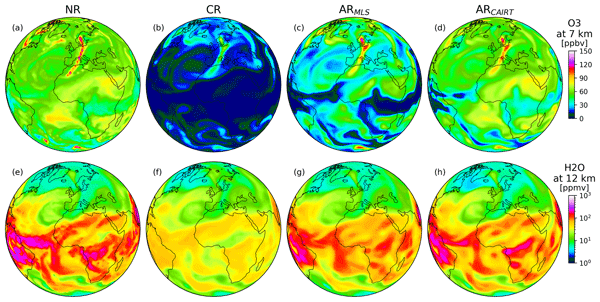
The Changing Atmosphere Infra-Red Tomography Explorer (CAIRT) is a satellite mission concept developed to observe, among other, the gradient of ozone and water vapour in the upper troposphere and lower stratosphere where these species have their largest radiative impact. By simulating CAIRT observations and measuring their constrain on an atmospheric model using data assimilation, this study shows that CAIRT specifications are adequate to fulfil this objective.
Miriam Sinnhuber, Christina Arras, Stefan Bender, Bernd Funke, Hanli Liu, Daniel R. Marsh, Thomas Reddmann, Eugene Rozanov, Timofei Sukhodolov, Monika E. Szelag, and Jan Maik Wissing
Atmos. Chem. Phys., 25, 14719–14734, https://doi.org/10.5194/acp-25-14719-2025, https://doi.org/10.5194/acp-25-14719-2025, 2025
Short summary
Short summary
Nitric oxide in the upper atmosphere varies with solar activity. Observations show that this starts a chain of processes affecting the ozone layer and climate system. This is often underestimated in models. We compare five models which show large differences in simulated NO. Analysis of these discrepancies identify two processes which interact with each other: the balance between atomic and molecular oxygen in the thermosphere, and a poleward - downward transport in the winter thermosphere.
Maryam Ramezani Ziarani, Miriam Sinnhuber, Thomas Reddmann, Bernd Funke, Stefan Bender, and Michael Prather
Geosci. Model Dev., 18, 7891–7905, https://doi.org/10.5194/gmd-18-7891-2025, https://doi.org/10.5194/gmd-18-7891-2025, 2025
Short summary
Short summary
Our study aims to present a new method for incorporating top-down solar forcing into stratospheric ozone relying on linearized ozone scheme. The addition of geomagnetic forcing led to significant ozone losses in the polar upper stratosphere of both hemispheres due to the catalytic cycles involving NOy. In addition to the particle precipitation effect, accounting for solar UV variability in the ICON-ART model leads to the changes in ozone in the tropical stratosphere.
Jan Maik Wissing and Olesya Yakovchuk
Ann. Geophys. Discuss., https://doi.org/10.5194/angeo-2023-33, https://doi.org/10.5194/angeo-2023-33, 2023
Revised manuscript not accepted
Short summary
Short summary
We investigated a subauroral particle flux maximum (located at 60 N/S with focus at 0–100 E) seen in the NOAA POES detector, which we attributed to crosstalk contamination of radiation belt electrons. Affected are the processed TED proton channels (which should already be corrected by NOAA) and lower MEPED channels. The particle flux in the contaminated area can be more than factor 2 higher than typical auroral flux. The region of intense particle crosstalk may be removed by a latitudinal cut.
Monali Borthakur, Miriam Sinnhuber, Alexandra Laeng, Thomas Reddmann, Peter Braesicke, Gabriele Stiller, Thomas von Clarmann, Bernd Funke, Ilya Usoskin, Jan Maik Wissing, and Olesya Yakovchuk
Atmos. Chem. Phys., 23, 12985–13013, https://doi.org/10.5194/acp-23-12985-2023, https://doi.org/10.5194/acp-23-12985-2023, 2023
Short summary
Short summary
Reduced ozone levels resulting from ozone depletion mean more exposure to UV radiation, which has various effects on human health. We analysed solar events to see what influence it has on the chemistry of Earth's atmosphere and how this atmospheric chemistry change can affect the ozone. To do this, we used an atmospheric model considering only chemistry and compared it with satellite data. The focus was mainly on the contribution of chlorine, and we found about 10 %–20 % ozone loss due to that.
Thomas Reddmann, Miriam Sinnhuber, Jan Maik Wissing, Olesya Yakovchuk, and Ilya Usoskin
Atmos. Chem. Phys., 23, 6989–7000, https://doi.org/10.5194/acp-23-6989-2023, https://doi.org/10.5194/acp-23-6989-2023, 2023
Short summary
Short summary
Recent analyses of isotopic records of ice cores and sediments have shown that very strong explosions may occur on the Sun, perhaps about one such explosion every 1000 years. Such explosions pose a real threat to humankind. It is therefore of great interest to study the impact of such explosions on Earth. We analyzed how the explosions would affect the chemistry of the middle atmosphere and show that the related ozone loss is not dramatic and that the atmosphere will recover within 1 year.
Cited articles
Andersson, M. E., Verronen, P. T., Rodger, C. J., Clilverd, M. A., and Wang, S.: Longitudinal hotspots in the mesospheric OH variations due to energetic electron precipitation, Atmos. Chem. Phys., 14, 1095–1105, https://doi.org/10.5194/acp-14-1095-2014, 2014. a
Arras, C. and Wickert, J.: Estimation of ionospheric sporadic E intensities from GPS radio occultation measurements, J. Atmos. Sol.-Terr. Phy., 171, 60–63, https://doi.org/10.1016/j.jastp.2017.08.006, 2018. a
Asikainen, T. and Mursula, K.: Recalibration of NOAA/MEPED energetic proton measurements, J. Atmos. Sol. Terr. Phys., 73, 335–347, https://doi.org/10.1016/j.jastp.2009.12.011, 2011. a
Asikainen, T. and Mursula, K.: Correcting the NOAA/MEPED energetic electron fluxes for detector efficiency and proton contamination, J. Geophys. Res.-Space, 118, 6500–6510, https://doi.org/10.1002/jgra.50584, 2013. a, b, c
Asikainen, T., Mursula, K., and Maliniemi, V.: Correction of detector noise and recalibration of NOAA/MEPED energetic proton fluxes, J. Geophys. Res., 117, A09204, https://doi.org/10.1029/2012JA017593, 2012. a
Baker, D. N., Kanekal, S. G., Hoxie, V. C., Henderson, M. G., Li, X., Spence, H. E., Elkington, S. R., Friedel, R. H. W., Goldstein, J., Hudson, M. K., Reeves, G. D., Thorne, R. M., Kletzing, C. A., and Claudepierre, S. G.: A Long-Lived Relativistic Electron Storage Ring Embedded in Earth's Outer Van Allen Belt, Science, 340, 186–190, https://doi.org/10.1126/science.1233518, 2013. a, b, c
Baker, D. N., Jaynes, A. N., Hoxie, V. C., Thorne, R. M., Foster, J. C., Li, X., Fennell, J. F., Wygant, J. R., Kanekal, S. G., Erickson, P. J., Kurth, W., Li, W., Ma, Q., Schiller, Q., Blum, L., Malaspina, D. M., Gerrard, A., and Lanzerotti, L. J.: An impenetrable barrier to ultrarelativistic electrons in the Van Allen radiation belts, Nature, 515, 531–534, https://doi.org/10.1038/nature13956, 2014. a
Baker, D. N., Hoxie, V., Zhao, H., Jaynes, A. N., Kanekal, S., Li, X., and Elkington, S.: Multiyear Measurements of Radiation Belt Electrons: Acceleration, Transport, and Loss, J. Geophys. Res.-Space, 124, 2588–2602, https://doi.org/10.1029/2018JA026259, 2019. a
Bartels, J., Heck, N. H., and Johnston, H. F.: The three-hour-range index measuring geomagnetic activity, Terrestrial Magnetism and Atmospheric Electricity, 44, 411–454, https://doi.org/10.1029/TE044i004p00411, 1939. a
Bender, S., Espy, P. J., and Paxton, L. J.: Validation of SSUSI-derived auroral electron densities: comparisons to EISCAT data, Ann. Geophys., 39, 899–910, https://doi.org/10.5194/angeo-39-899-2021, 2021. a
Crack, M., Rodger, C. J., Clilverd, M. A., Hendry, A. T., and Sauvaud, J.-A.: Energetic Electron Precipitation From the Radiation Belts: Geomagnetic and Solar Wind Proxies for Precipitation Flux Magnitudes, J. Geophys. Res.-Space, 130, e2024JA033158, https://doi.org/10.1029/2024JA033158, 2025. a
Crutzen, P. J., Isaksen, I. S. A., and Reid, G. C.: Solar Proton Events: Stratospheric Sources of Nitric Oxide, Science, 189, 457–459, https://doi.org/10.1126/science.189.4201.457, 1975. a
Evans, D., Garrett, H., Jun, I., Evans, R., and Chow, J.: Long-term observations of the trapped high-energy proton population (L<4) by the NOAA Polar Orbiting Environmental Satellites (POES), Adv. Space Res., 41, 1261–1268, https://doi.org/10.1016/j.asr.2007.11.028, 2008. a
Evans, D. S. and Greer, M. S.: Polar Orbiting Environmental Satellite Space Environment Monitor – 2, Instrument Descriptions and Archive Data Documentation, National Oceanic and Atmospheric Administration, NOAA Space Environ. Lab, Boulder, Colorado, USA, version 1.4b, including TED calibrations, https://www.ncei.noaa.gov/data/poes-metop-space-environment-monitor/doc/sem2_docs/2005/SEM2v1.4b.pdf (last access: 31 Mach 2026), 2004. a, b
Evans, D. S. and Greer, M. S.: Polar Orbiting Environmental Satellite Space Environment Monitor – 2, Instrument Descriptions and Archive Data Documentation, National Oceanic and Atmospheric Administration, NOAA Space Environ. Lab, Boulder, Colorado, USA, version 2.0, https://www.ncei.noaa.gov/data/poes-metop-space-environment-monitor/doc/sem2_docs/2006/SEM2v2.0.pdf (last access: 31 March 2026), 2006. a, b, c
Funke, B., Baumgaertner, A., Calisto, M., Egorova, T., Jackman, C. H., Kieser, J., Krivolutsky, A., López-Puertas, M., Marsh, D. R., Reddmann, T., Rozanov, E., Salmi, S.-M., Sinnhuber, M., Stiller, G. P., Verronen, P. T., Versick, S., von Clarmann, T., Vyushkova, T. Y., Wieters, N., and Wissing, J. M.: Composition changes after the “Halloween” solar proton event: the High Energy Particle Precipitation in the Atmosphere (HEPPA) model versus MIPAS data intercomparison study, Atmos. Chem. Phys., 11, 9089–9139, https://doi.org/10.5194/acp-11-9089-2011, 2011. a
Gelinas, L. J. and Hecht, J. H.: Calibration/validation final report for the Special Sensor Ultraviolet Limb Imager (SSULI) and the Special Sensor Ultraviolet Spectrographic Imager (SSUSI) on the Defense Meteorological Satellite Program (DMSP) F19 Spacecraft, Aerospace Report TOR-2016-00996, Space and Missile Systems Center, Air Force Space Command, 483 N. Aviation Blvd., El Segundo, CA, USA, attn: SMC/RS, 90245-2808, 2016. a
Heath, D. F., Krueger, A. J., and Crutzen, P. J.: Solar proton event – Influence on stratospheric ozone, Science, 197, 886–889, https://doi.org/10.1126/science.197.4306.886, 1977. a
Iles, R. H. A., Fazakerley, A. N., Johnstone, A. D., Meredith, N. P., and Bühler, P.: The relativistic electron response in the outer radiation belt during magnetic storms, Ann. Geophys., 20, 957–965, https://doi.org/10.5194/angeo-20-957-2002, 2002. a
Kavanagh, A. J., Cobbett, N., and Kirsch, P.: Radiation Belt Slot Region Filling Events: Sustained Energetic Precipitation Into the Mesosphere, J. Geophys. Res.-Space, 123, 7999–8020, https://doi.org/10.1029/2018JA025890, 2018. a
Kim, H., Shiokawa, K., Park, J., Miyoshi, Y., Miyashita, Y., Stolle, C., Connor, H. K., Hwang, J., Buchert, S., Kwon, H.-J., Nakamura, S., Nakamura, K., Oyama, S.-I., Otsuka, Y., Nagatsuma, T., and Sakaguchi, K.: Isolated Proton Aurora Driven by EMIC Pc1 Wave: PWING, Swarm, and NOAA POES Multi-Instrument Observations, Geophys. Res. Lett., 48, e2021GL095090, https://doi.org/10.1029/2021GL095090, 2021. a
Kim, K. C., Lee, D.-Y., Kim, H.-J., Lee, E. S., and Choi, C. R.: Numerical estimates of drift loss and Dst effect for outer radiation belt relativistic electrons with arbitrary pitch angle, J. Geophys. Res.-Space, 115, https://doi.org/10.1029/2009JA014523, 2010. a
Knight, H. K.: Auroral ionospheric E region parameters obtained from satellite- based far-ultraviolet and ground-based ionosonde observations – effects of proton precipitation, Ann. Geophys., 39, 105–118, https://doi.org/10.5194/angeo-39-105-2021, 2021 a
Knight, H. K., Strickland, D. J., Correira, J., Hecht, J. H., and Straus, P. R.: An empirical determination of proton auroral far ultraviolet emission efficiencies using a new nonclimatological proton flux extrapolation method, J. Geophys. Res.-Space, 117, https://doi.org/10.1029/2012JA017672, 2012. a
Knight, H. K., Galkin, I. A., Reinisch, B. W., and Zhang, Y.: Auroral Ionospheric E Region Parameters Obtained From Satellite-Based Far Ultraviolet and Ground-Based Ionosonde Observations: Data, Methods, and Comparisons, J. Geophys. Res. Space Phys., 123, 6065–6089, https://doi.org/10.1029/2017ja024822, 2018. a
Lam, M. M., Horne, R. B., Meredith, N. P., Glauert, S. A., Moffat-Griffin, T., and Green, J. C.: Origin of energetic electron precipitation >30 keV into the atmosphere, J. Geophys. Res.-Space, 115, https://doi.org/10.1029/2009JA014619, 2010. a
Laundal, K. M. and Richmond, A. D.: Magnetic Coordinate Systems, Space Sci. Rev., 206, 27–59, https://doi.org/10.1007/s11214-016-0275-y, 2017. a
Li, J., Bortnik, J., Chu, X., Ma, D., Tian, S., Wang, C.-P., Manweiler, J. W., and Lanzerotti, L. J.: Modeling Ring Current Proton Fluxes Using Artificial Neural Network and Van Allen Probe Measurements, Space Weather, 21, e2022SW003257, https://doi.org/10.1029/2022SW003257, e2022SW003257 2022SW003257, 2023. a
Li, X., Baker, D. N., Kanekal, S. G., Looper, M., and Temerin, M.: Long term measurements of radiation belts by SAMPEX and their variations, Geophys. Res. Lett., 28, 3827–3830, https://doi.org/10.1029/2001GL013586, 2001. a
McIlwain, C. E.: Ring current effects on trapped particles, J. Geophys. Res., 71, 3623–3628, https://doi.org/10.1029/JZ071i015p03623, 1966. a
McPeters, R. D. and Jackman, C. H.: The response of ozone to solar proton events during solar cycle 21: The observations, J. Geophys. Res.-Atmos., 90, 7945–7954, https://doi.org/10.1029/JD090iD05p07945, 1985. a
Millan, R. and Thorne, R.: Review of radiation belt relativistic electron losses, J. Atmos. Sol.-Terr. Phy., 69, 362–377, https://doi.org/10.1016/j.jastp.2006.06.019, 2007. a
Nesse Tyssøy, H., Sandanger, M. I., Ødegaard, L.-K. G., Stadsnes, J., Aasnes, A., and Zawedde, A. E.: Energetic electron precipitation into the middle atmosphere-Constructing the loss cone fluxes from MEPED POES, J. Geophys. Res.-Space, 121, 5693–5707, https://doi.org/10.1002/2016JA022752, 2016. a
Ødegaard, L.-K. G., Tyssøy, H. N., Sandanger, M. I. J., Stadsnes, J., and Søraas, F.: Space Weather impact on the degradation of NOAA POES MEPED proton detectors, J. Space Weather Space Clim., 6, A26, https://doi.org/10.1051/swsc/2016020, 2016. a
Paxton, L. J., Meng, C.-I., Fountain, G. H., Ogorzalek, B. S., Darlington, E. H., Gary, S. A., Goldsten, J. O., Kusnierkiewicz, D. Y., Lee, S. C., Linstrom, L. A., Maynard, J. J., Peacock, K., Persons, D. F., and Smith, B. E.: Special sensor ultraviolet spectrographic imager: an instrument description, in: Instrumentation for Planetary and Terrestrial Atmospheric Remote Sensing, edited by: Chakrabarti, S. and Christensen, A. B., SPIE, https://doi.org/10.1117/12.60595, 1992. a
Paxton, L. J., Schaefer, R. K., Zhang, Y., and Kil, H.: Far ultraviolet instrument technology, J. Geophys. Res. Space Phys., 122, 2706–2733, https://doi.org/10.1002/2016ja023578, 2017. a
Paxton, L. J., Schaefer, R. K., Zhang, Y., Kil, H., and Hicks, J. E.: SSUSI and SSUSI-Lite: Providing Space Situational Awareness and Support for Over 25 Years, Johns Hopkins APL Tech. Dig., 34, 388–400, 2018. a
Peck, E. D., Randall, C. E., Green, J. C., Rodriguez, J. V., and Rodger, C. J.: POES MEPED differential flux retrievals and electron channel contamination correction, J. Geophys. Res.-Space, 120, 4596–4612, https://doi.org/10.1002/2014JA020817, 2015. a, b, c, d
Pettit, J. M., Randall, C. E., Peck, E. D., Marsh, D. R., van de Kamp, M., Fang, X., Harvey, V. L., Rodger, C. J., and Funke, B.: Atmospheric Effects of >30-keV Energetic Electron Precipitation in the Southern Hemisphere Winter During 2003, J. Geophys. Res.-Space, 124, 8138–8153, https://doi.org/10.1029/2019JA026868, 2019. a
Reeves, G. D., McAdams, K. L., Friedel, R. H. W., and O'Brien, T. P.: Acceleration and loss of relativistic electrons during geomagnetic storms, Geophys. Res. Lett., 30, https://doi.org/10.1029/2002GL016513, 2003. a, b
Richmond, A. D.: Ionospheric Electrodynamics Using Magnetic Apex Coordinates., J. Geomagn. Geoelectr., 47, 191–212, https://doi.org/10.5636/jgg.47.191, 1995. a
Rodger, C. J., Clilverd, M. A., Green, J. C., and Lam, M. M.: Use of POES SEM-2 observations to examine radiation belt dynamics and energetic electron precipitation into the atmosphere, J. Geophys. Res.-Space, 115, https://doi.org/10.1029/2008JA014023, 2010. a
Ross, J. P. J., Glauert, S. A., Horne, R. B., Watt, C. E. J., and Meredith, N. P.: On the Variability of EMIC Waves and the Consequences for the Relativistic Electron Radiation Belt Population, J. Geophys. Res.-Space, 126, e2021JA029754, https://doi.org/10.1029/2021JA029754, 2021. a, b
Rusch, D., Gérard, J.-C., Solomon, S., Crutzen, P., and Reid, G.: The effect of particle precipitation events on the neutral and ion chemistry of the middle atmosphere – I. Odd nitrogen, Planet. Space Sci., 29, 767–774, https://doi.org/10.1016/0032-0633(81)90048-9, 1981. a
Sandanger, M. I., Ødegaard, L.-K. G., Nesse Tyssøy, H., Stadsnes, J., Søraas, F., Oksavik, K., and Aarsnes, K.: In-flight calibration of NOAA POES proton detectors – Derivation of the MEPED correction factors, J. Geophys. Res.-Space, 120, 9578–9593, https://doi.org/10.1002/2015JA021388, 2015. a
Selesnick, R. S., Baker, D. N., Jaynes, A. N., Li, X., Kanekal, S. G., Hudson, M. K., and Kress, B. T.: Observations of the inner radiation belt: CRAND and trapped solar protons, J. Geophys. Res.-Space, 119, 6541–6552, https://doi.org/10.1002/2014JA020188, 2014. a, b
Selesnick, R. S., Tu, W., Yando, K., Millan, R. M., and Redmon, R. J.: POES/MEPED Angular Response Functions and the Precipitating Radiation Belt Electron Flux, J. Geophys. Res.-Space, 125, e2020JA028 240, https://doi.org/10.1029/2020JA028240, 2020. a
Solomon, S., Rusch, D., Gérard, J., Reid, G., and Crutzen, P.: The effect of particle precipitation events on the neutral and ion chemistry of the middle atmosphere: II. Odd hydrogen, Planet. Space Sci., 29, 885–893, https://doi.org/10.1016/0032-0633(81)90078-7, 1981. a
Solomon, S., Reid, G. C., Rusch, D. W., and Thomas, R. J.: Mesospheric ozone depletion during the Solar Proton Event of July 13, 1982 Part II. Comparison between theory and measurements, Geophys. Res. Lett., 10, 257–260, https://doi.org/10.1029/GL010i004p00257, 1983. a
Søraas, F., Sandanger, M. I., and Smith-Johnsen, C.: NOAA POES and MetOp particle observations during the 17 March 2013 storm, J. Atmos. Sol.-Terr. Phy., 177, 115–124, https://doi.org/10.1016/j.jastp.2017.09.004, 2018. a, b
SSUSI: Data products, https://ssusi.jhuapl.edu/data_products, last access: 24 October 2024, no longer available online. a
Strickland, D. J., Jasperse, J. R., and Whalen, J. A.: Dependence of auroral FUV emissions on the incident electron spectrum and neutral atmosphere, J. Geophys. Res. Space Phys., 88, 8051, https://doi.org/10.1029/ja088ia10p08051, 1983. a
Thébault, E., Finlay, C. C., Beggan, C. D., Alken, P., Aubert, J., Barrois, O., Bertrand, F., Bondar, T., Boness, A., Brocco, L., Canet, E., Chambodut, A., Chulliat, A., Coïsson, P., Civet, F., Du, A., Fournier, A., Fratter, I., Gillet, N., Hamilton, B., Hamoudi, M., Hulot, G., Jager, T., Korte, M., Kuang, W., Lalanne, X., Langlais, B., Léger, J.-M., Lesur, V., Lowes, F. J., Macmillan, S., Mandea, M., Manoj, C., Maus, S., Olsen, N., Petrov, V., Ridley, V., Rother, M., Sabaka, T. J., Saturnino, D., Schachtschneider, R., Sirol, O., Tangborn, A., Thomson, A., Tøffner-Clausen, L., Vigneron, P., Wardinski, I., and Zvereva, T.: International Geomagnetic Reference Field: the 12th generation, Earth Planets Space, 67, 79, https://doi.org/10.1186/s40623-015-0228-9, 2015. a
Turner, D. L., Shprits, Y., Hartinger, M., and Angelopoulos, V.: Explaining sudden losses of outer radiation belt electrons during geomagnetic storms, Nat. Phys., 8, 208–212, https://doi.org/10.1038/nphys2185, 2012. a, b
van Allen, J. A.: The Geomagnetically Trapped Corpuscular Radiation, J. Geophys. Res., 64, 1683–1689, https://doi.org/10.1029/JZ064i011p01683, 1959. a
van Allen, J. A.: Origins of magnetospheric physics, Smithsonian Institution Press, 144 pp., ISBN 0-87474-940-9, 1983. a
Van Zandt, T., Clark, W., and Warnock, J.: Magnetic apex coordinates: A magnetic coordinate system for the ionospheric F2 layer, J. Geophys. Res., 77, https://doi.org/10.1029/JA077i013p02406, 1972. a
Vette, J. I. and Goddard Space Flight Center: The AE-8 trapped electron model environment, National Space Science Data Center (NSSDC), World Data Center A for Rockets and Satellites (WDC-A-R&S), National Aeronautics and Space Administration, Goddard Space Flight Center, 1991. a
Winant, A., Pierrard, V., and Botek, E.: Comparison of radiation belt electron fluxes simultaneously measured with PROBA-V/EPT and RBSP/MagEIS instruments, Ann. Geophys., 41, 313–325, https://doi.org/10.5194/angeo-41-313-2023, 2023. a
Wissing, J. M. and Kallenrode, M.-B.: Atmospheric Ionization Module Osnabrück (AIMOS): A 3-D model to determine atmospheric ionization by energetic charged particles from different populations, J. Geophys. Res.-Space, 114, https://doi.org/10.1029/2008JA013884, 2009. a, b
Wu, D. L.: Ionospheric S4 Scintillations from GNSS Radio Occultation (RO) at Slant Path, Remote Sensing, 12, https://doi.org/10.3390/rs12152373, 2020. a
Yakovchuk, O. and Wissing, J. M.: Magnetic local time asymmetries in precipitating electron and proton populations with and without substorm activity, Ann. Geophys., 37, 1063–1077, https://doi.org/10.5194/angeo-37-1063-2019, 2019. a, b, c
Yando, K., Millan, R. M., Green, J. C., and Evans, D. S.: A Monte Carlo simulation of the NOAA POES Medium Energy Proton and Electron Detector instrument, J. Geophys. Res.-Space, 116, https://doi.org/10.1029/2011JA016671, 2011. a, b, c, d
Yue, C., Bortnik, J., Chen, L., Ma, Q., Thorne, R. M., Reeves, G. D., and Spence, H. E.: Transitional behavior of different energy protons based on Van Allen Probes observations, Geophys. Res. Lett., 44, 625–633, https://doi.org/10.1002/2016GL071324, 2017. a
Short summary
We investigate the subauroral flux maximum (at 60° N/S geomagetic) observed in low-energy particle channels. Two independent atmospheric impact measurements refute the subauroral flux under low Kp, pointing to instrumental contamination, likely from energetic electrons. We propose correction methods to mitigate contamination, ensuring accurate ionization estimates. Without correction, subauroral flux overestimates thermospheric ionization, underscoring the need for data refinement.
We investigate the subauroral flux maximum (at 60° N/S geomagetic) observed in low-energy...


