
the Creative Commons Attribution 4.0 License.
the Creative Commons Attribution 4.0 License.
 | 30 Oct 2026
Planning of the JUICE/JANUS camera observations during the first ever Lunar-Earth Gravity Assist

Luca Penasa
Livio Agostini
Alessio Aboudan
Michael Aye
Klaus-Dieter Matz
Matthew Read
Thomas Bilotta
Ricardo Hueso
Alice Lucchetti
Elke Kersten
Romolo Politi
Ganna Portyankina
Benoit Seignovert
Frank Trauthan
Angelo Zinzi
Ry Evill
Angela Dietz
Ines Belgacem
Thomas Cornet
Jose María Castro-Marin
Vincenzo Della Corte
Stubbe Hviid
Thomas Roatsch
Nicole Schmitz
Manish R. Patel
Luisa M. Lara
Pasquale Palumbo
The Jupiter Icy Moons Explorer (JUICE) spacecraft, launched in April 2023, will reach the Jovian system in July 2031 and will conduct an extensive science campaign of the Jupiter system, with a strong focus on Jupiter itself and of its icy Galilean satellites. During its cruise phase the spacecraft performed a double gravity assist maneuver (Moon–Earth) in August 2024, followed by a “farewell” observational sequence on 9 September 2024. These events constitute the Lunar Earth Gravity assist (LEGA) campaign. JANUS, the high resolution optical camera of JUICE, used this opportunity to perform an imaging campaign under realistic illumination, viewing geometry and thermal conditions that closely mimic the forthcoming Jupiter operations. JANUS acquired a total of 461 images in full frame, lossless mode, covering the complete set of 13 spectral filters (340–1080 nm). This paper summarizes the end-to-end workflow from the definition of scientific and engineering constraints, through the design and ground-segment validation of the observation sequences, to the acquisition, processing and preliminary analysis of the LEGA data. The campaign demonstrated that a thermal-pre-warm strategy using the spacecraft survival heaters can bring the JANUS optics to the required −20 °C thermal stability significantly limiting the power draw but preserving image quality. Exposure times were limited by a -pixel smearing criterion; nevertheless, exposure times ranging from 0.22 to 163 ms yielded adequate signal-to-noise ratios across all filters, and full 13-filter colour sequences were successfully obtained at high ground-track speeds. A series of images acquired with increasing compression ratios showed no perceptible degradation, establishing a realistic data-volume budget for the science phase. Simultaneous measurements by MAJIS, NavCam and the external Earth-observation satellites enabled a three-way cross-calibration that will improve the absolute radiometric accuracy of JANUS. The LEGA experience shows that extending payload operations during cruise-phase flybys dramatically enhances calibration quality, cross-instrument synergy and scientific return. These lessons will directly inform the planning of the remaining JUICE Earth flyby windows (September 2026 and January 2029) and provide a best-practice template for the Jupiter phase of the mission.
- Article
(6066 KB) - Full-text XML
- BibTeX
- EndNote


The JUICE (Jupiter Icy Moons Explorer) mission is the first European Space Agency (ESA) mission targeting a planet in the outer solar system. Its primary goal is to explore the Jupiter system and its icy Galilean satellites Europa, Ganymede and Callisto (Grasset et al., 2013). JUICE launched atop an Ariane 5 launcher on 14 April 2023 from Europe's Spaceport in Kourou, French Guiana. Its arrival to Jupiter is planned after an 8 year-long journey throughout the inner Solar System, in July 2031. During its nominal science phase, JUICE will spend several years orbiting Jupiter, surveying its atmosphere, its space environment, and performing multiple flybys of Europa, Ganymede and Callisto. Afterwards JUICE will enter in orbit around Ganymede, the largest moon of our solar system, conducting a detailed investigation of Ganymede's interior, surface, exosphere and space environment. During the cruise phase, JUICE performs a number of gravity assists to change the spacecraft's speed and direction, allowing it to reach its destination with less fuel consumption: the first ever performed Moon–Earth flyby in August 2024, a Venus flyby in August 2025, an Earth flyby in September 2026 and a final Earth flyby in January 2029.
The JUICE spacecraft performed its first gravity assist maneuver with Moon and Earth on 19 and 20 August 2024 (Dietz et al., 2026). It was the first-ever done double gravity assist maneuver: the spacecraft passed by the Moon and then Earth in rapid succession (less than 24 h), using the Moon's gravity to fine-tune the Earth flyby (Fig. 1). The closest approach (CA) to the Moon occurred on 19 August at 21:15 UTC and the one to the Earth the following day at 23:56 UTC, at a distance from the surface of 752 and 6839 km, respectively (Dietz et al., 2026). This was the first opportunity since launch in which all on-board instruments, including JANUS (the scientific high-resolution camera system), had the possibility to perform observations similar to those that will occur during the science phase at Jupiter, simulating in particular both low and high-altitude flybys at icy satellites and observations of the Jovian atmosphere. It therefore provided, for the first time, insights into the instrument performances under nominal operation conditions. The primary purpose of the observations was to perform an in-depth check of instrument operational capabilities, performances and calibration. However, the dataset acquired allowed also studies of the Moon's surface and of the Earth's atmosphere and surface.
On 9 September 2024, while on its way to Venus following the Moon–Earth flyby, JUICE looked back to the Earth and the Moon from a distance of 5.7 and 5.3 million km, respectively. JANUS observed the Moon–Earth system for 10 min, tracking the Earth. Those observations are proxies for the Jupiter distant monitoring that will be performed regularly during the science phase.
Details about the gravity assist and the farewell images are summarized in Table 1.
This paper describes how the JANUS observations were planned and acquired under the limitations imposed by multiple constraints and it highlights how such activities are proxies of the operations during the science phase and are essential for its success. Agostini et al. (2026) presents the calibration of the JANUS data and improvements that shall be investigated based on the Lunar Earth Gravity Assist (LEGA) and farewell data. A study of the Moon's surface is presented by Lucchetti et al. (2026) and Hueso et al. (2026) presents the investigation of the Earth observations.
Table 1Information about the Moon and Earth flybys and the Moon–Earth farewell. Object in FOV: time interval in which the observed object (Moon or Earth) was in the JANUS FOV. Phase angle: is the boresight intersect phase angle (or surface phase angle). Distance: is the slant distance, i.e. the distance between the camera and the surface along the line of sight (target – boresight intersection). Relative speed: maximum relative velocity during the CA. Operation: time interval in which the instrument was switched ON.
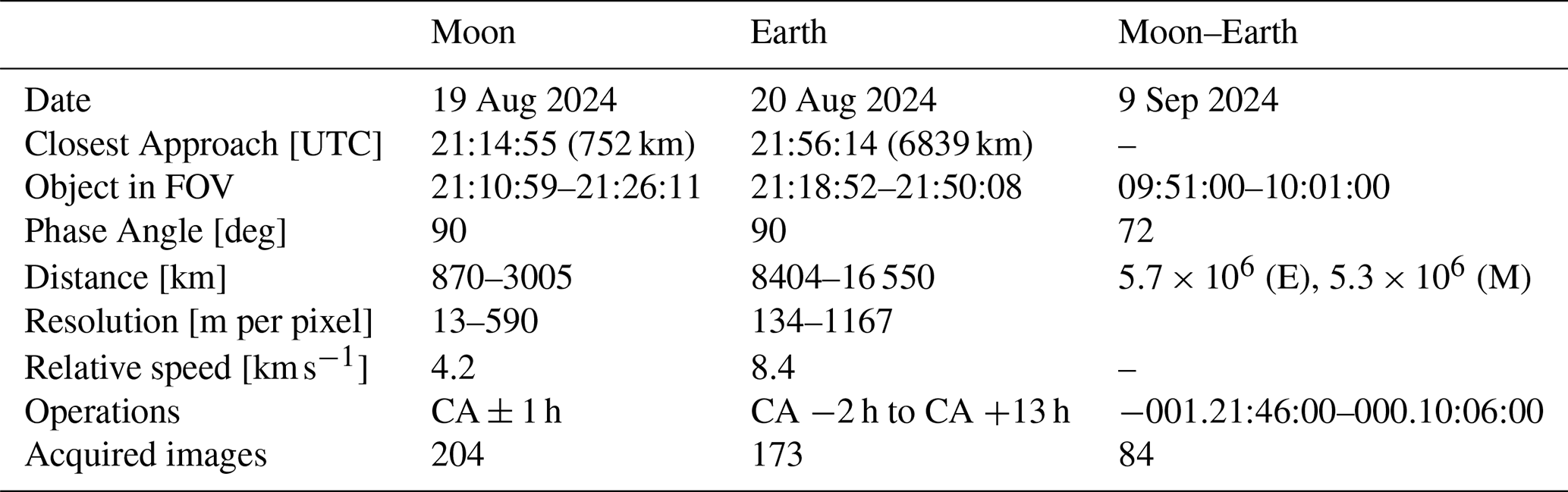
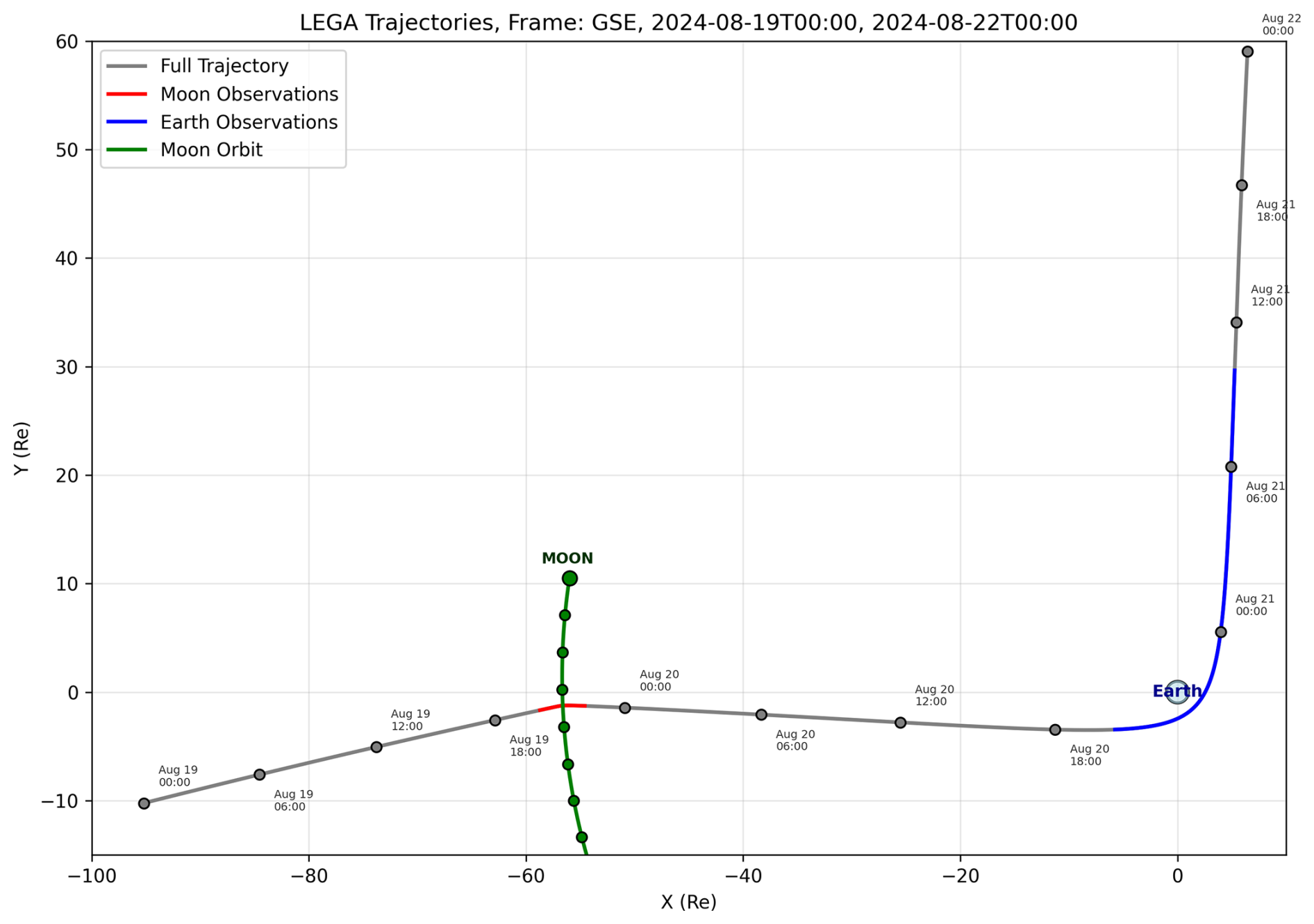
Figure 1JUICE and the Moon trajectory during LEGA. The trajectory is drawn in the Geocentric Solar Ecliptic (GSE) frame, which is a Cartesian coordinate system with the +x axis pointing from the Earth to the center of the Sun, the +z axis is normal to the ecliptic plane, pointing towards the North Ecliptic Pole, while +y completes the right-handed system, pointing towards the dusk side (opposite to the direction of Earth's orbital motion). JUICE approaches from −x moving towards +y after the Earth flyby. Markers are shown every 6 h, and the total interval plotted is indicated on the plot title. Highlighted periods in red and blue show the operational segments of JANUS. The off-pointing period (farewell images) is not shown here, due to its large distance from Earth (towards +y).
JUICE carries 10 state-of-the-art instruments, comprising the most powerful remote sensing, geophysical and in situ payload suite ever flown to the outer Solar System. Among those, JANUS (Jovis Amorum ac Natorum Undique Scrutator) is the scientific optical camera system. The scientific objectives together with a comprehensive overview of the instrument design and performances are summarised in Palumbo et al. (2025). Here we describe JANUS, highlighting the aspects that are relevant to the LEGA operations and acquired dataset.
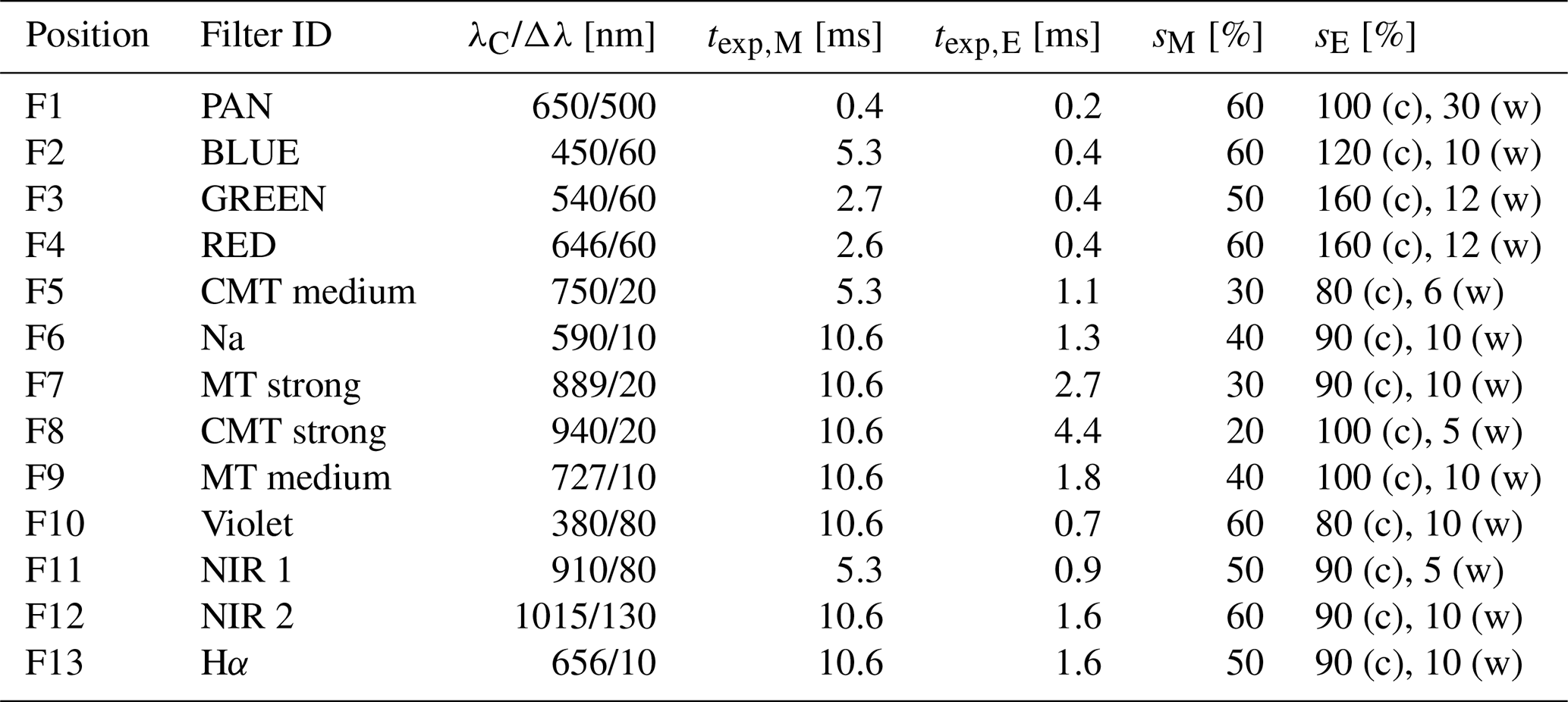
JANUS is a modified Ritchey-Chretien telescope with a nominal focal length of 467 mm, an aperture of 103.6 mm and a rectangular field of view (FOV) of 1.72°×1.29°. Its focal plane employs a 2000×1504 pixel CMOS sensor, yielding an angular sample (instantaneous field of view (iFOV)) of 15 µrad per pixel, which results in images with 7.5 m per pixel resolution at a distance of 500 km. The CMOS sensor uses a rolling shutter readout strategy, which means that JANUS does not produce an instantaneous image where all pixels are exposed at the same time, but the exposure happens row by row with a delay of 0.2215 ms between the exposure of one row and the following one. The main consequence is that a geometric distortion is introduced when there is a relative motion between target and S/C. The camera is equipped with a filter wheel with 13 filters (Table 2), which allows JANUS to acquire multi-spectral images in the 340–1080 nm wavelength range. The very different bandwidths, coupled with the system response at the different wavelengths, result in a wide range of exposure times to be used to achieve a similar signal-to-noise ratio (SNR). JANUS is equipped with a compression unit that compresses the data using a standard wavelet compressor, allowing both lossless and lossy compression up to a factor 33:1.
JANUS has a COver Mechanism (COM) which provides external closure of the telescope and protects its optical parts from sunlight and contamination.
For best image quality, the JANUS telescope shall be thermally stabilized at −20 °C before the beginning of the imaging sequence. Nominally, thermal stability is reached, in about 12 h, and maintained by the JANUS thermal control which is activated just after the instrument is powered ON. Due to power limitations during specific mission phases, power and/or duration reduced strategies, as the one used during LEGA, are under investigation (see Sect. 3.1.2).
Table 2The JANUS filters with their main characteristics: central wavelength (λC), bandwidth (Δλ), typical exposure time for Moon and Earth images and the corresponding saturation levels. In the case of Earth, the saturation level is provided for clouds (c) and water (w).
The observation strategy was developed to perform an in-depth check of operational capabilities, camera performances, calibrations and data quality in a science-phase like scenario. The Moon, thanks to its well known surface properties, was a perfect calibrator that could be used to validate and improve the JANUS radiometric calibration. The Earth was a proxy for Jupiter's atmosphere observations. To plan the observations, a number of constraints had to be taken into account: Moon and Earth brightness, rapid motion of the S/C, fixed S/C attitude, encounter geometry, data volume limitations, instrument constraints and capabilities.
The overall design was subject to a number of technical and mission/spacecraft constraints that we describe below.
3.1 Constraints and Operational Environment
3.1.1 Thermal
During the hot cruise phase (heliocentric distance <1.34 au) the spacecraft −x axis (i.e., the side where the large High Gain Antenna is mounted; Sarri et al., 2026) is maintained pointed to the Sun to use the High Gain Antenna as a sun shield, to protect the spacecraft body from direct high solar flux. The same configuration was used during LEGA. As a consequence of the fixed attitude, surface tracking (nadir pointing) was not possible. Instead, the camera operated with a slanted pointing, with the camera boresight sweeping the target at constant surface phase angle of approximately 90°. The observation window began when the JANUS boresight, approximately aligned with the S/C +z axis (i.e. the nadir direction, the one that will face the target during scientific observations; Sarri et al., 2026), crossed the surface target. The main consequence of the fixed attitude is that the exposure times had to be limited to avoid smearing.
3.1.2 Payload operation windows
All instruments, including JANUS operated during the Moon and Earth flybys. The Mission Operation Control (MOC) defined two payload operation windows: CA ±1 h for the Moon flyby and from CA −4 h to CA +3 d for the Earth flyby. CA stands for Closest Approach, i.e. the shortest distance between the S/C and the target surface. JANUS was powered ON at CA −1 h for the Moon flyby and CA −2 h for the Earth flyby, respectively 1 and 1.3 h before the beginning of image acquisition. The nominal 12 h for thermal stabilization were not possible, thus, the S/C survival heaters (which can be operated when the instrument is switched off) were used to warm up the JANUS telescope to the −20 °C, allowing to acquire images under thermally stable conditions at the desired temperature. The S/C survival heaters were switched ON about 12 h before the beginning of the imaging sequences.
This approach was first implemented during LEGA (and initially tested during its full rehearsal one month before) and has the advantage of significantly reducing the power consumption. JANUS requires between 10 and 20 W when it is powered ON to reach and/or keep thermal stability, while the survival S/C heaters, which are operated with JANUS off, require significantly less power (about 3 W).
During the science phase, periods of observations will be interleaved with periods of very limited power availability, e.g. downlink windows, in which instruments might be requested to be switched off. In the cold space environment, JANUS drifts away from thermal stability very quickly as soon as the thermal control is switched off. Therefore, different strategies, such as the use of survival heaters, which reduce power consumption assuring image quality, are very important alternatives which shall be tested and optimised to assure the best image quality within the available power envelope.
3.1.3 RIME “quiet time”
The Radar for Icy Moon Exploration (RIME) instrument (Sarri et al., 2026) was granted to operate alone for a few minutes around the Moon closest approach to perform some tests of electro-magnetic cleanliness. All other payloads, including JANUS, had to be in quiet mode to ensure that no interference was introduced by the subsystems. JANUS operations began as soon as the “RIME quiet time” was concluded, 30 s before terminator crossing.
3.1.4 JANUS-specific operational constraints
In addition to the aforementioned constrains posed by the S/C and the other instruments, JANUS had its own constraints that had to be accounted for during the sequence design.
Smearing. Because of the fixed spacecraft attitude requirement described in Sect. 3.1.1, surface tracking was not possible and the camera boresight swept the target at constant velocity during the flybys. The image exposure times had to be limited to avoid smearing. The smearing limit was set to a motion of the JANUS boresight of below pixel. Typical exposure times are summarised in Table 2.
Filter change time. The time needed to change filter of one position is 0.5 s. This time interval plays a critical role in multifilter sequences for color cubes when the spacecraft is in motion, as in the LEGA case, and the JANUS FOV continuously shifts across the surface. The maximum number of filters that could be used was thus determined by the time that color sequence footprint moved of maximum 60 %–70 % of the JANUS FOV, assuring an overlap of 20 %–30 % between the footprints in all filters. An example is shown in Fig. 2, where the footprints of F2, F4, F11 and F12 overlap on about 20 %–30 % of the FOV.
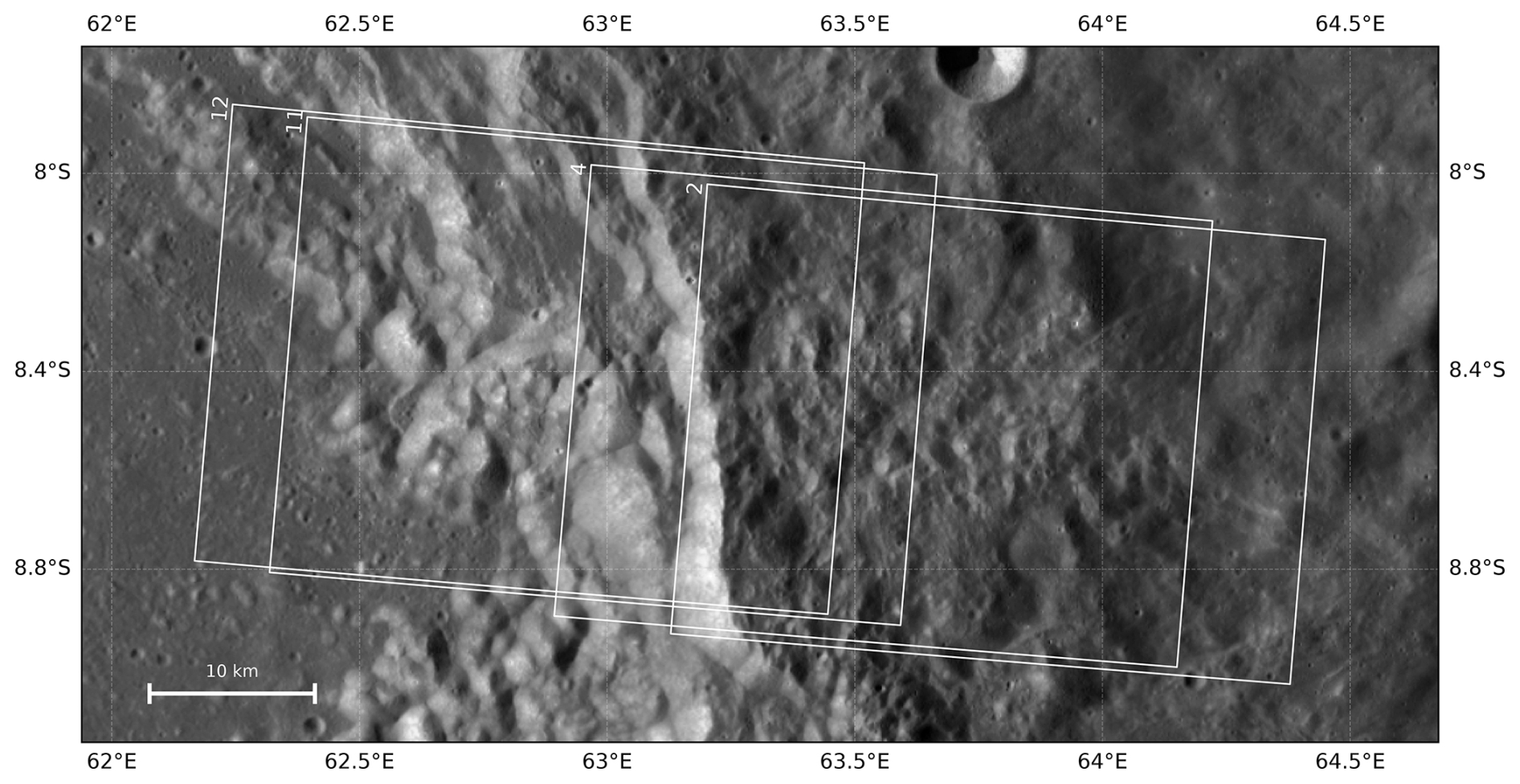
Figure 2Example of multifilter sequence. The footprints of F2, F4, F11 and F12 (indicated on the image) overlap on about 20 %–30 % of the FoV. Background image: LRO LROC-WAC Global Mosaic 100 m (Robinson et al., 2010) – from https://data.lroc.im-ldi.com/lroc/view_rdr/WAC_GLOBAL (last access: 16 October 2026). Moon mosaic © NASA/LROC Team.
3.2 JANUS Campaigns
This section describes the design and testing capabilities of the JANUS LEGA campaign.
Overall design
During LEGA, JANUS acquired 204 image of the Moon and 173 images of the Earth. All images were in full frame and resolution (not binned/down-sampled) and commanded lossless, to assure maximum data quality. Figures 3 and 6 show the JANUS footprints plotted over Moon and Earth maps, respectively.
All sequences were rehearsed on the JANUS Ground Reference Model (GRM), which is representative of the flight unit in both hardware and onboard software. The timing between images as well as the duration of the sequences was simulated. This was especially important for flyby operations, where precise time synchronization between the image sequences and the footprint on the surface was critical. No command errors occurred during LEGA, confirming that a full chain rehearsal is a prerequisite for any time critical cruise or science phase campaign.
The images were processed using the nominal JANUS calibration pipeline (Agostini et al., 2026).
Each flyby was divided in segments within which different instrument settings were tested: single filter imaging, multi-filter imaging and acquisitions with different compression factor. The objectives of each segment are described below.
Moon flyby. Moon observations were acquired over an elongated stripe from the nightside to the dayside (Fig. 3).
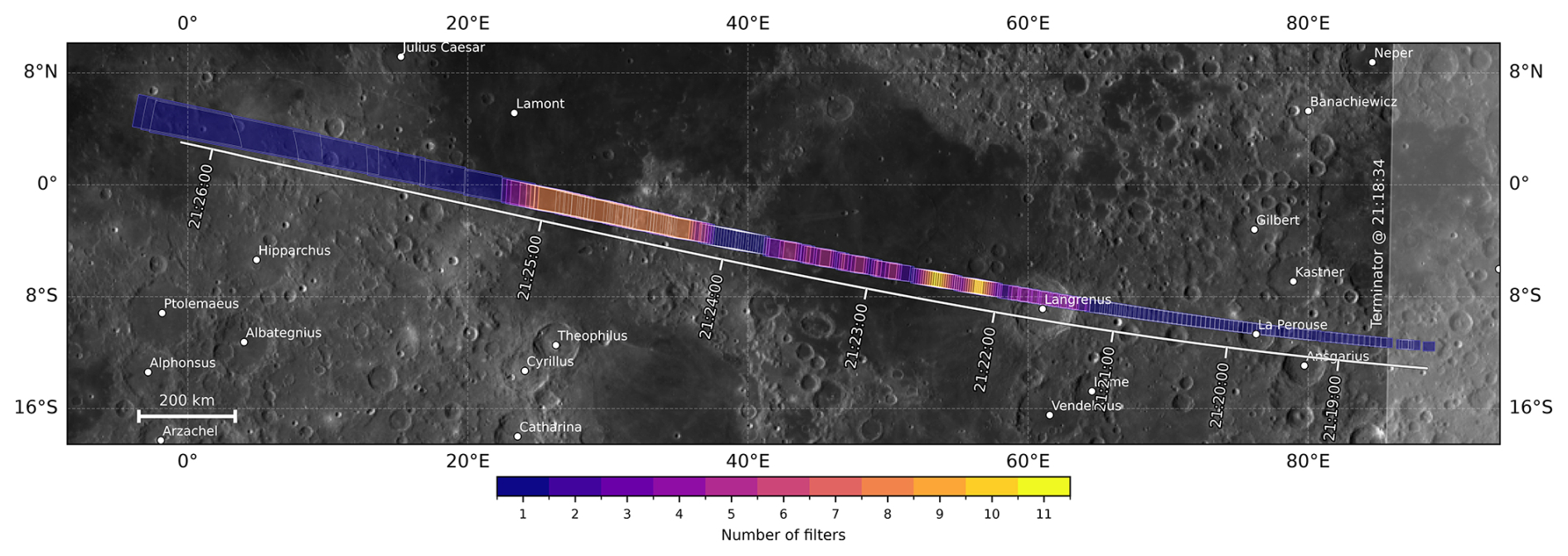
Figure 3Footprints of the JANUS FOV on the Moon map. Footprints are moving from right to left. Background image: LRO LROC-WAC Global Mosaic 100 m (Robinson et al., 2010) – from https://data.lroc.im-ldi.com/lroc/view_rdr/WAC_GLOBAL (last access: 16 October 2026). Moon mosaic © NASA/LROC Team.
A total of 204 images were acquired over the target. While observing the nightside, we attempted to observe the Ganymede Laser Altimeter (GALA) spot on the Moon's surface to test the alignment of the two instruments boresighs (Seq. 1, Table 3). For this purpose we acquired a number of images in the near-IR filter (F12, λc=1015 nm). This measurement was inherently difficult due to the marginal sensitivity of JANUS at the edge of its spectral range and to the non-ideal geometry and limited time both instruments could operate. In particular, due to the RIME quiet time constraint (Sect. 3.1.3, this observation could only be performed in the 30 s before the terminator crossing.
Table 3JANUS sequences executed during the Moon and Earth flybys and during the Moon–Earth farewell observation. For each sequence a description if provided together with the exposure times used for each filter. “Date and Time” indicates when the sequence has started, together with its duration. “i” and “e” indicate, respectively, the incidence and emission angle ranges during each sequence.
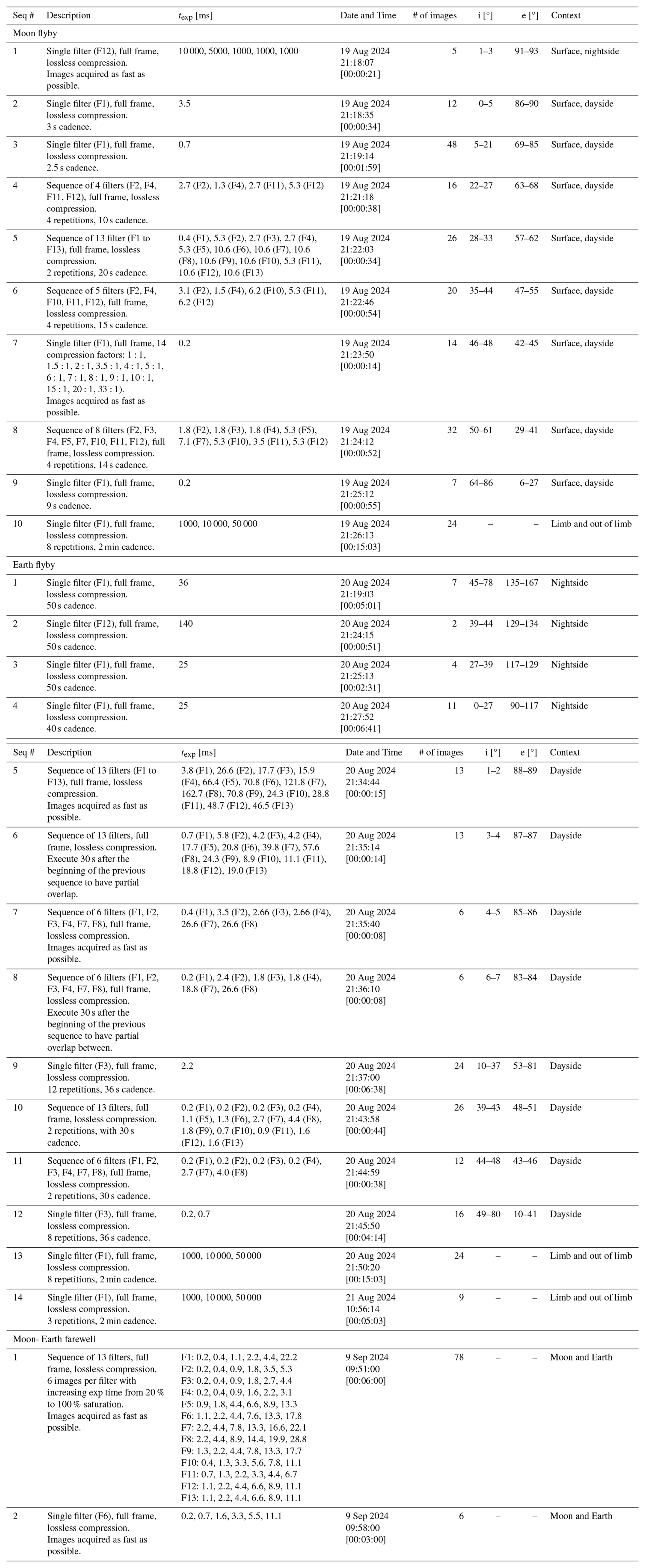
After the terminator crossing, dayside lunar surface observations were constrained by geometry, relative speed and radiometry, which together determined the usable filters and corresponding exposure times.
The first two sequences in daylight (Seq. 2 and 3, Table 3) are characterized by high incidence angle and were acquired in a single filter (F1, λc=650 nm). The cadences were chosen to have overlap between consequent footprints, providing up to fourfold redundancy in surface coverage along the track. These images enable validation of the radiometric performance and post processing techniques, e.g., to correct image smearing and improve resolution.
The subsequent 3 sequences (Seq. 4, 5 and 6, Table 3) were multi-filter acquisitions using a variable number of filters. Those sequences allow to extend performance and calibration verifications to the entire wavelength range. While flying over the Mare Fecunditatis all 13 filters were used (Fig. 5). The relative uniformity of the Mare Fecunditatis allowed the comparison of images with non-overlapping footprints, enabling the validation of the radiometric performance to the entire wavelength range covered by JANUS. In addition, it enabled the assessment of straylight contributions from areas outside the JANUS FOV.
A compression test was carried on over a cratered area (Seq. 7, Table 3): images with increasing compression were acquired to evaluate the information loss as function of the used compression. While flying over the region north of Rimae Gutemberg we acquired a sequence of 14 images in the panchromatic filter (F1, λc=650 nm) with increasing compression ratio from 1:1 to 33:1. The images were acquired as fast as possible, to ensure a significant overlap between the footprints (Fig. 4).
Typically, a compression of 3.5:1 is foreseen to be used for well illuminated images. From a first and very preliminary analysis, the information loss is not as drastic as feared as function of the used compression. Small craters and other high-resolution features are preserved up to high compression rates with radiance values also preserved. This result, even though, preliminary, allows to set realistic expectations of the compression that can be used during the science phase, preserving the image quality but at the same time complying with a limited mission-wise data volume availability. Further tests under higher noise levels might be required to predict how compression may affect observations under low illumination in close flybys of the Galilean moons or in night-side observations of Jupiter.
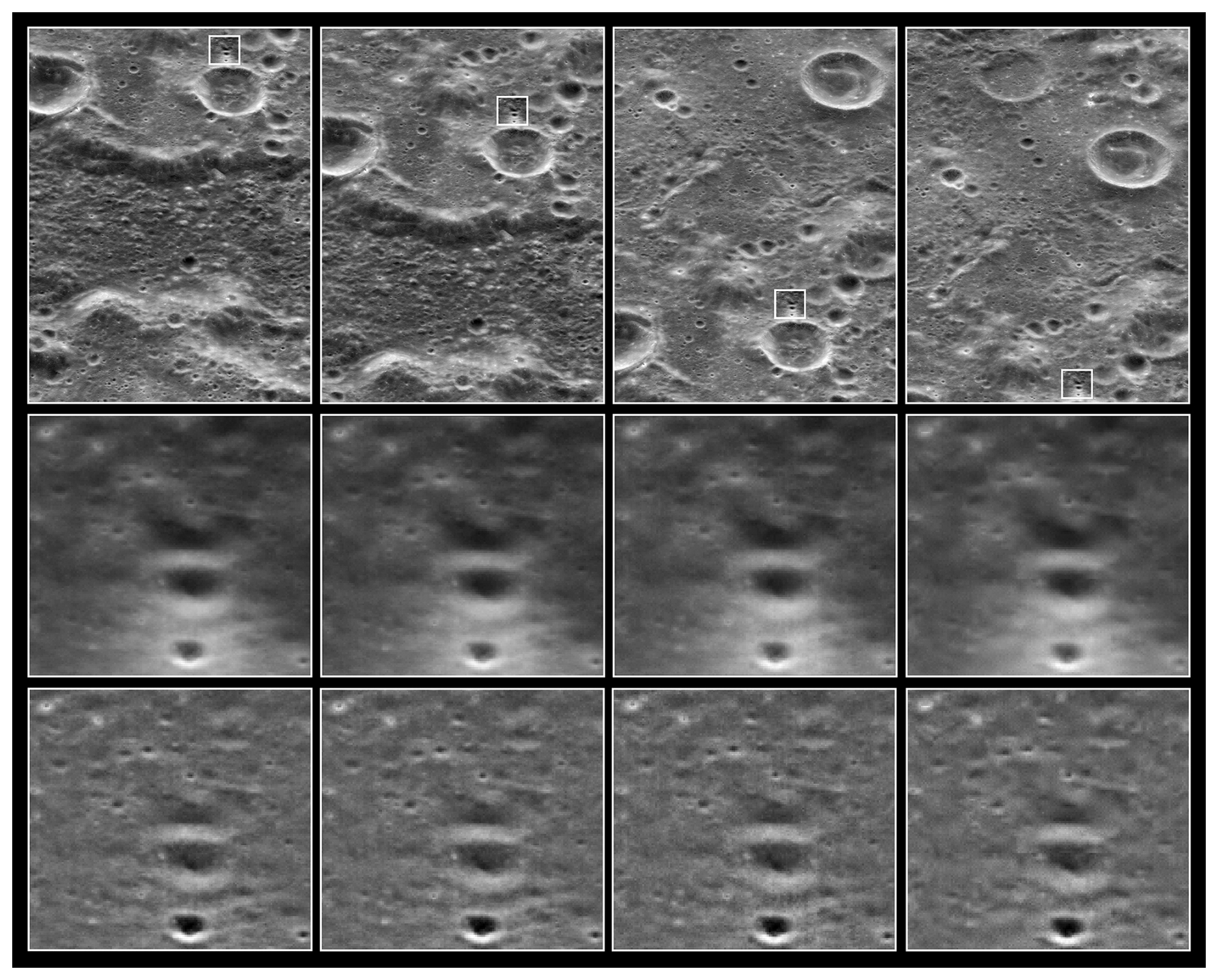
Figure 4Images acquired during the compression test with compression 1:1 (first column), 3.5:1 (second column), 10:1 (third column) and 33:1 (fourth column). From top to bottom full JANUS FOV images (top), 150×140 pixel cropped images shown with a zoom ×10 (center), 150×140 pixel cropped images shown with a zoom ×10 and after applying a high-pass filter (bottom). All panels in the top and center rows are contrast stretched using the same radiance range to demonstrate the consistency of radiance values across the different images. The high-pass-filtered images are displayed using a common color scale, highlighting equivalent contrast levels and structures observed under progressively higher compression rates. Images: 0777417466_0128_01, 0777417466_0130_01, 0777417466_0137_01, 0777417466_0140_01.
Two final sequences on the Moon surface (Seq. 8 and 9, Table 3), one multifilter and one with single filter were carried on while flying towards the Moon limb.
After limb crossing, a number of images with long exposure times (Seq. 10, Table 3) were acquired to characterize the straylight originating from an out-of-field source at increasing angular distance and with decreasing apparent size.
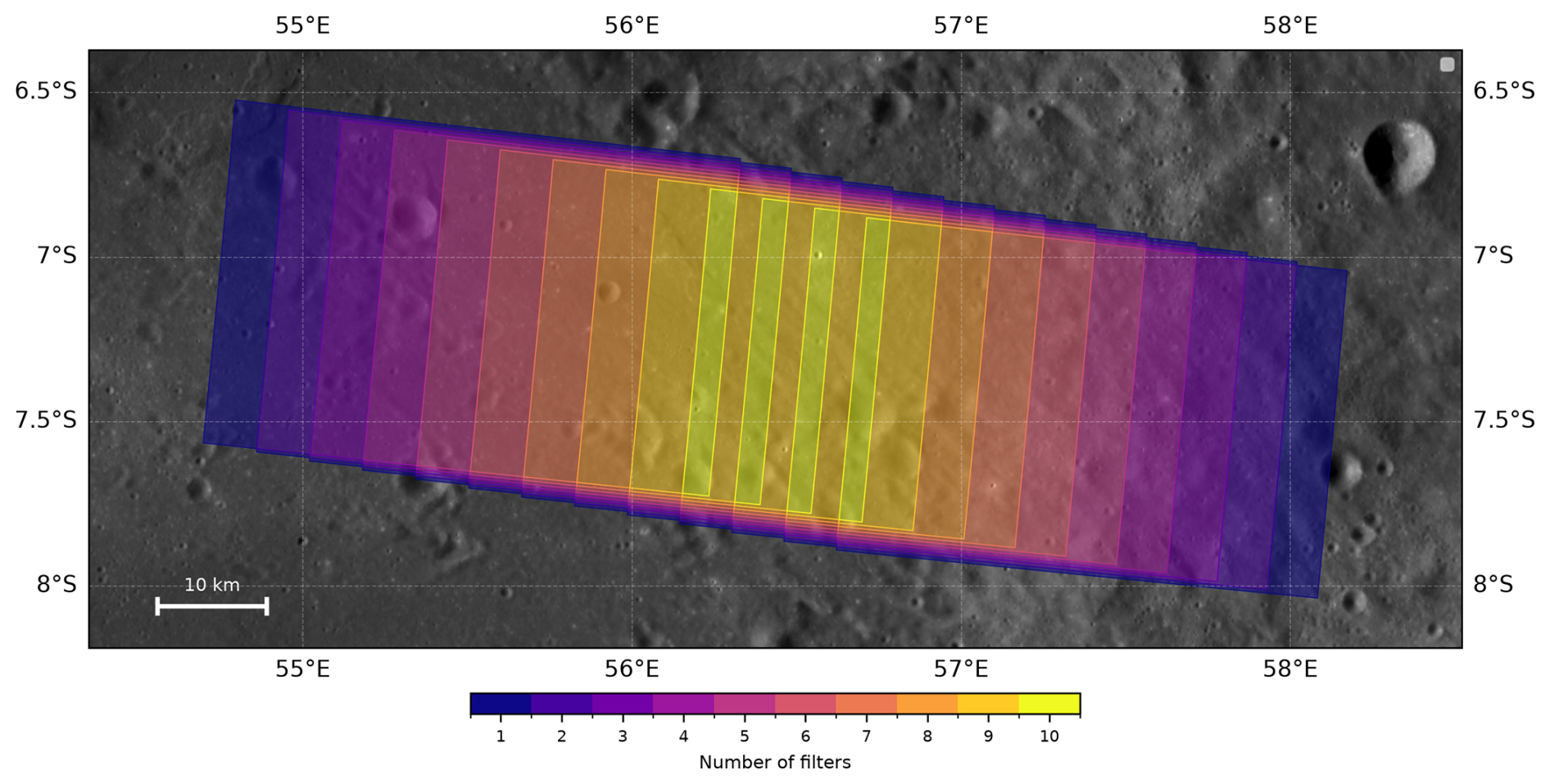
Figure 5JANUS footprints while flying over the Mare Fecunditatis. The color scale indicates how many filters imaged, during the sequence, that part of the Moon surface. Background image: LRO LROC-WAC Global Mosaic 100 m (Robinson et al., 2010) – from https://data.lroc.im-ldi.com/lroc/view_rdr/WAC_GLOBAL (last access: 16 October 2026). Moon mosaic © NASA/LROC Team.
Earth flyby. A similar approach was used to plan the Earth observations. Given the higher flyby altitude, image timing was less stringent constraint compared to the Moon flyby, enabling full multifilter observations on several footprints.
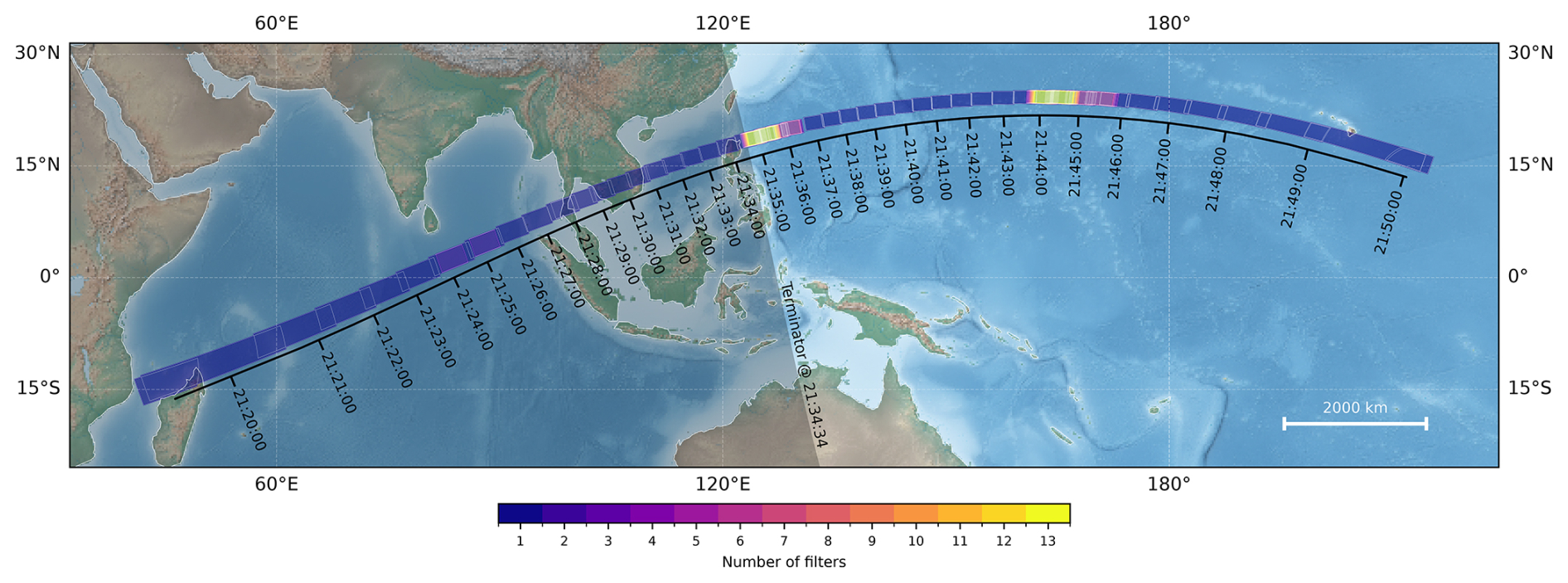
Figure 6Footprints of the JANUS FoV overlapped on the Earth map. Footprints are moving from left to right and from nightside to day-side with a terminator crossing just east of the Philippines shortly before the first multi-filter sequence. Background image: Earth: Basemap from Natural Earth data – http://naturalearthdata.com (last access: 5 August 2026). Earth basemap © Natural Earth.
Earth observations were acquired over an elongated ground track extending from nightside to dayside with the sub-spacecraft point moving from North of Madagascar to central Pacific over a distance of 18 700 km (Fig. 6). JUICE's trajectory over the Earth allowed to test the design of very different exposure times for the changing illumination conditions, test for smearing effects associated to short dwell times (where the dwell time is the time in which the boresight is moving of less than of a pixel, thus considered at a fixed position), check the performance of the onboard image compression algorithm and obtain radiometric data to be compared with data from Earth satellites. Hueso et al. (2026) describe the analyses of these observations. A total of 173 images were acquired, with an average ground sampling resolution of 140 m per pixel. Since the spacecraft velocity over the target varied from 5.0 to 6.8 km s−1 this resulted in dwell times of 18 to 44 ms. For the nightside images, short dwell times limited the possibilities to obtain well-exposed images in other filters than the panchromatic (F1). Thus, nightside images were acquired only with the panchromatic filter (F1) to maximize the visibility of surface features illuminated by the Moon. For the dayside images the high velocity flyby limited the capability to plan for repeated observations of the same areas.
The first two images targeted Earth's limb over Madagascar and the Indian Ocean. Their exposure times were chosen to accommodate to the dwell time of nearly 35 ms of that period and test the visibility of Madagascar's north coast over the dim illumination provided by the Moon. The night-time sequence included 24 images that targeted potential observations of lightning over tropical latitudes and the detection of city lights over Cambodia and Vietnam (Seq. 1, 2, 3 and 4, Table 3). Most images were acquired with the panchomatic filter (F1, λc=650 nm) and short exposure times to avoid smearing effects. Two images (Seq. 2, Table 3) were instead acquired with the near-IR filter (F12, λc=1015 nm) and longer exposure times (140 ms equivalent to 5 times the dwell time) to test image quality under smearing conditions.
The transition across the terminator was monitored using sequences of short-exposure monochromatic images (Seq. 3 and 4, Table 3), including four panchromatic images with 25 ms exposure time to capture the rapid change in illumination. JANUS acquired 116 images of Earth's dayside (Seq. 7 to 12 and 4, Table 3). These observations covered tropical latitudes over the ocean and included several multi-filter sequences. Two of the multi-filter sequences targeted an area of the Pacific Ocean also observed with two Earth observing satellites: EnMap and PRISMA (Caporusso et al., 2020) both obtaining high-resolution hyperspectral data of the area covered by JANUS to compare the radiometric quality of the observations (Hueso et al., 2026). Most other daytime observations used the green filter (F3, λc=540 nm) alternating exposure times that varied by a factor of 3–5 to obtain images well exposed for the dark ocean and bright clouds. This filter was preferred over the panchromatic one, as the latter would have saturated even at the minimum exposure time of 0.2215 ms due to its broad spectral bandwidth.
All images were acquired with lossless compression: in addition to preserving the highest images quality, it allowed to investigate the effective compressions under a wide range of illumination conditions.
3.3 Synergistic Instrument Campaigns
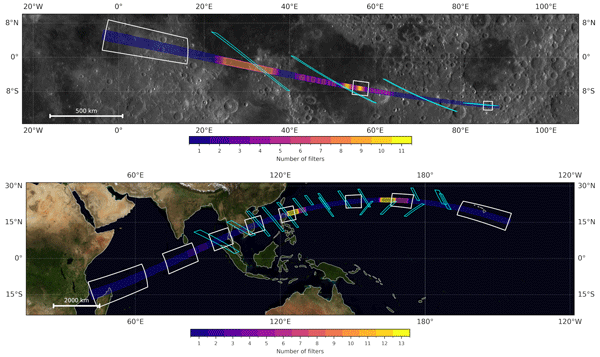
One of the strengths of LEGA is that it was a synergistic instrument campaign, in which several instruments operated at the same time acquiring simultaneous datasets which can be compared. MAJIS, the visible and infrared imaging spectrometer onboard JUICE (Poulet et al., 2024), observed the Moon and the Earth during the same time intervals as JANUS, acquiring 4 hyperspectral cubes targeting the lunar surface and 19 targeting the Earth (Poulet et al., 2026). The overlap between the datasets allows to compare, for example, the geometric and radiometric calibrations of JANUS with the ones of MAJIS.
The navigation camera (Gorog et al., 2019; Cornet et al., 2026) performed 6 observations on the Moon. Three of them where evenly spaced between the terminator and the illuminated limb. The observation over Mare Fecunditatis overlaps the JANUS and MAJIS footprints. The observation on the limb matches the JANUS one but with a larger FOV (Fig. 7). The partial overlap with JANUS observations provides additional opportunities for cross-calibration between the two imaging systems. In particular, the images acquired over the Mare Fecunditatis are an excellent dataset for a radiometric cross-calibration because JANUS used all 13 filters.
On the Earth, NavCam performed 8 observations from the night limb (over Madagascar) to the illuminated limb in the Pacific Ocean (over Hawaii). All footprints overlap with JANUS images. The footprint over the Pacific, overlap with a multifilter JANUS sequence and very nicely shows the same cloud features.
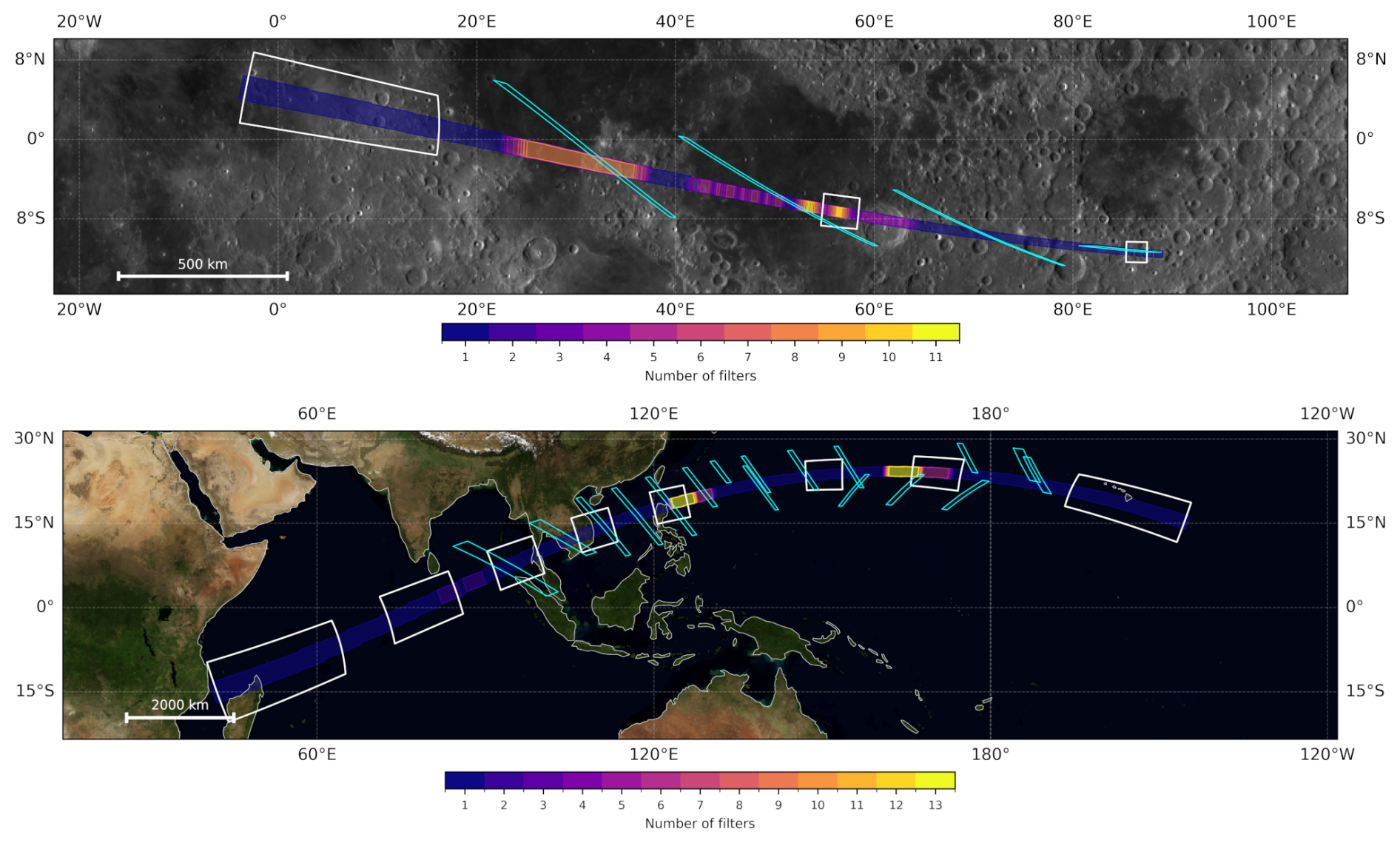
Figure 7Footprints of the JANUS FoV overlapped on the Moon map (top) and on the Earth map (bottom). The NavCam (white) and MAJIS (light blue) footprints are shown, indicating when the three instruments have observed simultaneously. Background image: Moon: LRO LROC-WAC Global Mosaic 100 m (Robinson et al., 2010) – from https://data.lroc.im-ldi.com/lroc/view_rdr/WAC_GLOBAL (last access: 16 October 2026). Moon mosaic © NASA/LROC Team. Earth: Basemap from Natural Earth data – http://naturalearthdata.com (last access: 5 August 2026). Earth basemap © Natural Earth.
Through coordination during the LEGA planning, the two Earth-observing satellites Environmental Mapping and Analysis Program (EnMAP) and PRecursore IperSpettrale della Missione Applicativa (PRISMA), operated by the German (DLR) and Italian (ASI) space agencies respectively, observed an area over the Western Pacific Ocean which was also imaged by JANUS. The closest in time EnMAP hyperspectral observation took place 21 h before the JANUS one, while the PRISMA data were acquired 2 h after the JANUS images. A comparison between the JANUS, EnMAP and PRISMA observations is presented in Hueso et al. (2026).
On 9 September 2024, about 20 d after the Moon–Earth flyby, JUICE looked back to the Earth and the Moon from a distance of 5.7 and 5.3 million km, respectively.
Despite still being in the hot cruise phase, a deviation of up to 45 min from the S/C −x axis pointed to the Sun was allowed. An off-pointing of about 17°, maintained for about 20 min, allowed both bodies to enter in the JANUS FOV.
Since no operations restriction, as in the case of LEGA, were in place, the nominal warm up procedure was used. A quantitative assessment of the warm upp performances will be carried on during the next activities in flight. JANUS switched on 12 h before the observations to thermally stabilize and observed the Earth–Moon system for 10 min, while the S/C was tracking the Earth, acquiring 84 images in all 13 filters.
Since the S/C was tracking the Moon–Earth system, the exposure times were not constrained. For each filters 6 images with increasing exposure time, going from 20 % to 100 % saturation level, we acquired. For one filter (F6, λc=590 nm) we acquired 6 additional images with exposure time complementary to the ones used in the previous sequence. An example of RGB color composite image is shown in Fig. 8, obtained combining a red (F4), a blue (F2) and a green (F3) image.
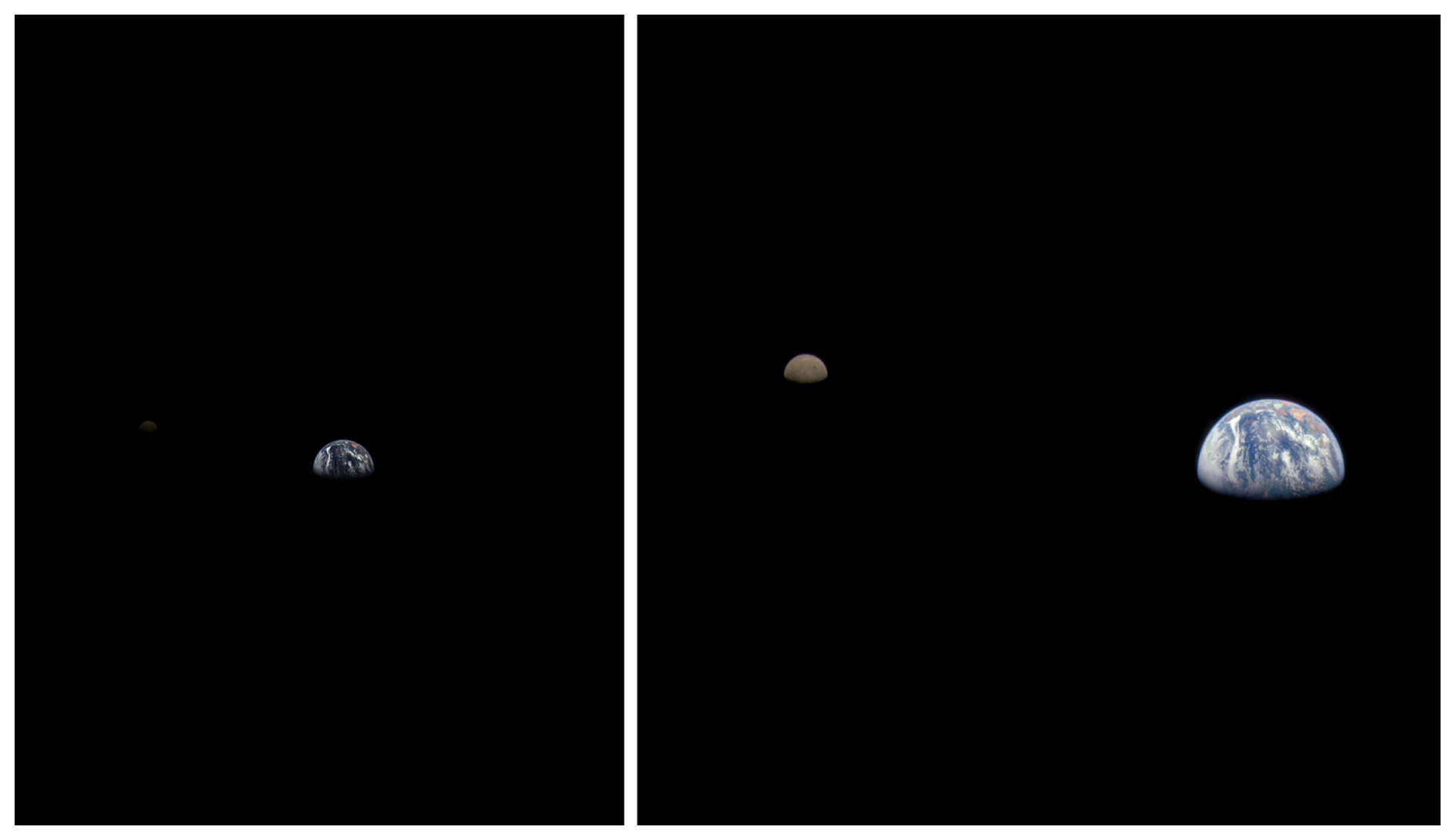
Figure 8The Moon–Earth system as seen by JANUS on 9 September 2024. Left: Full frame; right: Zoom on the Moon–Earth system. A gamma curve correction is applied. Image: 0779190669_0008_02, 0779190669_0014_03, 0779190669_0020_04.
Those images enable the evaluation of the radiometric calibration as well as the characterization of ghosts generated by the optics. In addition the presence of two resolved objects not on the same image line, allows to characterize the Signal Dependent Baseline Shift (SDBS), a detector effect that is affecting each image, as described in Agostini et al. (2026).
Some highlights and lessons learned from these campaign are summarized below:
-
Ground segment validation is essential. All sequences were rehearsed on the JANUS Ground Reference Model (GRM). The timing between the acquired images as well as the duration of the sequences was as planned. No in flight command errors occurred, confirming that a full chain rehearsal is a prerequisite for any time critical cruise or science phase campaign.
-
Thermal strategy validated. The spacecraft survival heaters, which can operate when the instrument is switched OFF and use significant less power than JANUS, were successfully used to warm up JANUS to the desired temperature of −20 °C. This allowed to power ON the instrument between 1 and 2 h before the beginning of the imaging sequence, reducing the overall power budget while preserving image quality.
-
Exposure time and smearing. The pixel smearing limit dictated the exposure time ranges that could be used in the different phases of the Moon and Earth flybys. This in turn defined which filters could be used to reach a reasonable SNR.
-
13 filter colour sequences. 13 filter sequences were acquired over the Mare Fecunditatis and over a Pacific Ocean swath, confirming that a full colour cube acquisition with (some) overlap between the individual frames is feasible in this range of ground-track speeds.
-
Compression performance. A very preliminary analysis of the images acquired with different compression ratios indicates that compression can be used during the science phase, preserving the image quality but at the same time complying with a limited mission-wise data volume availability.
-
Synergistic observations. The simultaneous MAJIS, NavCam and JANUS measurements enabled a three way cross-calibration that will help to improve the absolute radiometric calibration.
More broadly, the LEGA campaign highlights the value of maintaining an active science payload during cruise phase flybys and opportunistic encounters.
In the section above we described the activities that JANUS carried on during the Moon and Earth flybys and during the Moon–Earth farewell, highlighting the process that went into their planning and the scientific and technical objectives of the acquired observations.
The LEGA campaign served simultaneously as a unique calibration opportunity and as a full-scale rehearsal of the science phase operations that will be performed during JUICE's Jovian tour. By exploiting the Moon and Earth flybys, and the subsequent “farewell” imaging sequence, JANUS was exercised under a wide range of realistic illumination, viewing geometries and thermal conditions. The resulting high-quality dataset (204 lunar, 173 terrestrial, and 84 farewell images) not only supports scientific investigations, but also provides the reference measurements needed to refine JANUS radiometric and geometric calibrations and to carry out cross-calibrations with MAJIS, NavCam and additional Earth-observation systems (EnMAP, PRISMA). The campaign validated the instrument design, the on-board processing chain, and the operational concept.
For deep-space missions, whether they involve planned planetary flybys or chance encounters with comets, asteroids, or other bodies, maintaining an active science payload during these windows dramatically expands the calibration and science return. In cruise, cameras are typically limited to stellar observations that deliver stability, radiometric, and geometric checks. In contrast, LEGA allowed JANUS to acquire resolved images of planetary surfaces and Earth's atmosphere, thereby testing the full end-to-end imaging chain including exposure-time management, smear mitigation, multi-filter colour sequences, compression, stray-light, all under conditions representative of the forthcoming Jupiter operations. In short, the LEGA experience demonstrates that a modest increase in cruise-phase operational flexibility can lead to a substantial gain in calibration fidelity, cross-instrument synergy, and scientific value – insights that will directly inform the planning of the remaining JUICE Earth flyby windows in September 2026 and January 2029, and will serve as a best-practice template for future cruise checkout operations of JANUS. More in general, LEGA observations demonstrate that instrument operations during spacecraft gravity assists are important and should be considered for all missions.
The JANUS data associated with this manuscript are published in the ESA-JUICE_LEGA-Special-Issue_v1.0 dataset (https://doi.org/10.57780/esa-2bb387d; European Space Agency, 2026).
CT led the science operations, design of the sequences and the writing of the manuscript. LP contributed to the design of the operations and of the sequences and to different parts of the manuscript. LA, AA, MA, KDM, MR, TB, EK, RP, FT contributed to the definitions of the parameters needed for the observations and data processing. RH and AL provided scientific inputs for the observations. PP designed the observations. RY, AD, IB made the observations possible. All other authors reviewed and edited the manuscript.
The contact author has declared that none of the authors has any competing interests.
Publisher's note: Copernicus Publications remains neutral with regard to jurisdictional claims made in the text, published maps, institutional affiliations, or any other geographical representation in this paper. The authors bear the ultimate responsibility for providing appropriate place names. Views expressed in the text are those of the authors and do not necessarily reflect the views of the publisher.
This article is part of the special issue “The first-ever lunar–Earth flyby: a unique test environment for Juice”. It is not associated with a conference.
JANUS has been funded by the respective Space Agencies: ASI (lead funding agency), DLR, Spanish Research Ministry and the UK Space Agency. Main hardware-provider Companies and Institutes are Leonardo SpA (Prime Industry), DLR-Berlin, CSIC-IAA and Sener. For the generation of the trajectory plot we used a series of tools available at https://gitlab.gwdg.de/juice/science_planning (last access: 5 August 2026).
This research has been supported by the Italian Space Agency (ASI) in the frame of the ASI-INAF agreement no. 2023-6-HH.0. R. Hueso was supported by Grant PID2023-149055NB-C31 funded by MICIU/AEI/10.13039/501100011033 and FEDER, UE, and by Grupos de Investigación del Gobierno Vasco IT1742-22
This paper was edited by Stephanie C. Werner and reviewed by two anonymous referees.
Agostini, L., Matz, K.-D., Tubiana, C., Della Corte, V., Penasa, L., Bilotta, T., Sarti, F., Read, M., Hviid, S., Mottola, S., Aboudan, A., Trauthan, F., Politi, R., Aye, M., Hueso, R., Lucchetti, A., Kersten, E., Belgacem, I., Dietz, A., Evill, R., Bell III, J. F., Zinzi, A., Castro-Marin, J. M., Roatsch, T., Schmitz, N., Patel, M. R., Lara, L. M., Portyankina, G., and Palumbo, P.: Calibrating JANUS: an overview of the calibration pipeline and what we learned from the Moon-Earth flyby data, EGUsphere [preprint], https://doi.org/10.5194/egusphere-2026-2032, 2026. a, b, c
Caporusso, G., Lopinto, E., Lorusso, R., Loizzo, R., Guarini, R., Daraio, M., and Sacco, P.: The hyperspectral prisma mission in operations, In Proceedings of the IGARSS 2020–2020 IEEE International Geoscience and Remote Sensing Symposium, https://doi.org/10.1007/s11214-026-01289-4, 2020. a
Cornet, T., Tissot-Favre, A., Belgacem, I., Vallejo, F., Escalante Lopez, A., Andres, R., Witasse, O., Vallat, C., and Altobelli, N.: The JMC and NAVCAM cameras on the ESA JUICE spacecraft, EGU General Assembly 2026, Vienna, Austria, 3–8 May 2026, EGU26-20758, https://doi.org/10.5194/egusphere-egu26-20758, 2026. a
Dietz, A., Boutonnet, A., and Budnik, F.: The JUICE Lunar-Earth gravity assist from trajectory design, navigation and spacecraft operations perspective, EGUsphere [preprint], https://doi.org/10.5194/egusphere-2026-1015, 2026. a, b
European Space Agency: ESA-JUICE_LEGA-Special-Issue_v1.0, European Space Agency [data set], https://doi.org/10.57780/esa-2bb387d, 2026. a
Gorog, F., Arnolfo, M.-C., Belmana, S., Dervaux, S., and Gherardi, D.: JUICE navigation camera design, in: International Conference on Space Optics – ICSO 2018, edited by: Sodnik, Z., Karafolas, N., and Cugny, B., vol. 11180 of Society of Photo-Optical Instrumentation Engineers (SPIE) Conference Series, 111804N, https://doi.org/10.1117/12.2536086, 2019. a
Grasset, O., Dougherty, M. K., Coustenis, A., Bunce, E. J., Erd, C., Titov, D., Blanc, M., Coates, A., Drossart, P., Fletcher, L. N., Hussmann, H., Jaumann, R., Krupp, N., Lebreton, J. P., Prieto-Ballesteros, O., Tortora, P., Tosi, F., and Van Hoolst, T.: JUpiter ICy moons Explorer (JUICE): An ESA mission to orbit Ganymede and to characterise the Jupiter system, Planet. Space Sci., 78, 1–21, https://doi.org/10.1016/j.pss.2012.12.002, 2013. a
Hueso, R., Antuñano, A., Lara, L. M., Stephan, K., Zinzi, A., Coustenis, A., Yair, Y., Sato, M., Haruyama, J., Simon, A., Tubiana, C., Penasa, L., Agostini, L., Luchetti, A., Aboudan, A., Aye, M., Kersten, E., Matz, K.-D., Politti, R., Trauthan, F., Evill, R., Belgacem, I., Yukihiro, T., Castro-Marín, J. M., Della Corte, V., Hviid, S., Roatsch, T., Schmitz, N., Patel, M., Portyankina, G., and Palumbo, P.: JUICE-JANUS observations of Earth in preparation for the JANUS investigation of Jupiter’s atmosphere, EGUsphere [preprint], https://doi.org/10.5194/egusphere-2026-710, 2026. a, b, c, d
Lucchetti, A., Massironi, M., Gwinner, K., Kenkmann, T., Penasa, L., Baby, N. R., Rotzoll, L., Karagoz, O., Rizos, J. L., Pajola, M., Tosi, F., Fornasier, S., Tusberti, F., Stephan, K., Pozzobon, R., Suarez-Valencia, J. E., Cagnin, D., Zambon, F., Chiarolanza, G., Coustenis, A., Giacomini, L., Hauber, E., Marchi, S., Matteoni, P., Mitri, G., Rossi, C., Hueso, R., Aboudan, A., Agostini, L., Kersten, E., Matz, K. D., Politi, R., Trauthan, F., Tubiana, C., Aye, M., Zinzi, A., Evill, R., Belgacem, I., Castro-Marin, J. M., Della Corte, V., Hviid, S., Roatsch, T., Schmitz, N., Lara, L. M., Patel, M. R., Portyankina, G., Palumbo, P., and the JANUS team: Morphological and Spectrophotometric exploitation of JANUS LEGA Dataset: Langrenus impact crater characterization and evolution of the highland ”isthmus” between Mare Fecunditatis and Mare Tranquillitatis, EGUsphere [preprint], https://doi.org/10.5194/egusphere-2026-1901, 2026. a
Palumbo, P., Roatsch, T., Lara, L. M., Castro-Marin, J. M., Della Corte, V., Hviid, S., Jaumann, R., Michaelis, H., Patel, M. R., Portyankina, G., Schmitz, N., Amoroso, M., Mugnuolo, R., Aboudan, A., Agostini, L., Althaus, C., Álvarez, F., Bartolomei, M., Behnke, T., Bilotta, T., Colombatti, G., Colosimo, A., Coustenis, A., Cremonese, G., Crews, C., Dattolo, A., Debei, S., Denk, T., Fiethe, B., Herranz, M., Hoffmann, H., Hueso, R., Koncz, A., Jiménez-Ortega, J., Lichopoj, A., Livi, L., Llamas, X., Lopes, R., Lucchetti, A., Martinez-Navajas, I., Mazzotta Epifani, E., Mertens, V., Pajola, M., Sarti, F., Schroedter, R., Stephan, K., Tosi, F., Tubiana, C., Wendler, B., Wendler, D., Williams, D., Wolff, F., Zusi, M., Chiodini, S., Ficai Veltroni, I., Galeotti, A., García-Segura, A., Greggio, D., Holland, A. D., Kenkmann, T., Leese, M. R., Magrin, D., Michalik, H., Munari, M., Noci, G. E., Paolinetti, R., Schipani, P., Soman, M., Stefanov, K. D., Turella, A., Aharonson, O., Bell, J. F., Bertini, I., Coates, A. J., Di Achille, G., Grassi, D., Groussin, O., Gwinner, K., Haruyama, J., Hauber, E., Hiesinger, H., Langevin, Y., Lainey, V., Marchi, S., Marinangeli, L., Marzari, F., Massironi, M., Mitri, G., Mottola, S., Oberst, J., Postberg, F., Poulet, F., Preusker, F., Schmidt, J., Schneider, N. M., Simon, A., Takahashi, Y., Tirsch, D., Vincendon, M., Balme, M. R., Bettanini, C., Borin, P., Capria, M. T., Elgner, S., Esposito, F., Ferranti, L., Ferrari, S., Fornasier, S., Galluzzi, V., Giacomini, L., Guzzetta, L., Jones, G. H., Kersten, E., Ledeit, L., Martellato, E., Matz, K. D., Mennella, V., Murray, C., Otto, K. A., Pelizzo, M. G., Penasa, L., Politi, R., Popa, C., Pozzobon, R., Prieto Ballesteros, O., Re, C., Rotundi, A., Sato, M., Schmedemann, N., Shoji, D., Simioni, E., Sindoni, G., Trauthan, F., and Yair, Y.: The JANUS (Jovis Amorum ac Natorum Undique Scrutator) VIS-NIR Multi-Band Imager for the JUICE Mission, Space Sci. Rev., 221, 32, https://doi.org/10.1007/s11214-025-01158-6, 2025. a
Poulet, F., Piccioni, G., Langevin, Y., Dumesnil, C., Tommasi, L., Carlier, V., Filacchione, G., Amoroso, M., Arondel, A., D'Aversa, E., Barbis, A., Bini, A., Bolsée, D., Bousquet, P., Caprini, C., Carter, J., Dubois, J.-P., Condamin, M., Couturier, S., Dassas, K., Dexet, M., Fletcher, L., Grassi, D., Guerri, I., Haffoud, P., Larigauderie, C., Le Du, M., Mugnuolo, R., Pilato, G., Rossi, M., Stefani, S., Tosi, F., Vincendon, M., Zambelli, M., Arnold, G., Bibring, J.-P., Biondi, D., Boccaccini, A., Brunetto, R., Carapelle, A., Cisneros González, M., Hannou, C., Karatekin, O., Le Cle'ch, J.-C., Leyrat, C., Migliorini, A., Nathues, A., Rodriguez, S., Saggin, B., Sanchez-Lavega, A., Schmitt, B., Seignovert, B., Sordini, R., Stephan, K., Tobie, G., Zambon, F., Adriani, A., Altieri, F., Bockelée, D., Capaccioni, F., De Angelis, S., De Sanctis, M.-C., Drossart, P., Fouchet, T., Gérard, J.-C., Grodent, D., Ignatiev, N., Irwin, P., Ligier, N., Manaud, N., Mangold, N., Mura, A., Pilorget, C., Quirico, E., Renotte, E., Strazzulla, G., Turrini, D., Vandaele, A.-C., Carli, C., Ciarniello, M., Guerlet, S., Lellouch, E., Mancarella, F., Morbidelli, A., Le Mouélic, S., Raponi, A., Sindoni, G., and Snels, M.: Moons and Jupiter Imaging Spectrometer (MAJIS) on Jupiter Icy Moons Explorer (JUICE), Space Sci. Rev., 220, 27, https://doi.org/10.1007/s11214-024-01057-2, 2024. a
Poulet, F., Piccioni, G., Langevin, Y., Dumesnil, C., Carlier, V., Seignovert, B., Dexet, M., Fletcher, L. N., Leyrat, C., Altieri, F., Carter, J., D'Aversa, E., De Sanctis, M., Grassi, D., Guerlet, S., Le Mouélic, S., Migliorini, A., Oliva, F., Royer, C., Rodriguez, S., Stephan, K., Tosi, F., Zambon, F., Adriani, A., Arnold, G., Bibring, J.-P., Bockelée, D., Brunetto, R., Capaccioni, F., Carli, C., Cavalié, T., Cisneros González, M., Ciarnello, M., De Angelis, S., Drossart, P., Filacchione, G., Fouchet, T., Gérard, J.-C., Grodent, D., Irwin, P., Jacquinod, S., Karatekin, O., Lellouch, E., Ligier, N., Mangold, N., Mebsout, M., Merlin, F., Morbidelli, A., Mura, A., Nathues, A., Palumbo, M. E., Pilorget, C., Poch, O., Quirico, E., Raponi, A., Robert, S., Roussos, E., Sanchez-Lavega, A., Schmitt, B., Sindoni, G., Snels, M., Sordini, R., Stefani, S., Strazzulla, G., Trent, T., Tobie, G., Turrini, D., Vandaele, A.-C., Vincendon, M., Witasse, O., Vallat, C., and Moraino, A.: ESA/JUICE encounters Earth/Moon in 2024: overview of the Moons And Jupiter Imaging Spectrometer (MAJIS) observations, Ann. Geophys., 44, 163–193, https://doi.org/10.5194/angeo-44-163-2026, 2026. a
Robinson, M. S., Brylow, S. M., Tschimmel, M., Humm, D., Lawrence, S. J., Thomas, P. C., Denevi, B. W., Bowman-Cisneros, E., Zerr, J., Ravine, M. A., Caplinger, M. A., Ghaemi, F. T., Schaffner, J. A., Malin, M. C., Mahanti, P., Bartels, A., Anderson, J., Tran, T. N., Eliason, E. M., McEwen, A. S., Turtle, E., Jolliff, B. L., and Hiesinger, H.: Lunar Reconnaissance Orbiter Camera (LROC) Instrument Overview, Space Sci. Rev., 150, 81–124, https://doi.org/10.1007/s11214-010-9634-2, 2010. a, b, c, d
Sarri, G., Erd, C., Cavel, C., Faye, F., Schirmann, T., Lelièvre, V., Tailfer, C., Durand, P., Laborde, S., Ravily, P., Deyber, S., Deschamps, S., Rouchit, P., Goodburn, S., Humbert, P., Ecale, E., Regnier, P., Philavong, V., Duhamel, H., Juillard, F., Planche, L., Roux, L., Bouchet, T., Massart, B., Moisson, X., Faust, M., Huber, M., Amann, M., Purvinskis, R., Lange, J., Osipenco, S., Chwalla, M., Baroni, M., Gare, P., Schnorhk, A., Monteiro, D., Scharmberg, C., Atzei, A., Grzymisch, J., Torelli, F., Escolar Blasco, D., Gumpinger, J., Peyrou-Lauga, R., le Letty, R., Verstaen, S., Landstroem, S., Paulsen, T., Torralba, I., Gherardi, D., Barbu, M., Bramanti, C., Bertini, F., Bonnier, A.-L., Barsanti, I., Redding, S., Glasbergen, H., Furnell, R., Accomazzo, A., Tanco, I., Dietz, A., Altobelli, N., Vallat, C., and Witasse, O.: The JUICE Spacecraft System Design, Space Sci. Rev., 222, 35, https://doi.org/10.1007/s11214-026-01289-4, 2026. a, b, c
- Abstract
- The JUICE mission and the Moon–Earth gravity assist
- The JANUS camera system
- Development of LEGA observational concept
- Moon–Earth farewell
- Lessons learned
- Conclusions
- Data availability
- Author contributions
- Competing interests
- Disclaimer
- Special issue statement
- Acknowledgements
- Financial support
- Review statement
- References