
the Creative Commons Attribution 4.0 License.
the Creative Commons Attribution 4.0 License.
 | 20 Oct 2026
The JUICE Lunar–Earth gravity assist from trajectory design, navigation and spacecraft operations perspective
Angela Dietz

Arnaud Boutonnet
Frank Budnik
This paper describes the world's first-ever Lunar–Earth Gravity Assist (LEGA) performed by ESA's JUICE spacecraft on 19–20 August 2024 from trajectory design, navigation and spacecraft operations point of view.
This double flyby – Moon first, Earth second – enabled a large Delta-V gain while minimizing propellant use, redirecting JUICE towards its next destination: Venus (August 2025) and ultimately Jupiter (2031). The manoeuvre was unprecedented in complexity, requiring extremely accurate navigation, rigorous preparation, and coordinated operations across engineering, flight dynamics, and science teams.
Overall, JUICE demonstrated outstanding platform stability, navigation accuracy, and subsystem robustness during this critical milestone, validating the operational feasibility of LEGA as an enabling technique for complex interplanetary trajectories.
- Article
(2618 KB) - Full-text XML
- BibTeX
- EndNote


1.1 The JUICE mission
The Jupiter Icy Moons Explorer (JUICE) is the European Space Agency's first dedicated mission to the Jovian system, designed to investigate Jupiter and three of its Galilean moons – Europa, Callisto, and especially Ganymede – through comprehensive geological, geophysical, and habitability-focused studies. Operated from ESA's European Space Operations Centre (ESOC) in Darmstadt, Germany, the spacecraft was launched on 14 April 2023 aboard an Ariane 5 from Kourou, French Guiana, and is currently navigating its interplanetary cruise through the inner Solar System. As a direct transfer to Jupiter was beyond the performance capabilities of the launcher and incompatible with onboard propellant resources, JUICE follows a complex trajectory incorporating multiple gravity-assist manoeuvres to reach the Jovian system in 2031. Upon arrival, it will perform a Ganymede gravity assist to reduce the Jupiter Orbit Insertion Delta-V, followed by an extensive “Jupiter Tour” comprising 35 flybys of Ganymede, Europa, and Callisto. The mission will culminate in JUICE becoming the first spacecraft to enter orbit around a moon in the outer Solar System, ultimately achieving a 500 km and later a 200 km circular orbit around Ganymede as the final phase of its nominal mission.
A more comprehensive and detailed description of the JUICE mission, spacecraft design and ground segment can be found in Sarri et al. (2026), Witasse et al. (2026) and Altobelli et al. (2026).
1.2 The JUICE spacecraft
The JUICE spacecraft is a highly redundant deep-space platform engineered to operate across extreme thermal and radiation environments throughout the Solar System. Power is supplied by two steerable cross-shaped solar arrays with a total area of 85 m2, enabling efficient energy generation even at Jupiter. The power subsystem also manages a battery capable of sustaining the spacecraft through eclipses of up to 5 h.
Attitude control is fully three-axis stabilized, relying on measurements from star trackers and a three-gyro inertial measurement unit, combined with a four-wheel reaction wheel assembly. Propulsion is provided by a 425 N main engine, supplemented by 22 and 10 N thrusters for attitude and orbit control.
Central data handling is performed by the Control and Data Management Unit (CDMU), which operates over SpaceWire and MIL-Bus networks using the ECSS Packet Utilisation Standard (PUS). Units lacking native PUS capability interface through Remote Interface Units. Extensive redundancy is implemented across platform units to guarantee long-term reliability.
The telecommunications suite includes a 2.4 m high-gain antenna for high-rate downlink at Jupiter, a steerable medium-gain antenna for inner cruise operations, and two low-gain antennas providing near-omnidirectional coverage for safe mode and contingency scenarios. Housekeeping telemetry and telecommands are transmitted via X-band, while science data can be returned as well in Ka-band. Given the extended communication latency at large heliocentric distances, JUICE implements a high-degree of autonomy.
JUICE carries a comprehensive science payload hosted largely on a +Z-mounted optical bench, with electronics housed inside two radiation-shielded vaults, see also Fig. 1. Its instruments can be discriminated as follows:
-
Remote sensing package includes imaging (JANUS, Palumbo et al., 2025) and spectral-imaging capabilities from the ultraviolet to the sub-millimetre wavelengths (MAJIS, Poulet et al., 2024; UVS, Retherford et al., 2024; SWI, Hartogh et al., 2026).
-
Geophysical package consists of a laser altimeter (GALA, Hussmann et al., 2019) and a radar sounder (RIME, Bruzzone et al., 2015) for exploring the surface and subsurface of the moons, and a radio science experiment (3GM, Iess et al., 2026) to probe the atmospheres of Jupiter and its satellites and to perform measurements of the gravity fields.
-
In-situ package comprises a powerful package to study the particle environment (PEP, Barabash et al., 2025), a magnetometer (J-MAG, Brown and the The J-MAG Instrument Team, 2024) and a radio and plasma wave instrument (RPWI, Wahlund et al., 2025), including electric fields sensors and a Langmuir probe. An experiment (PRIDE, Gurvits et al., 2023) using ground-based very-long-baseline interferometry will provide precise determination of the spacecraft position and velocity.
In addition to these science instruments, the spacecraft is equipped with a navigation camera (NavCam) for autonomous guidance and two monitoring cameras (JMCs) originally intended for deployment verification but repurposed for imaging during flybys and a radiation monitor (RADEM, Hajdas et al., 2025).
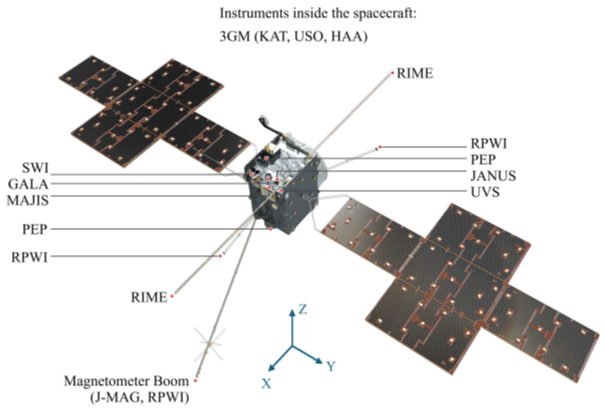
Figure 1JUICE and its instruments (Credit: ESA/Juice).
In the multibody environment of interplanetary trajectories or giant planets tours, it can be beneficial – Delta-V-wise – to rely on Gravity Assists (GA) to shape the trajectory. There is a trade-off between Delta-V savings and mission duration; sometimes, the use of gravity assist is mission enabling. The resulting reference trajectory is defined by a given amount of Delta-V needed, called deterministic Delta-V, implemented via Deep Space Manoeuvres (DSMs).
The concept of GA can be understood by using a simplified – but realistic – patched conic model: such a model divides the interplanetary trajectory into arcs: ellipse between bodies, and hyperbola during the GA. The spacecraft hyperbola around the planet (for the Sun) or a moon (for a planet) is defined by an incoming infinite velocity vector.
In the patched conics model, the mission designer is left free with the selection of the gravity assist parameters, e.g. two parameters in the so-called B plane, that will fully define the outgoing infinite velocity vector. One standard constraint is that the free parameters are selected such that the hyperbola pericentre altitude is safe vis-a-vis the surface (or the atmosphere if applicable). By definition, the size of the outgoing vector is the same as that of the incoming one, the net effect of a GA is only a rotation of the vector.
When optimising an interplanetary trajectory with GA, the standard bodies are Venus, the Earth and Mars. For the case of an Earth-GA, the Moon is usually considered as a potential perturbation that can only increase the deterministic Delta-V. From a programmatic point of view, an interplanetary mission requires a launch window. At ESA, the duration of this window is usually three weeks. If the interplanetary scenario features an EGA, some launch days can lead to a relatively close encounter with the Moon. In such a case, it can be decided not to launch on these days because the Delta-V penalty is too large.
What was found by the ESOC mission analysis section is that instead of avoiding the Moon, it can be purposely targeted with the objective to save deterministic Delta-V: the Lunar–Earth GA (LEGA) was born. The actual JUICE LEGA is shown in Fig. 2.
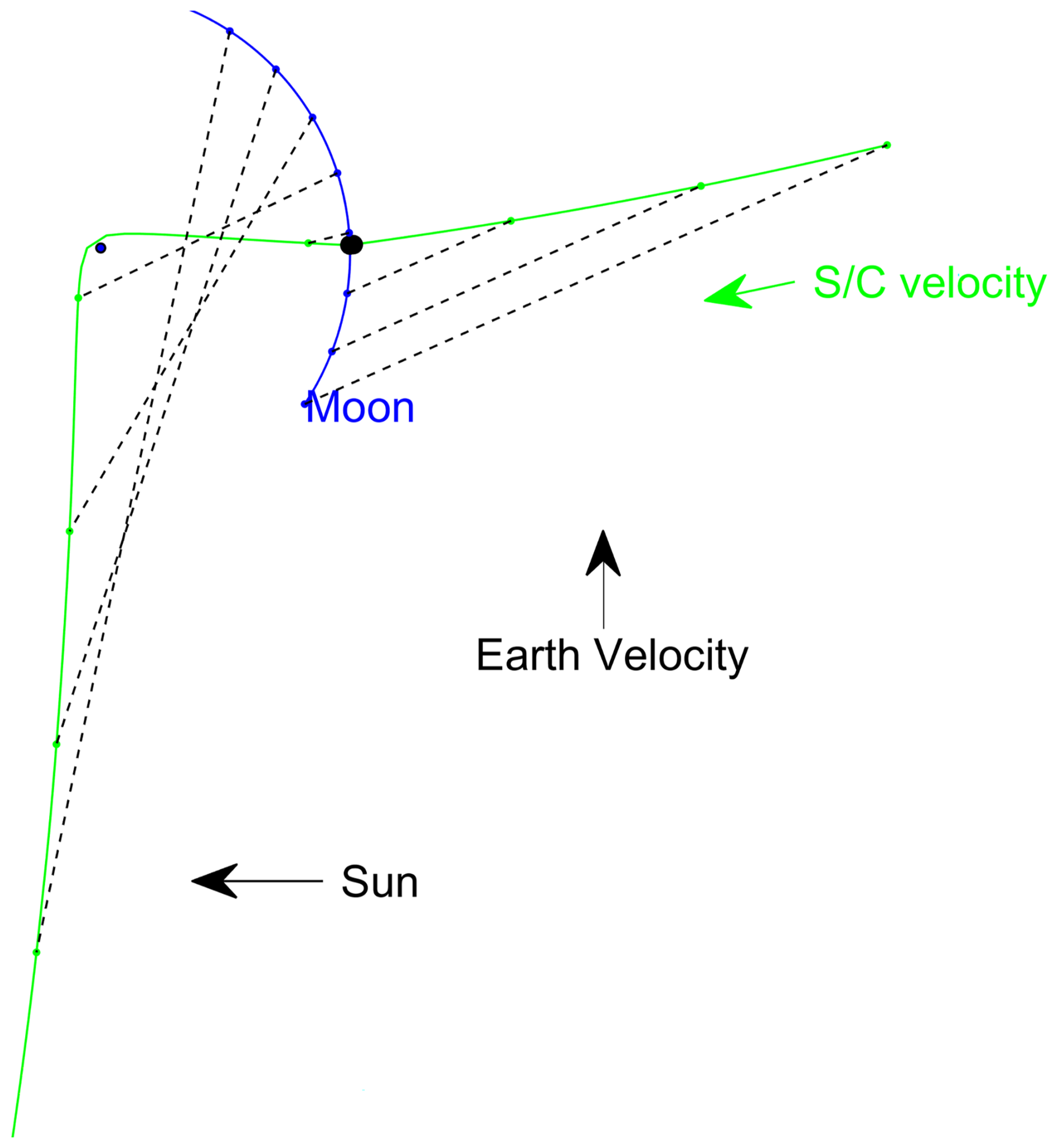
Figure 2Ecliptic projection of the actual LEGA flown by JUICE on the 19 and 20 August 2024. The Earth is fixed. The Moon's orbit is shown in blue. The spacecraft orbit is shown in green. The dashed black lines indicate the positions of the Moon and the spacecraft every 24 h.
To better understand the usefulness of the LEGA, it is important to understand how standard Venus- or Earth- or Mars-GA are used. Upon launch, for an interplanetary mission, the infinite velocity magnitude at Earth is usually around 3 km s−1 with Ariane 5 ECA. It corresponds to a performance of more than 5 tons. If the mission targets Jupiter, the last leg of the interplanetary cruise must be close to a Hohmann transfer between the Earth and Jupiter. Doing the maths shows that the required infinite velocity at Earth is around 9 to 11 km s−1.
The difference can be partially covered by DSMs like for NASA's Juno. But the big chunk necessitates GAs. A typical Earth-Venus-Earth sequence leverages the infinite velocity to the required range. But as the vector does not point into the right direction when returning to Earth, two additional EGA are necessary to rotate the velocity before departing to Jupiter.
One important characteristic of Ariane 5 ECA is that its performance is optimal when launching to the East to low escape declinations, while rapidly degrading for higher declinations. As higher declinations are usually needed to fly to e.g. Venus, the solution consists in launching at low declination one or more years earlier into a first Earth to Earth arc. Upon return to Earth, the required high declination is targeted.
The LEGA concept enhances a single EGA by modifying its infinite velocity vector. Its main effect is not on the direction of the infinite velocity, but on its magnitude instead: as written before, with a normal GA, it remains unchanged. With the LEGA, it is increased. This means that a lower infinite velocity at launch is needed, which can be converted into e.g. higher payload mass. The increase of the infinite velocity is shown in Fig. 3 for the actual JUICE trajectory.
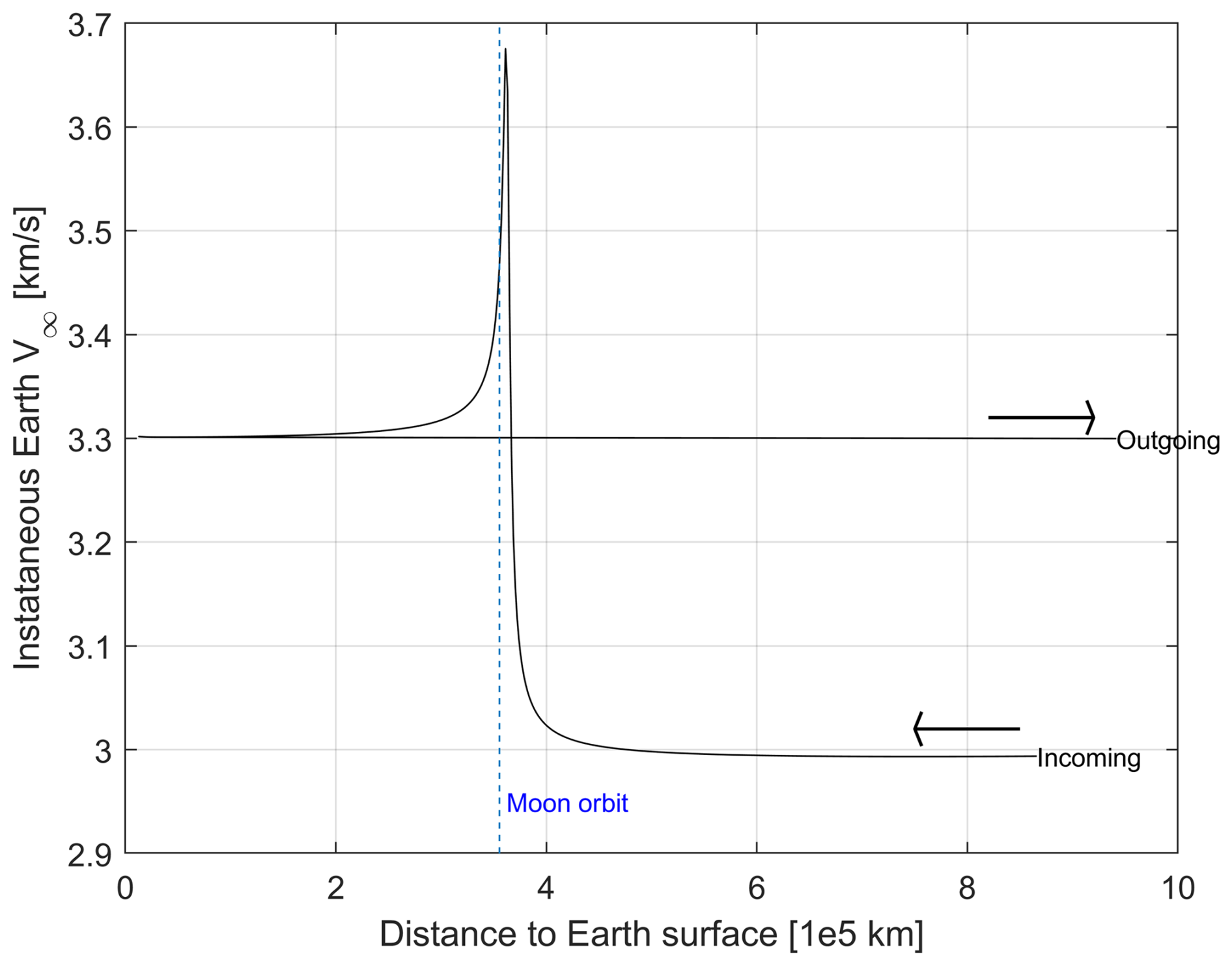
Figure 3On the incoming leg, the instantaneous Earth infinite velocity is close to 3 km s−1. With a standard EGA, it would remain constant until escape. With the LEGA, there is a sharp variation during the Moon GA (around 380 000 km altitude). After the Moon GA, the value stabilises around 3.3 km s−1 and remains constant until escape.
For this case, the infinite velocity is raised by 300 m s−1. If this 300 m s−1 were to be performed by the spacecraft, the optimal DSM, applied far from Earth at aphelion, would be around 150 m s−1. This represents more than 100 kg of satellite mass, which can be used for other purposes. All details about the concept can be found in the inception reference Schoenmaekers et al. (2014).
But any novelty comes at a price. That of the LEGA is firstly related to the navigation and guidance functions, although these functions are not specific to the LEGA: when operationally flown, a spacecraft can never be exactly on the reference trajectory. The first reason is the limited knowledge of the spacecraft state coming from the navigation function, measurement uncertainties (e.g. range, Doppler, Delta-DOR), manoeuvres mechanisation errors, or dynamical uncertainties (e.g. solar radiation pressure). The second reason is the application of the guidance function along the reference trajectory: at each Trajectory Correction Manoeuvre (TCM), the trajectory is reoptimized, and the spacecraft flies inside a kind of “tube” around the reference trajectory, the deviation is called dispersion. Therefore, the minimum gravity assist pericentre altitude considers a margin for navigation and guidance. All the TCMs used to keep the spacecraft close to its reference trajectory are called stochastic Delta-V: the term “stochastic” is linked to the fact that the estimation is based on uncertain parameters. This is why it is considered in the Delta-V budget with a given percentile, e.g. 95 % or 99 %.
The dispersion along the reference trajectory slowly varies, e.g. along the elliptical arcs in the patched conics model. On the contrary, GA is a non-linear event that quickly amplifies the dispersions: a small error before the GA (navigation + guidance) is amplified and requires large correction after the GA, called cleanup. In the case of the LEGA, the short time between both GA – around 24 h – is not enough to operationally implement a TCM. Therefore, the initial dispersion is amplified twice, which leads to a much greater cleanup compared to a standard EGA.
For the actual LEGA flown by JUICE, the Moon is encountered first, then the Earth. The Earth closest approach was around 6800 km (governed by the necessity to encounter later Venus), while that of the Moon was set at 750 km (the lower the better, with the safety constraint to guarantee no impact with the Moon).
Preliminary parametric analyses were conducted by scanning the B plane of the Moon and computing the corresponding LEGA cleanup. By superimposing the expected dispersions before the LEGA, an estimate of the stochastic Delta-V cost was obtained. For the actual JUICE trajectory, it was estimated to be 75 m s−1. This is much higher than the standard assumption of 15 m s−1 for a standalone EGA. This difference in the stochastic Delta-V partially reduces the deterministic Delta-V saving. The preliminary estimate of the stochastic Delta-V cost was confirmed by a detailed interplanetary navigation/guidance analysis for the actual trajectory. More details can be found in Boutonnet et al. (2023).
The superiority of the LEGA vs. EGA in total Delta-V cost (deterministic + stochastic) depends on the day of the launch in the launch window: from a mission design point of view, when an interplanetary trajectory option is found, it returns an optimal launch date. The three-week launch window is added on top: the cost is maximum at the edges of the window, while the minimum corresponds to the optimal launch date. When taking the sum of the deterministic and the stochastic Delta-Vs, it turns out that the actual JUICE trajectory is sometimes cheaper with the LEGA.
This is true for the optimal launch date (which is slightly different for both the LEGA and the EGA cases), but the slope of the launch window curve is steeper for the LEGA case. At some point, the two curves cross: the overall optimal three-week window is a mixture of the LEGA and the EGA cases. The LEGA is optimal at the beginning of the window, while the EGA is optimal at the end as shown in Fig. 4. As the actual launch took place – by chance – 2 d after the LEGA optimal launch date (14 April 2023), the Delta-V saving was maximised.
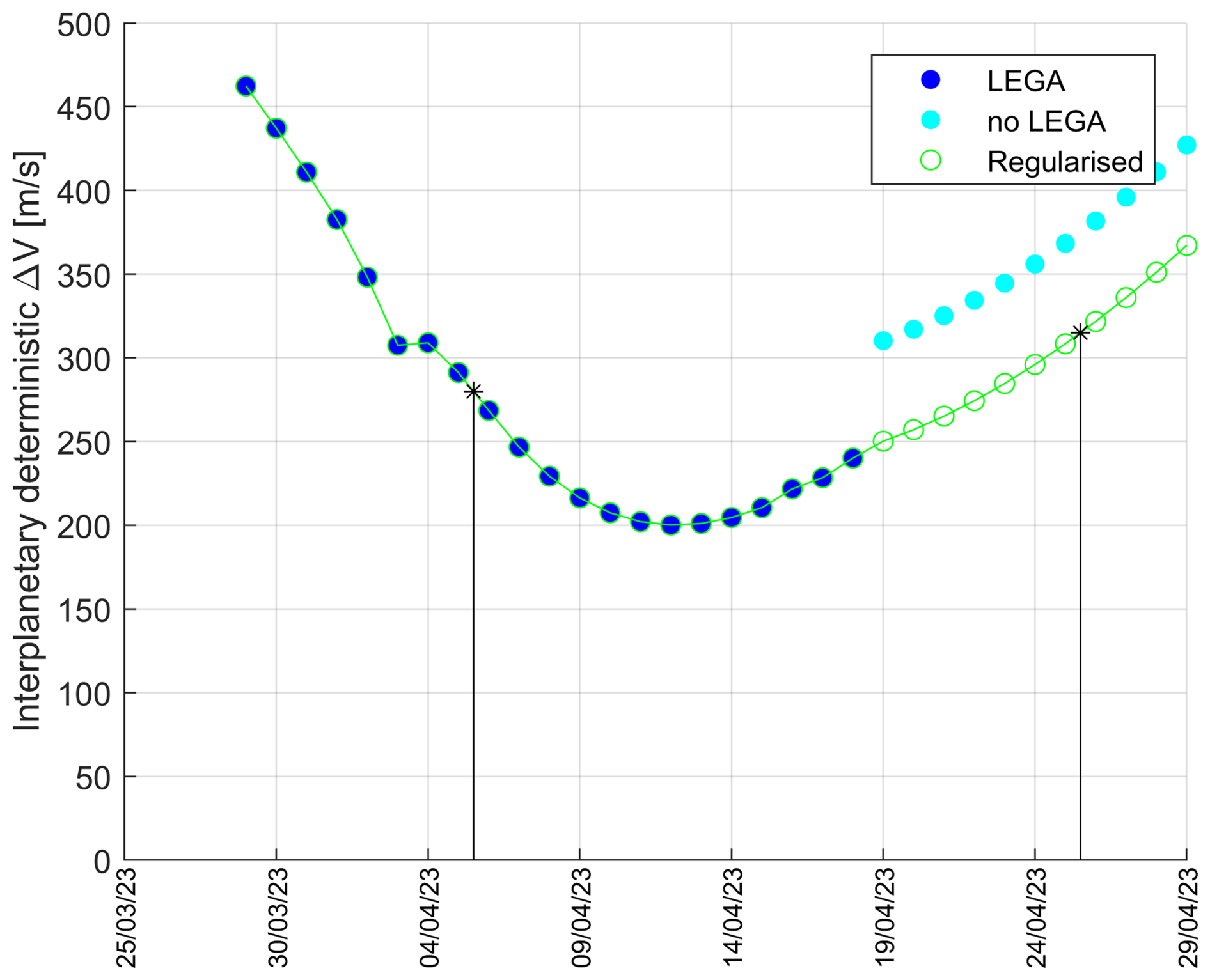
Figure 4Comparison of the LEGA and the EGA to derive the optimal launch window. The optimal three weeks launch window is indicated with vertical black lines. The blue (LEGA) and red (EGA) dotted curves correspond to the deterministic Delta-V. The regularised curve (green circles) corresponds to the red (EGA) curve minus the stochastic Delta-V cost difference ( m s−1).
Besides the impact of the stochastic Delta-V, there is another challenge related to the LEGA: safety. Again, parametric analyses were conducted varying the Moon B plane targeting and computing the perigee altitude deviation at the Earth. The expected perigee altitude dispersions are 200 km at 99 %. As the minimum perigee altitude considering worst case dispersions is well above the atmosphere, the LEGA is considered safe. Like for the impact on the stochastic Delta-V cost, all details can be found in Boutonnet et al. (2023). Special contingency cases require emergency procedures; these cases are not handled by mission design, but by flight dynamics instead, see Sect. 3.
The LEGA has been selected in the baseline of the JUICE trajectory for the interplanetary cruise. More details about the entire mission, from launch through the Jupiter tour until the final low altitude Ganymede orbit can be found in Boutonnet et al. (2024).
The LEGA inception dates to 2012. From a mission analysis point of view, its feasibility, its optimality and its safety were demonstrated. But there was still a long way towards in-flight implementation….
This section gives a high-level summary of the LEGA navigation campaign. A more comprehensive and detailed description of the navigation process for the LEGA can be found in Syndercombe et al. (2025).
In preparation for each navigation campaign, Trajectory Correction Manoeuvre (TCM) slots before and after the flyby are defined. These are stochastic manoeuvre slots, which Delta-Vs are a-priori zero and which execution are decided shortly before based on the latest spacecraft orbit determination, judging on the observed orbit dispersion (difference to the reference orbit) and orbit knowledge (uncertainty of the determined orbit). The suitable metric for navigating a planetary swing-by is performed in the B plane. The definition of the B plane was already introduced in Sect. 2. The two directions in the plane are defined as T and R, whereby T is usually chosen to be aligned with the projection of the body's equator into the B plane and R completes the right-handed triad. In the B plane the reference orbit is represented by a 2-dimensional target impact point and the orbit knowledge (or uncertainty) is represented by a 2-dimensional error ellipse. For the LEGA, the body that is to be targeted is the Moon, hence, all subsequent shown plots are the Moon B plane. The subsequent Earth swing-by is performed in open loop, i.e. without any ground intervention after the Moon swing-by. Due to the error amplification described in section 2, correcting orbit dispersion using a TCM before the LEGA is always far less expensive in terms of Delta-V or propellant usage than correcting it after the swing-by. This is particularly true for the LEGA being a double swing-by.
Figure 5 shows the adopted TCM slots at 4, 2 and 1 week before the Moon swing-by and a correction 1 week after the Earth swing-by. A second cleanup TCM slot has been planned much later, close to the subsequent perihelion on 1 January 2025, which was found to be more optimum in correcting orbit errors in the B plane than just using one post swing-by TCM+1w. In addition, two emergency TCMs, eTCM, shortly before each swing-by were defined for being able to react to contingency situations, which are not further elaborated here (and which were not used).
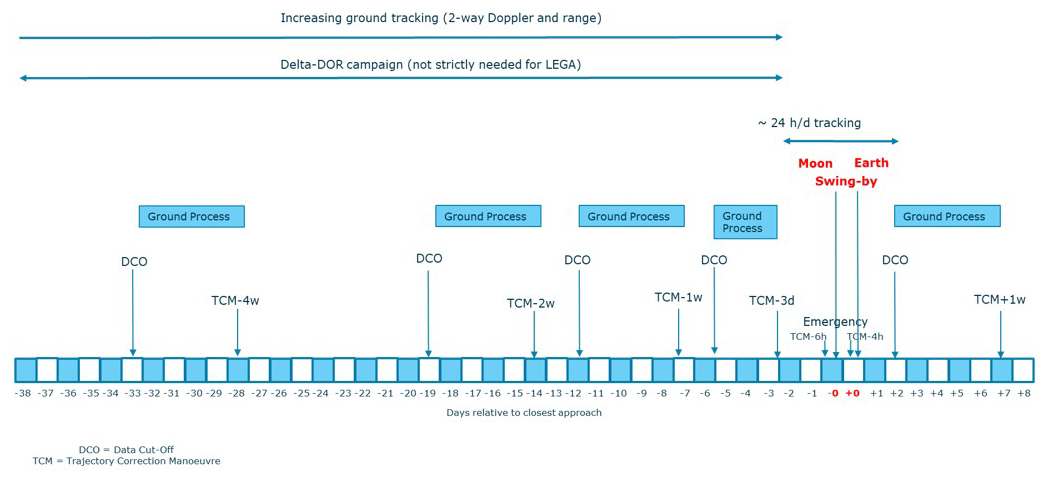
Figure 5Schematic schedule for TCMs, ground processing and Data Cut-Off (DCO) for orbit determination around the LEGA.
At data Cut-Off (DCO) before each TCM slot, an orbit determination using ground-based radiometric tracking is performed and the result, estimated orbit state and uncertainty, mapped to the Moon B plane. The orbit determination for deciding on the execution of TCM-4w was performed on 16 July 2024 and its result is shown in Fig. 6. The zoomed in plot shows the orbit dispersion and the error ellipse at 3-sigma level. It is a good approximation to assume that errors from the orbit determination are Gaussian distributed, which gives a 98.89 % probability that the true trajectory impact point is within the 3-sigma ellipse. Since the distance to the target impact point – the orbit dispersion – is significantly larger than the 3-sigma uncertainty, the TCM-4w slot was decided to be used to correct the orbit dispersion as early as possible. As indicated in the plot, a Delta-V of 3.8 cm s−1 was required to move the estimated impact point in the B plane to the optimum target point. In contrast, correcting the dispersion only after the LEGA would require a total Delta-V of more than 160 m s−1 (!), as shown by the overlayed contour plot in Fig. 6. The TCM was hence commanded on ground, uplinked to the spacecraft and executed flawlessly a few days later.
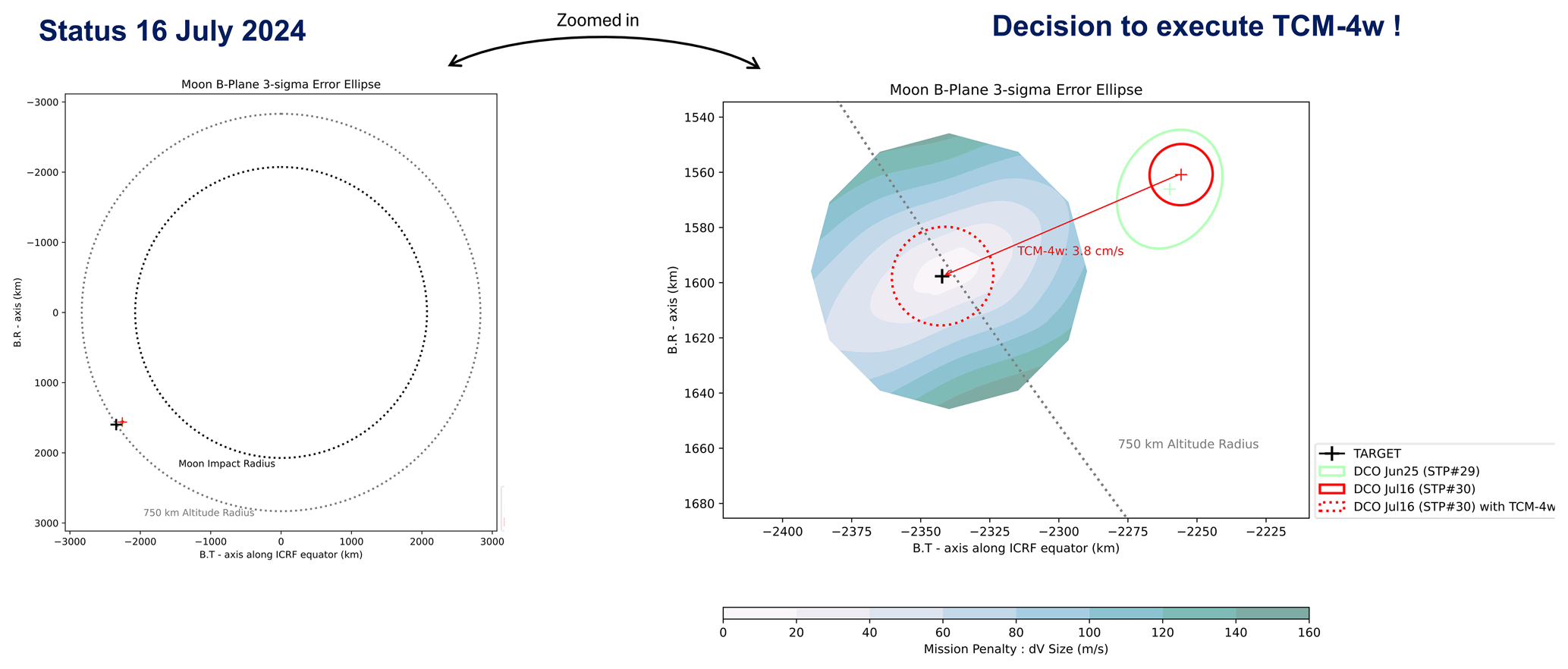
Figure 6Moon B plane results before TCM-4w slot. Left: overview showing the target and estimated impact point as well as the Moon impact sphere (below which the spacecraft would impact the Moon); Right: zoomed in version with an overlaid contour plot which shows the Delta-V penalty which would need to be paid post-LEGA for orbit deviations from the optimum target point. The legend of the right plot labels the optimum target (TARGET) and the solutions in the B plane achieved at the corresponding DCOs. Based on the orbit determined at the DCOs, the spacecraft onboard guidance – including a TCM or not - are updated in so-called Short Term Planning (STP) cycles (referred to as “Ground Process” in Fig. 5).
The process was repeated shortly before TCM-2w and TCM-1w slots on 31 July and 6 August 2024 respectively, which results are both shown in Fig. 7. The 3-sigma error ellipses were in both occasions larger or close to the orbit dispersion. Moreover, the resulting Delta-V penalty if corrected after the LEGA would be less than 10 m s−1 which is at an acceptable level compared with the stochastic Delta-V budget of 75 m s−1 that was allocated to the LEGA before launch. It was hence decided to not execute any of these TCMs.
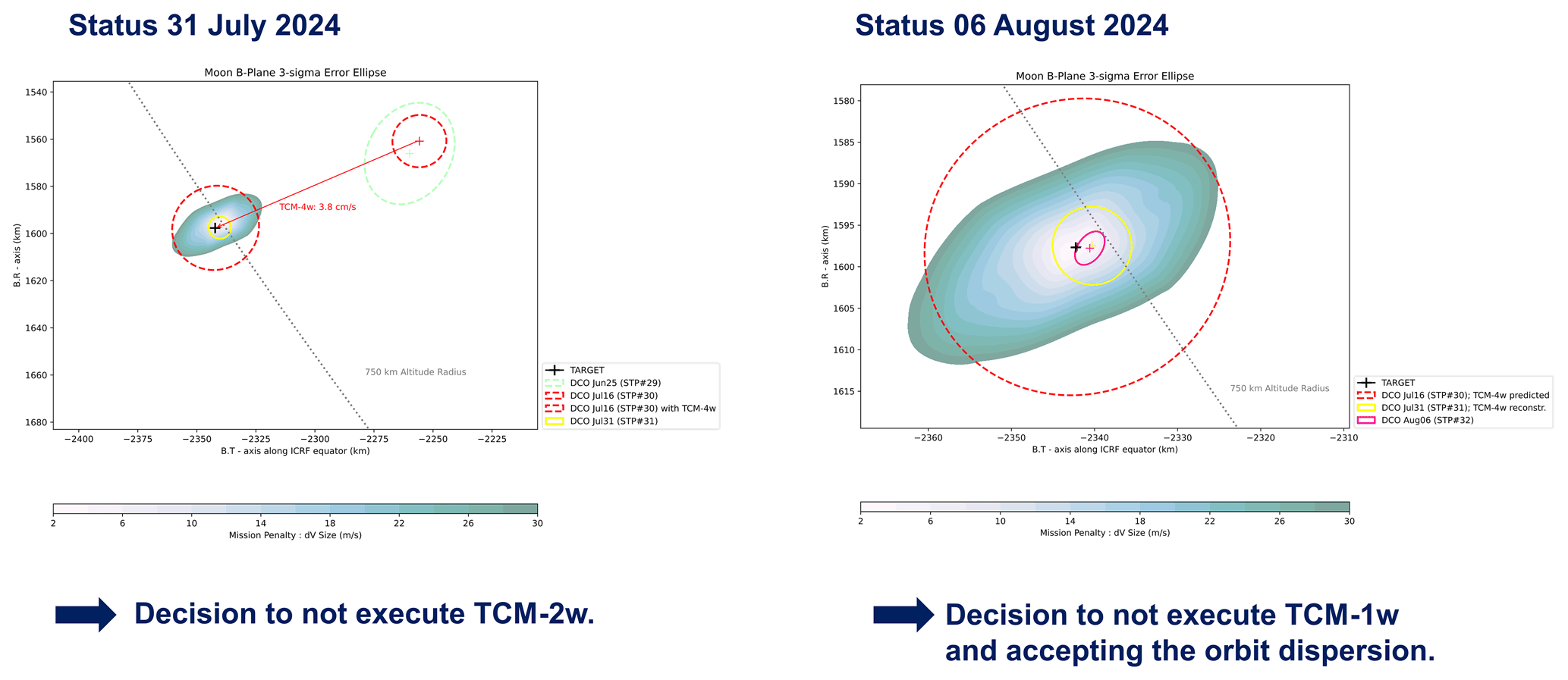
Figure 7Moon B plane results before TCM-2w on 31 July 2024 (left) and before TCM-1w on 6 August 2024 (right).
The further evolution of the impact point and error ellipse in the B plane was continued to be closely monitored after TCM-1w slot while the spacecraft was approaching the Moon with spacecraft tracking continuously increased, which results are shown in Fig. 8. The successive estimates of the impact point remained stable, and the error ellipses were continuously shrinking, each of them being nested in the previous, which gives confidence in the correctness of the orbit determination and prediction results, and which is what spacecraft navigators love to see.
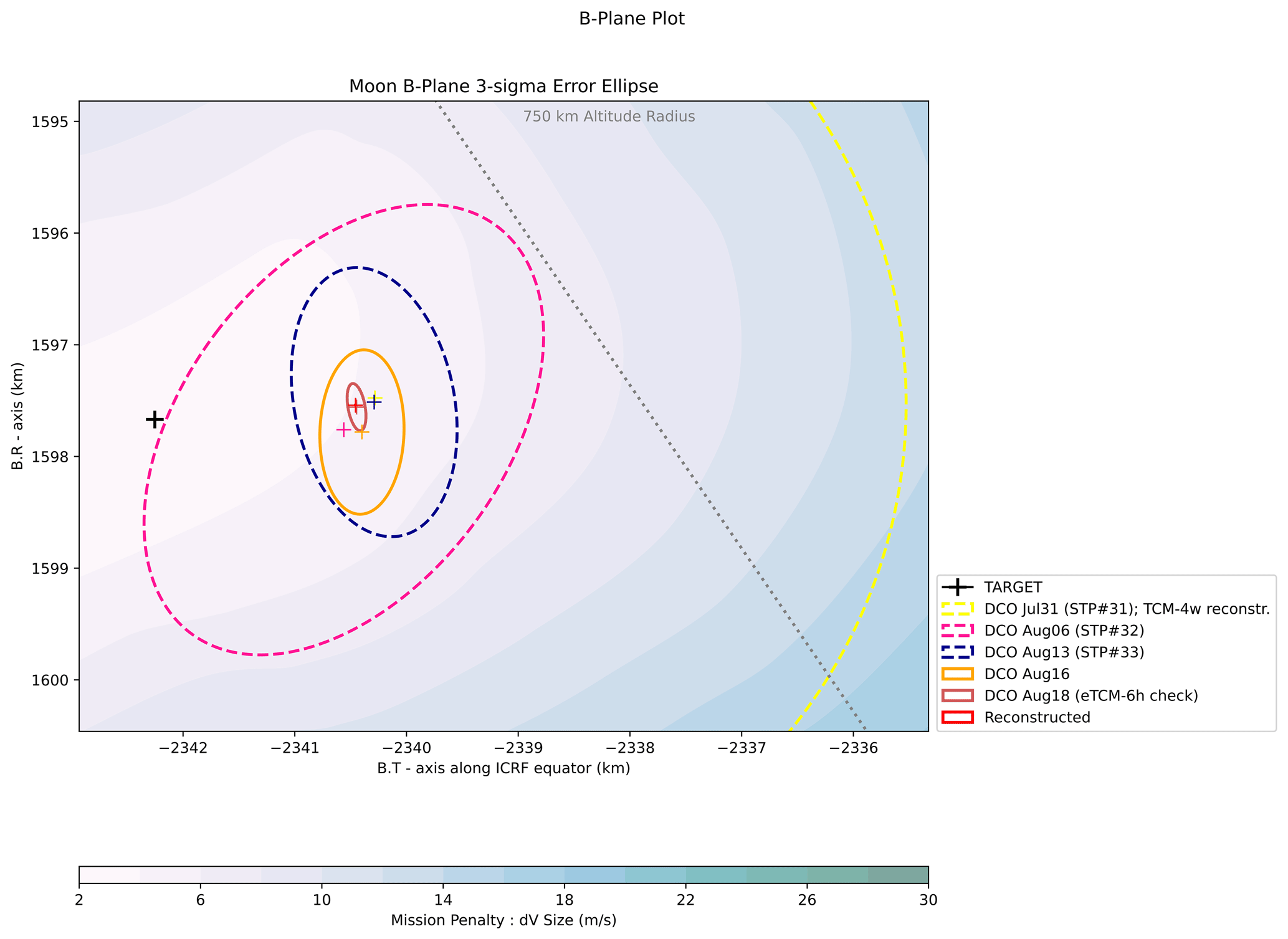
Figure 8Moon B plane results evolution before and after the swing-by. The reconstructed impact point that has been estimated after the swing-by is given in red.
Figure 8 also shows the reconstructed impact point with the associated 3-sigma error ellipse which has only a distance of 2 km from the optimum target. Due to the bending of the trajectory around the swing-by, the radiometric tracking data give very strong information on the reconstructed trajectory relative to the Moon, yielding a very small error ellipse in the B plane, which is shown but is not discernible on the scale of Fig. 8, and very small formal uncertainties in the finally reconstructed parameters of the swing-by. These were
-
Moon time of closest approach: 19 August 2024 at 21:14:54.681 UTC with a 3-sigma uncertainty of 0.001 s.
-
Moon closest approach distance: 2489.519 km with a 3-sigma uncertainty of 0.001 km = 752 km distance from the Moon surface
-
Earth time of closest approach: 20 August 2024 at 21:56:13.637 UTC with a 3-sigma uncertainty of 0.001 s.
-
Earth closest approach distance: 13 210.572 km with a 3-sigma uncertainty of 0.002 km = 6839 km distance from the Earth surface
The orbit dispersion of 2 km in the B plane was corrected with two post-LEGA TCMs:
-
TCM +1 week on 27 August 2024 with a Delta-V of 1.60 m s−1
-
TCM close to subsequent perihelion on 1 January 2025 of 1.78 m s−1.
Both manoeuvres were executed successfully at the time of writing. The total stochastic manoeuvre Delta-V used for the LEGA navigation was hence 3.42 m s−1 which is much smaller than the 75 m s−1 stochastic Delta-V budget allocation made before launch. The JUICE LEGA navigation was hence a large success giving the mission a significant propellant margin back that will be used for the future exploration of the Jovian system.
This section describes the high-level operational aspects of the LEGA. More details can be found in Heck et al. (2025).
The spacecraft overall performance was excellent during the double flyby. The Earth Distance reached a minimum of 6839 km above Southeast Asia and the Pacific Ocean during the Earth closest approach on 20 August 2024 with a Sun distance of 149 million km, or 1 AU. The spacecraft approached the flyby during a full Moon, arriving from the dark side. This resulted in near-simultaneous eclipse and ground contact occultation shortly before the Moon closest approach. The spacecraft was aligned with the Moon, Earth and Sun, thus in opposition with a very low Sun-spacecraft-Earth angle.
4.1 Moon eclipse
The batteries were fully charged four weeks before the Lunar Closest Approach, to cope with manoeuvre slots and the Moon eclipse of 32 min. During the eclipse before the closest approach (between 20:36 to 21:08 on 19 August 2024), the batteries discharged by around 6 %. During a single telemetry frame four solar array power regulators (APR) have been observed in maximum power point tracking (MPPT) while in the eclipse penumbra. This is the first time that this APR mode is observed in flight.
4.2 Platform observations
The spacecraft was able to deliver exceptionally accurate manoeuvre performances. Additionally, the parasitic forces induced by pure torque wheel-offloading are barely noticeable in the orbit determination. These two factors combined allowed to execute only two of the overall eight allocated manoeuvre slots, as described in depth in the previous section.
Flight Dynamics noticed a small torque and Delta-V shortly starting at the Moon CA +5 min and lasting around 20 min. At this time the Sun-Moon-spacecraft angle decreased from 80 to 40°, thus the sunlight reflection on the Moon was illuminating the +X face of the spacecraft, which is usually always kept in the dark. This small impact on the trajectory is suspected to be due to spacecraft outgassing and confirmed by several instrument measurements.
Multiple star tracker optical head blindings and straylight detection happened during both flybys that were monitored by the flight control team. All star tracker optical heads were blinded by the Earth for around 2 h, however, never all three at the same time. The AOCS continued nominally; at no time the Gyro Stellar Estimator had to propagate the attitude using only the internal measurement unit (IMU).
The communications subsystem was switched from medium gain antenna (MGA) to low gain antenna (LGA) 3 d around the Earth flyby, i.e. when the spacecraft was below 1 million km from the Earth. This helped to increase the ground coverage during the fast trajectory induced changes of spacecraft attitude close to Earth.
For 6 d around the flybys, JUICE had almost permanent ground station visibility, however, the Earth flyby occurred outside visibility with ground. Around the Earth closest approach, the transmitter was switched off due to ITU regulations to transmit at full power below 45 000 km. Afterwards, the low gain antenna visibility was not very favourable, therefore no communication was attempted. Overall, this resulted in a communication blackout of more than 8 h.
During the LEGA, a special on-board mission timeline (MTL) strategy was used. MTL breakpoints were defined that marked the times, where emergency TCM products (if needed) from Flight Dynamics would become valid. The mission timeline was therefore split into 3 parts and the MTL parts 2 and 3 were loaded automatically via execution of a TC file on-board that was re-filling the Mission Timeline.
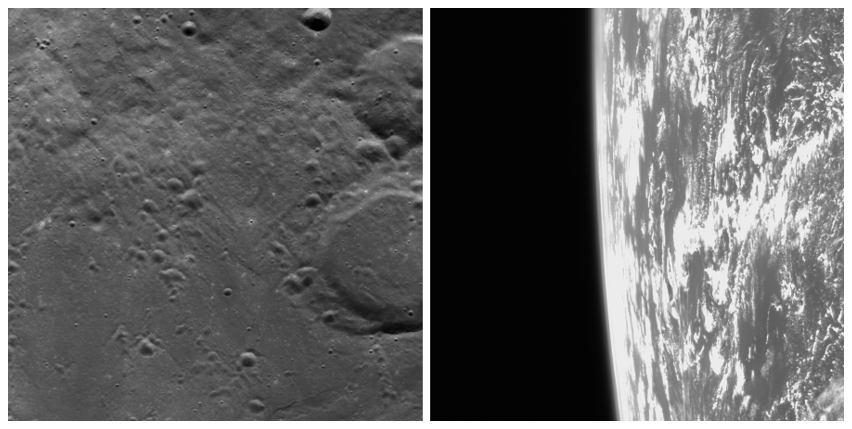
Figure 9Moon image from NavCam on 19 August 2024 (left) and Earth image on 20 August 2024 (right) (Credit: ESA/Juice/NavCam).
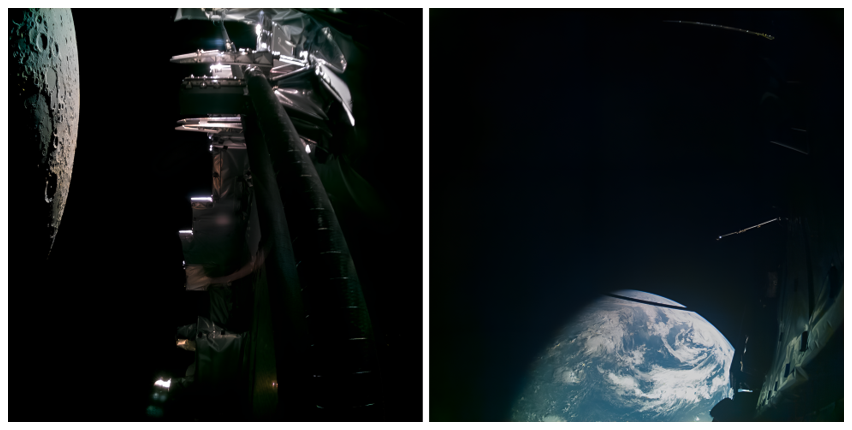
Figure 10Processed Moon image from JMC2 on 19 August 2024 (left) and Earth image from JMC1 on 20 August 2024 (right) (Credit: ESA/Juice/JMC).
4.3 Instrument operations
All instruments operated during the Earth-Moon flyby. Two slots of payload observations had been selected:
-
at the Moon between closest approach −1 h to closest approach +1 h
-
at the Earth between closest approach −4 h to closest approach +3 d
There was a period of a few minutes around the closest approach of the Moon flyby, where only RIME was operated with the other instruments in quiet mode. Generally, the payload operations performed very smoothly, thanks to the previously performed LEGA rehearsal operations in early July 2024. The laser altimeter GALA was the only payload affected by an anomaly due to a still unexplained instrument reset. This prevented GALA to measure at the Moon closest approach.
Concerning attitude, the spacecraft was kept with −X Sun pointing throughout the entire phase, i.e. by using the high-gain antenna as a Sun shield for the spacecraft. The phase angle around the Sun direction was the only degree of freedom that was optimised for payload operations as follows:
-
Earth Closest Approach −3 d: roll around −X to point +Z (instrument optical bench) towards the Moon
-
Earth Closest Approach −12 h: 180° roll around −X to ensure circa 30 min of Earth visibility on +Z before closest approach
-
Earth Closest Approach +2 h: 180° roll around −X to keep +Z at an angular distance of around 5° from the Earth direction
-
Earth Closest Approach +2 d +6 h: a full 360° roll around −X is carried out
The NavCam was operated during the LEGA and 15 images were obtained; 6 of the Moon and 9 of the Earth, see two examples in Fig. 9. In addition, the two JUICE Monitoring Cameras (JMC) obtained 140 images with JMC1 and 144 images with JMC2, see two examples in Fig. 10.
Though not formally part of the Lunar–Earth gravity assist, a dedicated farewell off-pointing slew was performed on 9 September 2024 in order to observe the Earth-Moon system in the LEGA outbound arc. Spacecraft constraints allow a maximum 45 min off pointing from the default Sun pointing attitude at Earth distances. The slew resulted in a total dwell duration of 20 min, centred at 09:56 and with the spacecraft +Z axis aligned with Earth centre. This enabled the operations of several payloads: JANUS, GALA, RPWI and PEPLo.
The JUICE Lunar–Earth gravity assist was an outstanding operational and technical success. It demonstrated ESA's capability to execute complex multi-body gravity assists with exceptional precision. Through careful campaign planning, execution and excellent spacecraft performance, the teams involved achieved near-perfect targeting of both flybys and preserved almost the entire stochastic Delta-V budget. This efficiency directly enhances the mission's scientific potential at Jupiter by freeing additional propellant margin for the Jupiter Tour. JUICE was precisely on track for its following Venus flyby in August 2025 and its later Earth flybys en route to Jupiter.
This paper is based on operational documentation, spacecraft telemetry and operational mission products from the JUICE mission. No dedicated dataset or software package was generated for this work. Mission data is available through the ESA Planetary Science Archive (PSA), which contains the long-term repository for JUICE science and auxiliary mission data in accordance with the JUICE data release policy.
AB is the leading mission analyst of the JUICE mission and was designing the detailed trajectory for the spacecraft. FB is the Flight Dynamics Coordinator of the JUICE mission. He was defining the LEGA navigation campaign and was leading the decision process for orbit correction manoeuvres as part of orbit determination activities. AD is currently the JUICE spacecraft operations manager and was establishing the flight operations plan for the LEGA mission phase.
AD prepared the overall manuscript with contributions from all co-authors in their respective sections.
The contact author has declared that none of the authors has any competing interests.
Publisher's note: Copernicus Publications remains neutral with regard to jurisdictional claims made in the text, published maps, institutional affiliations, or any other geographical representation in this paper. The authors bear the ultimate responsibility for providing appropriate place names. Views expressed in the text are those of the authors and do not necessarily reflect the views of the publisher.
This article is part of the special issue “The first-ever lunar–Earth flyby: a unique test environment for Juice”. It is not associated with a conference.
JUICE is a mission under ESA leadership with contributions from its Member States, NASA, JAXA and the Israel Space Agency. It is the first Large-class mission in ESA's Cosmic Vision programme.
The authors would like to acknowledge all the colleagues contributing in the teams of ESOC Mission Analysis, Flight Dynamics and JUICE Flight Control, as well as all other ESA support teams, whose contribution was key to the success of JUICE's Lunar Earth Gravity Assist.
This paper was edited by Elias Roussos and reviewed by two anonymous referees.
Altobelli, N., Accomazzo, A., Boutonnet, A., Budnik, F., Cavel, C., Costa, M., Cornet, T., Dietz, A., Erd, C., Mestre, A., Pinzan, G., Sarri, G., Schamberg, C., Tanco, I., Vallat, C., and Witasse, O.: The ESA JUICE Ground Segment, Space Sci. Rev., 222, 24, https://doi.org/10.1007/s11214-026-01271-0, 2026.
Barabash, S., Brandt, P., Clark, G., Fränz, M., Mitchell, D., Roussos, E., Shimoyama, M., Stenberg Wieser, G., Vorburger, A., Wieser, M., and the PEP Team: Particle Environment Package (PEP) for the JUICE mission: Current Status, EPSC-DPS Joint Meeting 2025, Helsinki, Finland, 7–12 September 2025, EPSC-DPS2025-818, https://doi.org/10.5194/epsc-dps2025-818, 2025.
Boutonnet, A., Langevin, Y., and Rocchi, A.: JUICE Interplanetary Phase: Trajectory Design and Navigation. Paper ASS 23-204, 33rd AAS/AIAA Spaceflight Mechanics Meeting, Austin, TX, 15–19 January 2023.
Boutonnet, A., Langevin, Y., and Erd, C.: Designing the JUICE Trajectory, Space Sci. Rev., 220, 67, https://doi.org/10.1007/s11214-024-01093-y, 2024.
Brown, P. and the The J-MAG Instrument Team: The J-MAG Magnetometer: Instrument design, performance, and initial in-flight results., EGU General Assembly 2024, Vienna, Austria, 14–19 Apr 2024, EGU24-1750, https://doi.org/10.5194/egusphere-egu24-1750, 2024.
Bruzzone, L., Plaut, J. J., Alberti, G., Blankenship, D. D., Bovolo, F., Campbell, B. A., Castelletti, D., Gim, Y., Ilisei, A. M., Kofman, W., Komatsu, G., McKinnon, W., Mitri, G., Moussessian, A., Notarnicola, C., Orosei, R., Patterson, G. W., Pettinelli, E., and Plettemeier, D.: Jupiter ICY moon explorer (JUICE): Advances in the design of the radar for Icy Moons (RIME), in: 2015 IEEE International Geoscience and Remote Sensing Symposium (IGARSS), Milan, Italy, 26–31 July 2015, 1257–1260, https://doi.org/10.1109/IGARSS.2015.7326002, 2015.
Gurvits, L. I., Accomazzo, A., Asaki, Y., Barabash, S., Bertarini, A., Bocanegra-Bahamon, T. M., Bower, G. C., Cimò, G., Dirkx, D., Duev, D. A., Duev, M., Edwards, P. G., Fedorova, A. A., Girard, J., Grenzler, B., Guillemot, L., Haas, R., Iess, L., Jauncey, D. L., Kallunki, J., Kary, A., Klioner, S. A., Pogrebenko, S. V., Rioja, M., Roatsch, T., Rosenblatt, P., Sato, K., Savolainen, T., Sekido, M., Tazaki, F., Titov, D., Torsvik, T., Vermeersen, L. L. A., Zakhvatkin, M., and Zubko, N.: Planetary Radio Interferometry and Doppler Experiment (PRIDE) of the JUICE Mission, Space Sci. Rev., 219, 79, https://doi.org/10.1007/s11214-023-01026-1, 2023.
Hajdas, W., Altobelli, N., Arruda, L., Desorgher, L., Galli, A., Gonçalves, P., Marques, A., Marcinkowski, R., Meier, D., Menicucci, A., Nieminen, P., Pinto, M., Rienäcker, I., Rostomyan, T., Roussos, E., Sánchez-Cano, B., Santin, G., Santos, F., Socha, P., Stein, T. A., Verstaen, S., Vogiatzi, M., Witasse, O., Xiao, H., and Mrigakshi, A. I.: The JUICE Radiation Environment Monitor, RADEM, Space Sci. Rev., 221, 43, https://doi.org/10.1007/s11214-025-01163-9, 2025.
Hartogh, P., Rezac, L., Cavalié, T., Jarchow, C., Moreno, R., Schulz-Ravanbakhsh, A., Carrasco Gallardo, A., Dabrowski, B., Goodyear, S., Rengel, M., Herpin, F., Kasai, Y., Kotiranta, M., Lellouch, E., Murk, A., Olberg, M., Szutowicz, S., and Wirström, E.: Juice/SWI during the Lunar-Earth-Gravity-Assist (LEGA) – Part 1: General overview, Ann. Geophys., 44, 645–654, https://doi.org/10.5194/angeo-44-645-2026, 2026.
Heck, M., Aldebert, C., Altobelli, N., Dietz, A., Pinzan, G., and Tanco, I., Lunar–Earth Gravity Assist, a first for JUICE and for Spaceflight, in: Proceedings of the 18th International Conference on Space Operations (SpaceOps 2025), Montreal, Canada, 26–30 May 2025, https://doi.org/10.82217/spaceops2025_224, 2025.
Hussmann, H., Althaus, C., Araki, H., Behnke, T., Castro-Marin, J. M., Eisenmenger, H., Enya, K., Gerber, T., Herranz de la Revilla, M., Hüttig, C., Ishibashi, K., Jiménez-Ortega, J., Kallenbach, R., Kimura, J., Kobayashi, M., Lara, L. M., Lingenauber, K., Lichopoj, A., Lötzke, H.-G., Lüdicke, F., Martínez-Navajas, I., Michaelis, H., Namiki, N., Noda, H., Oberst, J., Oshigami, S., Rodríguez García, J. P., Rodrigo, J., Rösner, K., Stark, A., Steinbrügge, G., Thabaut, P., Thomas, N., del Togno, S., Touhara, K., Villamil, S., Wendler, B., Wickhusen, K., and Willner, K.: The Ganymede laser altimeter (GALA): key objectives, instrument design, and performance, CEAS Space Journal, 11, 381–390, https://doi.org/10.1007/s12567-019-00282-8, 2019.
Iess, L., Asmar, S. W., Armstrong, J. W., Cicalò, S., Di Benedetto, M., Di Stefano, I., Fienga, A., Genova, A., Grassi, D., Imperi, L., Marti, M., Notaro, M., Tortora, P., and Zannoni, M.: The JUICE 3GM instrument, Space Sci. Rev., 222, 33, https://doi.org/10.1007/s11214-025-01202-5, 2026.
Palumbo, P., Aboudan, A., Accomazzo, A., Agostini, L., Althaus, C., Álvarez, F., Amoroso, M., Bartolomei, M., Behnke, T., Bilotta, T., Castro-Marin, J. M., Chiodini, S., Colombatti, G., Colosimo, A., Coustenis, A., Crews, C., Cremonese, G., Dattolo, A., Debei, S., Della Corte, V., Denk, T., Esposito, F., Ficai Veltroni, I., Fiethe, B., Galeotti, A., García-Segura, A., Giacomini, L., Grassi, D., Greggio, D., Gwinner, K., Hauber, E., Hviid, S., Herranz, M., Hoffmann, H., Holland, A. D., Hueso, R., Jaumann, R., Jiménez-Ortega, J., Kenkmann, T., Kersten, E., Koncz, A., Lara, L. M., Leese, M. R., Lichopoj, A., Livi, L., Llamas, X., Lopes, R., Lucchetti, A., Magrin, D., Martinez-Navajas, I., Massironi, M., Matz, K.-D., Mazzotta Epifani, E., Mennella, V., Mertens, V., Michaelis, H., Michalik, H., Mottola, S., Mugnuolo, R., Munari, M., Noci, G. E., Otto, K. A., Pajola, M., Patel, M. R., Paolinetti, R., Politi, R., Popa, C., Portyankina, G., Postberg, F., Preusker, F., Prieto Ballesteros, O., Roatsch, T., Schroedter, R., Schmitz, N., Schipani, P., Schmidt, J., Sarti, F., Sato, M., Stephan, K., Stefanov, K. D., Tosi, F., Trauthan, F., Tubiana, C., Turella, A., Wendler, B., Wendler, D., Williams, D., Wolff, F., Yair, Y., and Zusi, M.: The JANUS (Jovis Amorum ac Natorum Undique Scrutator) VIS-NIR Multi-Band Imager for the JUICE Mission, Space Sci. Rev., 221, 32, https://doi.org/10.1007/s11214-025-01158-6, 2025.
Poulet, F., Adriani, A., Altieri, F., Amoroso, M., Arondel, A., Arnold, G., Barbis, A., Bibring, J.-P., Biondi, D., Boccaccini, A., Bolsée, D., Bousquet, P., Brunetto, R., Capaccioni, F., Caprini, C., Carapelle, A., Carlier, V., Carter, J., Condamin, M., Couturier, S., Dassas, K., D'Aversa, E., De Sanctis, M.-C., Dexet, M., Dumesnil, C., Filacchione, G., Fletcher, L., Grassi, D., Hannou, C., Haffoud, P., Karatekin, Ö., Larigauderie, C., Le Cle'ch, J.-C., Le Du, M., Leyrat, C., Lellouch, E., Ligier, N., Manaud, N., Migliorini, A., Mugnuolo, R., Pilorget, C., Piccioni, G., Raponi, A., Rossi, M., Saggin, B., Sanchez-Lavega, A., Schmitt, B., Seignovert, B., Sordini, R., Stefani, S., Stephan, K., Tobie, G., Tommasi, L., Tosi, F., Vincendon, M., Zambelli, M., and Zambon, F.: Moons and Jupiter Imaging Spectrometer (MAJIS) on Jupiter Icy Moons Explorer (JUICE), Space Sci. Rev., 220, 27, https://doi.org/10.1007/s11214-024-01057-2, 2024.
Retherford, K. D., Bagenal, F., Becker, T. M., Beth, A., Bonfond, B., Brooks, S. M., Bunce, E., Davis, M. W., Ferrell, S., Fletcher, L., Galand, M., Giles, R. S., Gladstone, G. R., Greathouse, T. K., Grodent, D., Hue, V., Johnson, E., Kammer, J. A., Lamy, L., McGrath, M. A., Molyneux, P. M., Nerney, E. G., Persyn, S., Quemerais, E., Raut, U., Roth, L., Spencer, J. R., Stern, S. A., Trantham, B. J., Velez, M. A., and Versteeg, M. H.: JUICE Ultraviolet Spectrograph Measurements of Icy Satellite, Jupiter, and Io System Environments, Magnetospheres of the Outer Planets (MOP) Meeting 2024, Minneapolis, USA, 7–12 July 2024, 2024.
Sarri, G., Accomazzo, A., Altobelli, N., Amann, M., Atzei, A., Barbu, M., Baroni, M., Barsanti, I., Bertini, F., Bonnier, A.-L., Bramanti, C., Cavel, C., Chwalla, M., Deschamps, S., Deyber, S., Dietz, A., Duhamel, H., Durand, P., Ecale, E., Erd, C., Escolar Blasco, D., Faust, M., Faye, F., Furnell, R., Gare, P., Gherardi, D., Glasbergen, H., Goodburn, S., Gumpinger, J., Huber, M., Humbert, P., Juillard, F., Laborde, S., Landstroem, S., Lange, J., le Letty, R., Lelièvre, V., Massart, B., Moisson, X., Monteiro, D., Osipenco, S., Paulsen, T., Peyrou-Lauga, R., Philavong, V., Planche, L., Purvinskis, R., Ravily, P., Redding, S., Regnier, P., Rouchit, P., Roux, L., Scharmberg, C., Schirmann, T., Schnorhk, A., Tailfer, C., Tanco, I., Torelli, F., Torralba, I., Vallat, C., Verstaen, S., and Witasse, O.: The JUICE Spacecraft System Design, Space Sci. Rev., 222, 35, https://doi.org/10.1007/s11214-026-01289-4, 2026.
Schoenmaekers, J., Langevin, Y., Boutonnet, A., and Martens, W.: Improved interplanetary transfers with Lunar–Earth gravity assists, Paper IAC-14-C1.9.12, 65th International Astronautical Congress, Toronto, Canada, 29 September–3 October 2014, 2014.
Syndercombe, T., Castellini, F., Budnik, F., and Meles, R.: The JUICE Navigation Campaign for the First Combined Lunar–Earth Gravity Assist, in: Proceedings of the 18th International Conference on Space Operations (SpaceOps 2025), Montreal, Canada, 26–30 May 2025, https://doi.org/10.82217/spaceops2025_286, 2025.
Wahlund, J.-E., Accomazzo, A., Alison, D., André, M., André, N., Andrews, D., Åhlén, L., Asai, K., Balikhin, M., Baran, J., Barcinski, T., Baskevitch, C.-A., Benko, I., Berthod, C., Berglund, M., Bergman, J. E. S., Birch, J., Björneholm, O., Bochra, K., Bonnin, X., Borys, M., Cully, C., Clémencon, A., Cecconi, B., Davidsson, J., Dazzi, P., De Léon, E., Dimmock, A., Edberg, N. J. T., Eriksson, A. I., Fischer, G., Fredriksson, J., Fujii, M., Fujishima, S., Galand, M., Garnier, P., Gare, P., Génot, V., Geyskens, N., Gill, R., Girard, J. N., Gomis, S., Grosset, L., Grygorczuk, J., Hachemi, T., Hadid, L., Henry, F., Henri, P., Hess, L. G., Holback, B., Holmberg, M., Jackman, C. M., Jansky, J., Jansson, S.-E., Jeandet, A., Johansson, E. P. G., Johansson, F., Katoh, Y., Kasaba, Y., Khotyaintsev, Y., Kimura, T., Kita, H., Kojima, H., Kolmasova, I., Kovi, K. K., Kowalski, T., Kucinski, T., Kullen, A., K.Vaivads, A., Kumamoto, A., Laifr, J., Landström, S., Lamy, L., Lan, R., Lebassard, M., Lebreton, J.-P., Leclercq, L., Le Contel, O., Le Duff, O., Lemaire, B., Leray, V., Louarn, P., Louis, C. K., Marchaudon, A., Mansour, M., Mårtensson, B., Mehrez, F., Millet, A.-L., Miyoshi, Y., Mizuno, H., Modolo, R., Morawski, M., Müller-Wodarg, I., Morooka, M. W., Misawa, H., Namiki, M., Nilsson, T., Nyberg, T., Ohlsson, D., Osipenco, S., Ossowski, M., Palma, P., Pelikan, D., Pisa, D., Puccio, W., Rauch, J. L., Richard, L., Roth, L., Rothkaehl, H., Roos, A., Ryszawa, E., Sahraoui, F., Santolik, O., Saur, J., Sato, Y., Sawamura, A., Shiwa, F., Söderström, J. C., Sou, G., Soucek, J., Stverak, S., Sumant, A. V., Suzuki, T., Szewczyk, P., Tanimoto, K., Taubenschuss, U., Techer, J.-D., Torralba, I., Torsvik, T., Trescastro, J. L., Travnicek, P., Tsuchiya, F., Uhlir, L., Vaivads, A., Varizat, L., Vigren, E., Wattieaux, G., Wiklund, U., Wisniewski, Ł., Wong, H. C., Yagitani, S., Yearby, K. H., and Zarka, P.: The Radio & Plasma Wave Investigation (RPWI) for the JUpiter ICy moons Explorer (JUICE), Space Sci. Rev., 221, 1, https://doi.org/10.1007/s11214-024-01110-0, 2025.
Witasse, O., Altobelli, N., Barabash, S., Blanc, M., Boutonnet, A., Brandt, P., Bruzzone, L., Budnik, F., Bunce, E., Carter, J., Cavalié, T., Cavel, C., Cecconi, B., Cimò, G., Coustenis, A., Cremonese, G., Denk, T., Dietz, A., Dirkx, D., Dougherty, M., Erd, C., Faye, F., Fletcher, L. N., Gare, P., Gladstone, R., Gonçalves, P., Grasset, O., Gurvits, L. I., Hajdas, W., Hartogh, P., Hussmann, H., Iess, L., Kaspi, Y., Kersten, E., Krupp, N., Langevin, Y., Lebreton, J.-P., Loisel, V., Lorente, R., Martinez, S., Masters, A., Modolo, R., Mueller-Wodarg, I., Palumbo, P., Piccioni, G., Plaut, J. J., Poinsignon, V., Portyankina, G., Poulet, F., Radola, D., Retherford, K. D., Roatsch, T., Rothkaehl, H., Roussos, E., Santolík, O., Sarri, G., Stark, A., Stevenson, D., Tanco, I., Titov, D., Tobie, G., Tosi, F., Tubiana, C., Vallat, C., Van Hoolst, T., Wahlund, J.-E., and Wurz, P.: The JUpiter ICy moons Explorer (JUICE) mission: post-launch status and mission overview, Space Sci. Rev., submitted, 2026.
- Abstract
- Introduction
- Trajectory Design for the JUICE Lunar–Earth gravity assist
- The JUICE Navigation Campaign for the Lunar–Earth Gravity Assist
- LEGA from the Operations Perspective
- Conclusions
- Code and data availability
- Author contributions
- Competing interests
- Disclaimer
- Special issue statement
- Acknowledgements
- Review statement
- References