
Articles | Volume 44, issue 1
https://doi.org/10.5194/angeo-44-461-2026
© Author(s) 2026. This work is distributed under
the Creative Commons Attribution 4.0 License.
the Creative Commons Attribution 4.0 License.
https://doi.org/10.5194/angeo-44-461-2026
© Author(s) 2026. This work is distributed under
the Creative Commons Attribution 4.0 License.
the Creative Commons Attribution 4.0 License.
Regular paper
| 
10 Jun 2026
Regular paper |
| 10 Jun 2026
| 10 Jun 2026
Juice-SWI during the Lunar-Earth-Gravity-Assist (LEGA) – Part 2: Instrument operations
Thibault Cavalié
CORRESPONDING AUTHOR

Univ. Bordeaux, CNRS, LAB, UMR 5804, 33600 Pessac, France
Raphael Moreno
LIRA, Observatoire de Paris, Université PSL, CNRS, Sorbonne Université, Université Paris Cité, 5 place Jules Janssen, 92195 Meudon, France
Ladislav Rezac
CORRESPONDING AUTHOR
Max-Planck-Institut für Sonnensystemforschung, Göttingen, Germany
Fabrice Herpin
Univ. Bordeaux, CNRS, LAB, UMR 5804, 33600 Pessac, France
Christopher Jarchow
Max-Planck-Institut für Sonnensystemforschung, Göttingen, Germany
Paul Hartogh
Max-Planck-Institut für Sonnensystemforschung, Göttingen, Germany
Alberto Carrasco Gallardo
Max-Planck-Institut für Sonnensystemforschung, Göttingen, Germany
Samuel Goodyear
Max-Planck-Institut für Sonnensystemforschung, Göttingen, Germany
Pierre Mancini
Univ. Bordeaux, CNRS, LAB, UMR 5804, 33600 Pessac, France
Ali Schulz-Ravanbakhsh
Max-Planck-Institut für Sonnensystemforschung, Göttingen, Germany
Borys Dabrowski
Max-Planck-Institut für Sonnensystemforschung, Göttingen, Germany
Yasuko Kasai
Institute of Science Tokyo, Tokyo, Japan
Emmanuel Lellouch
LIRA, Observatoire de Paris, Université PSL, CNRS, Sorbonne Université, Université Paris Cité, 5 place Jules Janssen, 92195 Meudon, France
Axel Murk
Institute of Applied Physics, University of Bern, Sidlerstrasse 5, Bern, 3012, Bern, Switzerland
Donal Murtagh
Department of Physics and Astronomy, Chalmers University of Technology, 412 96 Gothenburg, Sweden
Michael Olberg
Department of Physics and Astronomy, Chalmers University of Technology, 412 96 Gothenburg, Sweden
Miriam Rengel
Max-Planck-Institut für Sonnensystemforschung, Göttingen, Germany
Hideo Sagawa
Faculty of Science, Kyoto Sangyo University, Kamigamo-Motoyama, Kita-ku, Kyoto 603-8555, Japan
Slawomira Szutowicz
Centrum Badán Kosmicznych Polskiej Akademii Nauk, Bartycka 18A, Warsaw, Poland
Eva Wirström
Department of Physics and Astronomy, Chalmers University of Technology, 412 96 Gothenburg, Sweden
Related authors
Christopher Jarchow, Ladislav Rezac, Paul Hartogh, Ali Schulz-Ravanbakhsh, Thibault Cavalié, Fabrice Herpin, Raphael Moreno, and Axel Murk
Ann. Geophys., 44, 795–809, https://doi.org/10.5194/angeo-44-795-2026, https://doi.org/10.5194/angeo-44-795-2026, 2026
Short summary
Short summary
The Jupiter Icy Moons Explorer is a spacecraft sent towards Jupiter to perform detailed observations of the giant gas planet & its Galilean satellites. The Submillimetre Wave Instrument onboard this spacecraft is a newly built instrument, which first of all has to demonstrate proper performance before the observed data can be trusted. Using the Earth as a well-known observation target, proper functionality of this instrument has been verified during the Lunar Earth Gravity Assist in August 2024.
Paul Hartogh, Ladislav Rezac, Thibault Cavalié, Christopher Jarchow, Raphael Moreno, Ali Schulz-Ravanbakhsh, Alberto Carrasco Gallardo, Borys Dabrowski, Samuel Goodyear, Miriam Rengel, Fabrice Herpin, Yasuko Kasai, Mikko Kotiranta, Emmanuel Lellouch, Axel Murk, Michael Olberg, Slawomira Szutowicz, and Eva Wirström
Ann. Geophys., 44, 645–654, https://doi.org/10.5194/angeo-44-645-2026, https://doi.org/10.5194/angeo-44-645-2026, 2026
Short summary
Short summary
We provide an introduction and overview about the initial Submillimetre Wave Instrument (SWI) characterization, operation, and in-flight calibration during the Lunar Earth Gravity Assist (LEGA) campaign of the Juice (Jupiter icy moons) spacecraft. A preliminary analysis on the frequency calibration is provided. For detailed analyses on total power and beam calibration and the observation and operations planning we refer to three other SWI papers prepared for this special issue of Annales Geophysicae (ANGEO).
Raphael Moreno, Ladislav Rezac, Tomáš Formánek, Thibault Cavalié, Christopher Jarchow, Emmanuel Lellouch, Paul Hartogh, Axel Murk, Mikko Kotiranta, Alberto Carrasco Gallardo, Samuel Goodyear, Ali Schulz-Ravanbakhsh, Borys Dabrowski, Fabrice Herpin, Yasuko Kasai, Donal Murtagh, Michael Olberg, Miriam Rengel, Hideo Sagawa, Slawomira Szutowicz, and Eva Wirström
EGUsphere, https://doi.org/10.5194/egusphere-2026-2064, https://doi.org/10.5194/egusphere-2026-2064, 2026
Short summary
Short summary
The Submillimetre Wave Instrument (SWI) onboard the Jupiter Icy Moons Explorer (Juice) spacecraft consists of a 29 cm antenna and two radio receivers operating at submillimeter wavelength. This instrument is designed to study Jupiter's atmosphere and the thin atmospheres of its moons.
We used Earth observations obtained during the Lunar-Earth-Gravity-Assist (LEGA) . This data analysis allows us to characterise the antenna beam and pointing corrections.

François Poulet, Giuseppe Piccioni, Yves Langevin, Cydalise Dumesnil, Vincent Carlier, Benoit Seignovert, Marc Dexet, Leigh N. Fletcher, Cédric Leyrat, Francesca Altieri, John Carter, Emiliano D'Aversa, Maria De Sanctis, Davide Grassi, Sandrine Guerlet, Stéphane Le Mouélic, Alessandra Migliorini, Fabrizio Oliva, Clément Royer, Sébastien Rodriguez, Katrin Stephan, Federico Tosi, Francesca Zambon, Alberto Adriani, Gabriele Arnold, Jean-Pierre Bibring, Dominique Bockelée, Rosario Brunetto, Fabrizio Capaccioni, Cristian Carli, Thibault Cavalié, Miriam Cisneros González, Mauro Ciarnello, Simone De Angelis, Pierre Drossart, Gianrico Filacchione, Thierry Fouchet, Jean-Claude Gérard, Denis Grodent, Patrick Irwin, Sophie Jacquinod, Ozgur Karatekin, Emmanuel Lellouch, Nicolas Ligier, Nicolas Mangold, Magali Mebsout, Frédéric Merlin, Alessandro Morbidelli, Alessandro Mura, Andreas Nathues, Maria E. Palumbo, Cédric Pilorget, Olivier Poch, Eric Quirico, Andrea Raponi, Séverine Robert, Elias Roussos, Agustin Sanchez-Lavega, Bernard Schmitt, Giuseppe Sindoni, Marcel Snels, Roberto Sordini, Stefania Stefani, Giovanni Strazzulla, Tim Trent, Gabriel Tobie, Diego Turrini, Ann-Carine Vandaele, Mathieu Vincendon, Olivier Witasse, Claire Vallat, and Alessandro Moraino
Ann. Geophys., 44, 163–193, https://doi.org/10.5194/angeo-44-163-2026, https://doi.org/10.5194/angeo-44-163-2026, 2026
Short summary
Short summary
During the double Lunar-Earth Gravitational Assist with the ESA/JUICE (Jupiter Icy Moons Explorer) spacecraft in August 2024, we acquired hyperspectral data cubes of both the Moon and Earth with the MAJIS (Moons And Jupiter Imaging Spectrometer) imaging spectrometer under challenging, real in-flight conditions. This allowed to characterize surface materials and thermophysical properties on the Moon, identify various cloud phases and gases in Earth's atmosphere, and thoroughly validate the performance of the instrument.
Hyunkwang Lim, Tamaki Fujinawa, Takafumi Sugita, Satoshi Inomata, Hiroshi Tanimoto, Christoph Mahnke, Andreas Petzold, Ulrich Bundke, Yugo Kanaya, Yasuko Kasai, Tomohiro O. Sato, Sang Seo Park, Minseok Kim, Yun Gon Lee, and Ukkyo Jeong
EGUsphere, https://doi.org/10.5194/egusphere-2026-4968, https://doi.org/10.5194/egusphere-2026-4968, 2026
This preprint is open for discussion and under review for Atmospheric Measurement Techniques (AMT).
Short summary
Short summary
Satellite measurements of nitrogen dioxide can be biased when the assumed vertical distribution of pollution does not match reality. We combined satellite, aircraft, and ground-based observations near major Asian airports and found that using aircraft-measured profiles generally reduced this bias. However, improvements varied by location, showing that spatial representativeness and other retrieval uncertainties also remain important.
Christopher Jarchow, Ladislav Rezac, Paul Hartogh, Ali Schulz-Ravanbakhsh, Thibault Cavalié, Fabrice Herpin, Raphael Moreno, and Axel Murk
Ann. Geophys., 44, 795–809, https://doi.org/10.5194/angeo-44-795-2026, https://doi.org/10.5194/angeo-44-795-2026, 2026
Short summary
Short summary
The Jupiter Icy Moons Explorer is a spacecraft sent towards Jupiter to perform detailed observations of the giant gas planet & its Galilean satellites. The Submillimetre Wave Instrument onboard this spacecraft is a newly built instrument, which first of all has to demonstrate proper performance before the observed data can be trusted. Using the Earth as a well-known observation target, proper functionality of this instrument has been verified during the Lunar Earth Gravity Assist in August 2024.
Laura N. Saunders, Kaley A. Walker, Gabriele P. Stiller, Piera Raspollini, Luis F. Millán, Marco Gai, Chris D. Boone, John Gille, Norbert Glatthor, Armin Kleinboehl, Anne Kleinert, Alyn Lambert, Donal Murtaugh, Patrick E. Sheese, Geoffrey C. Toon, and Gerald Wetzel
EGUsphere, https://doi.org/10.5194/egusphere-2026-4651, https://doi.org/10.5194/egusphere-2026-4651, 2026
Short summary
Short summary
We present a comprehensive evaluation of nitrous oxide (N2O) measurements taken during the 2002–2024 period from five limb-viewing satellite instruments: ACE-FTS, HIRDLS, MIPAS, Aura-MLS, and SMR. Coincident measurements are compared between satellite instruments and with independent reference data from balloon-borne instruments. We show that ACE-FTS, MIPAS, and SMR constitute an excellent 23-year record of N2O measurements that could be used to create an ESA-funded merged dataset in future.
Paul Hartogh, Ladislav Rezac, Thibault Cavalié, Christopher Jarchow, Raphael Moreno, Ali Schulz-Ravanbakhsh, Alberto Carrasco Gallardo, Borys Dabrowski, Samuel Goodyear, Miriam Rengel, Fabrice Herpin, Yasuko Kasai, Mikko Kotiranta, Emmanuel Lellouch, Axel Murk, Michael Olberg, Slawomira Szutowicz, and Eva Wirström
Ann. Geophys., 44, 645–654, https://doi.org/10.5194/angeo-44-645-2026, https://doi.org/10.5194/angeo-44-645-2026, 2026
Short summary
Short summary
We provide an introduction and overview about the initial Submillimetre Wave Instrument (SWI) characterization, operation, and in-flight calibration during the Lunar Earth Gravity Assist (LEGA) campaign of the Juice (Jupiter icy moons) spacecraft. A preliminary analysis on the frequency calibration is provided. For detailed analyses on total power and beam calibration and the observation and operations planning we refer to three other SWI papers prepared for this special issue of Annales Geophysicae (ANGEO).
Raphael Moreno, Ladislav Rezac, Tomáš Formánek, Thibault Cavalié, Christopher Jarchow, Emmanuel Lellouch, Paul Hartogh, Axel Murk, Mikko Kotiranta, Alberto Carrasco Gallardo, Samuel Goodyear, Ali Schulz-Ravanbakhsh, Borys Dabrowski, Fabrice Herpin, Yasuko Kasai, Donal Murtagh, Michael Olberg, Miriam Rengel, Hideo Sagawa, Slawomira Szutowicz, and Eva Wirström
EGUsphere, https://doi.org/10.5194/egusphere-2026-2064, https://doi.org/10.5194/egusphere-2026-2064, 2026
Short summary
Short summary
The Submillimetre Wave Instrument (SWI) onboard the Jupiter Icy Moons Explorer (Juice) spacecraft consists of a 29 cm antenna and two radio receivers operating at submillimeter wavelength. This instrument is designed to study Jupiter's atmosphere and the thin atmospheres of its moons.
We used Earth observations obtained during the Lunar-Earth-Gravity-Assist (LEGA) . This data analysis allows us to characterise the antenna beam and pointing corrections.
François Poulet, Giuseppe Piccioni, Yves Langevin, Cydalise Dumesnil, Vincent Carlier, Benoit Seignovert, Marc Dexet, Leigh N. Fletcher, Cédric Leyrat, Francesca Altieri, John Carter, Emiliano D'Aversa, Maria De Sanctis, Davide Grassi, Sandrine Guerlet, Stéphane Le Mouélic, Alessandra Migliorini, Fabrizio Oliva, Clément Royer, Sébastien Rodriguez, Katrin Stephan, Federico Tosi, Francesca Zambon, Alberto Adriani, Gabriele Arnold, Jean-Pierre Bibring, Dominique Bockelée, Rosario Brunetto, Fabrizio Capaccioni, Cristian Carli, Thibault Cavalié, Miriam Cisneros González, Mauro Ciarnello, Simone De Angelis, Pierre Drossart, Gianrico Filacchione, Thierry Fouchet, Jean-Claude Gérard, Denis Grodent, Patrick Irwin, Sophie Jacquinod, Ozgur Karatekin, Emmanuel Lellouch, Nicolas Ligier, Nicolas Mangold, Magali Mebsout, Frédéric Merlin, Alessandro Morbidelli, Alessandro Mura, Andreas Nathues, Maria E. Palumbo, Cédric Pilorget, Olivier Poch, Eric Quirico, Andrea Raponi, Séverine Robert, Elias Roussos, Agustin Sanchez-Lavega, Bernard Schmitt, Giuseppe Sindoni, Marcel Snels, Roberto Sordini, Stefania Stefani, Giovanni Strazzulla, Tim Trent, Gabriel Tobie, Diego Turrini, Ann-Carine Vandaele, Mathieu Vincendon, Olivier Witasse, Claire Vallat, and Alessandro Moraino
Ann. Geophys., 44, 163–193, https://doi.org/10.5194/angeo-44-163-2026, https://doi.org/10.5194/angeo-44-163-2026, 2026
Short summary
Short summary
During the double Lunar-Earth Gravitational Assist with the ESA/JUICE (Jupiter Icy Moons Explorer) spacecraft in August 2024, we acquired hyperspectral data cubes of both the Moon and Earth with the MAJIS (Moons And Jupiter Imaging Spectrometer) imaging spectrometer under challenging, real in-flight conditions. This allowed to characterize surface materials and thermophysical properties on the Moon, identify various cloud phases and gases in Earth's atmosphere, and thoroughly validate the performance of the instrument.
Linda Megner, Jörg Gumbel, Ole Martin Christensen, Björn Linder, Donal P. Murtagh, Nickolay Ivchenko, Lukas Krasauskas, Jonas Hedin, Joachim Dillner, Gabriel Giono, Georgi Olentsenko, Louis Kern, Joakim Möller, Ida-Sofia Skyman, and Jacek Stegman
Atmos. Meas. Tech., 18, 6869–6892, https://doi.org/10.5194/amt-18-6869-2025, https://doi.org/10.5194/amt-18-6869-2025, 2025
Short summary
Short summary
The MATS satellite mission studies atmospheric gravity waves, crucial for momentum transport between atmospheric layers. Launched in November 2022, MATS uses a limb-viewing telescope to capture high-resolution images of noctilucent clouds and airglow, visualising wave patterns in the high atmosphere. This paper accompanies the public release of the Level 1b dataset, i.e. calibrated limb images. Later products will provide global maps of gravity wave properties, airglow, and noctilucent clouds.
Judit Pérez-Coll Jiménez, Nickolay Ivchenko, Ceona Lindstein, Lukas Krasauskas, Jonas Hedin, Donal P. Murtagh, Linda Megner, Björn Linder, and Jörg Gumbel
Ann. Geophys., 43, 701–707, https://doi.org/10.5194/angeo-43-701-2025, https://doi.org/10.5194/angeo-43-701-2025, 2025
Short summary
Short summary
This study uses images taken by the Swedish satellite MATS (Mesospheric Airglow Tomography and Spectroscopy) to conduct a statistical analysis of the molecular oxygen atmospheric band emissions in the aurora. This auroral emission can not be observed from the ground, making it one of the least understood auroral emissions. Our results provide a new dataset with information on the peak altitude, geomagnetic location, and auroral intensity of 378 events detected between February and April 2023.
Björn Linder, Lukas Krasauskas, Linda Megner, and Donal P. Murtagh
Atmos. Chem. Phys., 25, 12843–12851, https://doi.org/10.5194/acp-25-12843-2025, https://doi.org/10.5194/acp-25-12843-2025, 2025
Short summary
Short summary
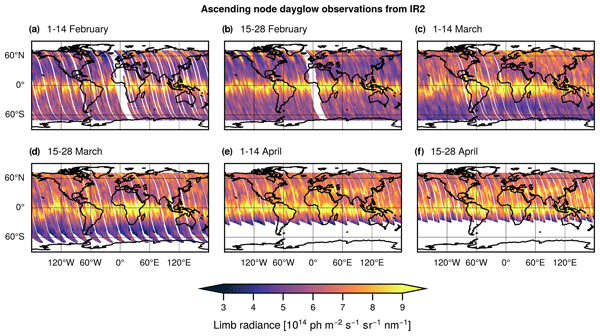
The Swedish satellite MATS (Mesospheric Airglow/Aerosol Tomography and Spectroscopy) conducts global measurements of atmospheric airglow in the mesosphere and lower thermosphere. In this article, we present the first global results from the mission. Observations from February to April 2023 show that the emission strength is largely controlled by atmospheric tides and by perturbations introduced by a propagating planetary wave.
Björn Linder, Jörg Gumbel, Donal P. Murtagh, Linda Megner, Lukas Krasauskas, Doug Degenstein, Ole Martin Christensen, and Nickolay Ivchenko
Atmos. Meas. Tech., 18, 4453–4466, https://doi.org/10.5194/amt-18-4453-2025, https://doi.org/10.5194/amt-18-4453-2025, 2025
Short summary
Short summary
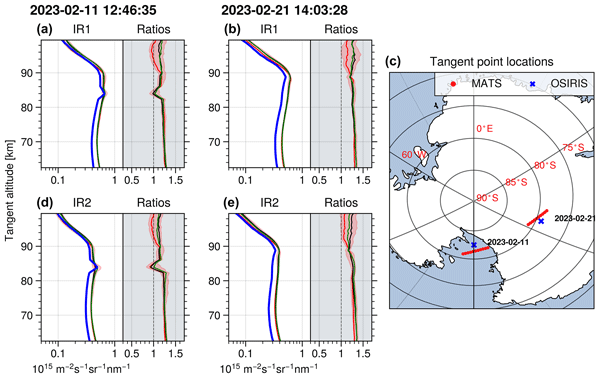
In this study, the primary instrument carried by the satellite MATS is compared to the OSIRIS instrument on board the Odin satellite. A total of 36 close approaches between December 2022 and February 2023 were identified and analysed. The comparison reveals that the two instruments have good structural agreement and that MATS detects a signal that is ~20 % stronger than what is measured by OSIRIS.
Yajun Xu, Tomohiro O. Sato, Ayano Nakamura, Tamaki Fujinawa, Suyun Wang, and Yasuko Kasai
EGUsphere, https://doi.org/10.5194/egusphere-2024-194, https://doi.org/10.5194/egusphere-2024-194, 2024
Preprint withdrawn
Short summary
Short summary
Usually, the vertical column density of NO2 is obtained by converting the slant column density derived from the measured spectra using an air mass factor (AMF). This work proposes two deep neural network models for calculating the tropospheric AMF and altitude-dependent AMF. Experiments shown that the RMSPE and computation time are approximately 30 times smaller and two times shorter compared to the traditional method.
Michael Kiefer, Dale F. Hurst, Gabriele P. Stiller, Stefan Lossow, Holger Vömel, John Anderson, Faiza Azam, Jean-Loup Bertaux, Laurent Blanot, Klaus Bramstedt, John P. Burrows, Robert Damadeo, Bianca Maria Dinelli, Patrick Eriksson, Maya García-Comas, John C. Gille, Mark Hervig, Yasuko Kasai, Farahnaz Khosrawi, Donal Murtagh, Gerald E. Nedoluha, Stefan Noël, Piera Raspollini, William G. Read, Karen H. Rosenlof, Alexei Rozanov, Christopher E. Sioris, Takafumi Sugita, Thomas von Clarmann, Kaley A. Walker, and Katja Weigel
Atmos. Meas. Tech., 16, 4589–4642, https://doi.org/10.5194/amt-16-4589-2023, https://doi.org/10.5194/amt-16-4589-2023, 2023
Short summary
Short summary
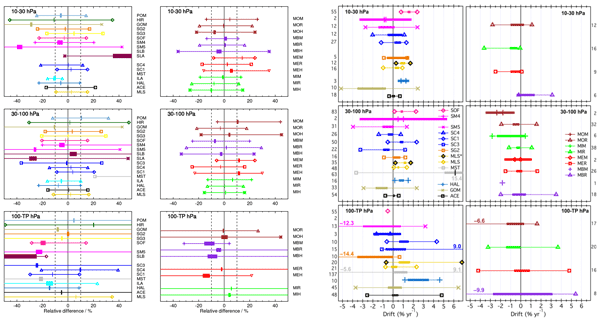
We quantify biases and drifts (and their uncertainties) between the stratospheric water vapor measurement records of 15 satellite-based instruments (SATs, with 31 different retrievals) and balloon-borne frost point hygrometers (FPs) launched at 27 globally distributed stations. These comparisons of measurements during the period 2000–2016 are made using robust, consistent statistical methods. With some exceptions, the biases and drifts determined for most SAT–FP pairs are < 10 % and < 1 % yr−1.
William G. Read, Gabriele Stiller, Stefan Lossow, Michael Kiefer, Farahnaz Khosrawi, Dale Hurst, Holger Vömel, Karen Rosenlof, Bianca M. Dinelli, Piera Raspollini, Gerald E. Nedoluha, John C. Gille, Yasuko Kasai, Patrick Eriksson, Christopher E. Sioris, Kaley A. Walker, Katja Weigel, John P. Burrows, and Alexei Rozanov
Atmos. Meas. Tech., 15, 3377–3400, https://doi.org/10.5194/amt-15-3377-2022, https://doi.org/10.5194/amt-15-3377-2022, 2022
Short summary
Short summary
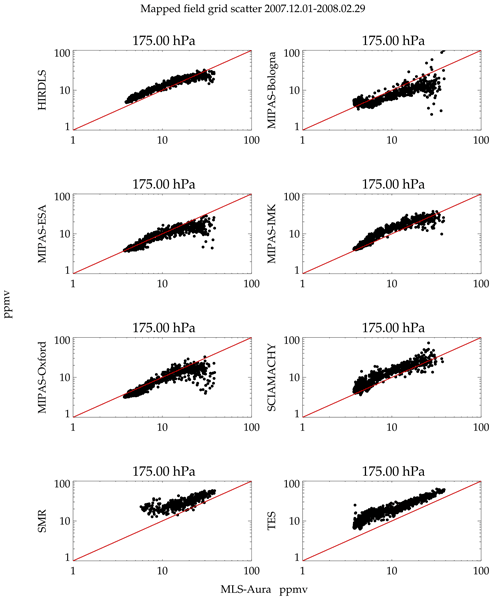
This paper attempts to provide an assessment of the accuracy of 21 satellite-based instruments that remotely measure atmospheric humidity in the upper troposphere of the Earth's atmosphere. The instruments made their measurements from 1984 to the present time; however, most of these instruments began operations after 2000, and only a few are still operational. The objective of this study is to quantify the accuracy of each satellite humidity data set.
Patrick E. Sheese, Kaley A. Walker, Chris D. Boone, Adam E. Bourassa, Doug A. Degenstein, Lucien Froidevaux, C. Thomas McElroy, Donal Murtagh, James M. Russell III, and Jiansheng Zou
Atmos. Meas. Tech., 15, 1233–1249, https://doi.org/10.5194/amt-15-1233-2022, https://doi.org/10.5194/amt-15-1233-2022, 2022
Short summary
Short summary
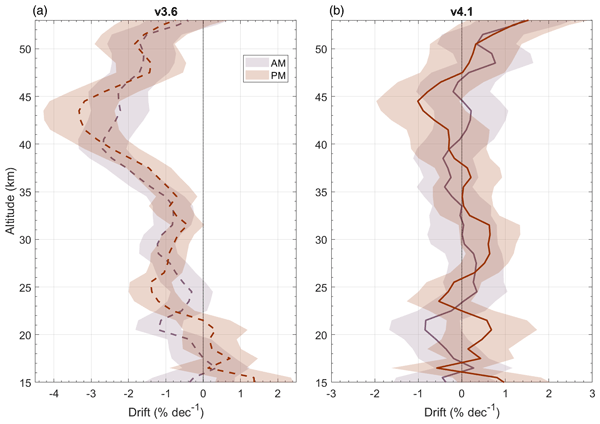
This study analyzes the quality of two versions (v3.6 and v4.1) of ozone concentration measurements from the ACE-FTS (Atmospheric Chemistry Experiment Fourier Transform Spectrometer), by comparing with data from five satellite instruments between 2004 and 2020. It was found that although the v3.6 data exhibit a better agreement than v4.1 with respect to the other instruments, v4.1 exhibits much better stability over time than v3.6. The stability of v4.1 makes it suitable for ozone trend studies.
Anqi Li, Chris Z. Roth, Adam E. Bourassa, Douglas A. Degenstein, Kristell Pérot, Ole Martin Christensen, and Donal P. Murtagh
Earth Syst. Sci. Data, 13, 5115–5126, https://doi.org/10.5194/essd-13-5115-2021, https://doi.org/10.5194/essd-13-5115-2021, 2021
Short summary
Short summary
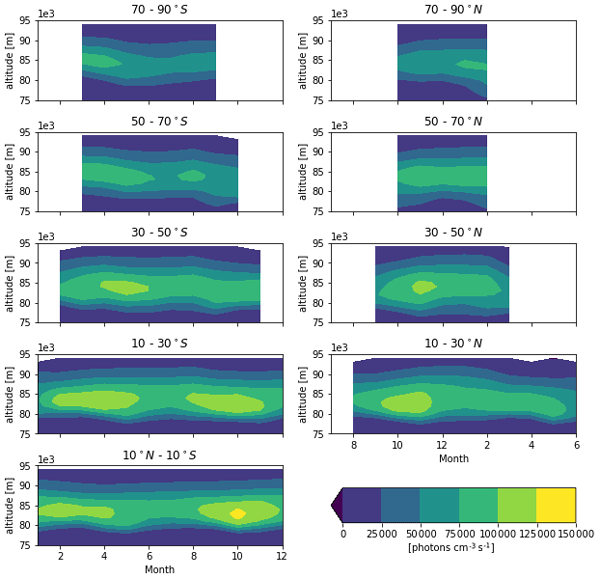
The nightglow emission originating from the vibrationally excited hydroxyl layer (about 85 km altitude) has been measured by the infrared imager (IRI) on the Odin satellite for more than 15 years. In this study, we document the retrieval steps, the resulting volume emission rates and the layer characteristics. Finally, we use the monthly zonal averages to demonstrate the fidelity of the data set. This unique, long-term data set will be valuable for studying various topics near the mesopause.
Cited articles
Altobelli, N., Tanco, I., Accomazzo, A., Vallat, C., Witasse, O., Dietz, A., Lorente, R., Martinez, S., Pinzan, G., Budnik, F., Mestre, A., Cornet, T., Costa, M., Boutonnet, A., Erd, C., Sarri, G., and Schamberg, C.: The ESA JUICE Ground Segment, Space Sci. Rev., 222, 24, https://doi.org/10.1007/s11214-026-01271-0, 2026. a
Benmahi, B., Cavalié, T., Fouchet, T., Moreno, R., Lellouch, E., Bardet, D., Guerlet, S., Hue, V., and Spiga, A.: First absolute wind measurements in Saturn's stratosphere from ALMA observations, Astron. Astrophys., 666, A117, https://doi.org/10.1051/0004-6361/202244200, 2022. a
Benmahi, B., Cavalié, T., Fouchet, T., Moreno, R., Lellouch, E., Bardet, D., Guerlet, S., Hue, V., and Spiga, A.: First absolute wind measurements in Saturn's stratosphere from ALMA observations (Corrigendum), Astron. Astrophys., 696, C5, https://doi.org/10.1051/0004-6361/202554767e, 2025. a
Biver, N., Hofstadter, M., Gulkis, S., Bockelée-Morvan, D., Choukroun, M., Lellouch, E., Schloerb, F. P., Rezac, L., Ip, W. H., Jarchow, C., Hartogh, P., Lee, S., von Allmen, P., Crovisier, J., Leyrat, C., and Encrenaz, P.: Distribution of water around the nucleus of comet 67P/Churyumov-Gerasimenko at 3.4 AU from the Sun as seen by the MIRO instrument on Rosetta, Astron. Astrophys., 583, A3, https://doi.org/10.1051/0004-6361/201526094, 2015. a
Boissinot, A., Spiga, A., Guerlet, S., Cabanes, S., and Bardet, D.: Global climate modeling of the Jupiter troposphere and effect of dry and moist convection on jets, Astron. Astrophys., 687, A274, https://doi.org/10.1051/0004-6361/202245220, 2024. a
Boutonnet, A., Langevin, Y., and Erd, C.: Designing the JUICE Trajectory, Space Sci. Rev., 220, 67, https://doi.org/10.1007/s11214-024-01093-y, 2024. a, b
Carrión-González, Ó., Moreno, R., Lellouch, E., Cavalié, T., Guerlet, S., Milcareck, G., Spiga, A., Clément, N., and Leconte, J.: Doppler wind measurements in Neptune's stratosphere with ALMA, Astron. Astrophys., 674, L3, https://doi.org/10.1051/0004-6361/202346621, 2023. a
Cavalié, T., Billebaud, F., Biver, N., Dobrijevic, M., Lellouch, E., Brillet, J., Lecacheux, A., Hjalmarson, Å., Sandqvist, A., Frisk, U., Olberg, M., Bergin, E. A., and The Odin Team: Observation of water vapor in the stratosphere of Jupiter with the Odin space telescope, Planet. Space Sci., 56, 1573–1584, https://doi.org/10.1016/j.pss.2008.04.013, 2008. a, b
Cavalié, T., Feuchtgruber, H., Lellouch, E., de Val-Borro, M., Jarchow, C., Moreno, R., Hartogh, P., Orton, G., Greathouse, T. K., Billebaud, F., Dobrijevic, M., Lara, L. M., González, A., and Sagawa, H.: Spatial distribution of water in the stratosphere of Jupiter from Herschel HIFI and PACS observations, Astron. Astrophys., 553, A21, https://doi.org/10.1051/0004-6361/201220797, 2013. a
Cavalié, T., Moreno, R., Lellouch, E., Hartogh, P., Venot, O., Orton, G. S., Jarchow, C., Encrenaz, T., Selsis, F., Hersant, F., and Fletcher, L. N.: The first submillimeter observation of CO in the stratosphere of Uranus, Astron. Astrophys., 562, A33, https://doi.org/10.1051/0004-6361/201322297, 2014. a
Cavalié, T., Benmahi, B., Hue, V., Moreno, R., Lellouch, E., Fouchet, T., Hartogh, P., Rezac, L., Greathouse, T. K., Gladstone, G. R., Sinclair, J. A., Dobrijevic, M., Billebaud, F., and Jarchow, C.: First direct measurement of auroral and equatorial jets in the stratosphere of Jupiter, Astron. Astrophys., 647, L8, https://doi.org/10.1051/0004-6361/202140330, 2021. a, b
Cavalié, T., Rezac, L., Moreno, R., Lellouch, E., Fouchet, T., Benmahi, B., Greathouse, T. K., Sinclair, J. A., Hue, V., Hartogh, P., Dobrijevic, M., Carrasco, N., and Perrin, Z.: Evidence for auroral influence on Jupiter's nitrogen and oxygen chemistry revealed by ALMA, Nat. Astron., 7, 1048–1055, https://doi.org/10.1038/s41550-023-02016-7, 2023. a
Costagliola, F., Sakamoto, K., Muller, S., Martín, S., Aalto, S., Harada, N., van der Werf, P., Viti, S., Garcia-Burillo, S., and Spaans, M.: Exploring the molecular chemistry and excitation in obscured luminous infrared galaxies, An ALMA mm-wave spectral scan of NGC 4418, Astron. Astrophys., 582, A91, https://doi.org/10.1051/0004-6361/201526256, 2015. a
De Beck, E. and Olofsson, H.: Circumstellar environment of the M-type AGB star R Doradus. APEX spectral scan at 159.0–368.5 GHz, Astron. Astrophys., 615, A8, https://doi.org/10.1051/0004-6361/201732470, 2018. a
de Kleer, K., Butler, B., de Pater, I., Gurwell, M. A., Moullet, A., Trumbo, S., and Spencer, J.: Ganymede's Surface Properties from Millimeter and Infrared Thermal Emission, Plan. Sci. J., 2, 5, https://doi.org/10.3847/PSJ/abcbf4, 2021. a
de Pater, I., Sault, R. J., Moeckel, C., Moullet, A., Wong, M. H., Goullaud, C., DeBoer, D., Butler, B. J., Bjoraker, G., Ádámkovics, M., Cosentino, R., Donnelly, P. T., Fletcher, L. N., Kasaba, Y., Orton, G. S., Rogers, J. H., Sinclair, J. A., and Villard, E.: First ALMA Millimeter-wavelength Maps of Jupiter, with a Multiwavelength Study of Convection, Astron. J., 158, 139, https://doi.org/10.3847/1538-3881/ab3643, 2019. a
de Pater, I., Goldstein, D., and Lellouch, E.: The Plumes and Atmosphere of Io, in: Io: A New View of Jupiter's Moon, edited by: Lopes, R. M. C., de Kleer, K., and Keane, J. T., Astrophys. Space Sci. Lib., 468, 233–290, https://doi.org/10.1007/978-3-031-25670-7_8, 2023. a
Gallardo Cava, I., Alcolea, J., Bujarrabal, V., Gómez-Garrido, M., and Castro-Carrizo, A.: The nebula around the binary post-AGB star 89 Herculis, Astron. Astrophys., 671, A80, https://doi.org/10.1051/0004-6361/202244415, 2023. a
Gapp, C., Rengel, M., Hartogh, P., Sagawa, H., Feuchtgruber, H., Lellouch, E., and Villanueva, G. L.: Abundances of trace constituents in Jupiter's atmosphere inferred from Herschel/PACS observations, Astron. Astrophys., 688, A10, https://doi.org/10.1051/0004-6361/202347345, 2024. a
Grasset, O., Dougherty, M. K., Coustenis, A., Bunce, E. J., Erd, C., Titov, D., Blanc, M., Coates, A., Drossart, P., Fletcher, L. N., Hussmann, H., Jaumann, R., Krupp, N., Lebreton, J.-P., Prieto-Ballesteros, O., Tortora, P., Tosi, F., and Van Hoolst, T.: JUpiter ICy moons Explorer (JUICE): An ESA mission to orbit Ganymede and to characterise the Jupiter system, Planet. Space Sci., 78, 1–21, https://doi.org/10.1016/j.pss.2012.12.002, 2013. a
Guerlet, S., Fouchet, T., Spiga, A., Flasar, F. M., Fletcher, L. N., Hesman, B. E., and Gorius, N.: Equatorial Oscillation and Planetary Wave Activity in Saturn's Stratosphere Through the Cassini Epoch, J. Geophys. Res., 123, 246–261, https://doi.org/10.1002/2017JE005419, 2018. a
Guerlet, S., Spiga, A., Delattre, H., and Fouchet, T.: Radiative-equilibrium model of Jupiter's atmosphere and application to estimating stratospheric circulations, Icarus, 351, 113935, https://doi.org/10.1016/j.icarus.2020.113935, 2020. a
Gulkis, S., Frerking, M., Crovisier, J., Beaudin, G., Hartogh, P., Encrenaz, P., Koch, T., Kahn, C., Salinas, Y., Nowicki, R., Irigoyen, R., Janssen, M., Stek, P., Hofstadter, M., Allen, M., Backus, C., Kamp, L., Jarchow, C., Steinmetz, E., Deschamps, A., Krieg, J., Gheudin, M., Bockelée-Morvan, D., Biver, N., Encrenaz, T., Despois, D., Ip, W., Lellouch, E., Mann, I., Muhleman, D., Rauer, H., Schloerb, P., and Spilker, T.: MIRO: Microwave Instrument for Rosetta Orbiter, Space Sci. Rev., 128, 561–597, https://doi.org/10.1007/s11214-006-9032-y, 2007. a
Hartogh, P., Crovisier, J., de Val-Borro, M., Bockelée-Morvan, D., Biver, N., Lis, D. C., Moreno, R., Jarchow, C., Rengel, M., Emprechtinger, M., Szutowicz, S., Banaszkiewicz, M., Bensch, F., Blecka, M. I., Cavalié, T., Encrenaz, T., Jehin, E., Küppers, M., Lara, L.-M., Lellouch, E., Swinyard, B. M., Vandenbussche, B., Bergin, E. A., Blake, G. A., Blommaert, J. A. D. L., Cernicharo, J., Decin, L., Encrenaz, P., de Graauw, T., Hutsemekers, D., Kidger, M., Manfroid, J., Medvedev, A. S., Naylor, D. A., Schieder, R., Thomas, N., Waelkens, C., Roelfsema, P. R., Dieleman, P., Güsten, R., Klein, T., Kasemann, C., Caris, M., Olberg, M., and Benz, A. O.: HIFI observations of water in the atmosphere of comet C/2008 Q3 (Garradd), Astron. Astrophys., 518, L150, https://doi.org/10.1051/0004-6361/201014665, 2010a. a
Hartogh, P., Jarchow, C., Lellouch, E., de Val-Borro, M., Rengel, M., Moreno, R., Medvedev, A. S., Sagawa, H., Swinyard, B. M., Cavalié, T., Lis, D. C., Błęcka, M. I., Banaszkiewicz, M., Bockelée-Morvan, D., Crovisier, J., Encrenaz, T., Küppers, M., Lara, L.-M., Szutowicz, S., Vandenbussche, B., Bensch, F., Bergin, E. A., Billebaud, F., Biver, N., Blake, G. A., Blommaert, J. A. D. L., Cernicharo, J., Decin, L., Encrenaz, P., Feuchtgruber, H., Fulton, T., de Graauw, T., Jehin, E., Kidger, M., Lorente, R., Naylor, D. A., Portyankina, G., Sánchez-Portal, M., Schieder, R., Sidher, S., Thomas, N., Verdugo, E., Waelkens, C., Whyborn, N., Teyssier, D., Helmich, F., Roelfsema, P., Stutzki, J., Leduc, H. G., and Stern, J. A.: Herschel/HIFI observations of Mars: First detection of O2 at submillimetre wavelengths and upper limits on HCl and H2O2, Astron. Astrophys., 521, L49, https://doi.org/10.1051/0004-6361/201015160, 2010b. a
Hartogh, P., Rezac, L., Cavalié, T., Jarchow, C., Moreno, R., Schulz-Ravanbakhsh, A., Carrasco Gallardo, A., Dabrowski, B., Goodyear, S., Rengel, M., Herpin, F., Kasai, Y., Kotiranta, M., Lellouch, E., Murk, A., Olberg, M., Szutowicz, S., and Wirström, E.: Juice/SWI during the Lunar-Earth-Gravity-Assist (LEGA), I. General overview, EGUsphere [preprint], https://doi.org/10.5194/egusphere-2026-1011, 2026b. a
Jarchow, C., Rezac, L., Hartogh, P., Schulz-Ravanbakhsh, A., Cavalie, T., Herpin, F., Moreno, R., and Murk, A.: Juice/SWI during the Lunar-Earth-Gravity-Assist, III. Observations of the Earth as Calibration Target, EGUsphere [preprint], https://doi.org/10.5194/egusphere-2026-1096, 2026. a, b, c
King, O. R. T. and Fletcher, L. N.: PlanetMapper: A Python package for visualising, navigating and mapping Solar System observations, J. Open Sour. Softw., 8, 5728, https://doi.org/10.21105/joss.05728, 2023. a
Lefour, C., Cavalié, T., Moreno, R., Rezac, L., Fouchet, T., Lellouch, E., and Hartogh, P.: New 12C/13C and 15N/14N isotopic ratios measurements in HCN in the Jupiter stratosphere revealed by ALMA, Astron. Astrophys., in press, https://doi.org/10.1051/0004-6361/202659264, 2026. a
Livengood, T. A., Chin, G., Sagdeev, R. Z., Mitrofanov, I. G., Boynton, W. V., Evans, L. G., Litvak, M. L., McClanahan, T. P., Sanin, A. B., Starr, R. D., and Su, J. J.: Moonshine: Diurnally varying hydration through natural distillation on the Moon, detected by the Lunar Exploration Neutron Detector (LEND), Icarus, 255, 100–115, https://doi.org/10.1016/j.icarus.2015.04.004, 2015. a
Marconi, M. L.: A kinetic model of Ganymede's atmosphere, Icarus, 190, 155–174, https://doi.org/10.1016/j.icarus.2007.02.016, 2007. a
Medvedev, A. S., Sethunadh, J., and Hartogh, P.: From cold to warm gas giants: A three-dimensional atmospheric general circulation modeling, Icarus, 225, 228–235, https://doi.org/10.1016/j.icarus.2013.03.028, 2013. a
Moreno, R., Rezac, L., Formánek, T., Cavalié, T., Jarchow, C., Lellouch, E., Hartogh, P., Murk, A., Kotiranta, M., Carrasco Gallardo, A., Goodyear, S., Schulz-Ravanbakhsh, A., Dabrowski, B., Herpin, F., Kasai, Y., Murtagh, D., Olberg, M., Rengel, M., Sagawa, H., Szutowicz, S., and Wirström, E.: Juice/SWI during the Lunar-Earth-Gravity-Assist (LEGA). IV. Antenna pointing and beam characterisation, EGUsphere [preprint], https://doi.org/10.5194/egusphere-2026-2064, 2026. a, b
Moses, J. I., Fouchet, T., Bézard, B., Gladstone, G. R., Lellouch, E., and Feuchtgruber, H.: Photochemistry and diffusion in Jupiter's stratosphere: Constraints from ISO observations and comparisons with other giant planets, J. Geophys. Res., 110, E08001, https://doi.org/10.1029/2005JE002411, 2005. a
Mousis, O., Lunine, J. I., Fletcher, L. N., Mandt, K. E., Ali-Dib, M., Gautier, D., and Atreya, S.: New Insights on Saturn's Formation from its Nitrogen Isotopic Composition, Astrophys. J. Lett., 796, L28, https://doi.org/10.1088/2041-8205/796/2/L28, 2014. a
Olberg, M., Frisk, U., Lecacheux, A., Olofsson, A. O. H., Baron, P., Bergman, P., Florin, G., Hjalmarson, Å. ., Larsson, B., Murtagh, D., Olofsson, G., Pagani, L., Sandqvist, A., Teyssier, D., Torchinsky, S. A., and Volk, K.: The Odin satellite. II. Radiometer data processing and calibration, Astron. Astrophys., 402, L35–L38, https://doi.org/10.1051/0004-6361:20030336, 2003. a
Ossenkopf, V.: Optimization of mapping modes for heterodyne instruments, Astron. Astrophys., 495, 677–690, https://doi.org/10.1051/0004-6361:200809619, 2009. a
Rezac, L. and Cavalié, T.: Juice-SWI ObsID 242 – AT scan, TIB AV-Portal [video], https://doi.org/10.5446/72321, 2026a. a
Rezac, L. and Cavalié, T.: Juice-SWI ObsID 243 – CT scan, TIB AV-Portal [video], https://doi.org/10.5446/72322, 2026b. a
Rezac, L. and Cavalié, T.: Juice-SWI ObsID 373 – 2D map, TIB AV-Portal [video], https://doi.org/10.5446/72325, 2026c. a
Rezac, L. and Cavalié, T.: , TIB AV-Portal [video], 2026.
Rezac, L. and Cavalié, T.: Juice-SWI ObsID 257 – Limb scan, TIB AV-Portal [video], https://doi.org/10.5446/72323, 2026e. a
Rezac, L. and Cavalié, T.: Juice-SWI ObsID 282 – Limb stare, TIB AV-Portal [video], https://doi.org/10.5446/72324, 2026f. a
Roelfsema, P. R., Helmich, F. P., Teyssier, D., Ossenkopf, V., Morris, P., Olberg, M., Shipman, R., Risacher, C., Akyilmaz, M., Assendorp, R., Avruch, I. M., Beintema, D., Biver, N., Boogert, A., Borys, C., Braine, J., Caris, M., Caux, E., Cernicharo, J., Coeur-Joly, O., Comito, C., de Lange, G., Delforge, B., Dieleman, P., Dubbeldam, L., de Graauw, T., Edwards, K., Fich, M., Flederus, F., Gal, C., di Giorgio, A., Herpin, F., Higgins, D. R., Hoac, A., Huisman, R., Jarchow, C., Jellema, W., de Jonge, A., Kester, D., Klein, T., Kooi, J., Kramer, C., Laauwen, W., Larsson, B., Leinz, C., Lord, S., Lorenzani, A., Luinge, W., Marston, A., Martín-Pintado, J., McCoey, C., Melchior, M., Michalska, M., Moreno, R., Müller, H., Nowosielski, W., Okada, Y., Orleański, P., Phillips, T. G., Pearson, J., Rabois, D., Ravera, L., Rector, J., Rengel, M., Sagawa, H., Salomons, W., Sánchez-Suárez, E., Schieder, R., Schlöder, F., Schmülling, F., Soldati, M., Stutzki, J., Thomas, B., Tielens, A. G. G. M., Vastel, C., Wildeman, K., Xie, Q., Xilouris, M., Wafelbakker, C., Whyborn, N., Zaal, P., Bell, T., Bjerkeli, P., De Beck, E., Cavalié, T., Crockett, N. R., Hily-Blant, P., Kama, M., Kaminski, T., Leflóch, B., Lombaert, R., de Luca, M., Makai, Z., Marseille, M., Nagy, Z., Pacheco, S., van der Wiel, M. H. D., Wang, S., and Yıldız, U.: In-orbit performance of Herschel-HIFI, Astron. Astrophys., 537, A17, https://doi.org/10.1051/0004-6361/201015120, 2012. a, b, c
Schieder, R. and Kramer, C.: Optimization of heterodyne observations using Allan variance measurements, Astron. Astrophys., 373, 746–756, https://doi.org/10.1051/0004-6361:20010611, 2001. a
Stephan, K., Roatsch, T., Tosi, F., Matz, K.-D., Kersten, E., Wagner, R., Molyneux, P., Palumbo, P., Poulet, F., Hussmann, H., Barabash, S., Bruzzone, L., Dougherty, M., Gladstone, R., Gurvits, L. I., Hartogh, P., Iess, L., Wahlund, J.-E., Wurz, P., Witasse, O., Grasset, O., Altobelli, N., Carter, J., Cavalié, T., D'Aversa, E., Della Corte, V., Filacchione, G., Galli, A., Galluzzi, V., Gwinner, K., Hauber, E., Jaumann, R., Krohn, K., Langevin, Y., Lucchetti, A., Migliorini, A., Piccioni, G., Solomonidou, A., Stark, A., Tobie, G., Tubiana, C., Vallat, C., van Hoolst, T., and The Juice Swt Team: Regions of interest on Ganymede's and Callisto's surfaces as potential targets for ESA's JUICE mission, Planet. Space Sci., 208, 105324, https://doi.org/10.1016/j.pss.2021.105324, 2021. a
Szabó, Z. M., Belloche, A., Menten, K. M., Gong, Y., Kóspál, Á., Ábrahám, P., Yang, W., Cyganowski, C. J., and Wyrowski, F.: Molecular inventory of the environment of a young eruptive star: Case study of the classical FU Orionis star V1057 Cyg, Astron. Astrophys., 694, A329, https://doi.org/10.1051/0004-6361/202451851, 2025. a
Tolls, V., Melnick, G. J., Ashby, M. L. N., Bergin, E. A., Gurwell, M. A., Kleiner, S. C., Patten, B. M., Plume, R., Stauffer, J. R., Wang, Z., Zhang, Y. F., Chin, G., Erickson, N. R., Snell, R. L., Goldsmith, P. F., Neufeld, D. A., Schieder, R., and Winnewisser, G.: Submillimeter Wave Astronomy Satellite Performance on the ground and in orbit, Astrophys. J. Suppl. Ser., 152, 137–162, https://doi.org/10.1086/382507, 2004. a
Wirstrom, E. S., Bjerkeli, P., Rezac, L., Brinch, C., and Hartogh, P.: Effect of the 3D distribution on water observations made with the SWI – I. Ganymede, Astron. Astrophys., 637, A90, https://doi.org/10.1051/0004-6361/202037609, 2020. a
Short summary
The Submillimetre Wave Instrument (SWI) aboard the Juice mission is a sophisticated and first-of-its-kind payload. SWI is designed to support the diverse science objectives of the Juice mission targeting Jupiter's middle atmosphere, icy-moon's exospheres as well as near sub-surface thermophysical properties. This presents significant planning, operations and commanding challenges which are described in this paper in the context of the Lunar and Earth Gravity Assist (LEGA).
The Submillimetre Wave Instrument (SWI) aboard the Juice mission is a sophisticated and...


