
Articles | Volume 44, issue 1
https://doi.org/10.5194/angeo-44-245-2026
© Author(s) 2026. This work is distributed under
the Creative Commons Attribution 4.0 License.
the Creative Commons Attribution 4.0 License.
https://doi.org/10.5194/angeo-44-245-2026
© Author(s) 2026. This work is distributed under
the Creative Commons Attribution 4.0 License.
the Creative Commons Attribution 4.0 License.
Regular paper
| 
08 Apr 2026
Regular paper |
| 08 Apr 2026
| 08 Apr 2026
Benchmarking the Swedish Power Grid Against a 1-in-100-Year Geoelectric Field Scenario
Vanina Lanabere
CORRESPONDING AUTHOR

Swedish Institute of Space Physics, Uppsala, Sweden
Andrew P. Dimmock
Swedish Institute of Space Physics, Uppsala, Sweden
Sven Molenkamp Venholen
Swedish Defence Research Agency, Stockholm, Sweden
Alice V. L. Wallner
Swedish Institute of Space Physics, Uppsala, Sweden
Department of Physics and Astronomy, Uppsala University, Uppsala, Sweden
Andreas Johlander
Swedish Defence Research Agency, Stockholm, Sweden
Lisa Rosenqvist
Swedish Defence Research Agency, Stockholm, Sweden
Johan Setréus
Swedish National Grid-Svenska Kraftnät, Sundbyberg, Sweden
Related authors
Harriet George, Andrew P. Dimmock, Vanina Lanabare, Heikki Vanhamäki, Ilkka Virtanen, Anita Aikio, Adrian Blagau, Octav Marghitu, Milla Myllymaa, Habtamu Tesfaw, Stephan Buchert, and Mykhaylo Shumko
EGUsphere, https://doi.org/10.5194/egusphere-2026-3108, https://doi.org/10.5194/egusphere-2026-3108, 2026
Short summary
Short summary
Bursty bulk flows are mesoscale ion flows that are ejected from magnetic reconnection sites in the Earth's magnetotail, and they couple to the ionosphere via field aligned currents that close through the ionosphere. We analyse unique triple-conjunctive observations of the coupled bursty bulk flow / current / ionosphere system to evaluate a case study of a bursty bulk flow and its ionospheric effects. We identify multiple current signatures of this bursty bulk flow within the ionosphere.
Vanina Lanabere, Stephan Buchert, Adrian Blagau, Harriet George, Sota Nanjo, Liisa Juusola, Andrew P. Dimmock, Samuel Wharton, Heikki Vanhamäki, Octav Marghitu, Louis Richard, Lei Cai, Alice V. L. Wallner, Daria Kotova, Yaqi Jin, Theresa Hoppe, Jennifer A. Carter, and Anita Aikio
EGUsphere, https://doi.org/10.5194/egusphere-2026-2997, https://doi.org/10.5194/egusphere-2026-2997, 2026
Short summary
Short summary
We studied a series of fast plasma streams that connected Earth’s nightside magnetic environment with the high‑latitude ionized upper atmosphere on 7 December 2023. Using satellite, auroral images and ground observations, we showed how each stream disturbed the upper atmosphere. Their repeated impact strengthened these disturbances until a substorm began, revealing how small events can build up to a larger magnetic disruption.
Liisa Juusola, Ari Viljanen, Ilja Honkonen, Magnar Gullikstad Johnsen, Andrew Dimmock, Vanina Lanabere, and Alice Wallner
EGUsphere, https://doi.org/10.5194/egusphere-2026-1110, https://doi.org/10.5194/egusphere-2026-1110, 2026
Short summary
Short summary
During severe space storms, the induced geoelectric field has the potential to cause substantial problems in power grids. We examine the geomagnetically induced currents (GIC) the geoelectric field would have driven in a simple model power grid located in Northern Europe during the May 2024 superstorm. Our results help us understand how the complicated interaction between the driving from space and the response of the conducting ground produces the most intense GIC peaks.
Harriet George, Andrew P. Dimmock, Vanina Lanabare, Heikki Vanhamäki, Ilkka Virtanen, Anita Aikio, Adrian Blagau, Octav Marghitu, Milla Myllymaa, Habtamu Tesfaw, Stephan Buchert, and Mykhaylo Shumko
EGUsphere, https://doi.org/10.5194/egusphere-2026-3108, https://doi.org/10.5194/egusphere-2026-3108, 2026
Short summary
Short summary
Bursty bulk flows are mesoscale ion flows that are ejected from magnetic reconnection sites in the Earth's magnetotail, and they couple to the ionosphere via field aligned currents that close through the ionosphere. We analyse unique triple-conjunctive observations of the coupled bursty bulk flow / current / ionosphere system to evaluate a case study of a bursty bulk flow and its ionospheric effects. We identify multiple current signatures of this bursty bulk flow within the ionosphere.
Vanina Lanabere, Stephan Buchert, Adrian Blagau, Harriet George, Sota Nanjo, Liisa Juusola, Andrew P. Dimmock, Samuel Wharton, Heikki Vanhamäki, Octav Marghitu, Louis Richard, Lei Cai, Alice V. L. Wallner, Daria Kotova, Yaqi Jin, Theresa Hoppe, Jennifer A. Carter, and Anita Aikio
EGUsphere, https://doi.org/10.5194/egusphere-2026-2997, https://doi.org/10.5194/egusphere-2026-2997, 2026
Short summary
Short summary
We studied a series of fast plasma streams that connected Earth’s nightside magnetic environment with the high‑latitude ionized upper atmosphere on 7 December 2023. Using satellite, auroral images and ground observations, we showed how each stream disturbed the upper atmosphere. Their repeated impact strengthened these disturbances until a substorm began, revealing how small events can build up to a larger magnetic disruption.
Liisa Juusola, Ari Viljanen, Ilja Honkonen, Magnar Gullikstad Johnsen, Andrew Dimmock, Vanina Lanabere, and Alice Wallner
EGUsphere, https://doi.org/10.5194/egusphere-2026-1110, https://doi.org/10.5194/egusphere-2026-1110, 2026
Short summary
Short summary
During severe space storms, the induced geoelectric field has the potential to cause substantial problems in power grids. We examine the geomagnetically induced currents (GIC) the geoelectric field would have driven in a simple model power grid located in Northern Europe during the May 2024 superstorm. Our results help us understand how the complicated interaction between the driving from space and the response of the conducting ground produces the most intense GIC peaks.
Liisa Juusola, Ari Viljanen, Andrew P. Dimmock, Mirjam Kellinsalmi, Audrey Schillings, and James M. Weygand
Ann. Geophys., 41, 13–37, https://doi.org/10.5194/angeo-41-13-2023, https://doi.org/10.5194/angeo-41-13-2023, 2023
Short summary
Short summary
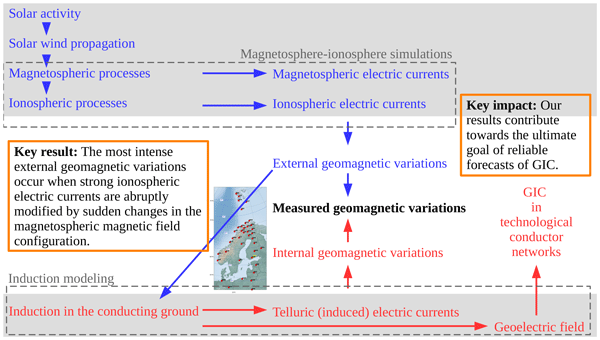
We have examined events during which the measured magnetic field on the ground changes very rapidly, causing a risk to technological conductor networks. According to our results, such events occur when strong electric currents in the ionosphere at 100 km altitude are abruptly modified by sudden compression or expansion of the magnetospheric magnetic field farther in space.
Cited articles
Amm, O.: Ionospheric elementary current systems in spherical coordinates and their application, J. Geomagn. Geoelectr., 49, 947–955, https://doi.org/10.5636/jgg.49.947, 1997. a, b
Amm, O. and Viljanen, A.: Ionospheric disturbance magnetic field continuation from the ground to the ionosphere using spherical elementary current systems, Earth Planets Space, 51, 431–440, https://doi.org/10.1186/BF03352247, 1999. a, b
Bergin, A., Chapman, S. C., Watkins, N. W., Moloney, N. R., and Gjerloev, J. W.: Extreme Event Statistics in Dst, SYM-H, and SMR Geomagnetic Indices, Space Weather, 21, e2022SW003304, https://doi.org/10.1029/2022SW003304, 2023. a
Bolduc, L.: GIC observations and studies in the Hydro-Québec power system, J. Atmos. Sol.-Terr. Phy., 64, 1793–1802, https://doi.org/10.1016/S1364-6826(02)00128-1, 2002. a
Carrington, R. C.: Description of a singular appearance seen in the Sun on September 1, 1859, Mon. Not. R. Astron. Soc., 20, 13–15, https://doi.org/10.1093/mnras/20.1.13, 1859. a
Cordell, D., Mann, I. R., Dimitrakoudis, S., Parry, H., and Unsworth, M. J.: Long-term peak geoelectric field behavior for space weather hazard assessment in Alberta, Canada using geomagnetic and magnetotelluric measurements, Space Weather, 23, e2024SW004305, https://doi.org/10.1029/2024SW004305, 2025. a
Dimmock, A. P., Rosenqvist, L., Hall, J.-O., Viljanen, A., Yordanova, E., Honkonen, I., André, M., and Sjöberg, E. C.: The GIC and geomagnetic response over Fennoscandia to the 7–8 September 2017 geomagnetic storm, Space Weather, 17, 989–1010, https://doi.org/10.1029/2018SW002132, 2019. a, b
Engels, M., Korja, T., and the BEAR Working Group: Multisheet modelling of the electrical conductivity structure in the Fennoscandian Shield, Earth Planets Space, 54, 559–573, https://doi.org/10.1186/BF03353045, 2002. a, b
Gilbert, J. L.: Modeling the effect of the ocean-land interface on induced electric fields during geomagnetic storms, Space Weather, 3, https://doi.org/10.1029/2004SW000120, 2005. a
Girgis, R. and Vedante, K.: Effects of GIC on power transformers and power systems, in: PES T&D 2012, 1–8, https://doi.org/10.1109/TDC.2012.6281595, 2012. a
Juusola, L., Vanhamäki, H., Viljanen, A., and Smirnov, M.: Induced currents due to 3D ground conductivity play a major role in the interpretation of geomagnetic variations, Ann. Geophys., 38, 983–998, https://doi.org/10.5194/angeo-38-983-2020, 2020. a
Juusola, L., Viljanen, A., Dimmock, A. P., Kellinsalmi, M., Schillings, A., and Weygand, J. M.: Drivers of rapid geomagnetic variations at high latitudes, Ann. Geophys., 41, 13–37, https://doi.org/10.5194/angeo-41-13-2023, 2023. a
Kappenman, J. G.: Great geomagnetic storms and extreme impulsive geomagnetic field disturbance events – An analysis of observational evidence including the great storm of May 1921, Adv. Space Res., 38, 188–199, https://doi.org/10.1016/j.asr.2005.08.055, 2006. a, b, c
Kataoka, R. and Ngwira, C.: Extreme geomagnetically induced currents, Progress in Earth and Planetary Science, 3, 23, https://doi.org/10.1186/s40645-016-0101-x, 2016. a
Korja, T., Engels, M., Zhamaletdinov, A. A., Kovtun, A. A., Palshin, N. A., Smirnov, M. Y., Tokarev, A. D., Asming, V. E., Vanyan, L. L., Vardaniants, I. L., and Group, B. W.: Crustal conductivity in Fennoscandia – a compilation of a database on crustal conductance in the Fennoscandian Shield, Earth Planets Space, 54, 535–558, https://doi.org/10.1186/BF03353044, 2002. a, b
Lanabere, V.: Benchmarking the Swedish Power Grid Against a 1-in-100-Year Geoelectric Field Scenario, TIB [video], https://doi.org/10.5446/71703, 2025. a
Lanabere, V., Dimmock, A. P., Rosenqvist, L., Juusola, L., Viljanen, A., Johlander, A., and Odelstad, E.: Analysis of the geoelectric field in Sweden over solar cycles 23 and 24: Spatial and temporal variability during strong GIC events, Space Weather, 21, e2023SW003588, https://doi.org/10.1029/2023SW003588, 2023. a, b, c, d, e, f, g
Love, J. J., Rigler, E. J., Hayakawa, H., and Mursula, K.: On the uncertain intensity estimate of the 1859 Carrington storm, J. Space Weather Spac., 14, 21, https://doi.org/10.1051/swsc/2024015, 2024. a
Lucas, G. M., Love, J. J., and Kelbert, A.: Calculation of voltages in electric power transmission lines during historic geomagnetic storms: An investigation using realistic Earth impedances, Space Weather, 16, 185–195, https://doi.org/10.1002/2017SW001779, 2018. a, b
Mac Manus, D. H., Rodger, C. J., Dalzell, M., Renton, A., Richardson, G. S., Petersen, T., and Clilverd, M. A.: Geomagnetically induced current modeling in New Zealand: Extreme storm analysis using multiple disturbance scenarios and industry provided hazard magnitudes, Space Weather, 20, e2022SW003320, https://doi.org/10.1029/2022SW003320, 2022. a
Malone-Leigh, J., Campanyà, J., Gallagher, P. T., Hodgson, J., and Hogg, C.: Mapping geoelectric field hazards in Ireland, Space Weather, 22, e2023SW003638, https://doi.org/10.1029/2023SW003638, 2024. a
Marshalko, E., Kruglyakov, M., Kuvshinov, A., and Viljanen, A.: Three-dimensional modeling of the ground electric field in Fennoscandia during the Halloween geomagnetic storm, Space Weather, 21, e2022SW003370, https://doi.org/10.1029/2022SW003370, 2023. a
NERC: Benchmark geomagnetic disturbance event description, Tech. rep., North American Electric Reliability Corporation, https://www.nerc.com/comm/OC/GeomagneticDisturbanceTaskForceGMDTF/Benchmark_GMD_Event_Description_Final.pdf, (last access: 30 June 2025), 2016. a
Ngwira, C. M., Pulkkinen, A., Wilder, V., and Crowley, G.: Extended study of extreme geoelectric field event scenarios for geomagnetically induced current applications, Space Weather, 11, 121–131, https://doi.org/10.1002/swe.20021, 2013. a, b
Pulkkinen, A., Lindahl, S., Viljanen, A., and Pirjola, R.: Geomagnetic storm of 29–31 October 2003: Geomagnetically induced currents and their relation to problems in the Swedish high-voltage power transmission system, Space Weather, 3, https://doi.org/10.1029/2004SW000123, 2005. a, b
Pulkkinen, A., Bernabeu, E., Thomson, A., Viljanen, A., Pirjola, R., Boteler, D., Eichner, J., Cilliers, P. J., Welling, D., Savani, N. P., Weigel, R. S., Love, J. J., Balch, C., Ngwira, C. M., Crowley, G., Schultz, A., Kataoka, R., Anderson, B., Fugate, D., Simpson, J. J., and MacAlester, M.: Geomagnetically induced currents: Science, engineering, and applications readiness, Space Weather, 15, 828–856, https://doi.org/10.1002/2016SW001501, 2017. a
Rosenqvist, L., Fristedt, T., Dimmock, A. P., Davidsson, P., Fridström, R., Hall, J. O., Hesslow, L., Kjäll, J., Smirnov, M. Y., Welling, D., and Wintoft, P.: 3D modeling of geomagnetically induced currents in Sweden–Validation and extreme event analysis, Space Weather, 20, e2021SW002988, https://doi.org/10.1029/2021SW002988, 2022. a, b, c, d, e
Siscoe, G., Crooker, N., and Clauer, C.: Dst of the Carrington storm of 1859, Adv. Space Res., 38, 173–179, https://doi.org/10.1016/j.asr.2005.02.102, 2006. a
Thomson, A. W. P., Dawson, E. B., and Reay, S. J.: Quantifying extreme behavior in geomagnetic activity, Space Weather, 9, https://doi.org/10.1029/2011SW000696, 2011. a, b
Tsubouchi, K. and Omura, Y.: Long-term occurrence probabilities of intense geomagnetic storm events, Space Weather, 5, https://doi.org/10.1029/2007SW000329, 2007. a
Tsurutani, B. T., Gonzalez, W. D., Lakhina, G. S., and Alex, S.: The extreme magnetic storm of 1–2 September 1859, J. Geophys. Res.-Space, 108, https://doi.org/10.1029/2002JA009504, 2003. a
Vanhamäki, H. and Juusola, L.: Correction to: Introduction to spherical elementary current systems, C1, Springer International Publishing, Cham, ISBN 978-3-030-26732-2, https://doi.org/10.1007/978-3-030-26732-2_13, 2020. a
Viljanen, A., Nevanlinna, H., Pajunpää, K., and Pulkkinen, A.: Time derivative of the horizontal geomagnetic field as an activity indicator, Ann. Geophys., 19, 1107–1118, https://doi.org/10.5194/angeo-19-1107-2001, 2001. a
Viljanen, A., Tanskanen, E. I., and Pulkkinen, A.: Relation between substorm characteristics and rapid temporal variations of the ground magnetic field, Ann. Geophys., 24, 725–733, https://doi.org/10.5194/angeo-24-725-2006, 2006. a
Viljanen, A., Pirjola, R., Wik, M., Ádám, A., Prácser, E., Sakharov, Y., and Katkalov, J.: Continental scale modelling of geomagnetically induced currents, J. Space Weather Spac., 2, A17, https://doi.org/10.1051/swsc/2012017, 2012. a, b
Wallner, A. V. L., Dimmock, A. P., Lanabere, V., Johlander, A., Molenkamp Venholen, S., Viljanen, A., Juusola, L., Rosenqvist, L., Setréus, J., Yordanova, E., Buchert, S., Heiter, U., and Khotyaintsev, Y. V.: The Geomagnetic Storm on 10–12 May 2024 and Its Effect on the Swedish Power Grid, Space Weather, 24, e2025SW004788, https://doi.org/10.1029/2025SW004788, 2026. a, b, c
Wik, M., Viljanen, A., Pirjola, R., Pulkkinen, A., Wintoft, P., and Lundstedt, H.: Calculation of geomagnetically induced currents in the 400 kV power grid in southern Sweden, Space Weather, 6, 07005, https://doi.org/10.1029/2007SW000343, 2008. a
Wik, M., Pirjola, R., Lundstedt, H., Viljanen, A., Wintoft, P., and Pulkkinen, A.: Space weather events in July 1982 and October 2003 and the effects of geomagnetically induced currents on Swedish technical systems, Ann. Geophys., 27, 1775–1787, https://doi.org/10.5194/angeo-27-1775-2009, 2009. a, b
Wintoft, P., Viljanen, A., and Wik, M.: Extreme value analysis of the time derivative of the horizontal magnetic field and computed electric field, Ann. Geophys., 34, 485–491, https://doi.org/10.5194/angeo-34-485-2016, 2016. a, b
Short summary
The goal of this study was to explore how a once-in-a-century geoelectric field event could affect the Swedish power grid by combining past storm data with a simplified model of the power grid. We identified regions that may be at higher risk and estimated how many power lines could be exposed to large voltages. These insights reveal vulnerable areas and provide a foundation for strengthening preparedness against rare, high-impact events.
The goal of this study was to explore how a once-in-a-century geoelectric field event could...


