Articles | Volume 44, issue 1
https://doi.org/10.5194/angeo-44-195-2026
© Author(s) 2026. This work is distributed under
the Creative Commons Attribution 4.0 License.
https://doi.org/10.5194/angeo-44-195-2026
© Author(s) 2026. This work is distributed under
the Creative Commons Attribution 4.0 License.
Variability and trend analysis of temperature and height in the upper troposphere and stratosphere region over the tropics (Réunion), by combining balloon-sonde and satellite measurements
Gregori de Arruda Moreira
CORRESPONDING AUTHOR
Federal Institute of Education, Science and Techonology of São Paulo (IFSP), São Paulo, 01109-010, Brazil
Hassan Bencherif
Laboratoire de l'Atmosphère et des Cyclones, LACy, UMR 8105 CNRS, Université de La Réunion, Météo-France, Reunion Island, France
Tristan Millet
Laboratoire de l'Atmosphère et des Cyclones, LACy, UMR 8105 CNRS, Université de La Réunion, Météo-France, Reunion Island, France
Damaris Kirsch Pinheiro
Federal University of Santa Maria, Santa Maria, 97105-900, Brazil
Related authors
No articles found.
Jean-Marcel Rivonirina, Thierry Portafaix, Solofoarisoa Rakotoniaina, Béatrice Morel, Chao Tang, Kévin Lamy, Marie Lothon, Tom Toulouse, Olivier Liandrat, Solofo Rakotondraompiana, and Hassan Bencherif
Ann. Geophys., 43, 651–666, https://doi.org/10.5194/angeo-43-651-2025, https://doi.org/10.5194/angeo-43-651-2025, 2025
Short summary
Short summary
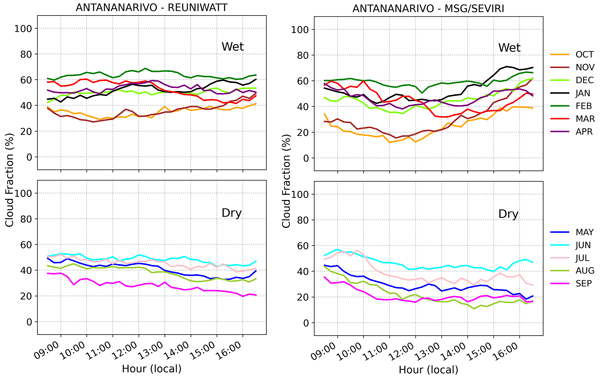
The lack of ground observation instruments and the vast ocean coverage make the Southwest Indian Ocean (SWIO) region difficult to access and poorly studied. For gathering ground-based camera information, satellite measurements have been used with the primary goal of characterizing both sites Saint-Denis of Reunion Island and Antananarivo Madagascar in terms of cloudiness. This study shows the particularity of each site and enhances our understanding of cloud properties, particularly in the SWIO.
Tristan Millet, Hassan Bencherif, Thierry Portafaix, Nelson Bègue, Alexandre Baron, Valentin Duflot, Cathy Clerbaux, Pierre-François Coheur, Andrea Pazmiño, Michaël Sicard, Anne Boynard, Jean-Marc Metzger, Guillaume Payen, Nicolas Marquestaut, and Sophie Godin-Beekmann
Atmos. Chem. Phys., 25, 10887–10905, https://doi.org/10.5194/acp-25-10887-2025, https://doi.org/10.5194/acp-25-10887-2025, 2025
Short summary
Short summary
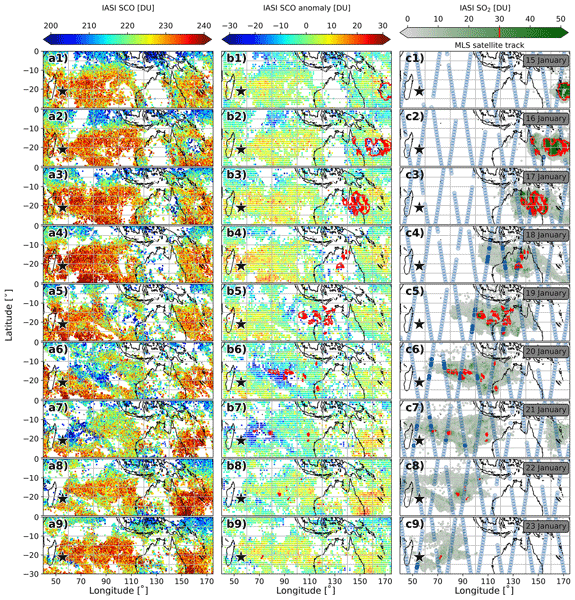
On 15 January 2022, the Hunga volcano erupted, releasing sulfur dioxide and water vapor into the stratosphere, impacting ozone levels over the Indian Ocean. Satellite data show the presence of a transient ozone depletion event related to the water vapor anomalies and sulfate aerosol clouds. Ozone reduction was confined to two distinct layers. On 21 January, the fifth percentile of total and stratospheric column ozone anomalies reached −18.6 and −14.5 DU, respectively.
Marion Ranaivombola, Nelson Bègue, Lucas Vaz Peres, Farahnaz Fazel-Rastgar, Venkataraman Sivakumar, Gisèle Krysztofiak, Gwenaël Berthet, Fabrice Jegou, Stuart Piketh, and Hassan Bencherif
Atmos. Chem. Phys., 25, 3519–3540, https://doi.org/10.5194/acp-25-3519-2025, https://doi.org/10.5194/acp-25-3519-2025, 2025
Short summary
Short summary
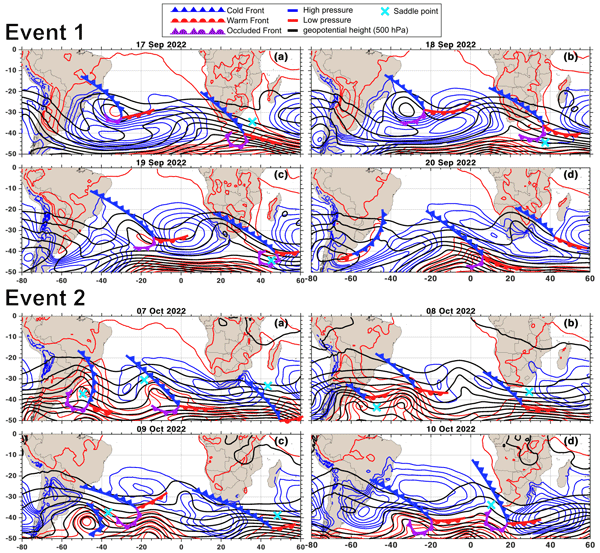
From September to October 2022, the Biomass Burning Aerosol Campaign (BiBAC) in Kruger National Park revealed a significant aerosol loading linked to biomass burning activity, with southeastward transport over southern Africa and the southwestern Indian Ocean (SWIO) basin. The study revealed a predominance of biomass burning aerosols and two distinct transport mechanisms of aerosol plumes and CO, underscoring the importance of east-coast observations in understanding atmospheric dynamics.
Michaël Sicard, Alexandre Baron, Marion Ranaivombola, Dominique Gantois, Tristan Millet, Pasquale Sellitto, Nelson Bègue, Hassan Bencherif, Guillaume Payen, Nicolas Marquestaut, and Valentin Duflot
Atmos. Chem. Phys., 25, 367–381, https://doi.org/10.5194/acp-25-367-2025, https://doi.org/10.5194/acp-25-367-2025, 2025
Short summary
Short summary
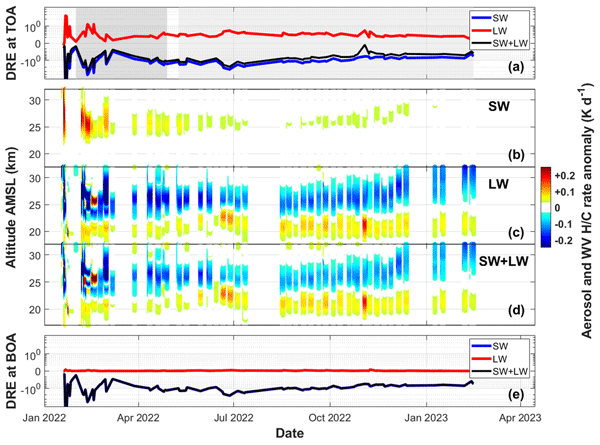
This study quantifies the radiative impact over Réunion Island (21° S, 55° E) of the aerosols and water vapor injected into the stratosphere by the Hunga volcano in the South Pacific. The overall aerosol and water vapor impact on the Earth’s radiation budget for the whole period is negative (cooling, -0.82 ± 0.35 W m-2) and dominated by the aerosols. At the Earth’s surface, aerosols are the main drivers and produce a negative (cooling, -1.04 ± 0.36 W m-2) radiative impact.
Gabriela Dornelles Bittencourt, Hassan Bencherif, Damaris Kirsch Pinheiro, Nelson Begue, Lucas Vaz Peres, José Valentin Bageston, Douglas Lima de Bem, Francisco Raimundo da Silva, and Tristan Millet
Atmos. Meas. Tech., 17, 5201–5220, https://doi.org/10.5194/amt-17-5201-2024, https://doi.org/10.5194/amt-17-5201-2024, 2024
Short summary
Short summary
The study examines the behavior of ozone at equatorial and subtropical latitudes in South America, in a multi-instrumental analysis. The methodology applied used ozonesondes (SHADOZ/NASA) and satellite data (TIMED/SABER), as well as analysis with ground-based and satellite instruments, allowing a more in-depth study at both latitudes. The main motivation is to understand how latitudinal differences in the observation of ozone content can interfere with the behavior of this trace gas.
Nelson Bègue, Alexandre Baron, Gisèle Krysztofiak, Gwenaël Berthet, Corinna Kloss, Fabrice Jégou, Sergey Khaykin, Marion Ranaivombola, Tristan Millet, Thierry Portafaix, Valentin Duflot, Philippe Keckhut, Hélène Vérèmes, Guillaume Payen, Mahesh Kumar Sha, Pierre-François Coheur, Cathy Clerbaux, Michaël Sicard, Tetsu Sakai, Richard Querel, Ben Liley, Dan Smale, Isamu Morino, Osamu Uchino, Tomohiro Nagai, Penny Smale, John Robinson, and Hassan Bencherif
Atmos. Chem. Phys., 24, 8031–8048, https://doi.org/10.5194/acp-24-8031-2024, https://doi.org/10.5194/acp-24-8031-2024, 2024
Short summary
Short summary
During the 2020 austral summer, the pristine atmosphere of the southwest Indian Ocean basin experienced significant perturbations. Numerical models indicated that the lower-stratospheric aerosol content was influenced by the intense and persistent stratospheric aerosol layer generated during the 2019–2020 extreme Australian bushfire events. Ground-based observations at Réunion confirmed the simultaneous presence of African and Australian aerosol layers.
Tristan Millet, Hassan Bencherif, Thierry Portafaix, Nelson Bègue, Alexandre Baron, Valentin Duflot, Michaël Sicard, Jean-Marc Metzger, Guillaume Payen, Nicolas Marquestaut, and Sophie Godin-Beekmann
EGUsphere, https://doi.org/10.5194/egusphere-2023-2645, https://doi.org/10.5194/egusphere-2023-2645, 2023
Preprint withdrawn
Short summary
Short summary
The eruption of the Hunga Tonga volcano in January 2022 released substantial amounts of aerosols, sulfur dioxide, and water vapor into the stratosphere. Satellite and ground instruments followed the displacement of the volcanic aerosol plume and its impact on ozone levels over the Indian Ocean. Ozone data reveal the presence of a persistent ozone mini-hole structure from 17 January to 22 January, with most ozone depletion occurring within the ozone layer at the location of the aerosol plume.
Bibiana Lopes, Damaris Kirsch Pinheiro, Hassan Bencherif, Gabriela Dornelles Bittencourt, Lucas Vaz Peres, Jean-Maurice Cadet, Thierry Portafaix, and Nathalie Tissot Boiaski
EGUsphere, https://doi.org/10.5194/egusphere-2023-1474, https://doi.org/10.5194/egusphere-2023-1474, 2023
Preprint archived
Short summary
Short summary
This is a study of the climatology and behavior of UV radiation on the surface during events of secondary effects of the Antarctic ozone hole over south of Brazil. Considering all implications of excess exposure to UV radiation on the surface on human health it is important to know how much radiation the population is being exposed to during those events. Results showed that for each 1 % decrease in the ozone total column, the UV index tends to increase by 4 % in the region of study.
Gabriela Dornelles Bittencourt, Damaris Kirsch Pinheiro, Hassan Bencherif, Lucas Vaz Peres, Nelson Begue, José Valentin Bageston, Douglas Lima de Bem, Vagner Anabor, and Luiz Angelo Steffenel
EGUsphere, https://doi.org/10.5194/egusphere-2023-1471, https://doi.org/10.5194/egusphere-2023-1471, 2023
Preprint archived
Short summary
Short summary
The study examines ozone depletions at mid-latitudes in Brazil during austral spring Antarctic Ozone Hole influence events. The methodology applied used data from the total column ozone, vertical profile of the atmosphere, and reanalysis data to analyze the atmospheric dynamics. The main motivation of this work is to show how this important trace gas dynamically behaves in the atmosphere in the active period of the Antarctic Ozone Hole in regions of medium latitudes.
Olivier Delage, Thierry Portafaix, Hassan Bencherif, Alain Bourdier, and Emma Lagracie
Nonlin. Processes Geophys., 29, 265–277, https://doi.org/10.5194/npg-29-265-2022, https://doi.org/10.5194/npg-29-265-2022, 2022
Short summary
Short summary
The complexity of geophysics systems results in time series with fluctuations at all timescales. The analysis of their variability then consists in decomposing them into a set of basis signals. We developed here a new adaptive filtering method called empirical adaptive wavelet decomposition that optimizes the empirical-mode decomposition existing technique, overcoming its drawbacks using the rigour of wavelets as defined in the recently published empirical wavelet transform method.
Cited articles
Anthes, R. A., Bernhardt, P. A., Chen, Y., Cucurull, L., Dymond, K. F., Ector, D., Healy, S. B., Ho, S., Hunt, D. C., Kuo, Y., Liu, H., Manning, K., McCormick, C., Meehan, T. K., Randel, W. J., Rocken, C., Schreiner, W. S., Sokolovskiy, S. V., Syndergaard, S., Thompson, D. C., Trenberth, K. E., Wee, T., Yen, N. L., and Zeng, Z.: The COSMIC/FORMOSAT-3 Mission: Early Results, Bulletin of the American Meteorological Society, 89, 313–334, 2008.
Astudillo, J. M., Lau, L., Tang, Y. T., and Moore, T.: A novel approach for the determination of the height of the tropopause from ground-based GNSS observations, Remote Sensing, 12, https://doi.org/10.3390/rs12020293, 2020.
Baldy, S., Ancellet, G., Bessafi, M., Badr, A., and Lan Sun Luk, D.: Field observations of the vertical distribution of tropospheric ozone at the Island of La Réunion, J. Geophys. Res., 101, 23835–23849, 1996.
Batista, P. P., Clemesha, B. R., and Simonich, D. M.: A 14-year monthly climatology and trend in the 35–65km altitude range from Rayleigh Lidar temperature measurements at a low latitude station, Journal of Atmospheric and Solar-Terrestrial Physics, 71, 1456–1462, 2009.
Bègue, N., Bencherif, H., Sivakumar, V., Kirgis, G., Mze, N., and Leclair de Bellevue, J.: Temperature variability and trends in the UT-LS over a subtropical site: Reunion (20.8° S, 55.5° E), Atmos. Chem. Phys., 10, 8563–8574, https://doi.org/10.5194/acp-10-8563-2010, 2010.
Bencherif, H., Diab, R. D., Portafaix, T., Morel, B., Keckhut, P., and Moorgawa, A.: Temperature climatology and trend estimates in the UTLS region as observed over a southern subtropical site, Durban, South Africa, Atmos. Chem. Phys., 6, 5121–5128, https://doi.org/10.5194/acp-6-5121-2006, 2006.
Birner, T., Sankey, D., and Shepherd, T. G.: The tropopause inversion layer in models and analyses, Geophys. Res. Lett., 33, L14804, https://doi.org/10.1029/2006GL026549, 2006.
Britannica: Réunion, https://www.britannica.com/place/Reunion (last access: 8 May 2025), 2025.
France, J. A., Harvey, V. L., Randall, C. E., Hitchman, M. H., and Schwartz, M. J.: A climatology of stratopause temperature and height in the polar vortex and anticyclones, J. Geophys. Res., 117, D06116, https://doi.org/10.1029/2011JD016893, 2012.
Frierson, D. M.: Robust increases in midlatitude static stability in simulations of global warming, Geophys. Res. Lett., 33, https://doi.org/10.1029/2006GL027504, 2006.
Fueglistaler, S., Dessler, A. E., Dunkerton, T. J., Folkins, I., Fu, Q., and Mote, P. W.: Tropical tropopause layer, Rev. Geophys., 47, RG1004, https://doi.org/10.1029/2008RG000267, 2009.
Global Modeling and Assimilation Office (GMAO): tavg3_3d_asm_Nv: MERRA-2 3D IAU State, Meteorology Instantaneous 3-hourly (p-coord, 0.625x0.5L42), version 5.12.4, Greenbelt, MD, USA: Goddard Space Flight Center Distributed Active Archive Center (GSFC DAAC), https://doi.org/10.5067/SUOQESM06LPK, 2015.
Hoinka, K. P.: Statistics of the Global Tropopause Pressure, Mon. Wea. Rev., 126, 3303–3325, 1998.
Ladstädter, F., Steiner, A. K., and Gleisner, H.: Resolving the 21st century temperature trends of the upper troposphere–lower stratosphere with satellite observations, Sci. Rep. 13, 1306, https://doi.org/10.1038/s41598-023-28222-x, 2023.
Ladstädter, F., Stocker, M., Scher, S., and Steiner, A. K.: Observed changes in the temperature and height of the globally resolved lapserate tropopause, Atmos. Chem. Phys., 25, 16053–16062, https://doi.org/10.5194/acp-25-16053-2025, 2025.
Loon, H. V. and Jenne, R. L.: The Half-Yearly Oscillations in the Tropics of the Southern Hemisphere, J. Atmos. Sci., 26, 218–232, 1969.
Morioka, Y., Tozuka, T., and Yamagata, T.: Climate variability in the southern Indian Ocean as revealed by self-organizing maps, Clim. Dyn., 35, 1059–1072, 2010.
NASA Goddard Space Flight Center (GSFC) SHADOZ Team: Southern Hemisphere ADditional OZonesondes (SHADOZ) Version 06 (V06) Station Data (Version V06), NASA [SHADOZ] [data set], https://doi.org/10.57721/SHADOZ-V06, 2019.
Negash, T. and Raju, U. P.: Study on long term troposphere lower stratosphere temperature (TLST) trend in tropical and subtropical northern hemisphere using ground based and COSMIC satellite data, Journal of Atmospheric and Solar-Terrestrial Physics, 261, 106306, https://doi.org/10.1016/j.jastp.2024.106306, 2024.
Randel, W. and Jensen, E.: Physical processes in the tropical tropopause layer and their roles in a changing climate, Nature Geosci., 6, 169–176, 2013.
Randel, W. J. and Cobb, J. B.: Coherent variations of monthly mean total ozone and lower stratospheric temperature, J. Geophys. Res., 99, 5433–5447, 1994.
Randel, W. J., Wu, F., and Gaffen, D. J.: Interannual variability of the tropical tropopause derived from radiosonde data and NCEP reanalyses, J. Geophys. Res, 105 , 15509–15523, 2000.
Reid, G. C. and Gage, K. S.: On the annual variation in height of the tropical tropopause, J. Atmos. Sci., 38, 1928–1938, 1981.
Reid, G. C. and Gage, K. S.: A relationship between the height of the tropical tropopause and the global angular momentum of the atmosphere, Geophys. Res. Lett., 1, 840–842, 1984.
Reid, G. C. and Gage, K. S.: Interannual variations in the height of the tropical tropopause, J. Geophys. Res., 90, 5629–5635, 1985.
Saji, N. H., Goswami, B. N., Vinayachandran, P. N., and Yamagata, T.: A dipole mode in the tropical Indian Ocean, Nature 401, 360–363, 1999.
Santer, B. D., L. Wigley, T. M., Simmons, A. J., Kållberg, P. W., Kelly, G. A., Uppala, S. M., Ammann, C., Boyle, J. S., Brüggemann, W., Doutriaux, C., Fiorino, M., Mears, C., Meehl, G. A., Sausen, R., Taylor, K. E., Washington, W. M., Wehner, M. F., and Wentz, F. J.: Identification of anthropogenic climate change using a second-generation reanalysis, J. Geophys. Res., 109, D21104, https://doi.org/10.1029/2004JD005075, 2004.
Schmidt, T., Wickert, J., Beyerle, G., and Reigber, C.: Tropical tropopause parameters derived from GPS radio occultation measurements with CHAMP, J. Geophys. Res., 109, D13105, https://doi.org/10.1029/2004JD004566, 2004.
Seidel, D. J., Ross, R. J., and Angell, J. K.: Climatological characteristics of the tropical tropopause as revealed by radiosonde, J. Geophys. Res., 106, 7857–7878, 2001.
Selkirk, H. B.: The tropopause cold trap in the Australian monsoon during STEP/AMEX 1987, J. Geophys. Res., 98, 8591–8610, 1993.
Shangguan, M. and Wang, W.: The semi-annual oscillation (SAO) in the upper troposphere and lower stratosphere (UTLS), Atmos. Chem. Phys., 22, 9499–9511, https://doi.org/10.5194/acp-22-9499-2022, 2022.
Sivakumar, V., Baray, J.-L., Baldy, S., and Bencherif, H.: Tropopause characteristics over a southern subtropical site, Reunion Island (21° S, 55° E): Using radiosonde–ozonesonde data, J. Geophys. Res., 111, D19111, https://doi.org/10.1029/2005JD006430, 2006.
Sivakumar, V., Bencherif, H., Bègue, N., and Thompson, A. M.: Tropopause Characteristics and Variability from 11 yr of SHADOZ Observations in the Southern Tropics and Subtropics, J. Appl. Meteor. Climatol., 50, 1403–1416, 2011a.
Sivakumar, V., Vishnu Prasanth, P., Kishore, P., Bencherif, H., and Keckhut, P.: Rayleigh LIDAR and satellite (HALOE, SABER, CHAMP and COSMIC) measurements of stratosphere-mesosphere temperature over a southern sub-tropical site, Reunion (20.8° S; 55.5° E): climatology and comparison study, Ann. Geophys., 29, 649–662, 2011b.
Sivakumar, V., Jimmy, R., Bencherif, H., Bègue, N., and Portafaix, T.: Use of the TREND RUN model to deduce trends in South African Weather Service (SAWS) atmospheric data: Case study over Addo (33.568° S, 25.692° E) Eastern Cape, South Africa, Journal of Neutral Atmosphere, 51–58, hal-02098051, 2017.
Sterling, C. W., Johnson, B. J., Oltmans, S. J., Smit, H. G. J., Jordan, A. F., Cullis, P. D., Hall, E. G., Thompson, A. M., and Witte, J. C.: Homogenizing and estimating the uncertainty in NOAA's long-term vertical ozone profile records measured with the electrochemical concentration cell ozonesonde, Atmos. Meas. Tech., 11, 3661–3687, https://doi.org/10.5194/amt-11-3661-2018, 2018.
Tegtmeier, S., Anstey, J., Davis, S., Dragani, R., Harada, Y., Ivanciu, I., Pilch Kedzierski, R., Krüger, K., Legras, B., Long, C., Wang, J. S., Wargan, K., and Wright, J. S.: Temperature and tropopause characteristics from reanalyses data in the tropical tropopause layer, Atmos. Chem. Phys., 20, 753–770, https://doi.org/10.5194/acp-20-753-2020, 2020.
Toihir, A. M., Portafaix, T., Sivakumar, V., Bencherif, H., Pazmiño, A., and Bègue, N.: Variability and trend in ozone over the southern tropics and subtropics, Ann. Geophys., 36, 381–404, 2018.
Thompson, A. M., Witte, J. C., McPeters, R. D., Oltmans, S. J., Schmidlin, F. J., Logan, J. A., Fujiwara, M., H. Kirchhoff, W. J., Posny, F., R. Coetzee, G. J., Hoegger, B., Kawakami, S., Ogawa, T., Johnson, B. J., Vömel, H., and Labow, G.: Southern Hemisphere Additional Ozonesondes (SHADOZ) 1998–2000 tropical ozone climatology 1. Comparison with Total Ozone Mapping Spectrometer (TOMS) and ground-based measurements, J. Geophys. Res., 108, 8238, https://doi.org/10.1029/2001JD000967, 2003.
Thompson, A. M., Witte, J. C., Sterling, C., Jordan, A., Johnson, B. J., Oltmans, S. J., Fujiwara, M., Vömel, H., Allaart, M., Piters, A., R. Coetzee, G. J., Posny, F., Corrales, E., Diaz, J. A., Félix, C., Komala, N., Lai, N., Ahn Nguyen, H. T., Maata, M., et al.: First reprocessing of Southern Hemisphere Additional Ozonesondes (SHADOZ) ozone profiles (1998–2016): 2. Comparisons with satellites and ground-based instruments, Journal of Geophysical Research: Atmospheres, 122, 13000–13025, https://doi.org/10.1002/2017JD027406, 2017.
Thompson, A. M., Stauffer, R. M., Wargan, K., Witte, J. C., Kollonige, D. E., and Ziemke, J. R.: Regional and seasonal trends in tropical ozone from SHADOZ profiles: Reference for models and satellite products, J. of Geophys. Res. Atmos., 126, https://doi.org/10.1029/2021JD034691, 2021.
UCAR COSMIC Program: COSMIC-1 Data Products, UCAR/NCAR – COSMIC [data set], https://doi.org/10.5065/ZD80-KD74, 2002.
Vignon, E. and Mitchell, D. M.: The stratopause evolution during different types of sudden stratospheric warming event, Clim. Dyn., 44, 3323–3337, 2015.
Witte, J. C., Thompson, A. M., Smit, H. G. J., Fujiwara, M., Posny, F., Coetzee, G. J. R., Northam, E. T., Johnson, B. J., Sterling, C. W., Mohamad, M., Ogino, Shin-Ya, Jordan, A., and da Silva, F.: First reprocessing of Southern Hemisphere ADditional OZonesondes (SHADOZ) profile records (1998-2015): 1. Methodology and evaluation, J. Geophys. Res. Atmos., 122, 6611–6636, 2017.
Witte, J. C., Thompson, A. M., Smit, H. G. J., Vömel, H., Posny, F., and Stübi, R.: First reprocessing of Southern Hemisphere ADditional OZonesondes profile records: 3. Uncertainty in ozone profile and total column, Journal of Geophysical Research: Atmospheres, 123, 3243–3268, https://doi.org/10.1002/2017JD027791, 2018.
WMO: Definition of the tropopause, WMO Bull., 6, 136, 1957.
Xia, P., Shan, Y., Ye, S., and Jiang, W.: Identification of Tropopause Height with Atmospheric Refractivity, J. Atmos. Sci., 78, 3–16, 2021.
Xian, T. and Homeyer, C. R.: Global tropopause altitudes in radiosondes and reanalyses, Atmos. Chem. Phys., 19, 5661–5678, https://doi.org/10.5194/acp-19-5661-2019, 2019.
Zhran, M. and Mousa, A.: Global tropopause height determination using GNSS radio occultation, The Egyptian Journal of Remote Sensing and Space Science, 26, 317–331, 2023.
Zhran, M., Mousa, A., Alshehri, F., and Jin, S.: Evaluation of Tropopause Height from Sentinel-6 GNSS Radio Occultation Using Different Methods, Remote Sens., 15, 5513, https://doi.org/10.3390/rs15235513, 2023.
Zou, L., Hoffmann, L., Müller, R., and Spang, R.: Variability and trends of the tropical tropopause derived from a 1980–2021 multi-reanalysis assessment, Front. Earth Sci., 11, 1177502, https://doi.org/10.3389/feart.2023.1177502, 2023.
Short summary
Tropopause temperature and height serve as key indicators of anthropogenic climate change. However, monitoring their variability remains challenging due to the sparse distribution of observation stations, particularly in the Southern Hemisphere. To address this, we compared temperature profiles from three datasets—SHADOZ, COSMIC-1, and MERRA-2—to assess their similarities and differences and to develop a refined dataset for trend analysis.
Tropopause temperature and height serve as key indicators of anthropogenic climate change....