
the Creative Commons Attribution 4.0 License.
the Creative Commons Attribution 4.0 License.
 | 15 Dec 2025
Establishing a European Heliophysics Community (EHC)
Thierry Dudok de Wit
Geraint H. Jones
Matt G. G. T. Taylor
Nicolas André
Charlotte Goetz
Lina Z. Hadid
Laura A. Hayes
Heli Hietala
Caitríona M. Jackman
Larry Kepko
Aurélie Marchaudon
Adam Masters
Mathew Owens
Noora Partamies
Stefaan Poedts
Jonathan Rae
Yuri Shprits
Manuela Temmer
Daniel Verscharen
Robert F. Wimmer-Schweingruber
Europe hosts a large and highly active community of scientists working in the broad domain of Heliophysics. This broad discipline addresses plasmas in the regions of space and atmosphere influenced by the Sun and solar wind. However, this community has historically been fragmented, both geographically and thematically, which has limited the potential for strategic coordination, collaboration, and growth. This has recently prompted a grass-roots community-building effort to foster communication and interactions within the European Heliophysics Community (EHC). This white paper outlines the motivation, priorities, and initial steps towards establishing the EHC, and presents a vision for the future of Heliophysics in Europe. As a crucial first step of this endeavour, a dedicated EHC website is now available: https://www.heliophysics.eu/ (last access: November 2025).
- Article
(7080 KB) - Full-text XML
- BibTeX
- EndNote


Heliophysics spans a wide range of disciplines covering the study of the Sun, its sphere of influence, and the different bodies in the Solar System and their interactions with the Sun. The field also covers a staggering wide range of scales, from the outer edge of the Solar System to mesoscales, and down to the smallest (kinetic) scales at which electron dynamics determine plasma behaviour. Heliophysics is therefore inherently interdisciplinary, encompassing aspects of solar physics, space plasma physics, ionosphere-thermosphere physics, magnetospheric physics, planetary physics, small body physics, fundamental and applied space weather research, and more. Common to all these disciplines is the physics of (fully and partially) ionised plasmas, ranging from collisional to collisionless, and from magnetic to plasma energy dominated, see Fig. 1.
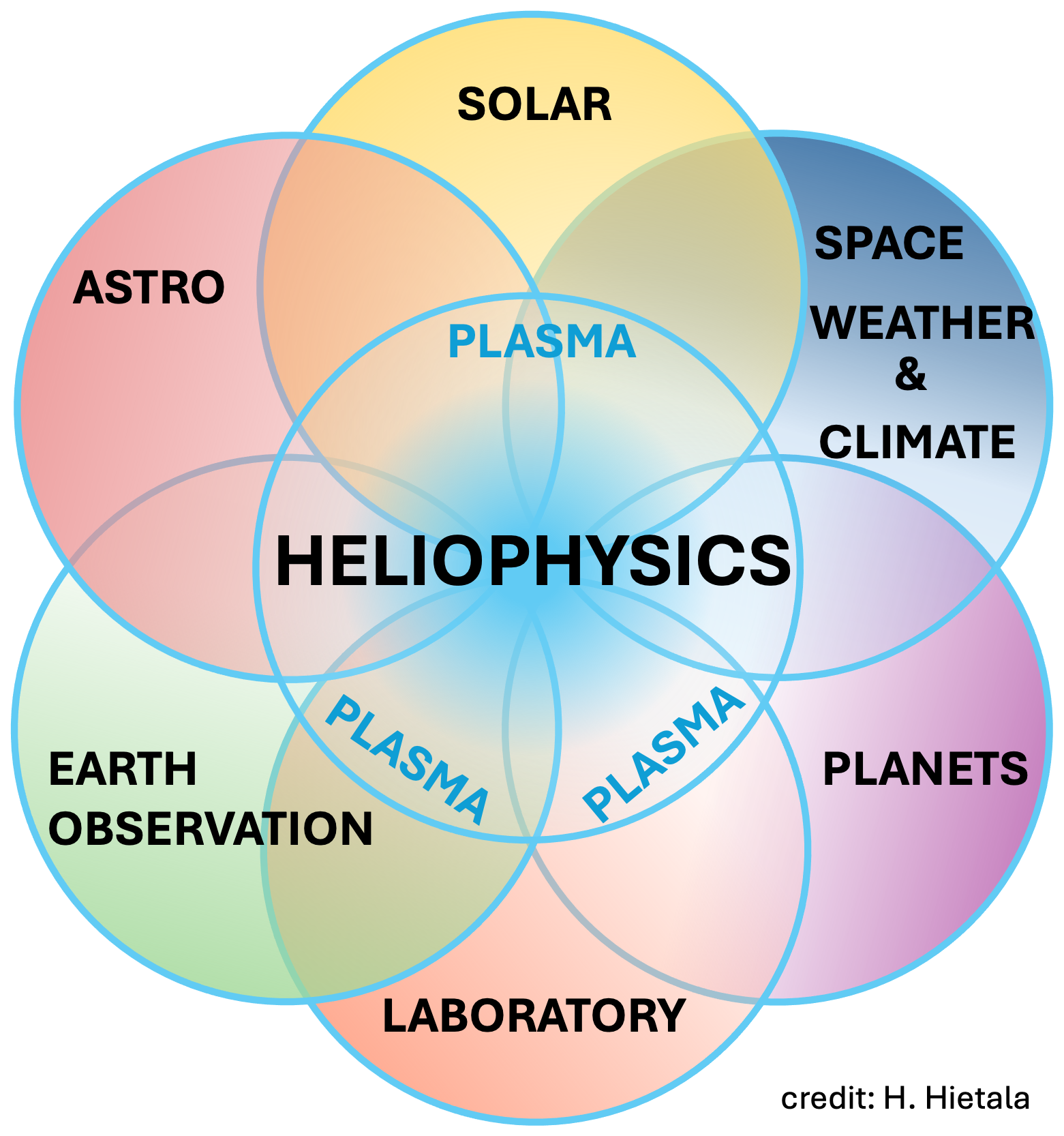
Figure 1Illustration of the interconnected areas/topics of Heliophysics and neighbouring disciplines and communities, plasma and Heliophysics being denoted as crucial components of all surrounding disciplines. (Credit: Heli Hietala)
In Europe, a large and highly active community of scientists is working on these different aspects. However, this broad umbrella discipline has historically been fragmented geographically and thematically, which has made communication, coordination, and collaboration cumbersome, even though fundamental plasma physics and techniques share a common thread. For this reason, there is a clear need for an EHC that would improve communication (within the community and with other disciplines), foster collaboration and networking, drive innovation, and position Europe as a major player in addressing the scientific and practical challenges posed by our Sun. Such coordination would enhance Europe's leadership, long-term competitiveness, and resilience in Heliophysics research and its applications.
This community-building effort was ignited at the first Heliophysics in Europe Science Workshop, a week-long meeting held at the European Space Research and Technology Centre (ESTEC, Noordwijk) in October 2023. Motivated and inspired by the high interest and overwhelmingly positive community feedback received at a meeting held at the General Assembly of the European Geosciences Union (EGU) in 2024, the second workshop, a comprehensive online edition, took place in November 2024. These discussions were complemented by a three-day forum hosted by the International Space Science Institute (ISSI, Bern) in January 2025. The authors of this paper are the participants of that forum.
This white paper synthesises the outcomes of these ongoing discussions and sets out a vision for building a joint community. It reflects contributions across the thematic scope of EGU's Solar-Terrestrial (ST) and Planetary and Solar System Sciences (PS), and also partly that of the Nonlinear Processes in Geosciences (NP) divisions. An EHC would facilitate the formation of interdisciplinary research teams, strengthen joint European Space Agency (ESA) mission proposals, and support more coordinated interdisciplinary research for cutting-edge science. A coordinated EHC would also promote interdisciplinary communication between early career and senior researchers and provide a platform to develop new ideas for space missions, ground-based facilities, modelling efforts, and shared software tools and data infrastructure across Heliophysics. Although this paper describes a European initiative, such an EHC is inherently international and aligns closely with the recent call for international cooperation in Heliophysics (Kepko et al., 2024).
After a brief historical overview in Sect. 2, we present several examples in Sect. 3 that illustrate the added scientific value of interdisciplinary interactions in Heliophysics. Sect. 4 captures the main message of our work with a list of suggestions and a vision of the way forward.
For many years, European space scientists had expressed the desire to improve communication and interaction within the scientific community. In particular, members of the Earth's magnetosphere community considered organising meetings similar to those supported by the Geospace Environment Modelling (GEM) programme, an initiative of the USA's National Science Foundation (NSF) Division of Atmospheric Sciences, focusing on topical, interactive discussions instead of more formal, conference-style presentations. Around 2020, this discussion expanded to encompass a broader range of space plasma scientists under the Heliophysics umbrella, including those specialising in the Sun, planets and small bodies, as well as the ground-based and space weather communities.
A key issue in these discussions was that there was no single European entity representing this broad interdisciplinary field. For example, there was no equivalent to what is covered by the division on Solar-Terrestrial (ST), on Planetary and Solar-System Sciences (PS), and Nonlinear Processes in Geosciences (NP) in the European Geosciences Union (EGU). Clearly, the field's wide breadth and fragmentation also complicated interactions between sub-communities. This made responding to mission proposals and job or studentship calls challenging, as well as highlighting the logistical challenges of interacting across pre-existing sub-sections of the community, i.e. how to connect space- and ground-based observations. These discussions also raised the need for better support of shared tools and open-source software platforms, which support many cross-domain studies but lack coordinated development and long-term support. Within the Space Weather and Space Climate community, discussions about coordination has been ongoing for around a decade (Lilensten et al., 2021). These discussions ultimately resulted in establishing the European Space Weather and Space Climate Association (E-SWAN) in 2022, demonstrating the value of community action.
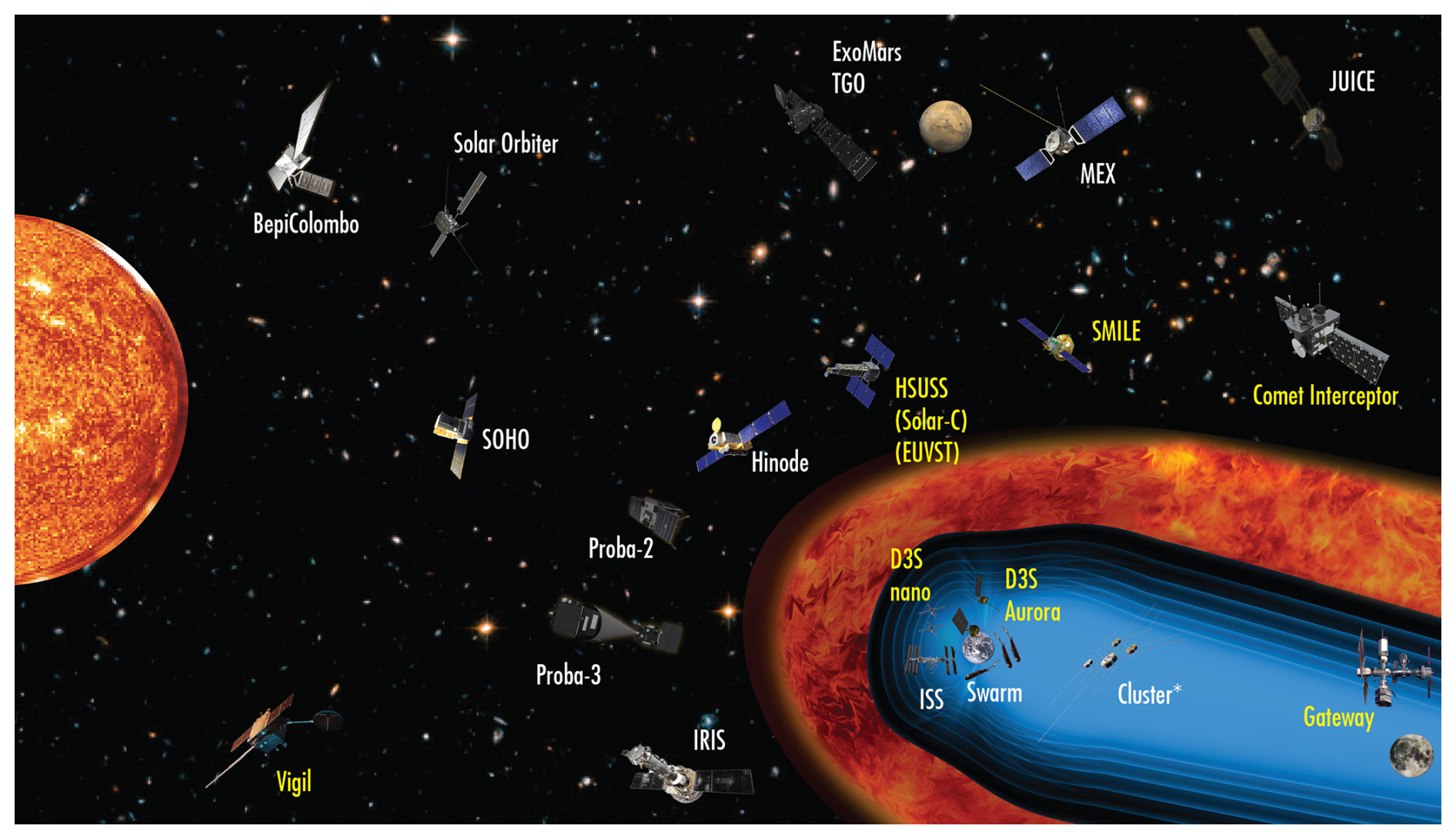
Figure 2The set of ESA-led (or collaborative missions with other agencies) in operation recently and in upcoming years which have capability to study Heliophysics phenomena. The asterisk by “Cluster” indicates that the science phase of the mission has recently finished following the re-entry of Cluster 2, Salsa, in September 2024. The yellow text indicates where missions have not yet launched. These missions pursue a wide range of scientific objectives across different disciplines and over large distances, thereby deepening our understanding of the space plasma that fills our solar system. (Credit: ESA)
Driven by and in support of the European science community, the ESA has built a solid portfolio of Heliophysics missions. Missions that are of interest for Heliophysics commmunity such as Ulysses, SoHO, Cluster, Double Star, Solar Orbiter, Cassini-Huygens, Venus Express, Mars Express, Rosetta, BepiColombo, and Jupiter Icy Moons Explorer (Juice), are a result of and the responsibility of the Science Directorate (D/SCI). However, in recent years, other ESA directorates have also developed and launched missions that address Heliophysics science. These include the Directorate of Earth Observation (D/EOP) with Swarm and other Earth Explorer missions (including the Earth Explorer 10 candidate, Daedalus, and follow-on activities carried out by the ESA-NASA Lower Thermosphere-Ionosphere Science Working Group (ENLoTIS, Berthelier et al. (2024)) and Soil Moisture and Ocean Salinity mission (SMOS). The Directorate of Operations (D/OPS) has developed the Vigil mission, the Distributed Space Weather Sensor System (D3S) (e.g nanosatellites and the Aurora mission), and the Space Weather Service Network. The Directorate of Human and Robotic Exploration (D/HRE) has developed and supported many payloads, both for the International Space Station and for the Lunar Gateway and Lunar surface, and the Directorate of Technology, Engineering, and Quality (D/TEC) has expertise in developing instrumentation and models for measuring and simulating environments throughout the heliosphere. The latter directorate is also responsible for the Proba-2 and Proba-3 missions, with support from D/SCI. The fleet of ESA related recent and upcoming mission that allow us to study the various topics of heliophysics are illustrated in Fig. 2.
Recognizing the need to coordinate and communicate these activities more effectively across these directorates, the Director General of the ESA established the ESA Heliophysics Working Group (ESAHWG) in 2021. This cross-directorate group comprises representatives from the various directorates whose activities fall under the Heliophysics discipline. The intention is to improve internal interactions in this area within ESA. As part of their remit, the group was tasked with identifying synergistic activities and setting up community meetings to examine them. The ESAHWG organised a workshop entitled Heliophysics in Europe, supported by the community, to highlight cross-cutting activities in Europe and encourage discussion within the scientific community. Following this meeting, the community identified the need for structuring, establishing the EHC to identify cross-cutting topics, support early career colleagues, and develop a platform for long-term coordination. In parallel, there has been an international effort to recognise Heliophysics as a unified discipline with a substantial global community (e.g. Kepko et al., 2024). Therefore, the emergence of the EHC is well timed to build on this “heliophysical momentum” through grass-roots community action. In the next Section, we demonstrate this with a selection of examples that reveal the importance of multidisciplinarity in Heliophysics. However, the key message of this article and our vision for the future are detailed in Sect. 4.
Heliophysics covers a network of interconnected systems that are connected by a wide range of temporal and spatial scales, see in particular (Schrijver and Siscoe, 2009, 2010a, b; Schrijver et al., 2016, 2022). The Sun lies at the core, whose variability and solar wind interact with and shape the environment of all bodies within the Solar System through diverse processes such as heating, driving chemical reactions, sputtering of atmospheres and solid surfaces, space weathering (e.g. Hapke, 2001), ionisation, energizing plasma populations. These interactions shape magnetized bodies' magnetospheres, and create induced magnetospheres where mass-loading occurs. Defining the boundaries of Heliophysics has proven surprisingly difficult, many of our community discussions have revolved around this very question. The field is inherently interdisciplinary and resists a strict definition, drawing strength from its ability to connect diverse sub-disciplines and research approaches. It is therefore clear that Heliophysics encompasses not only the study of the Sun and solar wind themselves, but also numerous subdisciplines in terrestrial and other planetary research areas, including, but not limited to, atmospheric science, magnetospheric physics, and cometary science. Another common thread of these studies is their multiscale approach (both temporal and spatial) in the sense that often, observing the interplay between processes operating at different scales is more important than observing the processes themselves. Due to the universality of the involved plasma processes, Heliophysics learns from and informs other fields, such as plasma-astrophysics and laboratory plasma physics (Koepke, 2008; Howes, 2018).
This Section presents selected examples of Heliophysics research to highlight its interdisciplinary nature. This list is not intended to be exhaustive; instead, it aims to demonstrate the vital importance of cross-disciplinary collaboration in achieving solid scientific progress. Examples of the key aspects of the interdisciplinary research that can be performed by EHC and discussed in the following subsections are illustrated in Fig. 3.
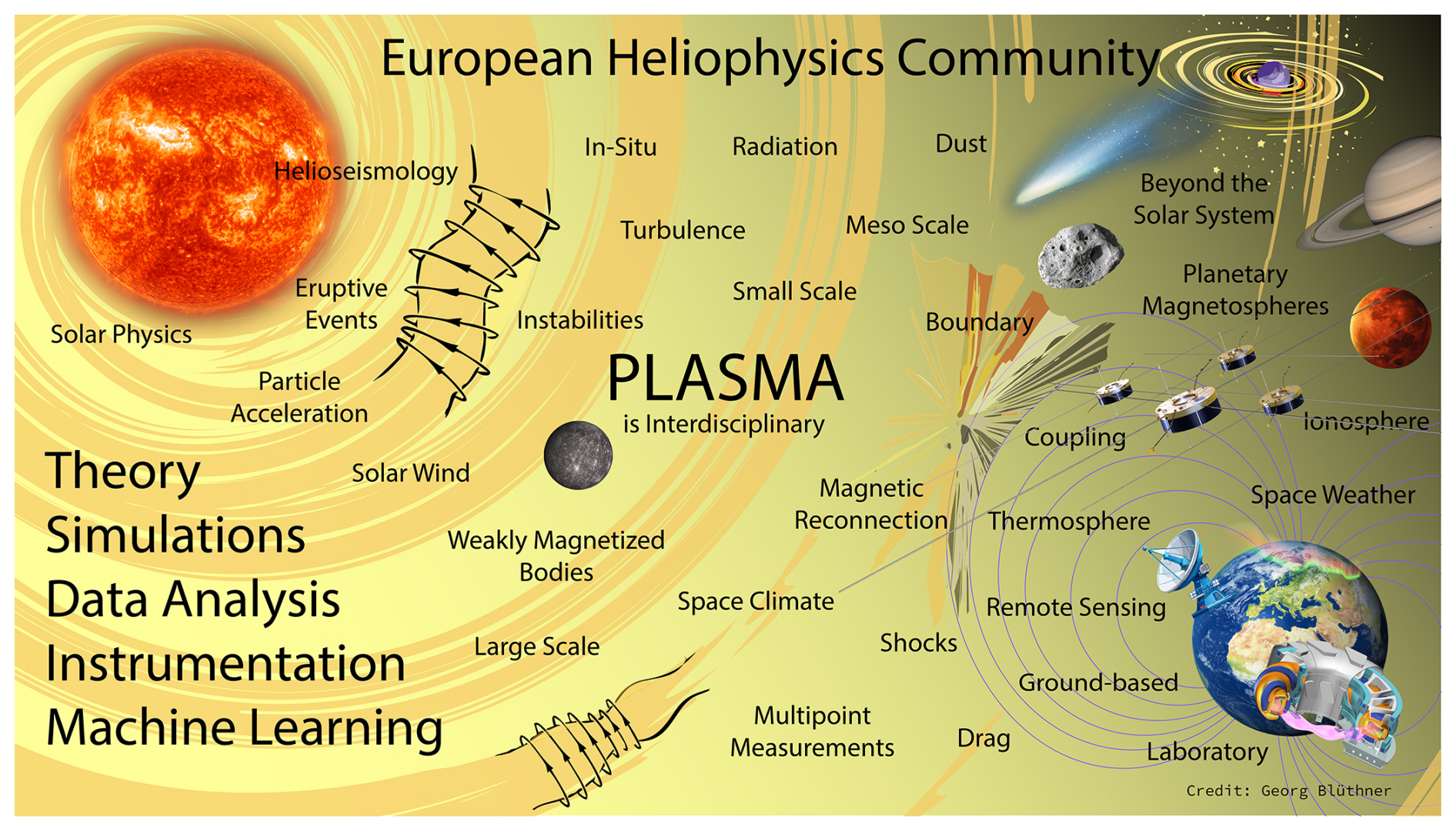
Figure 3Illustration of some key aspects of various interdisciplinary research in the domain of Heliophysics discussed in the examples in Sect. 3. These examples are not exhaustive, but they are intended to demonstrate the different interdisciplinary research activities of EHC. (Credit: Georg Blüthner)
3.1 Solar Physics and observing the source of Heliophysics Variability
Solar physics forms a central pillar of Heliophysics, providing the origin point for the magnetic and plasma structures that shape the heliosphere and drive variability throughout the Solar System(Owens and Forsyth, 2013). From the solar dynamo and the emergence of magnetic fields to the heating of the corona and the eruption of flares and Coronal Mass Ejections (CMEs), solar physics addresses fundamental plasma phenomena with far-reaching heliospheric consequences.
A distinctive feature of solar physics within the context of Heliophysics is its dependence on remote sensing (e.g. Antonucci et al., 2020). Multi-wavelength observations, from EUV and X-ray to white light and radio, provide continuous imaging and spectroscopy of the solar atmosphere. These measurements are essential for diagnosing plasma temperatures, densities, and velocities, and for tracking the evolution of magnetic structures. Remote sensing enables the reconstruction of coronal magnetic fields, the detection of emerging flux, and the monitoring of flares and CMEs in real time.
Europe has established itself as a leader in solar physics through a combination of space missions and ground-based observatories. ESA-led missions such as SoHO and Solar Orbiter have provided critical insights into the solar atmosphere and solar wind (e.g. Velli et al., 2020). Ground-based observatories including the Swedish 1 m Solar Telescope, GREGOR telescope, Télescope Héliographique pour l'Étude du Magnétisme et des Instabilités Solaires (THEMIS), and radio facilities such as the Nancay Radioheliograph, and LOw Frequency ARray (LOFAR) contribute high-resolution imaging and radio diagnostics (e.g. Morosan et al., 2014). The European Solar Telescope (EST), currently under development, will further enhance Europe's capability to probe the structure and evolution of the solar magnetic field at small scales. ESA and European research teams have contributed to and benefited from international missions such as Hinode and IRIS, and are also involved in the upcoming Solar-C (EUVST) mission. These collaborations enhance scientific return and promote coordination across agencies and disciplines.
As such, solar physics is not an isolated discipline, but an integral part of Heliophysics. Its remote sensing capabilities, combined with theoretical modeling and data-driven approaches, provide the starting point for understanding the coupled Sun–heliosphere–planet system. In the next subsection, we explore how solar outputs, including the solar wind and eruptive events, structure the heliosphere and connect to space environments throughout the solar system.
3.2 Connecting the Sun and the Heliosphere
The Sun drives a supersonic solar wind flow, the origin of which is closely linked to one of the major open questions in contemporary physics: the nature of solar coronal heating (Cranmer and Winebarger, 2019). This solar wind inflates the heliosphere, a giant plasma bubble that surrounds the Solar System and protects it from interstellar space. The topology and geometry of Earth's and other planets' magnetic fields are heavily influenced by the plasma stream, which mainly consists of protons and electrons emitted from the Sun's surface. Substantial variations in the solar wind's plasma and magnetic field characteristics stem from transient events, such as CMEs or co-rotating interaction regions (CIRs), as well as abrupt polarity changes due to the heliospheric current sheet. This plasma and the associated magnetic field constitute the external input to any magnetospheric processes. Hence, the different sources of the solar wind on the Sun structure the heliosphere (see e.g., Temmer, 2021; Zhang et al., 2021).
Our understanding of the heliosphere was shaped by early space missions such as the Pioneers (e.g. Fimmel et al., 1980) and Voyagers (Stone, 1977), by the twin Helios spacecraft (Porsche, 1977) and Ulysses (Wenzel et al., 1992), and today by a fleet of spacecraft including assets at the Sun-Earth Lagrange point L1: SoHO (Domingo et al., 1995), Wind (Harten and Clark, 1995), and ACE (Stone et al., 1998). In addition, there are STEREO (Kaiser et al., 2008) and Rosetta (Schwehm and Schulz, 1999; Glassmeier et al., 2007), while Parker Solar Probe (Fox et al., 2016), BepiColombo (Benkhoff et al., 2021), and Solar Orbiter (Müller et al., 2020) are today probing the inner heliosphere. After passing the heliospheric termination shock in 2004 (Stone et al., 2005) and the heliopause in 2013, Voyager 1 continues to return data from the local interstellar medium (Burlaga et al., 2022; Blinder, 2024). This fleet of missions allows us to track the solar wind from its origins to interplanetary space. Several of these missions are illustrated in Fig. 2.
Solar Orbiter is an excellent example of an interdisciplinary laboratory, addressing Heliophysics both in situ and from a remote sensing perspective, its value augmented by collaboration with other missions. For instance, Telloni et al. (2023) exploited simultaneous remote and local observations of the same coronal plasma volume, with Solar Orbiter/Metis and instruments on Parker Solar Probe to determine the coronal heating rate in the slow solar wind, and tracked the radial evolution of turbulence between Parker Solar Probe and Solar Orbiter (Telloni et al., 2021). Trotta et al. (2024) tracked the evolution of an interplanetary shock from 0.07 to 0.7 AU. Temmer et al. (2017) conducted a comprehensive study connecting solar flare–CME initiation to their Earth impact by combining remote sensing, in situ measurements, and modeling, including 3D reconstruction and magnetic flux rope analysis. Witasse et al. (2017) tracked a CME from 1 AU past Mars, comet 67P/Churyumov-Gerasimenko, Saturn, and New Horizons en route to Pluto. The high-resolution images from Parker Solar Probe and Solar Orbiter also serve as benchmark studies connecting small-scale structures related to solar wind interactions with evolving CMEs (Cappello et al., 2024). Although not exhaustive, these examples illustrate the rich opportunities provided by the fleet of spacecraft in the Solar System and how they contribute to heliospheric science. Several European missions (Helios, Ulysses, SoHO, Rosetta, Bepi Colombo, and Solar Orbiter) have played and are playing a key role in our understanding of the physics of the heliosphere. They provide the critical link between observations at the smallest distances from the Sun (i.e. Parker Solar Probe) to the farthest reaches that space probes have ever reached (Voyager 1 and 2) and probe the interplanetary medium with unprecedented resolution (e.g. Yang et al., 2023; Trotta et al., 2023). Recent studies show plenty of small-scale solar wind structures, such as mini flux ropes and embedded magnetic fluctuations in the mesoscale regime, related to CMEs that might play an important role in the interaction with the Earth's magnetic field (e.g. Lynch et al., 2023). Meso-scale solar wind structures may also transfer energy from the Sun to geospace, see for example the review by Viall et al. (2021).
In the context of solar physics, studying solar flares, CMEs, and particle acceleration has profound implications for a wide range of areas within physics. It connects plasma physics, high-energy astrophysics and fundamental particle physics, establishing it as a vital foundation for interdisciplinary research. Recent results linking solar and magnetospheric physics emphasise the various types of solar wind originating from different regions of the Sun and their impact on the magnetosheath (Koller et al., 2024). This study revealed that classifications into quasi-parallel and quasi-perpendicular shocks are affected by the different types of solar wind types, suggesting importance of merging research on solar wind sources and dynamics with studies on near Earth plasma environments such as shocks and the magnetosheath.
Among such solar wind sources interplanetary Coronal Mass Ejections (ICMEs) are large-scale solar eruptions that evolve significantly as they travel through the heliosphere. Understanding their structure, expansion, and impact on space weather requires multi-point observations. Fig. 4 shows an example of multiple spacecraft in situ observations of a CME at different heliocentric distances (Davies et al., 2021) by Solar Orbiter, Wind, and BepiColombo that were closely aligned with a longitudinal separation of less than 5 °enabling to study radial evolution the ICME. Meanwhile STEREO-A remotely observed the same event from a 75° west of Earth, offering an optimal perspective to image the global structure of the CME. By combining these remote-sensing data with in situ measurements, Davies et al. (2021) were able to track the large-scale shape of the CME and its evolution through the inner heliosphere. The observations revealed a flattening of the flux rope cross-section, suggesting that the ICME expansion was neither self-similar nor cylindrically symmetric. Additionally, a comparative analysis of the magnetic field strength between spacecraft indicated a deviation from the expected power-law dependence with distance suggesting a complex evolution of the ICME as previously thought. Other examples of multi-point ICMEs studies can be found in Weiss et al. (2021); Palmerio et al. (2024)
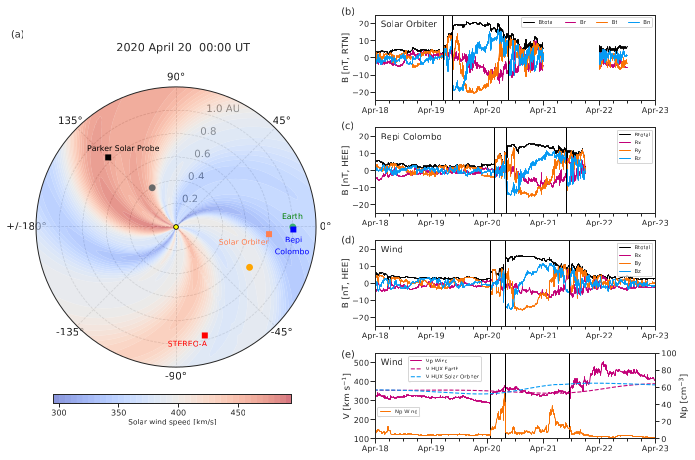
Figure 4(a) Overview of spacecraft positions in the Heliosphere and in situ solar wind speed data up to 1 AU. (b) Solar Orbiter (c) BepiColombo, (d) Wind, magnetic field data, and (e) the wind proton speed and density (solid lines) and the WSA/HUX solar wind speed at Earth and Solar Orbiter (dashed lines). Vertical lines indicate, from left to right, the shock arrival time and the beginning and end times of the flux rope, determined visually. Reprinted from Davies et al. (2021).
This section would be incomplete without mentioning the imaging of the far side of the Sun, which is directly relevant to space weather forecasting (Heinemann et al., 2025). The techniques developed for this purpose draw on a variety of disciplines. The first observations were based on the illumination of hydrogen atoms in interplanetary space by intense Lyman α emissions from active regions (Bertaux et al., 2000). Helioseismology is nowadays routinely used for forecasting purposes (Lindsey and Braun, 2017).
3.3 Magnetospheric Systems and Planetary Plasma Physics
Just as planetary geology is built on earlier scientific understanding of surface processes on Earth, planetary magnetospheric science has been strongly influenced by the earliest observations of the Earth's magnetosphere and the effect of the solar wind on it (Stern, 1996). Advancement from terrestrial to planetary magnetospheric studies has occurred much faster than in geology.
Decades of theoretical advances started to be confirmed when the first spacecraft, Explorer 1 exited the Earth's atmosphere and discovered the Van Allen Radiation Belts (Van Allen et al., 1958). Theoretical breakthroughs and experiments by luminaries such as Kristian Birkeland, who proposed that beams of electrons could create polar aurora and “polar magnetospheric storms” (Birkeland, 1908), now termed “substorms” (Akasofu and Chapman, 1963), and led to the idea that the magnetosphere-ionosphere could form a coupled system. Discoveries of fundamental plasma physical processes, such as magnetic reconnection led to the idea that planetary magnetospheres could really be coupled to the solar wind (Dungey, 1961), where sheared magnetic field lines could be reconfigured to thread a thin current sheet that separates two very disparate plasma regimes.
Fundamental scientific questions that arose from these revolutionary ideas, leading to missions to target the three-dimensional nature of near-Earth space (Cluster), what processes trigger polar magnetospheric substorms (Time History of Events and Macroscale Interactions during Substorms; THEMIS), and what is involved in the process of magnetic reconnection (Magnetospheric Multiscale: MMS). Over the last two decades, the study of the terrestrial magnetosphere has made major leaps forward thanks to multipoint measurements of these three missions, started first by the recently terminated Cluster mission. Cluster has pioneered our three-dimensional view of plasma physics at ion and fluid scales (Masson et al., 2024), including the 3-D nature of magnetic reconnection, of Kelvin-Helmholtz instability, and of fast flows and instability in stretched field lines of the magnetotail. The THEMIS mission (Angelopoulos, 2008) specifically targeted the scientific question of the causes and consequences of the polar magnetospheric substorms. THEMIS was designed to uniquely determine whether magnetic reconnection or plasma instability detonates the explosive energy release during a substorm (Angelopoulos et al., 2008; Rae et al., 2009). Both of these missions focused on ion and fluid scale physics to determine the global context and consequences of the physical processes. In contrast, the MMS mission (Burch et al., 2016) focused entirely on microscopic kinetic/electron scales, respectively to understand in unprecedented detail how the fundamental plasma process such as magnetic reconnection occurs.
Taken in isolation, these are three missions that targeted specific scientific questions and gained unrivaled insight into each of these scientific questions. However, thanks to coordinated planning, and a large number of conjunction events between Cluster, THEMIS and MMS, their mutual benefit was far greater than their individual contributions, enabling different spatial and temporal scales to be probed simultaneously for the first time. These missions have gradually untangled the multiscale complexity of space plasmas, leading us to recognise that we are dealing with a system of systems, and one that should in future be planned for at the very start of the mission planning stage. Clearly, further international collaboration via “clusters of Clusters” is required to take the next big steps not only in magnetospheric science, but also in plasma physics across the universe (Retinò et al., 2022; Rae et al., 2022; Kepko et al., 2024).
The first significant planetary magnetic field observations beyond Earth were made at Jupiter, when Pioneer 10 passed through its magnetosphere in late 1973. This was closely followed by Mariner 10's first flyby of Mercury in March 1974. These events occurred only around 15 years after Luna 1 first left Earth's magnetosphere. In the early years of the space age, terrestrial magnetospheric science taught us a great deal about how our planet's magnetosphere responds to changes in the heliospheric magnetic field and the dynamic and magnetic pressures of the highly variable solar wind.
The exploration of other planets that have a magnetosphere complements our knowledge and understanding of the terrestrial magnetosphere. The heliospheric environment changes with distance from the Sun. For example, Mercury's magnetosphere is much smaller than it would be if it were located at a greater heliocentric distance, where the heliospheric magnetic field is weaker and solar wind number density lower. In addition to the changing heliospheric environment at increasing distances from the Sun, the magnetised planets themselves differ from one another in planetary field strength, planetary rotation rate, alignment of their magnetic and spin axes and internal plasma sources. Thus the study of multiple planetary magnetospheres is worth much more than the sum of the individual parts as it allows us to compare and contrast space plasma physics in a broad range of parameter spaces (Jackman et al., 2014).
Magnetospheres also provide a unique laboratory in the form of radiation belts, regions where highly energised electrons and various ion species are trapped. Several planets in the Solar System host these regions (Mauk and Fox, 2010), with the Earth's radiation belts being among the earliest discoveries of the fledgling field of space science in the late 1950s (Van Allen and Frank, 1959). Given their dynamic nature, these belts have undergone significant scrutiny (Reeves et al., 2003; Thorne et al., 2007; Baker et al., 2004; Horne et al., 2005; Shprits et al., 2006). The causes of radiation belt changes are not well understood scientifically; operationally, these same particles can pose serious risks to satellites and astronauts (Baker et al., 1996) and have driven the growth of a key component of the applied discipline of Space Weather. Interest in the nature of other Solar System radiation belts is growing, particularly in the case of Jupiter, where field strengths are 50 times greater than on Earth, leading to a variety of complex physical processes. Understanding planetary radiation belts could provide a better understanding of exoplanetary systems and emissions (Roussos et al., 2022).
The Cassini-Huygens mission to Saturn is a prime example of an interdisciplinary project involving various instruments and scientific objectives. The mission's objectives included studying the planet's interior, atmosphere, magnetosphere, rings and moons. One of the Cassini mission's most famous discoveries was the plumes emanating from the icy moon Enceladus. This was first observed through disturbances in magnetometer data (Dougherty et al., 2006). Subsequently, the plumes' appearance (Porco et al., 2006), composition and location near the south pole (Spencer et al., 2006) were confirmed using the other instruments on Cassini. Following the detection of magnetic field signatures during the first close flyby of Enceladus, the spacecraft's trajectory was altered to enable closer study of this intriguing moon. What began as a somewhat serendipitous event arguably became one of the mission's most significant discoveries, providing opportunities for instrument teams to collaborate, and widening participation of science communities, e.g., scientists addressing habitability and origin of life in the Solar System. Builds on the legacy of Cassini-Huygens, the L4 mission to Enceladus, the first flagship mission of ESA's Voyage 2050 programme, is planned to further study Enceladus' surface and subsurface, but also external environment, requiring an interdisciplinary approach for assessing external impacts on habitability. Potential habitability is also one of the major target of Juice in the Jovian system exploring the gas giant Jupiter, its space environment, and its moons, Ganymede, Europa and Callisto. In particular Ganymede, with its intrinsic magnetic field, generating a mini magnetosphere, is an especially exciting target for studying complex and unique relationship with the space environment around Jupiter.
The BepiColombo mission (Benkhoff et al., 2021) is a collaboration between ESA and the Japan Aerospace Exploration Agency (JAXA). It is another excellent example of an interdisciplinary mission that effectively integrates planetary, magnetospheric, and solar wind science. Designed to study Mercury, the planet closest to the Sun, the BepiColombo mission comprises two orbiters: the Mercury Planetary Orbiter (MPO) and the Mercury Magnetospheric Orbiter (MMO, also known as Mio). Each orbiter is designed to investigate different yet interconnected aspects of the planet and its environment. By combining geological, geophysical, and chemical analyses of Mercury's surface with in-depth studies of its magnetosphere and its interactions with the solar wind, BepiColombo bridges multiple scientific disciplines. This approach allows scientists to investigate how the planet's thin exosphere is influenced by internal planetary processes and external solar activity, thereby advancing our understanding of magnetospheric dynamics in an extreme solar environment. Thus, the mission exemplifies the synergy between different fields of space science, offering profound insights into Mercury's evolution and the broader workings of planetary systems. In addition to its primary objectives at Mercury, BepiColombo has already made substantial contributions to heliospheric science during its extended cruise phase. As discussed by Sánchez-Cano et al. (2025), the spacecraft has provided valuable observations of the solar wind, transient events, and planetary environments encountered during its flybys of Earth, Venus, and Mercury. These measurements not only enhance our understanding of space weather in the inner heliosphere but also demonstrate the scientific value of planetary missions beyond their nominal operational phases.
The transport of mass, momentum and energy across boundaries or interaction between the particles and the electromagnetic fields are of interest not only in heliophysical plasmas, but also in plasmas all-over in the universe. Fundamental plasma processes such as magnetic reconnection, waves and turbulence in the boundary region have been studied throughout the Solar System based on in situ and remote observations, as well as simulation studies. The Solar System is the unique place in the universe where the fundamental plasma processes can be studied with in situ measurements for different plasma conditions from the diverse planetary and interplanetary environments. These unique observations allow validation of the models and compare with the remote observations of universal plasma processes.
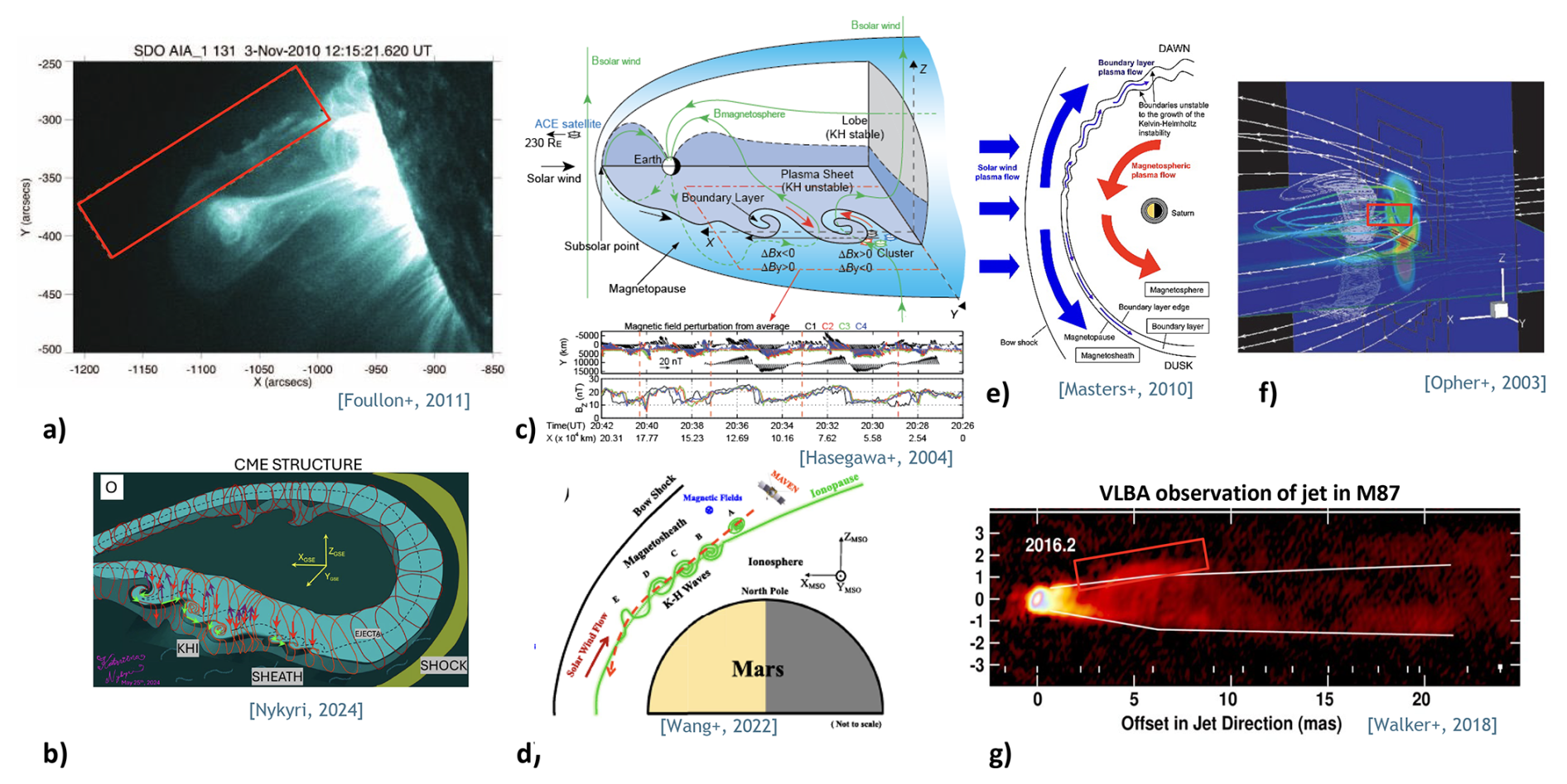
Figure 5Kelvin-Helmholtz waves at (a) Sun (adapted from Foullon et al., 2011), (b) solar wind (adapted from Nykyri, 2024), (c) Earth (adapted from Hasegawa et al., 2004), (d) Mars (adapted from Wang et al., 2022), (e) Saturn (adapted from Masters et al., 2010), (f) heliopause (adapted from Opher et al., 2003), and (g) the edge of the galactic jets (adapted from Walker et al., 2018).
An example of such plasma processes (shown in Fig. 5) is the different studies of the Kelvin–Helmholtz instability in various contexts: (a) near the Sun (Foullon et al., 2011); (b) in the solar wind at the boundary of a CME (Nykyri, 2024); (c) at the flank of the Earth's magnetopause (Hasegawa et al., 2004); (d) at the Mars dawnside ionopause (Wang et al., 2022); (e) at the Saturn dawnside magnetopause (Masters et al., 2010) (f) near the heliopause (Opher et al., 2003), and (g) at the edge of galactic jets (Walker et al., 2018). By comparing and contrasting these plasma processes, we can study how plasma flows interact with different obstacles throughout the Solar System and in an astrophysical context.
3.4 Investigating Coupled Ionosphere-Thermosphere-Magnetosphere Systems
The coupled Ionosphere–Thermosphere–Magnetosphere (ITM) system is a highly dynamic, interconnected region of space close to magnetized planets, such as Earth, where solar and geomagnetic energy inputs drive complex physical processes, see Fig. 6. The magnetosphere, which is dominated by the planet's magnetic field, interacts with the solar wind, channelling energy and particles towards the high latitude ionospheres. This energy input alters the ionospheric conductivity, driving currents that influence thermospheric winds and temperatures through ion-neutral coupling. The ionisation of the primarily neutral thermosphere can also lead to chemical changes. All thermospheric effects can propagate throughout the ITM system and penetrate deep into the atmosphere. Additionally, the ITM is characterised by numerous interfaces, primarily the gradual transition from the neutral atmosphere (in the mesosphere and below) to the ionised atmosphere, and the shift from a collisional to a collisionless regime. For these reasons, ITM science is inherently interdisciplinary. Therefore, it is crucial to understand the ITM as a coupled system.
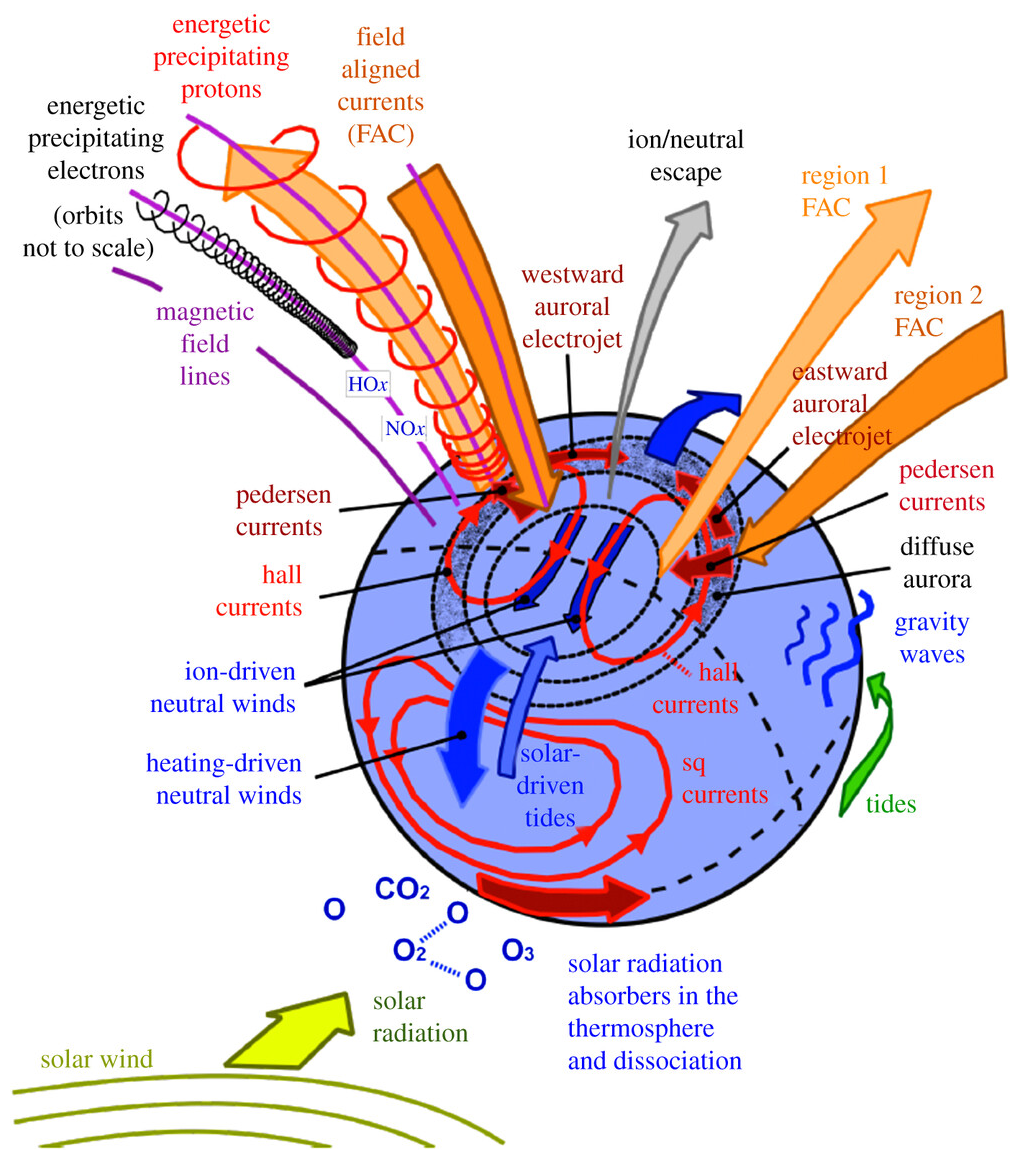
The atmosphere and the exosphere mark the end of the process chain for all Solar System objects within the heliosphere. Here, the Sun's energy is deposited through processes such as Joule heating. Understanding the fundamental interactions in the ITM system is therefore essential, particularly on Earth, as these interactions can disrupt human infrastructures during intense space weather events.
The global electric circuit is another example of a system that links the space environment to the different layers of the atmosphere. This is exemplified by events such as sprites and elves during thunderstorms (Pasko et al., 2012), and more generally by the role of atmospheric electricity (Gordillo-Vázquez and Pérez-Invernón, 2021).
An additional degree of complexity arises from the coupling with the solar wind and magnetosphere at high latitudes. This coupling is responsible for the main deposition of energy in the system through ionospheric currents and particle precipitation, which also cause the aurora. Excitation by solar illumination and thermospheric winds at the equator generates the equatorial electrojet and fountain. Such electrodynamic couplings are also observed on other planets, but they can differ greatly due to factors such as rapid planetary rotation, the presence or absence of an intrinsic magnetic field, and the density of the atmosphere. This is where past, present and future space exploration missions, combined with detailed physical models, can be crucial in enabling in-depth comparative planetology.
Luminous emissions, of which aurorae are the perfect example, illustrate the beauty of heliophysical processes. New discoveries are still being made in this field, such as Strong Thermal Emission Velocity Enhancement (STEVE) (MacDonald et al., 2018), fragments (Dreyer et al., 2021) and dynamic continuum emissions (Partamies et al., 2025). Aurorae have been observed on various planets in the Solar System across the electromagnetic spectrum, from radio waves to infrared, visible light and ultraviolet radiation. They can be regularly observed with space telescopes such as Hubble and JWST all the way to Uranus, as well as with terrestrial radio telescopes, which also detect radio emissions from Jupiter's and Saturn's moons (e.g. Prangé et al., 2004).
The long-term development of empirical, physical and chemical models (e.g. Bruinsma, 2015; Laundal et al., 2022; Verronen et al., 2011) together with the existence of an extensive ground-based infrastructure (see Sect. 3.7) has established Europe as a leading provider of accurate descriptions of the electrodynamics, thermodynamics, and chemistry of the near-Earth space environment. This enables us to unveil its complex physical and chemical processes. The coupling with the lower layers of the atmosphere has also been explored in depth in recent years.
Last but not least, Europe has played a major role in missions such as Swarm (Friis-Christensen et al., 2006), which has combined core magnetic field investigations with ionospheric connectivity and beyond, and SMILE (Branduardi-Raymont et al., 2018), which investigates the coupling of the magnetosphere. By comparing inputs and impacts at the same time, and associating ground based observations SMILE allow us to access physical parameters that cannot be measured directly, such as conductivities and Joule heating.
As an example, the physical ionosphere model called TRANSport au CARré (TRANSCAR) has been developed, maintained and updated over the last 30 years. Initially developed for high latitudes and open field lines (Blelly et al., 1996, 2005), TRANSCAR was then extended by the IRAP Plasmasphere-Ionosphere Model (IPIM) to encompass closed field lines and the description of the plasmaphere (Marchaudon and Blelly, 2015, 2020).
Inputs to TRANSCAR/IPIM can be derived from empirical models, directly from data, or adjusted from a combination of data assimilated into these models. For example, the convection electric field can be derived from SuperDARN radar data assimilated into dedicated empirical models (e.g. Thomas and Shepherd, 2018). Conversely, field-aligned currents can be recovered from magnetometers on satellite missions such as CHAMP, IRIDIUM/AMPERE, and Swarm (e.g. Workayehu et al., 2019; Pedersen et al., 2021). It is challenging to model the thermosphere in dynamic situations, but it can be fitted with density data derived from accelerometers on satellites such as CHAMP, Swarm, GRACE and GOCE. Once optimised, TRANSCAR/IPIM simulations can be compared with other datasets for validation and interpretation, such as hmF2 and NmF2 data from ionosondes, electron density, electron and ion temperatures, and ion velocity from incoherent scatter radars, as well as total electron content (TEC) maps from GNSS satellites. Pitout et al. (2015) simulated the impact of field aligned currents observed with Swarm on the electrodynamics of auroral structures. Marchaudon et al. (2018) modelled the effect of a solar high-speed stream (HSS) on the sharp depletion of ionospheric electron density in the F region. The model results were successfully compared with observations from the EISCAT radar and/or Scandinavian ionosondes.
3.5 Weakly Magnetised Bodies
A special category of body in the solar system are those that do not possess a global magnetic field, for example Venus, Mars, Comets and most Moons. This makes their interaction with the solar wind fundamentally different from that of Earth, Mercury, and the giant planets and presents a whole new laboratory of plasma physics to explore. However, missions to these objects are always inter-disciplinary, and thus Heliophysics is often not a priority in the mission objectives. This also offers opportunity to overlap and learn from other disciplines, e.g. about remanent magnetic fields in the Martian crust or solar wind sputtering on surfaces. Even though the communities involved in these objects are often small, they should not be overlooked when proposing new missions to funders.
For example, ESA's Rosetta mission (Glassmeier et al., 2007) observed the solar wind-comet interaction at comet 67P/Churyumov-Gerasimenko for over two years as well as provided data from Earth, Mars and asteroid flybys. Rosetta has delivered data critical to our understanding of energy transfer in a two-component plasma and shown that aurora-like features can exist at comets (Galand et al., 2020; Goetz et al., 2022). The main drawback of the Rosetta data is its lack of context for the solar wind and the lack of multi-point measurements. Comet Interceptor, ESA's new mission to a comet, has been designed to incorporate three spacecraft, which will provide, for the first time ever, three point measurements of the magnetic field in the plasma environment of a comet (Jones et al., 2024).
ESA's Venus Express has been instrumental in understanding the interaction of a completely unmagnetized planet with a strong solar wind (Svedhem et al., 2007). Venus Express was able to show that Venus' atmosphere is continuously eroded by the solar wind and found indications of magnetic reconnection in the tail as well as a plethora of common plasma waves in the entire magnetosphere (Futaana et al., 2017).
Mars is particularly interesting, as it does not possess a global magnetic field, but only local crustal magnetic fields. These induce asymmetries within the plasma environment that cannot be reproduced elsewhere (Vaisberg et al., 2018). ESA's Mars Express (Chicarro et al., 2004) has been measuring the plasma in the Martian magnetosphere and ionosphere since 2003. While making many fascinating discoveries on its own on atmospheric and magnetospheric dynamics (Martin et al., 2025) , it has also shown the strength of multi-point measurements through combination with NASA's MAVEN mission. For example, measurements by the Radiation Assessment Detector (RAD) (Hassler et al., 2012) on NASA's Mars Science Laboratory rover Curiosity (Grotzinger et al., 2012) and more recently with Fine Resolution Epithermal Neutron Detector (FREND) on Exo-Mars Trace Gas Orbiter (TGO) (Semkova et al., 2018) are also contributing to our understanding of the propagation of CMEs and energetic particles through the Solar System (see, e.g., Witasse et al., 2017; Kouloumvakos et al., 2024). These multi-point and multi-instrument measurements will be crucial for further understanding of plasma processes within the complex Martian magnetosphere (Sánchez-Cano et al., 2022).
Dusty plasmas have gradually become a discipline on their own, combining aspects of plasma physics, planetary science, astrophysics, materials science, and chemistry. Dusty plasmas are characterised by the presence of micro- to nanometer-sized dust grains that become electrically charged. Charged dust occurs in various regions: in the interplanetary medium (Horányi et al., 2009), in planetary rings, in cometary tails where solar UV radiation and the solar wind ionize gases and interact with dust (Price et al., 2019), in lunar and asteroid surfaces whose surfaces are eroded by the solar wind (Popel et al., 2018), and also in the Earth's mesosphere where noctilucent clouds are linked to dusty plasma produced by meteor ablation. In this context, the Moon stands out as an interesting laboratory not only for dusty plasmas but also for investigating kinetic processes in plasmas and the complex interactions between the solar wind and non-magnetised surface (Halekas et al., 2023). Some of these are illustrated in Fig. 7.
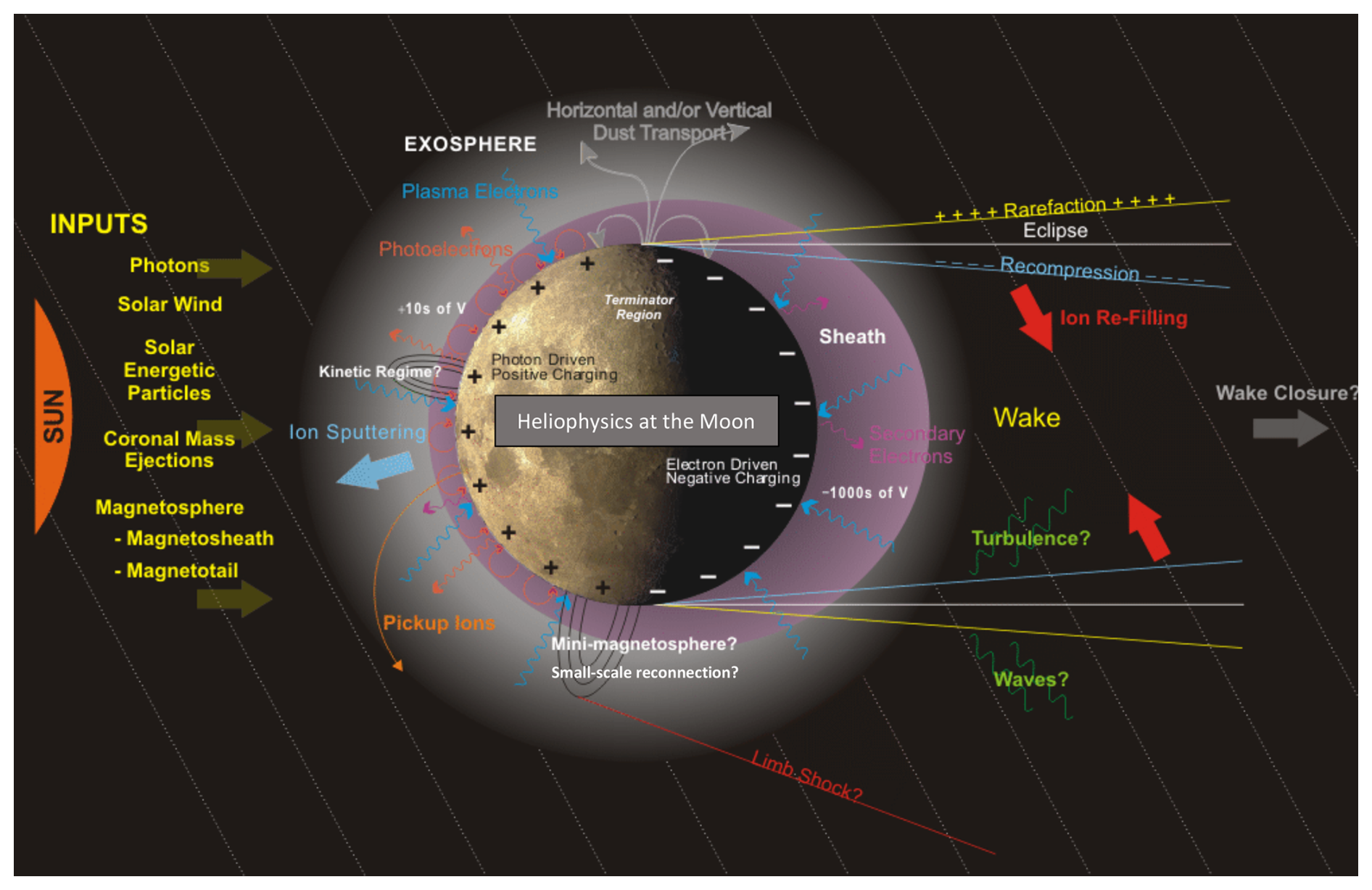
Figure 7Physical processes acting in the lunar environment. Reprinted from Halekas et al. (2023).
3.6 From Space to Laboratory Plasmas
As already mentioned, space plasmas offer the possibility to perform in situ investigations of fundamental plasma processes without significantly affecting the surrounding environment. Consequently, they frequently serve as natural laboratories for the observational study of plasma turbulence (Bruno and Carbone, 2013) and kinetic processes associated with shocks or reconnection (Verscharen et al., 2019).
Similarly, laboratory experiments on Earth aim to improve our understanding of related fundamental processes. Heliophysics thus provides many synergies with laboratory plasma experiments. Ground-based plasma devices such as the Large Plasma Device (LAPD), the Facility for Laboratory Reconnection Experiments (FLARE) and PHAse Space MApping (PHASMA) attempt to reproduce phenomena such as plasma waves, magnetic reconnection and particle acceleration (Gekelman et al., 1991; Ji et al., 2022; Shi et al., 2022). Unlike space plasmas, these devices provide reproducible and, to a certain extent, controllable conditions, thus complementing space observations of these processes when they occur sporadically. Comparisons between space and laboratory plasmas provide new insights into the fundamental physics of plasmas (Howes, 2018; Ji et al., 2023).
3.7 Observation Systems Beyond Space-Based: Ground-Based and Other Infrastructure
Historically, and particularly since the International Geophysical Year (1957–1958), Europe has been a driving force in the installation and operation of ground-based experiments in Heliophysics. This is one of the main reasons for the extensive coverage of instruments and the related scientific and technical expertise of European teams.
Thus, Europe plays a key role in the main instrument networks that provide information on the Ionosphere-Thermosphere-Magnetosphere (ITM) system. These include ground-based magnetometers (INTERMAGNET) for measuring ionospheric currents, ionosondes (GIRO) and GNSS receivers (IGS) for determining ionospheric density and structure, and low-frequency telescopes (LOFAR) and VLF receivers (AWDANet) for studying the dynamics of the mesosphere and thermosphere. Optical airglow observations and meteor measurements by optics and radars also support the studies of mesosphere and lower thermosphere. In the subarctic and arctic regions, specific instruments dedicated to monitoring the polar cap and auroral regions and their complex electrodynamics have long been in place. These include incoherent scatter radars (EISCAT), coherent HF radars (SuperDARN), all-sky cameras (e.g., MIRACLE and ALIS), riometers, Fabry–Pérot interferometers and scanning Doppler images. Some examples of the synergy between ground-based and space-based observations are given by Amm et al. (2005); Oberheide et al. (2015); Sarris (2019); Alfonsi et al. (2022).
The above mentioned ground-based observation networks offer complementary strengths to space missions and significantly enhance Earth system scientific understanding. While satellite instruments provide broad spatial coverage, ground-based networks offer high-resolution, localised measurements. Coordinated campaigns that align satellite overpasses with ground-based measurements with, for instance EISCAT and SuperDARN radars or optical networks with carefully designed special observation mode, allow for targeted investigations of dynamical ITM processes, such as substorms.
Europe also plays a key role in installing ground-based instruments in hard-to-reach regions (e.g. the sub-Antarctic and Antarctic regions, sub-Saharan Africa, South America and East Asia) to monitor the equatorial region and southern auroral and polar zones. To this end, European teams are assisting local teams in the equatorial region with installing ground magnetometers to study the equatorial electrojet and GNSS receivers to investigate equatorial scintillations. They also train the regional teams to maintain and operate these instruments. Around the South Pole, Europe draws on its numerous national sub-Antarctic and Antarctic bases (in the UK, Italy, France, Norway, Sweden, Finland and Germany) to install instruments similar to those used in the Northern Hemisphere (e.g. SuperDARN radars, ground-based magnetometers, cosmic ray detectors and all-sky cameras) and to lead interhemispheric studies.
Several key European instruments, including large (> 1 m) solar telescopes based in the Canary Islands, are also used for solar physics research. France, Germany and Sweden each own a telescope of this size, which they use to study the complex processes occurring on the Sun's surface and in filaments. The 4 m European Solar Telescope (EST), led by the Instituto de Astrofísica de Canarias (IAC, Spain), will also be deployed here.
Long-term solar radio observations have been performed by several countries, including France (Nançay radio observatory), Finland (Metsähovi radio observatory), Germany (Tremsdorf solar radio astronomy observatory) and Italy (Bologna and Cagliari sites), to track types II, III and IV, which are related to solar flares and CMEs (Pick and Vilmer, 2008). In addition, many smaller solar telescopes and coronagraphs are used across Europe, allowing for synoptic observations of the Sun's surface, corona and filaments. One of the main international networks is SAMNeT, which the UK leads. Ishii et al. (2025) provides a comprehensive overview of national and international instrumentation and networks that continuously observe the solar surface, Earth's magnetic field, and the ionosphere using both ground- and space-based instruments.
3.8 Long Time Scales: Space Climate
Long-term reconstructions of solar activity underpin a wide range of interdisciplinary science. Centennial- and millennial-scale solar activity reconstructions are used to estimate historical solar forcing, a key input to climate models and understanding the terrestrial system in the past (Ermolli et al., 2013; Chatzistergos et al., 2023). Secular changes in solar activity, such as the Maunder minimum (1650–1715), also shed light on astrophysical observations of non-magnetically cycling sun-like stars (Baum et al., 2022). And more directly, understanding the range of solar activity that has occurred in the past provides the best estimate of what we can expect in the future, which is vital to ensuring societal and technological resilience to space weather (Owens et al., 2021).
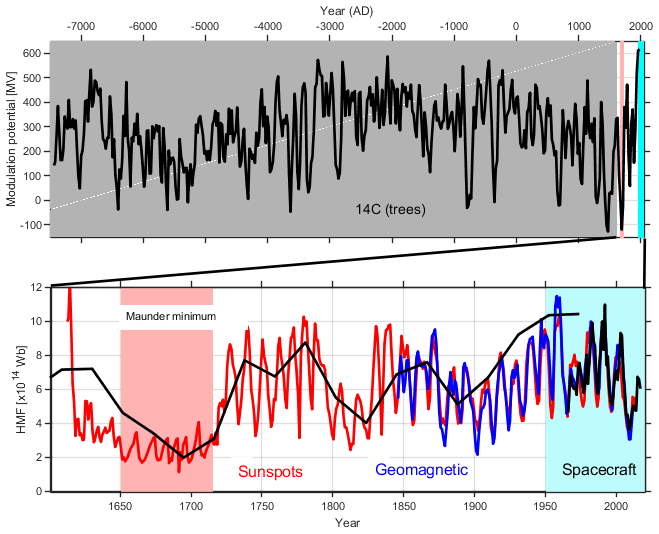
Figure 8Reconstructions of solar activity from a range of sources, including direct spacecraft measurements, ground-based magnetometers, sunspot observers, and radionuclide information in tree rings and ice sheets. Reprinted from Owens et al. (2018);
The long-term solar activity reconstructions, such as those shown in Fig. 8, are themselves the product of interdisciplinary science. To extend reconstructions further into the past, it is necessary to use increasingly indirect solar activity proxies, often by calibrating against other (shorter duration, but more direct) measures or proxies. Direct, high temporal resolution spacecraft measurements of the near-Earth solar wind properties have been made near-continuously since the mid-1960s, and have been collated in the ongoing OMNI dataset (King and Papitashvili, 2005). Over a similar time scale, ground-based neutron monitors can reveal the rate at which galactic cosmic rays (GCRs) produce nuclear reactions with atmospheric molecules (Usoskin et al., 2005). This, in turn, provides information about the solar magnetic field strength, which partially shields Earth from GCRs. Stretching back around 170 years, ground-based magnetometers measure the level of disturbance of the Earth's magnetic field resulting from the solar wind (Lockwood and Owens, 2011). These long time series of geomagnetic activity can then be coupled to atmosphere and climate models to investigate the connections between solar effects on our past, current and future climate (Seppälä et al., 2014).
Sunspot number counts, which measure visible solar activity, stretch back over four centuries. However, the construction of such a long-term dataset requires the interpretation of historical texts (Arlt and Vaquero, 2020; Clette et al., 2023). However, conversion to a more physical measure – such as open solar flux or total solar irradiance – requires considerable modelling and assumptions (Owens and Lockwood, 2012; Krivova et al., 2021). On similar timescales, records of auroral occurrence provide about geomagnetic storms, but these data are complicated to use quantitatively, owing to changing patterns of human migration and hence sampling of geomagnetic latitude. But the longest reconstructions come from radionuclides produced in Earth's atmosphere by GCRs. These become locked up in tree rings and ice sheets, potentially enabling solar activity to be reconstructed back millennia (Muscheler et al., 2007; Brehm et al., 2021). This, however, requires extremely interdisciplinary science, spanning heliospheric, magnetospheric, high-energy physics, climate, glaciology, dendrochronology, etc.
3.9 Beyond Space Plasmas of the Solar System
Our list of examples of heliophysics, which highlights the interdisciplinary nature of research, would be incomplete without mentioning the outer edges of the heliosphere and their connection with the interstellar medium.
The heliosphere moves through the Very Local Interstellar Medium (VLISM) at a speed of approximately 26 km s−1 (Linsky et al., 2019). The interstellar plasma thus encounters an obstacle, the heliosphere, and must flow around it. Similarly, the solar wind must at some point encounter the interstellar plasma. Because both the interstellar plasma and the solar wind are magnetized flows, they do not mix. The interstellar plasma must therefore flow around the heliosphere, and the solar wind must “wrap itself around” the heliosphere. The interface between the solar wind and the interstellar medium is called the heliopause. Information about the obstacle posed by the heliopause is transmitted back into the solar wind, where the termination shock forms, which deflects the solar wind and slows it down (Blum and Fahr, 1970). Voyager 1 passed the termination shock in December 2004 at 94 au (Stone et al., 2005) (Voyager 2 passed it in August 2007 at 84 au). The region between the termination shock and the heliopause is called the heliosheath. Voyager 1 passed the heliopause and entered interstellar space in 2012 (Stone et al., 2013), Voyager 2 did so in 2018 (Stone et al., 2019). Recent observations by the Interstellar Boundary Explorer (IBEX, McComas et al., 2009) have shown that there is very likely no bow shock in the interstellar medium as had long been expected (McComas et al., 2012), however, this result is still being debated (Zank et al., 2013; Scherer and Fichtner, 2014; Schwadron et al., 2015).
The neutral gas of interstellar matter enters the heliosphere uninhibited by the heliospheric boundary layers discussed in the previous paragraph where it can be ionized and picked up by the solar wind, forming a new population of suprathermal ions in the heliosphere, so-called pick-up ions (see, e.g., Kallenbach et al., 2000, for a review). This mass loading of the solar wind slows it down by about 20 % and heats it beyond about 20–30 au (Richardson and Stone, 2009). The pick-up process results in a highly non-thermal velocity distribution function (Vasyliunas and Siscoe, 1976). This distribution is convected outward by the solar wind all the way to the termination shock, where it was widely believed to be further accelerated to form the anomalous component of cosmic rays (ACR, see, e.g., Jokipii, 1986). While the flux of low-energy particles increased as Voyager 1 approached the termination shock (McDonald et al., 2003), it continued to increase beyond the termination shock, which indicates that ACRs are probably accelerated along the flanks of the heliosphere (McComas and Schwadron, 2006). An alternative explanation involving magnetic reconnection at the compressed heliospheric current sheets around the termination shock was given by Drake et al. (2010).
Since its formation some 4.5 billion years ago, the Solar System and heliosphere have revolved around the galaxy nearly 20 times and on its path must have experienced a wide range of interstellar environments. In high-density environments the heliosphere was compressed to within 25 au (Müller et al., 2009). Stronger compressions to within Saturn's orbit were probably achieved by close-by supernova explosions in the galactic neighborhood (Wallner et al., 2020). Similarly to the records of short-term (on an astrophysical scale) variations in the heliosphere, there are archives of this “galactic voyage” that our heliosphere has undertaken during its history (McCracken et al., 2005; Scherer et al., 2006).
The heliosphere is the only “astrosphere” that we can investigate in situ. This system therefore serves as a model for understanding astrospheres surrounding stars that drive stellar winds (Weaver et al., 1977). These astrospheres strongly influence the space environments of planet-hosting stars and have implications for astrobiology (Herbst et al., 2022). As such, the heliosphere provides a good example of how research in heliophysics can benefit astrophysics and vice versa, by drawing on the rich and diverse observations of remote astrospheres.
Heliophysics is an inherently interdisciplinary endeavour aimed at understanding our wider space environment. As such, it brings together scientists from various subdisciplines who require different data sources and employ various analysis, theoretical and modelling approaches. For these activities to succeed, the scientists involved must engage with each other across disciplinary and methodological boundaries. This engagement will help the European community to define novel science priorities and to coordinate creative ideas for new space missions at the cutting edge of heliophysics. This is a strategic goal of the EHC, which aims to bring fragmented communities together under a single, overarching theme. Here we briefly outline the key aspects and the recommended actions.
4.1 Low-threshold communication channels
To foster collaboration and innovation within the wider Heliophysics community, it is essential to establish communication platforms and provide a forum for exchanging ideas among scientists involved in Heliophysics research. Low threshold communication channels, such as a dedicated mailing list, a newsletter and a website, which are accessible and open to all community members, regardless of their career stage, are the backbone of this networking. The website is now active at https://www.heliophysics.eu/ (last access: November 2025) and subscription to a regular newsletter is possible at https://spaceweather.gfz.de/helio-europe-mailing-list (last access: November 2025). The latter includes a link for submitting announcements. Most recently the EHC has set up a LinkedIn account, for further communication and interaction (https://www.linkedin.com/company/heliophysics (last access: November 2025)).
4.2 Exchange Experience Across Generations
The planning, development, and operation of space missions is a cross-generational effort. Therefore, the continuous training and carrying over of expertise is essential for the success of Heliophysics as a field. The future of Heliophysics relies on well-trained Early Career Researchers (ECRs) who are motivated to pursue a scientific career in this field and to advance the future space-mission development. In this regard, the support of ECRs must lie at the heart of all activities by the ECRs. As one component of this effort, we aim to establish a monthly EHC seminar series titled “HelioMeet”. This initiative is designed to provide a platform for ECRs to present their latest research, engage in meaningful discussions, explore interdisciplinary connections across various Heliophysics subfields, and encourage putting problems in a broader perspective. HelioMeet will amplify the voices of early-career researchers within the broader scientific community, helping them establish professional networks, gain visibility, and contribute actively to shaping the future of Heliophysics.
4.3 Exchange information on data sources, facilities, tools, and with other disciplines
Our community already routinely practices openly sharing data from different sources and instruments. However, finding information about accessing data products can sometimes be difficult. Maintaining public data archives, communicating about free access to data and making space-based and ground-based data linkable are thus key to the success of Heliophysics data analysis. Community efforts and a communication platform for effective information exchange are needed to leverage synergies between data providers, scientific facilities, and the providers of data analysis tools. Heliophysics is connected to many other fields of science, such as exoplanet research, laboratory plasma physics and astrophysical plasma research. Therefore, the Heliophysics community is interested in and invested in exchanging with related fields outside its scope for mutual benefit.
4.4 Coordinated Data and Software Infrastructure for Heliophysics
Modern Heliophysics research increasingly depends on integrated data access, analysis, and modeling across traditionally separate domains, from solar observations to planetary magnetospheres, and combining multi-messenger data from both space- and ground-based platforms. However, the lack of shared infrastructure, standards, and sustained support for tools and data systems remains a major bottleneck to interdisciplinary science. This is being addressed with activities such as the International Heliophysics Data Environment Alliance (IHDEA, Masson et al., 2024). To address Europe's scientific and strategic goals in Heliophysics, coordinated development investment in open-source software, data infrastructure, and community-led initiatives is essential.
A robust and interoperable ecosystem, where researchers can seamlessly work across missions, instruments, and domains, requires common data models, open documentation, reusable software libraries, and standardised metadata standards. Some domains have developed powerful tools, particularly in Python, for example the community-led SunPy project (SunPy Community et al., 2020; Barnes et al., 2023), which provides core functionality for solar data analysis and is now foundational in the Heliophysics ecosystem. Yet many of these efforts across Heliophysics still operate in isolation, are inconsistently maintained, or lack interoperability, making it difficult to integrate data or replicate results across subfields. The Python in Heliophysics Community (PyHC) (Barnum et al., 2023) builds on this foundation by promoting best practices, code compatibility, and sustainable development across a suite of open-source tools, including SunPy, and mission-specific packages. While PyHC originated in the US, there is a clear opportunity for European leadership, through ESA, national agencies, Horizon Europe programmes, and community networks, to shape its direction, and coordinate development across European tools and archives.
Europe already leads in open data access through resources like ESA's Heliophysics Archives. But infrastructure alone is not enough, long-term support for software maintenance, documentation, and developer coordination is essential, yet often underfunded or overlooked.
To enable interdisciplinary Heliophysics, data and software must be recognised as critical scientific outputs. Embracing open science and FAIR principles will support transparency, reuse, and broader participation. With targeted investment and coordination, Europe is well positioned to lead the development of a sustainable, interoperable ecosystem for Heliophysics research.
4.5 Outreach
The EHC encourages the exploitation of public events such as solar eclipses and Long Nights of Science to raise the profile of the community. In this respect, we aim to coordinate public events across Europe to promote public engagement. It is imperative to involve schools to ensure the next generation's interest in science. Citizen science involves inviting the general public to participate in active research by analysing data, finding events or attending public talks at local, regional, national or international levels. These activities can be coordinated by sharing presentation materials and data among EHC scientists through EHC repositories.
The EHC encourages the systematic use of the keywords “Heliophysics” and “EHC” (for example, as ORCID keywords) to increase the discipline's visibility and foster community cohesion. The term “Heliophysics” has now officially been added to the Merriam-Webster dictionary.
4.6 Scheme of Organisation
We envisage the EHC as a community-driven initiative where Heliophysics researchers are actively engaged at all career stages. Regardless of the organisational structure that the EHC adopts, all roles must be determined through transparent, open and inclusive practices. Based on our experience of national organisations such as MIST in the UK, ATST in France and AEF in Germany, we recognise that a low-overhead approach can lead to higher productivity, efficiency and inclusivity levels than a more formal organisational or management structure. Membership in the EHC must be open to heliophysicists from all career stages, and we envisage that membership can be simply acquired by registering for the EHC mailing list. In this way, the threshold for joining the EHC is very low, enabling participation for a wide range of community members.
In an initial attempt to maintain momentum, the team of the ISSI Forum, joined by several volunteers, decided to set up four working groups that will focus on the following topics:
-
The EHC interim steering committee
-
Community engagement
-
Exchange experience across generations
-
Preparing the EHC workshop
As the authors of this paper do not represent the diversity of the EHC community, we would like to emphasise that the structuring phase is still ongoing. Depending on community interest and engagement, the working groups and their members will be revised and completed. The society is committed to equality, diversity, and inclusion, as will be reflected in the dedicated section on its website and will be addressed by a separate working group.
4.7 Communication and Coordination with other Organisations
There are national and international organisations that coordinate scientific communities engaged in Heliophysics. We believe that effective coordination and collaboration with these organisations is essential for our multidisciplinary research, which is based on internationally coordinated space and ground-based observations of the solar system. The Heliophysics research pursued by EHC is directly relevant to space weather science, so close communication with E-SWAN is essential. However, while Heliophysics contains the science of space weather, it does not address more applied questions such as impacts on infrastructure (see also the introductory note in Schrijver et al., 2022).
The EHC can serve as a hub for different national organisations (MIST, ATST, AEF, etc.) to plan next-generation missions or observations at a European level, involving countries with and without such national organisations. We anticipate that this coordination will enable EHC to join the worldwide ground observation network more effectively. EHC is anticipated to play a key role in the planning of the internationally coordinated space-based observations, such as the ISTP-NEXT proposal (Kepko et al., 2024), for solar and terrestrial missions, as well as other planetary missions throughout the solar system. These communications among the different space agencies and the international scientific communities are expected to keep track of what missions are planned globally, and how to prepare to take advantage of emerging opportunities for collaboration. Coordination with international programmes such as SCOSTEP (Scientific Committee on Solar-Terrestrial Physics) or ILWS (International Living with the Stars) that are promoting interdisciplinary research and collaboration will strengthen Heliophysics discipline worldwide.
No data sets were used in this article.
All authors contributed equally to the conceptualisation and the writing. The four lead authors coordinated the contributions.
At least one of the (co-)authors is a member of the editorial board of Annales Geophysicae. The peer-review process was guided by an independent editor, and the authors also have no other competing interests to declare.
Publisher's note: Copernicus Publications remains neutral with regard to jurisdictional claims made in the text, published maps, institutional affiliations, or any other geographical representation in this paper. While Copernicus Publications makes every effort to include appropriate place names, the final responsibility lies with the authors. Views expressed in the text are those of the authors and do not necessarily reflect the views of the publisher.
We gratefully acknowledge support by the International Space Science Insitute, ISSI, Bern, for supporting and hosting the forum that resulted in this paper.
H.H. is supported by the Royal Society award URF\R1\180671. D.V. is supported by STFC Consolidated Grant ST/W001004/1. This publication was funded by the Open-Access-Fund of the Austrian Academy of Sciences.
This paper was edited by Nick Sergis and reviewed by Tuija Pulkkinen and Sébastien Verkercke.
Akasofu, S. I. and Chapman, S.: Magnetic Storms: The Simultaneous Development of the Main Phase (DR) and of Polar Magnetic Substorms (DP), J. Geophys. Res., 68, 3155–3158, https://doi.org/10.1029/JZ068i010p03155, 1963. a
Alfonsi, L., Bergeot, N., Cilliers, P. J., De Franceschi, G., Baddeley, L., Correia, E., Di Mauro, D., Enell, C.-F., Engebretson, M., Ghoddousi-Fard, R., Häggström, I., Ham, Y.-b., Heygster, G., Jee, G., Kero, A., Kosch, M., Kwon, H.-J., Lee, C., Lotz, S., Macotela, L., Marcucci, M. F., Miloch, W. J., Morton, Y. J., Naoi, T., Negusini, M., Partamies, N., Petkov, B. H., Pottiaux, E., Prikryl, P., Shreedevi, P. R., Slapak, R., Spogli, L., Stephenson, J., Triana-Gómez, A. M., Troshichev, O. A., Van Malderen, R., Weygand, J. M., and Zou, S.: Review of Environmental Monitoring by Means of Radio Waves in the Polar Regions: From Atmosphere to Geospace, Surv. Geoph., 43, 1609–1698, https://doi.org/10.1007/s10712-022-09734-z, 2022. a
Amm, O., Donovan, E. F., Frey, H., Lester, M., Nakamura, R., Wild, J. A., Aikio, A., Dunlop, M., Kauristie, K., Marchaudon, A., McCrea, I. W., Opgenoorth, H.-J., and Strømme, A.: Coordinated studies of the geospace environment using Cluster, satellite and ground-based data: an interim review, Ann. Geophys., 23, 2129–2170, https://doi.org/10.5194/angeo-23-2129-2005, 2005. a
Angelopoulos, V.: The THEMIS Mission, Space Sci. Rev., 141, 5–34, https://doi.org/10.1007/s11214-008-9336-1, 2008. a
Angelopoulos, V., McFadden, J. P., Larson, D., Carlson, C. W., Mende, S. B., Frey, H., Phan, T., Sibeck, D. G., Glassmeier, K.-H., Auster, U., Donovan, E., Mann, I. R., Rae, I. J., Russell, C. T., Runov, A., Zhou, X.-Z., and Kepko, L.: Tail Reconnection Triggering Substorm Onset, Science, 321, 931, https://doi.org/10.1126/science.1160495, 2008. a
Antonucci, E., Harra, L., Susino, R., and Telloni, D.: Observations of the Solar Corona from Space, Space Sci. Rev., 216, 117, https://doi.org/10.1007/s11214-020-00743-1, 2020. a
Arlt, R. and Vaquero, J. M.: Historical sunspot records, Living Rev. Solar Phys., 17, 1, https://doi.org/10.1007/s41116-020-0023-y, 2020. a
Baker, D., Kanekal, S., Li, X., Monk, S., Goldstein, J., and Burch, J.: An extreme distortion of the Van Allen belt arising from the Halloween solar storm in 2003, Nature, 432, 878–880, 2004. a
Baker, D. N., Allen, J. H., Belian, R. D., Blake, J. B., Kanekal, S. G., Klecker, B., Lepping, R. P., Li, X., Mewaldt, R. A., Ogilvie, K., Onsager, T., Reeves, J. D., Rostoker, G., Sheldon, R. B., Singer, H. J., Spence, H. E., and Turner, N. E.: An assessment of space environmental conditions during the recent Anik E1 spacecraft operational failure, ISTP Newsletter, 6, 8–29, 1996. a
Barnes, W. T., Christe, S., Freij, N., Hayes, L. A., Stansby, D., Ireland, J., Mumford, S. J., Ryan, D. F., and Shih, A. Y.: The SunPy Project: An interoperable ecosystem for solar data analysis, Front. Astron. Space Sci., 10, 1076726, https://doi.org/10.3389/fspas.2023.1076726, 2023. a
Barnum, J., Masson, A., Friedel, R. H. W., Roberts, A., and Thomas, B. A.: Python in Heliophysics Community (PyHC): Current status and future outlook, Adv. Space Res., 72, 5636–5649, https://doi.org/10.1016/j.asr.2022.10.006, 2023. a
Baum, A. C., Wright, J. T., Luhn, J. K., and Isaacson, H.: Five Decades of Chromospheric Activity in 59 Sun-like Stars and New Maunder Minimum Candidate HD 166620, Astron. J., 163, 183, https://doi.org/10.3847/1538-3881/ac5683, 2022. a
Benkhoff, J., Murakami, G., Baumjohann, W., Besse, S., Bunce, E., Casale, M., Cremonese, G., Glassmeier, K. H., Hayakawa, H., Heyner, D., Hiesinger, H., Huovelin, J., Hussmann, H., Iafolla, V., Iess, L., Kasaba, Y., Kobayashi, M., Milillo, A., Mitrofanov, I. G., Montagnon, E., Novara, M., Orsini, S., Quemerais, E., Reininghaus, U., Saito, Y., Santoli, F., Stramaccioni, D., Sutherland, O., Thomas, N., Yoshikawa, I., and Zender, J.: BepiColombo – Mission Overview and Science Goals, Space Sci. Rev., 217, 90, https://doi.org/10.1007/s11214-021-00861-4, 2021. a, b
Bertaux, J., Quemerais, E., Lallement, R., Lamassoure, E., Schmidt, W., and Kyrölä, E.: Monitoring solar activity on the far side of the Sun from sky reflected Lyman radiation, Geophys. Res. Lett., 27, 1331–1334, https://doi.org/10.1029/1999GL003722, 2000. a
Berthelier, J.-J., Clemmons, J., Ivchenko, N., Knudsen, D., Matsuo, T., Maute, A., Palmroth, M., Partamies, N., Perry, G., Pfaff, R., Sarris, T. , Stolle, C., Thayer, J., and Vines, S.: Exploring Earth's Interface with Space: The Scientific Case for a Satellite Mission to the Lower Thermosphere-Ionosphere Transition Region, Tech. Rep. ESA-EOPSM-ELTI-RP-4592, European Space Agency [code], https://doi.org/10.5270/ESA-NASA.LTI-SC.2024-07-v1.0, 2024. a
Birkeland, K.: On the Cause of Magnetic Storms and the Origin of Terrestrial Magnetism, no. Bd. 1, in Norwegian Aurora Polaris Expedition, 1902–1903, H. Aschehoug, https://doi.org/10.5962/bhl.title.17857, 1908. a
Blelly, P.-L., Robineau, A., Lilensten, J., and Lummerzheim, D.: 8-moment fluid models of the terrestrial high-latitude ionosphere between 100 and 3000 km, in: Solar Terrestrial Energy Program Ionospheric Model Handbook, edited by Schunk, R., 53–72, Utah State University, Logan, 1996. a
Blelly, P.-L., Lathuillère, C., Emery, B., Lilensten, J., Fontanari, J., and Alcaydé, D.: An extended TRANSCAR model including ionospheric convection: simulation of EISCAT observations using inputs from AMIE, Ann. Geophys., 23, 419–431, https://doi.org/10.5194/angeo-23-419-2005, 2005. a
Blinder, C.: Voyager 1 science resumes after interstellar crisis, Science, 384, 942–943, https://doi.org/10.1126/science.adq7355, 2024. a
Blum, P. W. and Fahr, H. J.: Interaction between Interstellar Hydrogen and the Solar Wind, Astron. Astroph., 4, 280, https://ui.adsabs.harvard.edu/abs/ (last access: November 2025), 1970. a
Branduardi-Raymont, G., Wang, C., Escoubet, C. P., Adamovic, M., Agnolon, D., Berthomier, M., Carter, J., Chen, W., Colangeli, L., and Zhu, Z.: Smile definition study report (red book), ESA, https://doi.org/10.5270/esa.smile.definition_study_report-2018-12, 2018. a
Brehm, N., Bayliss, A., Christl, M., Synal, H.-A., Adolphi, F., Beer, J., Kromer, B., Muscheler, R., Solanki, S. K., Usoskin, I., Bleicher, N., Bollhalder, S., Tyers, C., and Wacker, L.: Eleven-year solar cycles over the last millennium revealed by radiocarbon in tree rings, Nat. Geosci., 14, 10–15, https://doi.org/10.1038/s41561-020-00674-0, 2021. a
Bruinsma, S.: The DTM-2013 thermosphere model, J. Space Weather Space Clim., 5, A1, https://doi.org/10.1051/swsc/2015001, 2015. a
Bruno, R. and Carbone, V.: The Solar Wind as a Turbulence Laboratory, Living Rev. Solar Phys., 2, 4, https://doi.org/10.12942/lrsp-2013-2, 2013. a
Burch, J. L., Moore, T. E., Torbert, R. B., and Giles, B. L.: Magnetospheric Multiscale Overview and Science Objectives, Space Sci. Rev., 199, 5–21, https://doi.org/10.1007/s11214-015-0164-9, 2016. a
Burlaga, L. F., Ness, N. F., Berdichevsky, D. B., Jian, L. K., Kurth, W., Park, J., Rankin, J., and Szabo, A.: Magnetic Field Observations in the Very Local Interstellar Medium by Voyagers 1 and 2, Astroph. J., 932, 59, https://doi.org/10.3847/1538-4357/ac658e, 2022. a
Cappello, G. M., Temmer, M., Vourlidas, A., Braga, C., Liewer, P. C., Qiu, J., Stenborg, G., Kouloumvakos, A., Veronig, A. M., and Bothmer, V.: Internal magnetic field structures observed by PSP/WISPR in a filament-related coronal mass ejection, Astron. Astroph., 688, A162, https://doi.org/10.1051/0004-6361/202449613, 2024. a
Chatzistergos, T., Krivova, N. A., and Yeo, K. L.: Long-term changes in solar activity and irradiance, J. Atmos. Solar-Terr. Phys., 252, 106150, https://doi.org/10.1016/j.jastp.2023.106150, 2023. a
Chicarro, A., Martin, P., and Trautner, R.: The Mars Express mission: an overview, in: Mars Express: the Scientific Payload, edited by: Wilson, A. and Chicarro, A., vol. 1240 of ESA Special Publication, 3–13, https://sci.esa.int/documents/33745/35957/1567254632829-OverviewWeb.pdf (last access: November 2025), 2004. a
Clette, F., Lefèvre, L., Chatzistergos, T., Hayakawa, H., Carrasco, V. M. S., Arlt, R., Cliver, E. W., Dudok de Wit, T., Friedli, T. K., Karachik, N., Kopp, G., Lockwood, M., Mathieu, S., Muñoz-Jaramillo, A., Owens, M., Pesnell, D., Pevtsov, A., Svalgaard, L., Usoskin, I. G., van Driel-Gesztelyi, L., and Vaquero, J. M.: Recalibration of the Sunspot-Number: Status Report, Solar Phys., 298, 44, https://doi.org/10.1007/s11207-023-02136-3, 2023. a
Cranmer, S. R. and Winebarger, A. R.: The Properties of the Solar Corona and Its Connection to the Solar Wind, Ann. Rev. Astron. Astroph., 57, 157–187, https://doi.org/10.1146/annurev-astro-091918-104416, 2019. a
Davies, E. E., Möstl, C., Owens, M. J., Weiss, A. J., Amerstorfer, T., Hinterreiter, J., Bauer, M., Bailey, R. L., Reiss, M. A., Forsyth, R. J., Horbury, T. S., O'Brien, H., Evans, V., Angelini, V., Heyner, D., Richter, I., Auster, H. U., Magnes, W., Baumjohann, W., Fischer, D., Barnes, D., Davies, J. A., and Harrison, R. A.: In situ multi-spacecraft and remote imaging observations of the first CME detected by Solar Orbiter and BepiColombo, Astron. Astroph., 656, A2, https://doi.org/10.1051/0004-6361/202040113, 2021. a, b, c
Domingo, V., Fleck, B., and Poland, A. I.: The SOHO Mission: an Overview, Solar Phys., 162, 1–37, https://doi.org/10.1007/BF00733425, 1995. a
Dougherty, M. K., Khurana, K. K., Neubauer, F. M., Russell, C. T., Saur, J., Leisner, J. S., and Burton, M. E.: Identification of a Dynamic Atmosphere at Enceladus with the Cassini Magnetometer, Science, 311, 1406–1409, https://doi.org/10.1126/science.1120985, 2006. a
Drake, J. F., Opher, M., Swisdak, M., and Chamoun, J. N.: A Magnetic Reconnection Mechanism for the Generation of Anomalous Cosmic Rays, Astroph. J., 709, 963–974, https://doi.org/10.1088/0004-637X/709/2/963, 2010. a
Dreyer, J., Partamies, N., Whiter, D., Ellingsen, P. G., Baddeley, L., and Buchert, S. C.: Characteristics of fragmented aurora-like emissions (FAEs) observed on Svalbard, Ann. Geophys., 39, 277–288, https://doi.org/10.5194/angeo-39-277-2021, 2021. a
Dungey, J. W.: Interplanetary Magnetic Field and the Auroral Zones, Phys. Rev. Lett., 6, 47–48, https://doi.org/10.1103/PhysRevLett.6.47, 1961. a
Ermolli, I., Matthes, K., Dudok de Wit, T., Krivova, N. A., Tourpali, K., Weber, M., Unruh, Y. C., Gray, L., Langematz, U., Pilewskie, P., Rozanov, E., Schmutz, W., Shapiro, A., Solanki, S. K., and Woods, T. N.: Recent variability of the solar spectral irradiance and its impact on climate modelling, Atmos. Chem. Phys., 13, 3945–3977, https://doi.org/10.5194/acp-13-3945-2013, 2013. a
Fimmel, R. O., van Allen, J., and Burgess, E.: Pioneer, first to Jupiter, Saturn, and beyond, vol. SP-446, NASA, Washington DC, USA, 1980. a
Foullon, C., Verwichte, E., Nakariakov, V. M., Nykyri, K., and Farrugia, C. J.: Magnetic Kelvin-Helmholtz Instability at the Sun, Astroph. J. Lett., 729, L8, https://doi.org/10.1088/2041-8205/729/1/L8, 2011. a, b
Fox, N. J., Velli, M. C., Bale, S. D., Decker, R., Driesman, A., Howard, R. A., Kasper, J. C., Kinnison, J., Kusterer, M., Lario, D., Lockwood, M. K., McComas, D. J., Raouafi, N. E., and Szabo, A.: The Solar Probe Plus Mission: Humanity's First Visit to Our Star, Space Sci. Rev., 204, 7–48, https://doi.org/10.1007/s11214-015-0211-6, 2016. a
Friis-Christensen, E., Lühr, H., and Hulot, G.: Swarm: A constellation to study the Earth's magnetic field, Earth Planets Space, 58, 351–358, https://doi.org/10.1186/BF03351933, 2006. a
Futaana, Y., Stenberg Wieser, G., Barabash, S., and Luhmann, J. G.: Solar Wind Interaction and Impact on the Venus Atmosphere, Space Sci. Rev., 212, 1453–1509, https://doi.org/10.1007/s11214-017-0362-8, 2017. a
Galand, M., Feldman, P. D., Bockelée-Morvan, D., Biver, N., Cheng, Y. C., Rinaldi, G., Rubin, M., Altwegg, K., Deca, J., Beth, A., Stephenson, P., Heritier, K. L., Henri, P., Parker, J. W., Carr, C., Eriksson, A. I., and Burch, J.: Far-ultraviolet aurora identified at comet 67P/Churyumov-Gerasimenko, Nat. Astron., 4, 1084–1091, https://doi.org/10.1038/s41550-020-1171-7, 2020. a
Gekelman, W., Pfister, H., Lucky, Z., Bamber, J., Leneman, D., and Maggs, J.: Design, construction, and properties of the large plasma research device – The LAPD at UCLA, Rev. Sci. Instrum., 62, 2875–2883, https://doi.org/10.1063/1.1142175, 1991. a
Glassmeier, K.-H., Boehnhardt, H., Koschny, D., Kührt, E., and Richter, I.: The Rosetta Mission: Flying Towards the Origin of the Solar System, Space Sci. Rev., 128, 1–21, https://doi.org/10.1007/s11214-006-9140-8, 2007. a, b
Goetz, C., Behar, E., Beth, A., Bodewits, D., Bromley, S., Burch, J., Deca, J., Divin, A., Eriksson, A. I., Feldman, P. D., Galand, M., Gunell, H., Henri, P., Heritier, K., Jones, G. H., Mandt, K. E., Nilsson, H., Noonan, J. W., Odelstad, E., Parker, J. W., Rubin, M., Simon Wedlund, C., Stephenson, P., Taylor, M. G. G. T., Vigren, E., Vines, S. K., and Volwerk, M.: The Plasma Environment of Comet 67P/Churyumov-Gerasimenko, Space Sci. Rev., 218, 65, https://doi.org/10.1007/s11214-022-00931-1, 2022. a
Gordillo-Vázquez, F. J. and Pérez-Invernón, F. J.: A review of the impact of transient luminous events on the atmospheric chemistry: Past, present, and future, Atmos. Res., 252, 105432, https://doi.org/10.1016/j.atmosres.2020.105432, 2021. a
Grotzinger, J. P., Crisp, J., Vasavada, A. R., Anderson, R. C., Baker, C. J., Barry, R., Blake, D. F., Conrad, P., Edgett, K. S., Ferdowski, B., Gellert, R., Gilbert, J. B., Golombek, M., Gómez-Elvira, J., Hassler, D. M., Jandura, L., Litvak, M., Mahaffy, P., Maki, J., Meyer, M., Malin, M. C., Mitrofanov, I., Simmonds, J. J., Vaniman, D., Welch, R. V., and Wiens, R. C.: Mars Science Laboratory Mission and Science Investigation, Space Sci. Rev., 170, 5–56, https://doi.org/10.1007/s11214-012-9892-2, 2012. a
Halekas, J., Sarantos, M., Regoli, L., Harada, Y., Zheng, Y., Nishino, M., Vines, S., Szalay, J., Chi, P., Leon, O., Denevi, B., Sibeck, D., Chen, L.-J., Hartzell, C., Horanyi, M., Stanier, A., Lillis, R., Fuqua Haviland, H., Wang, X., Keller, J., Zou, X.-D., Chu, F., Cao, X., Xu, S., Liuzzo, L., Kurth, W., Hospodarsky, G., Angelopoulos, V., Yokota, S., Fatemi, S., Miyoshi, Y., Morrissey, L., Bale, S., Sawyer, R., Jordan, A., Alves, M., Prem, P., Allen, R., Ridenti, M., Waller, D., Blewett, D., Malaspina, D., Tucker, O., Poppe, A., Nord, M., Grava, C., Hood, L., Deca, J., Dudok de Wit, T., Ho, G., Kramer, G., Krasnoselskikh, V., and Saxena, P.: The Value of the Moon for Heliophysics, Bull. Am. Astron. Soc., vol. 55, 149, https://doi.org/10.3847/25c2cfeb.ed6f0be4, 2023. a, b
Hapke, B.: Space weathering from Mercury to the asteroid belt, J. Geophys. Res., 106, 10039–10074, https://doi.org/10.1029/2000JE001338, 2001. a
Harten, R. and Clark, K.: The Design Features of the GGS Wind and Polar Spacecraft, Space Sci. Rev., 71, 23–40, https://doi.org/10.1007/BF00751324, 1995. a
Hasegawa, H., Fujimoto, M., Phan, T. D., Rème, H., Balogh, A., Dunlop, M. W., Hashimoto, C., and TanDokoro, R.: Transport of solar wind into Earth's magnetosphere through rolled-up Kelvin-Helmholtz vortices, Nature, 430, 755–758, https://doi.org/10.1038/nature02799, 2004. a, b
Hassler, D. M., Zeitlin, C., Wimmer-Schweingruber, R. F., Böttcher, S., Martin, C., Andrews, J., Böhm, E., Brinza, D. E., Bullock, M. A., Burmeister, S., Ehresmann, B., Epperly, M., Grinspoon, D., Köhler, J., Kortmann, O., Neal, K., Peterson, J., Posner, A., Rafkin, S., Seimetz, L., Smith, K. D., Tyler, Y., Weigle, G., Reitz, G., and Cucinotta, F. A.: The Radiation Assessment Detector (RAD) Investigation, Space Sci. Rev., 170, 503–558, https://doi.org/10.1007/s11214-012-9913-1, 2012. a
Heinemann, S. G., Pomoell, J., Caplan, R. M., Owens, M. J., Jones, S., Upton, L., Jha, B. K., and Arge, C. N.: Quantifying Uncertainties in Solar Wind Forecasting due to Incomplete Solar Magnetic Field Information, Astroph. J., 986, 166, https://doi.org/10.3847/1538-4357/adcf9e, 2025. a
Herbst, K., Baalmann, L. R., Bykov, A., Engelbrecht, N. E., Ferreira, S. E. S., Izmodenov, V. V., Korolkov, S. D., Levenfish, K. P., Linsky, J. L., Meyer, D. M. A., Scherer, K., and Strauss, R. D. T.: Astrospheres of Planet-Hosting Cool Stars and Beyond ⋅ When Modeling Meets Observations, Space Sci. Rev., 218, 29, https://doi.org/10.1007/s11214-022-00894-3, 2022. a
Horányi, M., Havnes, O., and Morfill, G. E.: Dusty plasmas in the solar system, in: Complex and Dusty Plasmas: From Laboratory to Space, edited by Fortov, V. E. and Morfill, G. E., CRC Press, Boca Raton, USA, p. 291, https://doi.org/10.1201/9780367802882, 2009. a
Horne, R. B., Thorne, R. M., Shprits, Y. Y., Meredith, N. P., Glauert, S. A., Smith, A. J., Kanekal, S. G., Baker, D. N., Engebretson, M. J., Posch, J. L., Spasojevic, M., Inan, U. S., Pickett, J. S., and Décréau, P. M. E.: Wave acceleration of electrons in the Van Allen radiation belts, Nature, 437, 227–230, https://doi.org/10.1038/nature03939, 2005. a
Howes, G. G.: Laboratory space physics: Investigating the physics of space plasmas in the laboratory, Phys. Plasmas, 25, 055501, https://doi.org/10.1063/1.5025421, 2018. a, b
Ishii, M., Costa, J. E., Kuznetsova, M., Bisi, M. M., Meza, A., Veronig, A. M., Denardini, C. M., Plainaki, C., Dasso, S., Temmer, M., Molina, M. G., Berdermann, J., Yoon, K., Gonzalez-Esparza, J. A., Valdivia, J. A., Supnithi, P., Marshall, R., Bruinsma, S. L., Onsager, T., Lanabere, V., Pötzi, W., Bouya, Z., Rodger, C. J., Bothmer, V., Luo, B., Nandy, D., Martini, D., Wintoft, P., Kero, J., Jackson, D., Kholodkov, K., Rabiu, B., Cid, C., Alfonsi, L., Raulin, J. P., Boteler, D., Scipion Castill, D. E., and Tulunay, Y.: Global landscape of space weather observations, research and operations, Adv. Space Res., https://doi.org/10.1016/j.asr.2025.06.021, 2025. a
Jackman, C. M., Arridge, C. S., André, N., Bagenal, F., Birn, J., Freeman, M. P., Jia, X., Kidder, A., Milan, S. E., Radioti, A., Slavin, J. A., Vogt, M. F., Volwerk, M., and Walsh, A. P.: Large-Scale Structure and Dynamics of the Magnetotails of Mercury, Earth, Jupiter and Saturn, Space Sci. Rev., 182, 85–154, https://doi.org/10.1007/s11214-014-0060-8, 2014. a
Ji, H., Daughton, W., Jara-Almonte, J., Le, A., Stanier, A., and Yoo, J.: Magnetic reconnection in the era of exascale computing and multiscale experiments, Nat. Rev. Phys., 4, 263–282, https://doi.org/10.1038/s42254-021-00419-x, 2022. a
Ji, H., Yoo, J., Fox, W., Yamada, M., Argall, M., Egedal, J., Liu, Y. H., Wilder, R., Eriksson, S., Daughton, W., Bergstedt, K., Bose, S., Burch, J., Torbert, R., Ng, J., and Chen, L. J.: Laboratory Study of Collisionless Magnetic Reconnection, Space Sci. Rev., 219, 76, https://doi.org/10.1007/s11214-023-01024-3, 2023. a
Jokipii, J. R.: Particle acceleration at a termination shock 1. Application to the solar wind and the anomalous component, J. Geoph. Res., 91, 2929–2932, https://doi.org/10.1029/JA091iA03p02929, 1986. a
Jones, G. H., Snodgrass, C., Tubiana, C., Küppers, M., Kawakita, H., Lara, L. M., Agarwal, J., André, N., Attree, N., Auster, U., Bagnulo, S., Bannister, M., Beth, A., Bowles, N., Coates, A., Colangeli, L., Corral van Damme, C., Da Deppo, V., De Keyser, J., Della Corte, V., Edberg, N., El-Maarry, M. R., Faggi, S., Fulle, M., Funase, R., Galand, M., Goetz, C., Groussin, O., Guilbert-Lepoutre, A., Henri, P., Kasahara, S., Kereszturi, A., Kidger, M., Knight, M., Kokotanekova, R., Kolmasova, I., Kossacki, K., Kührt, E., Kwon, Y., La Forgia, F., Levasseur-Regourd, A.-C., Lippi, M., Longobardo, A., Marschall, R., Morawski, M., Muñoz, O., Näsilä, A., Nilsson, H., Opitom, C., Pajusalu, M., Pommerol, A., Prech, L., Rando, N., Ratti, F., Rothkaehl, H., Rotundi, A., Rubin, M., Sakatani, N., Sánchez, J. P., Simon Wedlund, C., Stankov, A., Thomas, N., Toth, I., Villanueva, G., Vincent, J.-B., Volwerk, M., Wurz, P., Wielders, A., Yoshioka, K., Aleksiejuk, K., Alvarez, F., Amoros, C., Aslam, S., Atamaniuk, B., Baran, J., Barciński, T., Beck, T., Behnke, T., Berglund, M., Bertini, I., Bieda, M., Binczyk, P., Busch, M.-D., Cacovean, A., Capria, M. T., Carr, C., Castro Marín, J. M., Ceriotti, M., Chioetto, P., Chuchra-Konrad, A., Cocola, L., Colin, F., Crews, C., Cripps, V., Cupido, E., Dassatti, A., Davidsson, B. J. R., De Roche, T., Deca, J., Del Togno, S., Dhooghe, F., Donaldson Hanna, K., Eriksson, A., Fedorov, A., Fernández-Valenzuela, E., Ferretti, S., Floriot, J., Frassetto, F., Fredriksson, J., Garnier, P., Gaweł, D., Génot, V., Gerber, T., Glassmeier, K.-H., Granvik, M., Grison, B., Gunell, H., Hachemi, T., Hagen, C., Hajra, R., Harada, Y., Hasiba, J., Haslebacher, N., Herranz De La Revilla, M. L., Hestroffer, D., Hewagama, T., Holt, C., Hviid, S., Iakubivskyi, I., Inno, L., Irwin, P., Ivanovski, S., Jansky, J., Jernej, I., Jeszenszky, H., Jimenéz, J., Jorda, L., Kama, M., Kameda, S., Kelley, M. S. P., Klepacki, K., Kohout, T., Kojima, H., Kowalski, T., Kuwabara, M., Ladno, M., Laky, G., Lammer, H., Lan, R., Lavraud, B., Lazzarin, M., Le Duff, O., Lee, Q.-M., Lesniak, C., Lewis, Z., Lin, Z.-Y., Lister, T., Lowry, S., Magnes, W., Markkanen, J., Martinez Navajas, I., Martins, Z., Matsuoka, A., Matyjasiak, B., Mazelle, C., Mazzotta Epifani, E., Meier, M., Michaelis, H., Micheli, M., Migliorini, A., Millet, A.-L., Moreno, F., Mottola, S., Moutounaick, B., Muinonen, K., Müller, D. R., Murakami, G., Murata, N., Myszka, K., Nakajima, S., Nemeth, Z., Nikolajev, A., Nordera, S., Ohlsson, D., Olesk, A., Ottacher, H., Ozaki, N., Oziol, C., Patel, M., Savio Paul, A., Penttilä, A., Pernechele, C., Peterson, J., Petraglio, E., Piccirillo, A. M., Plaschke, F., Polak, S., Postberg, F., Proosa, H., and Protopapa, S.: The Comet Interceptor Mission, Space Sci. Rev., 220, 9, https://doi.org/10.1007/s11214-023-01035-0, 2024. a
Kaiser, M. L., Kucera, T. A., Davila, J. M., St. Cyr, O. C., Guhathakurta, M., and Christian, E.: The STEREO Mission: An Introduction, Space Sci. Rev., 136, 5–16, https://doi.org/10.1007/s11214-007-9277-0, 2008. a
Kallenbach, R., Geiss, J., Gloeckler, G., and von Steiger, R.: Pick-up Ion Measurements in the Heliosphere – A Review, Astroph. Space Sci., 274, 97–114, https://doi.org/10.1023/A:1026587620772, 2000. a
Kepko, L., Nakamura, R., Saito, Y., Vourlidas, A., Taylor, M. G., Mandrini, C. H., Blanco-Cano, X., Chakrabarty, D., Daglis, I. A., De Nardin, C. M., Petrukovich, A., Palmroth, M., Ho, G., Harra, L., Rae, J., Owens, M., Donovan, E., Lavraud, B., Reeves, G., Tripathi, D., Vilmer, N., Hwang, J., Antiochos, S., and Wang, C.: Heliophysics Great Observatories and international cooperation in Heliophysics: An orchestrated framework for scientific advancement and discovery, Adv. Space Res., https://doi.org/10.1016/j.asr.2024.01.011, 2024. a, b, c, d
King, J. H. and Papitashvili, N. E.: Solar Wind Spatial Scales in and Comparisons of Hourly Wind and ACE Plasma and Magnetic Field Data, J. Geophys. Res., 110, https://doi.org/10.1029/2004JA010649, 2005. a
Koepke, M. E.: Interrelated laboratory and space plasma experiments, Rev. Geoph., 46, RG3001, https://doi.org/10.1029/2005RG000168, 2008. a
Koller, F., Raptis, S., Temmer, M., and Karlsson, T.: The Effect of Fast Solar Wind on Ion Distribution Downstream of Earth's Bow Shock, Astroph. J. Lett., 964, L5, https://doi.org/10.3847/2041-8213/ad2ddf, 2024. a
Kouloumvakos, A., Papaioannou, A., Waterfall, C. O. G., Dalla, S., Vainio, R., Mason, G. M., Heber, B., Kühl, P., Allen, R. C., Cohen, C. M. S., Ho, G., Anastasiadis, A., Rouillard, A. P., Rodríguez-Pacheco, J., Guo, J., Li, X., Hörlöck, M., and Wimmer-Schweingruber, R. F.: The multi-spacecraft high-energy solar particle event of 28 October 2021, Astron. Astroph., 682, A106, https://doi.org/10.1051/0004-6361/202346045, 2024. a
Krivova, N. A., Solanki, S. K., Hofer, B., Wu, C.-J., Usoskin, I. G., and Cameron, R.: Modelling the evolution of the Sun’s open and total magnetic flux, Astron. Astroph., 650, A70, https://doi.org/10.1051/0004-6361/202140504, 2021. a
Laundal, K. M., Reistad, J. P., Hatch, S. M., Madelaire, M., Walker, S., Hovland, A. Ø., Ohma, A., Merkin, V. G., and Sorathia, K. A.: Local Mapping of Polar Ionospheric Electrodynamics, J. Geoph. Res., 127, e30356, https://doi.org/10.1029/2022JA030356, 2022. a
Lilensten, J., Dumbović, M., Spogli, L., Belehaki, A., Van der Linden, R., Poedts, S., Barata, T., Bisi, M. M., Cessateur, G., De Donder, E., Guerrero, A., Kilpua, E., Korsos, M. B., Pinto, R. F., Temmer, M., Tsagouri, I., Urbář, J., and Zuccarello, F.: Quo vadis, European Space Weather community?, J. Space Weather Space Clim., 11, 26, https://doi.org/10.1051/swsc/2021009, 2021. a
Lindsey, C. and Braun, D.: Seismic imaging of the Sun's far hemisphere and its applications in space weather forecasting, Space Weather, 15, 761–781, https://doi.org/10.1002/2016SW001547, 2017. a
Linsky, J. L., Redfield, S., and Tilipman, D.: The Interface between the Outer Heliosphere and the Inner Local ISM: Morphology of the Local Interstellar Cloud, Its Hydrogen Hole, Strömgren Shells, and 60Fe Accretion, Astroph. J., 886, 41, https://doi.org/10.3847/1538-4357/ab498a, 2019. a
Lockwood, M. and Owens, M. J.: Centennial changes in the heliospheric magnetic field and open solar flux: The consensus view from geomagnetic data and cosmogenic isotopes and its implications, J. Geophys. Res., 116, A04109, https://doi.org/10.1029/2010JA016220, 2011. a
Lynch, B. J., Viall, N. M., Higginson, A. K., Zhao, L., Lepri, S. T., and Sun, X.: The S-Web Origin of Composition Enhancement in the Slow-to-moderate Speed Solar Wind, Astroph. J., 949, 14, https://doi.org/10.3847/1538-4357/acc38c, 2023. a
MacDonald, E. A., Donovan, E., Nishimura, Y., Case, N. A., Gillies, D. M., Gallardo-Lacourt, B., Archer, W. E., Spanswick, E. L., Bourassa, N., Connors, M., Heavner, M., Jackel, B., Kosar, B., Knudsen, D. J., Ratzlaff, C., and Schofield, I.: New science in plain sight: Citizen scientists lead to the discovery of optical structure in the upper atmosphere, Sci. Adv., 4, eaaq0030, https://doi.org/10.1126/sciadv.aaq0030, 2018. a
Marchaudon, A. and Blelly, P.-L.: A new interhemispheric 16-moment model of the plasmasphere-ionosphere system: IPIM, J. Geophys. Res. (Space Physics), 120, 5728–5745, https://doi.org/10.1002/2015JA021193, 2015. a
Marchaudon, A. and Blelly, P.-L.: Impact of the Dipole Tilt Angle on the Ionospheric Plasma as Modeled with IPIM, J. Geophys. Res. (Space Physics), 125, e2019JA027672, https://doi.org/10.1029/2019JA027672, 2020. a
Marchaudon, A., Blelly, P.-L., Grandin, M., Aikio, A., Kozlovsky, A., and Virtanen, I.: IPIM Modeling of the Ionospheric F2 Layer Depletion at High Latitudes during a High-Speed Stream Event, J. Geophys. Res. (Space Physics), 123, 7051–7066, https://doi.org/10.1029/2018JA025744, 2018. a
Martin, P., Titov, D., Wilson, C., Cardesín-Moinelo, A., Godfrey, J., Bibring, J. P., González-Galindo, F., Jaumann, R., Määttänen, A., Spohn, T., Kminek, G., and Sefton-Nash, E.: Mars Express: From the Launch Pad to a 20-Year Success Record at Mars, Space Sci. Rev., 221, 48, https://doi.org/10.1007/s11214-025-01174-6, 2025. a
Masson, A., Escoubet, C. P., Taylor, M. G. G. T., Sieg, D., Sanvido, S., Abascal Palacios, B., Lemmens, S., and Sousa, B.: The pioneer Cluster mission: preparation of its legacy phase near re-entry, Earth Planets Space, 76, 114, https://doi.org/10.1186/s40623-024-02060-1, 2024. a
Masson, A., Fung, S. F., Camporeale, E., Kuznetsova, M. M., Poedts, S., Barnum, J., Ringuette, R., De Zeeuw, D., Polson, S., Sadykov, V. M., Navarro, V., Thomas, B., Caplan, R. M., Linker, J., Rastaetter, L., Wiegand, C., McGranaghan, R. M., Petrenko, M., Didigu, C., Reerink, J., Ireland, J., and Cecconi, B.: Heliophysics and space weather information architecture and innovative solutions: Current status and ways forward, Adv. Space Res., https://doi.org/10.1016/j.asr.2024.05.052, 2024. a
Masters, A., Achilleos, N., Kivelson, M. G., Sergis, N., Dougherty, M. K., Thomsen, M. F., Arridge, C. S., Krimigis, S. M., McAndrews, H. J., Kanani, S. J., Krupp, N., and Coates, A. J.: Cassini observations of a Kelvin-Helmholtz vortex in Saturn's outer magnetosphere, J. Geophys. Res. (Space Physics), 115, A07225, https://doi.org/10.1029/2010JA015351, 2010. a, b
Mauk, B. H. and Fox, N. J.: Electron radiation belts of the solar system, J. Geophys. Res., 115, A12220, https://doi.org/10.1029/2010JA015660, 2010. a
McComas, D. J. and Schwadron, N. A.: An explanation of the Voyager paradox: Particle acceleration at a blunt termination shock, Geoph. Res. Lett., 33, L04102, https://doi.org/10.1029/2005GL025437, 2006. a
McComas, D. J., Allegrini, F., Bochsler, P., Bzowski, M., Collier, M., Fahr, H., Fichtner, H., Frisch, P., Funsten, H. O., Fuselier, S. A., Gloeckler, G., Gruntman, M., Izmodenov, V., Knappenberger, P., Lee, M., Livi, S., Mitchell, D., Möbius, E., Moore, T., Pope, S., Reisenfeld, D., Roelof, E., Scherrer, J., Schwadron, N., Tyler, R., Wieser, M., Witte, M., Wurz, P., and Zank, G.: IBEX–Interstellar Boundary Explorer, Space Sci. Rev., 146, 11–33, https://doi.org/10.1007/s11214-009-9499-4, 2009. a
McComas, D. J., Alexashov, D., Bzowski, M., Fahr, H., Heerikhuisen, J., Izmodenov, V., Lee, M. A., Möbius, E., Pogorelov, N., Schwadron, N. A., and Zank, G. P.: The Heliosphere's Interstellar Interaction: No Bow Shock, Science, 336, 1291, https://doi.org/10.1126/science.1221054, 2012. a
McCracken, K. G., Beer, J., and McDonald, F. B.: The Long-Term Variability of the Cosmic Radiation Intensity at Earth as Recorded by the Cosmogenic Nuclides, ISSI Scientific Reports Series, 3, 83, https://www.issibern.ch/wp-content/uploads/SR-003.pdf (last access: November 2025), 2005. a
McDonald, F. B., Stone, E. C., Cummings, A. C., Heikkila, B., Lal, N., and Webber, W. R.: Enhancements of energetic particles near the heliospheric termination shock, Nature, 426, 48–51, https://doi.org/10.1038/nature02066, 2003. a
Morosan, D. E., Gallagher, P. T., Zucca, P., Fallows, R., Carley, E. P., Mann, G., Bisi, M. M., Kerdraon, A., Konovalenko, A. A., MacKinnon, A. L., Rucker, H. O., Thidé, B., Magdalenić, J., Vocks, C., Reid, H., Anderson, J., Asgekar, A., Avruch, I. M., Bentum, M. J., Bernardi, G., Best, P., Bonafede, A., Bregman, J., Breitling, F., Broderick, J., Brüggen, M., Butcher, H. R., Ciardi, B., Conway, J. E., de Gasperin, F., de Geus, E., Deller, A., Duscha, S., Eislöffel, J., Engels, D., Falcke, H., Ferrari, C., Frieswijk, W., Garrett, M. A., Grießmeier, J., Gunst, A. W., Hassall, T. E., Hessels, J. W. T., Hoeft, M., Hörandel, J., Horneffer, A., Iacobelli, M., Juette, E., Karastergiou, A., Kondratiev, V. I., Kramer, M., Kuniyoshi, M., Kuper, G., Maat, P., Markoff, S., McKean, J. P., Mulcahy, D. D., Munk, H., Nelles, A., Norden, M. J., Orru, E., Paas, H., Pandey-Pommier, M., Pandey, V. N., Pietka, G., Pizzo, R., Polatidis, A. G., Reich, W., Röttgering, H., Scaife, A. M. M., Schwarz, D., Serylak, M., Smirnov, O., Stappers, B. W., Stewart, A., Tagger, M., Tang, Y., Tasse, C., Thoudam, S., Toribio, C., Vermeulen, R., van Weeren, R. J., Wucknitz, O., Yatawatta, S., and Zarka, P.: LOFAR tied-array imaging of Type III solar radio bursts, Astron. Astroph., 568, A67, https://doi.org/10.1051/0004-6361/201423936, 2014. a
Müller, D., St. Cyr, O. C., Zouganelis, I., Gilbert, H. R., Marsden, R., Nieves-Chinchilla, T., Antonucci, E., Auchère, F., Berghmans, D., Horbury, T. S., Howard, R. A., Krucker, S., Maksimovic, M., Owen, C. J., Rochus, P., Rodriguez-Pacheco, J., Romoli, M., Solanki, S. K., Bruno, R., Carlsson, M., Fludra, A., Harra, L., Hassler, D. M., Livi, S., Louarn, P., Peter, H., Schühle, U., Teriaca, L., del Toro Iniesta, J. C., Wimmer-Schweingruber, R. F., Marsch, E., Velli, M., De Groof, A., Walsh, A., and Williams, D.: The Solar Orbiter mission. Science overview, Astron. Astroph., 642, A1, https://doi.org/10.1051/0004-6361/202038467, 2020. a
Müller, H. R., Frisch, P. C., Fields, B. D., and Zank, G. P.: The Heliosphere in Time, Space Sci. Rev., 143, 415–425, https://doi.org/10.1007/s11214-008-9448-7, 2009. a
Muscheler, R., Joos, F., Beer, J., Müller, S. A., Vonmoos, M., and Snowball, I.: Solar activity during the last 1000yr inferred from radionuclide records, Quater. Sci. Rev., 26, 82–97, https://doi.org/10.1016/j.quascirev.2006.07.012, 2007. a
Nykyri, K.: Giant Kelvin-Helmholtz (KH) Waves at the Boundary Layer of the Coronal Mass Ejections (CMEs) Responsible for the Largest Geomagnetic Storm in 20 Years, Geophys. Res. Lett., 51, e2024GL110477, https://doi.org/10.1029/2024GL110477, 2024. a, b
Oberheide, J., Shiokawa, K., Gurubaran, S., Ward, W. E., Fujiwara, H., Kosch, M. J., Makela, J. J., and Takahashi, H.: The geospace response to variable inputs from the lower atmosphere: a review of the progress made by Task Group 4 of CAWSES-II, Prog. Earth Planet. Sci., 2, 2, https://doi.org/10.1186/s40645-014-0031-4, 2015. a
Opher, M., Liewer, P. C., Gombosi, T. I., Manchester, W., DeZeeuw, D. L., Sokolov, I., and Toth, G.: Probing the Edge of the Solar System: Formation of an Unstable Jet-Sheet, Astroph. J. Lett., 591, L61–L65, https://doi.org/10.1086/376960, 2003. a, b
Owens, M. J. and Forsyth, R. J.: The Heliospheric Magnetic Field, Living Rev. Solar Phys., 10, https://doi.org/10.12942/lrsp-2013-5, 2013. a
Owens, M. J. and Lockwood, M.: Cyclic loss of open solar flux since 1868: The link to heliospheric current sheet tilt and implications for the Maunder Minimum, J. Geophys. Res., 117, A04102, https://doi.org/10.1029/2011JA017193, 2012. a
Owens, M. J., Lockwood, M., Riley, P., and Barnard, L.: Long-term variations in the heliosphere, in: Long-term Datasets for the Understanding of Solar and Stellar Magnetic Cycles, edited by: Banerjee, D., Jiang, J., Kusano, K., and Solanki, S., vol. 340 of IAU Symposium, 108–114, https://doi.org/10.1017/S1743921318000972, 2018. a
Owens, M. J., Lockwood, M., Barnard, L. A., Scott, C. J., Haines, C., and Macneil, A.: Extreme Space-Weather Events and the Solar Cycle, Solar Phys., 296, 82, https://doi.org/10.1007/s11207-021-01831-3, 2021. a
Palmerio, E., Carcaboso, F., Khoo, L. Y., Salman, T. M., Sánchez-Cano, B., Lynch, B. J., Rivera, Y. J., Pal, S., Nieves-Chinchilla, T., Weiss, A. J., Lario, D., Mieth, J. Z. D., Heyner, D., Stevens, M. L., Romeo, O. M., Zhukov, A. N., Rodriguez, L., Lee, C. O., Cohen, C. M. S., Rodríguez-García, L., Whittlesey, P. L., Dresing, N., Oleynik, P., Jebaraj, I. C., Fischer, D., Schmid, D., Richter, I., Auster, H.-U., Fraschetti, F., and Mierla, M.: On the Mesoscale Structure of Coronal Mass Ejections at Mercury’s Orbit: BepiColombo and Parker Solar Probe Observations, Astroph. J., 963, 108, https://doi.org/10.3847/1538-4357/ad1ab4, 2024. a
Partamies, N., Dayton-Oxland, R., Herlingshaw, K., Virtanen, I., Gallardo-Lacourt, B., Syrjäsuo, M., Sigernes, F., Nishiyama, T., Nishimura, T., Barthelemy, M., Aruliah, A., Whiter, D., Mielke, L., Grandin, M., Karvinen, E., Spijkers, M., and Ledvina, V. E.: First observations of continuum emission in dayside aurora, Ann. Geoph., 43, 349–367, https://doi.org/10.5194/angeo-43-349-2025, 2025. a
Pasko, V. P., Yair, Y., and Kuo, C.-L.: Lightning Related Transient Luminous Events at High Altitude in the Earth's Atmosphere: Phenomenology, Mechanisms and Effects, Space Sci. Rev., 168, 475–516, https://doi.org/10.1007/s11214-011-9813-9, 2012. a
Pedersen, M. N., Vanhamäki, H., Aikio, A. T., Käki, S., Workayehu, A. B., Waters, C. L., and Gjerloev, J. W.: Field-Aligned and Ionospheric Currents by AMPERE and SuperMAG During HSS/SIR-Driven Storms, J. Geophys. Res. (Space Physics), 126, e2021JA029437, https://doi.org/10.1029/2021JA029437, 2021. a
Pick, M. and Vilmer, N.: Sixty-five years of solar radioastronomy: flares, coronal mass ejections and Sun Earth connection, Astron. Astroph. Rev., 16, 1–153, https://doi.org/10.1007/s00159-008-0013-x, 2008. a
Pitout, F., Marchaudon, A., Blelly, P.-L., Bai, X., Forme, F., Buchert, S. C., and Lorentzen, D. A.: Swarm and ESR observations of the ionospheric response to a field-aligned current system in the high-latitude midnight sector, Geophys. Res. Lett., 42, 4270–4279, https://doi.org/10.1002/2015GL064231, 2015. a
Popel, S. I., Zelenyi, L. M., Golub', A. P., and Dubinskii, A. Y.: Lunar dust and dusty plasmas: Recent developments, advances, and unsolved problems, Planet. Space Sci., 156, 71–84, https://doi.org/10.1016/j.pss.2018.02.010, 2018. a
Porco, C. C., Helfenstein, P., Thomas, P. C., Ingersoll, A. P., Wisdom, J., West, R., Neukum, G., Denk, T., Wagner, R., Roatsch, T., Kieffer, S., Turtle, E., McEwen, A., Johnson, T. V., Rathbun, J., Veverka, J., Wilson, D., Perry, J., Spitale, J., Brahic, A., Burns, J. A., Del Genio, A. D., Dones, L., Murray, C. D., and Squyres, S.: Cassini Observes the Active South Pole of Enceladus, Science, 311, 1393–1401, https://doi.org/10.1126/science.1123013, 2006. a
Porsche, H.: General aspects of the mission Helios 1 and 2. Introduction to a special issue on initial scientific results of the Helios Mission., J. Geophys.-Z. Geophys., 42, 551–559, 1977. a
Prangé, R., Pallier, L., Hansen, K. C., Howard, R., Vourlidas, A., Courtin, R., and Parkinson, C.: An interplanetary shock traced by planetary auroral storms from the Sun to Saturn, Nature, 432, 78–81, https://doi.org/10.1038/nature02986, 2004. a
Price, O., Jones, G. H., Morrill, J., Owens, M., Battams, K., Morgan, H., Drückmuller, M., and Deiries, S.: Fine-scale structure in cometary dust tails I: Analysis of striae in Comet C/2006 P1 (McNaught) through temporal mapping, Icarus, 319, 540–557, https://doi.org/10.1016/j.icarus.2018.09.013, 2019. a
Rae, I. J., Mann, I. R., Angelopoulos, V., Murphy, K. R., Milling, D. K., Kale, A., Frey, H. U., Rostoker, G., Russell, C. T., Watt, C. E. J., Engebretson, M. J., Moldwin, M. B., Mende, S. B., Singer, H. J., and Donovan, E. F.: Near-Earth initiation of a terrestrial substorm, J. Geoph. Res., 114, A07220, https://doi.org/10.1029/2008JA013771, 2009. a
Rae, J., Forsyth, C., Dunlop, M., Palmroth, M., Lester, M., Friedel, R., Reeves, G., Kepko, L., Turc, L., Watt, C., Hajdas, W., Sarris, T., Saito, Y., Santolik, O., Shprits, Y., Wang, C., Marchaudon, A., Berthomier, M., Marghitu, O., Hubert, B., Volwerk, M., Kronberg, E. A., Mann, I., Murphy, K., Miles, D., Yao, Z., Fazakerley, A., Sandhu, J., Allison, H., and Shi, Q.: What are the fundamental modes of energy transfer and partitioning in the coupled Magnetosphere-Ionosphere system?, Exp. Astron., 54, 391–426, https://doi.org/10.1007/s10686-022-09861-w, 2022. a
Reeves, G., McAdams, K., Friedel, R., and O'Brien, T.: Acceleration and loss of relativistic electrons during geomagnetic storms, Geophys. Res. Lett., 30, 1529, https://doi.org/10.1029/2002GL016513, 2003. a
Retinò, A., Khotyaintsev, Y., Le Contel, O., Marcucci, M. F., Plaschke, F., Vaivads, A., Angelopoulos, V., Blasi, P., Burch, J., De Keyser, J., Dunlop, M., Dai, L., Eastwood, J., Fu, H., Haaland, S., Hoshino, M., Johlander, A., Kepko, L., Kucharek, H., Lapenta, G., Lavraud, B., Malandraki, O., Matthaeus, W., McWilliams, K., Petrukovich, A., Pinçon, J.-L., Saito, Y., Sorriso-Valvo, L., Vainio, R., and Wimmer-Schweingruber, R.: Particle energization in space plasmas: towards a multi-point, multi-scale plasma observatory, Exp. Astron., 54, 427–471, https://doi.org/10.1007/s10686-021-09797-7, 2022. a
Richardson, J. D. and Stone, E. C.: The Solar Wind in the Outer Heliosphere, Space Sci. Rev., 143, 7–20, https://doi.org/10.1007/s11214-008-9443-z, 2009. a
Roussos, E., Allanson, O., André, N., Bertucci, B., Branduardi-Raymont, G., Clark, G., Dialynas, K., Dandouras, I., Desai, R. T., Futaana, Y., Gkioulidou, M., Jones, G. H., Kollmann, P., Kotova, A., Kronberg, E. A., Krupp, N., Murakami, G., Nénon, Q., Nordheim, T., Palmaerts, B., Plainaki, C., Rae, J., Santos-Costa, D., Sarris, T., Shprits, Y., Sulaiman, A., Woodfield, E., Wu, X., and Yao, Z.: The in-situ exploration of Jupiter's radiation belts, Exp. Astron., 54, 745–789, https://doi.org/10.1007/s10686-021-09801-0, 2022. a
Sánchez-Cano, B., Lester, M., Andrews, D. J., Opgenoorth, H., Lillis, R., Leblanc, F., Fowler, C. M., Fang, X., Vaisberg, O., Mayyasi, M., Holmberg, M., Guo, J., Hamrin, M., Mazelle, C., Peter, K., Pätzold, M., Stergiopoulou, K., Goetz, C., Ermakov, V. N., Shuvalov, S., Wild, J. A., Blelly, P.-L., Mendillo, M., Bertucci, C., Cartacci, M., Orosei, R., Chu, F., Kopf, A. J., Girazian, Z., and Roman, M. T.: Mars' plasma system. Scientific potential of coordinated multipoint missions: “The next generation”, Exp. Astron, 54, 641–676, https://doi.org/10.1007/s10686-021-09790-0, 2022. a
Sánchez-Cano, B., Hadid, L. Z., Aizawa, S., Murakami, G., Bamba, Y., Chiba, S., Hara, T., Heyner, D., Ho, G., Iwai, K., Kilpua, E., Kinoshita, G., Lavraud, B., Miyoshi, Y., Pinto, M., Schmid, D., Shiota, D., Vainio, R., Andre, N., Aronica, A., Asmar, S., Auster, H.-U., Barabash, S., Barthe, A., Baumjohann, W., Benkhoff, J., Bentley, M., Bunce, E., Cappuccio, P., Delcourt, D., di Stefano, I., Doria, I., Dresing, N., Fedorov, A., Fischer, D., Fiethe, B., Fränz, M., Gieseler, J., Giner, F., Giono, G., Harada, Y., Hussmann, H., Iess, L., Imamura, T., Jeszenszky, H., Jones, G., Katra, B., Kazakov, A., Kozyrev, A., Laky, G., Lefevre, C., Lichtenegger, H., Lindsay, S., Lucente, M., Magnafico, C., Magnes, W., Martindale, A., Matsuoka, A., Milillo, A., Mitrofanov, I., Nishiyama, G., Oleynik, P., Orsini, S., Paik, M., Palmroos, C., Plainaki, C., Penou, E., Persson, M., Quarati, F., Quémerais, E., Richter, I., Robidel, R., Rojo, M., Saito, Y., Santoli, F., Stark, A., Stumpo, M., Tian, R., Varsani, A., Verdeil, C., Williamson, H., Witasse, O., and Yokota, S.: BepiColombo cruise science: overview of the mission contribution to heliophysics, Earth Planets Space, 77, 114, https://doi.org/10.1186/s40623-025-02256-z, 2025. a
Sarris, T. E.: Understanding the ionosphere thermosphere response to solar and magnetospheric drivers: status, challenges and open issues, Phil. Trans. Royal Soc. A, 377, 20180101, https://doi.org/10.1098/rsta.2018.0101, 2019. a, b
Scherer, K. and Fichtner, H.: The Return of the Bow Shock, Astroph. J., 782, 25, https://doi.org/10.1088/0004-637X/782/1/25, 2014. a
Scherer, K., Fichtner, H., Borrmann, T., Beer, J., Desorgher, L., Flükiger, E., Fahr, H.-J., Ferreira, S. E. S., Langner, U. W., Potgieter, M. S., Heber, B., Masarik, J., Shaviv, N., and Veizer, J.: Interstellar-Terrestrial Relations: Variable Cosmic Environments, The Dynamic Heliosphere, and Their Imprints on Terrestrial Archives and Climate, Space. Sci. Rev., 127, 327–465, https://doi.org/10.1007/s11214-006-9126-6, 2006. a
Schrijver, C. J. and Siscoe, G. L.: Heliophysics: Plasma Physics of the Local Cosmos, Cambridge University Press, Cambridge, UK, ISBN 9781107340657, 2009. a
Schrijver, C. J. and Siscoe, G. L.: Heliophysics: Evolving Solar Activity and the Climates of Space and Earth, Cambridge University Press, Cambridge, UK, ISBN 9780511760358, 2010a. a
Schrijver, C. J. and Siscoe, G. L.: Heliophysics: Space Storms and Radiation: Causes and Effects, Cambridge University Press, Cambridge, UK, ISBN 9781139194532, 2010b. a
Schrijver, C. J., Bagenal, F., and Sojka, J. J.: Heliophysics: Active Stars, their Astrospheres, and Impacts on Planetary Environments, Cambridge Univeristy Press, Cambridge, UK, ISBN 9781316106778, 2016. a
Schrijver, K., Bagenal, F., Bastian, T., Beer, J., Bisi, M., Bogdan, T., Bougher, S., Boteler, D., Brain, D., Brasseur, G., Brownlee, D., Charbonneau, P., Cohen, O., Christensen, U., Crowley, T., Fischer, D., Forbes, T., Fuller-Rowell, T., Galand, M., Giacalone, J., Gloeckler, G., Gosling, J., Green, J., Guetersloh, S., Hansteen, V., Hartmann, L., Horanyi, M., Hudson, H., Jakowski, N., Jokipii, R., Kivelson, M., Krauss-Varban, D., Krupp, N., Lean, J., Linsky, J., Longcope, D., Marsh, D., Miesch, M., Moldwin, M., Moore, L., Odenwald, S., Opher, M., Osten, R., Rempel, M., Schmidt, H., Siscoe, G., Siskind, D., Smith, C., Solomon, S., Stallard, T., Stanley, S., Sojka, J., Tobiska, K., Toffoletto, F., Tribble, A., Vasyliunas, V., Walterscheid, R., Wang, J., Wood, B., Woods, T., and Zapp, N.: Principles Of Heliophysics: a textbook on the universal processes behind planetary habitability, arXiv [preprint], https://doi.org/10.48550/arXiv.1910.14022, 2022. a, b
Schwadron, N. A., Möbius, E., Leonard, T., Fuselier, S. A., McComas, D. J., Heirtzler, D., Kucharek, H., Rahmanifard, F., Bzowski, M., Kubiak, M. A., Sokół, J. M., Swaczyna, P., and Frisch, P.: Determination of Interstellar He Parameters Using Five Years of Data from the IBEX: Beyond Closed Form Approximations, Astroph. J. Suppl., 220, 25, https://doi.org/10.1088/0067-0049/220/2/25, 2015. a
Schwehm, G. and Schulz, R.: Rosetta Goes to Comet Wirtanen, Space Sci. Rev., 90, 313–319, https://doi.org/10.1023/A:1005231006010, 1999. a
Semkova, J., Koleva, R., Benghin, V., Dachev, T., Matvilichuk, M., Tomov, B., Kratzec, K., Maltchev, S., Dimitrov, P., Mitrofanov, I., Malahov, A., Golovin, D., Mokrousov, M., Sanin, A., Litvak, M., Kozyrev, A., Tretyakov, V., Nikiforov, S., Vostrukhin, A., Fedosov, F., and Drobishev, S.: Charged particles radiation measurements with Liulin-MO dosimeter of FREND instrument aboard ExoMars Trace Gas Orbiter during the transit and in high elliptic Mars orbit, Icarus, 303, 53–66, https://doi.org/10.1016/j.icarus.2017.12.034, 2018. a
Seppälä, A., Matthes, K., and Randall, C. e. a.: What is the solar influence on climate? Overview of activities during CAWSES-II, Prog. Earth Planet. Sci., 24, https://doi.org/10.1186/s40645-014-0024-3, 2014. a
Shi, P., Srivastav, P., Barbhuiya, M. H., Cassak, P. A., Scime, E. E., Swisdak, M., Beatty, C., Gilbert, T., John, R., Lazo, M., Nirwan, R. S., Paul, M., Scime, E. E., Stevenson, K., and Steinberger, T.: Electron-only reconnection and associated electron heating and acceleration in PHASMA, Phys. Plasmas, 29, 032101, https://doi.org/10.1063/5.0082633, 2022. a
Shprits, Y., Thorne, R., Glauert, S., Cartwright, M., Russell, C., Baker, D., and Kanekal, S.: Acceleration mechanism responsible for the formation of th enew radiation belt during the 2003 Halloween solar storm, Geophys. Res. Lett., 33, https://doi.org/10.1029/2005GL024256, 2006. a
Spencer, J. R., Pearl, J. C., Segura, M., Flasar, F. M., Mamoutkine, A., Romani, P., Buratti, B. J., Hendrix, A. R., Spilker, L. J., and Lopes, R. M. C.: Cassini Encounters Enceladus: Background and the Discovery of a South Polar Hot Spot, Science, 311, 1401–1405, https://doi.org/10.1126/science.1121661, 2006. a
Stern, D. P.: A brief history of magnetospheric physics during the space age, Rev. Geoph., 34, 1–32, https://doi.org/10.1029/95RG03508, 1996. a
Stone, E. C.: The Voyager Missions to the Outer System, Space Sci. Rev., 21, 75–75, https://doi.org/10.1007/BF00200845, 1977. a
Stone, E. C., Frandsen, A. M., Mewaldt, R. A., Christian, E. R., Margolies, D., Ormes, J. F., and Snow, F.: The Advanced Composition Explorer, Space Sci. Rev., 86, 1–22, https://doi.org/10.1023/A:1005082526237, 1998. a
Stone, E. C., Cummings, A. C., McDonald, F. B., Heikkila, B. C., Lal, N., and Webber, W. R.: Voyager 1 Explores the Termination Shock Region and the Heliosheath Beyond, Science, 309, 2017–2020, https://doi.org/10.1126/science.1117684, 2005. a, b
Stone, E. C., Cummings, A. C., McDonald, F. B., Heikkila, B. C., Lal, N., and Webber, W. R.: Voyager 1 Observes Low-Energy Galactic Cosmic Rays in a Region Depleted of Heliospheric Ions, Science, 341, 150–153, https://doi.org/10.1126/science.1236408, 2013. a
Stone, E. C., Cummings, A. C., Heikkila, B. C., and Lal, N.: Cosmic ray measurements from Voyager 2 as it crossed into interstellar space, Nature Astron., 3, 1013–1018, https://doi.org/10.1038/s41550-019-0928-3, 2019. a
SunPy Community, Barnes, W. T., Bobra, M. G., Christe, S. D., Freij, N., Hayes, L. A., Ireland, J., Mumford, S., Perez-Suarez, D., Ryan, D. F., Shih, A. Y., Chanda, P., Glogowski, K., Hewett, R., Hughitt, V. K., Hill, A., Hiware, K., Inglis, A., Kirk, M. S. F., Konge, S., Mason, J. P., Maloney, S. A., Murray, S. A., Panda, A., Park, J., Pereira, T. M. D., Reardon, K., Savage, S., Sipőcz, B. M., Stansby, D., Jain, Y., Taylor, G., Yadav, T., Rajul, and Dang, T. K.: The SunPy Project: Open Source Development and Status of the Version 1.0 Core Package, Astroph. J., 890, 68, https://doi.org/10.3847/1538-4357/ab4f7a, 2020. a
Svedhem, H., Titov, D. V., McCoy, D., Lebreton, J. P., Barabash, S., Bertaux, J. L., Drossart, P., Formisano, V., Häusler, B., Korablev, O., Markiewicz, W. J., Nevejans, D., Pätzold, M., Piccioni, G., Zhang, T. L., Taylor, F. W., Lellouch, E., Koschny, D., Witasse, O., Eggel, H., Warhaut, M., Accomazzo, A., Rodriguez-Canabal, J., Fabrega, J., Schirmann, T., Clochet, A., and Coradini, M.: Venus Express – The first European mission to Venus, Planet. Space Sci., 55, 1636–1652, https://doi.org/10.1016/j.pss.2007.01.013, 2007. a
Telloni, D., Andretta, V., Antonucci, E., Bemporad, A., Capuano, G. E., Fineschi, S., Giordano, S., Habbal, S., Perrone, D., Pinto, R. F., Sorriso-Valvo, L., Spadaro, D., Susino, R., Woodham, L. D., Zank, G. P., Romoli, M., Bale, S. D., Kasper, J. C., Auchère, F., Bruno, R., Capobianco, G., Case, A. W., Casini, C., Casti, M., Chioetto, P., Corso, A. J., Da Deppo, V., De Leo, Y., Dudok de Wit, T., Frassati, F., Frassetto, F., Goetz, K., Guglielmino, S. L., Harvey, P. R., Heinzel, P., Jerse, G., Korreck, K. E., Landini, F., Larson, D., Liberatore, A., Livi, R., MacDowall, R. J., Magli, E., Malaspina, D. M., Massone, G., Messerotti, M., Moses, J. D., Naletto, G., Nicolini, G., Nisticò, G., Panasenco, O., Pancrazzi, M., Pelizzo, M. G., Pulupa, M., Reale, F., Romano, P., Sasso, C., Schühle, U., Stangalini, M., Stevens, M. L., Strachan, L., Straus, T., Teriaca, L., Uslenghi, M., Velli, M., Verscharen, D., Volpicelli, C. A., Whittlesey, P., Zangrilli, L., Zimbardo, G., and Zuppella, P.: Exploring the Solar Wind from Its Source on the Corona into the Inner Heliosphere during the First Solar Orbiter-Parker Solar Probe Quadrature, Astroph. J. Lett., 920, L14, https://doi.org/10.3847/2041-8213/ac282f, 2021. a
Telloni, D., Romoli, M., Velli, M., Zank, G. P., Adhikari, L., Downs, C., Burtovoi, A., Susino, R., Spadaro, D., Zhao, L., Liberatore, A., Shi, C., De Leo, Y., Abbo, L., Frassati, F., Jerse, G., Landini, F., Nicolini, G., Pancrazzi, M., Russano, G., Sasso, C., Andretta, V., Da Deppo, V., Fineschi, S., Grimani, C., Heinzel, P., Moses, J. D., Naletto, G., Stangalini, M., Teriaca, L., Uslenghi, M., Berlicki, A., Bruno, R., Capobianco, G., Capuano, G. E., Casini, C., Casti, M., Chioetto, P., Corso, A. J., D'Amicis, R., Fabi, M., Frassetto, F., Giarrusso, M., Giordano, S., Guglielmino, S. L., Magli, E., Massone, G., Messerotti, M., Nisticò, G., Pelizzo, M. G., Reale, F., Romano, P., Schühle, U., Solanki, S. K., Straus, T., Ventura, R., Volpicelli, C. A., Zangrilli, L., Zimbardo, G., Zuppella, P., Bale, S. D., and Kasper, J. C.: Coronal Heating Rate in the Slow Solar Wind, Astroph. J. Lett., 955, L4, https://doi.org/10.3847/2041-8213/ace112, 2023. a
Temmer, M.: Space weather: the solar perspective: An update to Schwenn (2006), Living Rev. Solar Phys., 18, 4, https://doi.org/10.1007/s41116-021-00030-3, 2021. a
Temmer, M., Thalmann, J. K., Dissauer, K., Veronig, A. M., Tschernitz, J., Hinterreiter, J., and Rodriguez, L.: On Flare-CME Characteristics from Sun to Earth Combining Remote-Sensing Image Data with In Situ Measurements Supported by Modeling, Solar Phys., 292, 93, https://doi.org/10.1007/s11207-017-1112-5, 2017. a
Thomas, E. G. and Shepherd, S. G.: Statistical Patterns of Ionospheric Convection Derived From Mid-latitude, High-Latitude, and Polar SuperDARN HF Radar Observations, J. Geophys. Res. (Space Physics), 123, 3196–3216, https://doi.org/10.1002/2018JA025280, 2018. a
Thorne, R., Shprits, Y., Meredith, N., Horne, R., Li, W., and Lyons, R.: Refilling of the slot region between the inner and outer electron radiation belts during geomagnetic storms, J. Geophys. Res., 112, https://doi.org/10.1029/2006JA012176, 2007. a
Trotta, D., Horbury, T. S., Lario, D., Vainio, R., Dresing, N., Dimmock, A., Giacalone, J., Hietala, H., Wimmer-Schweingruber, R. F., Berger, L., and Yang, L.: Irregular Proton Injection to High Energies at Interplanetary Shocks, Astroph. J. Lett., 957, L13, https://doi.org/10.3847/2041-8213/ad03f6, 2023. a
Trotta, D., Larosa, A., Nicolaou, G., Horbury, T. S., Matteini, L., Hietala, H., Blanco-Cano, X., Franci, L., Chen, C. H. K., Zhao, L., Zank, G. P., Cohen, C. M. S., Bale, S. D., Laker, R., Fargette, N., Valentini, F., Khotyaintsev, Y., Kieokaew, R., Raouafi, N., Davies, E., Vainio, R., Dresing, N., Kilpua, E., Karlsson, T., Owen, C. J., and Wimmer-Schweingruber, R. F.: Properties of an Interplanetary Shock Observed at 0.07 and 0.7 au by Parker Solar Probe and Solar Orbiter, Astroph. J., 962, 147, https://doi.org/10.3847/1538-4357/ad187d, 2024. a
Usoskin, I. G., Alanko-Huotari, K., Kovaltsov, G. A., and Mursula, K.: Heliospheric modulation of cosmic rays: Monthly reconstruction for 1951–2004, J. Geophys. Res., 110, https://doi.org/10.1029/2005JA011250, 2005. a
Vaisberg, O. L., Ermakov, V. N., Shuvalov, S. D., Zelenyi, L. M., Halekas, J., DiBraccio, G. A., McFadden, J., and Dubinin, E. M.: The Structure of Martian Magnetosphere at the Dayside Terminator Region as Observed on MAVEN Spacecraft, J. Geophys. Res. (Space Physics), 123, 2679–2695, https://doi.org/10.1002/2018JA025202, 2018. a
Van Allen, J. A., Ludwig, G. H., Ray, E. C., and McIlwain, C. E.: Observation of high intensity radiation by satellites 1958 alpha and gamma, Journal of Jet Propulsion. 28, 9, 588–592, https://doi.org/10.2514/8.7396, 1958. a
Van Allen, J. and Frank, L.: Radiation around the Earth to a radial distance of 107,400 km, Nature, 183, 430–434, 1959. a
Vasyliunas, V. M. and Siscoe, G. L.: On the flux and the energy spectrum of interstellar ions in the solar system, J. Geoph. Res., 81, 1247, https://doi.org/10.1029/JA081i007p01247, 1976. a
Velli, M., Harra, L. K., Vourlidas, A., Schwadron, N., Panasenco, O., Liewer, P. C., Müller, D., Zouganelis, I., St Cyr, O. C., Gilbert, H., Nieves-Chinchilla, T., Auchère, F., Berghmans, D., Fludra, A., Horbury, T. S., Howard, R. A., Krucker, S., Maksimovic, M., Owen, C. J., Rodríguez-Pacheco, J., Romoli, M., Solanki, S. K., Wimmer-Schweingruber, R. F., Bale, S., Kasper, J., McComas, D. J., Raouafi, N., Martinez-Pillet, V., Walsh, A. P., De Groof, A., and Williams, D.: Understanding the origins of the heliosphere: integrating observations and measurements from Parker Solar Probe, Solar Orbiter, and other space- and ground-based observatories, Astron. Astroph., 642, A4, https://doi.org/10.1051/0004-6361/202038245, 2020. a
Verronen, P. T., Santee, M. L., Manney, G. L., Lehmann, R., Salmi, S. M., and SeppäLä, A.: Nitric acid enhancements in the mesosphere during the January 2005 and December 2006 solar proton events, J. Geoph. Res., 116, D17301, https://doi.org/10.1029/2011JD016075, 2011. a
Verscharen, D., Klein, K. G., and Maruca, B. A.: The multi-scale nature of the solar wind, Living Rev. Solar Phys., 16, 5, https://doi.org/10.1007/s41116-019-0021-0, 2019. a
Viall, N. M., DeForest, C. E., and Kepko, L.: Mesoscale Structure in the Solar Wind, Front. Astron. Space Sci., 8, 139, https://doi.org/10.3389/fspas.2021.735034, 2021. a
Walker, R. C., Hardee, P. E., Davies, F. B., Ly, C., and Junor, W.: The Structure and Dynamics of the Subparsec Jet in M87 Based on 50 VLBA Observations over 17 Years at 43 GHz, Astroph. J., 855, 128, https://doi.org/10.3847/1538-4357/aaafcc, 2018. a, b
Wallner, A., Feige, J., Fifield, L. K., Froehlich, M. B., Golser, R., Hotchkis, M. A. C., Koll, D., Leckenby, G., Martschini, M., Merchel, S., Panjkov, S., Pavetich, S., Rugel, G., and Tims, S. G.: 60Fe deposition during the late Pleistocene and the Holocene echoes past supernova activity, Proc. Nat. Acad. Sci., 117, 21873–21879, https://doi.org/10.1073/pnas.1916769117, 2020. a
Wang, X., Xu, X., Ye, Y., Wang, J., Wang, M., Zhou, Z., Chang, Q., Xu, Q., Xu, J., Luo, L., He, P., and Cheng, S.: MAVEN Observations of the Kelvin-Helmholtz Instability Developing at the Ionopause of Mars, Geophy. Res. Lett., 49, e98673, https://doi.org/10.1029/2022GL098673, 2022. a, b
Weaver, R., McCray, R., Castor, J., Shapiro, P., and Moore, R.: Interstellar bubbles. II. Structure and evolution., Astroph. J., 218, 377–395, https://doi.org/10.1086/155692, 1977. a
Weiss, A. J., Möstl, C., Davies, E. E., Amerstorfer, T., Bauer, M., Hinterreiter, J., Reiss, M. A., Bailey, R. L., Horbury, T. S., O’Brien, H., Evans, V., Angelini, V., Heyner, D., Richter, I., Auster, H.-U., Magnes, W., Fischer, D., and Baumjohann, W.: Multi-point analysis of coronal mass ejection flux ropes using combined data from Solar Orbiter, BepiColombo, and Wind, Astron. Astroph., 656, A13, https://doi.org/10.1051/0004-6361/202140919, 2021. a
Wenzel, K. P., Marsden, R. G., Page, D. E., and Smith, E. J.: The ULYSSES Mission, Astron. Astroph. Suppl., 92, 207, https://articles.adsabs.harvard.edu/full/1992A&AS...92..207W (last access: November 2025), 1992. a
Witasse, O., Sánchez-Cano, B., Mays, M. L., Kajdič, P., Opgenoorth, H., Elliott, H. A., Richardson, I. G., Zouganelis, I., Zender, J., Wimmer-Schweingruber, R. F., Turc, L., Taylor, M. G. G. T., Roussos, E., Rouillard, A., Richter, I., Richardson, J. D., Ramstad, R., Provan, G., Posner, A., Plaut, J. J., Odstrcil, D., Nilsson, H., Niemenen, P., Milan, S. E., Mandt, K., Lohf, H., Lester, M., Lebreton, J. P., Kuulkers, E., Krupp, N., Koenders, C., James, M. K., Intzekara, D., Holmstrom, M., Hassler, D. M., Hall, B. E. S., Guo, J., Goldstein, R., Goetz, C., Glassmeier, K. H., Génot, V., Evans, H., Espley, J., Edberg, N. J. T., Dougherty, M., Cowley, S. W. H., Burch, J., Behar, E., Barabash, S., Andrews, D. J., and Altobelli, N.: Interplanetary coronal mass ejection observed at STEREO-A, Mars, comet 67P/Churyumov-Gerasimenko, Saturn, and New Horizons en route to Pluto: Comparison of its Forbush decreases at 1.4, 3.1, and 9.9 AU, J. Geophys. Res. (Space Physics), 122, 7865–7890, https://doi.org/10.1002/2017JA023884, 2017. a, b
Workayehu, A. B., Vanhamäki, H., and Aikio, A. T.: Field-Aligned and Horizontal Currents in the Northern and Southern Hemispheres From the Swarm Satellite, J. Geophys. Res. (Space Physics), 124, 7231–7246, https://doi.org/10.1029/2019JA026835, 2019. a
Yang, L., Heidrich-Meisner, V., Berger, L., Wimmer-Schweingruber, R. F., Wang, L., He, J., Zhu, X., Duan, D., Kollhoff, A., Pacheco, D., Kühl, P., Xu, Z., Keilbach, D., Rodríguez-Pacheco, J., and Ho, G. C.: Acceleration of suprathermal protons near an interplanetary shock, Astron. Astroph., 673, A73, https://doi.org/10.1051/0004-6361/202245681, 2023. a
Zank, G. P., Heerikhuisen, J., Wood, B. E., Pogorelov, N. V., Zirnstein, E., and McComas, D. J.: Heliospheric Structure: The Bow Wave and the Hydrogen Wall, Astroph. J., 763, 20, https://doi.org/10.1088/0004-637X/763/1/20, 2013. a
Zhang, J., Temmer, M., Gopalswamy, N., Malandraki, O., Nitta, N. V., Patsourakos, S., Shen, F., Vršnak, B., Wang, Y., Webb, D., Desai, M. I., Dissauer, K., Dresing, N., Dumbović, M., Feng, X., Heinemann, S. G., Laurenza, M., Lugaz, N., and Zhuang, B.: Earth-affecting solar transients: a review of progresses in solar cycle 24, Prog. Earth Planet. Science, 8, 56, https://doi.org/10.1186/s40645-021-00426-7, 2021. a