Articles | Volume 33, issue 11
https://doi.org/10.5194/angeo-33-1361-2015
© Author(s) 2015. This work is distributed under
the Creative Commons Attribution 3.0 License.
https://doi.org/10.5194/angeo-33-1361-2015
© Author(s) 2015. This work is distributed under
the Creative Commons Attribution 3.0 License.
Superimposed disturbance in the ionosphere triggered by spacecraft launches in China
Institute for Geo-informatics & Digital Mine Research, College of Resources and Civil Engineering, Northeastern University, Shenyang, 110819, China
School of Environment Science and Spatial Informatics, China University of Mining and Technology, Xuzhou, 221116, China
S. J. Liu
Institute for Geo-informatics & Digital Mine Research, College of Resources and Civil Engineering, Northeastern University, Shenyang, 110819, China
S. N. Liu
Institute for Geo-informatics & Digital Mine Research, College of Resources and Civil Engineering, Northeastern University, Shenyang, 110819, China
Related authors
No articles found.
Jiateng Guo, Xuechuang Xu, Luyuan Wang, Xulei Wang, Lixin Wu, Mark Jessell, Vitaliy Ogarko, Zhibin Liu, and Yufei Zheng
Geosci. Model Dev., 17, 957–973, https://doi.org/10.5194/gmd-17-957-2024, https://doi.org/10.5194/gmd-17-957-2024, 2024
Short summary
Short summary
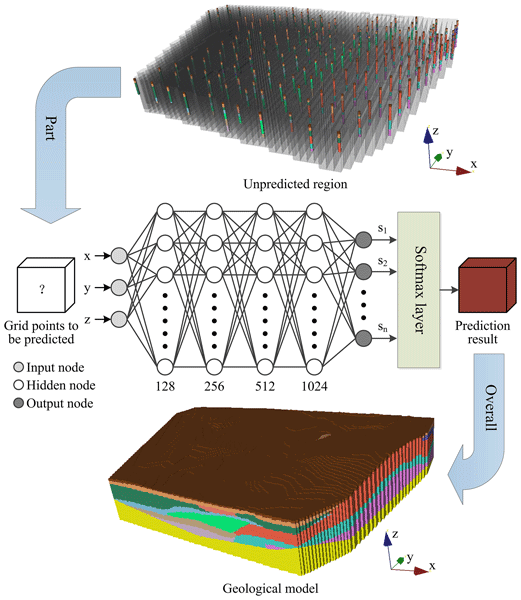
This study proposes a semi-supervised learning algorithm using pseudo-labels for 3D geological modelling. We establish a 3D geological model using borehole data from a complex real urban local survey area in Shenyang and make an uncertainty analysis of this model. The method effectively expands the sample space, which is suitable for geomodelling and uncertainty analysis from boreholes. The modelling results perform well in terms of spatial morphology and geological semantics.
Jiateng Guo, Zhibin Liu, Xulei Wang, Lixin Wu, Shanjun Liu, and Yunqiang Li
Geosci. Model Dev., 17, 847–864, https://doi.org/10.5194/gmd-17-847-2024, https://doi.org/10.5194/gmd-17-847-2024, 2024
Short summary
Short summary
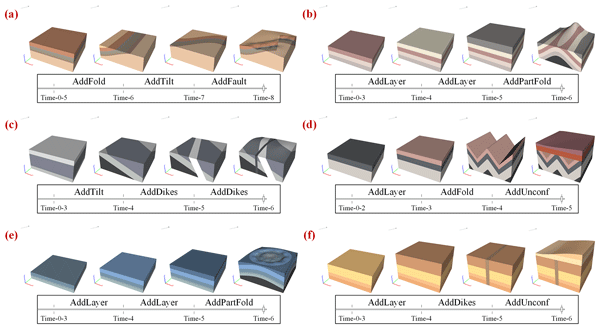
This study proposes a 3D and temporally dynamic (4D) geological modeling method. Several simulation and actual cases show that the 4D spatial and temporal evolution of regional geological formations can be modeled easily using this method with smooth boundaries. The 4D modeling system can dynamically present the regional geological evolution process under the timeline, which will be helpful to the research and teaching on the formation of typical and complex geological features.